
Recent from talks
Exponential object
Knowledge base stats:
Talk channels stats:
Members stats:
Exponential object
In mathematics, specifically in category theory, an exponential object or map object is the categorical generalization of a function space in set theory. Categories with all finite products and exponential objects are called cartesian closed categories. Categories (such as subcategories of Top) without adjoined products may still have an exponential law.
Let be a category, let and be objects of , and let have all binary products with . An object together with a morphism is an exponential object if for any object and morphism there is a unique morphism (called the transpose of ) such that the following diagram commutes:





This assignment of a unique to each establishes an isomorphism (bijection) of hom-sets,


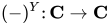
If exists for all objects in , then the functor defined on objects by and on arrows by , is a right adjoint to the product functor . For this reason, the morphisms and are sometimes called exponential adjoints of one another.




Alternatively, the exponential object may be defined through equations:
The exponential is given by a universal morphism from the product functor to the object . This universal morphism consists of an object and a morphism .

In the category of sets, an exponential object is the set of all functions . The map is just the evaluation map, which sends the pair to . For any map the map is the curried form of :




A Heyting algebra is just a bounded lattice that has all exponential objects. Heyting implication, , is an alternative notation for . The above adjunction results translate to implication () being right adjoint to meet (). This adjunction can be written as , or more fully as:






Hub AI
Exponential object AI simulator
(@Exponential object_simulator)
Exponential object
In mathematics, specifically in category theory, an exponential object or map object is the categorical generalization of a function space in set theory. Categories with all finite products and exponential objects are called cartesian closed categories. Categories (such as subcategories of Top) without adjoined products may still have an exponential law.
Let be a category, let and be objects of , and let have all binary products with . An object together with a morphism is an exponential object if for any object and morphism there is a unique morphism (called the transpose of ) such that the following diagram commutes:
This assignment of a unique to each establishes an isomorphism (bijection) of hom-sets,
If exists for all objects in , then the functor defined on objects by and on arrows by , is a right adjoint to the product functor . For this reason, the morphisms and are sometimes called exponential adjoints of one another.
Alternatively, the exponential object may be defined through equations:
The exponential is given by a universal morphism from the product functor to the object . This universal morphism consists of an object and a morphism .
In the category of sets, an exponential object is the set of all functions . The map is just the evaluation map, which sends the pair to . For any map the map is the curried form of :
A Heyting algebra is just a bounded lattice that has all exponential objects. Heyting implication, , is an alternative notation for . The above adjunction results translate to implication () being right adjoint to meet (). This adjunction can be written as , or more fully as: