


Community hub
Recent from talks
Contribute something
Nothing was collected or created yet.
Bijia
View on Wikipedia| Bijia | |||||||
|---|---|---|---|---|---|---|---|
 A woman wearing a Ming dynasty bijia. | |||||||
| Chinese | 比甲 | ||||||
| |||||||
Bijia (Chinese: 比甲) is a long, sleeveless jacket of Mongol origins which has opened side slits.[1]: 46, 68 The bijia started to be worn in the Yuan dynasty when it was designed by Empress Chabi.[2] The bijia eventually became one of the most typical form of women's clothing item in the Ming dynasty[3] and in the Qing dynasty.[4] It is also a type of hanfu which has been revived in present days.[5]
History
[edit]Yuan dynasty
[edit]The bijia originated from a long-length Mongol vest.[1]: 46 [6] According to the Yuan shi, the invention of bijiia is attributed to Empress Chabi during the Yuan dynasty.[2][7] Empress Chabi designed the bijia so that it would be a convenient form of attire while riding horses and shooting arrows.[2] The front region of the bijia designed by Empress Chabi was made of 1-piece of fabric, and its back region was twice longer than the front region.[2][7][8] It was collarless and sleeveless, and there were two loop straps which attached to it.[2][7][8] It also had no lapels.[8] The bijia was first worn by the Yuan dynasty emperor but it later became popular among commoners.[9]
Ming dynasty
[edit]After the fall of the Yuan dynasty, Mongol fashion of the Yuan dynasty continued to influence some styles of clothing worn in the Ming dynasty; this included the persisting usage of bijia.[1]: 46 [6] The bijia became a type of women clothing in the Ming dynasty, and by the middle of the Ming dynasty it had become a favourite form of dress for women, especially young women.[9]
In the Ming dynasty, the bijia was long in length and would reach below the knee level.[3] It was embroidered on woven textile and a jade ornament would be attached at the front of the bijia as a front closure.[3] Bijia created an illusion of slenderness, which women in the Ming dynasty sought after.[3]
Qing dynasty
[edit]In the Qing dynasty, Han Chinese women were allowed to continue the Ming dynasty clothing customs.[4] The bijia remained very popular in Qing dynasty,[9] and it was one of the most common forms of female clothing worn in the 17th and 18th century.[4]
-
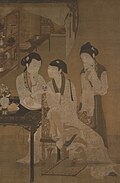 Woman wearing bijia (right). Woman wearing beizi (left). From the painting Amorous Meeting in a Room Interior, late 18th century Qing Dynasty.

21st Century
[edit]In the 21st century, the bijia regained popularity and is widely worn as a hanfu item.[10]
-
 Woman wearing a long, yellow bijia (middle), 2020.
.jpg)
Influences and derivatives
[edit]Theatrical beixin
[edit]The Chinese opera beixin (Chinese: 背心), also known as kanjian, majia, and beida, were sleeveless vests which originated from both the Ming dynasty's long-length bijia worn by women from the lower-middle class and from the Qing dynasty's majia (Chinese: 马甲),[11] a type of vest which were worn by the Manchu.[12]
-
 Theatrical beixin for a female Buddhist priest (front view).
 -
 Theatrical beixin for a female Buddhist priest (back view).


Majia
[edit]The majia (Chinese: 马甲), the sleeveless riding vest of the Qing dynasty, evolved from the bijia which was popular among women during the Ming and Qing dynasties.[9][13]
-
 Sleeveless Jacket with Flowering Vine Pattern and Bands (front), late 19th–early 20th century
 -
 Sleeveless Jacket with Flowering Vine Pattern and Bands (back), late 19th–early 20th century
 -
 Sleeveless Jacket, 19th century.


Similar looking garments
[edit]- Banbi
- Song dynasty beixin - Sleeveless and translucent vests, which became a popular female fashion in the Southern Song.[14]: 265–266
- Dahu
- Zhaojia (罩甲)
- Baeja - A sleeveless or very short-sleeved vest in Korea
-
 Beixin, Song dynasty
 -
 Zhaojia, Ming dynasty
.jpg)

See also
[edit]References
[edit]- ^ a b c Finnane, Antonia (2008). Changing clothes in China : fashion, history, nation. New York: Columbia University Press. ISBN 978-0-231-14350-9. OCLC 84903948.
- ^ a b c d e Zhao, George Qingzhi (2008). Marriage as political strategy and cultural expression : Mongolian royal marriages from world empire to Yuan dynasty. New York: Peter Lang Pub. pp. 240–241. ISBN 978-1-4331-0275-2. OCLC 192134589.
- ^ a b c d Hua, Mei (2011). Chinese clothing (Updated ed.). Cambridge, United Kingdom: Cambridge University Press. p. 41. ISBN 978-0-521-18689-6. OCLC 781020660.
- ^ a b c Wang, Anita Xiaoming (2018). "The Idealised Lives of Women: Visions of Beauty in Chinese Popular Prints of the Qing Dynasty". Arts Asiatiques. 73: 61–80. doi:10.3406/arasi.2018.1993. ISSN 0004-3958. JSTOR 26585538.
- ^ "A Brief History of Chinese Outfit for Girl - Bijia (vest) - 2021". www.newhanfu.com. 2020-02-16. Archived from the original on 2021-02-26. Retrieved 2021-06-23.
- ^ a b Schlesinger, Jonathan (2017). A world trimmed with fur : wild things, pristine places, and the natural fringes of Qing rule. Stanford, California. p. 31. ISBN 978-1-5036-0068-3. OCLC 949669739.
{{cite book}}: CS1 maint: location missing publisher (link) - ^ a b c Shea, Eiren L. (2020). Mongol court dress, identity formation, and global exchange. New York, NY. p. 89. ISBN 978-0-429-34065-9. OCLC 1139920835.
{{cite book}}: CS1 maint: location missing publisher (link) - ^ a b c Lee, Lily Xiao Hong (2015). Biographical Dictionary of Chinese Women, Volume II : Tang Through Ming 618-1644. Sue Wiles. Hoboken: Taylor and Francis. p. 25. ISBN 978-1-317-51562-3. OCLC 905984401.
- ^ a b c d 5000 years of Chinese costumes. Xun Zhou, Chunming Gao, 周汛, Shanghai Shi xi qu xue xiao. Zhongguo fu zhuang shi yan jiu zu. San Francisco, CA: China Books & Periodicals. 1987. p. 164. ISBN 0-8351-1822-3. OCLC 19814728.
{{cite book}}: CS1 maint: others (link) - ^ "A Brief History of Chinese Outfit for Girl - Bijia (vest) - 2021". www.newhanfu.com. 2020-02-16. Archived from the original on 2021-02-26. Retrieved 2021-07-03.
- ^ Ye, Tan (2020). Historical dictionary of Chinese theater (Second ed.). Lanham. p. 352. ISBN 978-1-5381-2064-4. OCLC 1128888776.
{{cite book}}: CS1 maint: location missing publisher (link) - ^ "Woman's domestic vest (majia)". collections.mfa.org. Retrieved 2021-07-30.
- ^ Li, Jinzhao (2005). Constructing Chinese America in Hawaiʻi: the Narcissus Festival, ethnic identity, and community transformation, 1949-2005 (Thesis thesis). hdl:10125/12055.
- ^ Kuhn, Dieter (2009). The age of Confucian rule : the Song transformation of China. Cambridge, Mass.: Belknap Press of Harvard University Press. ISBN 978-0-674-03146-3. OCLC 192050158.
| Characteristics |
| ||||||||||||||||||
|---|---|---|---|---|---|---|---|---|---|---|---|---|---|---|---|---|---|---|---|
| Garments |
| ||||||||||||||||||
| Headwear (list) |
| ||||||||||||||||||
| Footwear (list) | |||||||||||||||||||
| Accessories (list) |
| ||||||||||||||||||
| Influenced clothing |
| ||||||||||||||||||
| Cosmetics | |||||||||||||||||||
