Hubbry Logo
Mandarin squareMandarin squareMain
Open search
Mandarin square
Community hub
Mandarin square
logo
8 pages, 0 posts
0 subscribers
Be the first to start a discussion here.
Mandarin square
Mandarin square
from Wikipedia

Mandarin square
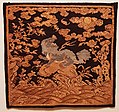
Qing dynasty mandarin square, 6th civil rank, about 30 cm square.
Chinese name
Traditional Chinese補子
Simplified Chinese补子
Literal meaningMaster's patch
Transcriptions
Standard Mandarin
Hanyu Pinyinbŭzi
Wade–Gilesputzŭ
Vietnamese name
Vietnamese alphabetBổ tử
Chữ Hán補子
Korean name
Hangul흉배
Hanja胸背
Transcriptions
Revised Romanizationhyungbae
Manchu name
Manchu scriptᠰᠠᠪᡳᡵᡤᡳ
Möllendorffsabirgi
English name
EnglishMandarin square/ rank badge

A mandarin square (Chinese: 補子), also known as a rank badge, was a large embroidered badge sewn onto the surcoat of officials in Imperial China (decorating hanfu and qizhuang), Korea (decorating the gwanbok of the Joseon dynasty), in Vietnam, and the Ryukyu Kingdom. It was embroidered with detailed, colourful animal or bird insignia indicating the rank of the official wearing it. Despite its name, the mandarin square (buzi) falls into two categories: round buzi and square buzi.[1]: 396  Clothing decorated with buzi is known as bufu (simplified Chinese: 补服; traditional Chinese: 補服) in China.[2] In the 21st century, the use of buzi on hanfu was revived following the Hanfu movement.

China

[edit]

The history of the square-shaped buzi is unclear. However, in the Yuan dynasty encyclopaedia Shilin Guangji (事林廣記), as well as contemporary Persian paintings of the Mongol court, there are pictures showing officials wearing clothing with squares on the back, decorated with flora, animals and birds.[3] By the Yuan dynasty, the square-shaped buzi was already worn as clothing ornaments.[4]: 235 

Ming dynasty

[edit]
A 15th-century portrait of the Ming minister Liu Daxia. His mandarin square indicates that he was a civil official of the first rank.

Mandarin squares were first authorized for the wear of officials in the sumptuary laws of 1391 of the Ming dynasty.[4]: 235  The use of squares depicting birds for civil officials and animals for military officials was an outgrowth of the use of similar squares, apparently for decorative use, in the Yuan dynasty.[5] The original court dress regulations of the Ming dynasty were published in 1368, but did not refer to badges as rank insignia.[6] These badges continued to be used through the remainder of the Ming and the subsequent Qing dynasty until the imperial system fell in 1912.

Ming nobles and officials wore their rank badges on full-cut red robes with the design stretching from side to side, completely covering the chest and back. This caused the badges to be slightly trapezoidal with the tops narrower than the bottom.[7] The Ming statutes never refer to the number of birds or animals that should appear on the badges. In the beginning, two or three were used. In a typical example of paired birds, they were shown in flight on a background of bright cloud streamers on a gold background. Others showed one bird on the ground with the second in flight. The addition of flowers produced an idealized naturalism.[8][9]

Qing dynasty

[edit]
A Qing dynasty photograph of a government official with mandarin square on the chest.

There was a sharp difference between the Ming and Qing styles of badges: the Qing badges were smaller with a decorative border.[10] And, while the specific birds and animals did not change much throughout their use, the design of the squares underwent an almost continual evolution.[11] According to rank, Qing-dynasty nobles had their respective official clothes. Princes, including Qin Wang and Jun Wang, usually wore black robes as opposed to the blue robes in court, and had four circular designs, one on each shoulder, front, and back, as opposed to the usual front-and-back design. Specifically, princes of the blood used four front-facing dragons, Qin Wang had two front-facing and two side-facing dragons, and Jun Wang had four side-facing ones; all had five claws on each foot. Beile and Beizi had a circular design on their official clothing, the former having two front-facing dragons, the latter two side-facing ones; these dragons had only four claws on each foot, and are referred to as "drakes" or "great serpents" (巨蟒 jù-mǎng). National duke, general, efu, "commoner" duke, marquis and count had two front-facing, four-clawed dragons on square designs, whereas viscount and baron had cranes and golden pheasants, as for mandarins of the first and second class.

Comparative table across dynasties

[edit]
Jesuit missionary Adam Schall wearing a robe with civilian mandarin badge of the first rank

The specific birds and animals used to represent rank varied only slightly from the inception of mandarin squares until the end of the Qing dynasty. Officials who held a lower position or did odd jobs used the magpie during the Ming dynasty. Supervising officials used xiezhi. Musicians used the oriole. The following tables[12] show this evolution:

Military

[edit]
Rank Ming (1391–1526) Ming and Qing (1527–1662) Late Qing (1662–1911) Image
1 Lion Lion Qilin (after 1662)
2 Lion Lion Lion
3 Tiger or leopard Tiger Leopard (after 1664)
4 Tiger or leopard Leopard Tiger (after 1664)
5 Bear Bear Bear
6 Panther Panther Panther
7 Panther Panther Rhinoceros (after 1759)[13]
8 Rhinoceros Rhinoceros Rhinoceros
9 Rhinoceros Sea horse[14] Sea horse[15]

Civil

[edit]
Rank Ming (1391–1526) Ming and Qing (1527–1662) Late Qing (1662–1911) Image
1 Crane or golden pheasant Crane Crane
2 Crane or golden pheasant Golden pheasant Golden pheasant
3 Peacock or wild goose Peacock Peacock
4 Peacock or wild goose Wild goose Wild goose
5 Silver pheasant Silver pheasant Silver pheasant
6 Egret or mandarin duck Egret Egret
7 Egret or mandarin duck Mandarin duck Mandarin duck[16]
8 Oriole, quail or paradise flycatcher Oriole Quail
9 Oriole, quail or paradise flycatcher Quail Paradise flycatcher[17]

21st century

[edit]

The use of the round-shaped and square-shaped buzi has been revived in China following the Hanfu movement.

Korea

[edit]

Korean rank badge (흉배 in Korean) is a small panel of embroidery that would have served to indicate the status of a government official in the Choson dynasty Korea (1392–1910). Made in the nineteenth century, it shows a pair of black and white leopards, one above the other in opposing stance, surrounded by stylised cloud patterns in pink, purple and pale green upon a blue background. It would have been worn by a military official from the first to third ranks. Leopards and tigers, respected for their strength and courage in Korea, were used for the dress of military officials while civil officials wore crane motifs. This badge shows the distinctively spotted animals among rocks, waves and clouds in a pattern which remained virtually unchanged for 300 years.

Vietnam

[edit]

See also

[edit]

References

[edit]

Further reading

[edit]
[edit]
Revisions and contributorsEdit on WikipediaRead on Wikipedia
from Grokipedia
A mandarin square, also known as a būzi or rank badge, is a square plaque of embroidered or woven affixed to the chest and back of official robes to indicate the wearer's rank in the Chinese imperial . These badges, typically measuring about 30 cm on each side, featured symbolic motifs such as birds for civil officials and animals for officials, serving as visible markers of status from the onward. The practice originated under the Mongol (1271–1368), where officials wore embroidered squares on their garments to denote hierarchy, but it was formalized and standardized during the (1368–1644) starting in 1391, when imperial edicts prescribed specific designs for the nine ranks of officials. This system continued into the (1644–1912), where the Manchu rulers adopted and slightly modified the Ming conventions, adding elements like sun discs. By the 19th century, as the Qing empire weakened, mandarin squares became commodified, often sold to Western tourists, which contributed to their preservation in museum collections abroad. The badges fell out of use after the , which ended imperial rule. Symbolism in mandarin squares was rich and hierarchical, with civil ranks represented by increasingly modest birds to reflect Confucian virtues: the first rank featured a crane, the second a , the third a peacock, the fourth a , the fifth a , the sixth an , the seventh a , the eighth a , and the ninth a or oriole. In contrast, military ranks used fierce animals: lions for the first and second, tigers or leopards for the third and fourth, a for the fifth, panthers for the sixth and seventh, a for the eighth, and sea horses for the ninth, emphasizing martial prowess. Designs often incorporated auspicious elements like clouds, waves, or the to invoke protection and good fortune, showcasing advanced textile techniques in embroidery and kesi . From 1652 in the Qing era, wives of officials also wore mandarin squares, typically with birds facing left on the front and right on the back to differentiate from men's robes, though the designs mirrored their husbands' ranks and were simpler in execution. These badges not only enforced bureaucratic order but also underscored the system's role in , allowing meritorious individuals from various classes to rise through the ranks, albeit with restrictions on hereditary .

Overview

Definition and Purpose

The mandarin square, known as (補子) in , hyungbae (胸背) in Korea, and bổ tử (補子) in , refers to a large embroidered square sewn onto the surcoats of imperial officials to denote their civil or . These badges typically measured about 30 centimeters on each side and featured intricate designs in silk embroidery, serving as a standardized visual marker within the hierarchical structures of East Asian bureaucracies influenced by Confucian principles. The primary purpose of the mandarin square was to provide an immediate, unambiguous indicator of an official's position in the prevalent in these societies, thereby reinforcing social order and protocol during court audiences, ceremonies, and public duties. Civil officials were distinguished by embroidered birds—such as cranes for the highest ranks or egrets for lower ones—symbolizing scholarly virtues and , while military officials displayed fierce animals like lions or tigers to evoke strength and vigilance. This distinction not only facilitated quick recognition of authority but also embodied sumptuary regulations that prevented rank inflation and maintained the prestige of the imperial administration. These badges were affixed to both the front and back of formal garments to ensure visibility from all angles, a practice that underscored their role in ceremonial visibility. In , they appeared on surcoats like the mangpao (蟒袍), part of the chaofu (朝服) ensemble; in Korea, on the gwanbok (官服), the official's overcoat; and in , on the surcoat of uniforms such as the áo giao lĩnh or similar court attire during dynasties like the Nguyễn. Originally evolving from earlier decorative motifs on robes during the Mongol , mandarin squares became mandatory symbols of rank by the late under the Ming dynasty's sumptuary laws of 1391, transforming them into essential elements of official identity across these regions. This standardization spread to tributary states like Korea and , where they adapted to local traditions while preserving the core function of denoting hierarchy.

Historical Origins

The mandarin square, known as buzi in Chinese, emerged during the Yuan dynasty (1271–1368) under Mongol rule, marking the first formalized use of square-shaped badges on official robes to denote status. The earliest textual evidence appears in the Shilin Guangji (事林廣記), a Yuan-era encyclopedia compiled around the 1340s by Chen Yuanjing, which illustrates these badges featuring motifs of flora and animals sewn onto garments as indicators of rank within the imperial bureaucracy. These badges represented an adaptation of broader Mongol sartorial practices, where central chest emblems (xiongbei) on robes signified authority through luxurious materials like silk and gold thread, influenced by Central Asian and Steppe traditions of equestrian attire and status symbols dating back to earlier nomadic empires. Prior to the Yuan, precursors to the mandarin square existed in the sumptuary laws of the Tang (618–907) and (960–1279) dynasties, which regulated embroidered patches on officials' clothing to distinguish civil from military roles and enforce hierarchical distinctions, though these were not yet standardized as square forms. Tang regulations, for instance, permitted bird-patterned patches for civil officials and beast motifs for military ones, reflecting Confucian emphasis on without the geometric uniformity later adopted. codes further refined sumptuary laws on official attire through detailed edicts on fabric and colors to prevent social blurring, though embroidered motifs remained integrated into robes rather than as separate badges. The Yuan system's innovations facilitated the spread of mandarin squares to states through cultural and diplomatic exchanges during the Yuan-Ming transition in the . In Korea, similar rank badges appeared on official attire in the dynasty (1392–1910), adapting Ming conventions around the 15th century; in , with adoption during the Le dynasty (1428–1789) and later dynasties. This transmission blended Mongol-Confucian elements across before the formalized the squares in 1391 as mandatory rank .

Use in China

Yuan and Ming Dynasties

During the (1271–1368), mandarin squares served as informal rank indicators on the robes of Mongol officials and nobles, featuring generic animal or bird motifs rather than strictly codified designs. These precursors to formalized badges reflected social and status through embroidered or woven plaques, often drawing from Mongol traditions of using and patterns to denote hierarchy, as evidenced by 14th-century artifacts. The (1368–1644) formalized mandarin squares through sumptuary laws issued in 1391 under the , mandating their use on red silk robes to distinguish official ranks and reinforce imperial authority. These laws established a system of nine ranks, with civil officials assigned embroidered birds—such as the crane for the first rank—and military officials assigned beasts, including the or for the first rank—to symbolize merit and function. Further regulations in 1527 refined this by limiting each rank to a single bird or animal motif, preventing misuse and ensuring visual clarity in court hierarchies. Mandarin squares in the Ming period were typically trapezoidal or square in shape, spanning the full chest area and sewn onto both the front and back of official surcoats for prominent display. Unauthorized wear of these badges was strictly prohibited, with severe penalties including or execution to maintain and deter rank usurpation. This system bolstered the Ming's merit-based by visually affirming the status of examination-passed s, thereby promoting administrative legitimacy and influencing the adoption of similar rank badges in tributary states like Korea and .

Qing Dynasty

The (1644–1912) adopted the mandarin square system from the preceding in 1654, standardizing these emblems as p'u fang (squares of rank) sewn onto the chest and back of officials' garments to denote civil or status. Unlike the larger Ming versions, which measured approximately 40 cm square, Qing mandarin squares were resized to about 30 cm square for a more compact fit, reflecting the Manchu preference for form-fitting attire suited to horseback riding. By the mid-17th century, following the dynasty's establishment, these squares featured embroidered borders of fine colored threads and gold, often incorporating auspicious motifs such as clouds, waves, flowers, and symbolic elements like the Eight Buddhist Treasures, which added layers of decorative and cosmological significance. Design modifications under the Qing retained core Ming symbols—such as birds for civil ranks (e.g., crane for the first rank) and beasts for military ranks (e.g., qilin for the first rank)—but introduced Manchu influences, including more lavish embroidery with colored silk threads and realistic natural backgrounds. For Manchu nobility, dragons replaced traditional symbols; lower-ranking princes like beile used four-clawed mang dragons, while higher-ranking qin wang (princes of the first degree) employed five-clawed long dragons, with configurations varying by facing direction (e.g., two front-facing and two side-facing for qin wang). These squares were primarily worn on p'u-fu jackets, the standard surcoat for court dress, where front and back emblems were vertically split to accommodate the garment's cut. Regulations extended to female relatives from 1652, with officials' wives wearing squares matching their husbands' ranks, typically featuring birds facing left on the front and right on the back; 19th-century adaptations included half-sun disks that visually completed a full when a couple was seated together, symbolizing marital and shared status. The system evolved across reigns: during the Yongzheng period (1723–1735), designs became more naturalistic; under Qianlong (1736–1795), refined further with intricate symbols like bats and peaches for prosperity, emphasizing imperial orthodoxy and cultural synthesis. By the late , techniques allowed for easier rank adjustments amid bureaucratic changes. Following the that ended imperial rule, mandarin squares were officially phased out in 1912 as symbols of the fallen Qing regime, though they persisted in ceremonial and private contexts into the 1920s amid political transition and cultural nostalgia.

Rank Symbols and Designs

Mandarin squares distinguished civil and ranks through symbolic motifs that reflected the Chinese bureaucratic , with birds exclusively assigned to civil officials and fierce animals to military ones, ensuring no overlap to prevent confusion in identification. The civil ranks followed a descending order of nine levels, each represented by a specific chosen for its mythological significance: the crane for , symbolizing longevity and scholarly grace; the for rank 2, denoting imperial favor; the peacock for rank 3, evoking beauty and vigilance; the wild goose for rank 4, representing fidelity; the for rank 5, signifying purity; the for rank 6, associated with adaptability; the for rank 7, symbolizing harmony; the for rank 8, denoting humility; and the for rank 9, reflecting modest virtue. This avian drew from ancient cosmological precedence, where higher birds like the crane were linked to in Daoist lore, elevating civil authority above martial prowess. Military ranks employed a parallel system of nine animals, emphasizing terrestrial power and ferocity to contrast the ethereal quality of civil birds: the or for rank 1, the for rank 2, embodying imperial might and protection; the for rank 3, symbolizing raw strength; the for rank 4, representing agility; the for rank 5, denoting endurance; the panther for rank 6, evoking stealth; the sea horse for rank 7, associated with naval vigilance; the for rank 8, signifying resilience; and the sea horse for rank 9. These beasts were selected for their roles in as guardians against chaos, underscoring the military's role in maintaining order. Higher-ranking officials often displayed two identical animals or birds on their badges, while lower ranks showed one, with imperial grants allowing exceptions. The designs of these badges incorporated intricate on silk squares, typically 12 to 13 inches per side, using fine , , and stem stitches for lifelike depiction. Civil bird motifs were rendered in vibrant, multi-hued threads—often drawing from the five elemental colors (blue, red, yellow, white, black)—against backgrounds of swirling clouds or , symbolizing the ascent to heavenly and scholarly contemplation. Military animal designs, by contrast, featured the creatures amid turbulent waves or rugged terrain, with rocks and foaming seas to convey the instability and fortitude of battle. Metallic and silver threads, along with occasional peacock feathers in early examples, added luster, while the overall composition balanced the central emblem with auspicious fillers like lingzhi fungi or floral scrolls. These elements were sewn onto the chest and back of surcoats, removable for reuse. Across dynasties, the core symbols remained unchanged from the Ming (1368–1644) onward, preserving the bird-animal distinction into the Qing (1644–1912), though stylistic variations emerged. Ming badges exhibited full-color vibrancy from vegetable-derived dyes, with bold compositions on or ribbed grounds, reflecting the dynasty's emphasis on elaborate splendor. Qing versions adopted slightly subdued tones in early periods using natural silks and feathers, evolving to brighter dyes post-1870s, alongside added motifs like a sun disc in the upper corner for imperial oversight; however, the fundamental rank assignments and hierarchical precedence stayed consistent, ensuring continuity in bureaucratic symbolism.

Modern Revival

The modern revival of mandarin squares, or buzi, emerged within the in the early 2000s, initially driven by online communities such as forums like the "Han Nationality Net" that promoted the reclamation of pre-Qing attire amid debates. Enthusiasts began incorporating round or square buzi into neo-Hanfu ensembles, adapting these embroidered badges for contemporary ceremonial and festive wear without their original imperial connotations. These revived buzi appear in outfits worn for events like China Huafu Day (Traditional Garment Day), officially recognized since 2018 and observed annually on the third day of the third lunar month (Shangsi Festival), as well as in broader gatherings, conventions, and tourism promotions that blend with modern leisure. Commercial adaptations have popularized simplified buzi designs using synthetic fabrics and accessible production methods, fueled by explosive growth on platforms like Douyin and , where content garnered over 55 billion views by 2022 and influencer posts surged post-COVID to emphasize national pride and identity. As of November 2025, the movement continues to grow, with increased international exhibitions and integration further popularizing buzi in global cultural contexts. This resurgence has extended globally through museum exhibitions, such as the Spurlock Museum's display of historical mandarin squares that highlights their enduring cultural symbolism, alongside international online sales of neo-Hanfu items featuring , though contemporary uses eschew any formal rank system.

Use in Korea

Joseon Dynasty Introduction

The adoption of mandarin squares, known in Korean as hyungbae or "chest badges," in the Dynasty (1392–1910) occurred in 1454 during the reign of King Danjong, marking a deliberate emulation of the Ming Dynasty's rank insignia system to signify official status. This introduction followed broader cultural and diplomatic exchanges with Ming , where scholars and officials debated the merits of incorporating Chinese bureaucratic symbols to strengthen Confucian , ultimately viewing them as essential for clarifying hierarchical roles within the emerging aristocracy. Initially, these badges replaced simpler fabric patches or woven indicators used in earlier court attire, providing a more standardized visual marker for civil and military officials. In , hyungbae served primarily as rank indicators affixed to the gwanbok, the formal official robes worn by elites, adapting the from to fit Korea's centralized bureaucracy while emphasizing moral and administrative distinctions between civil (symbolized by birds) and military (symbolized by beasts) branches. These badges were mandatory for officials from the third rank upward initially, later extending to all nine ranks, and were positioned on the chest (hyung) and back (bae) to ensure visibility during processions. The system reinforced Joseon's Sinicization efforts, aligning court protocols with Confucian ideals of order and hierarchy inherited from Ming influences. Sumptuary laws, codified in the Gyeongguk Daejeon (National Code) of 1485 under King Seongjong, strictly regulated hyungbae usage to maintain social distinctions, prohibiting their wear by commoners, slaves, or non-officials and limiting them to court audiences, state rituals, and formal ceremonies. Violations were punishable to prevent class blurring, underscoring the badges' role in upholding the dynasty's rigid status structure. This formalization in 1485 integrated hyungbae into the comprehensive legal framework, ensuring their consistent application across the bureaucracy for over four centuries until their suspension in 1899.

Design and Rank System

In the Joseon Dynasty, mandarin squares, known as hyungbae, featured distinct symbols for civil and military officials to denote rank within the nine-grade system. Civil officials' badges primarily depicted birds, with the crane serving as the central motif across multiple ranks, symbolizing longevity, purity, and elegance; for instance, the first rank displayed a double crane often accompanied by bullocho (an elixir plant) on a blue silk background adorned with clouds, waves, and rocks. Higher civil ranks (1-2pum) incorporated a crane encircled by a gold ring amidst clouds, while third-rank badges showed an eagle or magpie with a silver ring; lower ranks (7-9pum) used a single crane with a copper ring, though by the late 19th century, standardization in 1871 simplified civil designs to variations of the crane for all grades, using fewer unique symbols compared to the more diverse avian hierarchy in Chinese systems. Military officials' hyungbae employed quadrupedal animals to signify valor and authority, with leopards or tiger-like hopyo (a hybrid motif) for upper ranks (1-3pum), such as paired tigers or leopards amid cresting waves and clouds on blue silk, and simpler tiger designs for lower ranks (4-9pum). These badges differed from Chinese counterparts by favoring dominant blue silk grounds over red, reflecting a Korean aesthetic emphasis on serene, harmonious compositions with folk-inspired elements like bamboo or grass. Embroidery techniques evolved from weaving in the early period to intricate silk stitching with gold couching and seed stitches by the 17th century, enhancing the badges' ornamental quality. Style variations emerged over time, particularly in the 19th century when hyungbae became smaller—often under 20 cm—and incorporated embroidered borders for added refinement, while wives of officials wore simplified, scaled-down versions without the full symbolic complexity. Surviving artifacts, such as those in the National Folk Museum of Korea and the Metropolitan Museum of Art, illustrate this evolution from larger 16th-17th century pieces (30-40 cm) with bold motifs to more compact late-19th-century examples, suspended officially in 1899 amid modernization efforts.

Use in Vietnam

Le Dynasty and Earlier Adoption

The mandarin square, known in Vietnamese as bổ tử, was formally introduced in Vietnam in 1471 during the reign of Emperor (r. 1460–1497) in the Later (1428–1789). This adoption occurred as part of broader court reforms aimed at centralizing administration and standardizing bureaucratic hierarchy, drawing inspiration from Ming China through 's tributary relations. These reforms emphasized Confucian principles and modeled official attire on Chinese precedents to reinforce imperial authority and social order. Early bổ tử badges were embroidered squares sewn onto the chest and back of the áo giao lĩnh, a cross-collared robe that served as the standard outer garment for officials. Designs featured simple motifs of birds for civil ranks and animals for military ranks, adapted to Vietnam's nine-tier hierarchy, with lower ranks using or and higher ones employing crane or peacock equivalents. This system visually distinguished mandarins' status during court audiences and public duties, promoting discipline and preventing rank usurpation. Sumptuary regulations under the Hồng Đức era (1470–1497) mandated the wearing of bổ tử for eligible mandarins, prohibiting unauthorized use to maintain class distinctions and curb extravagance. These laws reflected the era's emphasis on moral governance and economic efficiency, influenced by ongoing diplomatic ties with Ming China, which supplied models for official regalia. Enforcement ensured that badges aligned with examination-based promotions, solidifying the meritocratic ethos of the . Prior to the Lê dynasty, Vietnamese official attire showed indirect influences from and Yuan via cultural and trade exchanges during the Lý (1009–1225) and Trần (1225–1400) periods. However, no evidence exists of formalized square badges until their institutionalization under Lê Thánh Tông, marking a shift toward more rigid, Ming-inspired protocols.

Nguyen Dynasty Usage

The mandarin square system, already established in earlier Vietnamese dynasties, was formalized and expanded under the Nguyen Dynasty (1802–1945), with detailed regulations issued during Emperor Gia Long's reign (1802–1820) by the Ministry of Ceremonies. These large embroidered badges were sewn onto the surcoats of both civil and military officials, serving as visible indicators of rank during court ceremonies in the imperial capital of Hue. The system encompassed nine hierarchical ranks for each category of official, reflecting a structured influenced by Confucian principles. Designs featured intricate of animals or birds on square patches, typically using vibrant threads on colored fabric backgrounds such as or , with aquatic elements like waves or lotuses often incorporated to evoke Vietnamese landscapes. For civil officials, birds symbolized the ranks: the crane for 1st to 3rd (on ), peacock for 4th to 6th (on ), for 7th, and for 9th. Military officials' badges depicted fierce animals: kylin for 1st to 3rd, specifically for 2nd, for 4th, for 5th, for 6th, panther for 7th, and for 9th. These symbols drew from Chinese imperial traditions but were adapted with local stylistic flourishes in the Nguyen court's attire. Subsequent emperors introduced modifications; under Minh Mang (1820–1841), for instance, surcoats temporarily omitted badges in certain contexts to emphasize simplicity in official dress. The tradition persisted through the dynasty but declined sharply with French colonization, as the protectorate over Annam was established in the 1880s and the traditional mandarin administrative system was dismantled under colonial rule. Surviving artifacts, including representative examples from various ranks, are preserved in the Vietnam National Museum of History's collection of approximately 50 badges, offering insight into Nguyen-era court hierarchy and craftsmanship.

References

Add your contribution
Related Hubs
User Avatar
No comments yet.