Hubbry Logo
search
logo
2305108

Bill James

logo
Community Hub0 Subscribers
Read side by side
from Wikipedia

George William James (born October 5, 1949)[1][2] is an American baseball writer, historian, and statistician whose work has been widely influential. Since 1977, James has written more than two dozen books about baseball history and statistics. His approach, which he named sabermetrics after the Society for American Baseball Research (SABR),[3] scientifically analyzes and studies baseball, often through the use of statistical data, in an attempt to determine why teams win and lose.

Key Information

In 2006, Time named him in the Time 100 as one of the most influential people in the world.[4] In 2003, James was hired as senior advisor on Baseball Operations for the Boston Red Sox and worked for the team for 17 years during which they won four World Series championships.[5][6]

Early life

[edit]

James was born in Holton, Kansas. He joined the United States Army in 1971. After his service, he graduated from the University of Kansas in 1973 with degrees in English and economics, and in 1975 with a degree in education.[1]

Career

[edit]

The Bill James Baseball Abstracts

[edit]

An aspiring writer and obsessive fan, James began writing baseball articles in his mid-twenties after leaving the United States Army. Many of his first baseball writings came while he was doing night shifts as a security guard at the Stokely-Van Camp's pork and beans cannery. Unlike most writers, his pieces did not recount games in epic terms or offer insights gleaned from interviews with players. A typical James piece posed a question (e.g., "Which pitchers and catchers allow runners to steal the most bases?"), and then presented data and analysis that offered an answer.[7]

Editors considered James's pieces so unusual that few believed them suitable for their readers. In an effort to reach a wider audience, James began self-publishing an annual book titled The Bill James Baseball Abstract, beginning in 1977. The first edition, titled 1977 Baseball Abstract: Featuring 18 categories of statistical information that you just can't find anywhere else, presented 68 pages of in-depth statistics compiled from James's study of box scores from the preceding season and was offered for sale through a small advertisement in The Sporting News. Seventy-five people purchased the booklet.[8] The 1978 edition, subtitled The 2nd annual edition of baseball's most informative and imaginative review, sold 250 copies.[9] Beginning in 1979, James wrote an annual preview of the baseball season for Esquire, and continued to do so through 1984.[10]

The first three editions of the Baseball Abstract garnered respect for James's work, including a very favorable review by Daniel Okrent in Sports Illustrated.[11] New annual editions added essays on teams and players. By 1982 sales had increased tenfold, and a media conglomerate agreed to publish and distribute future editions.

While writers had published books about baseball statistics before (most notably Earnshaw Cook's Percentage Baseball, in the 1960s), few had ever reached a mass audience. Attempts to imitate James's work spawned a flood of books and articles that continues to this day.

Post-Abstracts work

[edit]

In 1988, James ceased writing the Abstract, citing workload-related burnout and concern about the volume of statistics on the market. He has continued to publish hardcover books about baseball history, which have sold well and received admiring reviews. These books include three editions of The Bill James Historical Baseball Abstract (1985, 1988, 2001, the last entitled The New Bill James Historical Baseball Abstract).

James has also written several series of new annuals:

  • The Baseball Book (1990–1992) was a loosely organized collection of commentary, profiles, historical articles, and occasional pieces of research. James's assistant Rob Neyer was responsible for much of the research, and wrote several short pieces. Neyer went on to become a featured baseball columnist at ESPN and SB Nation.
  • The Player Ratings Book (1993–95) offered statistics and 50-word profiles aimed at the fantasy baseball enthusiast.
  • The Bill James Handbook (2003–present) provides past-season statistics and next-season projections for Major League players and teams, and career data for all current Major League players. Results for the Fielding Bible Awards, an alternative to the Gold Glove Awards voted on by a 10-person panel that includes James, are also included.[12][13]
  • The Bill James Gold Mine (2008–2010) was a collection of new essays and never-before-seen statistics, as well as profiles of players and teams.
  • Playing off the name of the earlier series, Solid Fool's Gold: Detours on the Way to Conventional Wisdom (2011) was a mixed collection of both baseball-related and miscellaneous pieces, culled from the Bill James Online archives (see below).

In 2008, James launched Bill James Online. Subscribers could read James's new, original writing and interact with one another—as well as with James—in a question-and-answer format. The web site also offered new "profiles" of teams and players full of facts and statistics that hoped to map what James has termed "the lost island of baseball statistics". On June 9, 2023, James wrote an article for the site announcing that it would soon be closed in order for James to "focus on other projects".[14]

STATS, Inc.

[edit]

In an essay published in the 1984 Abstract, James vented his frustration about Major League Baseball's refusal to publish play-by-play accounts of every game. James proposed the creation of Project Scoresheet, a network of fans that would work together to collect and distribute this information.[15]

While the resulting non-profit organization never functioned smoothly, it worked well enough to collect accounts of every game from 1984 through 1991. James's publisher agreed to distribute two annuals of essays and data—the 1987 and 1988 editions of Bill James Presents The Great American Baseball Statbook (though only the first of these featured writing by James).

The organization was eventually disbanded, but many of its members went on to form for-profit companies with similar goals and structure. STATS, Inc., the company James joined, provided data and analysis to every major media outlet before being acquired by Fox Sports in 2001.[16]

Innovations

[edit]

Among the statistical innovations attributable to James are:

  • Runs created. A statistic intended to quantify a player's contribution to runs scored, as well as a team's expected number of runs scored. Runs created is calculated from other offensive statistics. James's first version of it was: Applied to an entire team or league, the statistic correlates closely (usually within 5%) to that team's or league's actual runs scored. Since James first created the statistic, sabermetricians have refined it to make it more accurate, and it is now used in many different variations.
  • Range factor. A statistic that quantifies the defensive contribution of a player, calculated in its simplest form as (A is an assist, PO is a putout): The statistic is premised on the notion that the total number of outs that a player participates in is more relevant in evaluating his defensive play than the percentage of cleanly handled chances as calculated by the conventional statistic fielding percentage.
  • Defensive Efficiency Rating. A statistic that shows the percentage of balls in play a defense turns into an out. It is used to help determine a team's defensive ability. The formula is:
  • Win shares. A unifying statistic intended to allow the comparison of players at different positions, as well as players of different eras. Win Shares incorporates a variety of pitching, hitting and fielding statistics. One drawback of Win Shares is the difficulty of computing it.[17]
  • Pythagorean Winning Percentage. A statistic explaining the relationship of wins and losses to runs scored and runs allowed. The statistic correlates closely to a team's actual winning percentage. Its simplest formula is:
  • Game score is a metric to determine the strength of a pitcher in any particular baseball game. It has since been improved by Tom Tango.
  • Major League Equivalency. A metric that uses minor league statistics to predict how a player is likely to perform at the major league level.
  • The Brock2 System. A system for projecting a player's performance over the remainder of his career based on past performance and the aging process.
  • Similarity scores. Scoring a player's statistical similarity to other players, providing a frame of reference for players of the distant past. Examples: Lou Gehrig comparable to Don Mattingly; Joe Jackson to Tony Oliva.
  • Secondary average. A statistic that attempts to measure a player's contribution to an offense in ways not reflected in batting average. Secondary averages tend to be similar to batting averages, but can vary wildly, from less than .100 to more than .500 in extreme cases. The formula is (ISO is isolated power):
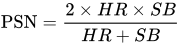
  • Power/Speed Number. A statistic that attempts to consolidate the various "clubs" of players with impressive numbers of both home runs and stolen bases (e.g., the 30–30 club (Bobby Bonds was well known for being a member), the 40–40 club (Jose Canseco was the first to perform this feat), and even the 25–65 club (Joe Morgan in the '70s)). The formula is:
  • Approximate Value. A system of cutoffs designed to estimate the value a player contributed to various category groups (including his team) to study broad questions such as "how do players age over time".
  • "Temperature gauge" to determine how "hot" a player is, based on recent performance.[18] The gauge has been used in NESN Red Sox telecasts and has provoked mixed reactions from critics.[19]
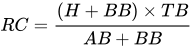
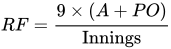
Although James may be best known as an inventor of statistical tools, he has often written on the limitations of statistics and urged humility concerning their place amid other kinds of information about baseball.[20] To James, context is paramount: he was among the first to emphasize the importance of adjusting traditional statistics for park factors and to stress the role of luck in a pitcher's win–loss record.[21] Many of his statistical innovations are arguably less important than the underlying ideas. When he introduced the notion of secondary average, it was as a vehicle for the then-counterintuitive concept that batting average represents only a fraction of a player's offensive contribution. (The runs-created statistic plays a similar role vis-à-vis the traditional RBI.) Some of his contributions to the language of baseball, like the idea of the "defensive spectrum", border on being entirely non-statistical.

Acceptance and employment in mainstream baseball

[edit]

Oakland Athletics general manager Billy Beane began applying sabermetric principles to running his low-budget team in the early 2000s, to notable effect, as chronicled in Michael Lewis' book Moneyball.

In 2003, James was hired by a former reader, John Henry, the new owner of the Boston Red Sox.

One point of controversy was in handling the relief pitching of the Red Sox.[22] James had previously published analysis of the use of the closer in baseball, and had concluded that the traditional use of the closer both overrated the abilities of that individual and used him in suboptimal circumstances. He wrote that it is "far better to use your relief ace when the score is tied, even if that is the seventh inning, than in the ninth inning with a lead of two or more runs."[23] The Red Sox in 2003 staffed their bullpen with several marginally talented relievers.[24] Red Sox manager Grady Little was never fully comfortable with the setup, and designated unofficial closers and reshuffled roles after a bad outing. When Boston lost a number of games due to bullpen failures, Little reverted to a traditional closer approach and moved Byung-hyun Kim from being a starting pitcher to a closer.[25] The Red Sox did not follow James's idea of a bullpen with no closer, but with consistent overall talent that would allow the responsibilities to be shared.[24] Red Sox reliever Alan Embree thought the plan could have worked if the bullpen had not suffered injuries.[25] During the 2004 regular season Keith Foulke was used primarily as a closer in the conventional model; however, Foulke's usage in the 2004 postseason was along the lines of a relief ace with multiple inning appearances at pivotal times of the game.[26] Houston Astros manager Phil Garner also employed a relief ace model with his use of Brad Lidge in the 2004 postseason.[27]

During his tenure with the Red Sox, James published several new sabermetric books (see #Bibliography below). Indeed, although James was typically tight-lipped about his activities on behalf of the Red Sox, he is credited with advocating some of the moves that led to the team's first World Series championship in 86 years, including the signing of non-tendered free agent David Ortiz, the trade for Mark Bellhorn, and the team's increased emphasis on on-base percentage.

After the Red Sox suffered through a disastrous 2012 season, Henry stated that James had fallen "out of favor [in the front office] over the last few years for reasons I really don't understand. We've gotten him more involved recently in the central process and that will help greatly."[28]

On October 24, 2019, James announced his retirement from the Red Sox, saying that he had "fallen out of step with the organization" and added that he hadn't earned his paycheck with the Red Sox for the last couple of years.[6][29] During his time with the team, Bill James received four World Series rings for the team's 2004, 2007, 2013, and 2018 World Series titles.[17]

Other writing

[edit]

James has written two true crime books, Popular Crime: Reflections on the Celebration of Violence (2011) and – together with his daughter Rachel McCarthy James – The Man from the Train (2017). The latter is an attempt to link scores of murders of entire families in the early 20th century United States to a single perpetrator. Those murders include the Villisca axe murders. The Jameses propose a solution to the murders based on the signature elements these killings share with each other.

James is a fan of the University of Kansas men's basketball team and has written about basketball. He has created a formula for what he calls a "safe lead" in the sport.[30]

In culture

[edit]

Michael Lewis, in his 2003 book Moneyball, dedicates a chapter to James's career and sabermetrics as background for his portrayal of Billy Beane and the Oakland Athletics' unlikely success.

James was inducted into the Baseball Reliquary's Shrine of the Eternals in 2007.[31]

James was profiled on 60 Minutes on March 30, 2008, in his role as a sabermetric pioneer and Red Sox advisor. In 2010, he was inducted into the Irish American Baseball Hall of Fame.[32]

James made a guest appearance on The Simpsons 2010 episode "MoneyBART".[33] He claimed "I've made baseball as fun as doing your taxes."

Steven Soderbergh's planned film adaptation of Moneyball would have featured an animated version of James as a "host".[34] This script was discarded when director Bennett Miller and writer Aaron Sorkin succeeded Soderbergh on the project. Ultimately, the 2011 film mentions James several times. His bio is briefly recapped, and Billy Beane is depicted telling John Henry that Henry's hiring of James is the reason Beane is interested in the Red Sox general manager job.

Controversies

[edit]

Dowd Report controversy

[edit]

In his Baseball Book 1990, James heavily criticized the methodology of the Dowd Report, which was an investigation (commissioned by baseball commissioner Bart Giamatti) on the gambling activities of Pete Rose. James reproached commissioner Giamatti and his successor, Fay Vincent, for their acceptance of the Dowd Report as the final word on Rose's gambling. (James's attitude on the matter surprised many fans, especially after the writer had been deeply critical of Rose in the past, especially what James considered to be Rose's selfish pursuit of Ty Cobb's all-time record for base hits.)

James expanded his defense of Rose in his 2001 book The New Historical Baseball Abstract, with a detailed explanation of why he found the case against Rose flimsy. James wrote "I would characterize the evidence that Rose bet on baseball as... well, not quite non-existent. It is extremely weak." This countered the popular opinion that the case against Rose was a slam dunk, and several critics claimed James misstated some of the evidence in his defense of Rose. Derek Zumsteg of Baseball Prospectus wrote an exhaustive review of the case James made and concluded: "James' defense of Rose is filled with oversights, errors in judgment, failures in research, and is a great disservice to the many people who have looked to him for a balanced and fair take on this complicated and important issue."[35]

In 2004, Rose admitted publicly he had bet on baseball and confirmed the Dowd Report was correct.[36] James remained steadfast, continuing to insist that the evidence available to Dowd at the time was insufficient to reach the conclusion that it did.

Paterno controversy

[edit]

On November 4, 2011, Jerry Sandusky was indicted for committing sex crimes against young boys, which brought the Penn State child sex abuse scandal to national attention. On December 11, 2011, James published an article called "The Trial of Penn State", depicting an imaginary trial in which Pennsylvania State University defended itself against charges of "acting rashly and irresponsibly in the matter of Joe Paterno, in such a manner that [they] defamed, libeled and slandered Paterno, unfairly demolishing his reputation."[37]

On July 12, 2012, the Freeh report was released, charging Paterno and three other University officials with covering up reports of sexual assaults and enabling the attacker to prey on other children for more than a decade, often in Pennsylvania State University facilities. Soon afterwards, during an interview on ESPN radio, James claimed that the Freeh report's characterizations of Paterno as a powerful figure were wrong, and that it was not Paterno's responsibility to report allegations of child molestation to the police. "[Paterno] had very few allies. He was isolated and he was not nearly as powerful as people imagine him to have been."[38] When asked if he knew anyone who had showered with a boy they were not related to, James said it was a common practice when he was growing up. "That was actually quite common in the town I grew up in. That was quite common in America 40 years ago."[39]

The July 2012 interview comments were widely criticized.[40][41][42][43] Rob Neyer wrote in defense of James.[44] James's employer, the Boston Red Sox, issued a statement disavowing the comments James made and saying that he had been asked not to make further public comments on the matter.[45]

"Replaceable players" controversy

[edit]

On November 7, 2018, James participated in a Twitter conversation regarding comments made by agent Scott Boras about teams "tanking".[46] James wrote:

If the players all retired tomorrow, we would replace them, the game would go on; in three years it would make no difference whatsoever. The players are NOT the game, any more than the beer vendors are.

This was arguably consistent with thoughts James had publicly expressed prior to his affiliation with the Red Sox. In an article in The 1988 Bill James Baseball Abstract, he had written:

This nation could support, without any detectable loss of player quality, at a very, very minimum, 200 major league teams.[47]

Nonetheless, in the context of James's association with the Red Sox front office and baseball's checkered labor history (including alleged collusion amongst the owners in the previous offseason to curb free agent salaries[48]), the tweets were taken by many as inflammatory. Major League Baseball Players Association executive director Tony Clark called James's comments "reckless and insulting".[49] Other active or former players also objected.[49] James told the New York Times:

I don't know that the idea that the game endures and we're all just passing through it is inherently an offensive idea. But if I phrased it in an offensive way, that was not my intention.[49]

The Red Sox responded by issuing a statement saying:

Bill James is a consultant to the Red Sox. He is not an employee, nor does he speak for the club. His comments on Twitter were inappropriate and do not reflect the opinions of the Red Sox front office or its ownership group. Our Championships would not have been possible without our incredibly talented players — they are the backbone of our franchise and our industry. To insinuate otherwise is absurd.[49]

Personal life

[edit]

James married Susan McCarthy in 1978. They have three children.[50]

In January 2024, James announced that he had suffered a stroke, which impeded the use of his right hand.[51]

Bibliography

[edit]

Books about James

[edit]
  • The Mind of Bill James (2006) ISBN
  • How Bill James Changed Our View of Baseball: by Colleagues, Critics, Competitors and Just Plain Fans (2007) ISBN 978-0879463175

See also

[edit]

Notes

[edit]

References

[edit]

Further reading

[edit]
[edit]
Revisions and contributorsEdit on WikipediaRead on Wikipedia
from Grokipedia
George William James (born October 5, 1949), professionally known as Bill James, is an American baseball writer, historian, and statistician who pioneered sabermetrics, the empirical, data-driven analysis of baseball performance and strategy.[1][2] Born in Holton, Kansas, and raised in nearby Mayetta, James graduated from the University of Kansas with degrees in English, economics, and education before self-publishing his influential Baseball Abstracts starting in 1977, which challenged conventional baseball wisdom through rigorous statistical scrutiny.[2][3] His innovations include foundational metrics such as Runs Created, which estimates a player's offensive contribution by weighting hits, walks, and total bases; the Pythagorean expectation formula for predicting team win percentages based on runs scored and allowed; and Win Shares, a comprehensive system apportioning team success to individual players.[1][4] These tools emphasized causal relationships in baseball outcomes, prioritizing observable data over subjective scouting reports and thereby transforming front-office decision-making across Major League Baseball.[5] In 2002, James was hired by the Boston Red Sox as Senior Baseball Operations Advisor, a role in which he contributed analytical insights during a period that saw the team secure four World Series championships between 2004 and 2018, breaking their long-standing curse and validating sabermetric principles in practice.[6][7] James's work, spanning over four decades and more than two dozen books, has earned him recognition as a transformative figure in the sport, though it initially faced skepticism from traditionalists favoring intuition over quantitative methods.[8][5]

Biography

Early life

George William James was born on October 5, 1949, in Holton, Kansas, to parents George L. James and Mildred (Burks) James.[2][9] He grew up in the rural community of Mayetta, Kansas, a small town with a population of around 200, located approximately 20 miles north of Topeka, where his family had resided for generations.[10][11] James's childhood unfolded in the 1950s and 1960s amid limited access to major league baseball, as Mayetta was geographically distant from any professional teams.[12] He became a dedicated baseball enthusiast at age 11, sparked by the inclusion of baseball cards in POST cereal boxes during the spring of 1961, which fueled his early fascination with the sport's statistics and players.[10] A fan of the Kansas City Royals franchise, James honed his analytical interest through local games and available box scores, laying the groundwork for his later statistical pursuits.[9] He graduated from Mayetta High School in 1967.[3]

Education and initial interests

James enlisted in the United States Army in 1971 and served until 1973.[13] Following his military service, he enrolled at the University of Kansas, where he majored in English and economics, graduating with degrees in those fields in 1973; he later obtained a degree in education from the same institution in 1975.[13][14] Raised in Mayetta, Kansas, James developed an early childhood interest in baseball as a supporter of the Kansas City Athletics (later the Royals), fostering a skepticism toward prevailing narratives in sports commentary, such as rooting against the New York Yankees influenced by works like The Year the Yankees Lost the Pennant.[15] This affinity for the game extended to an initial curiosity about underlying patterns, prompting him to question traditional evaluative methods even before formalizing his analyses.[15] In the early 1970s, while employed as a boiler-room attendant at a pork-and-beans factory in Lawrence, Kansas, James began scrutinizing baseball box scores and the Baseball Encyclopedia to test hypotheses empirically, marking the genesis of his statistical approach to evaluating player performance and game outcomes.[15]

Family and personal background

James was born on October 5, 1949, in Holton, Kansas, to George L. James, a janitor and handyman, and Mildred Burks James.[2][16] His mother died when he was five years old, an event that marked his early childhood with significant loss, after which he was raised primarily by his father.[17] James maintained a close relationship with his older sister, Nell, sharing many activities during their upbringing in a modest small-town environment. On November 3, 1978, James married Susan McCarthy, an artist.[2] The couple has three children: daughter Rachel, born in 1986; son Isaac, born in 1988; and son Reuben, born in 1993.[9] They have resided in Lawrence, Kansas, where James has prioritized a private family life alongside his professional pursuits in baseball analysis.[18]

Early Career and Sabermetric Foundations

Founding of sabermetrics

Bill James laid the groundwork for sabermetrics in the mid-1970s by systematically challenging the limitations of traditional baseball statistics, such as batting average and earned run average, which he viewed as incomplete measures of player performance and team success. Employed as a boiler room attendant at a Stokely-Van Camp pork and beans canning facility in Lawrence, Kansas, James devoted his off-hours to poring over baseball data from sources like The Baseball Encyclopedia, seeking patterns that revealed underlying truths about the game through empirical scrutiny rather than anecdotal scouting reports or ERA-era conventions.[19][12] This effort culminated in 1977 with the self-publication of the inaugural Bill James Baseball Abstract, a mimeographed pamphlet of approximately 68 pages distributed to fewer than 75 subscribers via photocopies and mailings, which featured innovative metrics like runs created approximations and critiques of defensive evaluations based on fielding percentage.[20][1] The Abstract's annual iterations from 1977 to 1984, produced independently without institutional support, aggregated historical data to test hypotheses—such as the relative value of on-base percentage over slugging—and exposed biases in media-driven narratives about player talent.[21] James formalized the discipline's name as "sabermetrics" in the 1980 edition of his Abstract, deriving the term from the Society for American Baseball Research (SABR), an organization founded in 1971 that fostered statistical inquiry among enthusiasts but had not yet codified a unified methodology.[22] He explicitly defined sabermetrics as "the search for objective knowledge about baseball," prioritizing causal inference from verifiable data over subjective judgments, which distinguished it from prior ad hoc analyses by figures like Branch Rickey or Earnshaw Cook.[23][24] This framing emphasized replicable, evidence-based tools to quantify skills like baserunning efficiency and pitching dominance, setting the stage for broader adoption despite initial resistance from baseball's establishment.[1]

The Bill James Baseball Abstracts

Bill James initiated the Baseball Abstracts series in 1977 with the self-publication of the 1977 Baseball Abstract, a 68-page booklet that compiled novel statistical data on the 1976 Major League Baseball season, including month-by-month performance records for players appearing in 100 or more games and league leaders in categories such as games played, at-bats, runs, hits, doubles, triples, home runs, RBIs, stolen bases, and batting average.[25] This inaugural edition emphasized 18 categories of information unavailable in standard baseball guides, such as detailed breakdowns of stolen base attempts and success rates, reflecting James's aim to quantify aspects of play overlooked by traditional box scores.[26] Initially distributed through mail-order sales to a niche audience of baseball enthusiasts, the Abstract sold approximately 75 copies in its first year, marking the beginning of James's independent effort to challenge conventional scouting and statistical evaluation.[25] The series continued annually from 1978 through 1988, evolving from modest self-published pamphlets—often photocopied and stapled—to professionally printed volumes after Ballantine Books acquired rights starting with the 1981 edition, which broadened circulation to tens of thousands of copies per year.[27] Each Abstract focused on the prior season's data, presenting player and team evaluations through original metrics, probabilistic models, and comparative analyses that prioritized observable outcomes over subjective impressions.[28] James committed to producing entirely new content annually, avoiding recycling prior material, which allowed the series to iteratively refine methodologies; for instance, early editions cataloged peripheral statistics like pitcher tendencies against left- and right-handed batters, while later ones incorporated predictive tools to forecast run production based on hits, walks, and extra-base distribution.[28][27] Central to the Abstracts were innovations in evaluative statistics, including the Runs Created formula, which approximated a player's offensive contribution by weighting hits, walks, and total bases against opportunities, thereby isolating individual impact from team context more accurately than raw averages.[27] James also developed metrics such as the Power/Speed Number, calculated as PSN=2×HR×SBHR+SB\mathrm{PSN} = \frac{2 \times \mathrm{HR} \times \mathrm{SB}}{\mathrm{HR} + \mathrm{SB}}, to balance home run and stolen base production, and Range Factor for fielders, RF=9×(A+PO)Innings\mathrm{RF} = \frac{9 \times (\mathrm{A} + \mathrm{PO})}{\mathrm{Innings}}, which adjusted assists and putouts for defensive range independent of batting interference.[29] These tools, grounded in empirical correlations between events and scoring, critiqued traditional reliance on batting average or RBI totals, demonstrating through historical data how such measures often conflated luck, ballpark effects, and clustering with skill.[20] The Abstracts' influence stemmed from their rigorous dissection of baseball's causal mechanisms, such as the Pythagorean expectation for win percentage, Pythagorean W%=R2R2+RA2\mathrm{Pythagorean~W\%} = \frac{R^{2}}{R^{2} + \mathrm{RA}^{2}}, which linked runs scored and allowed to game outcomes with high predictive fidelity across seasons.[27] By aggregating data from thousands of games, James exposed inefficiencies in player valuation—e.g., undervaluing on-base percentage relative to slugging—and provided ranked lists of performers adjusted for era and position, fostering a data-driven paradigm that later informed front-office decisions.[20] Though initially dismissed by mainstream baseball figures for diverging from experiential wisdom, the series cultivated a dedicated readership, with circulation peaking in the mid-1980s, and laid empirical groundwork for sabermetrics by insisting on falsifiable hypotheses over anecdotal lore.[30]

Establishment of STATS, Inc.

In the mid-1980s, Bill James grew frustrated with the incomplete and inconsistent nature of official baseball statistics provided by sources like the Elias Sports Bureau, which limited detailed play-by-play analysis. To address this, he proposed Project Scoresheet in his 1984 Baseball Abstract, envisioning a nationwide network of volunteers who would score games using standardized forms to capture granular data such as defensive positioning, pitch locations, and batted ball outcomes—information not routinely tracked by official scorers.[31][32] The project launched in 1985, recruiting thousands of fans to submit data, which was compiled into annual publications like Bill James Presents: The Great American Baseball Stat Book for the 1986 and 1987 seasons, offering unprecedented metrics on player performance and game events.[33] Project Scoresheet operated as a nonprofit prototype for systematic data collection but faced challenges including volunteer fatigue, data verification issues, and limited scalability, leading to its demise after the 1987 season.[34] James, recognizing the potential for professionalization, collaborated with key figures from the project—including John Dewan, who managed operations, and Dick Cramer—to transition its methodology and infrastructure into a commercial venture. This effort culminated in the establishment of STATS, Inc.'s advanced baseball data operations around 1988, building on the company's initial 1981 founding for general sports statistics by Cramer and Steve Mann.[34][35] STATS professionalized the volunteer model by employing paid scorers and deploying technology for real-time data capture, providing comprehensive play-by-play stats to media outlets, teams, and analysts.[20] James served as an investor in STATS and played a pivotal advisory role, leveraging the company's enhanced datasets to refine and disseminate his sabermetric innovations through co-published books and analyses. His involvement bridged the gap between amateur enthusiasm and industry-standard data provision, enabling metrics like Runs Created to be tested against richer empirical evidence rather than the sparse historical records he had previously relied upon. Without James' conceptual push via Project Scoresheet and subsequent support, STATS' dominance in baseball analytics—supplying data to every major media entity before its 2001 acquisition by Fox Sports—might have developed more slowly.[35][16] This establishment marked a shift from James' independent writings to institutionalized data infrastructure, amplifying sabermetrics' empirical foundation.[36]

Key Innovations and Methodological Contributions

Development of core metrics and concepts

Bill James developed the Runs Created (RC) metric in the late 1970s as a means to quantify a batter's offensive contribution by estimating runs generated, addressing limitations in traditional statistics like batting average that ignored baserunners and advancement.[37] The original formula multiplies opportunities created (hits plus walks) by advancement achieved (total bases), then divides by total opportunities (at-bats plus walks), yielding RC = (H + BB) × TB / (AB + BB).[38] James refined RC over time to incorporate factors like stolen bases and caught stealing, improving its accuracy for player evaluation.[39] In the early 1980s, James formulated the Pythagorean expectation to predict a team's winning percentage from its run scoring and prevention, using the exponent of 2: Pythagorean Win % = R² / (R² + RA²), where R is runs scored and RA is runs allowed.[40] This concept, introduced in his Baseball Abstracts, revealed discrepancies between actual wins and expected outcomes based on run differentials, attributing variances to luck, clustering of scoring, or managerial decisions rather than inherent team strength.[41] The metric's empirical fit to historical data underscored its utility for assessing over- or under-performance, influencing later adjustments like variable exponents for different eras or leagues. James introduced Secondary Average (SecA) in 1986 to capture offensive value beyond singles, defined as (total bases minus hits + walks + stolen bases minus caught stealing attempts) divided by at-bats, highlighting skills in power, patience, and baserunning.[42] Complementing this, his 1982 Power-Speed Number (PSN) balanced home run and stolen base production via PSN = 2 × HR × SB / (HR + SB), rewarding players who combined slugging with speed without overvaluing extremes in one area.[43] These metrics emphasized multifaceted contributions, challenging reliance on isolated stats and promoting holistic, data-driven player comparisons.[44]

Critiques of traditional baseball analysis

James argued that traditional batting metrics like batting average (.AVG) inadequately assessed hitters by emphasizing hits per at-bat while disregarding walks, which contribute significantly to scoring opportunities, and undervaluing extra-base hits that advance runners more effectively. He popularized the term "empty batting average" to denote high .AVG figures unaccompanied by productive run creation, noting that prior to the 1990s, it dominated player evaluations despite these flaws.[45] To counter this, James devised secondary average (SecA), calculated as SecA=BB+(TBH)+(SBCS)AB\mathrm{SecA} = \frac{\mathrm{BB} + (\mathrm{TB} - \mathrm{H}) + (\mathrm{SB} - \mathrm{CS})}{\mathrm{AB}}, which quantifies a batter's ability to generate extra value beyond singles through walks, isolated power, and baserunning.[45] Runs batted in (RBI), another staple, drew criticism for its heavy dependence on contextual factors such as the number of runners on base—provided largely by teammates—rendering it more a measure of opportunity than isolated offensive skill.[27] James highlighted how this led to inflated perceptions of certain players' contributions, advocating instead for metrics isolating individual run production, like his Runs Created formula introduced in the 1970s, which estimates a player's share of team runs based on on-base and slugging inputs.[46] In fielding evaluation, James lambasted error-based statistics as inherently subjective, with scorers' judgments varying on whether a play "should" have been made, often influenced by pitcher location, fielder positioning, or even game context, leading to inconsistent and unreliable rankings.[27] Players could artificially reduce errors by avoiding challenging plays, distorting metrics like fielding percentage.[47] He countered with range factor (RF), defined as RF=9×(A+PO)InningsRF = \frac{9 \times (A + PO)}{\mathrm{Innings}}, which prioritizes total chances converted into outs to better gauge defensive range and activity.[48] James also challenged entrenched narratives like the existence of repeatable "clutch" performance, analyzing historical data in his Baseball Abstracts to demonstrate that players excelling in high-leverage situations one season rarely repeated the feat predictably, suggesting such ability, if real, was not a stable trait amenable to traditional scouting or selection.[49] This undermined the premium placed on anecdotal "big-game" hitters, favoring empirical prediction over lore.[50] Overall, these critiques emphasized metrics' predictive power for wins over surface-level tallies, exposing how traditional stats often conflated correlation with causation in player value.[21]

Empirical and first-principles approaches

Bill James's analytical methodology emphasized empirical scrutiny of baseball data to challenge entrenched assumptions, prioritizing observable outcomes over anecdotal evidence or subjective evaluations. By compiling and examining extensive historical datasets, he identified statistical relationships that better predicted team and player performance, such as the correlation between on-base percentage and run production, which traditional metrics like batting average undervalued. This data-centric process involved testing hypotheses against large samples of games, revealing that factors like walks and extra-base hits contributed more to scoring than previously recognized in scouting reports.[51][23] Central to James's approach was reasoning from foundational elements of the game, recognizing that victories fundamentally arise from outscoring opponents through efficient conversion of opportunities into runs. He derived the Pythagorean expectation formula in 1979, approximating a team's winning percentage as W%=RS2RS2+RA2\mathrm{W\%} = \frac{RS^2}{RS^2 + RA^2}, where RSRS denotes runs scored and RARA runs allowed; this model, validated against decades of Major League Baseball records, demonstrated an exponent near 2 best captured the non-linear dynamics of run differentials and wins, outperforming simpler ratios. Similarly, his Runs Created metric modeled offensive output as the product of opportunities created (hits plus walks) and advancement (total bases), grounded in the causal sequence of baserunners reaching scoring position, thereby isolating true run-generating value from context-dependent stats like RBIs. These formulations stemmed from dissecting baseball's core mechanics—batting events leading to runs—rather than accepting surface-level aggregates.[52] James applied first-principles logic to critique defensive evaluation, arguing that errors and fielding percentage masked true skill by conflating range and arm strength with avoidable mistakes; empirical analysis showed fielding metrics correlated weakly with preventing runs, prompting innovations like Defensive Efficiency Ratio to quantify balls in play converted to outs. His insistence on causal realism—linking stats directly to game outcomes—extended to player similarity scores, which clustered historical performers by multivariate profiles to forecast potential, bypassing intuitive but unverified scout narratives. This dual commitment to data validation and mechanistic breakdown fostered sabermetrics as a discipline resistant to bias, though James cautioned against over-reliance on models without ongoing empirical refinement.[21][53]

Mainstream Acceptance and Professional Involvement

Shift from outsider to consultant

James maintained his status as an independent analyst for over two decades, self-publishing annual Baseball Abstracts while holding unrelated jobs such as night security at a Stokely-Van Camp plant in Lawrence, Kansas, until the mid-1980s and later as a researcher for STATS, Inc., after selling the company in 1988.[19] Despite the growing influence of his sabermetric ideas on fans and some executives, major league teams largely ignored formal employment overtures, with James occasionally providing informal, low-level consulting to the Kansas City Royals, his hometown team, without a full-time role.[54] The pivotal transition occurred in late 2002, when the Boston Red Sox hired James as senior baseball operations adviser on November 15, following months of quiet negotiations led by general manager Theo Epstein and ownership under John Henry, who recognized the value of data-driven analysis amid the team's 86-year championship drought.[6] [55] By the time of the announcement, James had already submitted an 86-page report evaluating the Red Sox roster and potential acquisitions, demonstrating his immediate applicability to professional decision-making.[15] This hire, viewed as audacious given James's lack of front-office experience, signified the mainstream validation of sabermetrics, bridging the gap between academic-style analysis and operational use in MLB.[7] The Red Sox contract was initially for one year with multiple club options, allowing James to contribute remotely from Kansas while influencing scouting, player evaluation, and strategy without relocating.[54] This arrangement marked his evolution from peripheral critic to integral consultant, coinciding with broader industry shifts toward analytics, though James himself emphasized that his role focused on probabilistic insights rather than guarantees.[15] Prior reluctance from teams stemmed from skepticism toward outsiders challenging scouting traditions, but the Red Sox's success—culminating in World Series titles in 2004, 2007, 2013, and 2018 during his tenure—affirmed the model's efficacy.[55]

Role with the Boston Red Sox

In November 2002, the Boston Red Sox announced the hiring of Bill James as senior advisor on baseball operations, a position he assumed in 2003 after years of producing influential but independent sabermetric analyses.[6][15] This marked a pivotal shift for James, transitioning him from an outsider statistician to an internal consultant for a major league team, where he provided data-driven insights on player evaluation, game strategy, and organizational decision-making.[7] Operating primarily from his home in Kansas and commuting as needed, James focused on applying empirical metrics to challenge traditional scouting methods, emphasizing predictive value over anecdotal observations.[56] James' advisory role contributed to the Red Sox's adoption of advanced analytics during Theo Epstein's general managership, underpinning personnel choices and tactical innovations that culminated in the team's 2004 World Series victory, breaking an 86-year championship drought known as the "Curse of the Bambino."[57] His methodologies informed the valuation of undervalued assets, such as low-cost performers with high on-base percentages, aligning with the club's resource-efficient approach under owner John Henry.[58] Over the subsequent years, James' influence extended to roster construction and performance forecasting, correlating with additional titles in 2007 and 2013, as the organization integrated sabermetric principles into its core operations.[59] By 2019, after 17 years, James departed the Red Sox as a full-time consultant, having earned four World Series rings for the championships in 2004, 2007, 2013, and 2018.[59] His tenure exemplified the mainstreaming of quantitative analysis in baseball, though James himself noted in later reflections that the team's successes stemmed from a collaborative ecosystem rather than any single formulaic prescription.[60] This period solidified his legacy in bridging theoretical innovations with practical outcomes, influencing the broader analytics revolution across MLB franchises.[57]

Influence on team strategies and the analytics revolution

James's sabermetric methodologies, emphasizing empirical evaluation of player value through metrics like on-base percentage and runs created over traditional statistics such as batting average, began permeating professional team strategies in the late 1990s. The Oakland Athletics, under general manager Billy Beane, exemplified this shift by prioritizing undervalued players with high on-base skills to maximize run production on a constrained budget, achieving playoff contention despite low payrolls in 2000–2003. This approach, detailed in Michael Lewis's 2003 book Moneyball, drew directly from James's critiques of scouting intuition and advocacy for data-driven efficiency, demonstrating causal links between advanced metrics and competitive success without proportional spending.[57] The Boston Red Sox's hiring of James as senior baseball operations advisor in November 2002 represented a pivotal mainstream adoption, transitioning sabermetrics from fringe analysis to front-office integration. Under general manager Theo Epstein, who credited James's influence in player acquisition and defensive emphasis—including the mid-2004 trade of Nomar Garciaparra for fielding upgrades—the Red Sox ended an 86-year championship drought with their 2004 World Series victory, followed by titles in 2007, 2013, and 2018 during James's 17-year tenure. These outcomes correlated with systematic use of analytics for lineup optimization, contract negotiations, and resource allocation, yielding four championships against teams reliant on conventional methods.[61][62] This integration catalyzed a league-wide analytics revolution, with every MLB front office by the mid-2010s establishing dedicated departments for statistical modeling, player development, and in-game tactics—such as defensive shifts based on batted-ball data and bullpen management via pitch-count efficiency. James's foundational insistence on objective, predictive metrics over anecdotal evidence reduced biases in talent evaluation, enabling smaller-market teams to compete via efficiency rather than star power alone, though larger franchises adapted to maintain dominance. While earlier statistical efforts existed, James's rigorous, published deconstructions provided the intellectual framework that empirically validated and scaled these practices, fundamentally altering causal decision-making in baseball operations.[23][36]

Broader Writings and Applications

Non-baseball books and investigations

In 2011, Bill James published Popular Crime: Reflections on the Celebration of Violence, a comprehensive survey of notable American true crime cases spanning from the early 19th century to the late 20th, including the Lizzie Borden axe murders of 1892, the Lindbergh baby kidnapping of 1932, and the O.J. Simpson trial of 1995.[63] [64] James, drawing on his lifelong interest in crime narratives, analyzes the societal fascination with these events, critiquing media sensationalism and public obsession while evaluating evidence and judicial outcomes in select cases.[65] The book emphasizes patterns in how crimes are reported and remembered, arguing that popular culture distorts factual understanding, though reviewers noted its eclectic structure and James's non-expert status in criminology as limitations.[64] James extended his investigative approach to historical serial killings in The Man from the Train: The Solving of a Century-Old Serial Killer Mystery (2017), co-authored with his daughter Rachel McCarthy James.[66] The work posits that an unidentified transient, possibly of German descent, committed dozens of axe murders in rural America between 1898 and 1912, linking unsolved cases like the 1912 Villisca, Iowa, killings—where eight people, including six children, were bludgeoned—to a pattern of rail-accessible attacks on families, often involving hatchet-like weapons and specific post-crime behaviors such as covering mirrors.[67] Employing statistical clustering and circumstantial evidence akin to his baseball sabermetrics, James identifies over 100 potential victims and nominates Paul Mueller, a German immigrant executed in 1915 for a New York murder, as a suspect based on physical descriptions and timeline fits.[66] While praised for its data-driven synthesis of archival records, the thesis has drawn skepticism from historians for relying on probabilistic connections over definitive forensic proof, with some cases remaining officially unattributed.[68]

Extensions to other fields like crime and history

James extended his empirical, data-driven analytical framework beyond baseball to the study of crime, particularly through examinations of historical cases that challenged conventional narratives and investigative shortcomings. In his 2011 book Popular Crime: Reflections on the Celebration of Violence, he surveyed over two centuries of prominent American crimes, from the 1799 murder of Elma Sands to modern cases like the 1996 killing of JonBenet Ramsey, emphasizing patterns in public fascination, media distortion, and judicial flaws rather than sensationalism.[64] Drawing on his reading of more than 1,000 true-crime books, James devised quantitative tools akin to sabermetric scoring, such as weighted point systems to assess suspect guilt—for instance, assigning points to evidentiary factors in the 1892 Lizzie Borden axe murders and concluding her innocence based on inconsistencies in traditional accounts.[69] This approach prioritized verifiable details, motive plausibility (e.g., passion over greed in many killings), and societal context, revealing how cultural biases and incomplete records obscured causal realities in historical crimes.[69] Further applying pattern recognition—mirroring his baseball metrics for identifying undervalued trends—James co-authored The Man from the Train: The Solving of a Century-Old Serial Killer Mystery in 2017 with his daughter Rachel McCarthy James, linking over 100 unsolved axe murders in the United States and Canada from 1898 to 1912 to a single itinerant perpetrator who exploited rail travel.[66] By cross-referencing crime scene similarities (e.g., families killed in sleep, covered mirrors, lack of robbery), newspaper omissions, and era-specific investigative limitations like rural isolation and racial prejudices, the analysis implicated the transient killer in high-profile cases such as the 1912 Villisca murders in Iowa, which had long evaded connection due to fragmented records and confirmation biases in local probes.[70] James critiqued the era's law enforcement for overlooking serial patterns, attributing this to a pre-forensic understanding of criminal psychology and mobility, thereby extending first-principles reasoning to reconstruct historical causality from disparate empirical fragments.[70] These works demonstrate James' broader methodological influence on historical inquiry, where he treated crime archives as datasets for hypothesis-testing, advocating reforms like improved evidence weighting to mitigate prosecutorial overreach and false narratives—echoing his baseball-era deconstructions of scouting lore.[64] While not producing formal statistical models for non-baseball history, his crime analyses implicitly modeled violence trends, noting long-term declines attributable to socioeconomic factors rather than moral panics, and underscoring the genre's value in exposing systemic errors over entertainment.[69] This outsider perspective, unburdened by academic or journalistic conventions, yielded contrarian reevaluations, such as questioning media-driven guilt assignments in cases like Sacco and Vanzetti, grounded in granular historical data over ideological presumptions.[69]

Political and social commentary

James has critiqued political punditry as intellectually stagnant, arguing that analysts often propagate unchallenged assertions on television and exhibit less rigorous thinking than sports commentators did decades ago, due to infrequent electoral feedback loops that delay corrections.[71] In a 2012 analysis of underfunded campaigns, he recommended avoiding negative attacks—which risk backfiring by making opponents appear petty—and instead adopting distinctive platforms, such as opposition to the war on drugs or support for gay rights, to differentiate from major-party orthodoxy and appeal to overlooked voter segments.[72] He emphasized persuasion over mobilization tactics like get-out-the-vote efforts, likening the latter to relying on narrow wins in low-probability scenarios.[72] Regarding the 2016 presidential race, James expressed personal opposition to Donald Trump, estimating that Trump's viability hinged on consolidating a "moron" vote comprising roughly one-seventh of the electorate, which he deemed insufficient for victory.[73] Nonetheless, he identified Trump's appeal in promoting "courage" against elite norms, advocating unapologetic prioritization of U.S. interests over foreign opinions, and embodying a disruptive challenge to established rules—a dynamic he analogized to flaws in baseball's Gold Glove voting as early as 2001.[73] [74] In social commentary, James's 2011 book Popular Crime dissects over two centuries of high-profile U.S. criminal cases, from Lizzie Borden to O.J. Simpson, using statistical scrutiny to challenge sensationalized narratives and media-driven assumptions of guilt or innocence.[64] He attributes America's elevated crime rates relative to other advanced nations to cultural factors rather than mere reporting differences, rejecting simplistic explanations and highlighting how public fascination with crime reveals societal priorities often dismissed by elites.[75] James warns that pretrial media coverage prejudices fair trials by preempting judicial fact-finding with public judgments.[76] He advocates data-informed policies for crime reduction, arguing that widespread interest in true crime stems from legitimate concerns about patterns and prevention, not mere voyeurism.[77]

Cultural Impact and Recognition

Depictions in film, literature, and media

Bill James's contributions to sabermetrics have been referenced in film, notably in the 2011 Columbia Pictures production Moneyball, directed by Bennett Miller and based on Michael Lewis's 2003 book of the same name. In the film, James is name-checked in dialogue, with the character Peter Brand (played by Jonah Hill) stating, "Bill James and mathematics cuts straight through [biased reasons for overlooking players]," underscoring James's role in challenging traditional scouting via statistical analysis.[78] The narrative credits James's pioneering work as foundational to the data-driven approach employed by Oakland Athletics general manager Billy Beane (Brad Pitt), though James himself is not portrayed by an actor and appears only through brief mentions of his influence.[17] In television, James guest-starred as himself in the Simpsons episode "MoneyBart" (Season 22, Episode 3), which aired on Fox on October 10, 2010. The episode satirizes sabermetrics when Lisa Simpson manages her brother Bart's Little League team using statistical models inspired by James's methods; James appears via a laptop screen consulted by Professor Frink, delivering the self-deprecating line, "I made baseball as much fun as doing your taxes," poking fun at the perceived dryness of advanced analytics.[79] This cameo highlights media portrayals of James as the archetypal, numbers-obsessed innovator transforming baseball's conventional wisdom.[80] Literature features fewer direct depictions of James, with his persona primarily appearing in non-fictional accounts of baseball analytics rather than fictional narratives. Michael Lewis's Moneyball book extensively profiles James as the intellectual progenitor of on-base percentage-focused strategies, depicting him as a self-published outsider challenging baseball's establishment in the 1970s and 1980s through mimeographed abstracts sold via mail order.[19] No prominent fictional characters are verifiably modeled after James in novels, though his methodologies inform portrayals of data-savvy protagonists in sports-themed literature exploring similar themes of empirical disruption.

Awards and honors

James received the inaugural Henry Chadwick Award from the Society for American Baseball Research (SABR) in 2010, recognizing his meritorious contributions to baseball research, history, and statistical analysis.[20] In 2017, he was honored with the Lifetime Achievement Award at the inaugural SABR Analytics Conference, saluting his foundational innovations in sabermetrics and data-driven evaluation of player performance.[81] The Boston chapter of the Baseball Writers' Association of America awarded him for long and meritorious service to the sport in late 2009.[82] During his tenure as senior advisor on baseball operations for the Boston Red Sox from 2003 to 2019, James earned four World Series championship rings for the team's titles in 2004, 2007, 2013, and 2018.[55]

Public perception and debates over his influence

Bill James is widely regarded as the pioneer of sabermetrics, with his annual Baseball Abstracts credited for shifting baseball analysis toward data-driven evaluation and influencing front-office strategies across Major League Baseball.[83] Public admiration for James often centers on his role in popularizing metrics that challenged conventional scouting wisdom, such as emphasizing on-base percentage over batting average, which contributed to the Boston Red Sox's 2004 World Series victory after an 86-year drought.[84] Supporters, including analysts and executives, hail him as transformative, arguing his work laid the groundwork for the analytics revolution that has permeated all major sports by enabling more objective player valuation and resource allocation.[83] Debates over James's influence frequently question the extent to which he originated or merely synthesized existing ideas, with some crediting earlier statisticians in the Society for American Baseball Research (SABR) for foundational contributions predating his publications.[85] Critics within baseball traditionalist circles contend that sabermetrics, amplified by James's writings, undervalues intangible factors like player toughness and situational awareness, leading to homogenized strategies that prioritize replaceable metrics over human elements.[86] James himself has fueled these discussions by critiquing contemporary applications of his ideas, asserting in 2024 that modern "computer guys" have hijacked analytics, producing overly complex models disconnected from actual wins and losses, such as flaws in wins above replacement (WAR) that build from runs rather than reverse-engineering from outcomes.[87] [88] These debates extend to James's Hall of Fame candidacy, where proponents argue his intellectual impact on decision-making merits induction despite lacking on-field play, while detractors view sabermetrics' limitations—such as overlooking clutch performance—as evidence his influence has been overstated or evolved beyond his intent.[89] By 2025, perceptions remain polarized: James is celebrated for democratizing baseball knowledge through accessible prose, yet debates persist on whether his emphasis on empirical skepticism has been diluted by algorithmic excesses, prompting calls for a balanced reintegration of scouting intuition.[90][91]

Controversies and Public Debates

Dowd Report and Pete Rose

The Dowd Report, a 1989 investigation commissioned by Major League Baseball Commissioner Bart Giamatti and led by attorney John Dowd, concluded that Pete Rose, then manager of the Cincinnati Reds, had engaged in extensive gambling on baseball, including bets on his own team to win, violating Rule 21 of baseball's rules against betting on games.[92] The report relied on witness testimonies from associates like bookie Ron Peters and alleged bettors Paul Janszen and Tommy Gioiosa, phone records, betting slips, and patterns in Rose's wagering habits to assert that Rose placed bets totaling thousands of dollars on approximately 52 Reds games in 1987, with potential extension to other years.[92] Bill James, analyzing the report's evidence in his writings, mounted a detailed critique, arguing that it failed to meet rigorous standards of proof and exemplified flaws in investigative methodology, such as overreliance on circumstantial evidence and uncorroborated claims from questionable sources.[1] [93] James contended that the core evidence implicating Rose in baseball betting was "extremely weak," emphasizing the absence of direct proof like recorded conversations in Rose's voice confirming wagers on specific games or unambiguous documentation linking him to baseball outcomes.[93] He dissected witness credibility, particularly Janszen, whom he accused of fabricating Rose's involvement to cover his own debts and bets, noting Janszen's and his girlfriend's failed polygraph tests on key claims, while highlighting the lack of firsthand knowledge among many informants who relied on hearsay.[93] Betting slips cited in the report, James argued, lacked precise date matches to games and incriminating details tying them explicitly to baseball rather than other sports like basketball or football, which Rose admitted pursuing heavily.[93] He further criticized the report for inferring guilt from patterns, such as Rose's heavy betting during Reds games, without accounting for alternative explanations like coincidental timing or Rose's general gambling intensity on non-baseball events.[93] In works such as his chapter on the Dowd Report in The Baseball Book (1992) and expanded analysis in The New Historical Baseball Abstract (2001), James advocated for a "beyond a reasonable doubt" standard akin to criminal proceedings, rather than the civil-like preponderance used by baseball, reproaching Giamatti and successor Fay Vincent for prematurely accepting the report as conclusive without independent verification or cross-examination.[1] He positioned Rose as potentially guilty of poor associations and excessive gambling but not demonstrably of betting on his team in a manner that compromised integrity, drawing parallels to lighter penalties in other sports like the NFL's suspensions and reinstatements of players such as Alex Karras for league betting.[94] Critics of James' defense, including evaluations in baseball analytics outlets, countered that overlooked elements like corroborated phone logs and Peters' detailed testimony strengthened the case, though James maintained the cumulative evidence remained inferential and prone to reasonable doubt.[93] James' vociferous opposition persisted through the 1990s, framing the ban as an overreach that prioritized institutional expediency over evidentiary rigor, but he largely fell silent after Rose's 2004 admission of betting on the Reds in his autobiography My Prison Without Bars, which confirmed the report's core allegation while acknowledging earlier denials.[1] [95] This development did not retroactively validate the Dowd Report's methods in James' view, as he had consistently distinguished between unproven suspicions and admitted facts, underscoring his emphasis on process over outcome in adjudicating baseball's moral and rule-based disputes.[1]

Defense of Joe Paterno

In July 2012, following the release of the Freeh report on July 12, which criticized Penn State University officials including head football coach Joe Paterno for failing to adequately respond to allegations of child sexual abuse by assistant coach Jerry Sandusky, Bill James publicly defended Paterno's actions.[96] James, writing on his subscription-based Bill James Online website, argued that Paterno had fulfilled his responsibilities by reporting the 2001 incident witnessed by graduate assistant Mike McQueary—allegedly involving Sandusky assaulting a young boy in a shower—to university police and administrators, consistent with protocols of the era rather than modern hindsight standards.[97] He contended that expectations for Paterno to personally investigate or escalate further overlooked institutional hierarchies and the limited information available, emphasizing that "it's very hard, in retrospect, to say that Paterno did not act appropriately" given the context. James further challenged the Freeh report's portrayal of Paterno as exerting undue influence over university decisions, asserting that Paterno lacked real power or allies within Penn State administration and was not positioned to override police or legal processes.[98] In a July 15, 2012, radio interview on WEEI, he reiterated that McQueary bore primary responsibility for not immediately contacting law enforcement directly, rather than relaying details up the chain, and questioned the report's causal links between Paterno's reported knowledge and Sandusky's continued access to facilities.[99] James framed his critique as rooted in analytical skepticism toward narrative-driven conclusions, drawing parallels to his sabermetric approach of questioning assumptions based on incomplete data, though he acknowledged the scandal's gravity without excusing Sandusky.[100] The comments drew immediate backlash from media outlets and fans, who viewed them as minimizing institutional failures in protecting victims, prompting the Boston Red Sox—James' employer as a senior baseball operations advisor—to issue a statement on July 16, 2012, distancing the organization from his views and requesting he refrain from further public statements on the matter.[101] Red Sox owner John Henry and general manager Ben Cherington personally spoke with James, clarifying that his opinions were personal and not representative of the team.[102] James did not retract his position but complied with the request, later reflecting in private forums that the episode highlighted tensions between contrarian analysis and public sensitivity to child abuse cases.[103] This incident underscored ongoing debates over retrospective accountability in high-profile scandals, with James' defense cited by some as an example of prioritizing procedural fidelity over moral urgency.[104]

"Replaceable players" comments

In November 2018, Bill James, then senior baseball operations advisor for the Boston Red Sox, sparked controversy with a series of tweets asserting that Major League Baseball (MLB) players were largely replaceable commodities. On November 7, he wrote that if all players retired en masse, the league could replace them within three years without significant decline in on-field quality, stating, "The game would go on; in three years it would make no difference except financially." He likened players to beer vendors, emphasizing that both roles could be filled by new entrants from a vast pool of aspirants, with the sport's continuity ensured by its institutional structure rather than any irreplaceable individuals.[105][106] The remarks drew immediate backlash from the MLB Players Association (MLBPA) and individual athletes, who viewed them as devaluing human talent and the unique skills required for professional play. MLBPA chief Tony Clark described the comments as "insulting" and reflective of a detached analytical mindset that overlooked players' irreplaceability as the sport's core product. Players like Max Scherzer and Curtis Granderson publicly countered, arguing that elite performers—honed through years of development—could not be swiftly duplicated, and that such views undermined labor negotiations amid rising player mobility restrictions. The Red Sox organization distanced itself, with president Sam Kennedy affirming players' centrality to the franchise's success. James subsequently deleted the tweets amid the furor.[107][108][109] James defended his position in a November 8, 2018, New York Times interview, reiterating that historical precedents—like the integration of Black and Latin American talent post-1947—demonstrated baseball's resilience to personnel shifts, with performance metrics stabilizing over time due to the depth of the amateur pipeline (millions of youths annually). He clarified that his intent was not to diminish players but to highlight systemic replaceability in aggregate, noting that even stars eventually yield to successors without existential threat to the game. Critics, however, contended this ignored qualitative factors like fan attachment to personalities and the rarity of sustained peak performance, as evidenced by free agency premiums for proven veterans over untested replacements. The episode underscored tensions between sabermetric efficiency models—which prioritize marginal value over individual lore—and player advocacy, with James' empirical framing rooted in long-term data trends rather than short-term sentiment.[110][111]

Critiques of contemporary sabermetrics

Bill James has critiqued contemporary sabermetrics for deviating from its original purpose of resolving core questions about team success and player value, instead fixating on incremental optimizations that prioritize efficiency over broader strategic insight and entertainment value.[112] In a 2024 interview, James stated that modern applications often emphasize "tiny edges, marginal decisions, and over-optimization," which he believes contribute to a less engaging product by encouraging homogenized tactics like extreme defensive shifts and launch-angle obsessions, diverging from sabermetrics' intent to tackle large-scale issues such as why teams win or how players decline.[112] A prominent example is James's longstanding objection to Wins Above Replacement (WAR), a metric central to current evaluations, which he argues fundamentally miscalculates player contributions by aggregating from run values rather than deriving directly from win probabilities.[113] In 2017 analyses, particularly regarding Aaron Judge's 2017 season, James contended that WAR erroneously equates runs scored or prevented in low-leverage blowouts with those in tight contests, ignoring baseball's inherent variability and the clustered nature of scoring that amplifies marginal differences near win thresholds.[113] [114] He described this as flawed statistical reasoning akin to outdated models, asserting that true value assessment should reverse-engineer from observed win outcomes to avoid inflating or deflating contributions based on context-blind run totals.[115] James has also highlighted sabermetrics' limitations in predictive modeling, particularly its overreliance on historical data without sufficient integration of scouting for qualitative factors like player ceilings, developmental trajectories, and intangible traits such as adaptability or work ethic. While acknowledging analytics' role in identifying valuable skills, he maintains that quantitative tools excel at post-hoc description but falter in forecasting individual improvement, where scouts provide essential context that pure data cannot replicate, as evidenced by persistent gaps in minor-to-major league transition projections. Furthermore, James has pointed to common misapplications, such as blanket dismissals of situational plays like bunting, which he attributes to selective interpretations rather than sabermetrics' nuanced findings that critique only low-value instances like sacrifice bunts in non-critical spots.[116] These critiques underscore his view that contemporary sabermetrics risks becoming dogmatic, sidelining first-principles evaluation of game dynamics in favor of rigid metric adherence, potentially exacerbating issues like stalled offense or defensive stagnation observed in the 2010s and early 2020s.[113]

Support for figures like Trevor Bauer

In June 2024, Bill James publicly warned Major League Baseball (MLB) of potential legal vulnerability stemming from its de facto exclusion of pitcher Trevor Bauer, who has been unsigned by any team since completing a 194-game suspension in December 2021 for violating the league's domestic violence and sexual assault policy. James tweeted that "MLB may now be in a position where, if they don't actively encourage someone to sign Trevor Bauer, they could be setting themselves up to lose a billion-dollar lawsuit," citing Bauer's eligibility restoration and the financial damages from foregone contracts, which James estimated could total hundreds of millions based on Bauer's prior earnings and performance as the 2020 National League Cy Young Award winner.[117] [118] This assessment drew from Bauer's legal outcomes, including the dismissal of criminal charges without prosecution in multiple jurisdictions and settlements or withdrawals in civil suits where accusers alleged non-consensual acts during encounters Bauer described as pre-negotiated rough sex.[119] James' intervention highlighted MLB's antitrust exemption limitations post-suspension, arguing that prolonged blackballing—despite no ongoing league discipline—could invite claims of collusion or tortious interference, especially given Bauer's sustained high-level play in Japan with the Yokohama DeNA BayStars, where he posted a 1.98 ERA over 17 starts in 2023 and continued performing effectively into 2024.[120] He emphasized the risk to MLB's collective bargaining structure, noting that teams' uniform refusal to sign Bauer, even amid pitching shortages, amplified exposure to damages calculated from his pre-suspension $40 million annual salary with the Los Angeles Dodgers.[121] Responding to interpretations of his remarks as personal endorsement, James clarified on June 21, 2024, that he was "not defending Trevor Bauer" but advocating for MLB to preempt litigation by facilitating a signing, framing it as pragmatic risk management rather than absolution of Bauer's admitted behaviors or the original allegations.[122] Earlier, in March 2024, James critiqued the rigid consensus around Bauer, tweeting about a "loud contingent shouting 'There is only ONE acceptable opinion here, you HAVE to agree with us or you're a [pejorative],'" which positioned his commentary against perceived orthodoxy in media and fan discourse on the case.[123] These statements elicited mixed reactions, with Bauer acknowledging them positively in interviews while Bauer's primary accuser, Lindsey Hill, dismissed the lawsuit threat as overlooking reputational harms.[124] Critics, including outlets questioning the separation of James' analytical legacy from his social commentary, viewed the tweets as downplaying assault claims, though James maintained focus on institutional accountability over individual culpability.[125] As of October 2025, no lawsuit has materialized, but Bauer's ongoing exile underscores the tensions James identified between player rights, league policy, and public perception.

Legacy and Ongoing Influence

Transformations in baseball decision-making

Bill James's development of sabermetrics fundamentally shifted baseball decision-making from reliance on traditional scouting intuition and basic statistics like batting average toward objective, data-derived evaluations of player value and team performance.[23] His annual Baseball Abstracts, beginning with self-published editions in 1977 and achieving national distribution by 1981, introduced metrics such as on-base percentage (OBP) as superior predictors of offensive success over batting average, emphasizing empirical correlations between stats and wins. These works challenged the subjective nature of fielding assessments and promoted runs created formulas to quantify individual contributions more accurately than runs batted in (RBI).[21] The 2002 hiring of James by the Boston Red Sox as senior advisor on baseball operations marked a pivotal institutional adoption, transitioning analytics from fringe theory to front-office practice.[54] Under this influence, the Red Sox integrated sabermetric principles, contributing to World Series victories in 2004, 2007, 2013, and 2018 after an 86-year drought, by prioritizing undervalued players with high OBP and defensive efficiency over star power. This success validated data-driven strategies, prompting MLB-wide emulation; by the mid-2000s, teams like the Oakland Athletics under Billy Beane had already applied James-inspired methods in Moneyball-era roster construction, achieving playoff contention on a low payroll through statistical arbitrage.[19] Sabermetrics engendered broader transformations, including the Pythagorean expectation formula—developed by James in the 1980s—which predicts win percentages from runs scored (R) and allowed (RA) with high accuracy (typically explaining over 90% of variance in team records), enabling front offices to assess true talent independent of luck or scheduling.[36] This facilitated precise talent evaluation, player development, and trade decisions, supplanting gut-feel scouting with predictive modeling; by 2010, nearly all MLB teams employed dedicated analytics departments, spawning roles like quantitative analysts and shifting scouting toward data-verified projections.[126] In-game tactics evolved accordingly, with increased emphasis on platoon advantages, defensive shifts based on batted-ball data, and bullpen management informed by leverage indices rather than save statistics.[23] These changes extended to resource allocation, where low-budget teams gained competitive edges by exploiting market inefficiencies James identified, such as undervaluing walks or isolating power (extra-base hits minus home runs).[127] However, widespread adoption homogenized strategies by the 2020s, reducing exploitable edges as proprietary data proliferated, though James's foundational insistence on objective knowledge over anecdote endures in MLB's analytical infrastructure.[128]

Limitations and self-critiques of data-driven methods

James has repeatedly cautioned against overinterpreting baseball statistics, noting their inherent tendency to obscure underlying realities without careful scrutiny. In a 2008 interview, he stated, "Baseball statistics are always trying to mislead you, and it is a constant battle not to be misled by them," citing examples like misleading pitcher won-loss records that fail to account for team context or defensive support.[129] He further emphasized the challenges of causal inference, observing that "it is almost always impossible to infer specific causes from general effects," as seen in debates over performance enhancers where multiple factors like training regimens confound isolated statistical signals.[129] James has critiqued advanced metrics for their methodological flaws and false precision. He has argued that Wins Above Replacement (WAR), a widely used composite statistic, is "misleading" because it constructs value bottom-up from run contributions rather than top-down from observed wins, leading to flawed comparisons between players; for instance, he contended that equating players like José Altuve and Aaron Judge in 2017 WAR values (8.3 and 8.1, respectively) stemmed from "bad statistical analysis."[115] This approach, he maintained, inherits errors from component metrics like batting average on balls in play, amplifying inaccuracies rather than reflecting true marginal contributions to victories.[113] More broadly, James has expressed concern over the field's shift toward granular data obsession, which he views as a deviation from sabermetrics' original promise. In July 2024, he described the "vast proliferation of (and fascination with) small measurements (exit velocity, pitch counts, pitch movement, launch angle, etc.)" as "not the success of sabermetrics, but its failure," arguing that such details distract from unresolved "basic, large-scale questions" about game dynamics that remain as elusive today as in 1970.[87] He attributed this to the field being "hijacked by the computer guys," who prioritize computational minutiae over holistic understanding, effectively stalling progress on core elements like strategic decision-making under uncertainty.[87] James advocates for humility in data-driven approaches, insisting that comprehensive game insight remains distant. He remarked in 2008, "We haven’t figured out anything yet. A hundred years from now, we won’t have begun to have the game figured out," underscoring that statistics alone cannot capture intangible factors or unquantifiable contexts like park effects and defensive positioning quirks, which demand qualitative integration alongside numbers.[129] This self-reflective stance highlights his belief that while data illuminates patterns, it demands perpetual skepticism to avoid overconfidence in predictive or evaluative models.[129]

Enduring relevance as of 2025

As of 2025, Bill James's pioneering metrics in sabermetrics continue to serve as cornerstones of baseball analytics, with teams and researchers routinely applying his formulas to evaluate performance and project outcomes. The Pythagorean expectation, formulated by James to predict winning percentages based on runs scored (R) and runs allowed (RA) via the equation Pythagorean W%=R2R2+RA2\mathrm{Pythagorean~W\%} = \frac{R^{2}}{R^{2}+RA^{2}}, remains a standard tool for assessing whether a team's record aligns with its underlying offensive and defensive efficiency, as demonstrated in recent predictive modeling discussions.[130] Similarly, the Runs Created (RC) formula, which estimates a hitter's run production from on-base and advancement metrics, endures as a foundational offensive evaluator, with 2025 analyses reaffirming its accuracy in aggregating batter contributions relative to actual team runs.[39] James's influence extends to postseason tools, where his World Series Prediction System—integrating regular-season stats, historical playoff trends, and team adjustments—continues to inform forecasts, as seen in its 2025 adaptation for evaluating MLB playoff contenders despite advancements in machine learning.[131] A 2025 retrospective edition compiling 34 years of his annual handbooks highlights the persistence of his statistical methodologies, providing updated projections and essays that underscore their applicability in contemporary decision-making.[132] Overall, James's advocacy for empirical, question-driven analysis of baseball data retains relevance amid 2025's data-rich environment, shaping how analysts balance traditional intuition with quantitative rigor to optimize strategies.[133]

References

User Avatar
No comments yet.