Recent from talks
Nothing was collected or created yet.
Blue Swede
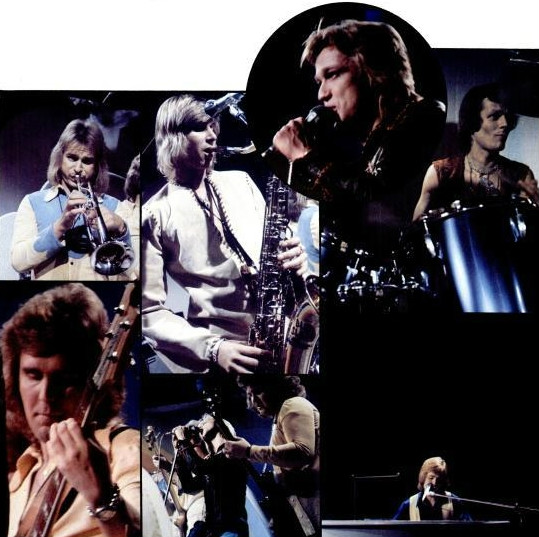
View on WikipediaBlue Swede (Swedish: Blåblus) were a Swedish rock band fronted by Björn Skifs which was active between the years 1973–1979. Blue Swede released two albums of cover versions, including a rendition of "Hooked on a Feeling", which brought them international chart success.[1] The band consisted of Anders Berglund (piano), Björn Skifs (lead vocals), Bosse Liljedahl (bass), Hinke Ekestubbe (saxophone), Jan Guldbäck (drums), Michael Areklew (guitar), and Tommy Berglund (trumpet).[2] They disbanded after Skifs decided to embark on his solo career.
Key Information
Career
[edit]Blue Swede was first formed in 1973, when Björn Skifs, a top vocalist in Sweden, was looking for a band to accompany him during his concerts.[3]
The band was originally called "Blåblus" (Swedish for "blue blouse" [could be made out of denim], a pun on the word "blues"[4]) and featured Skifs singing the lead vocals. The band got their international breakthrough in 1974 with their cover of the 1968 B. J. Thomas song "Hooked on a Feeling".[5] Blue Swede recorded Thomas's song in 1973, but based its rendition of the song on a 1971 version released by British pop eccentric Jonathan King, which created the "ooga-chaka" introduction.[clarification needed] The producer at the recording sessions was Bengt Palmers. Blue Swede released "Hooked on a Feeling" in Sweden in May 1973 and in the United States in February 1974. The song reached number one in the U.S. for one week in April 1974 and stayed in the Billboard Hot 100 chart for 18 weeks. The track also topped charts in Australia, Canada, and the Netherlands, where it reached a peak chart position of 26.[3] To capitalize on the success of the song, Blue Swede released the album Hooked on a Feeling that same year.
Throughout the rest of 1974, two follow-up singles from the same LP were released: "Silly Milly", which peaked at position 71 in the U.S., and a cover of The Association's "Never My Love", which made the Top Ten by peaking at position 7.[5] From the band's 1974 follow-up album, Out of the Blue, they recorded a medley of "Hush" by Deep Purple and "I'm Alive" by Tommy James and the Shondells (not The Hollies' song of the same name), peaking at position 61 in the U.S., and achieving its greatest chart success in Scandinavia. Skifs left the band in 1975 and the band continued as Blåblus, releasing a further two albums.
Discography
[edit]Albums
[edit]| Title | Album details | Peak chart positions | |||
|---|---|---|---|---|---|
| SWE [6] |
AUS [7] |
CAN [8] |
US [9] | ||
| Pinewood Rally | 5 | — | — | — | |
| Hooked on a Feeling |
|
— | 53 | 84 | 80 |
| Out of the Blue |
|
4 | — | — | — |
| Better Days Are Coming |
|
— | — | — | — |
| De' e vi som spelar på skivan |
|
— | — | — | — |
| "—" denotes releases that did not chart or were not released in that territory. | |||||
Singles
[edit]| Title | Year | Peak chart positions | Album | |||||||||
|---|---|---|---|---|---|---|---|---|---|---|---|---|
| SWE [6] |
AUS [7] |
BE (FLA) [10] |
CAN [11] |
GER [12] |
NL [13] |
NZ [14] |
UK [15] |
US [16] |
US AC [17] | |||
| "Hooked on a Feeling" | 1973 | 2 | 4 | 18 | 2 | 22 | 26 | 7 | 90[A] | 1 | 31 | Pinewood Rally / Hooked on a Feeling |
| "Silly Milly" | 9 | — | — | 50 | — | — | — | — | 71 | — | ||
| "Half Breed" | — | — | — | — | — | — | — | — | — | — | Pinewood Rally | |
| "Sally var en reko brud" | 1974 | — | — | — | — | — | — | — | — | — | — | Non-album single |
| "Doctor Rock 'n Roll" | — | — | — | — | — | — | — | — | — | — | Out of the Blue | |
| "Never My Love" | — | 52 | — | 7 | — | — | — | — | 7 | — | Pinewood Rally / Hooked on a Feeling | |
| "Hush"/"I'm Alive" (medley) | 1975 | — | — | — | 90 | — | — | — | — | 61 | — | Out of the Blue |
| "Boo, Boo Don't Cha Be Blue" | 1976 | — | — | — | — | — | — | — | — | — | — | Better Days Are Coming |
| "Låt mej lära känna dej" | 1977 | — | — | — | — | — | — | — | — | — | — | De' e vi som spelar på skivan |
| "Har jag gjort bort mig nu igen?" | — | — | — | — | — | — | — | — | — | — | Non-album single | |
| "Na Na Hey Hey Kiss Him Goodbye"/"Galaxy Take-Off" (medley) | 1978 | — | — | — | — | — | — | — | — | — | — | De' e vi som spelar på skivan |
| "Då dansar Angela" | — | — | — | — | — | — | — | — | — | — | ||
| "När inga ord räcker till" | 1979 | — | — | — | — | — | — | — | — | — | — | Non-album single |
| "—" denotes releases that did not chart or were not released in that territory. | ||||||||||||
See also
[edit]- List of Swedes in music
- Dancing baby, a.k.a. The ooga-chaka baby
Notes
[edit]- ^ Charted in 2014.
References
[edit]- ^ Caulfield, Keith (20 February 2014). "Blue Swede's 'Hooked On a Feeling' Sales Soar Thanks To 'Guardians of the Galaxy' Trailer". Billboard.com. Retrieved 3 August 2014.
- ^ Listing on Discogs.com.
- ^ a b Murrells, Joseph (1978). The Book of Golden Discs (2nd ed.). London: Barrie and Jenkins Ltd. pp. 325. ISBN 0-214-20512-6.
- ^ Schaefer, John (April 1, 2014). "That Was a Hit?!?: Blue Swede, 'Hooked On a Feeling'". SoundCheck. NPR. Archived from the original on June 18, 2015. Retrieved February 2, 2015.
- ^ a b Colin Larkin, ed. (1992). The Guinness Encyclopedia of Popular Music (First ed.). Guinness Publishing. p. 281. ISBN 0-85112-939-0.
- ^ a b "Björn Skifs Och Blåblus - Se alla låtar och listplaceringar". NostalgiListan (in Swedish). Retrieved 2022-01-17.
- ^ a b Kent, David (1993). Australian Chart Book 1970–1992 (illustrated ed.). St Ives, N.S.W.: Australian Chart Book. p. 39. ISBN 0-646-11917-6.
- ^ "Image : RPM Weekly". www.bac-lac.gc.ca. 2013-07-17. Retrieved 2022-01-17.
- ^ "Blue Swede". Billboard. Archived from the original on 2022-01-17. Retrieved 2022-01-17.
- ^ "ultratop.be - ULTRATOP BELGIAN CHARTS". www.ultratop.be. Retrieved 2022-01-17.
- ^ "Results: RPM Weekly". www.bac-lac.gc.ca. 2013-07-17. Retrieved 2022-01-17.
- ^ "Suche - Offizielle Deutsche Charts". www.offiziellecharts.de. Retrieved 2022-01-17.
- ^ "Dutch Charts - dutchcharts.nl". dutchcharts.nl. Retrieved 2022-01-17.
- ^ "flavour of new zealand - search listener". www.flavourofnz.co.nz. Retrieved 2022-01-17.
- ^ "BLUE SWEDE | full Official Chart History | Official Charts Company". www.officialcharts.com. Retrieved 2022-01-17.
- ^ "Blue Swede". Billboard. Archived from the original on 2022-01-17. Retrieved 2022-01-17.
- ^ "Blue Swede". Billboard. Archived from the original on 2022-01-18. Retrieved 2022-01-17.
Blue Swede
View on GrokipediaHistory
Formation
Blue Swede was formed in 1973 in Stockholm, Sweden, by established vocalist Björn Skifs, who sought a dedicated backing group to support his concert performances. Skifs, building on his prior experience fronting bands like Slam Creepers, assembled the ensemble to complement his solo endeavors with a fuller rock sound. The group initially operated under the Swedish name Blåblus, translating to "blue blouse" and serving as a playful pun on the blues genre.[4] For international appeal, this was anglicized to Blue Swede, evoking associations with "blue suede shoes" while nodding to their Swedish origins.[5] The core lineup included Skifs on lead vocals, Michael Areklew on guitar, Bosse Liljedahl on bass, Anders Berglund on keyboards, Hinke Ekestubbe on saxophone, Jan Guldbäck on drums, and Tommy Berglund on trumpet.[4] Their debut album, Pinewood Rally, was released later that year on the EMI label, showcasing a mix of original compositions and covers that introduced the band to the glam rock scene. The record helped secure early domestic recognition in Sweden through radio play and live shows, establishing Blue Swede as a rising act in the local music circuit before their wider international exposure.[3]Rise to international success
Blue Swede's breakthrough came with their 1973 cover of "Hooked on a Feeling," originally by B.J. Thomas, which they released in Sweden in May of that year and infused with the distinctive "ooga-chaka" intro inspired by Jonathan King's 1971 version.[2] The single gained traction internationally when EMI released it in the United States in late 1973, debuting on the Billboard Hot 100 at number 87 on February 16, 1974, before climbing to the top spot on April 6, where it held for one week and remained on the chart for a total of 18 weeks.[6][7] This marked the first time a Swedish act topped the US charts, propelling the band from their domestic formation earlier that year into global recognition.[8] Capitalizing on this momentum, Blue Swede released follow-up singles that further solidified their presence in English-speaking markets. "Never My Love," a cover of the Association's 1967 hit, entered the Billboard Hot 100 in August 1974 and peaked at number 7.[6] "Silly Milly" followed in June 1974, reaching number 71, while the 1975 double A-side "Hush/I'm Alive"—covering Deep Purple and Tommy James & the Shondells, respectively—peaked at number 61 in February 1975.[6] EMI's targeted promotion, including radio play and distribution focused on the US and other English-speaking regions, amplified these releases' reach.[9] The band's albums also saw significant international success during this period. Their debut LP, Hooked on a Feeling, released in 1974, featured the hit single and achieved strong sales in the US and Europe, leveraging the track's popularity to introduce their pop-rock sound.[10] The follow-up Out of the Blue, issued later in 1974, continued this trajectory with covers and originals, contributing to sustained commercial performance across continents.[11] These releases were supported by tours in the US and Europe, as well as media appearances on television shows, which boosted the visibility of glam-influenced pop rock acts in the mid-1970s.[9] At the height of their fame from 1973 to 1975, Blue Swede's appeal centered on frontman Björn Skifs' charismatic vocals, which delivered dynamic interpretations of their covers, paired with the band's high-energy live performances that captivated audiences during promotional tours.[12]Later years and disbandment
In 1975, frontman Björn Skifs departed Blue Swede to focus on his solo career, prompting the remaining members to revert to their original Swedish name, Blåblus, for domestic activities. This change marked the end of the band's international branding under Blue Swede, as they shifted emphasis to the Swedish market following the peak success of their English-language covers.[13] The group continued performing and recording without Skifs, recruiting new lead vocalists such as Dave McShane and Björn Inge. In 1976, Blåblus released the album Better Days Are Coming on EMI, featuring English tracks like covers of "Let Your Love Flow" and "Draggin' the Line," alongside originals, but it achieved limited commercial impact primarily in Sweden.[14] Collaborations followed, including summer tours with Jerry Williams in 1976 and Ted Gärdestad in 1977, reflecting a focus on local audiences and session work.[15] By 1978, Blåblus issued their final album, De' e vi som spelar på skivan, also on EMI, which incorporated more Swedish-language originals such as "Låt mej lära känna dej" and "Skiljas åt som vänner," alongside English covers like "Concrete and Clay."[16] This release, supported by a summer tour with Brian Chapman, underscored the band's pivot to homegrown material amid waning international interest after their mid-1970s U.S. hits.[15] The band disbanded in 1979 amid lineup shifts, including further personnel changes, and the broader decline of the glam rock-influenced pop scene that had defined their early sound.[13] Post-disbandment, core members like guitarist Michael Areklew pursued session work and solo endeavors, with occasional tributes and a partial reunion in 2011 led by Areklew.[15]Musical style
Genre and influences
Blue Swede's music is primarily classified as pop rock and glam rock, drawing from the vibrant 1970s trends with upbeat rhythms, brass sections, and theatrical flair that emphasized catchy hooks and energetic performances.[3] The band's influences encompassed the British glam rock movement, evident in their bold, anthemic arrangements reminiscent of the era's explosive sound, alongside American soul traditions adapted through covers of artists like Lee Dorsey and Burt Bacharach, which infused their tracks with rhythmic groove and emotional depth.[17] Frontman Björn Skifs contributed roots in Swedish pop, lending a melodic sensibility shaped by his earlier solo work and domestic success in the genre.[18] Central to their sound were the prominent saxophone lines from Hinke Ekestubbe, providing punchy brass accents and soulful interludes, paired with Bosse Liljedahl's driving bass lines that anchored the rhythmic drive, and Skifs' versatile vocals, which seamlessly blended raw rock energy with soaring, hook-laden melodies.[4][19] This combination evolved from the glam-infused intensity of their 1973 formation and early singles to a more polished, pop-oriented approach in their 1975 releases, reflecting broader shifts in international music tastes.[3] Through radio-friendly production emphasizing accessibility and broad appeal, Blue Swede bridged Swedish music with global audiences, notably as the first Swedish act to top the U.S. Billboard Hot 100.[20]Signature covers
Blue Swede's approach to music heavily emphasized cover versions of 1960s hits, reimagined with a glam rock edge characterized by energetic rhythms and theatrical flair to appeal to 1970s audiences. The band's debut single, a 1973 rendition of B.J. Thomas's 1968 track "Hooked on a Feeling," exemplified this strategy by incorporating the "ooga-chaka" chant from Jonathan King's 1971 version—inspired by the tribal rhythm in Johnny Preston's "Running Bear"—while transforming the original's soft pop into a buoyant, chant-driven rocker.[19] This adaptation removed subtle drug allusions from Thomas's lyrics and amplified the song's joyful vibe, propelling it to No. 1 on the Billboard Hot 100 in 1974 and marking the band's U.S. breakthrough.[9] Other notable covers included an upbeat, brassy take on The Association's 1967 ballad "Never My Love," which reached No. 7 on the U.S. charts in 1974, and a 1975 medley of Deep Purple's 1968 hard rock staple "Hush" with Tommy James and the Shondells' 1966 B-side "I'm Alive," blending gritty guitar riffs with pop accessibility.[9] The band also released "Silly Milly" in 1973, an adaptation of a 1971 German song originally by Sandwich and earlier performed by frontman Björn Skifs with his prior group Blåblus, infusing it with lively pop-rock energy.[21] Production techniques across these tracks featured layered vocal harmonies, extended introductory hooks like the repetitive chants, and a high-energy drive that converted introspective originals into vibrant 1970s anthems, often produced by Bengt Palmers to enhance their radio-friendly appeal. Covers formed the bulk of Blue Swede's international singles output, driving their global success—particularly in the U.S.—through two albums largely composed of reinterpretations between 1973 and 1975, though the band released some originals domestically.[19] This reliance on adaptations fueled their transatlantic rise but drew mixed reception in Sweden, where critics occasionally noted the covers' derivative nature amid Skifs's established solo career there.[22] The enduring impact of these versions is evident in revivals, such as the "Hooked on a Feeling" cover's prominent feature in the 2014 film Guardians of the Galaxy, which reignited its popularity and topped the Billboard 200 soundtrack chart for 17 weeks.[9]Band members
Core lineup
The core lineup of Blue Swede, active from 1973 to 1975, featured a stable group of musicians whose instrumental roles defined the band's pop-rock sound centered on cover versions with energetic arrangements.[4] Björn Skifs served as lead vocalist from 1973 to 1975, acting as the charismatic frontman whose prior solo hits in Sweden, including successes from his earlier band Slam Creepers, were key to the band's formation and its vibrant stage image.[22][4] Michael Areklew played guitar, providing the rhythmic foundation and glam rock riffs that underpinned the band's dynamic tracks like "Hooked on a Feeling."[23][24] Bosse Liljedahl handled bass, anchoring the band's driving sound across their two studio albums.[4][23] Anders Berglund contributed on keyboards and piano, adding melodic layers and arrangements that enhanced the harmonic depth of their covers and originals.[4][25] Hinke Ekestubbe performed on saxophone, delivering the distinctive brass elements that infused covers like "Never My Love" and original material with a soulful edge.[4][23] Jan Guldbäck played drums, supplying energetic beats that supported the band's lively live performances and studio recordings.[4][23] Tommy Berglund played trumpet, contributing to the brass sections in recordings from 1973 to 1975.[26][4]Membership changes
Blue Swede maintained a stable original lineup from its formation in 1973 through 1975, led by frontman Björn Skifs alongside core instrumentalists including bassist Bosse Liljedahl, saxophonist Hinke Ekestubbe, and drummer Jan Guldbäck. Blue Swede was the international name for the Swedish band Blåblus during this period.[3][15] Skifs departed the group in 1975 to focus on his solo career, leading to the end of Blue Swede and a reversion to the original name Blåblus, which carried on with remaining members.[15][19] During live performances from 1974 to 1975, the band occasionally augmented its sound with additional brass support.[3] By the time of the 1978 album De' e vi som spelar på skivan by Blåblus, the group had Liljedahl on bass, Ekestubbe on saxophone, continuing member Mikael Areklew (Michael Areklew) on guitar, and new drummer Björn Inge.[16][15] Blåblus disbanded in 1979, with no major reunions of Blue Swede, and members pursuing individual projects thereafter.[15][13]Discography
Studio albums
Blue Swede's debut studio album, Pinewood Rally, was released in 1973 by EMI Records in Sweden under the band's original moniker, Björn Skifs & Blåblus. The record featured a mix of original songs and covers, blending energetic pop hooks with rock elements that resonated with local audiences and laid the foundation for their early Swedish popularity.[27][28] Following the breakthrough of their signature cover, the band issued Hooked on a Feeling in 1974, also through EMI, as a targeted release aimed at the U.S. market. Featuring a mix of cover versions of popular songs and original tracks with a funky, upbeat twist, the album capitalized on the title track's success, incorporating ooga-chaka hooks and brass arrangements to create a distinctive pop-rock sound.[29][9] Out of the Blue, released later in 1974 by EMI with a 1975 North American edition, served as a follow-up that balanced original material with additional covers. Recorded at EMI Studios in Stockholm, it expanded on the band's international appeal through a mix of bluesy rock tracks and soul-infused pop, highlighting their evolving studio production techniques.[30][31] After frontman Björn Skifs departed in 1975, the group—now operating primarily as Blåblus—released Better Days Are Coming in 1976 via EMI. This album featured a mix of covers and originals, including versions of "Let Your Love Flow" and "Better Days Are Coming."[32][33][14] The band's final studio effort, De' e vi som spelar på skivan, emerged in 1978 under EMI as a Swedish-language release by Blåblus, featuring original compositions in rock and pop styles tailored to local tastes. This closing chapter reflected a return to roots amid waning international momentum.[16]Singles
Blue Swede's singles were predominantly cover versions of popular songs from the 1960s and early 1970s, which propelled the band to international recognition through strong performances on North American charts. The group released over ten singles across various markets between 1973 and 1975, with EMI serving as their primary label for international distribution. These releases often featured regional variations in track listings and B-sides to appeal to local audiences.[4] The band's most successful single, "Hooked on a Feeling"—a reworking of B.J. Thomas's 1968 recording with added "ooga-chaka" chants—debuted in Sweden in 1973 before achieving global breakthrough. It peaked at number 1 on the US Billboard Hot 100 for one week on April 6, 1974, remaining on the chart for 17 weeks, and also topped the Canadian RPM Top Singles chart. The single's B-side, "Gotta Have Your Love," was an original composition that contributed to its crossover appeal.[34][2] Following this success, Blue Swede issued "Silly Milly" in June 1974, an original track written by band members, which reached number 71 on the US Billboard Hot 100 and charted for 4 weeks; its B-side was "Lonely Sunday Afternoon." Later that year, their cover of The Association's "Never My Love" entered the charts in August, peaking at number 7 on the US Billboard Hot 100 for 12 weeks, highlighting the band's ability to infuse pop-rock energy into soft-rock originals.[34] In 1975, the double A-side single "Hush / I'm Alive"—covering Deep Purple's "Hush" and Tommy James & the Shondells' "I'm Alive"—debuted in February and peaked at number 61 on the US Billboard Hot 100, staying on the chart for 5 weeks. This release marked the band's final significant US entry, with "Why Don't You Go Your Way?" as the B-side.[34]| Single Title | Year | US Billboard Hot 100 Peak | Weeks on Chart | Other Notable Charts | B-Side |
|---|---|---|---|---|---|
| Hooked on a Feeling | 1974 | 1 | 17 | Canada #1 (RPM Top Singles) | Gotta Have Your Love |
| Silly Milly | 1974 | 71 | 4 | - | Lonely Sunday Afternoon |
| Never My Love | 1974 | 7 | 12 | - | Pinewood Rally |
| Hush / I'm Alive | 1975 | 61 | 5 | - | Why Don't You Go Your Way? |
