Hubbry Logo
South African ArgentinesSouth African ArgentinesMain
Open search
South African Argentines
Community hub
South African Argentines
logo
8 pages, 0 posts
0 subscribers
Be the first to start a discussion here.
South African Argentines
from Wikipedia

South African Argentines, also known as Boer Argentines, are Argentine citizens of South African descent, primarily Afrikaners who emigrated to Argentina in the early 20th century following the Second Anglo-Boer War. This migration was motivated by a desire to preserve their cultural identity and avoid British rule.

Key Information

By the time of their migration, slavery had long been abolished in both South Africa and Argentina, and the Boer settlers established predominantly European communities.[3]

The settlement began on 4 June 1902, with Afrikaners primarily establishing themselves in the Chubut Province of southern Argentina, particularly in the town of Sarmiento. A smaller group settled in the Río Negro Province. These regions were selected due to agricultural opportunities and favourable conditions for establishing Afrikaner communities.[4]

South African settlers were entirely of Boer origin. While the Afrikaans language persists within the community today, it is spoken by only around 300 individuals. Argentina was chosen as a destination due to the government's support for colonisation and opportunities for cultural and religious autonomy.[5]

History

[edit]
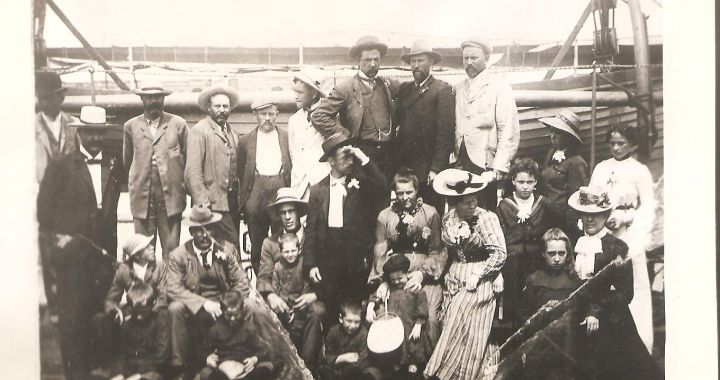
Afrikaner immigrants in Colonia Sarmiento.

Between 1902 and 1907/08 about 600 to 650 Boer settlers came to Argentina.[6][7] These Boers were descendants of Dutch and French settlers of South Africa (also called Afrikaners). They came mostly from the Transvaal Province and Orange Free State. Most left South Africa following the Second Anglo-Boer War as many had lost their farms in the war or regarded themselves as Bittereinders who felt they could not live under a British government.[7]

To migrate to the Argentine Patagonia region, the settlers sent two representatives to Comodoro Rivadavia (Louis Baumann and Camillo Ricchiardi), Chubut Province, to manage the establishment of the new colony. They were greeted by Francisco Pietrobelli, with whom toured the region, and called for the government land.[8] They came on British cargo ships with bullock carts (ox wagons) and the national government provided them mules and tents. The distribution of land was authorized by then President Julio Argentino Roca and the Minister of Agriculture, Wenceslao Escalante, who was honoured with the name of the colony and, later, the department where it is located.[9]

Notable people

[edit]

See also

[edit]

Further reading

[edit]

References

[edit]
Revisions and contributorsEdit on WikipediaRead on Wikipedia
from Grokipedia
South African Argentines are Argentine citizens of South African descent, primarily descendants of Afrikaner Boers who immigrated to the region in the early 20th century following the defeat in the Second Anglo-Boer War (1899–1902), seeking to escape British colonial rule and preserve their cultural and religious identity. Between 1902 and 1907, approximately 600 to 650 , primarily from Afrikaner families, arrived in , facilitated by Argentine government incentives under General Julio A. Roca, who offered them land in the arid, sparsely populated to promote settlement and development. These immigrants, descendants of 17th-century Dutch settlers in , established communities in areas such as Sarmiento and , acquiring about 80,000 acres of land—four times the allocation given to Argentine families—and initially maintaining an isolated existence focused on farming and rearing despite the harsh environmental conditions, including lack of water sources and infrastructure. The settlers faced significant challenges, including an unsuitable climate for traditional agriculture, cultural isolation from local Argentine populations, and economic hardships exacerbated by the discovery of oil on their lands, from which they derived no mineral rights as these belonged to the state. Between 1937 and 1939, roughly 550 to 600 individuals repatriated to South Africa due to these difficulties and limited integration opportunities, marked by prejudices against non-Protestant, non-white, or non-Afrikaans speakers. Those who remained preserved key elements of their heritage, including the Afrikaans language (a pre-1925 dialect serving as a linguistic "time capsule"), Calvinist Protestantism, and traditions like annual cultural festivals, while establishing schools and churches to sustain their ethnic identity amid growing contact with Spanish-speaking Argentines starting in the 1950s. Today, the community has significantly dwindled and integrated into broader Argentine society, with an estimated 500 to 1,200 descendants as of 2011, primarily in , where fluent speakers are mostly over 60 years old and younger generations predominantly use Spanish. Recent efforts to revitalize their heritage include the establishment of a cultural center and museum in , online language classes, and academic projects such as the University of Michigan's "From to Patagonia" initiative, which has conducted over 100 interviews to document their unique vocabulary and identity, alongside a 2015 documentary highlighting their history. While historical Boer migration forms the core of South African Argentine identity, smaller waves of more recent African and South African immigrants to Argentina exist but remain marginal in scale compared to the early 20th-century settlement.

History

Origins of Migration

The Second Boer War (1899–1902) acted as the principal catalyst for the migration of from to , as the British victory resulted in widespread destruction of Boer farms through scorched-earth tactics and the of Boer civilians in concentration camps. Approximately 28,000 Boer civilians, mostly women and children, perished in these camps due to , , and poor conditions. Following the war's conclusion with the in May 1902, faced severe economic devastation and political marginalization under British colonial rule in the newly formed . Many, known as "bittereinders" for their unyielding resistance, rejected oaths of allegiance to the British Crown and sought to maintain their cultural and political , viewing continued residence in as untenable. The Argentine government, seeking to populate and develop its sparsely inhabited Patagonian territories following the campaign, actively promoted immigration from 1901 onward via its consulate in , with assistance from Italian Boer ally Camillo Ricchiardi. Officials offered generous land grants—up to 625 hectares or more per family under Argentina's Immigration and Colonization Law of 1876—to attract hardy European settlers capable of farming arid lands, explicitly targeting the as suitable candidates due to their agricultural expertise and Protestant ethos. This initiative culminated in organized emigration waves beginning in 1902, with the first major group comprising about 650 individuals from roughly 120 families departing on May 21, 1902, aboard the Highland King and arriving in the following month; they were led by Commandant Stoffel Myburg, who coordinated the effort as a collective endeavor to safeguard Boer identity abroad. Subsequent groups followed through 1907, with estimates of the total influx varying from 600 individuals to around 800 families (potentially 3,000 people), reflecting the debated scale of this unique migration.

Settlement in Patagonia

The , primarily fleeing the aftermath of the Anglo-, selected in for settlement due to its semi-arid landscape, which echoed the dry conditions of South Africa's region, coupled with access to water sources suitable for irrigation in an otherwise arid environment. Argentine government propaganda portrayed the area as fertile and promising for , enticing groups to establish communities there despite the harsh realities noted by earlier explorers like , who described as barren and water-scarce. Arrivals began in 1902, with the first major group of approximately 54 families landing at by ship in June 1902, followed by additional waves that brought the total to between 600 and 800 families—equating to up to 3,000 individuals—by 1907 according to higher estimates, though scholarly sources often cite around 600 individuals overall. These immigrants received substantial land grants from the Argentine government under policies stemming from the Immigration and Colonization Law and the post-Conquest of the Desert initiatives of the 1880s, which aimed to populate with white European settlers; each family was allocated plots often exceeding 625 hectares, to encourage agricultural development. The grants were part of a broader effort by President Julio A. Roca to develop the region's underpopulated territories. Settlement focused on areas around Sarmiento and , where communities organized into villages such as Colonia Boer, establishing outposts with basic infrastructure adapted from South African models. The constructed systems drawing from local rivers to combat , built schools for multilingual education in , Spanish, and English, and formed churches to maintain their Dutch Reformed traditions, fostering a cohesive amid the isolation. These efforts emphasized self-reliance, with settlers initially living in tents while developing roads, bridges, and dams using their own labor and resources. Early agricultural successes emerged by 1904, as the community introduced South African-adapted crops like () for fodder and fruit trees, which proved viable in the irrigated plots and supported initial operations. These innovations, leveraging Boer expertise in dryland cultivation, allowed for sustainable land use and marked the establishment of a functional agricultural base, despite the challenging environment. The scale of this migration remains debated, with estimates ranging from 650 to 800 families overall, reflecting the peak influx during this formative period.

Post-Settlement Challenges and Dispersal

Following their initial establishment in the of around 1903, the Boer settlers encountered severe environmental hardships that undermined their agricultural efforts. Harsh Patagonian winters, prolonged droughts, locust plagues, and poor desert-like soil led to widespread crop failures between 1906 and 1910, intensifying the community's isolation and vulnerability. These conditions were compounded by the arid, treeless landscape and initial scarcity of water sources, forcing settlers to construct rudimentary shelters and trek long distances for basic resources during their first winters, resulting in illnesses and some deaths. Social and economic pressures further strained the community, as Argentine government support was limited to land grants of approximately 625 hectares per family, with little additional for infrastructure or sustenance beyond minimal provisions like a bag of and £1 per family. Internal divisions emerged over strategies, while assimilation pressures from Spanish-speaking neighbors and the growth of the local oil industry—discovered accidentally on land in 1907 but yielding no profits due to state-owned —drew younger members toward urban employment and intermarriage. and the failure of harvests exacerbated these issues, prompting many to question their long-term viability in the region. These challenges culminated in significant repatriation waves, with between 1937 and 1939, roughly half the community—around 550 to 600 individuals—returning to due to these difficulties and limited integration opportunities, facilitated by offers of resettlement aid amid ongoing economic distress and emotional ties to their homeland. The remaining settlers experienced gradual dispersal, as families relocated to urban centers like or integrated into broader Argentine farming communities during the 1920s and 1930s, driven by the search for better opportunities and the decline of isolated rural life. Later, minor migrations from brought a few dozen families in the 1940s and 1950s, attracted by economic prospects in Argentina's expanding sector, though these influxes were small and did not reverse the community's overall contraction.

Demographics

The influx of South African immigrants to Argentina reached its peak between 1902 and 1907, when approximately 600 Boer families—totaling an estimated 1,800 to 2,400 individuals—arrived in the region, primarily . This migration, driven by the aftermath of the Second Boer War, represented a notable but short-lived addition to Argentina's broader wave of European settlement during the early . Subsequent years saw a sharp decline, with the population reducing to around 1,500 by 1910 amid early repatriations to . By the 1930s, numbers had fallen further to around 1,000-1,200, influenced by ongoing out-migration, economic hardships, and initial assimilation processes that blurred ethnic boundaries. A major wave of in 1938–1939, supported by the South African government, saw nearly half of the remaining community—approximately 550 to 600 individuals—return home, exacerbating the downturn. The from the to brought relative stability with minimal net growth or decline, as an estimated 200 to 300 core families (around 800-1,200 individuals) persisted in rural Chubut holdings, sustaining a small but cohesive presence despite isolation and limited new arrivals. Post-World War II dynamics included modest inflows of 50 to 100 economic migrants from in the , yet overall stagnation prevailed as second- and third-generation intermarriage accelerated cultural integration and reduced identifiable counts. These trends are documented in Argentine national records from and , which enumerated small numbers of "extranjeros sudafricanos" (for example, 258 in ), though underreporting of assimilated descendants necessitates reliance on scholarly adjustments for a fuller picture. Seminal analyses, such as Brian M. du Toit's 1995 study of the Colonia Boer settlement, provide key estimates by accounting for rates, family sizes, and integration factors.

Current Distribution and Size

The South African Argentine community, consisting primarily of descendants from early 20th-century Boer migrations, remains small and geographically concentrated. As of 2024, estimates indicate approximately 30-40 direct descendants in the core communities of , , with broader individuals of partial South African heritage potentially numbering 500-1,000 across the country. The primary concentration is in Chubut, particularly around Sarmiento and nearby rural areas, where 70-80% of the remaining community lives, often on ancestral family farms engaged in . Smaller pockets exist in urban centers such as and , home to professionals and families of mixed heritage from later generations who have dispersed for and opportunities. These urban groups represent a minority of the overall and maintain looser ties to traditional practices. Demographically, the is predominantly elderly, with an average age exceeding 50 years, reflecting low birth rates and high rates of intermarriage with the broader Argentine . Linguistic surveys indicate that about 50% of community members are bilingual in and Spanish, primarily among older generations, while younger individuals are largely monolingual in Spanish. In recent decades, there has been a minor influx of South African expatriates to during the 2010s and 2020s, drawn by economic factors such as affordable living and job prospects in sectors like and energy, though these newcomers have not integrated into or formed distinct communities with the historical Boer descendants.

Cultural Heritage

Language and Dialect

The Patagonian Afrikaans dialect, known locally as Patagonaafs, originated from the late 19th- and early 20th-century form of (then often referred to as ) spoken by Boer immigrants who arrived in Argentina's between 1902 and 1907, following the Anglo-Boer War. Due to geographic isolation in rural , the dialect evolved independently, preserving archaic features from pre-1925 —before its standardization as an official language in —such as retained glides and voiced consonants that have shifted in modern varieties. Key linguistic characteristics of Patagonian include phonetic distinctions like the preservation of the -glide in words such as "kind" (pronounced [kjənt]) and a voiced in "nege" (pronounced [niəgə]), contrasting with the in contemporary South African . Grammatical simplification is evident through Spanish influence, notably the use of single (e.g., "Ek gaan nie plaas toe" for "I'm not going to the farm") instead of the double typical in standard . While specific Spanish loanwords are limited in documentation, contact with Spanish speakers has led to adaptations in noun plurals and neologisms, such as "vliegtuigstasie" for , reflecting bilingual . These features were systematically documented in 2018 linguistic fieldwork by researchers from the , highlighting the dialect's unique retention and divergence. Among the approximately 30-40 fluent speakers as of 2024, Patagonian Afrikaans is primarily spoken at home by older generations (aged 60 and above), with estimates suggesting that over half of these individuals remain bilingual, using it for familial conversations and cultural expression. Transmission occurs informally through family interactions rather than formal schooling, as the dialect lacks institutional support in Argentine education systems. However, usage is declining sharply across generations, with third- and fourth-generation speakers showing only receptive proficiency or none at all, driven by intermarriage, , and the dominance of Spanish in daily life. Preservation efforts gained momentum in the through academic initiatives, including the University of Michigan's "From to : Voices of Displacement" project, which has conducted over 100 interviews, created a archive of oral histories, and developed resources to document the . Community-led activities, such as online classes started around 2014 and cultural festivals, further support revival among younger members; as of , these include ongoing events to sustain heritage. Despite these measures, the faces full assimilation into Spanish by the third generation onward, rendering it endangered due to its small speaker base and lack of intergenerational transmission, consistent with assessments of vulnerable heritage languages in isolated immigrant communities.

Religious and Social Traditions

The South African Argentine community, primarily descendants of Boer settlers, has historically adhered to the (NGK), a Calvinist denomination rooted in their Afrikaner heritage. Initial religious services were conducted in , reflecting the immigrants' South African origins, with lay leaders presiding over worship in private homes due to the scarcity of clergy in the early years of settlement . By 1903, a formal congregation was established in under the leadership of Rev. Louis P. Vorster, marking the beginning of organized NGK activities among the . In Sarmiento, , the community maintained an active NGK presence, with 249 members recorded by 1969, underscoring the persistence of Protestant worship amid isolation. Key religious practices emphasize Calvinist principles, including family-centered readings, the singing of traditional Boer hymns, and the administration of sacraments like and communion by visiting pastors or elders. These gatherings reinforced communal bonds and ethical values such as and , often drawing on narratives from the to instill a sense of in family devotions. Social customs derived from Boer traditions include endogamous family structures that prioritized kinship ties and rural self-sufficiency, with early resistance to intermarriage preserving cultural isolation. Communal events featured shared meals reminiscent of South African braai, gradually incorporating Argentine elements as settlers adapted to local ranching life. Over generations, religious and social traditions have evolved through increased intermarriage with Spanish-speaking Catholic Argentines, particularly since the , leading to a shift toward bilingualism and greater integration into broader Argentine society. While Protestant ethics and NGK attendance remain in some families, the dominant Catholic milieu has influenced hybrid practices, with now largely confined to older generations and private rituals. Retention of core traditions persists in some households, where Calvinist holidays and sessions continue to transmit heritage. In the 2000s, community efforts have revived social customs through annual heritage events, such as games festivals (boeresport) that blend Boer sports with local celebrations, fostering pride in dual identities. These gatherings often include watching South African rugby matches alongside Argentine festivals, highlighting the fusion of immigrant roots with Patagonian culture.

Integration and Legacy

Economic and Social Contributions

South African Argentines, primarily descendants of Afrikaner who settled in , introduced key agricultural innovations adapted from their South African expertise, significantly enhancing productivity in the arid Patagonian landscape. In , early settlers successfully advocated for borehole drilling rigs from to access , overcoming severe water shortages that had previously hindered development; this not only enabled for crops and but also inadvertently led to the discovery of the region's first , spurring economic growth by the . As sheep farmers, the initial wave of approximately 600 immigrants received substantial land grants from the Argentine government, establishing expansive ranches that became models of resilience in the harsh environment and contributed to Chubut's and industries. Descendants have sustained these economic roles in , while expanding into on ancestral farms and offering bilingual (Afrikaans-Spanish) services that support regional multicultural initiatives. The community's has enriched Patagonia's multicultural composition, with intermarriages becoming prevalent from the third generation onward, often with Spanish-speaking Argentines, thereby strengthening cultural ties rooted in Dutch-Afrikaans heritage. These unions facilitated broader societal cohesion amid initial isolation. Cultural exchanges have grown since the , including university research on dynamics that highlights the Boer experience and fosters interdisciplinary studies on global migrations. Despite challenges from the community's small size—leading to linguistic shifts toward Spanish and cultural dilution—the legacy endures through sites in Chubut, such as preserved ranches and museums that educate visitors on Boer and sustainable farming practices.

Notable Figures

Commandant Stoffel Myburg (c. ) served as a key leader in the early 20th-century migration of to , organizing the transport of families aboard ships like the Highland King and acting as the first administrator of the Colonia Boer settlement in , where he helped establish the community. In contemporary times, Emanuel Ntaka (born 1977), a musician and sociocultural activist of mixed Argentine-South African heritage from recent immigration, has gained recognition for his work as a pop singer in the band Mambrú and for promoting Afro-Argentine identity through music that fuses South African influences with Argentine rhythms, including projects addressing racial heritage in . Descendants from families like the Bothas have contributed to modern efforts, with some involved as local linguists in projects documenting and preserving the unique Patagonian Afrikaans dialect, though these individuals remain more prominent within regional cultural circles than on a national stage. Due to the small scale of the South African Argentine community—estimated at fewer than 1,000 as of 2018, with the core bilingual group around 30-40 as of 2024—most notable figures achieve recognition primarily at the local level , where they sustain traditions through family-based initiatives rather than broader fame.

References

Add your contribution
Related Hubs
User Avatar
No comments yet.