Hubbry Logo
Pyroclastic rockPyroclastic rockMain
Open search
Pyroclastic rock
Community hub
Pyroclastic rock
logo
8 pages, 0 posts
0 subscribers
Be the first to start a discussion here.
Pyroclastic rock
Pyroclastic rock
from Wikipedia
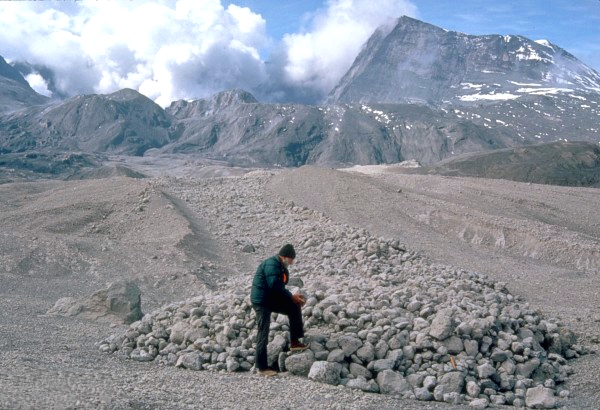
USGS scientist examines pumice blocks at the edge of a pyroclastic flow from Mount St. Helens
Rocks from the Bishop Tuff, uncompressed with pumice on left; compressed with fiamme on right.
Flight through a μCT-image stack of a lapillus of the volcano Katla in Iceland. Find spot: Beach near Vik at the end of road 215. Acquisition done using "CT Alpha" by "Procon X-Ray GmbH", Garbsen, Germany. Resolution 11,2μm/Voxel, width approx. 24 mm.
3D-Rendering of the above image stack, in parts transparent. Heavy particles in red.

Pyroclastic rocks are clastic rocks composed of rock fragments produced and ejected by explosive volcanic eruptions. The individual rock fragments are known as pyroclasts. Pyroclastic rocks are a type of volcaniclastic deposit, which are deposits made predominantly of volcanic particles.[1][2] Phreatic pyroclastic deposits are a variety of pyroclastic rock formed from volcanic steam explosions and are entirely composed of accidental clasts. Phreatomagmatic pyroclastic deposits are formed from explosive interaction of magma with groundwater.[3] The word pyroclastic is derived from the Ancient Greek words πῦρ (pûr), meaning 'fire', and κλαστός (klastós), meaning 'broken'.[citation needed]

Unconsolidated accumulations of pyroclasts are described as tephra. Tephra may become lithified to a pyroclastic rock by cementation or chemical reactions as the result of the passage of hot gases (fumarolic alteration) or groundwater (e.g. hydrothermal alteration and diagenesis) and burial, or if it is emplaced at temperatures so hot that the soft glassy pyroclasts stick together at point contacts and deform. This process is called welding.[4]

One of the most spectacular types of pyroclastic deposit is an ignimbrite, which is the deposit of a ground-hugging pumiceous pyroclastic density current (a rapidly flowing hot suspension of pyroclasts in gas). Ignimbrites may be loose deposits or solid rock, and they can bury entire landscapes. An individual ignimbrite can exceed 1,000 km3 (240 cu mi) in volume, can cover 20,000 km2 (7,700 sq mi) of land, and may exceed 1 km (0.62 mi) thick (e.g. where it is ponded within a volcanic caldera).

Classification

[edit]

Pyroclasts include juvenile pyroclasts derived from chilled magma, mixed with accidental pyroclasts, which are fragments of country rock. Pyroclasts of different sizes are classified (from smallest to largest) as volcanic ash, lapilli, or volcanic blocks (or, if they exhibit evidence of having been hot and molten during emplacement, volcanic bombs). All are considered to be pyroclastic because they were formed (fragmented) by volcanic explosivity, for example during explosive decompression, shear, thermal decrepitation, or by attrition and abrasion in a volcanic conduit, volcanic jet, or pyroclastic density current.[5]

Clast size Pyroclast Mainly unconsolidated (tephra) Mainly consolidated: pyroclastic rock
> 64 mm block (angular)
bomb (if fluidal-shaped)
blocks; agglomerate pyroclastic breccia; agglomerate
< 64 mm lapillus lapilli lapillistone (lapilli tuff is where lapilli are supported within a matrix of tuff)
< 2 mm coarse ash coarse ash coarse tuff
< 0.063 mm fine ash fine ash fine tuff

Pyroclasts are transported in two main ways: in atmospheric eruption plumes, from which pyroclasts settle to form topography-draping pyroclastic fall layers, and by pyroclastic density currents (PDCs) (including pyroclastic flows and pyroclastic surges),[6] from which pyroclasts are deposited as pyroclastic density current deposits, which tend to thicken and coarsen in valleys, and thin and fine over topographic highs.

During Plinian eruptions, pumice and ash are formed when foaming silicic magma is fragmented in the volcanic conduit, because of rapid shear driven by decompression and the growth of microscopic bubbles. The pyroclasts are then entrained with hot gases to form a supersonic jet that exits the volcano, admixes and heats cold atmospheric air to form a vigorously buoyant eruption column that rises several kilometers into the stratosphere and cause aviation hazards.[7] Particles fall from atmospheric eruption plumes and accumulate as layers on the ground, which are described as fallout deposits.[8]

Pyroclastic density currents arise when the mixture of hot pyroclasts and gases is denser than the atmosphere and so, instead of rising buoyantly, it spreads out across the landscape. They are one of the greatest hazards at a volcano, and may be either 'fully dilute' (dilute, turbulent ash clouds, right down to their lower levels) or 'granular fluid based' (the lower levels of which comprise a concentrated dispersion of interacting pyroclasts and partly trapped gas).[9] The former type are sometimes called pyroclastic surges (even though they may be sustained rather than "surging") and lower parts of the latter are sometimes termed pyroclastic flows (these, also, can be sustained and quasi steady or surging). As they travel, pyroclastic density currents deposit particles on the ground, and they entrain cold atmospheric air, which is then heated and thermally expands.[10] Where the density current becomes sufficiently dilute to loft, it rises into the atmosphere as a 'phoenix plume'[11] (or 'co-PDC plume').[12] These phoenix plumes typically deposit thin ashfall layers that may contain little pellets of aggregated fine ash.[13]

Hawaiian eruptions such as those at Kīlauea produce an upward-directed jet of hot droplets and clots of magma suspended in gas; this is called a lava fountain[14] or 'fire-fountain'.[15] If sufficiently hot and liquid when they land, the hot droplets and clots of magma may agglutinate to form 'spatter' ('agglutinate'), or fully coalesce to form a clastogenic lava flow.[14][15]

See also

[edit]

References

[edit]
Revisions and contributorsEdit on WikipediaRead on Wikipedia
from Grokipedia
Pyroclastic rocks are igneous rocks formed from fragments (pyroclasts) produced and ejected during explosive volcanic eruptions, which may include material from , crystals, lithic material from surrounding , or previously erupted volcanic products due to rapid gas exsolution and decompression, and subsequently consolidated into solid deposits. These fragments, which can include fine (<2 mm), lapilli (2–64 mm), and larger blocks or bombs (>64 mm), originate from the fragmentation of , crystals, lithic material from surrounding , or previously erupted volcanic products. The term "pyroclastic" derives from the Greek words pyr () and klastos (broken), reflecting their origin as "fire-broken" debris. Pyroclastic rocks exhibit clastic textures, resembling sedimentary rocks in their fragmental nature but composed of volcanic and associated fragments, and they form through various transport and deposition processes such as fallout from eruption plumes, pyroclastic surges, or high-density pyroclastic flows. Common types include (lithified ash deposits), volcanic (coarse angular fragments), (welded tuff from pyroclastic flows), and highly vesicular varieties like and , which result from gas expansion during eruption. is primarily based on clast size, composition, and degree of welding or cementation, with unconsolidated equivalents collectively termed . These rocks are significant in volcanic hazard assessment, as pyroclastic flows that produce them can travel at speeds exceeding 80 km/h (50 mph) with temperatures of °C (390–1,300°F), devastating landscapes and while leaving thick deposits that may later erode into lahars. Notable examples include the Bishop Tuff from California's and deposits from the 1980 eruption, illustrating their role in reconstructing ancient volcanic events through stratigraphic analysis.

Fundamentals

Definition

Pyroclastic rocks, derived from words "pyr" () and "klastos" (broken), consist of fragmented materials ejected during volcanic explosions, reflecting their origin in fiery fragmentation processes. These rocks are classified as clastic, meaning they are composed of discrete particles known as pyroclasts, which form through the violent disruption of or surrounding materials. Unlike effusive volcanic rocks, which result from the slow of molten lava flows without significant fragmentation, pyroclastic rocks arise exclusively from volcanic activity where rapid gas expansion shatters the material into fragments. This distinction highlights pyroclastic rocks' sedimentary-like texture, derived from accumulated ejecta rather than continuous cooling of fluid magma. Pyroclastic deposits encompass both unconsolidated forms, termed , and consolidated varieties such as , where loose pyroclasts undergo through compaction, cementation, or over time. represents the initial airborne or ground-deposited fragments, while consolidation transforms these into coherent rock units, though the processes of vary with environmental conditions. At their core, pyroclastic rocks originate from explosive eruptions driven by the sudden expansion of dissolved gases within magma, leading to its fragmentation into pyroclasts that are then transported and deposited. This gas-driven mechanism distinguishes explosive volcanism from effusive styles and underpins the formation of all pyroclastic materials.

Formation Mechanisms

Pyroclastic rocks originate from explosive volcanic eruptions, where ascending undergoes rapid fragmentation due to the exsolution of dissolved volatiles such as and as pressure decreases. This process generates high overpressures within bubbles, leading to brittle failure of the viscous and the production of fine- to coarse-grained pyroclasts ejected at velocities typically ranging from 100 to 300 m/s in Plinian-style eruptions. In more intense events, ejection speeds can exceed 500 m/s, propelling fragments into the atmosphere or along the surface. Once ejected, pyroclasts are transported via several modes depending on eruption intensity and environmental conditions. In highly explosive Plinian eruptions, pyroclasts form buoyant vertical columns rising to heights of 30 km or more, driven by the of the hot gas-particle mixture, before collapsing or dispersing as fallout. Column collapse generates ground-hugging pyroclastic density currents that travel at speeds of 100 km/h or greater, sometimes reaching 700 km/h, as dense mixtures of gas, ash, and larger fragments surge downslope. Pyroclastic surges, less dense and more dilute than flows, expand radially and can detach from the main current, while simple fallout occurs from settling of suspended particles in the atmosphere. Deposition begins as unconsolidated layers, which subsequently lithify into solid rock through various post-eruptive processes. Diagenetic cementation involves the precipitation of minerals like silica or from circulating , binding clasts together over time. In hot, rapidly emplaced deposits, occurs when glassy pyroclasts soften and fuse under the load of overlying material and residual heat, often exceeding 600°C, resulting in compacted, foliated textures. Hydrothermal alteration further modifies these deposits through interaction with hot fluids, promoting , clay mineral formation, or replacement by secondary minerals. Phreatomagmatic and phreatic eruptions represent specialized mechanisms involving external , producing distinct pyroclast textures. In phreatomagmatic events, rising interacts explosively with or , causing rapid expansion and fragmentation that yields blocky, angular clasts with quenched, vesicular surfaces due to the cooling effect of . eruptions, driven solely by superheated flashing to without direct involvement, eject fragments and generate fine with irregular, vesicular textures from hydrothermal systems. These interactions enhance fragmentation efficiency compared to purely magmatic eruptions. The scale of pyroclastic deposits varies widely, from small-volume events producing less than 1 km³ of material to super-eruptions exceeding 1,000 km³ in bulk volume, reflecting differences in magma chamber size and volatile content. Such volumes underscore the potential for widespread landscape alteration and climatic impacts.

Classification and Types

Size-Based Classification

Pyroclastic rocks and deposits are primarily classified based on the size of their constituent fragments, known as pyroclasts, using a scale adapted from the Wentworth grain-size classification originally developed for sedimentary rocks. This volcanic adaptation, recommended by the International Union of Geological Sciences (IUGS) Subcommission on the Systematics of Igneous Rocks, divides pyroclasts into ash (<2 mm), lapilli (2–64 mm), blocks (>64 mm and angular), and bombs (>64 mm and with fluidal, rounded, or vesicular shapes). Ash is further subdivided into fine ash (<1/16 mm or <0.063 mm) and coarse ash (1/16–2 mm), reflecting differences in fragmentation and transport behavior. Fragment size significantly influences the transport and deposition mechanisms of pyroclasts during volcanic eruptions. Fine ash particles, due to their small size and low settling velocity, are primarily transported via atmospheric suspension in eruption plumes and deposited through fallout over wide areas, often exceeding 1000 km from the source under favorable wind conditions. In contrast, larger lapilli, blocks, and bombs are typically ejected ballistically near the vent or transported within dense pyroclastic flows and surges, leading to more proximal deposition with rapid settling governed by gravity and flow dynamics. Unconsolidated pyroclastic deposits, collectively termed tephra, transition to lithified rocks upon diagenesis or welding. According to the IUGS classification, lithified pyroclastic rocks are named based on the dominant fragment size: if >75% (<2 mm), lapillistone if >75% lapilli (2–64 mm), and pyroclastic if >75% blocks or bombs (>64 mm). Mixed compositions use hyphenated names for the two most abundant components, such as lapilli or . This size-based system originated from 19th-century field observations of volcanic deposits and was formalized in the early through works like Wentworth and Williams (1932), which reviewed and standardized pyroclastic terminology, later refined by IUGS recommendations in to ensure consistent global application.

Compositional and Textural Types

Pyroclastic rocks are classified compositionally based on the dominant types of fragments they contain, which reflect the source and incorporated materials. Vitric components consist primarily of glassy fragments, such as shards, , and , derived from rapidly quenched during explosive eruptions. Crystal components are individual mineral fragments, commonly including , , , and iron-titanium oxides, which crystallize from the before fragmentation. Lithic components comprise fragments of preexisting or unrelated volcanic material, often as accidental inclusions entrained during eruption, such as or sedimentary clasts. These components can occur in varying proportions, leading to mixed compositions like crystal-vitric tuffs. Textural variations in pyroclastic rocks arise from depositional processes and post-emplacement modifications, distinguishing welded from non-welded types. Welded textures form when hot pyroclastic deposits (>600°C) undergo compaction, fusing glass shards and flattening into fiamme—elongated, lens-shaped structures characteristic of ignimbrites. Non-welded textures, in contrast, result from cooler emplacement or later cementation, producing loose or indurated tuffs with preserved fragment shapes and minimal deformation. Flow deposits from dense pyroclastic currents typically exhibit massive or poorly sorted textures, while surge deposits from dilute currents show laminated bedding and due to tractional transport. Hybrid types combine features from multiple depositional mechanisms, providing insights into complex eruption dynamics. Surge deposits often display cross-bedding and dune-like structures from turbulent flow, interspersed with fall-derived layers. Fall deposits, emplaced by gravitational settling from eruption columns, commonly exhibit normal grading, with coarser particles at the base fining upward. Accretionary lapilli—concentric aggregates of ash formed by moisture in the eruption cloud—are common in phreatomagmatic or humid conditions, indicating water-magma interaction. These features provide insights into eruption dynamics involving water.

Physical and Chemical Properties

Physical Characteristics

Pyroclastic rocks exhibit a wide range of textures and structures influenced by their explosive formation and depositional processes. Unwelded varieties, such as fallout tuffs and surge deposits, commonly display bedded or laminated structures resulting from particle sorting during airborne transport, with fine ash layers often showing cross-bedding or dune-like features in surge deposits. Pumice, a key component in many pyroclastic assemblages, features a highly vesicular texture with interconnected voids formed by rapid gas escape during eruption, achieving porosities up to 87% in extreme cases. In welded pyroclastic rocks like ignimbrites, high-temperature emplacement leads to compaction, producing foliated or eutaxitic structures where pumice fragments and glass shards are flattened and aligned parallel to bedding. Density and mechanical strength in pyroclastic rocks vary markedly based on degree and vesicularity. and unwelded tuffs typically have low bulk densities ranging from 0.92 to 1.58 g/cm³, attributed to high (32–47%) that reduces overall mass. Welded tuffs, by contrast, exhibit higher densities of 2.2–2.3 g/cm³ due to that expels pore space and increases compactness. follows suit, with unwelded forms being weak and friable (often <1,000 psi), while welded ignimbrites can achieve strengths up to 7,500 psi, approaching that of dense lavas. The color and appearance of pyroclastic rocks reflect their compositional variability and degree of sorting. Rhyolitic pyroclastics, rich in light-colored minerals, appear white, light gray, or pinkish, often with a uniform, powdery look in well-sorted ash deposits. Basaltic varieties tend toward dark gray or black hues due to mafic components, displaying a coarser, blocky appearance in poorly sorted breccias. Particle sorting enhances uniformity, creating layered contrasts, while oxidation can impart reddish or vermilion tones to exposed surfaces. Durability of pyroclastic rocks is generally low in unwelded forms owing to their friable nature and high porosity, which promotes rapid weathering and erosion through moisture infiltration and freeze-thaw cycles. These rocks disintegrate easily into loose fragments, contributing to slope instability in volcanic terrains. Welded types offer greater resistance, maintaining structural integrity longer under subaerial exposure.

Chemical Composition

Pyroclastic rocks inherit their chemical composition primarily from the parental , with major element abundances reflecting the silica content and differentiation level of the source. Silicon dioxide (SiO₂) is the dominant component, typically ranging from approximately 45-52 wt% in basaltic pyroclastics to 57-63 wt% in andesitic types and over 69 wt% in rhyolitic varieties, influencing the rock's viscosity and eruption style. Aluminum oxide (Al₂O₃), sodium oxide (Na₂O), and potassium oxide (K₂O) vary systematically with magma evolution; felsic compositions (rhyolitic to andesitic) show higher Al₂O₃ (around 15-18 wt%) and alkali contents (Na₂O + K₂O >5 wt%), while basaltic types exhibit lower SiO₂ (~50 wt%) and elevated iron (FeO) and magnesium (MgO) oxides. These variations align with calc-alkaline or tholeiitic series, as seen in subduction-related . The mineral assemblages in pyroclastic rocks mirror those of their effusive equivalents but are often fragmented and suspended in a glassy matrix. In pyroclastics, and feldspars ( and alkali feldspars) dominate, comprising up to 60-70% of phenocrysts, with minor or . varieties feature , (a ), and calcic as primary phases, reflecting higher temperatures and lower silica activity during crystallization. Volcanic glass shards, formed by rapid of during explosive eruptions, are ubiquitous across compositions, often constituting 20-90% of the rock volume in vitric tuffs and ignimbrites. Post-depositional alteration significantly modifies the primary composition, particularly the glassy components. transforms into fine-grained crystalline phases, such as clay minerals (e.g., or ), through hydration and recrystallization at low temperatures (<200°C). In hydrothermal settings, zeolitization occurs via interaction with alkaline fluids, replacing with zeolites like or mordenite, which incorporate SiO₂, Al₂O₃, and alkali metals while increasing . These processes can alter up to 100% of the original in water-saturated deposits over timescales of 10,000 years. Compositional analysis of pyroclastic rocks employs techniques like (XRF) for bulk major element determination, providing whole-rock SiO₂ and oxide abundances with precisions of ±0.5 wt%. Electron microprobe analysis targets individual glass shards and phenocrysts, yielding high-resolution data on Na₂O, K₂O, and trace elements at scales of 1-10 μm. Harker diagrams, plotting oxides against SiO₂, reveal fractionation trends, such as decreasing MgO with increasing silica, linking pyroclastic compositions to differentiation without deriving equations.

Geological Occurrence

Volcanic Environments

Pyroclastic rocks primarily form in zones, where the descent of oceanic plates into the mantle releases water-rich fluids that lower the of the overlying mantle wedge, generating andesitic to dacitic magmas prone to explosive eruptions. These settings favor the production of composite pyroclastic deposits through violent fragmentation of viscous, silica-rich magmas, often resulting in widespread ash falls and pyroclastic flows. Approximately 95% of global pyroclastic materials, including ash and pyroclastic density current deposits, originate from arc volcanoes associated with zones, reflecting their dominance in explosive subaerial volcanism over the past four decades. In hotspot environments, arise from both basaltic and rhyolitic magmas, though explosive activity is less common than in zones unless silica content increases, as seen in the rhyolitic eruptions of the . Here, mantle plumes provide heat for melting without plate boundary influences, leading to variable eruption styles; however, caldera-forming events in rhyolitic systems produce significant pyroclastic volumes through column collapse and formation. These intraplate provinces contribute only about 5% of modern pyroclastic output, primarily from infrequent but intense explosive phases. Rift zones, particularly continental rifts, generate pyroclastic rocks mainly through phreatomagmatic interactions between ascending basaltic magmas and or , creating fine and surge deposits in craters. Explosive eruptions in these divergent settings are typically less voluminous than in , driven by magma-water steam explosions rather than gas exsolution alone, and often interlayer with effusive basaltic flows in stratigraphic sequences. Overall, pyroclastic rock formation is concentrated in volcanic environments where high-viscosity, silica-enriched s trap volatiles, promoting fragmentation over effusive flow; caldera-forming supereruptions exemplify this, collapsing chambers and ejecting vast pyroclastic sheets. Globally, these deposits cluster along volcanic arcs, with lesser occurrences in hotspots and rifts, underscoring subduction's role in driving 80-95% of Earth's . Associated landforms like calderas and maars serve as key indicators of past pyroclastic activity, often preserving interlayered sequences that record eruption progression.

Notable Deposits and Examples

One of the most voluminous pyroclastic deposits in Earth's history is the from the in , , erupted approximately 2.1 million years ago with a dense-rock equivalent (DRE) volume of about 2,450 km³ covering an area of 15,500 km². This super-eruption produced widespread sheets and fallout , forming the initial complex. Similarly, the at Taupo Volcanic Zone in , dated to around 25.4 ka, ejected approximately 530 km³ DRE of rhyolitic (1,170 km³ bulk), creating extensive and surge deposits that reshaped the landscape and filled Lake Taupo . Historical examples include the AD 79 eruption of Vesuvius in Italy, which produced pyroclastic density current (PDC) deposits totaling about 1.25 km³ that buried the Roman cities of Pompeii and Herculaneum under layers of tuff up to 6 m thick. The overall eruption discharged roughly 4 km³ of phonolitic magma as plinian fallout and PDCs, with the Pompeii tuff characterized by welded and unwelded pumiceous ignimbrites. Another significant deposit is from the 1912 Novarupta eruption in Alaska, USA, which generated 11 km³ of ash-flow tuff that filled the Valley of Ten Thousand Smokes to depths exceeding 200 m over an area of 40 km². This event, the largest of the 20th century, involved rhyolitic to dacitic pyroclastic flows traveling up to 23 km from the vent. Recent eruptions have also produced notable pyroclastic materials, such as the 2010 summit eruption of in , which generated 0.11 km³ DRE of basaltic-andesitic , with ash plumes dispersing over the North Atlantic and , affecting air travel for weeks. The 2022 Hunga Tonga-Hunga Ha'apai eruption in , a submarine phreatomagmatic event, produced ashfall deposits several centimeters thick locally and a plume that expanded to 12 million km² globally, carrying fine ash and aerosols westward across the Pacific to Africa. This eruption ejected vast amounts of , though much was incorporated into and rafts. In the , diverse pyroclastic deposits illustrate subduction-related volcanism, such as the 1991 Mount Pinatubo eruption in the , which deposited over 5 km³ of dacitic ash and PDC material across river valleys and formed widespread ignimbrites. The Mazama ash from the 7.7 ka eruption forming in , , covers more than 1,000,000 km² with fallout up to 30 cm thick in places. In contrast, the features alkaline pyroclastic sequences, including thick trachytic ignimbrites from the Menengai Caldera in (erupted ~36 ka), which form widespread fallout and flow deposits in rift basins. in has produced localized nephelinitic and fall deposits during its eruptions.

Significance and Applications

Geological and Volcanological Importance

Pyroclastic rocks serve as critical stratigraphic markers in geological records, enabling precise dating of volcanic eruptions and correlation of sedimentary sequences across wide areas through tephrochronology. This discipline utilizes discrete layers of () from pyroclastic deposits to establish isochronous horizons, with dating often achieved via ⁴⁰Ar/³⁹Ar methods on sanidine or glass shards, providing ages with uncertainties as low as ±1-2% for eruptions older than 100 ka. Fission-track dating of or in tephra layers complements these techniques, particularly for deposits, allowing reconstruction of paleoenvironments by linking ash fallouts to contemporaneous climate shifts, tectonic events, or changes in distal sedimentary basins. These rocks also act as proxies for volcanic processes, revealing insights into dynamics and broader climatic influences. Textural and compositional variations in pyroclastic deposits, such as textures or mineral assemblages, indicate pre-eruptive conditions like mixing, rates, and chamber decompression, which can trigger explosive events. For instance, widespread ash veils from large eruptions form stratospheric aerosols that induce by reflecting solar radiation, with historical analogs showing temperature drops of 0.5-1°C lasting 1-3 years, as evidenced in ice core records and tree-ring proxies. Advancements in the 2020s have enhanced understanding of pyroclastic density currents (PDCs) through numerical modeling, aiding eruption forecasting by simulating flow dynamics and validating against ancient deposits. Studies employing depth-averaged and 3D multiphase models reconstruct PDC , , and bedform development, using field from ignimbrites to calibrate parameters like particle concentration and , thereby improving predictions of flow extent and hazard zones for future events. For example, phase diagrams derived from granular flow experiments have been applied to natural PDC deposits, confirming transitions between dune and antidune bedforms that reflect flow regimes. In , further insights into PDC trigger mechanisms and propagation dynamics have been provided through advanced multiphase modeling approaches. Despite these progresses, significant gaps persist in the geological record of pyroclastic rocks, particularly for small-scale eruptions, where thin or eroded layers often escape preservation, leading to incomplete chronologies of volcanic activity. Integration of satellite data, such as infrared imagery from MODIS or VIIRS, with ground-based deposit analysis offers modern analogs but faces challenges in detecting fine from low-intensity events due to atmospheric interference and resolution limits, hindering comprehensive validation of historical records.

Human Uses and Hazards

Pyroclastic rocks, particularly and , have been utilized by humans for various practical applications due to their unique physical properties such as and . , a lightweight vesicular rock formed from frothy volcanic ejecta, is widely employed as an abrasive in products like polishes, , and industrial cleaners, as well as in lightweight aggregates and admixtures to enhance insulation and reduce weight in . Additionally, its porous structure makes it ideal for horticultural uses, including amendment for and water retention in landscaping and agriculture. , a consolidated deposit, has been a key in historical , notably in ancient Roman structures where it was quarried from deposits near and used for walls, foundations, and monuments owing to its ease of cutting and availability. from pyroclastic eruptions serves as a pozzolanic material in production, reacting with lime to form durable binders; this technique originated in ancient , where ash from the Bay of Naples was mixed into for long-lasting like aqueducts and harbors. Despite these benefits, pyroclastic rocks pose significant hazards to human life and infrastructure during and after volcanic eruptions. Pyroclastic density currents (PDCs), fast-moving avalanches of hot ash, gas, and rock fragments, have caused devastating fatalities; the in produced a PDC that killed approximately 30,000 people in the city of Saint-Pierre through incineration and asphyxiation. Ash falls from explosive eruptions can disrupt aviation by abrading aircraft engines and reducing visibility; the 2010 eruption in grounded over 100,000 flights across for days, stranding millions and costing airlines billions in losses. Remobilized pyroclastic deposits, when saturated by rain or melted snow, trigger lahars—rapid mudflows that bury communities and infrastructure far from the volcano, as seen in eruptions where hot debris erodes valleys and incorporates water to form concrete-like flows. of fine volcanic ash can lead to respiratory issues, including irritation of eyes and airways, exacerbation of , and long-term risks like from crystalline silica content, particularly for cleanup workers and those with preexisting conditions. Mitigation strategies for pyroclastic hazards include land-use and early warning systems to minimize exposure. zone maps delineate high-risk areas around volcanoes, guiding building restrictions and evacuation planning to protect populations from PDCs, ash falls, and lahars. Monitoring networks provide real-time alerts, allowing timely evacuations and flight restrictions, as demonstrated in modern volcanic observatories. The 2022 Hunga -Hunga Ha'apai eruption highlighted economic vulnerabilities, causing approximately $90 million in damages to infrastructure, agriculture, and fisheries in through ash fallout and , underscoring the need for resilient coastal planning. More recently, the December 9, 2024, of volcano in the generated pyroclastic density currents, leading to evacuations within a 6 km radius and highlighting persistent risks to nearby communities. Pyroclastic rocks also hold cultural significance, from to modern eco-tourism. have long used , a glassy pyroclastic product, for crafting sharp tools like arrowheads, knives, and scrapers due to its , with evidence from archaeological sites showing widespread trade and manufacture across volcanic regions. has been employed as an abrasive in traditional stone-working. Today, sites preserved by pyroclastic deposits, such as Pompeii buried by the 79 CE Vesuvius eruption, attract millions for eco-tourism, offering insights into ancient Roman life and designated as a for its unparalleled preservation of urban architecture and daily artifacts.

References

Add your contribution
Related Hubs
User Avatar
No comments yet.