


Community hub
Recent from talks
Contribute something
Nothing was collected or created yet.
Breda M37
View on Wikipedia
The Mitragliatrice Breda calibro 8 modello 37 (commonly known as the Breda mod. 37 or simply Breda 37/M37 and also just M37) was an Italian heavy machine gun produced by Breda and adopted in 1937 by the Royal Italian Army. It was the standard heavy machine gun for the Royal Italian Army during World War II, and continued to be used by the Italian Army after the conflict.[3] Post-war, it was also used during the early stages of the Portuguese Colonial War until it was replaced by the MG42/59. The M37 remained in service or kept in strategic storage with a handful of African countries until the late 1980s.
Key Information


The weapon was also adopted by the Marines and Blackshirt militia. Some guns were also supplied to Nationalist forces during the Spanish Civil War and to Italian-trained Ustaše troops during WWII.
Design and operation
[edit]The Breda M37 is a downscaled version of the 13.2 mm Breda M31,[a] since the latter was considered too large to fit into the tankettes used by the Royal Italian Army. The M37 retains the same rising block breech-locking system of its predecessor, but its fed with 20-round metal strips, similar to the ones used by the Hotchkiss machine gun. Development of the gun faced some delays since the 8×59mm Rb Breda cartridge was not approved until 1935. Ultimately, it took two more years for the machine gun to finally appear.[5]
The strips were inserted into the left side of the gun and the gas-piston driven bolt removed a cartridge from the strip, fed it to the chamber, fired it and put the spent cartridge case back into the strip, which then moved one notch to the right to restart the cycle until the last round was fired. Then the strip was ejected on the right side of the gun as the machine gunner's assistant loaded a fresh ammunition strip.[5] Like the Hotchkiss, continuous fire required the assistant to feed one strip after another while the gunner kept the trigger pulled. M37 crews had a crank-operated machine to remove the spent cases from the strips and load them with fresh cartridges. These devices also had a hopper to store spent cases.[3] The barrels had an expected service life of 20,000 rounds each, and they had to be changed every 400 rounds fired to cool down.[6]
The cartridges didn't need to be oiled,[b] though the use of 20-round ammunition strips limited the rate of fire to about 200 rounds per minute (the weapon was air-cooled, so it could not be continuously fired anyway). Rugged and accurate, It was popular with its crews despite the weight of 38 kg (83 lb) with the tripod (it was heavier than the British Bren and the German MG 42), and the low rate of fire, specially when compared to the machine guns used by the Germans.[9][10][c]
According to Hobart, the gun was originally intended to be mounted on tanks and having the spent cases reinserted into the strips instead of scattering around the floor would prevent the crews from slipping on them;[7] while Ian V. Hogg's explanation is that tanks built during the 1930s had a lot of operating mechanisms exposed inside the hull, and having a ejected cartridge case finding its way to this machinery could result into mechanical breakdowns, though he also notes that the tank-mounted Breda 38 used a bag to collect spent cartridges instead;[5] Another suggestion is that this feature was included for economical reasons, allowing spent cartridges to be reused and saving strategic metals.[3] Regardless of the actual reason, it ultimately proved to be impractical on the battlefield.[3][5]
Variants
[edit]- Breda 37 − Original version. Post-war attempts to rechamber the gun to fire the 7.62×51mm NATO cartridge were unsuccessful[12]
- Breda 38 − Vehicle-mounted variant, it was fed from a top-mounted box magazine, fitted with a heavier barrel and a pistol grip. Officially designated as the Mitragliatrice Breda cal. 8 mod. 38 per carri armati[3][5][8]
Service use
[edit]
The Breda 37 was supposed to replace the Fiat–Revelli Modello 1935, but the latter remained in use during the campaigns in North Africa and the Balkans.[13] Every Italian machine gun section had 2 non-commissioned officers, 16 privates, and 2 Breda 37s or Fiat 35s. Each squad had a commander, a machine gunner, the gunner's assistant, 2 soldiers to carry the tripod, 2 soldiers to carry the spare parts, and 2 soldiers to carry the ammunition.[14]
Besides the Army, the Breda was also issued to the Blackshirt militia and Marines (such as the Decima Flottiglia MAS).[15][16] In North Africa, the M37 was mounted on SPA-Viberti AS.42 reconnaissance cars to improve mobility. Each vehicle carried up to three guns which could be dismounted if necessary.[17]
During the late stages of the Spanish Civil War, Italy supplied the Nationalist forces with about 2,500 guns.[4] During World War II, Italian-trained Ustaše troops were also supplied with Bredas.[18] In the North African campaign the British made wide use of captured M37s, particularly with its Long Range Desert Groups (LRDG).[19] After the Italians surrendered to the Allies in 1943, production of the Breda continued in the Italian Social Republic to supply its German allies,[12] who gave the M37 the designation 8 mm sMG 259(i), while the M38 was designated as the 8 mm Kpfw.MG 350(i).[8] It was also adopted by the Portuguese armed forces, who placed it into service as the Metralhadora m/938.[7][20] The Breda saw extensive service in Portugal's African colonies during the early stages of the Portuguese Colonial Wars.[21]
During the post-war period, the reformed Italian Army kept the M37 in use until the 1960s.[3] Attempts to convert the Breda to chamber and fire the 7.62×51mm NATO were unsuccessful and it was eventually replaced by the MG42/59.[12] The gun would remain in service or kept in strategic storage with a few African nations, including Somalia, Libya, and Chad[d] until the late 1980s.[23][24]
Gallery
[edit]-
 A 20-round ammuntion strip
 -
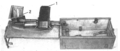 A device to remove spent cases from the ammo strips and replace them with fresh cartridges
 -
 A M37 mounted in an anti-aircraft tripod at a museum in Petaluma, California
 -
 Italian Army soldiers with a M37 ready for training, 1952
 -
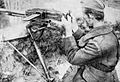 A Breda 37 operated by a Slovene partisan

_(1943-11-01)_Ladesteifen_259_(i)_und_Ladestreifenf%C3%BCller_259_(i)_(Bild).png)


Users
[edit].jpg)
 British Empire − Captured Model 37 and 38 guns were used by the LRDG[19]
 Chad − Used as late as 1988[25]
 Croatia[18]
 Ethiopia[26]
 Nazi Germany − Captured guns were designated as the 8 mm sMG 259(i)[8]
 Greece − Captured, used by the EDES[27]
 Kingdom of Italy
 Italian Social Republic[16]
- Italy − Replaced by the MG42/59[12]
 Libya − Some guns were possibly kept in reserve as late as 1988[28]
 Portugal − Designated as the m/938,[20] replaced by the MG42/59[7]
 Somalia − Remained in use as late as 1987[24]
 Spain − Approximately 2,500 were delivered during the Spanish Civil War[4]


Notes
[edit]- ^ Clifford erroneously stated that it was derived from the problematic Breda 30.[4]
- ^ Several sources stated that the M37 was fitted with an oiler,[5][7][8] while Pignato stated that while the ammunition didn't need oiling, the gun itself needed to be lubricated.[9]
- ^ The MG 42 had a rate of fire between 900 and 1200 rounds per minute.[11]
- ^ The People's Armed Forces, a Chadian insurgent group that opposed the rule of president Hissène Habré, was supported by Libya.[22]
References
[edit]- ^ War Department 1943, p. 191.
- ^ Pignato 1971, pp. 42−43.
- ^ a b c d e f Poggiaroni, Giulio (3 July 2020). "Breda Modello 37". Comando Supremo. Archived from the original on 16 May 2025. Retrieved 4 December 2021.
- ^ a b c Clifford 2020, p. 269.
- ^ a b c d e f Hogg 2002, p. 134.
- ^ Pignato 1971, pp. 41, 43.
- ^ a b c d Hobart 1975, p. 405.
- ^ a b c d Chamberlain & Gander 1975, p. 29.
- ^ a b Pignato 1971, pp. 39, 41.
- ^ Greentree 2024, pp. 26−27.
- ^ Hogg 2002, pp. 154, 160.
- ^ a b c d Pignato 1971, p. 39.
- ^ Pignato 1971, pp. 38−39.
- ^ War Department 1943, p. 63.
- ^ Battistelli & Crociani 2013, p. 28.
- ^ a b Crociani & Battistelli 2013, pp. 51, 54.
- ^ Molinari 2013, p. 87.
- ^ a b Brnardic 2016, p. 44.
- ^ a b Molinari 2013, p. 82.
- ^ a b Venter 2023, p. 58.
- ^ Abbott, Peter, and Rodrigues, Manuel, Modern African Wars 2: Angola and Mozambique, 1961-1974, Osprey Publishing (1998), p. 18
- ^ Ezell 1988, pp. 92.
- ^ Ezell 1988, pp. 92, 94.
- ^ a b Hogg 1987, p. 983.
- ^ Ezell 1988, p. 94.
- ^ Ezell 1988, p. 145.
- ^ Athanassiou 2025, p. 17.
- ^ Ezell 1988, p. 252.
Bibliography
[edit]- Athanassiou, Phoebus (2025). Partisan Warfare in Greece 1941–44 (PDF ed.). Bloomsbury Publishing. ISBN 978-1-4728-6750-6.
- Chamberlain, Peter; Gander, Terry (1975). Machine Guns. New York, NY: Arco Pub. ISBN 978-0-668-03506-4.
- Battistelli, Pier Paolo; Crociani, Piero (2013). Italian Blackshirt 1935–45 (PDF ed.). Bloomsbury Publishing. ISBN 978-1-4728-1895-9.
- Brnardic, Vladimir (2016). World War II Croatian Legionaries: Croatian Troops under Axis Command 1941–45 (PDF ed.). Bloomsbury Publishing. ISBN 978-1-4728-1769-3.
- Clifford, Alexander (2020). The People's Army in the Spanish Civil War: A Military History of the Republic and International Brigades 1936–1939. Pen and Sword Military. ISBN 978-1-5267-6095-1.
- Crociani, Piero; Battistelli, Pier Paolo (2013). Italian Navy & Air Force Elite Units & Special Forces 1940–45 (PDF ed.). Bloomsbury Publishing. ISBN 978-1-84908-858-9.
- Ezell, Edward Clinton (1988). Small Arms Today: latest reports on the world's weapons and ammunition (2nd ed.). Harrisburg, PA: Stackpole Books. ISBN 978-0-8117-2280-3.
- Greentree, David (2024). Eighth Army Soldier vs Italian Soldier: El Alamein 1942 (PDF ed.). Bloomsbury Publishing. ISBN 978-1-4728-6339-3.
- Hobart, Frank William Archer, ed. (1975). Jane's Infantry Weapons 1975 (1st ed.). London: Macdonald and Jane's. ISBN 978-0-354-00516-6.
- Hogg, Ian V, ed. (1987). Jane's Infantry Weapons: 1987−88 (13th ed.). London: Jane's Yearbooks. ISBN 978-0-7106-0843-7.
- Hogg, Ian V. (2002). Machine Guns: 14th century to present. Iola, Wisconsin: Krause Publications. ISBN 978-0-87349-288-1.
- Molinari, Andrea (2013) [2007]. Desert Raiders: Axis and Allied Special Forces 1940–43 (PDF ed.). Bloomsbury Publishing. ISBN 978-1-4728-0254-5.
- Pignato, Nicola (1971). Armi Della Fanteria Italiana Nella Seconda Guerra Mondiale (in Italian). Parma: Ermanno Albertelli.
- Venter, Al J. (2023). Portugal's Bush War in Mozambique. Casemate. ISBN 978-1-61200-937-7.
- War Department, United States (1943). TME 30-420 Handbook on the Italian Military Forces. Washington, D.C.
{{cite book}}: CS1 maint: location missing publisher (link)
External links
[edit] Media related to Breda Mod. 37 at Wikimedia Commons

Breda M37
View on GrokipediaDevelopment
Origins and design process
In the 1930s, the Italian Royal Army recognized the need for a modern, reliable heavy machine gun to equip its infantry and armored units, driven by ongoing dissatisfaction with the performance and reliability of earlier designs such as the Breda Model 1930 light machine gun and the FIAT-Revelli Model 1914 medium machine gun. These weapons, while in service, suffered from mechanical complexities and maintenance issues that hindered their effectiveness in sustained fire roles, prompting the army to seek a more robust replacement suitable for company-level support.[5][1] Development of the Breda M37 began in 1935 under the auspices of the Società Italiana Ernesto Breda per Costruzioni Meccaniche, evolving directly from the company's earlier Breda M31 aircraft machine gun, which itself was a licensed adaptation of the French Hotchkiss 13.2mm heavy machine gun. A significant factor in the timeline was the parallel approval process for the new 8×59mm Rb Breda cartridge, specifically developed for machine guns as part of Italy's dual-caliber system (6.5mm for rifles and 8mm for automatic weapons), which delayed initial progress until its formal designation in 1935. This cartridge choice aimed to provide greater stopping power without excessive recoil for rifle-caliber applications.[3][5][1] The design incorporated a gas-operated mechanism inspired by contemporary European systems, particularly the Hotchkiss lineage, but was scaled down and adapted for ground use with a rifle-caliber round, emphasizing stability through tripod mounting to enable prolonged bursts of fire in defensive or suppressive roles. Breda engineers prioritized simplicity and durability over the intricate features of predecessors, drawing on lessons from the M31's aviation demands to enhance infantry adaptability.[5][1] Initial prototypes underwent rigorous testing from 1935 to 1937 at Italian army proving grounds, where the focus was on improving reliability, reducing stoppages, and verifying performance across various environmental conditions compared to the problematic feeding and lubrication systems of earlier Breda and FIAT models. These trials confirmed the design's viability for heavy machine gun duties, leading to its formal adoption in 1937.[3][1]Adoption and production
The Breda M37 was officially adopted by the Royal Italian Army in 1937 as the Mitragliatrice Breda calibro 8 modello 37, serving as the primary heavy machine gun and intended to replace outdated designs like the Fiat-Revelli Modello 1914 in infantry support roles.[4][1] Manufacturing took place primarily at the Breda Meccanica Bresciana facility in Brescia, Italy, with limited subcontracting to other firms; production commenced that same year and ramped up to meet military demands. Output peaked between 1940 and 1942 amid escalating wartime needs, but continued until 1945, including by the Italian Social Republic for German allies after the 1943 armistice.[3] Early exports included initial shipments to Nationalist forces in Spain starting in 1938 during the Spanish Civil War, totaling about 2,500 units to bolster their heavy machine gun capabilities.Design
Specifications
The Breda M37 is a gas-operated heavy machine gun chambered in the 8×59mm Rb Breda cartridge, which features a rebated rim design to enable reliable feeding from metal strips without interference from rim overlap.[1][6] The cartridge achieves a muzzle velocity of approximately 800 m/s, providing effective penetration and range for its class.[1][6] Key physical and performance characteristics of the standard model are summarized below.| Parameter | Specification |
|---|---|
| Caliber | 8×59mm Rb Breda |
| Overall length | 1,270 mm |
| Barrel length | 780 mm |
| Weight (gun) | 19.5 kg |
| Weight (tripod) | 18.8 kg |
| Total weight | ~38.3 kg |
| Cyclic rate of fire | 450 rounds per minute |
| Practical rate of fire | 200 rounds per minute |
| Effective range | 800–1,000 m |
| Maximum range | 5,400 m |
| Feed system | 20-round metal strip (loaded from left) |
| Barrel type | Quick-change, heavy-profile, air-cooled with cooling fins |