Hubbry Logo
TZ-45TZ-45Main
Open search
TZ-45
Community hub
TZ-45
logo
8 pages, 0 posts
0 subscribers
Be the first to start a discussion here.
TZ-45
TZ-45
from Wikipedia

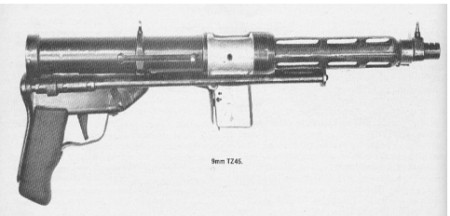
The TZ-45 was an Italian blowback-operated submachine gun produced between 1944 and 1945, with an estimated 6,000 made.

Key Information

History

[edit]

The TZ-45 submachine gun was designed by two Italians; Tonon, a lieutenant colonel in the National Republican Army whose first name remains unknown and Aldo Zorzoli, a gunsmith, and was produced by the Giandoso company. The vast majority of the estimated 6000 TZ 45s produced were issued to R.S.I. (Repubblica Sociale Italiana) units fighting against Italian partisan forces during the civil war in Northern Italy (1944–45). A few TZ-45 were possibly used by the Wehrmacht forces engaged in similar operations. After the war, the remaining guns were given to the military of the British and the American forces where they were evaluated. The general opinion was unfavorable due to the style of manufacturing and finish.[3]

The projects and manufacturing rights for the gun were later sold[4] to the Burmese army where it was manufactured as the BA-52 and colloquially known as the "Ne Win STEN". The Burmese copies were roughly manufactured and unreliable. The weapon remained in service into the mid-1980s with the Burmese infantry and into the early 1990s with support troops.[5]

Design and construction

[edit]

The TZ-45 was manufactured by a stamped process and was then welded together with a simple finish applied. The blowback-operation was similar to other submachine guns at the time, though the return spring differed as it was assembled around a telescoping guide rod. A muzzle brake was fitted to the firearm, and the shoulder stock of the weapon was formed out of steel rods that slid alongside the receiver when retracted.

Safety mechanisms for the gun included a fire selector that has a safe position that locks the bolt in the forward or rearward position, a grip safety behind the magazine housing preventing the bolt from moving in the direction of cocking or firing unless properly held, And a pin wedged in a specially designed notch in the bolt, preventing it from rolling back in case of accidental shock.

Accidental discharges were a common occurrence in similar submachine guns such as the Sten gun and M3. However, the double safety system the TZ-45 utilized proved to be a breakthrough which would inspire later submachine guns, such as the Danish Madsen M50.

Users

[edit]

References

[edit]
[edit]
Revisions and contributorsEdit on WikipediaRead on Wikipedia
from Grokipedia
The TZ-45 was a blowback-operated developed in during the latter stages of , specifically between 1944 and 1945, as a low-cost emergency weapon for the forces. Designed by brothers Tonon Giandoso and Zorzoli Giandoso and produced by Società Anonima Meccanica Torinese in limited quantities estimated at around 6,000 units, it featured a simple stamped metal construction akin to the British Sten gun, firing cartridges from an with both semi-automatic and full-automatic modes enabled by advanced primer ignition. While intended for to equip Republican Fascist troops amid resource shortages, its crude build led to reliability issues, though it incorporated a novel grip safety mechanism to prevent accidental discharge. Post-war, surviving examples saw adoption by the Burmese Army, extending its service life beyond the conflict. The weapon's defining characteristics include a 40-round box magazine capacity, a cyclic rate of approximately 500-600 rounds per minute, and an of 100-150 meters, reflecting pragmatic engineering under wartime duress rather than refined performance.

Historical Development

Wartime Context and Origins

Following the Italian armistice with the Allies on September 8, 1943, German forces occupied northern and , establishing the (RSI) under as a to continue the Axis war effort. This regime faced acute arms shortages, exacerbated by the internment of much of the by Germans, disrupted supply lines from lost southern territories, and relentless Allied bombing that damaged key industrial sites like those in the . RSI forces, including and units, required reliable small arms to combat growing partisan insurgencies and prepare for Allied advances, but reliance on strained German supplies proved insufficient for self-sustained operations. Material scarcity and declining manufacturing capacity in prompted a shift toward simplified designs emphasizing stamped-metal construction to minimize machining and resource demands, aligning with broader Axis priorities for economical production amid . The TZ-45 originated as a response to these pressures, conceptualized in by the Giandoso brothers— and Zorzoli—as a compact, low-cost alternative to the Model 38, which demanded greater precision work unsuitable for wartime constraints. This initiative reflected the RSI's imperative for domestic self-sufficiency in infantry weapons to arm irregular forces against partisan threats, who increasingly wielded captured or Allied-airdropped arms in northern Italy's civil war theater. Development accelerated in 1944 within the limited industrial pockets of , such as , where small-scale production could leverage existing gunmaking expertise despite Allied air campaigns and raw material deficits. The design's emphasis on basic fabrication techniques stemmed directly from causal factors like steel shortages and disruptions, enabling the RSI to prioritize over sophistication in equipping anti-partisan units during the final year of conflict.

Design Process and Prototyping

The TZ-45 was designed in 1944 by brothers Tonon Giandoso, a in the Italian Social Republic's armed forces, and Zorzoli Giandoso, an engineer, amid severe material shortages and industrial disruptions in German-occupied . Their process prioritized a low-cost, easily manufacturable inspired by simplified foreign designs like the British Sten gun, employing stamped components that were welded rather than machined for speed and resource efficiency. This approach allowed prototyping with basic tooling available to small workshops, bypassing the typical of earlier Italian firearms. Prototyping efforts centered on an open-bolt, blowback-operated mechanism using standard 9mm Parabellum cartridges, with iterative refinements to ensure reliable cycling despite crude fabrication tolerances. A key innovation emerged during testing: the incorporation of a safety lever on the magazine well, the first such feature on a , intended to prevent accidental discharge in close-quarters handling common to paratroopers and irregular units. Small batches of prototypes were empirically evaluated for basic functionality, including feed reliability and controllability, under RSI military oversight, with adjustments made to minimize parts count and enable hand-assembly in dispersed facilities. These trials emphasized practical wartime viability over refined or accuracy, reflecting causal constraints like Allied bombing of factories and reliance on salvaged materials, which necessitated designs tolerant of inconsistencies in and stamping quality. By late , the prototypes demonstrated sufficient promise for limited adoption, though production remained constrained by the impending collapse of the RSI regime.

Production and Output

The TZ-45 was manufactured from late 1944 to early 1945 by Fabbrica Fratelli Giandoso in Cremona, Italy, during the final months of the Italian Social Republic's existence. The production process relied on stamped steel fabrication and rudimentary welding to minimize material use and enable quick assembly, emulating the austere efficiency of designs like the British Sten gun amid resource scarcity. Output totaled an estimated 6,000 units, though assessments vary with some indicating as few as 600 due to inconsistent historical records. Wartime constraints, including Allied bombing campaigns targeting northern Italian industry and stringent raw material allocations, impeded scaling despite the weapon's simplified construction intended for high-volume output. Disruptions from the Allied liberation of in spring 1945 terminated production abruptly, as facilities fell under new control and demand evaporated with the Axis defeat. These factors resulted in limited runs that precluded the TZ-45's adoption for large-scale military use, underscoring the practical barriers to late-war armament initiatives.

Technical Design

Operating Mechanism

The TZ-45 operates on a simple blowback , firing from an position to enhance safety and simplify construction amid wartime resource constraints. In this system, the bolt remains locked rearward until the trigger is pulled, at which point the strikes the primer of the chambered cartridge, initiating ignition and propelling the projectile while the expanding gases drive the bolt rearward against the recoil spring. This design incorporates advanced primer ignition, where initial primer ignition occurs before the bolt fully closes, generating early pressure to assist in bolt acceleration and allowing for a lighter compared to conventional blowback systems. The reduced bolt weight contributes to a cyclic rate of approximately 600 rounds per minute in full-automatic mode, balancing controllability with the need to handle variable quality prevalent in late-war production. Selective fire capability is achieved through a basic sear mechanism that permits semi-automatic or full-automatic operation, with the fire selector integrated into the safety lever. Engineers tuned the recoil spring tension and empirically to mitigate jamming risks from low-quality or underpowered cartridges, prioritizing reliability in adverse field conditions over precision machining. This approach reflects pragmatic adaptations to material shortages, ensuring the weapon's functionality despite crude fabrication methods like stamped metal components.

Construction and Components

The TZ-45 utilized stamped construction, with components welded together and finished crudely to prioritize rapid manufacturability amid resource constraints. Its receiver adopted a basic tubular metal form, supplemented by attachments that reduced reliance on machined elements and material expenditure. The stock comprised a skeletal telescoping wire assembly of retractable steel rods, enabling collapsed portability while embodying minimalist design principles. Wooden plates formed the for user interface, while the barrel—exposed over much of its length—was secured through elementary attachment methods suited to hasty assembly. Such elemental fabrication permitted employment of non-specialized workers, yet engendered variable tolerances observable in surviving artifacts, underscoring pragmatic compromises in quality for output volume.

Ergonomics and Accessories

The TZ-45 employed basic fixed , comprising a front post on the perforated barrel jacket and a non-adjustable rear peep or notch sight welded to the receiver, calibrated for an effective range of 100 meters to suit close-quarters combat scenarios prevalent in doctrine. This minimalist sighting system prioritized rapid over precision, aligning with the weapon's design for hastily mobilized RSI forces. Ergonomically, the TZ-45 incorporated a pioneering grip safety integrated into the , which locked the bolt—whether in battery or cocked position—unless the grip was firmly squeezed, thereby mitigating risks of unintended firing during transport or drops by troops with limited . The full-auto-only trigger mechanism lacked a dedicated selector switch, emphasizing simplicity, while a retractable steel wire buttstock extended for shouldered firing to enhance stability and control under . Standard sling attachment points facilitated hands-free carrying in field conditions. Accessories for the TZ-45 were severely restricted by late-war material shortages in the , with no standard provisions for muzzle devices like suppressors, optics, or extended magazines beyond the issued 20- or 32-round box types; the design's austere construction eschewed modular rails or mounts, focusing instead on core reliability without ancillary enhancements. This approach ensured functionality amid resource scarcity but limited adaptability compared to more developed contemporary submachine guns.

Specifications

Physical Characteristics

The TZ-45 has an overall length of 851 mm with the stock extended and 546 mm with the stock folded, facilitating compact storage and transport. Its barrel measures 229 mm in length, contributing to a balance between maneuverability and ballistic performance. The unloaded weight is 3.2 kg, making it relatively lightweight for carry during extended operations. Constructed primarily from stamped and welded components, the TZ-45 features a simple tubular receiver with a perforated for cooling and hand protection. The folding wire stock, resembling designs like the American M3 "," collapses forward under the barrel to minimize profile, aiding handling in urban or trench environments. A wooden provides ergonomic grasp, while fixed —a front post and rear peep—offer basic targeting alignment. These dimensions and materials, verified through examination of surviving examples, prioritize over precision finishing amid wartime constraints.

Performance Data

The TZ-45 fires cartridges at a of approximately 380 m/s (1,200 ft/s). Its effective firing range extends to 150 meters, suitable for , though ballistic performance and accuracy are optimized for engagements within 50 meters due to the short 229 mm barrel and inherent limitations of handgun-caliber projectiles in blowback systems. The weapon employs a 40-round detachable box magazine as standard, with 20-round variants available for compatibility with Beretta Model 38 feeds; smaller 10- or 32-round options were also documented in production. Cyclic reaches 600–800 rounds per minute in full-automatic mode, but sustained bursts are constrained by rapid barrel overheating, necessitating controlled firing to avoid degradation in accuracy and function. Open-bolt blowback operation ensures consistent ignition with standard loads under clean conditions, yet the design's simplicity—lacking advanced extraction or dust covers—renders it prone to malfunctions from dirt accumulation and , as evidenced in operational testing reflecting trade-offs in wartime expediency over ruggedness.

Operational History

Employment in World War II

The TZ-45 submachine gun saw limited employment by forces of the Italian Social Republic (RSI) from late 1944 onward, primarily in northern Italy amid the intensifying Allied advance and partisan insurgency. Approximately 6,000 units were produced in Cremona, with distribution focused on second-line infantry and specialized units such as the Black Brigades, which conducted defensive operations against communist-led partisans. These weapons equipped RSI troops in sporadic engagements, leveraging the TZ-45's compact design for close-quarters combat in urban and forested ambushes during anti-partisan sweeps. Deployment remained constrained by low production rates and supply disruptions under Allied bombing and blockade, resulting in uneven issuance that favored Guardia Nazionale Repubblicana formations over frontline divisions holding positions like the . Historical records indicate the TZ-45's use in defensive actions against partisan raids, where its reliability in short bursts proved adequate for suppressing small groups at ranges under 100 meters, though shortages often hampered sustained operations. Survivor testimonies from RSI veterans describe instances of effective employment in night patrols and village clearances, yet overall combat logs from captured RSI ordnance depots reveal only marginal quantities recovered by Allied forces by April 1945. The weapon's late introduction, with significant deliveries occurring in spring 1945, curtailed its strategic impact, as RSI defenses collapsed amid the final Allied offensives. Nonetheless, the TZ-45 exemplified feasible domestic arms manufacturing under resource scarcity, producing a functional SMG from scavenged materials and simple tooling, which sustained irregular RSI resistance until Mussolini's execution on April 28, 1945. Empirical assessments from post-war analyses underscore its role as a stopgap measure rather than a game-changer, with effectiveness tied to operator familiarity in against numerically superior partisans.

Post-War Use and Surplus

Following Italy's surrender in 1945, the limited production run of approximately 6,000 TZ-45 submachine guns resulted in modest surplus stocks, many of which entered the international arms market. Captured or abandoned examples saw negligible adoption by Allied forces, with no documented widespread repurposing. The weapon's primary post-war military application emerged through export and licensing to (present-day ), where sold the manufacturing rights in the early . Burma initiated limited local production of a derivative designated the BA-52 for its armed forces, marking the TZ-45 design's most significant extended service. Burmese BA-52 variants supplemented existing British and indigenous in counter-insurgency operations and internal security roles during the 1950s and into the 1960s, though specific shipment volumes remain undocumented in available records. The locally made examples exhibited reduced reliability and build quality relative to Italian originals, contributing to their eventual obsolescence amid modernization efforts. By the late , TZ-45 and BA-52 stocks had largely been phased out of active service, with surviving specimens primarily preserved in military collections and museums, absent notable involvement in major contemporary conflicts.

Users

Military Adoption

The TZ-45 was formally adopted by the armed forces of the (RSI) in 1944, with production totaling approximately 6,000 units at the Giandoso factory in to equip select RSI formations amid late-war resource shortages. These weapons supplemented existing Italian small arms inventories for defensive and partisan suppression roles, though distribution remained limited due to the short production run and RSI's collapsing logistics. Following , licensed the TZ-45 design to (now ) in the early , leading to local production as the BA-52 for adoption by the Burmese Army. The BA-52 served as an interim through the and 1960s, filling gaps in the Burmese military's arsenal during post-independence reorganization and operations, with output focused on domestic needs rather than export. No other state militaries pursued formal procurement or integration of the TZ-45, with documented instances limited to battlefield captures by Allied forces or minor opportunistic use by other Axis elements, unsupported by procurement contracts or serial production data.

Non-State and Limited Uses

Following the conclusion of World War II, the TZ-45 submachine gun found no verified applications among non-state actors or irregular forces in combat, with its limited production of approximately 6,000 units and primary wartime issuance to Repubblica Sociale Italiana forces precluding widespread battlefield pickups for partisan use. Claims of post-war irregular employment in Italy remain unquantified and lack primary documentation, overshadowed by more prevalent captured Allied or standard Italian small arms such as the Beretta Model 38. Surviving examples have entered collector markets through surplus auctions and sales of deactivated specimens since the 1970s, when the U.S. Bureau of Alcohol, Tobacco, Firearms and Explosives classified the TZ-45 as a curio or relic. Notable transactions include a functional Italian TZ-45 sold at Rock Island Auction Company in 2017, highlighting its rarity among militaria enthusiasts. Deactivated display models are available from specialized dealers like International Military Antiques, often sourced from wartime remnants rather than post-war production. In , severe restrictions under national firearms laws—prohibiting civilian possession of automatic weapons—and international export controls have confined non-state access to licensed collectors or museums, preventing any informal or civilian operational roles. The weapon appears in modern media for historical or fictional portrayals, including the 2021 video game Enlisted, where it is modeled as a Battle Rating III with a 40-round magazine capacity. Film depictions, such as in The Last Four Days (1974), show TZ-45s wielded by both and partisans in dramatized scenes, though these represent absent real-world non-state precedents. No documented insurgent, civilian , or active non-state applications exist, underscoring the TZ-45's confinement to archival, collectible, and representational contexts.

Evaluation and Legacy

Combat Effectiveness

The TZ-45 experienced limited combat exposure, primarily in counter-partisan operations conducted by (RSI) forces in northern Italy from late 1944 until the war's end in May 1945, where approximately 6,000 units were deployed against irregular guerrilla fighters. This restricted operational history, amid resource shortages and frontline chaos, precluded large-scale performance studies, leaving assessments reliant on fragmentary period accounts and post-war analyses. Its blowback-operated design and stamped-steel construction emphasized simplicity, facilitating rudimentary field repairs by minimally trained personnel in austere conditions typical of defensive partisan warfare. In suppressive roles during urban and close-range engagements, the weapon's cyclic rate of approximately 800 rounds per minute supported sustained bursts for area denial, leveraging ammunition's ballistics for effective short-range incapacitation up to 150 meters. Compatibility with Model 38 magazines eased ammunition sharing in mixed RSI units, enhancing logistical resilience under duress. Surviving anecdotal reports from RSI combatants highlight its controllability in rapid fire, attributed to the and optional stock, which aided maneuverability over longer in confined partisan ambushes. Reliability varied with maintenance; clean exemplars exhibited low malfunction rates in controlled tests, though crude welds and hasty assembly often led to jamming from debris or wear in prolonged field use. The innovative grip safety, engaging only during two-handed operation, minimized negligent discharges but could complicate one-handed firing for wounded users, prompting some to bypass it with improvised bindings. Post-war Allied evaluations criticized overall durability, yet the design's export to —where licensed BA-52 variants served in irregular conflicts into the —indicates baseline tactical adequacy for high-volume, defensive fire in low-intensity scenarios.

Comparative Analysis

The TZ-45 shared the British 's emphasis on stamped fabrication for rapid, low-cost wartime production, yet diverged in operational refinements. Whereas the Sten achieved output surpassing 4 million units across variants, enabling widespread distribution to Allied forces and resistance groups, TZ-45 manufacture totaled around 6,000 weapons, constrained by its debut amid collapsing Italian infrastructure. The TZ-45's advanced primer ignition blowback system, where primer detonation occurs as the bolt accelerates forward, yielded superior full-automatic stability over the Sten's conventional open-bolt blowback, mitigating muzzle climb through reduced bolt velocity momentum. Complementing this, an integrated grip safety—pioneering for submachine guns—secured the bolt against unintended cycling absent a proper grip, countering the Sten's reputation for negligent discharges due to rudimentary safeties. Relative to the German MP40, the TZ-45 simplified construction by forgoing the MP40's and multifaceted stamped assemblies, which demanded more tooling and labor despite the latter's partial stamping. This expedited TZ-45 assembly, conferring a advantage in resource-starved conditions, though it compromised the MP40's polished finish, ergonomic folding stock, and consistent tolerances that enhanced handling precision. Approximately 1 million MP40s were produced, underscoring Germany's scaled industrial capacity versus Italy's fragmented efforts. Italian designers under the Social Republic garnered praise for the TZ-45's resourceful adaptations—like its API mechanism and grip safety—amid material shortages and partisan threats, embodying pragmatic innovation over prewar elaboration. Critics, however, noted its belated arrival precluded meaningful war impact, with output halting by spring 1945 as facilities fell, rendering it a footnote in Axis small arms evolution rather than a pivotal .

Limitations and Criticisms

The TZ-45's primary limitation stemmed from its limited production run of approximately 6,000 units between 1944 and 1945, which restricted its integration into broader (RSI) military doctrine and prevented widespread issuance beyond select RSI and units combating partisans. This small scale resulted from disrupted manufacturing amid Allied bombings and resource constraints in , where production shifted to the Giandoso brothers' facility in after original plans faltered. Wartime material shortages contributed to inconsistencies in stamped steel construction and magazine quality, occasionally leading to feeding malfunctions under adverse conditions, though such issues were not unique to the TZ-45 and mirrored problems in peer designs like the British Sten gun. Collector evaluations have noted rough , including a utilitarian stamped metal grip and basic fixed lacking adjustability, which could hinder precise aiming for untrained users. However, these ergonomics were empirically addressable through familiarization training, with no documented evidence of systemic unreliability exceeding that of contemporaries such as the German or Soviet in field trials or post-war Burmese service. Historiographic portrayals of the TZ-45 as a "last-ditch desperation" often overlook its successful incorporation of advanced primer ignition () , which enabled reliable cyclic rates of 500-600 rounds per minute despite embargoes on precision and alloys, prioritizing functional over refined finishing. This design choice facilitated operation with 9mm Parabellum ammunition under resource scarcity, underscoring causal adaptations to industrial constraints rather than inherent inadequacy.
Add your contribution
Related Hubs
User Avatar
No comments yet.