Hubbry Logo
BullbarBullbarMain
Open search
Bullbar
Community hub
Bullbar
logo
8 pages, 0 posts
0 subscribers
Be the first to start a discussion here.
Bullbar
Bullbar
from Wikipedia

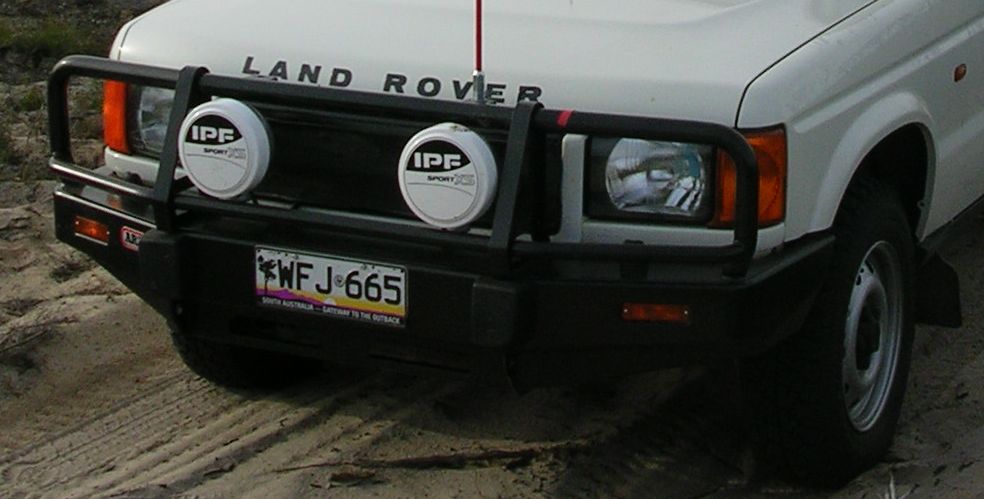
A bullbar on a Land Rover Discovery fitted with spotlights and a sand flag.
Push bar of a police car in Abu Dhabi, used to move stranded vehicles out of the way

A bullbar or push bumper (also kangaroo bar, roo bar, winch bar or nudge bar in Australia, livestock stop[NB 1] or kangaroo device in Russia, and push bar, ram bar, brush guard, grille guard, moose bumper, cactus pusher, rammer, PIT bar, PIT bumper, or cattle pusher in the United States and Canada) is a device installed on the front of a vehicle to protect its front from collisions, whether an accidental collision with a large animal in rural roads, or an intentional collision by police with another vehicle. They vary considerably in size and form, and are normally composed of welded steel or aluminium tubing, or, more recently, moulded polycarbonate and polyethylene materials. The "bull" in the name refers to cattle, which in rural areas sometimes roam onto rural roads and highways.

Safety and legality

[edit]

Studies have shown that using bull bars increases the risk of death and serious injury to pedestrians.[1] This is because the bull bar is rigid, and so transmits all the force to the pedestrian, unlike a bumper which resists some force and crumples. Due to the number of deaths and injuries caused by the rigid fronts of cars, often with metal bullbars (2,000 deaths and 18,000 serious accidents per year in Europe, according to official studies in the UK[2]), the sale of new metal bullbars which did not comply with a European Union Directive was banned in the European Union.[3] However, in the United Kingdom the sale and refitting of second-hand bars manufactured before 2007 or the use of pre-2007 bars already fitted is permitted as per the current MOT guidelines: "It is not illegal for vehicles to be fitted with bull bars, although the Department would not recommend their fitment unless it has been shown, through compliance with specified safety standards, that they do not pose an additional risk of injury to pedestrians or other vulnerable road users. There are no plans for legislation to require bull bars that are already fitted to be removed."[4]

Design and terminology

[edit]
Bull bar on a semi tractor

Where cattle are more prominent and where larger four-wheel drive vehicles are used, drivers use larger steel bullbars.

Brushbars (or bush bars) are similar to bullbars, often integrated into the bull bar design. They protect the front fender panels of the vehicle, especially headlights, from brush and small trees.

"Nudge bars", another kind of bullbar, are generally fitted to sedans and small SUVs, and consist of light aluminium alloy or polycarbonate tubing that protects only the radiator area without replacing the bumper. Bullbars typically replace the front bumper and front inner wheel wells, so most require indicator light housings.

Bullbars are sometimes used as a platform for mounting spotlights, fishrod holders and vehicle recovery winches. Radio antennas for equipment such as CB radios are often mounted onto bullbars, even though mounting on the roof provides better performance. Mounting on the roof is inconvenient in cities as it typically makes vehicles too tall to fit in underground carparks.

Bullbars incorporating a winch are often known as "winch bumpers"(USA) or "winch bars"(AU), especially in the UK where the sale of bullbars that do not meet European standards, as mentioned above, was banned since 2007. However, the legislation was not retrospective, and steel frontal protection systems can still be legal, for instance when incorporating a winch fitting.

As a safety feature, traditional bars are built to protect the vehicle, which is considered less safe than allowing controlled deformation to absorb kinetic energy during a collision. Modern design of bullbars and roo bars has advanced, so some vehicle manufacturers and aftermarket companies now offer impact bars which integrate with the vehicle safety system, such as activation of airbags after collision with the bullbar. Plastic bullbars made from materials such as polyethylene are designed to act like a spring and deflect due to the force of a collision so that the vehicle is still driveable after striking an animal. These designs are more "pedestrian friendly" than the same vehicle without any bullbar.[5][6] Some modern bullbars have crumple zones and/or are mounted on sliders, designed to move back in order to reduce impact forces.[7][8]

There are many aspects relating to the proper construction of a bullbar. It is widely accepted that the channel section which provides the strength for the protection system must be constructed from one piece of material and free from sections bolted on or welded together. The thickness of the material is something which should be considered when choosing a bullbar, generally the thicker the material, the stronger the product delivering greater protection. The grade of material is also important, products manufactured from steel or hi-tensile/structural grade alloys are stronger than a standard alloy or polymer products. Bull bars are popular among the SUV and truck owners in the U.S. and installation of a bull bar is not considered a modification, as this is bolt-on accessory.[9] The most popular materials of the US-built bull bars are polished stainless steel and mild steel with black powder coating. Some states require license plate relocation from the body to the bull bar. However, all states allow installation of aftermarket bull bars as of 2018.

In recent times bullbars have become popular also as a cosmetic accessory, particularly on the larger four wheel drive and Sports Utility Vehicles (SUVs). Studies and media attention to them[10] and their role in increasing pedestrian deaths led to an agreement with the European Union among carmakers not to install them on new vehicles from January 1, 2002.[11] This was followed by a full EU ban on the sale of rigid bullbars (e.g., by aftermarket fitters). Vehicles that already had them fitted prior to the ban remain legal.

Police usage

[edit]
Fully integrated roo bar fitted to a Holden Rodeo ute operated by the Western Australian Police Service

A push bumper or nudge bar is fitted to the chassis of the car and located to augment the front bumper, to allow the car to be used as a battering ram for simple structures or fences, or to push disabled vehicles off the road.

Damage to a PIT bumper on a Ford Crown Victoria Police Interceptor, resulting from its use.

The Pursuit Intervention Technique (PIT) bumper attaches to the front frame of a patrol car. It is designed to end vehicle pursuits by spinning the fleeing vehicle with a nudge to the rear quarter panel. Cars not fitted with a PIT Bumper can still attempt a PIT maneuver at risk of increased front-end damage and possible disablement if the maneuver fails and the pursuit continues.

Bullbars are installed using the same mounting holes in the front of the truck or SUV that are used to install snow plows, tow hooks, and other accessories. Bullbar installation require a set of lower brackets, while installing larger grille guards, such as brushbars, may also require upper mounting brackets. Some bullbars might cover front license plate of the vehicle. In this case special license plate brackets can be used to relocate it and ensure its proper visibility.

For the 2020 Nova Scotia attacks, the perpetrator's replica police cruiser was installed with a bullbar which he used for a head-on collision with an RCMP cruiser.[12]

Australia

[edit]
Roo bars fitted to a Volvo NH15 BP tanker road train

Kangaroos are a primary road safety hazard in Australia, hence the alternative name "roo bar". Kangaroos account for the majority of collisions between vehicles and animals in Australia;[13] the next most common type of animal being dogs at 12%.[citation needed] This high animal strike incidence is why roo bars are most commonly fitted to vehicles in Australia in outback or rural areas. [citation needed]

Over recent years there has been debate in Australia regarding the safety implications of fitting a bullbar, especially as four-wheel drives and their accessories are becoming increasingly popular in urban areas. The use of bullbars in urban areas is criticised by cycling and pedestrian organisations.[14]

Bullbar manufacturers in Australia must conform to Australian standard AS47861.1/2002. In some states it may be illegal to drive a vehicle fitted with a bullbar that does not comply with the Australian Design Rules (ADRs). The main ADR requirement that applies to bullbars is a clause within ADR 42/xx (where xx designates a version number), which states (in part) that:

No vehicle shall be equipped with any object or fitting, not technically essential to such vehicle, which protrudes from any part of the vehicle so that it is likely to increase the risk of bodily injury to any person.

This requirement is not specifically aimed at bullbars but does effectively prescribe requirements for their construction. ADR 42/00, the first version of this rule, applied to vehicles built from July 1988. Australian Standard AS4876.1-2002 Motor vehicle frontal protection systems Part 1: Road user protection was released in 2002, and applies construction rules to all bullbars manufactured since that date,[15] regardless of the age of the vehicle that they are fitted to. Similar requirements for older vehicles fitted with bullbars manufactured before that Australian Standard was implemented exist only in state legislation.

In 2003, New South Wales State Member of Parliament Anthony Roberts suggested there is little or no enforcement of the ADR requirement and Harold Scruby (of the Pedestrian Council of Australia) has proposed that modern standards should be made retrospective.[16]

Bullbars are not allowed to cause a vehicle to fail to comply with other ADRs to which they were originally constructed. This includes visibility of lights, such as headlights and indicators; but it particularly relates to ADR 69/00, the rule for 'Full frontal impact protection'. In order to comply with this rule, bullbars manufactured for vehicles equipped with SRS (airbag systems) must be tested for compatibility with the airbag system.[citation needed]

The major bull bar manufacturers in Australia are Whitlock Bull Bars, ARB, TJM, ECB, Ironman, Smartbar, Irvin Bullbars, AFN and Uneek.

See also

[edit]

Notes

[edit]

References

[edit]
[edit]
Revisions and contributorsEdit on WikipediaRead on Wikipedia
from Grokipedia
A bullbar, also known as a grille guard, nudge bar, or roo bar, is a robust metal framework mounted to the front of vehicles such as trucks, SUVs, and off-road vehicles to shield critical components like the bumper, grille, and from impact damage during collisions with large animals, debris, or obstacles. Originating in during the mid-20th century for protecting rural vehicles from roaming —hence the name "bull bar"—these accessories gained widespread use in farming, , and expeditionary driving where encounters with like kangaroos pose significant risks. Bullbars are typically constructed from or aluminum, featuring tubular designs that allow integration of auxiliary equipment such as winches, spotlights, and antennas, enhancing utility in remote or rugged terrains. While effective in minimizing and aiding recovery in off-road scenarios, empirical studies indicate that bullbars can exacerbate injuries to s and cyclists in urban collisions by altering crash dynamics and increasing impact forces on vulnerable body areas. Regulations vary globally; they remain standard in and parts of the for practical protection needs, but face restrictions in due to concerns, prompting designs that balance safeguarding with reduced harm to other road users.

History and Development

Origins and Early Adoption

Bullbars emerged in during the 1960s and 1970s as practical protective devices for vehicles traversing rural and roads, where frequent collisions with such as and like kangaroos posed significant risks to fronts. These incidents often resulted in damage to radiators, grilles, and headlights, prompting drivers in isolated areas to improvise barriers from available materials to mitigate repair costs and downtime. Initial designs were rudimentary or aluminum bars, typically welded or bolted directly to the front bumper frame, engineered to distribute impact forces away from vital components. Pioneering efforts often occurred in workshops or small rural facilities, reflecting hands-on adaptations by operators facing real-world hazards rather than standardized . Commercial availability gained traction in the early , coinciding with the rise of 4x4 vehicles suited for off-road tasks in farming and resource extraction. For instance, East Coast Bullbars, established around in , produced Australia's inaugural commercial bullbars by repurposing aluminum fence posts into channel-style protectors, marking a shift from ad-hoc fabrication to dedicated production for utility vehicles. This early adoption was driven by necessity in expansive, low-density regions where road infrastructure was minimal and animal encounters unavoidable, with subsequent firms like Irvin Bullbars formalizing output from rural bases in by 1976.

Evolution and Modern Innovations

During the and , bullbar designs underwent significant advancements in manufacturing techniques and material selection, incorporating aluminum and to achieve lighter weight without compromising structural integrity. These changes facilitated more seamless vehicle integration, with features such as mounts, tow points, and provisions for auxiliary driving lights becoming standard to enhance off-road functionality. The publication of Australian Standard AS 4876.1 in 2002 established requirements for frontal protection systems, emphasizing road user protection and compatibility with crash energy absorption mechanisms. In response, manufacturers developed bullbars with deformable sections and optimized geometries to meet these criteria, balancing animal collision resistance with reduced impact severity on pedestrians and other road users. Post-2020 innovations have focused on high-strength alloys and select composite elements to further minimize weight, supporting improved in line with global emissions regulations while preserving . Integration of LED arrays has also proliferated, providing energy-efficient illumination directly mounted within the bar structure for enhanced nighttime visibility. Australian bullbar exports, led by firms like ARB since the late , expanded into North American markets through the and , influencing local adaptations of grille guards and similar devices tailored to prevalent threats such as deer collisions.

Design and Construction

Materials and Components

Bullbars are predominantly constructed from high-tensile or high-strength tubing, valued for its rigidity and ability to withstand high-impact loads in off-road environments. Wall thicknesses typically range from 2.6 mm to 3 mm or greater, balancing structural integrity with manufacturability via processes like CNC bending. These tubes, often with outer diameters of 50-76 mm, form the primary horizontal bars that span the vehicle's front end. Surfaces are treated with over an e-coat primer to enhance resistance, particularly in harsh conditions involving , salt, or exposure; this multi-layer finish is cured at high temperatures for durability. Vertical supports, or uprights, are often fabricated from single sheets of that integrate seamlessly with the horizontal elements and extend to the bumper section, contributing to overall load distribution. Mounting brackets are vehicle-specific, engineered from thick plates (e.g., 8 mm) to secure the assembly to the while preserving factory for energy absorption during collisions. Common accessories include nudge bars—slimmer tubular guards for lighter protection—and mesh guards fitted over the grille to shield the from debris without severely impeding airflow. These elements are designed with first-principles load-bearing considerations, incorporating deformation zones in supports and brackets to manage impact forces from scenarios such as collisions with large animals at speeds up to 100 km/h, as validated in prototypes.

Types and Regional Variations

Bullbars encompass full-width rigid constructions, which span the vehicle's frontal expanse using heavy-gauge for unyielding protection against substantial impacts, and modular variants engineered for adaptability. Modular designs, such as ARB's full deluxe , integrate reinforced pans compatible with winches rated up to 16,500 pounds and built-in hi-lift jacking points, allowing customization for recovery equipment without compromising structural integrity. Adaptations vary by region to address prevalent collision risks from local . Australian bullbars, termed "roo bars," incorporate energy-absorbing features like hybrid steel-alloy frames to mitigate damage from strikes, which can exceed 50 kilograms in mass and occur at speeds over 80 km/h on rural . In , full-grille guards prevail, featuring vertical bars that shield the , headlights, and core components from deer penetrations, where impacts at highway velocities often total vehicle functionality absent such barriers. European preferences lean toward lighter nudge bars, constructed from thinner tubing for partial frontal coverage, functioning as less robust antecedents to heavier bullbars curtailed by post-2000 design constraints. Polymer-based alternatives, fabricated from materials such as , surfaced in the as weight-reduced substitutes for metallic bars in urban settings, yet demonstrate diminished energy dissipation in collisions relative to steel equivalents.

Primary Applications

Rural and Off-Road Use

In rural , particularly the , bullbars are standard equipment on four-wheel-drive vehicles for navigating unsealed tracks and encountering natural obstacles at low speeds, such as rocks, stumps, and dense scrub that could otherwise damage the underbody and front . These structures deflect impacts away from vulnerable components, preserving vehicle mobility in remote areas where is limited. Animal strikes further underscore their practical role in non-urban driving patterns, with kangaroo collisions representing about 90% of wildlife incidents and 5% of total road crashes in , concentrated in rural zones during dawn and . Bullbars shield critical front-end elements like the and grille from penetration by such impacts, minimizing operational downtime for farmers and travelers reliant on consistent vehicle function. Comparable dynamics apply in rural regions, where deer-vehicle collisions exceed 1 million annually, often prompting similar protective fittings to avert costly front-end repairs. Beyond deflection, bullbars integrate seamlessly with off-road recovery apparatus, providing robust attachment points for winches and shackles that enable self-extraction from , , or inclines without compromising structural integrity. This design prioritizes the causal preservation of cooling and access, essential for sustained operations in terrains where overheating or fluid loss could strand a far from services.

Specialized Vehicle Uses

Bullbars on police vehicles enable reinforced frontal protection for high-risk operations, including vehicle pursuits and rural patrols where collisions with wildlife are common. In Australia, law enforcement agencies fit vehicles with bullbars designed for ramming or nudging non-compliant vehicles to a stop, minimizing damage during low-speed impacts. These installations prioritize durability for repeated contacts, often incorporating materials like polyethylene in SmartBar systems to cushion collisions while preserving vehicle functionality. In the mining sector, serve as essential safeguards for fleet vehicles operating in remote Australian sites, protecting against strikes and major frontal impacts from obstacles like rocks or equipment. Major mining companies deploy SmartBar bullbars, which comply with (ANCAP) standards and feature energy-absorbing designs for slow-speed incidents common in site operations. This application emphasizes robustness over aesthetics, with roto-molded construction reducing risks and maintenance downtime in harsh environments. Emergency services vehicles, such as fire trucks and ambulances, utilize specialized bullbars like the ARB SmartBar for similar protective roles during response duties. These systems provide frontal shielding in urban-rural interfaces with high density, such as Australian highways, while integrating features like winch mounts for recovery tasks. Fleet adaptations focus on institutional demands for reliability, ensuring minimal disruption from or animal encounters without compromising operational speed.

Protective Benefits

Effectiveness in Animal and Obstacle Collisions

Bullbars are engineered to intercept and deflect impacts from large wildlife, such as in or deer in the United States, by presenting a rigid, elevated barrier that redirects the animal's away from vulnerable front-end components like the and headlights. This design leverages the principle that a continuous structure spanning the vehicle's width distributes across a broader contact area than a standard low-mounted bumper, which often fails to engage the animal's effectively during offset or high-center strikes. For instance, in scenarios involving a 50-100 kg colliding at 80 km/h—equivalent to approximately 18-37 kJ of depending on and —the bullbar's height and strength can prevent the animal from vaulting over or penetrating the hood, thereby minimizing deformation to the bay. Empirical observations from fleet operators and contexts support reduced front-end write-offs in high-wildlife zones. In the U.S. Midwest, where deer strikes number over 1.5 million annually, heavy-duty grille guards (analogous to bullbars) have been associated with up to 80% fewer towable incidents in commercial fleets, as the guards absorb and deflect impacts that would otherwise crumple unarmored grilles and disable vehicles. Similarly, Australian rural insurers have noted bullbars' role in limiting claims from roo strikes, with traditional fittings credited for preserving drivability after minor to moderate collisions by shielding core components. However, rigorous controlled studies on damage metrics remain sparse, with available largely derived from post-incident analyses rather than pre-post comparisons. In obstacle encounters, such as or fallen branches, bullbars offer analogous benefits through force redistribution, as their mounting to the allows energy to transfer via designed or rigid framing rather than concentrating on brittle . This contrasts with stock bumpers, which deform locally and propagate cracks to underlying structures; the bullbar's promotes sliding or upward deflection of irregular objects, reducing penetration risks in off-road or rural settings. confirms that at impact angles common in animal swerves—often glancing or elevated—the extended vertical profile engages sooner, converting linear into lateral or vertical vectors that spare critical systems.

Vehicle and Occupant Damage Reduction

Bullbars demonstrably reduce vehicle repair costs in frontal impacts by acting as a sacrificial structure that absorbs initial collision energy, sparing critical front-end components such as the , headlights, and grille. A 2000 analysis by the Australian Federal Office of Road Safety referenced studies by Taylor (1998) and Sansome (1999) indicating lower repair expenses for bullbar-equipped vehicles in such events, as the bar deforms preferentially to distribute forces away from the and bodywork. This protective effect is particularly evident in rural Australian contexts, where collisions with obstacles or low-mass impacts would otherwise necessitate extensive replacements of undeformed vehicle parts. For occupant , bullbars contribute to maintained cabin integrity during offset or frontal strikes by preventing direct intrusion into the passenger compartment, thereby allowing the vehicle's inherent deformation zones to manage residual momentum transfer consistent with principles of energy absorption in crash dynamics. Empirical assessment from Australian crash data (1990–1997) estimates that bullbars may avert up to 9 fatal outcomes annually in animal-related collisions by limiting penetration toward forward-control cabins, though broader evidence for consistent injury mitigation remains inconclusive. Longitudinal observations since the , drawn from Australian rural usage patterns, confirm that bullbar-fitted off-road vehicles incur substantially less structural damage from encounters with fixed obstacles like rocks or fallen branches, preserving frame alignment and suspension geometry over repeated exposures. This stems from the bar's role in redirecting impact loads externally, reducing propagation to load-bearing elements and thereby extending in demanding terrains.

Safety Assessments

Empirical Data on Vehicle Protection

A 2000 Australian federal assessment of bullbars analyzed fatal crash data from 1990-1997, identifying 52 rural fatal crashes involving animal strikes. Among these, only 19% involved vehicles equipped with bullbars, compared to an estimated national fitment rate of around 50% for relevant vehicles, suggesting bullbars contributed to preventing up to 9 occupant fatalities annually by mitigating intrusion from large animals like . This analysis attributed the protective effect to bullbars deflecting animals upward or absorbing initial impact without compromising vehicle integrity in wildlife-specific scenarios. In forward-control vehicles such as utilities and vans, bullbar fitment correlated with lower cabin intrusion risks in frontal impacts with obstacles, as evidenced by higher prevalence (44-48%) in surviving single-vehicle fatal frontal crashes relative to passenger cars (3%). reduction was noted as potentially substantial in and low-speed obstacle collisions, where unmodified bumpers often fail to prevent or grille penetration, though direct quantification remained limited due to data gaps in non-fatal incidents. Fleet and insurance analyses from rural in the , including insurer claim reviews, indicated average repair costs of approximately $4,200 per animal strike incident, with from high-risk zones suggesting bullbar-equipped experienced less severe front-end structural damage by distributing impact forces away from critical components. These outcomes countered assertions of negligible benefits by isolating collision variables, where rigid frontal protection outperformed deformable bumpers in preserving vehicle operability post-impact.

Impacts on Vulnerable Road Users

Research from the (TRL) in the 1990s, including analysis of real-world accidents, indicated that vehicles equipped with bull bars were more likely to cause injuries to s than unequipped vehicles, with impact testing confirming higher injury potential due to the rigid structures concentrating forces on the lower body. Bull bars alter collision by promoting leg override or direct impact against the horizontal bar, leading to elevated fracture risks in the and at speeds as low as 20-30 km/h, as opposed to energy-absorbing compliant bumpers that allow greater deformation. Australian Centre for Automotive Safety Research (CASR) pedestrian impact tests, conducted at 30 km/h using legform and headform dummies, revealed that many bull bar designs produced () values exceeding 1000—substantially higher than those from standard vehicle fronts—indicating increased head trauma risk from altered trajectories where the pedestrian's upper body contacts stiffer components. These tests demonstrated poorer biofidelity in dummy responses compared to bumpers, with rigid bull bars showing significantly worse performance than aluminum variants or unmodified fronts in metrics for and head loading. For cyclists, analogous biomechanical effects occur, as the elevated, unyielding bar height aligns with pedal and lower limb strike zones, exacerbating and skeletal injuries in low-speed impacts, per reviews synthesizing crash reconstructions. Real-world data from 1990s Australian analyses estimated bull bars in 12-20% of fatal collisions, with elevated severities in mixed urban-rural settings despite lower overall VRU exposure where bull bars predominate in rural fleets; 2000s reviews confirmed these patterns in transitional zones but noted sparse cyclist-specific incidence due to data limitations.

Regulatory Landscape

Australian Standards and Compliance

In Australia, vehicle frontal protection systems (VFPS), including bullbars, are regulated under the Australian Design Rules (ADRs) and Australian Standard AS 4876.1-2002, which specifies design, installation, and performance criteria to ensure compatibility with vehicle crashworthiness while addressing local conditions such as frequent collisions with wildlife like kangaroos. ADR 69/00, effective since November 2003, mandates that fitted VFPS maintain the vehicle's frontal impact occupant protection levels, requiring bullbars to incorporate energy-absorbing structures that deform upon collision to dissipate forces without compromising the vehicle's crumple zones or anthropomorphic test dummy performance thresholds. Compliance testing emphasizes mounting integrity, with bullbars required to secure firmly to the chassis without altering suspension geometry or ground clearance below ADR 43/04 minima of 100 mm unladen, and impact performance evaluated through pendulum tests or simulations to verify no degradation in ADR 69/00 offset deformable barrier outcomes. Pedestrian-friendly features, such as rounded edges, chamfered corners, and deformable polymer or foam sections, are stipulated to limit Head Injury Criterion (HIC) scores below 1500, reflecting adaptations since the early 2000s to balance animal strike protection—prevalent in rural areas where kangaroo-vehicle collisions number over 10,000 annually—with reduced harm to vulnerable road users. Certification applies to both steel and polymer bullbars, with manufacturers providing engineering sign-off that the system adheres to AS 4876.1 sections on materials, attachment points, and avoidance of protrusions exceeding ADR 92/00 external projection limits, ensuring no obstruction of headlights, indicators, or grille airflow post-installation. State authorities, such as those in New South Wales and South Australia, enforce these via vehicle inspections, rejecting non-compliant fittings that widen the frontal profile excessively or introduce sharp ends capable of increasing injury severity in low-speed impacts.

European and UK Restrictions

In the , Directive 2003/102/EC, adopted on 17 November 2003, established requirements for the protection of pedestrians and other vulnerable road users (VRUs) in vehicle-to-pedestrian collisions by mandating that front structures minimize injury severity through specific impact tests on bumpers, bonnets, and windscreens. This directive applied to new car and light van type-approvals from October 2005, effectively restricting rigid frontal protection systems like traditional steel bullbars, which were found to exacerbate head and leg injuries in low-speed impacts due to their high stiffness and protrusion. The rationale centered on empirical data from crash simulations and real-world accident analyses indicating that unmodified fronts cause disproportionate harm to VRUs, prompting a shift toward deformable designs integrated into the vehicle's bodywork. Subsequent updates, including Regulation (EC) No 78/2009 effective from 2010, reinforced these standards by replacing the directive and extending performance criteria to all new vehicle types, phasing out non-compliant aftermarket bullbars in favor of softer alternatives such as plastic clips or energy-absorbing modules that pass pedestrian safety assessments. Enforcement occurs through the EU type-approval framework under Regulation (EU) 2018/858, where vehicles must demonstrate compliance before market placement; sale or fitting of rigid steel bullbars failing these tests constitutes an offense, with traditional designs largely prohibited on passenger vehicles since 2007. Exemptions are limited and rarely granted, primarily for specialized categories like agricultural or forestry tractors under separate type-approval rules in Directive 2003/37/EC, where operational needs may justify modified frontal structures, though even these must mitigate VRU risks where feasible. In the , alignment with directives drove restrictions starting in the late 1990s, informed by (TRL) studies such as Report 243 (1995), which analyzed accidents involving bullbar-equipped vehicles and highlighted elevated risks to pedestrians from rigid bars overriding standard . Parliamentary debates from 1996 onward pushed for bans on existing vehicles, culminating in adoption of the framework, with the advising against bullbar fitment unless proven compliant with pedestrian safety standards to avoid increased danger to other road users. Post-Brexit, regulations retain these requirements via the Road Vehicles (Approval) Regulations 2020, prohibiting the sale of non-type-approved aftermarket steel bullbars while permitting softer, tested alternatives like plastic nudge bars for limited applications.

North American Approaches

In the United States, federal regulations under the (FMVSS) do not prohibit the installation of aftermarket bull bars or grille guards, provided they do not compromise compliance with existing standards for crashworthiness, lighting, or occupant protection. This permissive framework allows widespread use on pickup trucks and SUVs, particularly in rural states with high incidences of deer-vehicle collisions, such as and . In , drivers face a 1 in 59 chance of such an incident, with tens of thousands of crashes reported annually, often prompting owners to add grille guards for frontal protection against wildlife impacts. similarly ranks among the top states for animal collisions, with rates exceeding national averages and contributing to market demand for these accessories. Industry practices emphasize voluntary guidelines for construction, prioritizing structural durability, material strength, and weld integrity over pedestrian impact considerations, which aligns with North American priorities for off-road and animal collision scenarios rather than urban pedestrian safety metrics. While some states impose restrictions on bumper height or ride height modifications that could indirectly affect bull bar installations, no nationwide bans exist, fostering a market-driven approach where consumers select products based on perceived utility for rural driving conditions. Canada's regulatory landscape mirrors the U.S., with the Safety Regulations lacking federal prohibitions on bull bars or grille guards and permitting aftermarket additions without mandatory crash testing for or animal impacts. Provincial variations exist, such as potential scrutiny under traffic safety acts for equipment resembling police push bumpers, but generally allow installations on civilian vehicles if they do not violate height or protrusion limits. This has supported steady aftermarket sector expansion since the early 2000s, driven by demand for protective gear in regions with similar wildlife collision risks, without imposing the stringent compliance testing seen elsewhere.

Controversies and Perspectives

Debates on Utility vs. Risks

Proponents of bullbars emphasize their utility in rural and remote driving environments, where collisions with large such as are frequent and pose substantial risks to vehicles and occupants. In , insurance claims for wildlife collisions exceed 19,000 annually, with kangaroos involved in approximately 90% of animal-related crashes, often resulting in costly repairs to unprotected front ends. Bullbars, designed to absorb impacts from such encounters, provide enhanced protection to critical components like radiators and headlights, potentially reducing occupant injury by maintaining structural integrity during low-to-moderate speed strikes. Manufacturers and rural drivers argue that in these contexts, the preservation of vehicle functionality outweighs hypothetical urban risks, given the infrequency of encounters on roads. Critics, primarily from pedestrian safety advocacy and academic studies, contend that bullbars elevate injury risks to vulnerable road users through their rigid geometry and elevated contact points, which promote higher-impact loading on the body compared to compliant vehicle fronts. Experimental impact tests demonstrate that steel bullbars yield the highest pedestrian injury criteria among tested configurations, with forces concentrated on the legs and pelvis leading to increased fracture and soft-tissue damage risks. Literature reviews attribute this to the bars' stiffness, estimating involvement in up to 20% of fatal pedestrian collisions in earlier data, advocating for restrictions in urban settings where pedestrian volumes are high. Such analyses often prioritize kinematic simulations over real-world collision frequencies, framing bullbars as inherently dangerous irrespective of usage locale. A contextual perspective highlights the divergence between bullbar deployment and high-risk scenarios: installations predominate on vehicles for rural , where animal strikes vastly outnumber interactions, while urban fleets rarely feature them. Empirical assessments note insufficient fitment rate data to quantify net population-level effects on overall road trauma, suggesting that blanket risk elevations may not translate to measurable fatality increases given the niche application. Proponents counter that removing bullbars from rural fleets could amplify vehicle write-offs and stranding risks in remote areas without commensurate urban safety gains, underscoring a resolved by rather than universal prohibition.

Critiques of Regulatory Overreach

Critics contend that directives, such as Regulation (EC) No 78/2009, which prohibit rigid bull bars unless they meet stringent pedestrian impact absorption standards, unduly prioritize hypothetical urban collisions over prevalent rural hazards like deer strikes. In the , annual deer-vehicle collisions are estimated at 40,000 to 74,000 incidents, inflicting over £17 million in vehicle damage alone and posing risks to drivers without protective frontal structures. Such regulations, implemented since 2007, effectively ban traditional bull bars on vehicles under 3.5 tonnes, compelling rural operators to forgo robust protection against or impacts that far outnumber encounters in countryside settings. Rural stakeholders, including farmers, argue that these measures reflect an urban-centric imposition that exacerbates vulnerabilities for those navigating unpaved tracks or encountering "marauding " and overhanging foliage, where vehicle integrity directly affects occupational safety. The UK's Pedestrian Protection Directive mandates energy-absorbing designs with injury risk caps below 18%, rendering compliant "frontal protection systems" inadequate for off-road durability while imposing retroactive compliance burdens that overlook regional necessities. Economically, the type-approval process—entailing extensive crash testing and bracket modifications—entails prohibitive costs, often exceeding small manufacturers' capacities and leading to fines up to £20,000 per non-compliant unit, thereby curtailing access to affordable, purpose-built accessories vital for agricultural and remote operations. This fosters dependency on suboptimal alternatives, inflating repair expenses from animal impacts and diminishing vehicle resale values in rural markets. In contrast, Australia's Australian Design Rules (ADR) framework permits bull bars that satisfy frontal protection criteria without outright prohibition, enabling innovations like ADR-compliant steel constructions that preserve utility for kangaroo-prone or outback travel while incorporating pedestrian-friendly elements. Proponents of this model assert it avoids stifling practical adaptations, as evidenced by sustained availability of certified products, and critiques of European approaches highlight how blanket restrictions undermine user autonomy in favor of precautionary urban biases, potentially elevating overall rural incident severities.

References

Add your contribution
Related Hubs
User Avatar
No comments yet.