Hubbry Logo
CSS MuscogeeCSS MuscogeeMain
Open search
CSS Muscogee
Community hub
CSS Muscogee
logo
8 pages, 0 posts
0 subscribers
Be the first to start a discussion here.
CSS Muscogee
CSS Muscogee
from Wikipedia

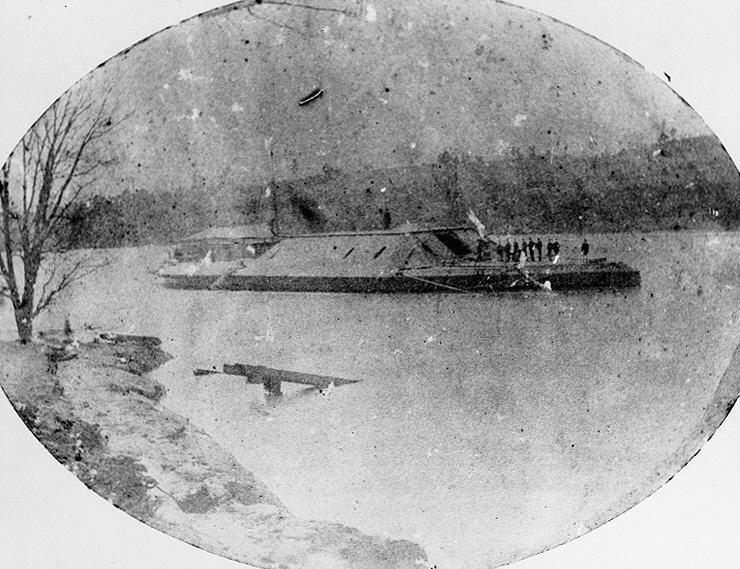
The incomplete CSS Jackson on the Chattahoochee River, shortly after December 22, 1864
History
Confederate States of America
NameMuscogee
NamesakeMuscogee people
BuilderColumbus Navy Yard, Columbus, Georgia
Laid down1862
LaunchedDecember 22, 1864
RenamedJackson, sometime in 1864
FateBurned, April 17, 1865
StatusWreck salvaged, 1962–1963; on display at the National Civil War Naval Museum, Columbus, Georgia
General characteristics
TypeCasemate ironclad
Tonnage1,250 tons
Length223 ft 6 in (68.1 m)
Beam59 ft (18 m)
Draft8 ft (2.4 m)
Installed power4 × boilers
Propulsion2 × propellers; 2 × direct-acting steam engines
Armament
  • 4 × 7 in (178 mm) Brooke rifles
  • 2 × 6.4 in (163 mm) Brooke rifles
ArmorCasemate: 4 in (102 mm)
CSS Muscogee and Chattahoochee
NRHP reference No.70000212
Added to NRHPMay 13, 1970

CSS Muscogee was an casemate ironclad built in Columbus, Georgia for the Confederate States Navy during the American Civil War. Her original paddle configuration was judged a failure when she could not be launched on the first attempt in 1864. She had to be rebuilt to use dual propeller propulsion. Later renamed CSS Jackson and armed with four 7-inch (178 mm) and two 6.4-inch (163 mm) cannons. She was captured while still fitting out and was set ablaze by Union troops in April 1865. Her wreck was salvaged in 1962–1963 and turned over to the National Civil War Naval Museum in Columbus for display. The ironclad's remains were listed on the National Register of Historic Places in 1970.

Background and description

[edit]

Muscogee was originally built as a sister ship to the casemate ironclad paddle steamer CSS Missouri, to a rough design by the Chief Naval Constructor, John L. Porter, as a sternwheel-powered ironclad. She proved to be too heavy to be launched on January 1, 1864, and had to be reconstructed and lengthened to a modified CSS Albemarle-class design, based on Porter's advice during his visit to the ironclad on January 23.[1][2][3]

As part of the reconstruction, the ironclad was lengthened to 223 feet 6 inches (68.1 m) overall after a new fantail was built on the stern. She had a beam of 59 feet (18 m) and a draft of 8 feet (2.4 m).[3] The removal of her sternwheel allowed her casemate to be shortened by 54 feet (16.5 m), which saved a considerable amount of weight.[2] The ironclad had a gross register tonnage of 1,250 tons.[3]

As originally designed, Muscogee was propelled by a sternwheel that was partially enclosed by a recess at the aft end of the casemate; the upper portion of the paddle wheel protruded above the casemate and would have been exposed to enemy fire. The sternwheel was probably powered by a pair of inclined two-cylinder direct-acting steam engines taken from the steamboat Time using steam provided by four return-flue boilers to the engines. As part of her reconstruction, Time's engines were replaced by a pair of single-cylinder, horizontal direct-acting steam engines from the adjacent Columbus Naval Iron Works, each of which drove a single 7-foot-6-inch (2.3 m) propeller; the original boilers appear to have been retained.[4]

Muscogee's casemate was built with ten gun ports, two each at the bow and stern and three on the broadside. The ship was armed with four 7-inch (178 mm) and two 6.4-inch (163 mm) Brooke rifles. The fore and aft cannons were on pivot gun mounts. The 7-inch guns weighed about 15,300 pounds (6,900 kg) and fired 110-pound (50 kg) shells. The equivalent statistics for the 6.4-inch gun were 10,700 pounds (4,900 kg) with 95-pound (43 kg) shells.[5] The casemate was protected by 4 inches (102 mm) of wrought-iron armor,[3] and the armor plates on the deck and sides of the fantail were 2 inches (51 mm) thick.[2]

History

[edit]
The hull of Jackson after recovery
CSS Jackson's propeller at the National Civil War Naval Museum

Muscogee was laid down during 1862 at the Columbus Naval Yard at Columbus, Georgia, on the banks of the Chattahoochee River.[3] The first attempt to launch her failed on January 1, 1864, despite the high water on the river and the assistance of the steamboat Mariana. Porter came down afterwards to examine the ironclad and recommended that she be rebuilt with screw propulsion rather than the sternwheel. She was finally launched on December 22, having been renamed Jackson at some point during the year.[2] A shortage of iron plate greatly hindered the ironclad's completion.[6]

On April 17, 1865, after the Union's Wilson's Raiders captured the city during the Battle of Columbus, Georgia, Jackson was set ablaze by Union troops while still fitting out and had her moorings cut. The ship drifted downriver some 30 miles (48 km) and ran aground on a sandbar. She was not thought to be worth salvaging because of the fire damage, but the Army Corps of Engineers dredged around her wreck in 1910 and salvaged her machinery.[7] A Union cavalry officer's report of the ironclad's condition at the time of her capture said that she had four cannon aboard and had a solid oak ram 15 feet (4.6 m) deep. The only detail about her armor that he recorded was that it curved over the edge of the deck and extended below the waterline.[8]

Recovery

[edit]

CSS Jackson's remains were raised in two pieces; the 106-foot (32.3 m) stern section in 1962 and the 74-foot (22.6 m) bow section the following year. They were then placed on exhibit at the National Civil War Naval Museum in Columbus.[9] A thick metal white frame outline, indicating the various dimensions of Jackson's original fore and aft deck arrangements and armored casemate, is now erected directly above the hull's wooden remains to simulate for visitors the ironclad's original size and shapes.[10] The ship's fantail, which was stored outside in a pole barn, was partially destroyed in a fire on 1 June 2020.[2]

The ironclad was listed on the National Register of Historic Places on May 13, 1970.[11]

See also

[edit]

References

[edit]
Revisions and contributorsEdit on WikipediaRead on Wikipedia
from Grokipedia
CSS Muscogee was an ironclad ram constructed for the during the . Built at , beginning in late 1862 on the , the vessel was launched in December 1864 but remained incomplete at the war's end. Designed initially as a paddle-wheel steamer before being modified into a screw-propelled ironclad, she was intended to reinforce Confederate defenses against Union advances along inland waterways. On April 16, 1865, as Union forces under Major General approached Columbus, Confederate personnel set Muscogee ablaze to prevent her capture, along with other naval assets in the area. Also referred to as CSS Jackson in some accounts, possibly after renaming to honor the state capital, the ship's hull sank into the river mud and was recovered during archaeological efforts in the . Today, the preserved remains serve as a key exhibit at the National Civil War Naval Museum in Columbus, offering insight into late-war Confederate shipbuilding amid resource shortages and strategic desperation.

Design and Construction

Specifications and Armament

The CSS Muscogee was constructed as a ram optimized for riverine operations on the Chattahoochee and Apalachicola rivers, featuring a low-profile hull with sloped armor to deflect projectiles. Her dimensions included a of 172 feet, a beam of 29 feet, and a depth of 6 feet, with a shallow draft of approximately 8 feet to navigate inland waterways. The armor plating, produced at local Georgia using welded railroad T-rails, measured 4 inches thick on the sloped casemate sides, providing protection against naval gunfire while minimizing weight. Propulsion was provided by two horizontal, non-condensing steam engines with 20-inch diameter cylinders, driving a central suited to shallow, obstructed rivers; this configuration prioritized maneuverability over open-water speed, with estimated output in the range of 400-600 horsepower based on comparable Confederate designs.
CategoryDetails
Length172 feet
Beam29 feet
Depth6 feet
Draft8 feet
Armor4-inch sloped (railroad iron)
Propulsion2 horizontal steam engines, central
The planned armament consisted of six guns, reflecting resource constraints and emphasis on heavy forward and aft firepower for and close-range engagements. This included two 7-inch Brooke rifled cannons mounted on pivots at the bow and for broad arcs of , supplemented by four broadside weapons such as 6.4-inch Brooke rifles or smoothbore cannons; storage was integrated into the hull below the to support sustained . The crew complement was projected at 100-150 officers and enlisted men, typical for mid-sized Confederate ironclads requiring operators for engines, guns, and navigation in confined waters. These specifications aligned with the design rationale of vessels like the CSS Atlanta, a slightly smaller (150 feet long, 34-foot beam) armed with four Brooke rifles, both prioritizing shallow-draft mobility and armored protection for defending southern river lines against Union advances rather than blue-water operations.

Building Challenges and Innovations

The CSS Muscogee was laid down in mid-1862 at the Columbus Naval Iron Works on the , amid the Confederate naval expansion aimed at countering Union control of inland waterways and river blockades. Commanded by Major James H. Warner, C.S.N., the yard leveraged local iron foundries and mills to fabricate armor plating and components, navigating acute shortages of skilled labor and imported machinery intensified by the Union blockade's disruption of coal and iron supplies. These constraints, common to decentralized Confederate , compelled reliance on regional resources and improvised techniques, with construction delays exacerbated by material scarcities that postponed iron plating installation. Design adaptations prioritized operational viability in shallow riverine environments, incorporating a wooden hull reinforced with iron casemates to balance buoyancy, protection, and low draft requirements of the Chattahoochee. Initially planned as a paddle-wheel vessel, the configuration shifted to twin screw propellers during build—under Lieutenant Augustus McLaughlin's oversight—to enhance maneuverability in tight waters and address a failed launch attempt in December 1863 due to excessive draft. This modification exemplified pragmatic engineering responses to on-site challenges, favoring swift adaptability over original specifications amid ongoing supply interruptions. Contemporary accounts and archaeological analyses of similar vessels reveal how such innovations reflected resource-driven priorities, with builders emphasizing accelerated assembly using proximate materials to mitigate blockade-induced deficits, though imperfect execution prolonged completion until late 1864. Local labor pools, supplemented by conscripted workers lacking naval expertise, necessitated iterative adjustments, underscoring the Confederacy's causal emphasis on feasible production in industrial outposts like Columbus over unattainable ideals.

Operational History

Commissioning and Initial Deployment

The CSS Muscogee, an ironclad ram constructed at , was launched into the in December 1864 after over two years of protracted construction delays stemming from material shortages and design modifications. Initially conceived as a stern-wheel , the vessel's excessive weight thwarted an early launch attempt in January 1864, prompting a redesign to incorporate a for improved maneuverability and a lengthened hull akin to modified ironclads. This refit aimed to enhance its viability for riverine defense amid escalating Union threats during General William T. , which concluded with the in the same month. Although launched, the Muscogee was not formally commissioned into active service, remaining incomplete with ongoing outfitting of armament, engines, and armor plating into early 1865. No dedicated assumed full control for operations, as crew training and provisioning were curtailed by the Confederacy's dwindling resources and the strategic collapse in Georgia. The ship was positioned as a static deterrent in the Chattahoochee Naval Squadron, alongside the earlier CSS Chattahoochee, to safeguard Columbus—a key industrial hub—from potential Union advances upriver, though verifiable records indicate no manned patrols or trials were conducted before the region's fall. Intended to bolster inland Confederate defenses against amphibious incursions, the 's readiness logs reflect partial engine tests and hull stability assessments post-launch, but causal constraints including labor shortages and supply disruptions prevented deployment. By January 1865, Confederate naval priorities had shifted southward, rendering the vessel's role symbolic rather than operational in deterring Union cavalry under Brigadier General , whose forces approached Columbus months later.

Limited Service and Strategic Context

Launched in December as the final major ironclad effort by the Confederate Navy at the Columbus Naval Iron Works, the vessel originally named CSS Muscogee was renamed CSS Jackson in early 1865, likely to commemorate the captured state capital of Jackson as a symbol of resolve amid mounting defeats. This redesignation occurred during incomplete fitting-out, reflecting the Confederacy's improvisational adaptations under resource constraints, but the ship never achieved full operational status or conducted extended patrols on the . Its brief post-launch phase involved only preparatory trials, with no documented instances of firing upon Union forces, as Northern armies prioritized overland campaigns inland from coastal blockades. In the broader strategic context of Confederate riverine warfare, the CSS Jackson embodied late-war efforts to secure southern waterways like the Chattahoochee, which served as critical arteries for munitions transport and industrial output from Columbus, a hub producing textiles, swords, and . Positioned to contest Union dominance and safeguard supply lines against incursions from the Gulf via the , it complemented land-based obstructions and fortifications coordinated with Georgia militia under Major General , who directed defenses around Columbus to prolong resistance. Though no major engagements materialized, the ironclad's mere existence forced Union commanders to allocate scouting and diversionary resources, indirectly tying down elements of the Western Theater's Federal forces amid Sherman's broader advance. Operational constraints severely hampered potential activity, including a mid-construction shift from paddlewheel to twin-screw due to unavailable machinery, which compromised engine reliability and maneuverability in the river's variable depths and currents. Designed with a shallow draft for Chattahoochee , the 225-foot vessel prioritized defensive over speed or offensive reach, aligning with the Confederacy's pragmatic pivot to localized deterrence in as offensive naval capabilities eroded. Absent verified combat logs, its role underscored the limitations of Confederate inland : innovative but tardy construction amid shortages, yielding psychological and positional value without tactical engagements.

Loss and Immediate Aftermath

Scuttling During Union Advance

As Confederate defenses crumbled following General Robert E. Lee's surrender at Appomattox Court House on April 9, 1865, Union Major General James H. Wilson's cavalry force of approximately 13,000 men pressed into as part of a broader raid aimed at disrupting remaining Confederate industrial capacity. Wilson's Raiders, advancing rapidly from , approached Columbus on April 16, 1865, overwhelming local militias and state troops numbering fewer than 3,000, which were ill-equipped to counter the Union's superior mobility and firepower. The incomplete ironclad CSS Muscogee, stationed on the near the Columbus Naval Iron Works, represented a potential asset that could have been repurposed as a or captured intact for Union use, prompting Confederate naval personnel and workers to initiate its destruction to deny this advantage. On the evening of April 16 and into April 17, 1865, amid the chaos of the Battle of Columbus—the last significant engagement of the Civil War—Confederate forces grounded the in shallow waters of the Chattahoochee to immobilize it, then systematically set fire to its wooden superstructure, , and fittings using torches and combustibles. This deliberate involved opening hull valves and creating breaches to the vessel, ensuring it sank rapidly while the blaze consumed combustible elements, rendering the ironclad inoperable and irretrievable in the immediate term. Union reports and Confederate accounts corroborate the action's success in preventing capture, with Wilson's troops arriving too late to intervene directly on the ship itself, though they contributed to the broader destruction of the naval yard. The rapid sequence—driven by the Union's unchallenged advance and the Confederacy's strategic imperative to avoid material losses—reflected the collapsing chain of command, as orders from Richmond had ceased and local commanders prioritized over evacuation. Eyewitness testimonies from Confederate officers, including those at the iron works, describe the frantic efforts under artillery fire, with flames visible across the river as Wilson's dismounted secured the east bank. Union after-action summaries noted the 's hulk as a smoldering ruin, confirming the scuttling's effectiveness without immediate counter-salvage due to the war's abrupt conclusion and shifting priorities toward . The site's location, now within the boundaries of Fort Moore (formerly Fort Benning) along the river, benefited from post-scuttling silting that buried portions of the wreck under sediment, aiding short-term concealment but complicating later access. No organized Confederate recovery occurred, as the surrender of Joseph E. Johnston's army on April 26, 1865, formalized the region's capitulation.

Environmental and Battlefield Factors

Upon its destruction during the Union capture of Columbus on April 16, 1865, the CSS Muscogee (also known as CSS Jackson) was set ablaze by Federal troops and cut adrift, allowing it to burn for nearly two weeks before sinking in the near the city amid ongoing skirmishes. The vessel's location adjacent to the exposed the wreck to exacerbated fire damage and indirect effects from artillery exchanges, as Confederate defenders fired on advancing Union and infantry crossing bridges and riverbanks. Submersion occurred in the river's shallow, variable depths—typically around eight feet at and below Columbus, subject to fluctuations from seasonal flows—which caused the hull to settle rapidly into the soft, unconsolidated muddy sediments of the riverbed under the influence of local currents. These currents scoured depressions in the bottom, promoting partial burial that limited initial exposure to oxidative degradation, while the muddy anaerobic conditions inhibited rapid biological and chemical breakdown of wooden and iron components. Seasonal flooding in the Chattahoochee, common in spring due to upstream rainfall, further aided preservation through additional sediment deposition, encasing remnants and preventing total disintegration seen in less buried riverine wrecks elsewhere, such as those in faster-flowing or exposed channels. Union troops, prioritizing the destruction of Columbus's industrial facilities and naval yard over submerged assets following Robert E. Lee's surrender nine days prior, conducted no systematic exploitation or further targeting of the site, as operational focus shifted to enforcing surrender terms amid the Confederacy's collapse. Period accounts from soldiers and maps confirm the river's shallow profile and temperate conditions (water temperatures approximating 60°F), which facilitated quenching of lingering fires upon final sinking without exacerbating structural collapse.

Recovery and Preservation Efforts

Mid-20th Century Salvage Operations

In the early 1960s, the U.S. Army Corps of Engineers initiated salvage operations to recover the wreck of CSS Muscogee (renamed CSS Jackson) from the , where it lay within the boundaries of Fort Benning, Georgia. These efforts, spanning 1962 to 1963, were prompted by riverbed obstructions potentially affecting navigation and military infrastructure development in the area. Divers and operations were employed to penetrate thick layers of and muck encasing the ironclad's remains, confirming the site's identity through distinctive hull , fragments, and Confederate naval markings. The recovery focused on major structural components, including the lower hull and sections, which were lifted in phased extractions despite challenges from ongoing river traffic and accumulating silt. Local historical societies and naval experts collaborated with the , providing documentation through photographs, sketches, and reports that underscored the vessel's innovative Confederate design features, such as its reinforced iron plating and propulsion adaptations. By late , the principal elements had been fully excavated and prepared for transfer, prioritizing preservation of the over dispersal of minor artifacts to maintain interpretive integrity.

Display and Conservation at National Civil War Naval Museum

Following its salvage from the in 1962–1963, the remains of CSS Muscogee—later known as CSS Jackson—were transferred to the Confederate Naval Museum in , which evolved into the National Civil War Naval Museum at Port Columbus. The museum, dedicated to preserving Civil War naval artifacts, opened its facilities in the early to house significant Confederate vessels, including the wooden hull sections of Muscogee. Key artifacts on display include the original wooden lower hull, outlined in to represent the full vessel structure, armored remnants, and the bronze propeller, which exemplifies Confederate work despite resource constraints. These exhibits highlight the industrial ingenuity of Confederate in Columbus, a major naval center, educating visitors on the limitations of late-war amid Union advances. Conservation efforts have focused on stabilizing iron and wood components against corrosion, with ongoing initiatives such as the 2019 campaign to preserve the precisely crafted fantail deck through specialized treatments. Exposure to outdoor elements initially posed risks to the artifacts, prompting advocacy in 2018 for enhanced protective measures like enclosures or relocation indoors to prevent further deterioration from humidity and weathering. Funding for maintenance has drawn from state historical commissions and private donations, enabling consistent care without reported major structural failures. As of 2025, the exhibits remain stable, with the and hull sections accessible to the , providing tangible evidence of Confederate naval adaptations unaltered by interpretive overlays. This preservation supports scholarly analysis of 19th-century and wartime , underscoring the vessel's role in demonstrating Southern resilience in ironclad design.

Historical Significance and Analysis

Contributions to Confederate Naval Strategy

The CSS Muscogee, constructed at the Columbus Naval Iron Works along the , formed a critical component of the Confederacy's riverine fleet aimed at safeguarding vital interior waterways and industrial centers in Georgia. As Union naval blockades tightened coastal access by , Confederate strategy emphasized decentralized, inland to counter threats to manufacturing hubs like Columbus, which produced steam engines for over a dozen ironclads and ranked second only to Richmond in Confederate output. Despite material shortages and Union interdiction of imports, the Muscogee's completion—launched on December 27, , after redesign from paddlewheel to twin-screw propulsion—exemplified adaptive local engineering that sustained defensive capabilities deep in the Southern heartland without reliance on besieged ports. This vessel's presence contributed to a deterrence posture that compelled Union forces to exercise caution in potential riverine incursions, thereby conserving Confederate manpower and resources amid asymmetric warfare against the North's industrial naval edge. Intended to repel advances up the Chattahoochee toward Columbus's arsenals and supply lines, the Muscogee paralleled earlier successes like the CSS Virginia, which in 1862 neutralized Union wooden squadrons and forced operational restraint; similarly, incomplete though operational by early 1865, it helped preclude direct Union flotilla assaults on the river, channeling Federal efforts toward costlier overland campaigns such as Wilson's Raid in March 1865. No engagements occurred, yet this non-kinetic impact aligned with broader Confederate ironclad doctrine, where even static threats tied down superior foes in river defenses. Empirically, the Muscogee's preservation until scuttling on April 16, 1865, validated a prioritization of quantity and localized adaptation over refined quality in a resource-constrained theater, enabling the Confederacy to extend its defensive perimeter inland and delay Union penetration of Georgia's interior routes. By forgoing high-seas ambitions for fortified riverine assets, such vessels underscored causal realism in Southern naval planning: ironclads' armored resilience against shellfire offset numerical disadvantages, fostering prolonged attrition without decisive losses, as evidenced by the Chattahoochee defenses' role in shielding economic lifelines until terrestrial collapse overtook naval efforts.

Effectiveness and Tactical Limitations

The CSS Jackson (formerly Muscogee), commissioned in late December 1864 after prolonged construction delays, never participated in combat due to the rapid Union advance on , which prompted its scuttling on April 16, 1865, just months after achieving operational status. This timing reflected broader Confederate naval constraints, where land-based Union dominance—exemplified by and subsequent operations—rendered riverine ironclads like the Jackson defensively irrelevant before they could deploy offensively. Mechanical unreliability compounded these tactical limitations, stemming from rushed wartime using unseasoned timber that caused persistent hull leakage and engine inefficiencies. The Jackson's system, adapted from an initial paddle-wheel design to screw propellers amid material shortages, suffered from underpowering typical of Southern-built ironclads, with historical assessments noting frequent breakdowns that hampered mobility even in calm waters. Confederate naval records indicate such vessels often required makeshift repairs, underscoring how industrial deficits—limited access to quality iron, skilled machinists, and —undermined ambitious designs intended for and close-quarters gunnery. In comparison to Union monitors, such as the USS Canonicus-class vessels, the Jackson's casemate armor (typically 4-6 inches of layered railroad iron over wood) proved inferior against rifled , lacking the monitors' thicker, compound-plated protection (up to 11 inches) and revolving turrets that enabled 360-degree without exposing broadsides. Fixed s restricted the Jackson's six-gun battery (primarily smoothbore 9-inch Dahlgrens) to forward or broadside arcs, making it vulnerable in open engagements where Union ships could maneuver and concentrate fire. This disparity highlighted Confederate overreach: while the Jackson represented ingenuity in achieving partial operational readiness despite encroaching invasions and crew shortages, its futility exposed systemic Southern weaknesses in sustaining advanced naval assets against a superior industrial foe.

Modern Interpretations and Preservation Debates

The remains of CSS Muscogee, later renamed CSS Jackson, are regarded by naval historians as a prime example of Confederate engineering improvisation, showcasing the adaptation of commercial shipbuilding techniques to wartime ironclad design amid material shortages in the final months of the conflict. Recovered in the early 1960s and conserved for display, the artifact provides tangible evidence of Southern industrial capacity on the Chattahoochee River, where Columbus, Georgia, served as a key Confederate naval yard producing vessels for riverine defense. At the National Civil War Naval Museum, its hull sections and components educate visitors on the evolution of armored warfare, paralleling Union efforts without elevating one side's narrative over empirical details of construction and deployment. Post-2020 archaeological assessments and museum interpretations emphasize the ship's causal role in bolstering local fortifications against Union incursions, as evidenced by its partial fitting-out and during the 1865 Columbus engagement, while underscoring operational constraints like incomplete armament that limited its strategic impact. These analyses, drawn from recovery data, reject glorification in favor of data-driven insights into Confederate resilience under blockade-induced scarcity, informing broader studies of Civil War logistics without partisan reframing. Preservation debates surrounding Confederate naval relics like CSS Muscogee contrast with widespread iconoclastic removals of public monuments post-2015, where critics cite associations with and as grounds for , yet shipwrecks and museum artifacts face no equivalent pressures due to their status as archaeological evidence rather than symbolic tributes. Advocates for retention, including historians focused on , argue that discarding such items erodes verifiable records of technological and tactical history, akin to preserving Union ironclads like USS Cairo for balanced scholarship, prioritizing over selective erasure. No documented calls for the CSS Jackson's removal or alteration have emerged, reflecting its treatment as neutral hardware in institutional settings that interpret both navies comprehensively. Ongoing conservation, such as 2019 fundraising for its fantail deck, underscores institutional commitment to empirical preservation amid these tensions.

References

Add your contribution
Related Hubs
User Avatar
No comments yet.