



Community hub
Recent from talks
Contribute something
Nothing was collected or created yet.
CVR College of Engineering
View on Wikipedia
 | This article has multiple issues. Please help improve it or discuss these issues on the talk page. (Learn how and when to remove these messages)
|
The CVR College of Engineering was established in 2000. It is approved by the All India Council for Technical Education and accredited by the National Board of Accreditation, India.
Key Information


CVR College of Engineering has been granted autonomous status by UGC and is affiliated with Jawaharlal Nehru Technological University, Hyderabad. The college is located in Mangalpally(V), Ibrahimpatnam(M), Ranga Reddy, 20 km from the center of Hyderabad, India. The college is supported by the Cherabuddi Educational Society.
Academics
[edit]The college offers Bachelor of Technology and Master of Engineering courses.
Rankings
[edit]| University and college rankings | |
|---|---|
| Engineering – India | |
| NIRF (2024)[1] | 151-200 |
The National Institutional Ranking Framework (NIRF) ranked it in the 151-200 band among engineering colleges in 2024.[2]
Gallery
[edit]-

-
-
 Canteen
 -
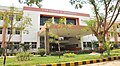 Main block
 -
 Aerial view


Notable alumni
[edit] |
- Raghuram, Telugu film singer and music composer
- Sankalp Reddy, director of The Ghazi Attack, Antariksham 9000 KMPH
- Roll Rida, rapper, contestant of Bigg Boss Telugu 2
- Prasanth Varma, director of Awe, Kalki, Zombie Reddy and Hanu-Man
See also
[edit]References
[edit]External links
[edit]


 | This article about a university or college in Telangana, India is a stub. You can help Wikipedia by adding missing information. |
CVR College of Engineering
View on GrokipediaHistory and Establishment
Founding and Early Years
CVR College of Engineering was established in 2001 by the Cherabuddi Education Society, a non-profit organization registered in January 1999 as an NRI-promoted entity aimed at fostering advanced engineering education through collaborations with overseas professionals and local academicians.[9][10] The society, under the leadership of Chairman Dr. Raghava V. Cherabuddi—a computer engineering PhD with prior experience at Microsoft and Intel—sought to create a premier technical institution in Telangana, marking CVR as the region's first NRI-initiated engineering college.[11][9] This founding reflected a vision to leverage international expertise for quality technical training, with the institution initially positioned to address the growing demand for skilled engineers in core disciplines.[10] From its inception, the college received approval from the All India Council for Technical Education (AICTE) in 2001 and established affiliation with Jawaharlal Nehru Technological University Hyderabad (JNTUH), ensuring alignment with national standards for curriculum and examinations.[10][2] The early focus centered on undergraduate B.Tech programs in foundational branches, including Computer Science and Engineering (CSE), Electronics and Communication Engineering (ECE), Electrical and Electronics Engineering (EEE), and Information Technology (IT), commencing in the 2001-2002 academic year with an initial intake of 220 students across these streams.[10] These programs emphasized practical training and theoretical foundations to prepare graduates for industry roles, laying the groundwork for the college's reputation in technical education.[12] The institution's initial campus was set up on a 32-acre site in Mangalpally village, Ibrahimpatnam mandal, Ranga Reddy District, Telangana, providing ample space for academic buildings, laboratories, and green areas to support a conducive learning environment.[3] This rural yet accessible location facilitated the college's early operations, including the development of essential infrastructure like classrooms and basic labs tailored to the starting programs. The first batch of students from the inaugural undergraduate cohorts graduated in 2005, signifying the successful completion of the four-year curriculum under JNTUH oversight and marking a key milestone in the college's formative phase.[10]Autonomy and Expansion
In 2013, the University Grants Commission (UGC) granted academic autonomy to CVR College of Engineering for a period of six years, effective from the 2014-15 academic year to 2019-20, which has since been extended, enabling the institution to continue exercising flexibility in curriculum design, syllabus revision, and internal evaluation processes while remaining affiliated to Jawaharlal Nehru Technological University, Hyderabad.[13][14] This status, achieved in less than 12.5 years since the college's establishment, marked a record among over 300 engineering colleges in the Telangana and Andhra Pradesh region at the time. The autonomy allowed the college to introduce industry-relevant courses and adopt innovative teaching methodologies, fostering greater alignment between academic offerings and technological advancements. The college underwent significant infrastructural expansion in the subsequent years, with the built-up area growing to over 36,000 square meters on its 33-acre campus by the early 2020s, supporting enhanced facilities for teaching, research, and student activities.[15] This development coincided with the introduction of specialized undergraduate programs, including B.Tech in Computer Science and Engineering (Artificial Intelligence and Machine Learning) and B.Tech in Computer Science and Engineering (Cyber Security), both launched in the 2020-21 academic year to address emerging demands in artificial intelligence, machine learning, and digital security.[16] Earlier, postgraduate education expanded with the launch of M.Tech programs between 2008 and 2010, such as M.Tech in Electrical Power Engineering in 2010, followed by additional specializations like M.Tech in Artificial Intelligence and Data Sciences in 2018-19.[17] PhD programs were initiated in Computer Science and Engineering (CSE) and Electronics and Communication Engineering (ECE) around 2015, establishing research centers to support doctoral scholars under the affiliating university's guidelines.[18] Key milestones in quality assurance included the National Assessment and Accreditation Council (NAAC) awarding an 'A' grade (CGPA 3.19) in 2016, reaccredited for five years effective from 2022 until October 10, 2027.[3][19] For program-specific accreditations, the National Board of Accreditation (NBA) granted approvals to initial undergraduate programs in 2012, which expanded to seven UG programs and two PG programs by 2022, including CSE, ECE, and Mechanical Engineering under Tier-1 status valid through 2025-28.[20] These accreditations underscored the institution's commitment to maintaining high academic standards and continuous improvement post-autonomy.Campus and Location
Site and Accessibility
CVR College of Engineering is situated in Vastunagar, Mangalpalli Village, Ibrahimpatnam Mandal, Ranga Reddy District, Telangana, India, on a sprawling 33-acre suburban campus.[15] The campus coordinates are approximately 17.1964°N 78.5951°E, placing it in a verdant, semi-rural setting that offers a serene environment conducive to learning while providing proximity to industrial zones in the surrounding Ibrahimpatnam area for enhanced practical exposure opportunities.[21][22] Located about 20 km from the center of Hyderabad, the site benefits from its position along the Mangalpalli-Pocharam BT Road, just 2.7 km from the 24-km stone on the Hyderabad-Nagarjunasagar Highway (NH-65).[23] The campus is highly accessible, with strong connectivity to major transport networks. It lies approximately 25 km from Rajiv Gandhi International Airport, facilitating easy travel for students and visitors from across the country and abroad.[24] The college is well-linked via NH-65, with local RTC buses operating on routes such as No. 277 from Koti/MGBS and No. 279 from JBS Secunderabad, stopping at Mangalpalli.[23] Additionally, the institution provides on-campus transport through 61 exclusive college buses that connect various localities in the Twin Cities (Hyderabad and Secunderabad) to the campus, ensuring convenient daily commuting for students.[25] Residential facilities on the campus include separate hostels for male and female students, with a combined capacity of 1,250 residents as of the 2025-26 academic year.[26] These hostels are equipped with mess services offering hygienic meals and round-the-clock security measures to ensure student safety and well-being. The green campus features extensive outdoor sports fields, promoting a balanced lifestyle amid its lush surroundings.[15]Infrastructure Facilities
CVR College of Engineering features a robust academic infrastructure designed to support engineering education and research. The campus includes 95 spacious classrooms and 119 specialized laboratories, all equipped with LCD projectors for enhanced teaching and learning experiences.[15] Department-specific facilities, such as the VLSI lab in the Electronics and Communication Engineering department and the structural engineering lab in the Civil Engineering department, provide hands-on training in core technical areas.[12][27] Additionally, the college maintains numerous computer systems distributed across 31 state-of-the-art computer laboratories, supported by high-speed internet connectivity and the latest hardware from brands like Lenovo, Dell, and Apple.[28] The central library occupies a dedicated three-story building spanning 1,450 square meters, serving as a key resource for students and faculty. It houses 87,582 books, including 17,046 reference titles, and subscribes to 191 print and digital journals, with full access to e-resources from organizations such as IEEE, ASME, and ASCE.[29] Digital access is available remotely through a dedicated platform, ensuring seamless availability of academic materials.[29] Other support facilities enhance the campus environment for academic and daily needs. A 1,500-seat air-conditioned auditorium, equipped with Wi-Fi and four high-powered LCD projectors, hosts lectures, seminars, and events.[15] The four-story student center includes a canteen, gymnasium, medical center, and spaces for administrative functions, while campus-wide Wi-Fi and power backup systems exceeding 500 kVA from captive generators ensure uninterrupted operations.[15][28][30] Recreational facilities promote physical well-being and extracurricular engagement. Outdoor amenities support sports like cricket, basketball, football, and volleyball, complemented by indoor options in the student center, including table tennis, chess, billiards, carrom, and a gym with high-quality equipment.[31] The college organizes the annual Engineering Premier League sports meet, a state-level cricket tournament initiated in 2017, fostering competitive spirit among students.[32]Academics
Undergraduate Programs
CVR College of Engineering offers 12 undergraduate B.Tech programs spanning traditional and emerging engineering disciplines, each designed to provide a strong foundation in core engineering principles while incorporating modern technological advancements. These programs include Civil Engineering, Computer Science and Business Systems, Computer Science and Engineering (CSE), CSE (Artificial Intelligence and Machine Learning), CSE (Data Science), CSE (Cyber Security), Electronics and Communication Engineering (ECE), Electronics Engineering (VLSI Design & Technology), Electrical and Electronics Engineering (EEE), Electronics and Instrumentation Engineering (EIE), Information Technology (IT), and Mechanical Engineering.[6] The curriculum for all programs follows a 4-year duration, requiring students to complete 160 credits through core subjects, electives, multidisciplinary minor programs (such as AI & ML, Cyber Security, Data Science, or IoT starting from the third year), capstone projects, and mandatory industry internships to foster practical skills and innovation.[6] As an autonomous institution since 2014, affiliated with Jawaharlal Nehru Technological University Hyderabad (JNTUH), the college has the flexibility to update its syllabus in alignment with industry needs and the National Education Policy 2020, emphasizing interdisciplinary learning and emerging technologies like AI and machine learning in specialized CSE branches.[13][3] Annual intake across these programs totals 1,980 seats, with approximately 1,386 (70%) allocated through the Telangana State Engineering, Agriculture, and Medical Common Entrance Test (TS EAMCET) via state counseling, and the remainder under management quota.[6][33] Eligibility for admission requires candidates to have completed 10+2 (or equivalent) with Physics, Chemistry, and Mathematics (PCM) as compulsory subjects, securing at least 45% aggregate marks (40% for reserved categories), followed by a valid rank in TS EAMCET or JEE Main for seat allocation.[34][35] Seven of the B.Tech programs hold National Board of Accreditation (NBA) Tier-1 status, valid up to 2028 for most (with some variations, e.g., EIE until 2027), including CSE, ECE, EEE, Civil Engineering, EIE, IT, and Mechanical Engineering, ensuring alignment with global quality standards and enhancing employability through rigorous outcome-based education.[3][36] These accreditations highlight the programs' focus on practical training, research-oriented projects, and integration of cutting-edge tools in fields like cyber security and VLSI design, preparing students for industry demands. The institution's NAAC 'A' grade accreditation, renewed in 2022 for five years, further supports academic excellence.[16]| Program | Annual Intake (Seats) |
|---|---|
| Civil Engineering | 60 |
| Computer Science and Business Systems | 60 |
| Computer Science and Engineering | 660 |
| CSE (AI & ML) | 240 |
| CSE (Data Science) | 240 |
| CSE (Cyber Security) | 180 |
| Electronics and Communication Engineering | 120 |
| Electronics Engineering (VLSI Design & Technology) | 60 |
| Electrical and Electronics Engineering | 60 |
| Electronics and Instrumentation Engineering | 60 |
| Information Technology | 120 |
| Mechanical Engineering | 60 |
Postgraduate and Research Programs
CVR College of Engineering offers six Master of Technology (M.Tech) programs, each spanning two years and designed to provide advanced technical expertise in specialized engineering domains. These programs include Artificial Intelligence (18 seats), Data Sciences (18 seats), Electrical Power Engineering (18 seats), Embedded Systems (18 seats), Structural Engineering (18 seats), and VLSI Design (18 seats), with admissions primarily conducted through the Telangana State Postgraduate Engineering Common Entrance Test (TS PGECET) or Graduate Aptitude Test in Engineering (GATE).[6][37][38] The total intake across these programs is 108 seats, fostering a focused environment for postgraduate study.[6][37] The M.Tech curriculum emphasizes advanced coursework, seminars, and a comprehensive dissertation, integrating theoretical knowledge with practical applications to prepare students for industry and research roles. Two of these programs—Structural Engineering and VLSI System Design—have received accreditation from the National Board of Accreditation (NBA) under Tier-1 for the period 2022–2025, ensuring alignment with global engineering standards.[39][40] In addition to M.Tech offerings, the college supports doctoral-level research through PhD programs in Computer Science and Engineering (CSE) and Electronics and Communication Engineering (ECE), with 22 faculty members serving as registered PhD guides.[6][7] These programs highlight a strong emphasis on scholarly output, including over 2,000 publications in SCOPUS and Web of Science-indexed journals, alongside funded projects supported by agencies such as the University Grants Commission (UGC).[7][41] Research opportunities at CVR are bolstered by dedicated facilities, including the NewGen Innovation and Entrepreneurship Development Centre (IEDC) for emerging technologies like AI, specialized VLSI laboratories, the UAV Design Center, and centers for Advanced Antenna Design and Nanotechnology Materials Research.[7] The college facilitates industry collaborations for thesis work and hosts annual workshops, seminars on research methodology and intellectual property rights, and publishes the CVR Journal of Science & Technology to promote scholarly dissemination.[7] Seed funding and incentives, such as Rs. 60,000 allowances and paid study leave for guides, further encourage high-impact research contributions.[7]Admissions and Student Life
Admission Process
Admissions to the undergraduate B.Tech programs at CVR College of Engineering are primarily governed by the Telangana State Engineering, Agriculture, and Medical Common Entrance Test (TS EAMCET), with 70% of seats allocated under Category A through counseling conducted by the Telangana State Council of Higher Education (TSCHE).[35] An additional 15% of total seats under the management quota (Category B) are reserved for Non-Resident Indians (NRIs) and NRI-sponsored candidates, who are selected based on JEE Main scores.[42] The remaining 15% of seats fall under the management quota, allowing direct admissions based on merit, including intermediate (10+2) marks and entrance exam performance, with applications processed through the college's official portal.[34] Eligibility requires candidates to have passed 10+2 with at least 45% aggregate in Physics, Chemistry, and Mathematics (40% for reserved categories). Cutoff ranks vary by branch and category; for instance, the closing rank for Computer Science and Engineering (CSE) in the general category was approximately 5,072 in the 2025 TS EAMCET Round 1.[43] For postgraduate M.Tech programs, admissions are based on scores from the Telangana State Postgraduate Engineering Common Entrance Test (TS PGECET) or GATE, with seats filled through decentralized counseling by TSCHE or merit-based selection.[34] Sponsored candidates, typically those with at least two years of relevant work experience, may be admitted directly without entrance exam requirements, subject to approval by the affiliating university, Jawaharlal Nehru Technological University Hyderabad (JNTUH).[35] Applications for both entrance-based and sponsored admissions are submitted via the college's official website or the TS PGECET portal, requiring a bachelor's degree in engineering or technology with a minimum 50% aggregate (45% for reserved categories).[38] Admissions to Ph.D. programs in Computer Science and Engineering and Electronics and Communication Engineering are managed through JNTUH's Ph.D. admission process, which requires candidates to qualify via an entrance test (such as UGC-NET or JNTUH eligibility exam) followed by an interview; eligible candidates must hold a relevant master's degree with at least 55% marks (50% for reserved categories).[44] The overall admission timeline aligns with state-level processes: TS EAMCET and TS PGECET applications typically open in March and close by May, with exams held in May-June, followed by counseling from June to August.[34] Classes for the academic year commence in August. Management quota seats are filled concurrently, often extending into July-August based on availability.[42] Scholarships are available to support admissions, including full fee reimbursement under government schemes like the Telangana Post-Matric Scholarship for SC/ST/BC students from families with income below INR 2 lakh annually, and merit-based waivers up to 100% of tuition fees for top performers in TS EAMCET (e.g., ranks below 10,000).[45] The college also offers orientation programs for incoming students to facilitate smooth transition, covering academic policies, campus resources, and registration procedures.[2]Extracurricular Activities
CVR College of Engineering fosters a vibrant extracurricular landscape through student-led clubs and events that promote technical innovation, cultural expression, sportsmanship, and community engagement. The college hosts the annual national-level technical festival, Ciencia, featuring workshops, hackathons, and competitions in areas such as robotics and coding, which has been organized since at least 2008 to encourage practical skills and interdisciplinary collaboration among participants from various institutions.[46][47] Cultural activities are supported by dedicated clubs including the Literary and Debate Club for discussions and public speaking, Rangmanch for theatre productions, Kalakriti for visual arts, Eloquent for storytelling, Shared Shelf for book readings, as well as groups focused on music, dance, and photography. These clubs organize regular events and contribute to annual cultural celebrations that highlight traditional and contemporary performances, enhancing students' creative and social development.[48][49][50] Sports engagements include intra-college leagues and participation in state-level events, with active clubs for cricket, volleyball, and chess that promote physical fitness and teamwork. The college has hosted the Engineering Premier League, an inter-college sports tournament initiated in 2017, featuring cricket and other disciplines to foster competitive spirit across engineering institutions.[46][51][52] Beyond these, the National Service Scheme (NSS) unit facilitates volunteer programs for community service, such as environmental drives and social outreach initiatives. The IEEE Student Branch organizes technical seminars and projects to advance professional networking, while the Entrepreneurship Development Cell (EDC) and Institution's Innovation Council (IIC) support startup ideas through workshops and incubation activities, preparing students for innovative ventures.[3][53][54]Rankings, Accreditations, and Achievements
National and International Rankings
CVR College of Engineering has demonstrated consistent performance in national ranking frameworks, particularly through the National Institutional Ranking Framework (NIRF) established by the Ministry of Education, Government of India. In the NIRF 2025 rankings for the Engineering category, the institution secured a position in the 151-200 band, reflecting stability from its 151-200 placement in 2024 and 2023.[5][55][56] This banding accounts for approximately 50 institutions evaluated on parameters including teaching, learning, and resources (30% weightage); research and professional practice (30%); graduation outcomes (20%); outreach and inclusivity (10%); and peer perception (10%).[5] Historically, CVR entered the NIRF rankings in 2017 in the 101-150 band among engineering institutions, marking its emergence from unranked status prior to 2016.[57] Subsequent years saw it maintain a foothold in the top 200, with placements in the 101-150 band in some earlier assessments before settling into the 151-200 range by 2023.[58] These rankings underscore progressive improvements in research output and perception, bolstered by accreditations that enhance institutional credibility.[59] In other national evaluations, CVR holds an AAAA rating from Careers360, positioning it among elite private engineering colleges in India based on criteria like academic excellence, infrastructure, and employability.[4] It also received a 4.5 out of 5-star rating from Career Connect, highlighting strengths in faculty quality and student outcomes.[3] In India Today 2024 rankings, it was placed 87th in engineering, while The Week 2025 ranked it 67th nationally and 6th in Telangana.[60] Within Telangana, state-specific surveys rank CVR among the top 10 engineering colleges, often in the 3rd to 8th position, representing the top 10% of over 200 affiliated institutions under Jawaharlal Nehru Technological University Hyderabad.[3][61]| Year | NIRF Engineering Band | Key Notes |
|---|---|---|
| 2017 | 101-150 | Initial entry post-establishment.[57] |
| 2023 | 151-200 | Focus on research and outcomes.[56] |
| 2024 | 151-200 | Consistent performance.[55] |
| 2025 | 151-200 | Emphasis on inclusivity and perception.[5] |