Hubbry Logo
search
logo
1945497

Calligram

logo
Community Hub0 Subscribers
Read side by side
from Wikipedia

Calligram in French by Guillaume Apollinaire describing and visually representing his lover. Parts of the face's image (such as the hat, eye, nose, mouth, neck) each use words associated specifically with that part.

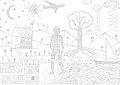
A calligram is a set of words arranged in such a way that it forms a thematically related image. It can be a poem, a phrase, a portion of scripture, or a single word; the visual arrangement can rely on certain use of the typeface, calligraphy or handwriting, for instance along non-parallel and curved text lines, or in shaped paragraphs. The image created by the words illustrates the text by expressing visually what it says, or something closely associated; it can also, on purpose, show something contradictory with the text or otherwise be misleading, or can contribute additional thoughts and meanings to the text.

Writers

[edit]

Guillaume Apollinaire was a famous calligram writer and author of a book of poems called Calligrammes.

José Juan Tablada wrote a book of Spanish-language calligrams entitled Li-Po y otros poemas[1].

[edit]

See also

[edit]

References

[edit]
Revisions and contributorsEdit on WikipediaRead on Wikipedia
from Grokipedia
A calligram is a form of visual poetry or artistic text in which the letters, words, or lines are arranged to form a pictorial image that relates to the content or theme of the writing.[1] This technique blends typography and imagery, often using the shape of the text—such as an object, animal, or symbol—to enhance or illustrate the poem's meaning.[2] The practice of creating calligrams dates back to ancient civilizations, with early examples appearing in Greek and Roman literature where poets shaped verses into forms like eggs, wings, or altars to evoke the subject matter.[3] During the Middle Ages, this tradition continued in illuminated manuscripts, such as the 9th-century Aratea, a Latin adaptation of ancient Greek astronomical texts by Aratus, where verses were arranged to mimic constellations and celestial figures.[4] Similar techniques appeared in other cultures, including classical Chinese poetry, where text formed decorative or symbolic patterns.[5] In the early 20th century, the French poet Guillaume Apollinaire revived and popularized the form in the modern era by coining the term "calligramme" in French.[6] His 1918 collection Calligrammes: Poèmes de la paix et de la guerre (1913-1916) features innovative typographic arrangements depicting rain, bridges, hearts, and military motifs, reflecting themes of World War I and personal experience.[7] Apollinaire's work marked a significant evolution, integrating free verse, simultaneity, and visual experimentation influenced by Cubism and Futurism, thus bridging poetry with visual arts.[8][9] Since Apollinaire, calligrams have influenced concrete poetry, digital art, and graphic design, appearing in advertisements, logos, and contemporary installations where text doubles as both narrative and visual element.[10] Today, they remain a versatile medium for exploring the interplay between language and perception in educational, artistic, and multimedia contexts.[11]

Definition and Characteristics

Definition

A calligram is a form of concrete poetry in which the arrangement of words, letters, or phrases is configured to form a visual image that thematically corresponds to the text's meaning.[12][13] This arrangement transforms the typographical elements into an integral part of the poetic expression, where the spatial layout reinforces the semantic content.[6] Calligrams are distinguished from related forms such as shaped poetry by their emphasis on the semantic integration of the visual form with the textual content, ensuring the image not only depicts but actively embodies the poem's thematic essence.[14] In contrast to asemic writing, which employs script-like marks devoid of specific linguistic meaning to evoke aesthetic intuition, calligrams prioritize legibility and readability to maintain the interplay between verbal and iconic communication.[15][16] At their core, calligrams operate through principles of typographical arrangement and spatial composition, harnessing the dual semiotics of language and image to create a unified artistic statement.[17] This fusion allows the visual structure to function as an extension of the linguistic sign, enhancing interpretive depth without subordinating one mode to the other.[18] Pioneered by figures such as Guillaume Apollinaire, calligrams exemplify this balanced synthesis in modern literary practice.[16]

Key Features

Calligrams employ visual elements such as strategic use of whitespace, varied letter orientations, and font modifications to construct shapes that echo the poem's theme. Whitespace delineates the contours of the image, allowing negative space to contribute to the overall form, as seen in arrangements where text outlines objects like a tie or a watch to symbolize constraint and temporality.[16] Letter orientations—ranging from clockwise spirals to zigzag patterns—guide the reader's eye along dynamic paths that mimic the subject's movement or structure, enhancing the immersive quality of the work. Font variations, including changes in size, weight, and style, emphasize key words or phrases, creating depth and hierarchy within the visual composition, such as enlarging central elements to focalize emotional cores like a heart in a love poem.[19] The poetic integration in calligrams aligns syntax and semantics with the visual form, often through enjambment that spans visual boundaries to disrupt or fluidly extend meaning. This technique fragments lines to parallel thematic disruptions, as in representations where text curves around a circular watch face, reflecting the cyclical nature of time and societal pressures through interrupted phrasing like "MY HEART LIKE AN INVERTED FLAME."[16] Semantics are amplified by the image's congruence with content, requiring readers to interpret text both linearly and holistically, fostering a layered understanding where form actively shapes interpretation. Apollinaire's innovations briefly merged this with cubist fragmentation, treating words as pictorial elements to evoke multidimensional experiences.[19] Variations of calligrams appear in diverse scripts, adapting to their inherent properties for unique visual-poetic effects. In Arabic script, calligraphic traditions shape cursive letters into abstract or representational forms—such as intertwining lines forming symbolic motifs—while respecting aniconic conventions through stylized, non-figural imagery that integrates poetry with geometric harmony.[20] Chinese ideograms, with their pictographic origins, lend themselves to calligrammatic arrangements where characters' visual structures form landscapes or objects, as explored in poetic writing that exploits semantic-visual overlaps for evocative, non-linear compositions.[21] These adaptations highlight how script-specific traits, like Arabic's fluidity or Chinese logographic density, enable culturally resonant fusions of text and image.

History

Ancient and Early Origins

The concept of calligrams, or shaped poetry where text forms visual images related to its theme, traces its earliest roots to ancient Greece during the Hellenistic period around the 3rd century BCE. Poets like Simmias of Rhodes created technopaegnia, or "art games," arranging verses into geometric or object-like shapes such as eggs, wings, or axes to enhance the poem's meaning through visual form. These works represented an innovative fusion of literature and visual art, influencing later traditions across cultures.[22] In non-Western traditions, shaped text emerged prominently in Islamic calligraphy by the medieval period, particularly through zoomorphic forms where Arabic script was arranged to depict animals or objects. Under the Fatimid dynasty (909–1171 CE), 10th-century tiraz textiles and manuscripts incorporated zoomorphic patterns, blending Sassanian and Byzantine influences with calligraphic designs to symbolize divine power and virtue; for instance, inscriptions forming animal silhouettes adorned luxury fabrics and architectural elements. This practice, rooted in the aniconic principles of Islamic art, elevated calligraphy as a sacred visual medium, with examples appearing in Persian manuscripts where text evoked shapes like lions or birds to convey spiritual narratives.[23] Medieval European illuminated manuscripts also featured shaped text as a decorative and devotional device, often arranging letters into crosses, initials, or geometric patterns to emphasize religious themes. A prominent example is the 9th-century Aratea, a Latin adaptation of ancient Greek astronomical texts, where verses were arranged to mimic constellations and celestial figures.[4] In Anglo-Saxon England, early 11th-century examples include triangular text layouts in manuscripts like the Exeter Book, where verses taper to a point to mimic architectural or symbolic forms, aiding meditation on sacred content. Similarly, scribes in Carolingian and Insular traditions crafted text into cross-like configurations, as seen in 9th-10th century gospel books, integrating visual harmony with liturgical function. These techniques drew from earlier Christian and classical influences, predating the 20th-century revival while highlighting text's dual role as both readable narrative and aesthetic object.[24][25] Non-Western influences extended to East Asia and South Asia, where script formations contributed to visual poetry. In ancient China, pattern poetry (túshī) from the 4th century CE onward arranged characters into symbolic shapes like fans or mountains, building on the pictographic origins of oracle bone script (c. 1200 BCE) to create multidimensional expressions, as exemplified by Su Hui's Xuanji Tu; full calligrammatic forms developed later in Tang dynasty works.[26] Japanese haiku visualizations, emerging in the Edo period (17th-19th centuries), combined poetic brevity with calligraphic layouts in haiga—ink paintings where text subtly integrates with imagery, echoing shaped compositions without strict figural forms.[27] In India, Devanagari script traditions from the medieval era (c. 7th-13th centuries) featured elaborate formations in temple inscriptions and manuscripts, where letters intertwined to form yantras or divine symbols, influencing later calligraphic arts that visualized mantras as geometric or iconic patterns.[28] These global precursors laid foundational conceptual groundwork for calligrams, emphasizing harmony between word, image, and meaning.

Modern Revival

The modern revival of calligrams began in early 20th-century Europe, where avant-garde movements such as Futurism, Dada, and Cubism spurred experimental approaches to visual language that integrated text and image. During the 1910s and 1920s, poets and artists drew on fragmented forms and typographic innovation to challenge linear reading, reviving the ancient practice as a modernist tool for expressing dynamism and simultaneity.[12][7] This emergence aligned with broader artistic shifts, as seen in Guillaume Apollinaire's influential collection Calligrammes (1918), which adapted calligrammatic forms to wartime themes and urban modernity.[7] Following World War II, calligrams evolved through integration with concrete poetry movements in Europe and Brazil during the 1950s and 1960s, emphasizing semantic minimalism and spatial arrangement over narrative flow. In Europe, Swiss-Bolivian poet Eugen Gomringer pioneered "constellations"—grid-based verbal structures that echoed calligrammatic shapes—beginning with works like "Silencio" (1953), which reduced language to visual silence amid postwar reconstruction.[29][30] Concurrently, Brazil's Noigandres group in São Paulo advanced concrete poetry from 1952, incorporating calligram-like forms to address industrialization and social change, as in their typographic experiments tied to the construction of Brasília.[29] This period marked a global dialogue, with concrete poetry formalizing calligrammatic principles through international exhibitions and manifestos.[31] From the 1970s onward, calligrams spread to postcolonial contexts in Africa and Asia, where artists adapted them to explore identity, decolonization, and cultural hybridity, often leveraging emerging digital printing for broader dissemination. In North Africa, creators like Algerian artist Abdallah Benanteur incorporated calligrammatic elements into engravings that blended Arabic script with abstract forms, reflecting postcolonial negotiations of heritage and modernity.[32] In sub-Saharan Africa, contemporary works in exhibitions such as the National Museum of African Art's "Inscribing Meaning" series featured calligrams as poetic text-image fusions, addressing linguistic diversity and resistance.[33] Similarly, in South Asia and the Middle East, postwar decolonization fostered modernist calligraphic abstractions that echoed calligrammatic innovation, using printed media to reclaim visual narratives from colonial legacies.[34] This adaptation connected early modernist experiments to diverse cultural revivals, sustaining calligrams' relevance into late-20th-century art.

Notable Figures

Guillaume Apollinaire

Guillaume Apollinaire, born Wilhelm Albert Włodzimierz Apolinary de Wąż Kostrowitzki on August 26, 1880, in Rome, Italy, was a French poet, playwright, and art critic who became a central figure in the Parisian avant-garde.[35] Raised primarily in France after his mother's return from Monaco, he adopted the pseudonym Guillaume Apollinaire and immersed himself in the bohemian literary and artistic circles of early 20th-century Paris. His life was marked by a restless pursuit of innovation, blending traditional poetry with emerging modernist sensibilities, until his death on November 9, 1918, at age 38, from complications of the Spanish flu, exacerbated by a shrapnel wound sustained during World War I.[35] Apollinaire's most influential contribution to poetry came in his 1918 collection Calligrammes: Poèmes de la paix et de la guerre, published shortly before his death, which featured experimental poems that integrated visual form with textual content.[35] In the preface, he described these works as an "idealisation of free verse poetry and typographical precision," aiming to revive ancient calligraphic traditions while pushing the boundaries of modern expression.[35] The collection includes pieces written during his service in the French army from 1914 to 1916, capturing the chaos and introspection of trench warfare, such as poems evoking the front lines' desolation and the fleeting beauty amid destruction.[35] Apollinaire innovated by introducing "calligrammes," or ideograms, where the arrangement of words on the page forms visual images that complement or embody the poem's theme, effectively merging poetry with drawing.[36] A prime example is "Il Pleut" ("It's Raining"), first published in 1916 in the journal SIC and later included in Calligrammes, where the text slants diagonally downward like falling rain, evoking the relentless patter and emotional weight of precipitation as a metaphor for distant voices and memories.[36][37] This technique transformed the poem into a hybrid artwork, challenging linear reading and emphasizing simultaneity of meaning.[37] Apollinaire's calligrammes profoundly influenced surrealism and visual poetry, serving as a precursor to movements that prioritized the irrational and the visual in language.[38] He coined the term "surrealism" in 1917 to describe the innovative staging of the ballet Parade by the Ballets Russes, which blended music, dance, and scenery in unexpected ways, later inspiring André Breton's formal manifesto.[35][39] His wartime experiences infused these innovations with a sense of urgency, as seen in calligrammes like those depicting soldiers or landscapes scarred by conflict, paving the way for poets to explore trauma through non-traditional forms.[35]

Other Practitioners

Similarly, Scottish poet and artist Ian Hamilton Finlay advanced calligrammatic practices in the 1960s through his concrete poetry integrated into garden installations at Little Sparta, where inscribed stones and sculptures formed shaped verses that merged text with landscape.[https://www.poetryfoundation.org/poets/ian-hamilton-finlay] Finlay's "garden poems," such as those etched in granite to mimic natural contours, echoed Apollinaire's foundational influence while emphasizing site-specific environmental dialogue, positioning the calligram as a three-dimensional, interactive medium.[40] Beyond Europe, Chinese artist Xu Bing developed square-word calligraphy in the late 1980s, a system that reconfigures English letters into square forms mimicking Chinese characters, creating calligrammatic compositions that blur linguistic boundaries and critique cultural translation.[https://www.metmuseum.org/art/collection/search/73325] This technique, first exhibited in his 1991 installation A Book from the Sky, produces visually poetic scrolls where text forms abstract, readable-yet-unintelligible patterns, highlighting the performative and deceptive nature of script in global contexts.[41] In Arabic literary traditions, Syrian poet Adonis (Ali Ahmad Said Esber) has employed shaped verses since the 1970s, integrating calligraphy into poetic forms known as "raqima" that arrange words into symbolic geometries, evoking modernist calligrammatic innovation while rooted in Islamic artistic heritage.[https://www.theguardian.com/books/gallery/2012/feb/09/syria-poet-adonis-artworks] Adonis's works, such as those in his 2012 exhibition of calligraphic drawings, use fluid, intertwined scripts to form visual metaphors for exile and renewal, expanding the calligram's scope to encompass political and spiritual dimensions in non-Western poetics.[42] Among contemporary practitioners, American artist Erica Baum has explored feminist perspectives on calligrammatic text since the 2000s, photographing fragmented passages from magazines and books to compose grid-like visual poems that reveal hidden narratives in everyday print culture.[https://bombmagazine.org/articles/2020/09/16/erica-baum-1/] In series like Dog Ear (2002–2005), Baum's cropped images of bent pages create emergent shapes from consumer language, subverting patriarchal discourse through decontextualized, sculptural arrangements of words that invite multiple interpretive readings.[43]

Techniques

Traditional Creation

Traditional calligrams were produced through labor-intensive manual processes that relied on analog materials and techniques, predating digital design tools and emphasizing the artist's direct interaction with text as a visual medium. Primary materials included high-quality paper for sketching and final rendering, along with inks and pens for hand-drawn works, or metal type, spacing blocks, and printing presses for typographic versions. In the early 20th century, manual typesetting emerged as a key method, where compositors physically arranged individual letters and words using wooden or metal cases to compose shapes, often employing tools like the Monotype machine for casting custom letter sizes when standard fonts proved insufficient. Stencils occasionally aided in outlining complex forms, while typewriters were experimented with in the mid-20th century for simpler linear arrangements, though their fixed mechanisms limited intricate curves. The creation process typically began with conceptual planning, where the poet or artist sketched the desired outline—such as a bird, heart, or rain pattern—on paper to define the overall silhouette and thematic flow. Words were then selected and arranged to conform to this outline, with lines of text curving or radiating to fill the shape while preserving semantic connections; letter sizes were scaled manually by choosing from available type variants or hand-adjusting proportions in drawings to maintain visual density and readability. For printed calligrams, the sketch was handed to a professional typesetter, who meticulously positioned elements in a composing stick before locking them into a forme for letterpress printing, a step that demanded iterative proofs to refine alignment. Hand-drawn calligrams, by contrast, involved direct inking over the sketch, treating text like brushstrokes to build tonal gradients through letter density. Significant challenges arose in balancing aesthetic form with textual legibility, as manual methods constrained flexibility—fixed type sizes in early 20th-century printing often forced compromises in scale, making it difficult to achieve smooth curves or fine details without sacrificing clarity. Print limitations, such as the rigidity of hot-metal typesetting, required skilled labor to simulate organic shapes using spacers and justified lines, resulting in occasional distortions; for instance, early calligrams like those in 1918 publications faced issues with ink bleed on paper or uneven pressure from presses, which could blur edges in intricate designs. These hurdles underscored the artisanal nature of the craft, where precision demanded extensive time and expertise from scribes or printers. Apollinaire's manual experiments, such as hand-drawn pieces like "Fleurs," exemplified these techniques by integrating poetic content with sketched forms before typographic adaptation.

Contemporary Methods

Contemporary methods for calligram creation primarily utilize digital software and computational techniques to arrange text into visual forms with enhanced precision and scalability. Adobe Illustrator, a vector graphics editor available since 1987 but widely adopted for calligrams in the post-1990s era, enables artists to warp text along paths and integrate it with shapes, as demonstrated in tutorials for creating themed designs like animal silhouettes or symbolic icons.[44] Similarly, the Processing programming language supports generative text shaping through code-based sketches, allowing dynamic calligram formation by mapping text to image contours or user interactions.[45] Hybrid approaches bridge traditional and digital practices by incorporating scanned or photographed elements into editing software. For example, artists scan handwritten text or poems and manipulate them in Adobe Photoshop using filters like Displace to conform the letters to an underlying image, such as a portrait, creating layered calligrams that blend organic handwriting with digital distortion.[46] In the 2020s, AI-assisted layouts have advanced these methods, with generative models analyzing input text and images to automatically suggest or produce shaped arrangements, as seen in platforms that output calligram art from descriptive prompts.[47] These innovations have improved accessibility through online tools tailored for non-professionals, such as interactive web-based generators that simulate calligram creation via simple inputs like poetry and outline drawings.[48] However, digital reproduction introduces ethical considerations, including the risk of infringing copyrights on source texts or visuals, particularly when AI systems reproduce protected poetic content without permission, and the importance of maintaining fidelity to the original artist's conceptual intent.[49] Seminal computational work, like the 2011 algorithm for digital micrography, underscores these methods' potential by using vector field optimization to pack minuscule text into coherent images, influencing modern generative tools.[50]

Cultural Significance

In Literature

Calligrams emerged as a pivotal innovation in avant-garde poetry, particularly during the early 20th century, by integrating textual content with spatial arrangement to challenge the linear progression of reading. This form compels readers to trace the contours of words shaped into images—such as objects, landscapes, or abstract forms—thereby disrupting conventional narrative flow and inviting multiple interpretive paths through the poem. In Guillaume Apollinaire's seminal collection Calligrammes (1918), this technique is employed to fuse linguistic expression with dynamic layouts, where the visual structure dictates the rhythm and direction of comprehension, transforming passive reading into an active, exploratory process.[16][51][52] Thematically, calligrams in literary traditions have been used to delve into motifs of fragmentation, identity, and war, leveraging their non-linear form to reflect the fractured realities of modern existence. During World War I, poets like Apollinaire harnessed calligrammatic shapes to evoke the disorientation of battle, with textual configurations resembling rain, hearts, or military motifs that symbolize personal and societal disintegration. In modernist anthologies, such as those compiling avant-garde works, calligrams illustrate identity's fluidity amid technological and wartime upheavals, where the dispersed arrangement of words mirrors the splintered self and collective trauma, enhancing thematic depth without relying on straightforward exposition.[53][54][55] Critical reception has positioned calligrams as a cornerstone of poetic evolution, with scholars emphasizing their role in creating a "poetry of space" that transcends traditional syntax and engages the reader's perceptual faculties. Analyses highlight how this spatial innovation enriches avant-garde literature by intertwining form and content, allowing for layered meanings that capture the ambiguities of human experience. In examinations of Apollinaire's contributions, critics underscore the calligram's enduring impact on textual experimentation, praising its ability to disrupt and revitalize narrative conventions in modernist poetry.[56][57][16]

In Visual Arts

Calligrams have extended beyond literary forms into visual arts, where they serve as a foundational element in concrete poetry and text-based installations, emphasizing the spatial arrangement of words to create imagery that integrates linguistic and pictorial elements. This integration treats text not merely as content but as a sculptural or painterly medium, influencing movements like concrete poetry in the mid-20th century, where artists manipulated typography to evoke visual metaphors independent of narrative sequence.[29] In paintings and sculptures, calligrams appear as embedded text structures that form abstract or representational shapes, often blending calligraphy with color and form to challenge traditional boundaries between writing and image-making. Contemporary practitioners like Sky Hopinka employ calligrams in photographic and sculptural works, shaping indigenous texts into effigy mound forms to explore land, memory, and language, as seen in installations at institutions like the Museum of Modern Art. These works transform calligrams into three-dimensional or mixed-media objects, where the physicality of text—etched, cast, or projected—amplifies thematic resonance.[58] Calligrams have featured in key exhibitions and art movements. In modern biennials and galleries, such as the 2022 Fluxus-themed exhibition at Millerntor Gallery, calligraffiti pieces reinterpreted calligrams as dynamic, graffiti-infused visuals, highlighting their adaptability in interdisciplinary contexts. This presence underscores calligrams' role in challenging artistic hierarchies, from Fluxus's anti-art ethos to biennial showcases that pair them with digital projections and site-specific works.[59] The fusion of calligrams with graphic design and advertising has evolved them into versatile tools for word art, where typographic shapes convey brand identities or conceptual messages without relying on illustration. Designer Ji Lee's "Word as Image" series exemplifies this, using single words morphed into icons—like "elevator" as ascending letters—for logos and campaigns, influencing commercial visuals since the early 2000s by prioritizing semantic visualization over literal depiction. This interdisciplinary shift has propelled calligrams into contemporary word art practices, seen in large-scale urban installations like Opiemme's "Black Calligrams," a 100-square-meter text-heart on a building facade, merging street art with poetic form to engage public spaces.[60][61]

References

User Avatar
No comments yet.