


Community hub
0 subscribers8 pages, 0 posts
Recent from talks
All channels
Be the first to start a discussion here.
Be the first to start a discussion here.
Be the first to start a discussion here.
Be the first to start a discussion here.
Contribute something
Welcome to the community hub built to collect knowledge and have discussions related to Mouse-like hamster.
Nothing was collected or created yet.
Mouse-like hamster
View on Wikipediafrom Wikipedia
Not found
Mouse-like hamster
View on Grokipediafrom Grokipedia
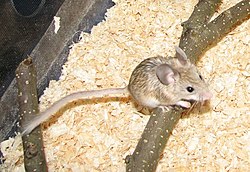
The mouse-like hamsters are small rodents belonging to the monogeneric family Calomyscidae, encompassing the genus Calomyscus with ten extant species that diverged early from other muroid rodents, earning them the status of "living fossils" in evolutionary terms.[1][2][3] These creatures measure 61–98 mm in head-body length, with tails of 72–102 mm that are often tufted at the tip, and weigh 15–30 grams; they feature soft, bicolored fur (dorsally grayish-brown or sandy and ventrally white), large eyes and ears for nocturnal activity, and four-rooted molars distinguishing them from similar genera like Peromyscus.[1][4] Lacking cheek pouches typical of true hamsters (Cricetidae), they are agile climbers adapted to rocky terrains, primarily feeding on seeds, green plant parts, insects, and occasionally carrion.[1][5]
Native to the arid and semi-arid landscapes of southwestern Asia, mouse-like hamsters exhibit a patchy distribution ranging from western Pakistan eastward through Afghanistan and Iran to Syria and Azerbaijan, extending northward to southern Turkmenistan and the Caucasus.[1][6] They inhabit barren rocky hillsides, desert steppes, and oak-covered slopes at elevations between 400 and 3,500 meters, often in areas with sparse vegetation that provide cover from predators.[1] Behaviorally, they are mostly nocturnal or crepuscular in warmer months but may remain active year-round in milder climates; solitary by nature, they construct shallow burrows or use rock crevices for shelter and are known for their inquisitive demeanor in captivity.[1] Reproduction occurs seasonally from March to December, with gestation lasting about 21 days and litters of 3–7 altricial young, reaching maturity at around four months.[1]
Conservation efforts for mouse-like hamsters vary by species, with most classified as Least Concern by the IUCN due to their adaptability, though Calomyscus hotsoni (Hotson's mouse-like hamster) is also Least Concern as of the last assessment in 2008, despite past concerns over habitat loss and restricted range in southeastern Iran and Pakistan.[1][7] Limited research highlights their ecological role in seed dispersal and potential as vectors for diseases like leishmaniasis, underscoring the need for further studies on their fragmented populations amid ongoing aridification in their native regions; recent taxonomic work as of 2024 has identified additional species, increasing recognized diversity.[5][6][3]
Taxonomy
Classification
The mouse-like hamsters are classified within the domain Eukarya, kingdom Animalia, phylum Chordata, subphylum Vertebrata, class Mammalia, order Rodentia, suborder Myomorpha, infraorder Myodonta, superfamily Muroidea, family Calomyscidae, and genus Calomyscus.[8] The family Calomyscidae was established in 1979 by Russian mammalogists Nikolai N. Vorontsov and Elena G. Potapova to recognize the distinct morphological and karyotypic features of these rodents, previously placed within Cricetidae. The genus Calomyscus was described in 1905 by British zoologist Oldfield Thomas, with the type species Calomyscus bailwardi Thomas, 1905, based on specimens from western Iran. Phylogenetically, Calomyscidae represents one of the most basal lineages within Muroidea, diverging from other muroid rodents approximately 20 million years ago during the early Miocene.[9] This early split positions the family as a "living fossil" lineage, retaining primitive traits from ancient mouse-like ancestors that predate the diversification of more derived groups like Muridae (true mice and rats) and Cricetidae (true hamsters and voles).[10] The oldest known fossils attributed to Calomyscus date to the late Miocene (approximately 11–5 million years ago) in deposits from Spain, France, Turkey, and Greece, supporting this ancient origin and indicating persistence through climatic shifts in arid regions. Distinct from Cricetidae and Muridae, members of Calomyscidae exhibit unique dental features, including a formula of 1/1, 0/0, 0/0, 3/3 (totaling 16 teeth) and molars with four roots, adaptations that underscore their evolutionary isolation.[4] These traits, combined with their brush-tailed morphology, highlight morphological divergence from the three-rooted molars typical of many other muroids.[4]Species
The genus Calomyscus comprises ten extant species, restricted to rocky, arid habitats in southwestern Asia, with distinctions primarily in body size, pelage coloration, cranial proportions, and chromosomal complements that reflect their geographic isolation and adaptation to specific microhabitats.[11][12]- Calomyscus bailwardi Thomas, 1905 (Zagros Mountains brush-tailed mouse), is primarily distributed in the Zagros Mountains of western and central Iran. It exhibits a body weight of 15–30 g and dorsal pelage ranging from light pink-brown to gray-brown, with some populations historically classified under subspecies such as C. b. mystax that are now often recognized as separate species.[13][4][14]
- Calomyscus baluchi Thomas, 1920 (Pakistan brush-tailed mouse), occurs in western Afghanistan and Baluchistan Province, Pakistan. It is differentiated from congeners like C. hotsoni by larger hind feet and broader cranial features.[15][16]
- Calomyscus behzadi Akbarirad, Dezhman, Aliabadian, and Siahsarvie, 2021 (Behzad's brush-tailed mouse), is endemic to western Iran. It is a medium-sized species with head-body length approximately 83 mm, distinguished by molecular, morphological, and karyological data from other congeners.[17][18]
- Calomyscus elburzensis Goodwin, 1938 (Goodwin's brush-tailed mouse), inhabits northern Iran, southern Turkmenistan, and northeastern Afghanistan. Known for natural hybridization zones with other species exhibiting variable karyotypes.[19][11]
- Calomyscus grandis Schlitter and Setzer, 1973 (Noble brush-tailed mouse), is endemic to the Alborz Mountains of northern Iran and represents the largest species, with head-body lengths of 74–91 mm and weights up to 30 g, featuring soft buffy-brown dorsal fur.[20][21]
- Calomyscus hotsoni Thomas, 1925 (Hotson's brush-tailed mouse), ranges across southeastern Iran and southwestern Pakistan. It has paler dorsal fur (pale yellow-brown with black tips) and smaller hind feet compared to C. baluchi, along with significant differences in condylobasal length and braincase breadth.[22][16]
- Calomyscus kermanensis Darvish, Matin, Sözen, and Pauperio, 2023 (Kerman brush-tailed mouse), is restricted to southern Iran, including Kerman, Fars, Yazd, and Kohgiluyeh and Boyer-Ahmad provinces. It is medium-sized with head-body length 65–91 mm, tail 74–102 mm, and is distinguished by genetic and morphological traits.[23][24]
- Calomyscus mystax Kashkarov, 1925 (Great Balkhan brush-tailed mouse), is found in southwestern Turkmenistan, northern Iran, and Azerbaijan. It was formerly treated as a subspecies of C. bailwardi but is now distinct based on smaller ears, narrower skull, and ash-gray pelage with a yellowish tinge.[25][14]
- Calomyscus tsolovi Nevo, Ivanitskaya, and Beiles, 1996 (Syrian brush-tailed mouse), is restricted to southwestern Syria. It shows geographic exclusivity with no known overlap with other congeners.[26]
- Calomyscus urartensis Vorontsov, Kartavtseva, and Nadezhdina, 1992 (Urar brush-tailed mouse), occupies northwestern Iran and the Nakhchivan exclave of Azerbaijan. It is characterized by unique chromosomal traits and limited range.[27]