



Community hub
Camelops
View on Wikipedia
| Camelops Temporal range: Middle Pliocene to Late Pleistocene,
| |
|---|---|

| |
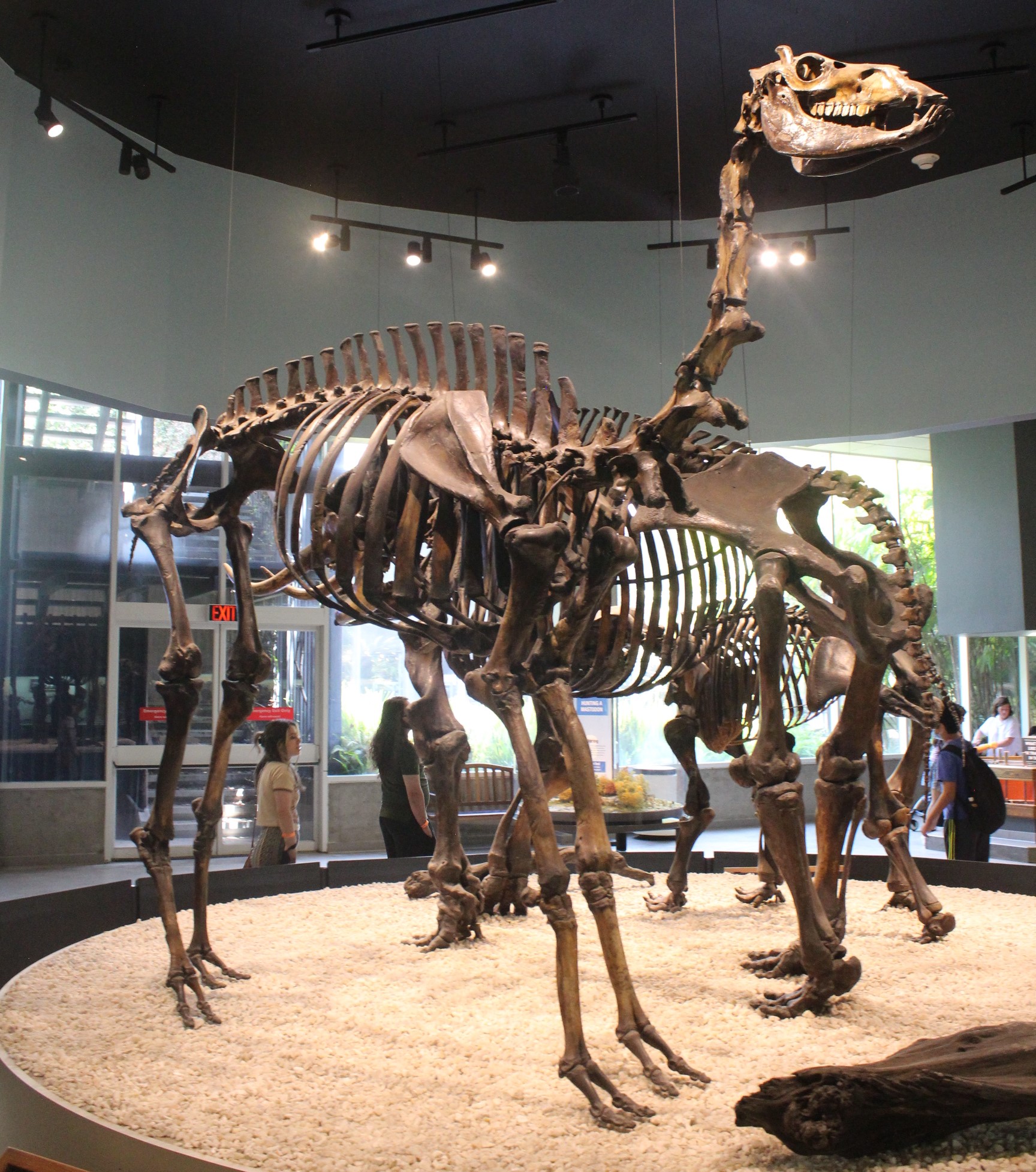
| Mounted skeleton of Camelops hesternus in the George C. Page Museum, Los Angeles | |
Scientific classification 
| |
| Kingdom: | Animalia |
| Phylum: | Chordata |
| Class: | Mammalia |
| Order: | Artiodactyla |
| Family: | Camelidae |
| Subfamily: | Camelinae |
| Tribe: | Camelini |
| Genus: | †Camelops Leidy, 1854 |
| Species | |
| |
Camelops is an extinct genus of camel that lived in North and Central America from the middle Pliocene (from around 4-3.2 million years ago) to the end of the Pleistocene (around 13-12,000 years ago). It is more closely related to living camels than to lamines (llamas, alpacas, vicuñas, and guanacos), making it a true camel of the Camelini tribe. Its name is derived from the Ancient Greek κάμηλος (cámēlos, "camel")[1] and ὄψ (óps, "face"),[2] i.e. "camel-face". Camelops lived across Western North America, ranging from the Pacific Coast to the Great Plains, southwards to Honduras and northwards to Alaska. Camelops became extinct as part of the end-Pleistocene extinction event, along with most large mammals across the Americas. The extinctions followed the arrival of humans to the Americas, and evidence has been found indicating that humans butchered Camelops, suggesting that hunting may have been a factor in its extinction.
Taxonomy and evolution
[edit]History of research
[edit]Camelops was first named by Joseph Leidy in 1854, based on a partial maxilla (upper jawbone), that was found in a gravel drift somewhere in the Kansas Territory, with Leidy naming the type species Camelops kansanus in the same publication based on the maxilla. Later authors have judged that while the jawbone undoubtedly represents Camelops, it is too fragmentary to be diagnostic to species, making C. kansanus a nomen dubium. Later in 1874, Leidy named the species Camelops hesternus, based on teeth found in a gravel deposit in Arroyo Las Positas in Livermore Valley, Alameda County in the southern Bay Area of California. Several other species, including Camelops sulcatus named by Edward Drinker Cope in 1893 based on a partial left mandible, found at Rock Creek, Texas, as well as Camelops huerfanensis, named by Francis Whittemore Cragin in 1892 based on remains found along the Huerfano River in Colorado (as well as its claimed subspecies Camelops huerfanensis dallasi named by Richard Swann Lull in 1921 for remains collected along the Trinity River in northeast Texas), Camelops aransas named by Oliver Perry Hay in 1926 for remains including a partial right mandible found on a bank of the Aransas River in southeast Texas, and Camelops traviswhitei named by Mooser and Dalquist in 1975 from remains found in Aguascalientes in central Mexico, are now regarded as junior synonyms of C. hesternus.[3]
Another species, C. minidokiae, named by Hay in 1927 for jaw and teeth remains found in a gravel bed near Minidoka, Idaho, has been suggested to also be potentially valid, given its apparently smaller size than C. hesternus, though other authors have suggested that it is another synonym for C. hesternus. This species is primarily recorded during the Irvingtonian (Early-Middle Pleistocene), though some remains of the species have been reported from the Rancholabrean (late Middle-Late Pleistocene).[3]
Some scientific publications have used the informal names "western camel" and "yesterday's camel" for Camelops.[4][5]
Evolution
[edit]The family Camelidae, which contains the living camels, as well as lamines (the tribe Lamini, which includes the llama, guanaco, alpaca and vicuña), first emerged in North America during the Eocene, around 46-42 million years ago, reaching its apex of diversity during the Miocene epoch (23-5.3 million years ago). The two modern tribes of Camelidae, Camelini and Lamini, are suggested to have diverged during this period, around 17.5-16 million years ago.[6] Living camels are thought to descend from Paracamelus, which crossed the Bering Land Bridge into Eurasia from North America during the Late Miocene, around 6 million years ago.[7] Although historically often assigned to Lamini,[3][8] ancient DNA obtained from Camelops indicates that it is a member of Camelini more closely related to living camels than to lamines, making it a true camel, with an estimated divergence from living camels around 11-10 million years ago.[6]
Phylogenetic relationships of Camelops compared to living and recently extinct camels, after Yuan et al. (2024).[9]
| Camelidae |
| |||||||||||||||||||||||||||
The oldest fossils of Camelops are known from southern North America, dating to around 4-3.2 million years ago during the Pliocene epoch.[6] During the Pliocene and Early Pleistocene epochs (Blancan-Irvingtonian) other camels, such as Gigantocamelus, Blancocamelus, Titanotylopus and cf. Paracamelus were also present in North America,[8][10] but by the Late Pleistocene (Rancholabrean), Camelops represented the last remaining camel in the Americas.[6]
Description
[edit]
Camelops hesternus was a large camel with a bodyform similar to a living dromedary, reaching a shoulder height of 2.3 m (7 ft 7 in)[11] with body mass estimates ranging from 437 kilograms (963 lb)[12] to 826 kilograms (1,821 lb),[13] to around 1,000 kilograms (2,200 lb),[11] though the size of the species was variable, with individuals known from the far north of the species range in Alaska and Yukon being considerably smaller than those from elsewhere.[14] Whether Camelops had humps or not like living camels is uncertain.[11] The skull has 1 incisor, 1 canine, 2 premolars and 3 molars in each half of the upper jaw, and 3 incisors, 1 canine, 1 premolar and 3 molars in each half of the lower jaw. The upper first premolar and both upper and lower second premolars are absent, with the lower first premolar usually absent and only occasionally present. The molar and premolar teeth are very high-crowned (hypsodont), with the molars being slender relative to their length, with the canines, upper third premolar and lower fourth premolar being reduced in size. The premaxilla bone is robust, with the rostrum of the skull being elongate, with the facial region of the skull not exhibiting considerable shortening. The nasal bones are strongly arched.[3] The brain is relatively large, estimated at 990 grams (2.18 lb).[13] The mandible is relatively deep. The limbs are relatively elongate (around 20% longer than those of living dromedaries[11]) but robust. The metapodial bones are robust and relatively short.[3]
Distribution, habitat and ecology
[edit]
During the Pleistocene, Camelops is known from fossils across western North America, ranging from California, Oregon and Washington State, eastwards to South Dakota, Nebraska, Kansas, Oklahoma and Texas, with rarer records further east, including near the Missouri-Illinois border.[15][16] Southwards Camelops ranged to Honduras in Central America.[16] The northernmost records of Camelops are known from Alaska and Yukon, but it probably only occupied this region during warm interglacial intervals, before becoming extirpated from the region during glacial periods, as is thought for some other species whose remains are also rarely found in the region, such as the ground sloth Megalonyx jeffersoni, mastodons and Castoroides giant beavers.[17] Across its range it inhabited a wide variety of habitats, from subtropical environments,[6] to tundra,[11] though it seems to have primarily lived in open habitats.[18] In parts of its range Camelops hesternus co-occurred alongside the lamines Hemiauchenia and Palaeolama.[15]
An isotopic analysis study including specimens across the species range concluded that Camelops hesternus was a browser that consumed shrubbery, including species with a both a C3 and C4 type carbon fixation, as well as possibly those with Crassulacean acid metabolism.[15] A paired dental microwear and δ13C analysis of C. hesternus fossils from two sites in Mexico likewise revealed it to be a browser that fed on C3 and C4 vegetation alike.[19] Plants consumed by Camelops are suggested to include saltbrush (Atriplex),[15][20] a plant also commonly found in the diet of living camels.[20] Other studies have supported a browsing or mixed feeding diet for Camelops,[18][20][21] but a 2021 dental wear analysis study suggested that in some locations such as in Nebraska, Camelops hesternus engaged in grazing, sometimes predominantly so, suggesting that Camelops hesternus was a flexible feeder.[21]

Tracks found in Alberta, Canada suggest that like living camels, Camelops probably lived in herds, which like living camels may have been led by a dominant adult male.[22] Isotopic analysis suggests that Camelops may have engaged in seasonal migrations.[15] As in living camels, Camelops may have had a slow reproductive rate, including giving birth to a single offspring at a time, as well as existing at relatively low population densities due to its large size.[18] Camelops hesternus was probably predated upon by large carnivores, which during the Late Pleistocene may have included dire wolves (Aenocyon dirus)[23] the sabertooth cat Smilodon fatalis,[24] the scimitar-toothed cat (Homotherium serum)[25] and the American lion (Panthera atrox).[26] Specimens of Camelops have been found exhibiting signs of disease like osteoarthritis.[27]
Relationship with humans and extinction
[edit]Camelops went extinct around 13-12,000 years ago as part of the end-Pleistocene extinction event along with most other large mammals across the Americas. These extinctions followed the arrival of humans to the Americas, and it is suggested that human hunting may have had a contributory role in the extinctions (though some authors have argued that climatic change was the most important factor[5]). At Wally's Beach in Alberta, Canada, butchered remains of Camelops hesternus displaying cut and fracture marks, alongside those of caballine true horses are associated with stone tools, with the site radiocarbon dated to around 13,300 years ago. This represents the only confirmed Camelops butchery site. The site was originally attributed to the Clovis culture based on the similar timing as well as findings of unassociated Clovis points within the local area, but the site does not display clear evidence of Clovis-type tools.[28] Some authors have suggested that fractured bones of Camelops found near Casper, Wyoming (which also represent the youngest well-dated remains of the species, dating to around 13,060 years Before Present[11]) may represent a butchery site, but this is not definitive.[29] Other possible, but not definitive sites where Camelops remains may be associated with human activity include Carter/Kerr-McGee and Colby sites in Wyoming (the latter of which is associated with a Clovis point) and the Lehner site in Arizona.[30] A sacrum of Camelops found near Tequixquiac in central Mexico has been suggested to have been shaped to resemble an animal head.[31]
See also
[edit]
- Aepycamelus
- Eulamaops
- Oxydactylus
- Poebrotherium
- Procamelus
- Protylopus
- Stenomylus
- Syrian camel, an extinct species that reached at least 9 feet (2.7 m) tall at the shoulder
- Pleistocene megafauna
- Snowmastodon Project
References
[edit]- ^ κάμηλος. Liddell, Henry George; Scott, Robert; A Greek–English Lexicon at the Perseus Project
- ^ ὄψ. Liddell, Henry George; Scott, Robert; A Greek–English Lexicon at the Perseus Project
- ^ a b c d e Baskin, Jon; Thomas, Ronny (2016-02-17). "A review of Camelops (Mammalia, Artiodactyla, Camelidae), a giant llama from the Middle and Late Pleistocene (Irvingtonian and Rancholabrean) of North America". Historical Biology. 28 (1–2): 120–127. Bibcode:2016HBio...28..120B. doi:10.1080/08912963.2015.1020800. ISSN 0891-2963.
- ^ Zazula, Grant D.; Turner, Derek G.; Ward, Brent C.; Bond, Jeffrey (September 2011). "Last interglacial western camel (Camelops hesternus) from eastern Beringia". Quaternary Science Reviews. 30 (19–20): 2355–2360. Bibcode:2011QSRv...30.2355Z. doi:10.1016/j.quascirev.2011.06.010.
- ^ a b Grayson, Donald K.; Meltzer, David J. (May 2003). "A requiem for North American overkill". Journal of Archaeological Science. 30 (5): 585–593. Bibcode:2003JArSc..30..585G. doi:10.1016/S0305-4403(02)00205-4.
- ^ a b c d e Heintzman, Peter D.; Zazula, Grant D.; Cahill, James A.; Reyes, Alberto V.; MacPhee, Ross D.E.; Shapiro, Beth (2 June 2015). "Genomic Data from Extinct North American Camelops Revise Camel Evolutionary History". Molecular Biology and Evolution. 32 (9): 2433–2440. doi:10.1093/molbev/msv128. ISSN 0737-4038. PMID 26037535.
- ^ Colombero, Simone; Bonelli, Edmondo; Pavia, Marco; Repetto, Giovanni; Carnevale, Giorgio (2016). "Paracamelus (Mammalia, Camelidae) remains from the late Messinian of Italy: insights into the last camels of western Europe". Historical Biology. 29 (4): 509–518. doi:10.1080/08912963.2016.1206539. ISSN 0891-2963. S2CID 132350588.
- ^ a b Harrison, J. A. Giant camels from the Cenozoic of North America. Smithsonian Contribution to Paleobiology 57, 1–29 (1985) .
- ^ Yuan, Junxia; Hu, Jiaming; Liu, Wenhui; Chen, Shungang; Zhang, Fengli; Wang, Siren; Zhang, Zhen; Wang, Linying; Xiao, Bo; Li, Fuqiang; Hofreiter, Michael; Lai, Xulong; Westbury, Michael V.; Sheng, Guilian (May 2024). "Camelus knoblochi genome reveals the complex evolutionary history of Old World camels". Current Biology. 34 (11): 2502–2508.e5. Bibcode:2024CBio...34.2502Y. doi:10.1016/j.cub.2024.04.050. PMID 38754423.
- ^ Rybczynski, Natalia; Gosse, John C.; Richard Harington, C.; Wogelius, Roy A.; Hidy, Alan J.; Buckley, Mike (2013-03-05). "Mid-Pliocene warm-period deposits in the High Arctic yield insight into camel evolution". Nature Communications. 4 (1): 1550. Bibcode:2013NatCo...4.1550R. doi:10.1038/ncomms2516. ISSN 2041-1723. PMC 3615376. PMID 23462993.
- ^ a b c d e f Anthony J. Stuart, 2021, Vanished Giants: The Lost World of the Ice Age, "6.17 Yesterday's Camel: Camelops Hesternus", p.99, University of Chicago Press
- ^ Bravo-Cuevas, Victor Manuel; Arroyo-Cabrales, Joaquín; Priego-Vargas, Jaime (2016-08-25). "The record of camelids (Artiodactyla, Camelidae) from the Valsequillo Basin, late Pleistocene of Puebla State, Central Mexico: taxonomy, diet, and geographic distribution" (PDF). Revista Brasileira de Paleontologia. 19 (2): 243–258. Bibcode:2016RvBrP..19..243B. doi:10.4072/rbp.2016.2.08.
- ^ a b Balcarcel, Ana M.; Bastiaans, Dylan; Orliac, Maeva J. (2023). "Endocranial Casts of Camelops hesternus and Palaeolama sp.: New Insights into the Recent History of the Camelid Brain". Brain, Behavior and Evolution. 98 (2): 107–120. doi:10.1159/000528762. ISSN 0006-8977. PMC 10137315. PMID 36574756.
- ^ Zazula, Grant D.; Macphee, Ross D. E.; Hall, Elizabeth; Hewitson, Susan (2016-10-18). "Osteological Assessment of Pleistocene Camelops hesternus (Camelidae: Camelinae: Camelini) from Alaska and Yukon". American Museum Novitates (3866): 1–45. doi:10.1206/3866.1. ISSN 0003-0082.
- ^ a b c d e Yann, Lindsey T.; DeSantis, Larisa R.G.; Koch, Paul L.; Lundelius, Ernest L. (November 2016). "Dietary ecology of Pleistocene camelids: Influences of climate, environment, and sympatric taxa". Palaeogeography, Palaeoclimatology, Palaeoecology. 461: 389–400. Bibcode:2016PPP...461..389Y. doi:10.1016/j.palaeo.2016.08.036.
- ^ a b Heintzman, Peter D.; Zazula, Grant D.; Cahill, James A.; Reyes, Alberto V.; MacPhee, Ross D.E.; Shapiro, Beth (September 2015). "Genomic Data from Extinct North American Camelops Revise Camel Evolutionary History". Molecular Biology and Evolution. 32 (9): 2433–2440. doi:10.1093/molbev/msv128. ISSN 0737-4038. PMID 26037535.
- ^ Zazula, Grant D.; MacPhee, Ross D.E.; Southon, John; Nalawade-Chavan, Shweta; Reyes, Alberto V.; Hewitson, Susan; Hall, Elizabeth (September 2017). "A case of early Wisconsinan "over-chill": New radiocarbon evidence for early extirpation of western camel (Camelops hesternus) in eastern Beringia". Quaternary Science Reviews. 171: 48–57. Bibcode:2017QSRv..171...48Z. doi:10.1016/j.quascirev.2017.06.031.
- ^ a b c Carbot-Chanona, Gerardo; Jiménez-Moreno, Francisco Javier; Palomino-Merino, Martín Rodolfo; Agustín-Serrano, Ricardo (October 2023). "A new specimen of Camelops hesternus (Artiodactyla, Camelidae) from Valsequillo, Puebla, Mexico, with comments about their dietary preferences and the population density of the species". Journal of South American Earth Sciences. 130 104594. Bibcode:2023JSAES.13004594C. doi:10.1016/j.jsames.2023.104594.
- ^ Marín-Leyva, Alejandro Hiram; Delgado-García, Sabrina; García-Zepeda, María Luisa; Arroyo-Cabrales, Joaquín; López-García, J. Ramón; Plata-Ramírez, Ramón Adrián; Meléndez-Herrera, Esperanza (3 June 2023). "Environmental inferences based on the dietary ecology of camelids from west-central Mexico during the Late Pleistocene". Historical Biology. 35 (6): 1011–1027. doi:10.1080/08912963.2022.2073822. ISSN 0891-2963. Retrieved 23 October 2025 – via Taylor and Francis Online.
- ^ a b c Trayler, Robin B.; Dundas, Robert G.; Fox-Dobbs, Kena; Van De Water, Peter K. (November 2015). "Inland California during the Pleistocene—Megafaunal stable isotope records reveal new paleoecological and paleoenvironmental insights". Palaeogeography, Palaeoclimatology, Palaeoecology. 437: 132–140. Bibcode:2015PPP...437..132T. doi:10.1016/j.palaeo.2015.07.034.
- ^ a b Cohen, Joshua E.; DeSantis, Larisa R.G.; Lindsey, Emily L.; Meachen, Julie A.; O'Keefe, F. Robin; Southon, John R.; Binder, Wendy J. (May 2021). "Dietary stability inferred from dental mesowear analysis in large ungulates from Rancho La Brea and opportunistic feeding during the late Pleistocene". Palaeogeography, Palaeoclimatology, Palaeoecology. 570 110360. Bibcode:2021PPP...57010360C. doi:10.1016/j.palaeo.2021.110360.
- ^ P. McNeil, L.V. Hills, S.M. Tolman, B. Kooyman Significance of latest Pleistocene tracks, trackways and trample grounds from southern Alberta Canada Bull. N. M.Mus. Nat. Hist. Sci., 42 (2007), pp. 209-224
- ^ Ripple, William J.; Van Valkenburgh, Blaire (1 August 2010). "Linking Top-down Forces to the Pleistocene Megafaunal Extinctions". BioScience. 60 (7): 516–526. doi:10.1525/bio.2010.60.7.7. ISSN 1525-3244.
- ^ Christiansen, Per; Harris, John M. (18 October 2005). "Body size of Smilodon (Mammalia: Felidae)". Journal of Morphology. 266 (3): 369–384. Bibcode:2005JMorp.266..369C. doi:10.1002/jmor.10384. ISSN 0362-2525. PMID 16235255.
- ^ DeSantis, Larisa R. G.; Feranec, Robert S.; Antón, Mauricio; Lundelius, Ernest L. (21 June 2021). "Dietary ecology of the scimitar-toothed cat Homotherium serum". Current Biology. 31 (12): 2674–2681.e3. Bibcode:2021CBio...31E2674D. doi:10.1016/j.cub.2021.03.061. PMID 33862006.
- ^ Fuller, Benjamin T.; Fahrni, Simon M.; Harris, John M.; Farrell, Aisling B.; Coltrain, Joan B.; Gerhart, Laci M.; Ward, Joy K.; Taylor, R.E.; Southon, John R. (August 2014). "Ultrafiltration for asphalt removal from bone collagen for radiocarbon dating and isotopic analysis of Pleistocene fauna at the tar pits of Rancho La Brea, Los Angeles, California". Quaternary Geochronology. 22: 85–98. Bibcode:2014QuGeo..22...85F. doi:10.1016/j.quageo.2014.03.002.
- ^ Morgan, Gary S.; Rinehart, Larry F. (2007). "Late Pleistocene (Rancholabrean) mammals from fissure deposits in the Jurassic Todilto Formation, White Mesa mine, Sandoval County, north-central New Mexico". New Mexico Geology. 29 (2): 39–51. doi:10.58799/NMG-v29n2.39. ISSN 2837-6420.
- ^ Waters, Michael R.; Stafford, Thomas W.; Kooyman, Brian; Hills, L. V. (7 April 2015). "Late Pleistocene horse and camel hunting at the southern margin of the ice-free corridor: Reassessing the age of Wally's Beach, Canada". Proceedings of the National Academy of Sciences of the United States of America. 112 (14): 4263–4267. Bibcode:2015PNAS..112.4263W. doi:10.1073/pnas.1420650112. ISSN 0027-8424. PMC 4394292. PMID 25831543.
- ^ Waters, Michael R.; Stafford, Thomas W.; Carlson, David L. (23 October 2020). "The age of Clovis—13,050 to 12,750 cal yr B.P." Science Advances. 6 (43) eaaz0455. Bibcode:2020SciA....6..455W. doi:10.1126/sciadv.aaz0455. ISSN 2375-2548. PMC 7577710. PMID 33087355.
- ^ Haynes, Gary; Stanford, Dennis (September 1984). "On the Possible Utilization of Camelops by Early Man in North America". Quaternary Research. 22 (2): 216–230. Bibcode:1984QuRes..22..216H. doi:10.1016/0033-5894(84)90041-3. ISSN 0033-5894.
- ^ Ardelean, Ciprian F.; Arroyo-Cabrales, Joaquin; Rivera-González, Irán; Solís-Rosales, Corina; Rodríguez-Ceja, María; Macías-Quintero, Juan Ignacio; Sánchez-Vázquez, Valeria M.; Mitrani, Alejandro; Ruvalcaba-Sil, José Luis (April 2023). "Oldest art or symbolic expressions in North America? Pleistocene modified bones and a human remain at Sima de las Golondrinas cave, Zacatecas, Mexico". L'Anthropologie. 127 (2) 103135. doi:10.1016/j.anthro.2023.103135.