Hubbry Logo
Molar (tooth)Molar (tooth)Main
Open search
Molar (tooth)
Community hub
Molar (tooth)
logo
8 pages, 0 posts
0 subscribers
Be the first to start a discussion here.
Molar (tooth)
Molar (tooth)
from Wikipedia

Molar
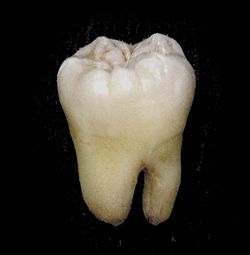
A lower wisdom tooth after extraction.
Permanent teeth of right half of lower dental arch, seen from above: In this diagram, a healthy wisdom tooth (third, rearmost molar) is included
Details
ArteryPosterior superior alveolar artery
Identifiers
Latindentes molares
MeSHD008963
TA98A05.1.03.007
TA2910
FMA55638
Anatomical terminology

The molars or molar teeth are large, flat teeth at the back of the mouth. They are more developed in mammals. They are used primarily to grind food during chewing. The name molar derives from Latin, molaris dens, meaning "millstone tooth", from mola, millstone and dens, tooth. Molars show a great deal of diversity in size and shape across the mammal groups. The third molar of humans is sometimes vestigial.

Human anatomy

[edit]

In humans, the molar teeth have either four or five cusps. Adult humans have 12 molars, in four groups of three at the back of the mouth. The third, rearmost molar in each group is called a wisdom tooth. It is the last tooth to appear, breaking through the front of the gum at about the age of 20, although this varies among individuals and populations, and in many cases the tooth is missing.[1]

The human mouth contains upper (maxillary) and lower (mandibular) molars. They are: maxillary first molar, maxillary second molar, maxillary third molar, mandibular first molar, mandibular second molar, and mandibular third molar.

Mammal evolution

[edit]

In mammals, the crown of the molars and premolars is folded into a wide range of complex shapes. The basic elements of the crown are the more or less conical projections called cusps and the valleys that separate them. The cusps contain both dentine and enamel, whereas minor projections on the crown, called crenulations, are the result of different enamel thickness. Cusps are occasionally joined to form ridges and expanded to form crests. Cingula are often incomplete ridges that pass around the base of the crown.[2]

Mammalian, multicusped cheek teeth probably evolved from single-cusped teeth in synapsids, although the diversity of therapsid molar patterns and the complexity in the molars of the earliest mammals make determining how this happened impossible. According to the widely accepted "differentiation theory", additional cusps have arisen by budding or outgrowth from the crown, while the rivalling "concrescence theory" instead proposes that complex teeth evolved by the clustering of originally separate conical teeth. Therian mammals (placentals and marsupials) are generally agreed to have evolved from an ancestor with tribosphenic cheek teeth, with three main cusps arranged in a triangle.[2]

Comparison of cheek teeth in various taxa: 1, a single-cusped pelycosaur; 2, Dromatherium (a Triassic cynodont); 3, Microconodon (a Triassic eucynodont); 4, Spalacotherium (a Cretaceous "symmetrodont"); 5, Amphitherium (a Jurassic prototribosphenid mammal)

Morphology

[edit]
Image showing molar teeth and their arrangement in the mouth of an adult human

Each major cusp on an upper molar is called a cone and is identified by a prefix dependent on its relative location on the tooth: proto-, para-, meta-, hypo-, and ento-. Suffixes are added to these names: -id is added to cusps on a lower molar (e.g., protoconid); -ule to a minor cusp (e.g., protoconulid). A shelf-like ridge on the lower part of the crown (on an upper molar) is called a cingulum; the same feature on the lower molar a cingulid, and a minor cusp on these, for example, a cingular cuspule or conulid.[3]

Tribosphenic

[edit]
A diagram of generalized tribosphenic molars with notable features labelled. Upper left molar in pink, lower left molar in blue.

The design that is considered one of the most important characteristics of therian mammals is called a tribosphenic molar. Among living mammals, the tribosphenic tooth is found in most insectivorous mammals as well as young platypuses, even though adult platypuses are toothless.

In tribosphenic teeth, the lower molar is divided into two regions: the three-cusped trigonid, or shearing end, and the talonid, or crushing heel. In modern tribosphenic molars, the trigonid is towards the front of the jaw and the talonid is towards the rear. The trigonid is defined by three large cusps: the protoconid is on the buccal/labial (cheek) side of the tooth, while the anterior paraconid and posterior metaconid are on the lingual (tongue) side.

Generalized tribosphenic left upper molar, showing the protocone, paracone, and metacone.

Upper molars look like three-pointed mountain ranges, with their features mirrored from the lower molars. The protocone cusp is on the lingual side of the tooth, while the anterior paracone and posterior metacone are on the buccal side. The protocone of the upper molar and talonid basin of the lower molar mesh together as a crushing system similar to a mortar and pestle.

Tribosphenic molars were present in the direct ancestors of all three living mammal groups, but it was most likely not ancestral to mammals as a whole. Many paleontologists argue that it developed independently in monotremes (from australosphenidans), rather than being inherited from a common ancestor that they share with marsupials and placentals (from boreosphenidans); this idea still has some critics.[4] For example, the dentition of the Early Cretaceous monotreme Steropodon is similar to those of Peramus and dryolestoids, which suggests that monotremes are related to some pre-tribosphenic mammals,[5] but, on the other hand, the status of neither of these two groups is well-established.

Some Jurassic mammalia forms, such as docodonts and shuotheriids, have "reversed tribosphenic" molars, in which a talonid-like structure develops towards the front of the lower molar, rather than towards the rear. This variant is regarded as an example of convergent evolution.[6]

Quadrate

[edit]
Pig tooth

From the primitive tribosphenic tooth, molars have diversified into several unique morphologies. In many groups, a fourth cusp, the hypocone (hypoconid), subsequently evolved (see below). Quadrate (also called quadritubercular or euthemorphic) molars have a hypocone, an additional fourth cusp on the lingual (tongue) side of the upper molar, located posterior to the protocone. Quadrate molars appeared early in mammal evolution and are present in many species, including hedgehogs, raccoons, and many primates, including humans.[7] There may be a fifth cusp.

In many mammals, additional smaller cusps called conules appear between the larger cusps. They are named after their locations, e.g. a paraconule is located between a paracone and a metacone, a hypoconulid is located between a hypoconid and an entoconid.[7]

Bunodont

[edit]
Upper and lower dentition of a chimpanzee

In bunodont molars, the cusps are low and rounded hills rather than sharp peaks. They are most common among omnivores such as pigs, bears, and humans.[7] Bunodont molars are effective crushing devices and often basically quadrate in shape.[8]

Hypsodont

[edit]

Hypsodont dentition is characterized by high-crowned teeth and enamel that extends far past the gum line, which provides extra material for wear and tear.[9] Some examples of animals with hypsodont dentition are cattle and horses, all animals that feed on gritty, fibrous material. Hypsodont molars can continue to grow throughout life, for example in some species of Arvicolinae (herbivorous rodents).[7]

Hypsodont molars lack both a crown and a neck. The occlusal surface is rough and mostly flat, adapted for crushing and grinding plant material. The body is covered with cementum both above and below the gingival line, below which is a layer of enamel covering the entire length of the body. The cementum and the enamel invaginate into the thick layer of dentin.[10]

Brachydont

[edit]

The opposite condition to hypsodont is called brachydont or brachyodont (from brachys 'short'). It is a type of dentition characterized by low-crowned teeth. Human teeth are brachydont.[7]

A brachydont tooth has a crown above the gingival line and a neck just below it, and at least one root. A cap of enamel covers the crown and extends down to the neck. Cementum is only found below the gingival line. The occlusal surfaces tend to be pointed, well-suited for holding prey and tearing and shredding.[10]

Zalambdodont

[edit]

Zalambdodont upper molars have at least three main cusps, one larger on the lingual side and two smaller on the labial side. The large cusp is joined to the other two by crests, forming a narrow V- or λ (lambda)-shape. The term "zalambdodont" roughly translates to "very lambda-toothed". Zalambdodont molars are found in tenrecs, golden moles, solenodons, and marsupial moles among living mammals.[3][11]

In zalambdodont placentals, the larger inner cusp is homologous with the paracone in a tribosphenic upper molar, while the metacone is absent, reduced or fused. Marsupial moles show the opposite condition, with the large cusp equivalent to the metacone, and the paracone absent instead. The protocone is either absent (as in some golden moles and tenrecs) or reduced to a small fourth cusp, positioned lingual to the large cusp at the tip of the V. The two labial cusps are located on an expanded shelf called the stylar shelf. In the lower molars, the talonid region is reduced or absent, having lost its role as a crushing basin against the protocone.[3][11] Zalambdodonty reduces tooth contact to a few simple shearing surfaces, though the evolutionary advantage of this tooth type is unclear.[11]

Dilambdodont

[edit]

Like zalambdodont molars, dilambdodont molars have a distinct ectoloph, but are shaped like two lambdas or a W. On the lingual side, at the bottom of the W, are the metacone and paracone, and the stylar shelf is on the labial side. A protocone is present lingual to the ectoloph. Dilambdodont molars are present in shrews, moles, and some insectivorous bats.[7]

Lophodont

[edit]
Lophodont molars of Elephas (left) and Loxodonta (center), compared to the nonlophodont mastodon (right)
Rodent molars (left) compared to an elephant molar, 2019

Lophodont teeth are easily identified by the differentiating patterns of ridges or lophs of enamel interconnecting the cusps on the crowns. Present in most herbivores, these patterns of lophs can be a simple, ring-like edge, as in mole rats, or a complex arrangement of series of ridges and cross-ridges, as those in odd-toed ungulates, such as equids.[8]

Lophodont molars have hard and elongated enamel ridges called lophs oriented either along or perpendicular to the dental row. Lophodont molars are common in herbivores that grind their food thoroughly. Examples include tapirs, manatees, and many rodents.[7]

When two lophs form transverse, often ring-shaped, ridges on a tooth, the arrangement is called bilophodont. This pattern is common in primates, but can also be found in lagomorphs (hares, rabbits, and pikas) and some rodents.[7][8]

Extreme forms of lophodonty in elephants and some rodents (such as Otomys) is known as loxodonty.[7] The African elephant belongs to a genus called Loxodonta because of this feature.

Selenodont

[edit]

In selenodont molars (so-named after moon goddess Selene), the major cusp is elongated into crescent-shaped ridge. Examples include most even-toed ungulates, such as cattle and deer.[7][8]

Secodont

[edit]
Carnassials of a Eurasian wolf

Many carnivorous mammals have enlarged and blade-like teeth especially adapted for slicing and chopping called carnassials. A general term for such blade-like teeth is secodont or plagiaulacoid.[7]

See also

[edit]

Notes

[edit]

References

[edit]
[edit]
Revisions and contributorsEdit on WikipediaRead on Wikipedia
from Grokipedia
A molar is a type of characterized by its large size, broad, flat occlusal surface, and multiple cusps, positioned posteriorly in the dental arches of s and other mammals for the primary purpose of grinding and pulverizing during mastication. In the permanent , there are twelve molars—three in each of the four quadrants—comprising the first, second, and third () molars, with no predecessors for the permanent molars. Human is diphyodont, featuring two sets of teeth: primary () and permanent, with primary molars erupting between approximately 12–33 months of age and serving similar grinding functions before being replaced. Permanent molars erupt later, with first molars typically around age 6, second molars around , and third molars between ages 17–25, though the latter often require surgical extraction if impacted. Structurally, molars consist of a crown covered in enamel—the hardest substance in the body—supported by , enclosing a pulp chamber with nerves and blood vessels, and anchored by two to three embedded in the jawbone. Beyond mastication, molars contribute to overall oral functions such as speech articulation, maintaining airway patency, and facial aesthetics, with their loss potentially leading to functional deficits if fewer than 20 teeth remain.

General Features

Definition and Location

Molars are the posterior-most teeth in the mammalian , specialized for grinding and crushing food through their broad, multicuspid crowns that facilitate mastication of tougher substances. They are distinguished from such as incisors, which primarily cut food; canines, adapted for tearing; and premolars, which perform initial shearing and grinding before the molars' more thorough processing. This functional specialization arises from their development posterior to the incisors in the jaws of mammals, where they form from distinct tooth germs. The term "molar" originates from the Latin molaris, meaning "," a that aptly reflects their role in pulverizing akin to a grinding stone. In mammalian jaws, molars occupy the rearmost positions in each quadrant of the dental arcade, providing maximal leverage for occlusal forces during . In humans, they correspond to teeth numbered 6 through 8 in the Fédération Dentaire Internationale (FDI) , encompassing the first, second, and third molars in both the maxillary and mandibular arches. While true molars—characterized by their permanent, nature and complex cuspidation—are exclusive to mammals, analogous posterior grinding teeth appear in other vertebrates. In some reptiles, such as certain and crocodilians, flattened posterior serves similar crushing functions, though these are typically homodont and continuously replaced. Among , pharyngeal or molariform teeth in species like enable grinding of plant material, representing convergent adaptations for posterior mastication despite lacking the mammalian occlusal morphology.

Basic Components

Molar teeth consist of a , , and internal structures, each contributing to their role in mastication. The is the visible portion above the gum line, primarily covered by enamel, the hardest substance in the , which protects the underlying from wear during chewing. The occlusal surface of the features cusps (also known as tubercles), which are elevated projections, along with fissures and grooves that form depressions and channels to facilitate the grinding and processing of food. These elements create a complex adapted for posterior occlusion. The roots anchor the molar in the jawbone, typically numbering two to three per tooth to provide stability against grinding forces. Covered by cementum, a mineralized tissue similar to bone, the roots extend into the alveolar socket and are connected via the periodontal ligament. Internally, molars contain a pulp chamber housing nerves, blood vessels, and connective tissue, which supplies vitality to the tooth. Beneath the enamel and surrounding the pulp, dentin forms the bulk of the tooth's structure, a resilient, calcified layer that supports the enamel while transmitting sensations from the pulp. Occlusal features include ridges, or lophs, which connect cusps and enhance shearing efficiency during mastication. Molars generally exhibit larger dimensions than , with crowns broader and taller to accommodate greater occlusal loads, though crown height varies based on functional demands.

Function and Role

In Mastication

Molars play a central role in mastication through their specialized grinding mechanism, utilizing the occlusal surfaces to crush and pulverize food particles during vertical closure and lateral excursions of the . This action involves the cusps and ridges of the molars shearing against opposing teeth, effectively reducing food to smaller sizes suitable for and further . The posterior position of molars enhances leverage, allowing for efficient force application during these movements. In the interaction between the maxillary and mandibular molars, occlusion forms dynamic as the translates laterally and transversely during the power stroke of . Upper and lower molars align to create shearing and compressive forces, with occlusal pressures in humans reaching 150-250 psi in the molar region, enabling the breakdown of resistant items. These facilitate a mortar-and-pestle-like motion, where transverse mandibular movements grind between the enamel ridges and valleys of opposing . Molars are particularly adapted for processing tough material and , where their broad, multi-cusped surfaces efficiently grind fibrous or resilient tissues into finer particles, thereby increasing surface area for enzymatic action in subsequent . This adaptation is evident in the ability of molars to handle abrasive foods like seeds or tough fibers, reducing through repeated occlusal contacts. The function of molars in mastication is supported by key jaw musculature, including the masseter and temporalis muscles, which generate the elevating and stabilizing forces necessary for occlusal engagement. The masseter provides powerful vertical closure to apply grinding pressure, while the temporalis assists in lateral movements and retrusion, ensuring coordinated molar occlusion throughout the chewing cycle.

Contribution to Digestion

Molars play a pivotal role in by mechanically reducing food particles to smaller sizes, thereby substantially increasing the surface area exposed to and microbial activity in the . This process begins the breakdown of complex food structures, allowing for more efficient extraction downstream. Specifically, the grinding action of molars facilitates the incorporation of , which contains α-amylase—an that hydrolyzes starches into simpler sugars, initiating before the food reaches the . Without adequate molar function, larger food particles would limit this initial enzymatic action, reducing overall digestive efficiency. In herbivores, molars are particularly adapted to handle tough, fibrous vegetation, grinding it into fine particles that enhance in specialized gut compartments like the . This particle size reduction is essential for symbiotic microorganisms to access and degrade , the primary structural component of cell walls, enabling the release of volatile fatty acids as an source. For instance, in ruminants, molars ensure that material is sufficiently pulverized to support microbial breakdown, which accounts for a significant portion of the animal's caloric intake. In contrast, omnivores rely on molars for balanced grinding of diverse types, including both fibrous and softer animal tissues, optimizing preparation for gastric and intestinal processing without specialized . Efficient molar function also has direct health implications for , as it promotes the formation of a well-mixed bolus that is easier for the to handle, thereby reducing the risk of , , and other discomforts associated with undigested large food masses. Poor mastication due to molar inefficiencies can overload the with unprocessed boluses, leading to prolonged gastric retention and impaired absorption. Evolutionarily, the specialization of molars has been instrumental in enabling dietary diversification among vertebrates, particularly mammals, by enhancing food preparation for varied nutritional needs—from the crushing of exoskeletons in insectivorous ancestors to the extensive grinding required for herbivorous diets rich in recalcitrant fibers. This functional versatility allowed early mammals to exploit new ecological niches, with molar adaptations correlating to shifts in feeding strategies over millions of years.

Human Molars

Number and Types

In human permanent dentition, there are 12 molars, consisting of three per quadrant: the first molar, second molar, and third molar (also known as the ). These molars are located in the posterior region of the mouth, behind the premolars. In deciduous dentition, children have 8 molars, with two per quadrant: the first and second deciduous molars, which are eventually replaced by the permanent molars. The first molars, often called the 6-year molars, are the earliest to erupt among the permanent molars and play a key role in establishing proper occlusion. The second molars, sometimes referred to as 12-year molars, follow in development. The third molars typically emerge later and are frequently subject to impaction due to limited space in the . Variations in molar number occur, including , where third molars are absent in approximately 20-25% of the population worldwide, with higher rates observed in certain ethnic groups such as Asians. , the presence of supernumerary teeth, is less common overall (affecting up to 3.8% of individuals) and rarely involves extra molars specifically.

Detailed Anatomy

Human permanent molars exhibit a complex anatomy adapted for grinding and crushing food, consisting of a crown, root system, and internal tissues. The crown features an occlusal surface with cusps, while the roots anchor the tooth in the alveolar bone. There are 12 permanent molars in total, six in each dental arch. The maxillary first molar, the largest in the upper arch, typically possesses four to five cusps: mesiobuccal, distobuccal, mesiolingual, and distolingual, with an occasional fifth cusp of Carabelli on the mesiolingual aspect. It has three roots—two buccal (mesio- and disto-) and one palatal—providing robust anchorage, and its occlusal surface is the broadest among molars, measuring approximately 10-12 mm mesiodistally. The occlusal surface includes central and distal fossae separated by developmental ridges, with fissures and pits forming an H-shaped groove pattern that aids in food retention during mastication. The is structurally similar to the first but smaller in overall dimensions, with four primary cusps and a reduced or absent fifth cusp. It also features three roots arranged similarly, though the palatal root may be slightly shorter. The occlusal surface displays a more transverse ridge prominence and shallower fissures compared to the first molar, with pits often located at the junction of the central groove and marginal ridges. The maxillary third molar, or , shows significant variability in form, often with three to four cusps and irregular fusion, commonly three that may merge into two or even one. Its occlusal surface is smaller and more oval, prone to deep pits and convoluted grooves that increase susceptibility to developmental anomalies. In the mandibular arch, the first molar is the largest, featuring five cusps: two buccal (mesio- and disto-), two lingual, and one distal, arranged in a rectangular occlusal outline. It has two —a wider mesial and a narrower distal —with the mesial often bifurcated. The occlusal surface exhibits a characteristic Y-shaped groove pattern, with the central connecting buccal and lingual grooves, and pits at the developmental lobe junctions. The mandibular second molar resembles the first but is slightly smaller, typically with four cusps (lacking a prominent distal cusp or having it reduced). It shares the two-root configuration, with roots that are more tapered. The occlusal grooves form a less pronounced , featuring supplemental grooves and shallower pits that distinguish it from the first molar. The mandibular third molar is highly variable, often with three to four cusps and two fused , though separate mesial and distal occur in some cases. Its occlusal surface is irregular, with multiple fissures, deep pits, and extra grooves due to incomplete lobe separation, contributing to its unpredictable morphology. Internally, molars are composed of enamel covering the crown, forming the bulk, and pulp within the core. Enamel, the hardest tissue, is thickest on cuspal tips at 1-2 mm, thinning toward fissures and cervical areas to protect against wear. underlies the enamel, containing tubules that radiate from the pulp outward, facilitating sensory response and nutrient transport. Pulp horns extend toward each cusp, housing vascular and neural elements that are most prominent under major cusps.

Development and Eruption

Odontogenesis

Odontogenesis, the process of tooth formation, begins during the sixth week of human gestation with the initiation stage, where the oral epithelium thickens to form the dental lamina, a band of tissue that gives rise to successive generations of teeth, including the primary and permanent molars. At this point, localized thickenings known as dental placodes emerge within the dental lamina, marking the sites for future tooth development; for molars, these placodes form posteriorly along the lamina, establishing their position in the dental arch. Epithelial-mesenchymal interactions drive this initiation, with signaling molecules from the underlying mesenchyme inducing epithelial budding, while genes such as Pax9 and Msx1 in the dental mesenchyme specify the competence for tooth formation and contribute to molar positioning by regulating mesenchymal condensation. The process advances through the proliferation stage, where epithelial buds elongate and branch from the dental lamina, followed by the bud stage around the 8th week of , characterized by the formation of rounded epithelial buds surrounded by condensing mesenchymal cells that will become the and follicle. Histodifferentiation occurs during the stage (approximately 9-10 weeks), as the epithelial bud invaginates to form a cap-like , with the mesenchymal proliferating beneath it; this stage involves further epithelial-mesenchymal signaling, where Bmp and Fgf pathways, modulated by Pax9 and Msx1, pattern the tooth type and ensure molar-specific development. Cytodifferentiation marks the bell stage (11-12 weeks), where the differentiates into inner and outer enamel epithelium, stellate reticulum, and stratum intermedium, while the forms odontoblasts and the follicle develops into the periodontal ligament precursor; this stage is crucial for establishing the molar's complex cuspal morphology through precise epithelial folding. Apposition begins around the 4th month of for primary molars and slightly later for permanent molars, with odontoblasts secreting dentin matrix and ameloblasts depositing enamel matrix in a rhythmic manner, leading to the incremental growth lines visible in mature teeth. Maturation follows, involving the mineralization and hardening of these matrices, with enamel reaching full while ameloblasts and odontoblasts continue to refine the structure; for molars, this phase extends postnatally, with the crown of the first permanent molar typically completing by 2.5 to 3 years of age, later than due to their larger size and more intricate occlusal surfaces. Molars form later in the developmental sequence compared to incisors and canines, reflecting an anterior-to-posterior gradient in differentiation timing with sequential initiation along the dental lamina. Genetic anomalies during odontogenesis often originate from mutations in key regulatory genes, leading to molar agenesis or malformations; for instance, heterozygous in MSX1 or PAX9 disrupt mesenchymal signaling at the stage, resulting in selective absence of second and third molars (oligodontia) or , as these genes are essential for dental lamina extension and formation in posterior regions. Such disruptions highlight the role of epithelial-mesenchymal reciprocity, where failure in Pax9-Msx1 mediated transcription factors arrests development before , underscoring the precision required for normal molar formation.

Eruption Patterns

In humans, the eruption of permanent molars follows a well-defined timeline within the mixed dentition phase. The first permanent molars, often referred to as the "six-year molars," typically emerge between 6 and 7 years of age in both the and , marking one of the earliest permanent tooth eruptions after the central incisors. The second permanent molars erupt later, around 11 to 13 years for mandibular molars and 12 to 13 years for maxillary ones, usually after the premolars have emerged. Third molars, or wisdom teeth, are the last to appear, generally between 17 and 21 years, though this can vary up to 25 years or require surgical intervention due to variability in development. The sequence of molar eruption is influenced by mandibular and maxillary growth, as well as space availability in the dental arch. First molars emerge distal to the deciduous second molars without replacing any primary teeth, initiating the transition to permanent dentition. Premolars typically follow the first molars, with second molars appearing after premolar eruption, and third molars last, often facing constraints from limited posterior jaw space in modern humans. This progression ensures alignment with overall craniofacial development, though deviations can occur due to genetic or environmental factors affecting bone remodeling and soft tissue adaptation. In general mammals, eruption patterns begin with deciduous molars forming the initial grinding dentition shortly after birth, providing early mastication capability before weaning. Permanent molars then erupt sequentially without direct replacement of deciduous counterparts, with the first permanent molar often coinciding with weaning to support a shift to solid foods; second and third molars follow as the animal matures. In large herbivores, such as or , this process is delayed, with permanent molars erupting over extended periods—sometimes years—due to the need for larger teeth to accommodate diets and prolonged lifespans. Complications during molar eruption are common, particularly for third molars, where impaction occurs in 16.7% to 68.6% of cases due to insufficient space or angulation issues, often necessitating extraction. Up to 70% of individuals may face third molar problems, including impaction or agenesis, linked to evolutionary reductions in jaw size. Eruption cysts, benign fluid-filled sacs over erupting teeth, frequently affect permanent first molars and primary molars, presenting as bluish gingival swellings that are usually self-resolving but may require marsupialization if symptomatic.

Evolutionary History

Origins in Ancestral Vertebrates

The origins of molar teeth trace back to the synapsid lineage of ancestral vertebrates, where early therapsids—mammal-like reptiles of the Permian period—displayed predominantly homodont , featuring uniform conical teeth suited for piercing and grasping. However, by the Late Permian around 252 million years ago, certain therapsid groups, notably dicynodonts, evolved specialized posterior marginal and palatal teeth capable of crushing tough , marking the initial functional specialization of postcanine . These crushing adaptations in dicynodonts, which emerged in the Middle Permian but diversified prominently in the Late Permian, represented a shift toward herbivory and laid the groundwork for more complex occlusal surfaces in later synapsids. This progression intensified in cynodonts, advanced therapsids that appeared in the Late Permian and persisted into the , where heterodonty—differentiation into incisors, canines, and postcanines—became a defining feature. In basal cynodonts, postcanine teeth developed increased morphological complexity, including multiple cusps and varied shapes, evolving from simple crushers into precursors of molars capable of more precise shearing and grinding. Heterodonty first arose among non-mammalian therapsids during the Middle Permian, but cynodonts refined it by enlarging canines and elaborating postcanines, facilitating the transition to mammalian-style occlusion. Fossil evidence from early mammaliaforms illustrates this evolutionary stage; , dating to approximately 200 million years ago in the , exemplifies the triconodont dentition ancestral to later mammals, with postcanine teeth featuring three aligned main cusps that enabled rudimentary of food. These triconodont molars in highlight the incremental buildup of occlusal complexity from cynodont predecessors, bridging reptilian and mammalian dental systems. Underlying these morphological changes is the role of clusters, which establish anterior-posterior regionalization in embryos, influencing the positional identity of posterior teeth and enabling their specialization within the jaw. In synapsids, Hox expression patterns contributed to the genetic circuitry that co-opted ancient regulatory networks for dental diversification, ensuring postcanines developed distinct identities from . This genetic framework, conserved across s, facilitated the evolutionary shift from uniform to zoned dentition observed in therapsid lineages.

Diversification in Mammals

Following the emergence of mammals in the , molar morphology diversified rapidly to accommodate varying diets, with early basal forms primarily adapted for insectivory through pointed, tribosphenic teeth featuring shearing crests for piercing exoskeletons and grinding soft tissues. This configuration, characterized by a protocone and trigon basin, allowed efficient processing of , the dominant source for small, nocturnal proto-mammals, enabling survival in niche environments alongside dinosaurs. As mammalian lineages radiated, dietary shifts drove further adaptations; for instance, the transition to herbivory in clades promoted the evolution of lophodont molars, where transverse ridges formed for grinding fibrous plant material, enhancing nutrient extraction from vegetation. The Cretaceous-Paleogene (K-Pg) mass extinction marked a pivotal temporal phase in molar diversification, unleashing therian mammals into vacated ecological niches and accelerating through increased tooth complexity tied to dietary innovation. Post-K-Pg, herbivorous forms proliferated with multicuspid molars, while carnivorous clades like developed secodont dentition—sharp, blade-like cusps on teeth for shearing flesh and sinew, optimizing meat consumption in predatory lifestyles. Rodents, facing abrasive diets of seeds and roots, evolved molars with high crowns and ever-growing roots to withstand continuous wear during gnawing, supporting their explosive diversification into diverse habitats. In , bunodont molars with low, rounded cusps emerged for omnivorous and frugivorous diets, providing broad crushing surfaces for fruits, nuts, and occasional animal matter, facilitating arboreal adaptations. In modern mammalian lineages, evolutionary trends include the reduction or loss of third molars in response to dietary shifts toward softer foods and reduced jaw size, as seen in where the upper third molar is consistently absent to streamline function, and in some like where prenatal growth rates and allometric changes led to their elimination. This tooth loss reflects broader optimizations for energy-efficient mastication in lineages with access to processed or less demanding diets, underscoring ongoing molar amid environmental pressures.

Morphology

Cuspal and Occlusal Patterns

Molar cusps and occlusal surfaces exhibit diverse patterns adapted to specific dietary and functional demands across mammals, primarily categorized by the arrangement and shape of cusps on the crown. These patterns facilitate functions ranging from crushing and grinding to shearing and puncturing, reflecting adaptations to varied food sources. Bunodont pattern features low, rounded, and conical cusps that form a broad, undulating occlusal surface ideal for crushing and grinding soft or mixed foods such as fruits, , and . This configuration provides efficient puncture and minimal shearing, commonly observed in omnivorous mammals like pigs and certain , where the cusps wear evenly to create a flat grinding plane over time. In contrast, the lophodont pattern is characterized by elongated transverse ridges, or lophs, connecting the cusps across the occlusal surface, forming a series of enamel folds suited for grinding tough, fibrous material. These ridges enhance shearing efficiency during lateral movements, as seen in herbivores such as and , where the pattern supports prolonged mastication of abrasive diets. The selenodont pattern displays crescent-shaped (selene- meaning moon-like) cusps and ridges oriented longitudinally, creating high-crowned surfaces that excel at shearing and grinding foliage with minimal tooth wear. This adaptation is prevalent in even-toed ungulates like deer and camels, where the curved enamel edges facilitate the breakdown of siliceous grasses through precise occlusion. Secodont pattern involves sharp, blade-like cusps and crests arranged for slicing and cutting, emphasizing carnivorous diets with high shearing forces along the occlusal edges. Found in carnivores such as dogs and cats, this pattern prioritizes tensile strength for tearing flesh, with cusps often forming pairs that maintain cutting efficiency despite wear. The tribosphenic pattern, considered a foundational mammalian innovation, consists of a triangular trigon basin on the upper molars opposed by a talonid on the lowers, enabling both crushing and grinding through versatile cusp interlock. This dual-function design, with primary cusps like the protocone and paracone forming the trigon, originated in early mammals and diversified into modern forms, supporting omnivorous habits. Finally, the dilambdodont pattern presents a W- or lambda-shaped arrangement of two transverse crests on upper molars, with a central stylar shelf for piercing and crushing small, hard prey like . This specialized two-lobed structure is typical in insectivorous bats, where the sharp ectoloph crest and accessory cusps optimize puncture and minimal grinding.

Crown Height Adaptations

Molar crown height varies significantly across mammals, reflecting adaptations to dietary abrasion and patterns. These variations range from low-crowned brachydont forms suited to softer, less abrasive foods to tall-crowned structures designed for prolonged exposure to gritty or silica-rich . Transitional mesodont forms occupy intermediate positions in environments with moderate demands. Brachydont molars feature short crowns where the height is less than the crown's mesiodistal length or buccolingual width, with enamel primarily covering the cusps and little reserve material below the gum line. This morphology is typical in consuming low-abrasion diets, such as folivorous , carnivores like dogs and cats, and omnivores including humans and pigs, where teeth do not require extensive replacement of worn tissue. In these forms, the roots are proportionally longer, anchoring the tooth securely without the need for continuous growth. In contrast, hypsodont molars exhibit tall crowns that exceed the length or width of the crown, often extending deep into the alveolus as a reserve that erupts over time to compensate for wear. This adaptation is prevalent in herbivores grazing on abrasive plants laden with silica or environmental grit, such as horses (Equus spp.) and ruminants like cattle (Bos taurus), where the teeth maintain functionality through gradual eruption. In extreme cases, hypsodont molars become hypselodont, continuously growing throughout life without a defined root, as seen in some lagomorphs and certain rodents, ensuring indefinite replacement of occlusal surfaces. Mesodont molars represent an intermediate crown height, with a hypsodonty index (crown height relative to crown length) typically between 0.8 and 1.2, providing a balance for diets involving moderate abrasion. Examples include certain like squirrels and some in transitional habitats, where teeth experience wear from mixed vegetation but do not necessitate full continuous growth. This form allows for extended life without the metabolic costs of perpetual eruption. The primary adaptive advantage of increased crown height, particularly hypsodonty, lies in enhancing the dentition's longevity against erosive forces from dietary silica and particles, thereby supporting sustained nutrient intake in challenging conditions. Studies of herbivorous mammals indicate that hypsodont forms correlate with expanded dietary breadth, including more grasses, and evolve rapidly in response to environmental shifts like . This morphology optimizes occlusal function by delaying exposure of softer until enamel wears sufficiently, maintaining efficient mastication over years.

Specialized Forms

Specialized molar forms represent deviations from typical tribosphenic or bunodont patterns, often tailored to extreme dietary specializations in particular mammalian clades. These variants prioritize shearing, piercing, or enhanced grinding over versatile mastication, enabling exploitation of niche resources like hard-shelled insects or abrasive vegetation. Zalambdodont molars feature a distinctive V-shaped ectoloph crest formed by a single row of conical cusps, with the largest cusp positioned at the lingual apex for precise occlusion. This morphology is prevalent in certain insectivorous mammals, such as solenodons (Solenodon spp.) and golden moles (Chrysochloridae), where the sharp, transversely oriented crests facilitate piercing and crushing exoskeletons of arthropods. Unlike dilambdodont forms, zalambdodont upper molars lack a prominent metacone, reducing complexity while maximizing shear efficiency during jaw closure. Quadrate molars exhibit a square occlusal outline defined by four principal cusps—protocone, paracone, metacone, and hypocone—arranged in a rectangular configuration that supports bilateral grinding motions. Found in various placental mammals, such as hedgehogs, raccoons, and many (including humans), this setup provides additional crushing surface area for processing varied diets including plant material and , with the hypocone enhancing transverse movement and distributing occlusal forces evenly to minimize wear. In camels (Camelidae), selenodont modifications refine crescentic ridges on hypsoprime cusps into elongated, folded enamel bands, optimizing shear along fibrous browse like thorny shrubs. These selenodont adaptations in camels promote efficient of silica-rich vegetation through repeated lateral strokes. Such specialized morphologies underpin ecological niches, particularly in zalambdodont bearers like solenodons, whose V-shaped crests pierce and colonies, supplemented by toxic for subduing swarms. Quadrate and selenodont variants similarly enable sustained exploitation of grinding-intensive diets, from folivory to camelid browsing, reducing in resource-scarce habitats.

References

Add your contribution
Related Hubs
User Avatar
No comments yet.