Hubbry Logo
CanarseeCanarseeMain
Open search
Canarsee
Community hub
Canarsee
logo
8 pages, 0 posts
0 subscribers
Be the first to start a discussion here.
Canarsee
Canarsee
from Wikipedia

The Canarsee were a band of Munsee-speaking Lenape who inhabited the westernmost end of Long Island[4] and Staten Island[3] at the time the Dutch colonized New Amsterdam in the 1620s and 1630s.

Key Information

They are credited with selling the island of Manhattan to the Dutch, even though they only occupied its lower reaches, with the balance the seasonal hunting grounds of the Wecquaesgeek of the Wappinger people to the north.[5]

Name

[edit]

As was common practice early in the days of white European colonisation of North America, a people came to be associated with a place, with its name displacing theirs among the colonies and those associated with them, such as explorers, mapmakers, trading company superiors who sponsored many of the early settlements, and officials in the colonizers' mother country in Europe. This was the case of the "Canarsee" people, also known as Canarsie and Canarse, as well as Canarise, Canarisse, and Canarsii,[6] whose name, to the extent they identified with one, is lost in history. They were also called the Canarse and Canarsie.

The Canarsee were among the peoples who were conflated with other Long Island bands into a group called the Metoac, an aggregation which failed to recognize their linguistic differences and varying tribal affinities.[7]

The name lives on in Canarsie, a neighborhood of Brooklyn — a part of the City of New York which is on Long Island.[8]: 32–35  Nyack at Fort Hamilton in Brooklyn was likely a Canarsee village.[9]

Sale of Manhattan

[edit]

It is the "Canarse" [sic] (possibly from the Nyack Tract), who only utilized the very southern end of Manhattan island, the Manhattoes, as a hunting ground, who are credited with selling Peter Minuit the entirety of the island for $24 in 1626.[5] A confusion of possession on the part of the Canarsees who failed to tell the Dutch that the balance of island was the hunting ground of the Wecquaesgeek, a Wappinger band of southwest Westchester County.[5]

Red Hook Lane Heritage Trail

[edit]

Red Hook Lane, a Canarsee path thru the marshland was in colonial times the main trail from Brooklyn Heights to Red Hook. The Red Hook Lane Heritage Trail in Red Hook marks in a zig-zag fashion where the old indian trail was to Cypress Tree Island. It begins at the Red Hook Lane Arresick.[10]

Notes

[edit]

References

[edit]
Revisions and contributorsEdit on WikipediaRead on Wikipedia
from Grokipedia
The Canarsee, also known as Canarsie or Canarse, were a band of the people who inhabited the southwestern end of , encompassing much of present-day Kings County (), New York, and the shores of prior to European contact. Their name derives from the Lenape term kanarseye, meaning "fenced land" or "fortified place," reflecting their use of enclosures for and defense. Subsisting through seasonal , , shellfish gathering, and cultivation in semi-permanent villages, the Canarsee maintained a clan-based where lands were held collectively. European colonization by the Dutch in the early 17th century led to rapid land dispossession through treaties and conflicts, resulting in their dispersal, assimilation, or relocation by the mid-18th century, with few direct descendants remaining in the area today.

Name and Etymology

Linguistic Origins and Variations

The name Canarsee derives from the Munsee dialect of the Lenape language, an Eastern Algonquian tongue spoken by the indigenous inhabitants of the New York metropolitan region prior to European colonization. It is commonly interpreted as signifying "fenced land," "fenced area," or "fortified place," referring to enclosures or palisades constructed for defense or agriculture in the tribe's coastal settlements. This etymology reflects the practical terminology in Lenape for landscape features altered by human activity, as documented in early colonial records of Dutch interactions with the group. Historical transliterations introduced variations due to the challenges of rendering unwritten Algonquian phonemes into European scripts, particularly Dutch and English orthographies in the . Common alternate spellings include Canarsie, Kanarsie, and Kanarseye, with the modern neighborhood name in adopting Canarsie by the . These differences stem from phonetic approximations, such as the rendering of the glottal or nasal sounds in words, and inconsistencies among early European scribes recording oral names during land transactions or exploratory accounts. No standardized orthography existed at the time, leading to fluidity in European adaptations that persisted into later historical texts.

Territory and Environment

Geographic Extent

The Canarsee, a band of Munsee-speaking , inhabited the western portion of , primarily the lands now comprising Kings County () and adjacent areas of southwestern County in New York. Their core territory centered on coastal and estuarine zones, including and its surrounding wetlands, which supported fishing, shellfish harvesting, and seasonal planting grounds. Key sites within this extent included regions near present-day Canarsie in southeastern , where their chieftaincy maintained headquarters, as well as areas around Gowanus Bay and Flatlands to the west and northwest. These boundaries were not rigidly demarcated as in European land surveys but defined by patterns of resource use, kinship ties, and seasonal mobility, with overlaps involving neighboring groups such as the Rockaway to the east. Dutch colonial records from the 1630s document land transactions with Canarsee sachems for tracts in , confirming control over fertile lowlands and waterfronts extending roughly from vicinity eastward toward the Rockaway . The overall extent covered approximately the southern and eastern fringes of modern , leveraging the bay's marshes for subsistence while facilitating trade routes across the harbor.

Settlement Patterns and Sites

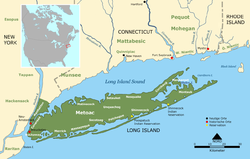
![Map of Long Island territories][float-right] The Canarsee, a subgroup of the , established settlements along the coastal fringes and estuaries of western , particularly in areas now comprising and southern , with evidence suggesting seasonal or semi-permanent occupations oriented toward resource-rich waterways such as . These patterns reflected adaptation to marine and estuarine environments, where villages facilitated fishing, shellfishing, and access to fertile lands for cultivation. Dwellings were clan-held, organized matrilineally, and consisted of bark-covered wigwams clustered in small groups rather than large fortified towns. Documentary accounts from early European observers identify key sites, including the principal village of Canarsee located near Flatlands in southeastern , noted for its proximity to bays and creeks. Additional villages existed at Maspeth in and possibly Hempstead further east, indicating a dispersed network rather than concentrated urbanism. In the Bay Ridge area, the Nyack band of Canarsee occupied a site at a prominent point of land, emphasizing strategic locations for oversight of water routes. Archaeological investigations reveal limited but telling evidence of these settlements, primarily in the form of shell middens and scattered artifacts from pre-contact periods, as urban expansion in Brooklyn has disturbed most potential sites. For instance, Jamaica Bay areas yielded "immense shell heaps" indicative of intensive shellfish processing at village loci like Canarsie, supporting interpretations of semi-sedentary coastal lifeways. Sensitivity assessments in southeastern Brooklyn confirm high potential for pre-contact remains in low-lying, water-adjacent zones, though intact deposits remain rare due to historical land alterations. No large-scale palisaded enclosures have been documented, aligning with patterns of small, kin-based communities vulnerable to environmental shifts and later disruptions.

Pre-Contact Society and Culture

Social Organization and Governance

The Canarsee, as a localized band or chieftaincy of the people inhabiting the western end of [Long Island](/page/Long Island) including present-day , organized society around extended kinship networks rather than rigid tribal hierarchies. centered on matrilineal grouped into three primary phratries—Turtle, , and —with descent traced through female ancestors, fostering exogamous marriages and mutual aid obligations among kin. Clan membership determined social roles, ceremonial duties, and access to communal resources, such as family-held territories often inherited maternally, while longhouses housed multiple related families under women's oversight as household heads. Governance operated through decentralized, consensus-driven processes led by sachems, who were selected for qualities like trustworthiness and oratory skill, often inheriting positions matrilineally from a sister's son, with authority limited to representing the group externally rather than wielding autocratic power. Local chieftaincies, such as the Canarsee's headquartered near Canarsie, maintained without overarching political unity, relying on ties for coordination across bands. Sachems consulted councils comprising elders, wise men, and influential women, who advised on decisions involving rituals, disputes, and , emphasizing collective input over individual mandate. Women held substantial influence in governance, managing clan lands held in trust for the group, participating in sachem selection and counsel, and exerting control over agricultural production and household economies, which underpinned community stability in this matrilocal framework. This structure reflected a balance of gender roles, with men focusing on hunting and warfare leadership, while women's authority in kinship and land stewardship ensured continuity amid seasonal migrations and communal land use devoid of private ownership.

Economy and Subsistence Strategies

The Canarsee, a coastal band of the , maintained a centered on exploiting marine resources in the and regions, supplemented by , hunting, and gathering. Fishing dominated their practices, with men using dugout canoes—crafted from single tree trunks without nails or sails—and employing nets, weirs, spears, and harpoons to target migratory fish such as shad, , , sturgeon, and alewives during seasonal runs in local rivers and bays. Shellfish harvesting provided a reliable staple, as women and children gathered clams, oysters, mussels, and quahogs from tidal flats and shores, often daily; these were consumed fresh, roasted, or preserved by smoking over fires to endure winter shortages. Shells from species like quahogs also served in crafting for personal adornment and later exchange. Horticulture involved women clearing small fields via girdling trees and cultivating the "Three Sisters" crops—corn (including varieties for meal, hominy, and popcorn), beans, and squash—along with sunflowers, tobacco, and herbs; yields were dried (e.g., corn in bundles, squash in rings) and stored in pits or bark containers for seasonal stability. Hunting by men using bows with triangular stone arrowheads yielded deer, elk, bear, rabbits, and birds like turkeys and passenger pigeons for meat, hides, and feathers, though terrestrial game was secondary to aquatic sources in their estuarine habitat. Gathering wild foods rounded out the diet, with berries (strawberries, blueberries), nuts (walnuts, acorns leached for ), and foraged from forests and meadows; preservation via or across all categories ensured self-sufficiency without reliance on external pre-contact. This adaptive strategy reflected ecological attunement, with semi-sedentary villages shifting seasonally to optimize resource access.

Beliefs, Practices, and Material Culture

The Canarsee, as a coastal band of the () people, adhered to an animistic worldview centered on a supreme creator known as Kishelemukong, or "Maker," who fashioned the world and its inhabitants through thought and delegated spirits called manitowak to govern natural forces. These manitowak encompassed benevolent entities like the sun, thunder beings, and mother, alongside potentially malevolent ones, with individuals seeking personal guardian spirits—often animals or natural phenomena—through dreams and visions to guide hunting, healing, and daily affairs. Post-death, souls were believed to journey upward through eleven intermediate realms over eleven days before reaching the twelfth heaven, a paradise of eternal hunting and abundance reserved for the virtuous. Religious practices emphasized reciprocity with spirits via tobacco offerings directed to the four cardinal directions, thunder beings, and other manitowak, alongside vision quests where adolescents fasted in isolation to invoke protective guardians. Ceremonial dances and feasts, such as those honoring mask beings (Misingw) or minor rites for and spirits, involved rhythmic drumming with deerhide instruments, recitation of personal visions, and communal purification to ensure communal health, bountiful harvests, and successful hunts; these occurred seasonally, often in fall around the , reflecting the sacred of twelve in cosmology. While formalized Big House ceremonies emerged later among inland groups, coastal bands like the Canarsee likely participated in analogous rituals adapted to , including feasts and dances propitiating water spirits. Material culture reflected adaptation to the coastal environment of and Brooklyn's woodlands, featuring dome-shaped wigwams constructed from sapling frames covered in bark or mats, accommodating extended families in semi-permanent villages. Clothing comprised deerskin breechcloths and for men, wraparound skirts and tunics for women, supplemented by fur robes in winter and feather cloaks observed among during early European encounters in 1524. Tools included stone adzes, bows with sinew strings, dugout canoes for fishing, and beads crafted from quahog and shells—used in , adornment, and belts symbolizing alliances or spiritual pacts. vessels for cooking and , woven baskets from reeds, and wooden mortars for processing acorns and nuts completed utilitarian artifacts, with decorative on hides signifying status or ceremonial roles.

European Contact and Early Relations

Initial Encounters with Dutch Explorers

The first recorded European encounters with the Canarsee occurred during Henry Hudson's 1609 expedition aboard the Half Moon, sponsored by the to seek a to . Entering on September 3, Hudson's crew anchored in Gravesend Bay—located in present-day southwestern , core Canarsee territory—around September 4-5, where they initiated trade with local Canarsee inhabitants, exchanging knives, beads, and trinkets for , corn, and beans. These initial interactions were characterized by peaceful barter, with Hudson's journal describing the natives as civil and noting their use of in exchanges. Hudson's voyage laid the groundwork for Dutch interest in the region, though he did not establish permanent presence. Subsequent Dutch trading voyages in the early 1610s built on this contact, focusing on fur procurement from bands like the Canarsee. By 1611, merchants such as Arnout Vogels had begun regular expeditions to the area, fostering ongoing exchanges of European goods for pelts and provisions with coastal groups including the Canarsee. In 1613-1614, Adriaen Block, a Dutch trader, expanded explorations after his ship burned near ; he constructed the yacht Onrust and navigated the into , trading with natives along western Long Island's shores—Canarsee domains—and mapping the area as distinct from the mainland. Block's efforts, part of broader Dutch reconnaissance, confirmed navigable routes and reinforced trade networks, with encounters remaining largely amicable and economically driven during this exploratory phase. These interactions preceded formal , introducing metal tools and beads to Canarsee society while sparking Dutch claims to the territory.

Trade Networks and Diplomacy

The Canarsee maintained interconnected trade networks with neighboring Algonquian groups, including other bands and Iroquoian tribes, exchanging furs, beads produced from coastal quahog and shells, , and squash for items, flint, and prestige goods via overland and riverine routes prior to European contact. These exchanges relied on kinship ties and seasonal gatherings, fostering economic interdependence across and the . Following Dutch exploration in 1609 and settlement from 1624, the Canarsee integrated into New Netherland's system, supplying pelts trapped in local wetlands and —valued by the Dutch as "sewan" for broader commerce—to outposts like in return for metal tools, cloth, and firearms. By the early 1630s, this commerce had intensified, with Canarsee villagers transporting goods to Dutch traders amid booming demand that peaked before depletion and competition from English colonists disrupted flows around 1640. production, leveraging the Canarsee's shoreline access, became central, as Dutch policies mandated its use in fur payments, binding indigenous networks to colonial expansion. Diplomatically, Canarsee sachems pursued pragmatic alliances with Dutch authorities to counter threats from Mohawk raiders and rival factions, engaging in councils that emphasized reciprocal trade protections and temporary land access rather than outright cessions. These parleys, often mediated by interpreters like multilingual women, aimed to leverage European goods for intertribal leverage, though asymmetries in vulnerability and access strained relations by the 1640s. Early pacts, such as those around 1626, reflected Canarsee views of shared usage over exclusive ownership, a conceptual gap that fueled later tensions despite initial mutual gains in stability and resources.

Specific Land Transactions

In 1636, Dutch colonists Andries Hudde and Wolfert Gerritsz negotiated the purchase of approximately 15,000 acres of Canarsee territory along the southwestern shore of , encompassing areas that later formed parts of Flatlands, Canarsie, and adjacent neighborhoods; the transaction involved trade goods and was documented in Dutch ground briefs as a transfer of use rights for settlement and . This deal, part of broader Dutch efforts to secure farmland across western , included specific parcels such as the 3,600-acre "Little Flat" prairie and salt meadows sold by Canarsee leaders including sachems Tenkirau, Ketamau, and Ararikan, reflecting the Dutch policy of formal deeds to legitimize colonial expansion amid Native communal land practices. Additional transactions followed, with Canarsee sachem Penhawitz signing at least three recorded land agreements between 1636 and 1667, ceding further tracts in southern for goods like cloth, tools, and ; these included sales near Gowanus Creek (about 930 acres) and extensions into emerging villages like Nieuw Utrecht and Midwout (). Such deeds often overlapped due to views of land as shared hunting and farming territories rather than exclusive property, enabling repeated negotiations as Dutch settlers sought permanent patents from authorities. By 1665, amid escalating pressures from settlement and the transition to English control after the Dutch surrender of , Canarsee representatives formalized a comprehensive transferring nearly all remaining ancestral lands in Kings County to European owners, fragmenting clan-held territories into individual settler patents; this effectively ended large-scale Canarsee control over Brooklyn's western expanse, though small remnant sales to British buyers occurred into the late . These transactions, while recorded as sales in colonial archives, frequently involved asymmetric understandings of permanence and , with from deeds showing Native signatories prioritizing short-term benefits over long-term alienation.

Decline and Displacement

Demographic Impacts of Disease and Warfare

The arrival of Europeans in the early introduced pathogens such as , , and to which the Canarsee, like other bands, had no prior exposure or immunity, resulting in mortality rates estimated at 80-95% across many Indigenous groups in the Northeast within the first century of contact. epidemics, recurring through the 1600s, particularly ravaged coastal populations including the Canarsee in the and [Staten Island](/page/Staten Island) areas, accelerating demographic collapse before widespread direct conflict. Pre-contact populations in the greater New York region numbered around 15,000-20,000, but localized bands like the Canarsee—likely comprising several hundred individuals—faced near-total attrition from these diseases by the mid-17th century, with survivors often migrating eastward or succumbing to secondary infections. Warfare compounded these losses, notably during (1643-1645), when Dutch colonial forces under Director launched preemptive attacks on villages, including Canarsee settlements, massacring inhabitants in retaliation for earlier incidents and broader tribute disputes. Initial skirmishes targeted Canarsee groups, killing at least three individuals and escalating into regional Algonquian unification against the Dutch, which further disrupted subsistence and led to hundreds of Indigenous deaths across affected bands. The war's toll, intertwined with ongoing epidemics, reduced local Lenape-affiliated populations to remnants by 1659, with Canarsee communities effectively dispersed or absorbed into allied groups. By the 1680s, the combined effects of serial epidemics and intermittent violence had eliminated sustained Canarsee presence in their core territories, with the broader population plummeting from approximately 20,000 at initial Dutch contact around to about 3,000 by 1700. This demographic implosion facilitated rapid European land acquisition and settlement, as surviving Canarsee kin integrated into other or neighboring Indigenous networks, marking the band's functional extinction as a distinct entity.

Conflicts and Forced Migrations

The Canarsee, a Munsee-speaking band of the , faced early intertribal conflict after European contact when they asserted independence from Mohawk overlords, prompting a retaliatory attack that nearly exterminated the group. This , occurring shortly after Dutch arrival in the 1620s, weakened their position amid growing colonial pressures. Tensions with Dutch colonists escalated in the early 1640s under Director , who demanded tribute in , furs, and food from local bands, including the Canarsee, who resisted as they already paid alliances to other indigenous groups rather than the Dutch. The conflict ignited into (1643–1645) following the Dutch massacre of refugees at Pavonia in February 1643, drawing the Canarsee into a coalition of approximately 20 tribes that retaliated by attacking Dutch farms and settlements on western . In spring 1644, Dutch forces seized corn from villages, killing three Canarsee and further spreading the war to their territories. Canarsee Penhawitz directed strikes on colonial outposts in response, contributing to a cycle of raids that devastated both sides. The war resulted in over 1,000 deaths, including Canarsee, reducing Long Island's indigenous population from around 10,000 in 1600 to 500 by 1659 through and associated epidemics. By 1645, surviving Canarsee bands submitted to Dutch demands, marking a shift from resistance to coerced accommodation amid territorial losses, such as the conveyance of lands to colonists. These conflicts precipitated forced displacements, with Canarsee communities pushed inland or into servitude under Dutch control, often alongside enslaved Africans, as colonial expansion eroded their coastal strongholds. Broader Lenape groups, including Canarsee remnants, underwent successive relocations westward due to settler violence and land encroachments, culminating in 19th-century removals to Oklahoma territories. The Canarsee effectively ceased as a distinct entity by the early 1800s, with the last known member dying around 1800.

Assimilation and Survival

Following the demographic collapses of the 17th century, driven primarily by European-introduced diseases such as and conflicts like the Pavonia Massacre of 1643—which killed approximately 1,600 , including Canarsee affiliates—surviving Canarsee populations dwindled rapidly, with pre-contact estimates for the band numbering in the low hundreds reduced to scattered families by the early . Land sales, including the 1640 conveyance by Penhawitz to the , accelerated displacement, forcing remnants to integrate with inland groups or adapt to encroaching settler economies through labor or intermarriage. Assimilation manifested in cultural hybridization, where Canarsee individuals adopted European trade goods, via missionary efforts, and mixed lineages, often merging into broader () networks or colonial fringes; by the 1700s, distinct Canarsee villages had vanished, with survivors documented in isolated cases, such as "Old Saar," recalled as one of the last members in the early by local settler descendants. This process aligned with wider patterns, where over 70 treaties were broken, culminating in forced removals westward through , , and to by 1870, though coastal bands like the Canarsee contributed fewer migrants due to proximity to dense . No federally recognized Canarsee tribe persists today, but genetic and cultural traces endure among descendants in (e.g., Bartlesville and Anadarko communities), , , and state-recognized groups like the Ramapough Nation in , reflecting survival through rather than localized continuity; archaeological remnants, such as unconfirmed burials near in 1947, underscore the erasure of physical sites amid development. Efforts to reawaken heritage, as seen in modern advocacy, highlight resilience against total assimilation, though Canarsee-specific identity remains subsumed within pan- narratives.

Legacy and Modern Perspectives

Descendants and Cultural Continuity

The distinct Canarsee band, a Munsee-speaking subgroup of the , effectively ceased to exist as a cohesive social unit by the early 1800s, primarily due to high mortality from European-introduced diseases, intertribal conflicts, and displacement from Dutch and English settlements in Kings and counties. Historical observer Gabriel Furman noted in 1824 that the Canarsee were "totally extinct," reflecting the rapid demographic collapse of small coastal bands amid colonial expansion. Surviving individuals likely intermarried with neighboring groups or relocated eastward, with some accounts placing potential descendants among communities on eastern , such as the near Patchogue, though this reservation is primarily tied to the Unkechauge band and direct genealogical links remain unverified in primary records. Broader descendants today number around 16,000 across federally recognized tribes like the in and the in , as well as state-recognized groups in and , but no organized Canarsee-specific community persists. Cultural continuity for Canarsee heritage manifests indirectly through Lenape-wide revitalization initiatives, which preserve shared Algonquian traditions such as seasonal farming, diplomacy, and oral histories encompassing the coastal subgroups' practices. Organizations like the Lenape Center in promote language reclamation (e.g., revitalizing the southern Unami dialect close to variants) and educational programs on pre-colonial lifeways, including subsistence strategies like harvesting and cultivation that Canarsee employed in . These efforts, often led by descendants tracing lineage to 17th-century bands, emphasize empirical reconstruction from archaeological evidence and ethnographic records rather than romanticized narratives, fostering awareness of Canarsee contributions to regional ecology and trade networks despite the loss of localized dialects and lineages.

Influence on Place Names and Local History

The neighborhood of Canarsie in retains its name directly from the Canarsee people, derived from the term kanarisy or similar variants meaning "fenced land" or "palisade," referring to enclosures built around agricultural fields or settlements for protection. This reflects the Canarsee's agrarian practices in the region, where they cultivated , beans, and squash while maintaining palisaded villages. The persistence of this name underscores the tribe's foundational presence in what became southeastern , with the area serving as a key Canarsee settlement site by the early 17th century. Additional place names trace to Canarsee leaders and territories, such as Gowanus in , named for Gouwane, a or chief of the Canarsee subgroup who negotiated early land transactions with Dutch settlers around 1636–1639. The , developed later on this site, perpetuated the name, linking it to the tribe's historical waterway use for fishing and transport. Similarly, the Canarsee's domain encompassed much of Kings County (modern ) and western Queens County, influencing broader through linguistic roots, though direct derivations beyond Canarsie and Gowanus remain sparse due to rapid Dutch anglicization post-1624. In local history, the Canarsee's pre-colonial territory—spanning approximately 70 square miles of fertile coastal plains and wetlands—shaped early European settlement patterns, with Dutch purchases like the 1639 deed from Canarsee leaders Seyseys and Claerwater for goods valued at about 24 guilders establishing precedents for colonial expansion in Brooklyn. This transaction, however, sparked debates over legitimacy, as some accounts note the Canarsee lacked authority over adjacent Manhattan lands claimed by other Lenape bands like the Weckquaesgeeks, highlighting inter-tribal boundaries and the Dutch strategy of exploiting divisions. Post-displacement by the 1660s, Canarsee lands transitioned to Dutch farms and English plantations, with remnants like Barren Island functioning as a Canarsee fishing outpost into the early colonial era before industrial uses overtook it. Their demographic decline from epidemics and warfare—reducing numbers from an estimated 400–500 in 1620 to near extinction by 1700—facilitated this shift, yet archaeological evidence of shell middens and artifacts in sites like Paerdegat Basin preserves traces of their maritime economy. Modern local recognizes the Canarsee as the primary indigenous stewards of Brooklyn's western environs, with their absence by the enabling urban development but leaving a legacy in preserved records of 12 sachemships under the Rockaway sachemdom. Community boards and historical societies, such as Community Board 18, reference this heritage in discussions of neighborhood identity, though claims of direct cultural continuity are limited by assimilation and migration records showing survivors integrating into other groups or Algonquian communities further north. Controversies persist over land deeds' validity, with some 20th-century analyses questioning whether Canarsee sales constituted "swindles" due to unequal exchanges and disputed territories, informing ongoing Native American land rights discourse in New York.

Debates on Historical Narratives and Claims

Historians debate the distinctiveness of the as an , arguing that colonial records and later ethnographies artificially segmented populations into separate "tribes" on [Long Island](/page/Long Island), including the Canarsee in western areas like . John A. Strong contends that pre-contact Native societies on the island were organized around villages and kinship bands rather than bounded tribes, with names like "Canarsee" emerging post-1630s in Dutch deeds referring to localized groups without evidence of centralized political autonomy. This challenges 19th-century narratives, such as Wood's 1824 enumeration of thirteen tribes, which imposed European tribal models on fluid Algonquian communities, as critiqued for lacking linguistic or archaeological support. A central controversy surrounds the 1626 Manhattan purchase, where Dutch director acquired the island from representatives of the Canarsee for goods valued at 60 guilders (approximately $24 in contemporary terms), though scholars note this transaction involved practical items like cloth, tools, and kettles rather than mere trinkets. The legitimacy is questioned because the Canarsee primarily inhabited and , using seasonally for hunting but lacking exclusive control; some accounts suggest they misrepresented authority over the island, which was more associated with upstream Lenape groups like the or . Proponents of the deal's validity, drawing from records, argue it reflected mutual understanding of territorial concessions amid early trade alliances, but critics highlight fundamental mismatches in Native concepts of land as communal use rights versus European fee-simple ownership. These narratives intersect with broader disputes over land claims, where colonial deeds from 1637–1647 list Canarsee sachems like Seysey and Claes Carstensens granting parcels in without clear of consensus from all kin groups, raising questions about unilateral authority in a non-hierarchical . Modern reinterpretations, informed by ethnohistorical , caution against over-relying on biased Dutch sources that minimized Native to justify expansion, while archaeological from sites like Narrows Avenue confirms village continuity but not tribal boundaries. Such debates underscore causal factors like depopulation (reducing Canarsee numbers from perhaps 300–500 in 1620 to remnants by 1650) enabling unchecked European claims, rather than isolated fraudulent sales.

References

Add your contribution
Related Hubs
User Avatar
No comments yet.