



Community hub
Recent from talks
Contribute something to knowledge base
Content stats: 0 posts, 0 articles, 1 media, 0 notes
Members stats: 0 subscribers, 0 contributors, 0 moderators, 0 supporters
Subscribers
Supporters
Contributors
Moderators
Hub AI
Delta Cancri AI simulator
(@Delta Cancri_simulator)
Hub AI
Delta Cancri AI simulator
(@Delta Cancri_simulator)
Delta Cancri
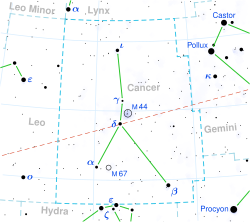
Delta Cancri is a star in the constellation of Cancer. It has the proper name Asellus Australis, Delta Cancri is its Bayer designation. This star is visible to the naked eye with an apparent visual magnitude of +3.94. Based on parallax measurements, it is located at a distance of 137 light-years (42 pc) from Earth. It is drifting further away with a line of sight velocity of 16 km/s.
The star is 0.08 degree north of the ecliptic, so it can be occulted by the Moon and more rarely by planets; it is occulted (eclipsed) by the sun from about 31 July to 2 August. Thus the star can be viewed the whole night, crossing the sky at the start of February.
The spectrum of this star matches a spectral class of K0 III, with the luminosity class III indicating that it is a giant star that has exhausted the hydrogen at its core. With an estimated age of 2.45 billion years and 1.71 times the mass of the Sun, this star has expanded to 11.7 times the Sun's radius. It is radiating 60 times the luminosity of the Sun from its enlarged photosphere at an effective temperature of 4,684 K. The temperature gives it the orange hue typical of K-type stars.
This star has an optical companion, named Delta Cancri B. This companion appears close to Delta Cancri A along the line of sight, in reality, it is much farther away than Delta Cancri A and has a different proper motion.
Component A was believed to be itself a binary star system whose components are Delta Cancri Aa and Ab. This companion would be separated by roughly 0.1" and be 0.96 magnitudes fainter. However, subsequent observations and modern studies suggest the companion does not exist.
Delta Cancri is the star's Bayer designation. This designation is Latinized from δ Cancri, and abbreviated Delta Cnc or δ Cnc.
It bore the traditional name Asellus Australis which is Latin for "southern donkey colt". In 2016, the International Astronomical Union organized a Working Group on Star Names (WGSN) to catalogue and standardize proper names for stars. The WGSN decided to attribute proper names to individual stars rather than entire multiple systems. It approved the name Asellus Australis for the component Delta Cancri Aa on 6 November 2016 and it is now so included in the List of IAU-approved Star Names. Together with Gamma Cancri, it formed the Aselli, flanking Praesepe.
As Arkū-sha-nangaru-sha-shūtu, which means "the southeast star in the Crab", it marked the 13th ecliptic station of the ancient Babylonians.
Delta Cancri
Delta Cancri is a star in the constellation of Cancer. It has the proper name Asellus Australis, Delta Cancri is its Bayer designation. This star is visible to the naked eye with an apparent visual magnitude of +3.94. Based on parallax measurements, it is located at a distance of 137 light-years (42 pc) from Earth. It is drifting further away with a line of sight velocity of 16 km/s.
The star is 0.08 degree north of the ecliptic, so it can be occulted by the Moon and more rarely by planets; it is occulted (eclipsed) by the sun from about 31 July to 2 August. Thus the star can be viewed the whole night, crossing the sky at the start of February.
The spectrum of this star matches a spectral class of K0 III, with the luminosity class III indicating that it is a giant star that has exhausted the hydrogen at its core. With an estimated age of 2.45 billion years and 1.71 times the mass of the Sun, this star has expanded to 11.7 times the Sun's radius. It is radiating 60 times the luminosity of the Sun from its enlarged photosphere at an effective temperature of 4,684 K. The temperature gives it the orange hue typical of K-type stars.
This star has an optical companion, named Delta Cancri B. This companion appears close to Delta Cancri A along the line of sight, in reality, it is much farther away than Delta Cancri A and has a different proper motion.
Component A was believed to be itself a binary star system whose components are Delta Cancri Aa and Ab. This companion would be separated by roughly 0.1" and be 0.96 magnitudes fainter. However, subsequent observations and modern studies suggest the companion does not exist.
Delta Cancri is the star's Bayer designation. This designation is Latinized from δ Cancri, and abbreviated Delta Cnc or δ Cnc.
It bore the traditional name Asellus Australis which is Latin for "southern donkey colt". In 2016, the International Astronomical Union organized a Working Group on Star Names (WGSN) to catalogue and standardize proper names for stars. The WGSN decided to attribute proper names to individual stars rather than entire multiple systems. It approved the name Asellus Australis for the component Delta Cancri Aa on 6 November 2016 and it is now so included in the List of IAU-approved Star Names. Together with Gamma Cancri, it formed the Aselli, flanking Praesepe.
As Arkū-sha-nangaru-sha-shūtu, which means "the southeast star in the Crab", it marked the 13th ecliptic station of the ancient Babylonians.
Recent media
Recent media