Hubbry Logo
Euphorbia lathyrisEuphorbia lathyrisMain
Open search
Euphorbia lathyris
Community hub
Euphorbia lathyris
logo
8 pages, 0 posts
0 subscribers
Be the first to start a discussion here.
Euphorbia lathyris
Euphorbia lathyris
from Wikipedia

Euphorbia lathyris
Scientific classification Edit this classification
Kingdom: Plantae
Clade: Tracheophytes
Clade: Angiosperms
Clade: Eudicots
Clade: Rosids
Order: Malpighiales
Family: Euphorbiaceae
Genus: Euphorbia
Species:
E. lathyris
Binomial name
Euphorbia lathyris
Synonyms

Euphorbia lathyrus (lapsus)

Euphorbia lathyris, the caper spurge or paper spurge, is a species of spurge native to Asia in western China, Kyrgyzstan and Pakistan and introduced elsewhere.[1][2][3][4]

Other names occasionally used include gopher spurge, gopher plant or mole plant.[2]

Growth

[edit]

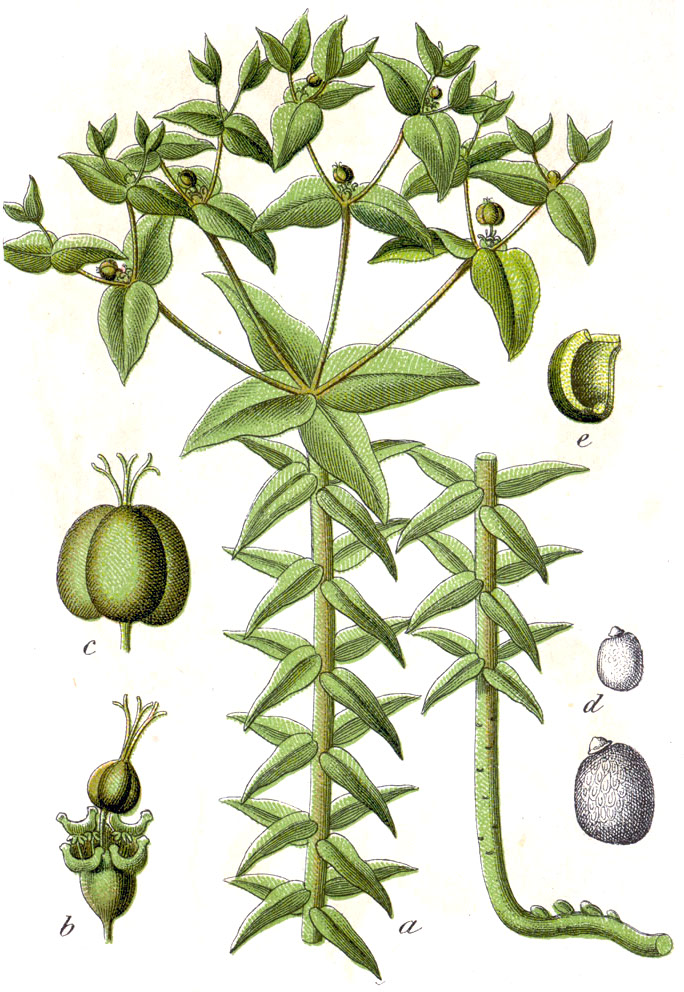
It is an erect biennial (occasionally annual) plant growing up to 1.5 m tall, with a glaucous blue-green stem. The leaves are arranged in decussate opposite pairs, and are lanceolate, 5–15 cm long and 1-2.5 cm broad, glaucous blue-green with a waxy texture and pale greenish-white midrib and veins. The flowers are green to yellow-green, 4 mm diameter, with no petals. The seeds are green ripening to brown or grey, produced in globular clusters 13–17 mm diameter of three seeds compressed together.[4][5]

Chemical characteristics

[edit]

All parts of the plant, including the seeds and roots, are poisonous. Handling may cause skin irritation as the plant produces latex. While poisonous to humans and most livestock, goats sometimes eat it and are immune to the toxin. However, the toxin can be passed through the goat's milk.[6]

Habitat

[edit]

Away from its native range, it is widely naturalised in many regions, where it is often considered an invasive weed.[2][3][5] It grows in partial shade to full sun in USDA zones 5–9.

Uses

[edit]

It is used in folk medicine as a remedy for cancer, corns, and warts and has purportedly been used by beggars to induce skin boils.[7]

References

[edit]
Revisions and contributorsEdit on WikipediaRead on Wikipedia
from Grokipedia
Euphorbia lathyris, commonly known as caper spurge, mole plant, or gopher spurge, is an annual or biennial in the family , characterized by its erect, smooth stems growing up to 1.5 meters (5 feet) tall, with opposite pairs of narrow, lanceolate, blue-green leaves that are often rotated to form four vertical rows. The produces small, yellowish-green flowers in terminal umbels from May to , followed by explosive, three-lobed seed capsules containing toxic seeds, and exudes a milky sap typical of the . Native to the Mediterranean region, , and parts of temperate (including and ), it has been widely introduced elsewhere as an ornamental and garden escapee, often thriving in disturbed, sunny habitats with well-drained soils. This species is noted for its drought tolerance and self-seeding habit, which can lead to it becoming weedy or invasive in suitable climates, though it is monitored rather than classified as a noxious weed in regions like Washington State. Historically, E. lathyris has been cultivated for its seeds, which resemble capers and were once processed as a substitute, as well as for its latex, explored as a potential source of biofuel or rubber. In traditional folk medicine, particularly in Europe, the plant has been used as a purgative, for treating warts and skin conditions, and as an antiseptic, though such applications are discouraged due to risks. The milky sap of E. lathyris is highly toxic, causing severe skin irritation, , eye damage, or blistering upon contact, and of seeds or sap can lead to in humans and , with potential carcinogenic effects from repeated exposure. Despite these hazards, it is sometimes planted ornamentally for its striking architectural form and deer-resistant qualities, and its common names derive from folk beliefs in its ability to repel moles and gophers, though evidence for this is anecdotal.

Taxonomy

Etymology and Common Names

The genus name derives from Euphorbos, the Greek physician who served King of and (circa 52–50 BC to 23 AD), as the king reportedly named a North African plant in his honor, a designation later adopted by for the genus in recognition of the plant's medicinal properties discovered by the physician. The specific epithet lathyris is derived from the ancient Greek name for a type of caper spurge. This binomial nomenclature was formally established by Linnaeus in his in 1753, marking the first scientific description of the species. Common names for Euphorbia lathyris vary by region and reflect its historical associations with pest repulsion, appearance, or uses. In and general English-speaking contexts, it is most frequently called caper spurge or paper spurge, the latter possibly due to the thin, papery texture of its leaves. In , additional names include mole plant and gopher spurge, stemming from claims of its ability to deter burrowing animals like moles and , though such effects lack scientific verification. Other less common designations are , alluding to the content in its seeds, and sassy jack in some southern U.S. dialects.

Classification

Euphorbia lathyris is a species within the kingdom Plantae, phylum Tracheophyta, class Magnoliopsida, order Malpighiales, family Euphorbiaceae, genus Euphorbia, and species lathyris. This species is placed in subgenus Esula of the genus Euphorbia, a large and morphologically diverse group that encompasses over 2,000 species worldwide, representing one of the most species-rich genera in the plant kingdom. Accepted synonyms for E. lathyris include Euphorbia lathyris var. lathyris, as well as historical variants such as Tithymalus lathyris (L.) Hill and Epurga lathyris (L.) Fourr.

Description

Morphology

Euphorbia lathyris is an erect, glabrous biennial , occasionally behaving as an , typically reaching heights of 0.6–1.5 m, though it can grow up to 2 m under optimal conditions. The stems are thick, fleshy, and blue-green, often unbranched below the but dichotomously branched above, with a smooth, waxy texture. The leaves are arranged in opposite, decussate pairs, creating a distinctive four-ranked appearance along the stem. They are sessile, narrowly lanceolate to oblong-lanceolate, measuring 5–15 cm in length and 1–2.5 cm in width, with entire margins, an acute to acuminate apex, and a clasping or cordate base. The blades are , glabrous, and feature a prominent pale greenish-white midrib and veins. The forms a terminal, often pseudumbel with 2–4 primary rays, subtended by slightly yellowish-green bracts that are ovate-elliptic and shorter than the cauline leaves. Cyathia, the characteristic cup-shaped structures of the , are subsessile, measuring 3–4 mm in diameter, with a glabrous, campanulate involucre that is green to yellow-green; each bears four elliptic glands with narrow horns. These appear from May to in typical habitats. The fruit is a depressed-globose, three-lobed capsule, 9–17 mm in diameter, with a smooth, spongy mesocarp and tardily dehiscent cocci. Seeds are ovoid-oblong, 4–6 mm long, brownish to grayish, with a rugose surface featuring irregular reticulate markings and a small, hat-shaped caruncle.

Reproduction

Euphorbia lathyris, a biennial or short-lived in the family, exhibits a reproductive strategy centered on production, with flowering typically occurring from May to June in the . The inflorescences consist of cyathia—specialized cup-like structures that house the minute, apetalous flowers, including both male and female organs on the same plant. These cyathia produce nectar, attracting a range of pollinators and facilitating primarily entomophilous . Common visitors include small bees, wasps, and flies, which transfer between cyathia within and among plants. The breeding system of E. lathyris is self-compatible, allowing for autogamous reproduction, though facultative predominates, with preferred to maximize . Following successful , the plant develops tricarpellate capsules that mature over summer, each containing three rugose, grayish seeds approximately 4.5–6 mm long and 3–4 mm wide. These seeds are equipped with a small caruncle, an that can attract ants for secondary dispersal, but the primary mechanism is or ; the capsules are tardily dehiscent. This dispersal, combined with the plant's self-seeding habit, contributes to its potential as a in disturbed habitats. Seed germination in E. lathyris is influenced by environmental cues, with optimal rates achieved under conditions of light exposure and cool stratification, typically involving a period of cold moist treatment at 0-5°C for 4-6 weeks to break . Seeds exhibit high viability, remaining dormant yet viable in the for several years, enabling persistent seed banks that support population establishment over time. primarily occurs in spring or early summer following winter stratification, though some autumn is possible, with seedlings entering if conditions are unfavorable. This longevity and conditional germination enhance the species' adaptability to variable climates.

Distribution and Habitat

Native Range

Euphorbia lathyris is native to the Mediterranean region, , and temperate —including parts of , , , and North Vietnam. In , it occurs in countries such as , , , and nearby northwest African regions. In , some sources report it in regions such as in and mountainous areas in northwest and . The species is adapted to a variety of environments within this range, typically found at elevations between 0 and 1,800 meters above . Within its native , Euphorbia lathyris prefers disturbed soils, often in areas with partial shade to full sun exposure. It grows best on well-drained loamy or rocky substrates, tolerating a range of 6.0 to 7.5. These conditions support its biennial growth habit in open, ruderal sites such as roadsides and waste grounds. The plant is suited to temperate to subtropical climates, aligning with USDA hardiness zones 5 through 9. It endures a range of temperatures and is moderately drought-tolerant, thriving in areas with annual of 500 to 1,000 mm. This climatic preference reflects its occurrence in seasonal, semi-arid to mesic environments across its native distribution.

Introduced Range and Invasiveness

Euphorbia lathyris has been introduced and naturalized across various regions outside its native range, primarily through human-mediated dispersal. In , it is established as an archaeophyte in Britain, with records indicating presence before 1500 AD, and it has naturalized widely since at least the in non-native parts of the continent. In , it was introduced from , likely as an ornamental or for purported pest-repellent properties, and is now widespread, particularly along the West Coast, including , , and Washington, as well as in eastern states. It is also naturalized in southern Australia, notably in , the Australian Capital Territory, Victoria, , and southeastern . In , it occurs commonly in disturbed habitats such as waste places, riverbeds, and coastal areas. The species exhibits invasive tendencies in several introduced regions, particularly in disturbed habitats. In , it is rated as a "Watch" species by the California Invasive Plant Council due to its potential to spread and naturalization in 25 counties, primarily coastal and inland valleys, where it invades grasslands, dunes, and . It is listed as invasive by the Native Plant Society and appears on Washington's Noxious Monitor List, indicating concern for its potential expansion in pastures and roadsides. In , it is regarded as an environmental weed in multiple states, while in and Chile's , it is considered invasive with a high risk assessment score of 9. Dispersal of E. lathyris occurs primarily through , which are explosively ejected from ripe capsules for short-distance ballistic spread, supplemented by attraction to the caruncle and longer-distance transport via , machinery, and human activities such as dumping garden waste or contaminated . Initial introductions were often intentional for ornamental use or as a mole/ repellent, with accidental spread via agricultural or contributing to its establishment. In suitable disturbed sites, populations can expand rapidly; for instance, one documented New York site increased from 30 to 300 plants in a single season through production.

Ecology

Growth Cycle

Euphorbia lathyris exhibits a biennial life cycle in temperate climates, though it can behave as an annual under milder conditions. In the first year, germinate primarily in spring or , with some autumn germination leading to overwintering ; the develops a basal rosette of leaves before entering if germinated late in the . In the second year, the bolts, producing an erect stem that reaches 1–1.5 m in height, followed by branching, flowering in summer, seed production, and subsequent death of the parent . As a biennial, flowering and stem elongation in E. lathyris are promoted by , involving exposure to cold temperatures during the overwintering phase to induce the transition from vegetative to reproductive growth. Optimal vegetative growth occurs at temperatures of 18–27°C (65–80°F), supporting rapid development. Lifecycle variations occur based on and timing: in mild environments, the may complete its cycle annually without a distinct overwintering phase. Seeds contribute to persistence through a , remaining viable for 1–10 years, which enables over multiple seasons despite the short-lived nature of the adult .

Ecological Interactions

_Euphorbia lathyris exhibits significant interactions with herbivores through its toxic latex, which serves as a primary defense mechanism. The milky latex produced by laticifer cells deters a range of insect herbivores, including the beet armyworm caterpillar (Spodoptera exigua) and the two-spotted spider mite (Tetranychus urticae), as evidenced by increased susceptibility in laticifer-deficient mutants that lack this protective secretion. Similarly, the latex and derived compounds effectively repel mammalian herbivores; field bioassays demonstrate that extracts from various plant parts, particularly roots, significantly reduce feeding by eastern cottontails (Sylvilagus floridanus), with antifeedant activity attributed to long-chain alkyl ferulates and the diterpenoid gopherenediol. While most mammals and insects avoid consumption due to these toxins, goats (Capra hircus) can graze on the plant without immediate adverse effects; however, the toxins bioaccumulate and transfer into their milk, posing risks to consumers. In terms of plant-plant interactions, E. lathyris engages in by forming dense stands in disturbed habitats such as roadsides, grasslands, and riparian areas, where it can exclude through rapid and replacement. This competitive ability contributes to its role as a ruderal or early-successional , often appearing in newly disturbed soils following events like , construction, or flooding, thereby initiating recovery but potentially altering dynamics. Although specific allelopathic mechanisms via exudates have not been conclusively demonstrated for this , its establishment in monocultures suggests indirect suppression of neighboring grasses and forbs in open, sunny sites. Ecologically, E. lathyris functions as a pioneer plant in succession sequences within Mediterranean and semi-arid ecosystems, stabilizing disturbed soils temporarily through its while its prolific seed production facilitates spread via , wind, and human activity. However, in introduced ranges, dense infestations can reduce local by displacing native flora, leading to decreased plant in affected grasslands and scrub habitats, though overall ecosystem-level impacts remain moderate with limited evidence of severe alterations. This dual role highlights its opportunistic nature, benefiting in early stages but posing challenges for native community restoration in invaded areas.

Chemistry and Toxicity

Chemical Composition

The latex of Euphorbia lathyris is a milky that serves as the primary site of specialized metabolites, consisting mainly of water and compounds. The water content of fresh latex typically ranges from 60% to 80%, forming the aqueous phase in which lipophilic components are suspended. This emulsion also contains diterpenes such as ingenol esters and lathyrane-type diterpenoids, which are macrocyclic structures isolated predominantly from seeds and latex. Triterpenes, including lanostane derivatives like and euphane types such as euphol and butyrospermol, constitute a significant portion of the non-aqueous fraction, often esterified with fatty acids like conjugated decadienoic and decatrienoic acids. In addition to terpenoids, the plant produces irritant esters referred to as Euphorbia factors (e.g., EFL1–EFL21), which are lathyrane diterpenoid derivatives with linkages contributing to their chemical reactivity. , including free and bound forms such as and glycosides, are present throughout the plant tissues, with higher concentrations in stems (up to 45 mg equivalents per 100 g dry weight). Alkaloids have been detected in seed extracts via screening, though they occur in lower abundance compared to terpenoids. These compounds vary in distribution, with from stems and leaves showing elevated terpenoid levels due to dense laticifer networks, while roots and mature tissues exhibit reduced concentrations. The seeds of E. lathyris are notably rich in hydrocarbons, comprising up to 5–6% of dry weight, primarily as polyisoprenoid chains and diterpene-derived oils that mimic fractions in their volatility and carbon chain length. This profile, including triterpenoid esters and sesquiterpenes, underscores the plant's potential as a source, with oils yielding gasoline-like distillates upon processing. In contrast to the watery , hydrocarbons are more concentrated in droplets, reflecting specialized storage in this reproductive tissue.

Toxic Effects

Contact with the latex sap of Euphorbia lathyris can cause severe skin irritation, including blistering and , particularly through phototoxic reactions that manifest within 24–48 hours of exposure followed by . The corrosive nature of the milky white leads to and potential ulceration upon dermal contact, with symptoms ranging from redness and itching to more intense blistering in sensitive individuals. Ingestion of the , especially its seeds or , results in significant gastrointestinal upset, characterized by , , and purgative effects due to its emetic properties. Additionally, the presence of ingenol diterpenes in the contributes to potential co-carcinogenic effects, promoting tumor development in susceptible tissues upon chronic exposure. While rarely fatal in humans, sufficient can lead to severe ; the is also toxic to , causing acute symptoms and potentially lethal outcomes if consumed in large quantities, though animals typically avoid it due to its acrid taste. Ocular exposure to the latex induces intense irritation, including keratoconjunctivitis, corneal , and temporary blindness in severe cases, necessitating immediate and medical intervention to prevent lasting damage. Due to its strong emetic and uterine-contracting properties, E. lathyris is contraindicated for pregnant women, as it may induce or premature labor.

Uses and Cultivation

Traditional and Medicinal Uses

In historical European medicine, Euphorbia lathyris was employed as a powerful purgative, with its seeds and used to induce strong effects for treating digestive disorders. This application dates back to ancient practices, where the plant's acrid milky sap was valued for its emetic and properties despite its irritant nature. During the and in broader European folk traditions, the from the stems was applied topically to remove corns and , leveraging its caustic action to and exfoliate growths. Similarly, the plant has been used in folk remedies for purported anti-cancer effects, particularly for treating cancers through direct application of the sap. In homeopathic practice, E. lathyris preparations are indicated for , addressing symptoms such as rheumatic pains that worsen during rest and paralytic weakness in the joints. In traditional Chinese medicine, the seeds, known as "Qian Jin Zi (千金子)," have been utilized as a and purgative to alleviate and , often in formulations for hydropsy and related fluid retention conditions. Due to the plant's , including severe gastrointestinal from and skin burns from contact, its medicinal applications are approached with caution, often limited to external or highly diluted forms to mitigate risks.

Horticultural and Other Uses

Euphorbia lathyris is cultivated ornamentally for its striking architectural form, featuring tall, upright stems reaching up to 1.2 meters (4 feet) and narrow, bluish-green leaves arranged in opposite pairs, which provide a sculptural element in gardens. Its makes it suitable for xeriscapes and low-water landscapes, where it thrives in full sun and well-drained soils without frequent . As a biennial or short-lived , it self-seeds readily in USDA hardiness zones 5 through 9, allowing natural while requiring occasional thinning to prevent overgrowth. In , the plant is often planted along borders to deter burrowing pests such as moles and gophers, attributed to toxins in its and milky sap that are believed to repel these animals. However, scientific evidence for its effectiveness is lacking, with extension services noting that such uses stem from rather than verified research, and it may not reliably reduce pest activity. Industrially, the seeds of E. lathyris have been explored as a source for due to their high content of unsaturated fatty acids, including oleic (C18:1) and linolenic acids, which contribute to favorable fuel properties. derived from its seed oil achieves a yield of approximately 91% and meets standard quality specifications, comparable to that from (Brassica napus). Historically, the earned the nickname "petroleum " for its , which contains s extractable as potential liquid fuels, prompting research in the late for arid-land energy crops, though yields were limited to about 7.5 barrels of oil equivalent per . Despite early interest, its commercial viability as a hydrocarbon source remains constrained by low and agronomic challenges.

References

Add your contribution
Related Hubs
User Avatar
No comments yet.