Hubbry Logo
Metacarpal bonesMetacarpal bonesMain
Open search
Metacarpal bones
Community hub
Metacarpal bones
logo
8 pages, 0 posts
0 subscribers
Be the first to start a discussion here.
Metacarpal bones
Metacarpal bones
from Wikipedia
Metacarpal bones
Metacarpals shown in red. Left hand, anterior (palmar) view.
The five metacarpal bones, numbered. Left hand, anterior (palmar) view.

os primum metacarpale / os metacarpale I

os secundum metacarpale / os metacarpale II

os tertium metacarpale / os metacarpale III

os quartum metacarpale / os metacarpale IV

os quintum metacarpale / os metacarpale V
Details
OriginsCarpal bones of wrist
InsertionsProximal phalanges
ArticulationsCarpometacarpal, intermetacarpal, metacarpophalangeal
Identifiers
Latinos metacarpale
pl. ossa metacarpalia
MeSHD050279
TA98A02.4.09.001
TA21264
FMA9612
Anatomical terms of bone

In human anatomy, the metacarpal bones or metacarpus, also known as the "palm bones", are the appendicular bones that form the intermediate part of the hand between the phalanges (fingers) and the carpal bones (wrist bones), which articulate with the forearm. The metacarpal bones are homologous to the metatarsal bones in the foot.

Structure

[edit]
Left hand shown with thumb on left.

The metacarpals form a transverse arch to which the rigid row of distal carpal bones are fixed. The peripheral metacarpals (those of the thumb and little finger) form the sides of the cup of the palmar gutter and as they are brought together they deepen this concavity. The index metacarpal is the most firmly fixed, while the thumb metacarpal articulates with the trapezium and acts independently from the others. The middle metacarpals are tightly united to the carpus by intrinsic interlocking bone elements at their bases. The ring metacarpal is somewhat more mobile while the fifth metacarpal is semi-independent.[1]

Each metacarpal bone consists of a body or shaft, and two extremities; the head at the distal or digital end (near the fingers), and the base at the proximal or carpal end (close to the wrist).

Body

[edit]

The body (shaft) is prismoid in form, and curved, so as to be convex in the longitudinal direction behind, concave in front. It presents three surfaces: medial, lateral, and dorsal.

  • The medial and lateral surfaces are concave, for the attachment of the interosseus muscles, and separated from one another by a prominent anterior ridge.
  • The dorsal surface presents in its distal two-thirds a smooth, triangular, flattened area which is covered in by the tendons of the extensor muscles. This surface is bounded by two lines, which commence in small tubercles situated on either side of the digital extremity, and, passing upward, converge and meet some distance above the center of the bone and form a ridge which runs along the rest of the dorsal surface to the carpal extremity. This ridge separates two sloping surfaces for the attachment of the interossei dorsales.
  • To the tubercles on the digital extremities are attached the collateral ligaments of the metacarpophalangeal joints.[2]

Base

[edit]

The base (basis) or carpal extremity is of a cuboidal form, and broader behind than in front. It articulates with the carpal bones and with the adjoining metacarpal bones while its dorsal and volar surfaces are rough, for the attachment of ligaments.[2]

[edit]

The head (caput) or digital extremity presents an oblong surface markedly convex from before backward, less so transversely, and flattened from side to side; it articulates with the proximal phalanx. It is broader, and extends farther upward, on the volar than on the dorsal aspect, and is longer in the antero-posterior than in the transverse diameter. On either side of the head is a tubercle for the attachment of the collateral ligament of the metacarpophalangeal joint.

The dorsal surface, broad and flat, supports the tendons of the extensor muscles.

The volar surface is grooved in the middle line for the passage of the flexor tendons, and marked on either side by an articular eminence continuous with the terminal articular surface.[2]

Neck

[edit]

The neck, or subcapital segment, is the transition zone between the body and the head.

Articulations

[edit]

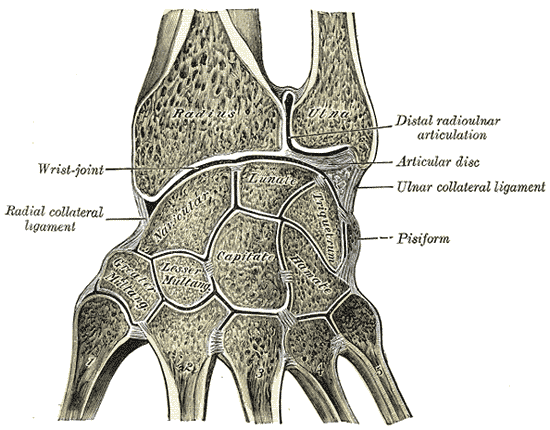
Besides the metacarpophalangeal joints, the metacarpal bones articulate by carpometacarpal joints as follows:

  1. the first with the trapezium;
  2. the second with the trapezium, trapezoid, capitate and third metacarpal;
  3. the third with the capitate and second and fourth metacarpals;
  4. the fourth with the capitate, hamate, and third and fifth metacarpals;
  5. and the fifth with the hamate and fourth metacarpal;

Insertions

[edit]

Extensor Carpi Radialis Longus/Brevis: Both insert on the base of metacarpal II; Assist with wrist extension and radial flexion of the wrist

Extensor Carpi Ulnaris: Inserts on the base of metacarpal V; Extends and fixes wrist when digits are being flexed; assists with ulnar flexion of wrist

Abductor Pollicis Longus: Inserts on the trapezium and base of metacarpal I; Abducts thumb in frontal plane; extends thumb at carpometacarpal joint

Opponens Pollicis: Inserts on metacarpal I; flexes metacarpal I to oppose the thumb to the fingertips

Opponens digiti minimi: Inserts on the medial surface of metacarpal V; Flexes metacarpal V at carpometacarpal joint when little finger is moved into opposition with tip of thumb; deepens palm of hand.[3]

Clinical significance

[edit]

Congenital disorders

[edit]

The fourth and fifth metacarpal bones are commonly "blunted" or shortened, in pseudohypoparathyroidism and pseudopseudohypoparathyroidism.

A blunted fourth metacarpal, with normal fifth metacarpal, can signify Turner syndrome.

Blunted metacarpals (particularly the fourth metacarpal) are a symptom of nevoid basal-cell carcinoma syndrome.

Fracture

[edit]

The neck of a metacarpal is a common location for a boxer's fracture, but all parts of the metacarpal bone (including head, body and base) are susceptible to fracture. During their lifetime, 2.5% of individuals will experience at least one metacarpal fracture. Bennett's fracture (base of the thumb) is the most common.[4] Several types of treatment exist ranging from non-operative techniques, with or without immobilization, to operative techniques using closed or open reduction and internal fixation (ORIF). Generally, most fractures showing little or no displacement can be treated successfully without surgery.[5] Intraarticular fracture-dislocations of the metacarpal head or base may require surgical fixation, as fragment displacement affecting the joint surface is rarely tolerated well.[5]

Other animals

[edit]
The principle of homology illustrated by the adaptive radiation of the metacarpal bones of mammals. All conform to the basic pentadactyl pattern but are modified for different usages. The third metacarpal is shaded throughout; the shoulder is crossed-hatched.

In four-legged animals, the metacarpals form part of the forefeet, and are frequently reduced in number, appropriate to the number of toes. In digitigrade and unguligrade animals, the metacarpals are greatly extended and strengthened, forming an additional segment to the limb, a feature that typically enhances the animal's speed. In both birds and bats, the metacarpals form part of the wing.

History

[edit]

Etymology

[edit]

The Greek physician Galen used to refer to the metacarpus as μετακάρπιον.[6][7] The Latin form metacarpium [6][8][9][10] more truly resembles[6] its Ancient Greek predecessor μετακάρπιον than metacarpus.[11][12] Meta– is Greek for beyond and carpal from Ancient Greek καρπός (karpós, "wrist"). In anatomic Latin, adjectives like metacarpius,[13] metacarpicus,[14] metacarpiaeus,[15] metacarpeus,[16] metacarpianus[17] and metacarpalis[12] can be found. The form metacarpius is more true[9][13] to the later Greek form μετακάρπιος.[13] Metacarpalis, as in ossa metacarpalia in the current official Latin nomenclature, Terminologia Anatomica[12] is a compound consisting of Latin and Greek parts.[14] The usage of such hybrids in anatomic Latin is disapproved by some.[9][14]

Additional images

[edit]

See also

[edit]

References

[edit]

Further reading

[edit]
Revisions and contributorsEdit on WikipediaRead on Wikipedia
from Grokipedia
The metacarpal bones are five elongated long bones that form the skeletal framework of the palm in the human hand, positioned between the distal row of carpal bones in the wrist and the proximal phalanges of the fingers. Numbered from I to V, they correspond respectively to the thumb, index finger, middle finger, ring finger, and little finger, providing the primary bony support for the hand's manipulative capabilities. Each metacarpal consists of three main parts: a broad proximal base for articulation with the carpals, a cylindrical central shaft that is concave on its medial and lateral surfaces to accommodate muscle attachments such as the interossei, and a rounded distal head that forms a condyloid joint with the phalanges. The metacarpals articulate proximally at the carpometacarpal (CMC) joints with the trapezium, trapezoid, capitate, and hamate bones (for metacarpals II–V), while the first metacarpal connects uniquely to the trapezium in a that permits greater mobility, including opposition of the thumb. Distally, their heads form the metacarpophalangeal (MCP) joints with the proximal phalanges, enabling flexion, extension, abduction, and adduction of the digits. Functionally, these bones maintain the hand's transverse and longitudinal arches, distributing forces during gripping and supporting the and intrinsic muscles to facilitate precise movements essential for daily activities. The second and third metacarpals are more rigidly fixed for stability, whereas the fourth and fifth exhibit increased mobility to aid in finger spreading. Clinically, the metacarpals are prone to fractures from direct trauma, such as "boxer's fractures" of the fifth metacarpal neck, which can impair hand function if not properly aligned, highlighting their critical role in overall . Blood supply to the metacarpals primarily arises from the dorsal and palmar metacarpal arteries, branches of the radial and ulnar arteries, ensuring robust nourishment for their high-demand role in mobility.

Overview

Definition and location

The metacarpal bones are five elongated long bones that form the metacarpus, the intermediate skeletal region of the hand situated between the carpus (wrist) and the phalanges of the fingers. These bones constitute the primary framework of the palm, providing structural support and enabling the hand's manipulative functions. Anatomically, the metacarpal bones are positioned proximally to articulate with the distal row of carpal bones—specifically, the first metacarpal with the trapezium; the second primarily with the trapezoid (and aspects of the trapezium and capitate); the third with the capitate; the fourth primarily with the hamate (and a small part of the capitate); and the fifth with the hamate—forming the carpometacarpal joints. Distally, they articulate with the proximal phalanges to create the metacarpophalangeal joints. Embedded within the soft tissues of the palm, the shafts of the metacarpals contribute to the palm's characteristic convexity, enhancing grip and dexterity. Each metacarpal bone features a broad proximal base, a cylindrical central shaft, and a rounded distal head, classifying them as typical long . The first metacarpal, associated with the thumb, is the shortest and most mobile among them, allowing greater opposition and rotation compared to the more aligned second through fifth metacarpals. Together, these bones align to form a transverse arch in the palm, which maintains the hand's concavity and facilitates efficient force transmission during movement.

Nomenclature and numbering

The metacarpal bones are standardized in as five distinct elements, numbered I to V from the lateral () side to the medial () side of the hand, aligning with the radial-to-ulnar direction to facilitate precise anatomical and clinical reference. This sequential numbering, often denoted with in formal anatomy texts, corresponds directly to the digits: metacarpal I with the (pollex), II with the (index), III with the (medius), IV with the (annularis), and V with the (digitus minimi). In clinical contexts, are commonly used with the abbreviation "MC" (e.g., MC1 for the first metacarpal), promoting brevity in medical documentation and imaging reports. Identification of individual metacarpals relies on their unique morphological features, which distinguish them within the palm's skeletal framework. The first metacarpal (MC I), or os metacarpale pollicis, is the shortest and thickest of the group, measuring approximately 45-50 mm in length on average, with a distinctive saddle-shaped articular base that articulates exclusively with the trapezium carpal bone. The second metacarpal (MC II), or os metacarpale indicis, has one of the longest lengths (typically 67-70 mm) and the broadest base among the metacarpals, articulating with three carpals (trapezium, trapezoid, and capitate) for enhanced stability. The third metacarpal (MC III), or os metacarpale medius, is among the longest (around 65-70 mm), marked by a prominent styloid process projecting dorsally from the radial aspect of its base, which serves as an attachment site for ligaments. In contrast, the fourth metacarpal (MC IV), or os metacarpale annularis, and fifth metacarpal (MC V), or os metacarpale digiti minimi, exhibit broader distal heads relative to their shafts, with the heads expanded transversely to accommodate the metacarpophalangeal joints and allow greater mobility in the ring and little fingers. These naming conventions trace back to , as outlined in standardized references like the , where "pollicis" denotes the thumb-specific bone and "digiti minimi" the counterpart, reflecting historical associations with digit function and position. Such nomenclature ensures consistency across educational, surgical, and radiographic applications, avoiding ambiguity in discussions of hand or .

Anatomy

Structure

The metacarpal bones are elongated long bones that form the skeletal framework of the palm, each comprising a proximal base, an intervening shaft (or body), a narrow neck, and a distal head. The proximal base is the widest portion of each metacarpal, featuring a concave articular surface that facilitates connection with the distal row of carpal bones through the carpometacarpal joints. Notably, the base of the first metacarpal (corresponding to the thumb) is distinctive, possessing a saddle-shaped facet that articulates specifically with the trapezium bone, enabling enhanced mobility. The shaft of the metacarpal adopts a triangular prism-like in cross-section, with a concave palmar surface that provides space for structures and a convex dorsal surface that contributes to the hand's overall contour. Nutrient foramina, through which vessels enter the bone, are typically situated on the palmar side of the shaft to support medullary circulation. The represents a constricted region distal to the shaft and proximal to the head, rendering it particularly vulnerable to fractures from direct trauma or axial loading. Additionally, the third metacarpal features a prominent styloid process extending dorsally from its base, which serves as an attachment point for ligaments. The distal head is convex and knob-like, forming the ball-shaped structure that articulates with the base of the proximal phalanx at the metacarpophalangeal joints; this configuration allows for hinge-like motion. The heads of the fourth and fifth metacarpals are comparatively broader, providing expanded surfaces to accommodate and stabilize the collateral ligaments during lateral movements. Morphological differences among the five metacarpals reflect their functional roles in hand dexterity. The first metacarpal is shorter, thicker, and rotated approximately 90 degrees relative to the others, positioning for opposition against the fingers. In contrast, the second and third metacarpals are longer and more rigidly aligned, contributing to stability, while the fourth and fifth metacarpals exhibit increased length and flexibility, particularly at their carpometacarpal articulations, to support cupping and spreading motions. The metacarpals are numbered Roman I through V from lateral () to medial () sides.

Articulations

The metacarpal bones form several key articulations that contribute to hand mobility and stability. The proximal bases of the metacarpals articulate with the distal row of at the carpometacarpal (CMC) joints, while the distal heads articulate with the proximal phalanges at the metacarpophalangeal (MCP) joints. Additionally, adjacent metacarpals connect via intermetacarpal joints, and a specialized stabilizes the MCP joints transversely. The CMC joints link the bases of the metacarpals to the trapezium, , capitate, and hamate bones. The first CMC joint, involving the base of the first metacarpal and the trapezium, is a characterized by high mobility, enabling opposition, abduction, adduction, flexion, and extension of the thumb due to its concavo-convex articular surfaces. In contrast, the second and third CMC joints are plane synovial joints with limited motion, providing stability to the central hand as the bases articulate with the and capitate, respectively. The fourth and fifth CMC joints exhibit greater mobility than the second and third, allowing some gliding and rotation as their bases connect to the hamate, facilitating ulnar deviation. The MCP joints are condyloid synovial joints formed by the rounded heads of the metacarpals and the concave bases of the proximal phalanges, permitting flexion and extension in the as well as abduction and adduction in the frontal plane. These movements are essential for grasping and fine motor tasks, with the joint capsules reinforced by collateral ligaments that tighten during flexion. Intermetacarpal joints occur between the adjacent bases of metacarpals II through , functioning as synovial plane joints that allow limited gliding motions, particularly between the fourth and fifth metacarpals to support hand cupping. These joints are stabilized by dorsal interosseous ligaments, which connect the bases and restrict excessive separation while permitting subtle shifts during finger movements. The deep transverse metacarpal ligament connects the palmar aspects of the MCP joint capsules across metacarpals II through V, forming a tight band that stabilizes the heads and prevents splaying during flexion, thereby enhancing overall hand coherence.

Attachments

The metacarpal bones serve as key attachment sites for various muscles and ligaments that facilitate the intricate movements of the hand, contributing to its dexterity and . On the palmar surface, these attachments primarily involve flexor tendons and intrinsic muscles, which anchor to the metacarpal shafts and bases to enable controlled finger flexion and opposition. The flexor digitorum superficialis tendons, for instance, traverse the palmar aspect of the metacarpals within fibrous sheaths and pulleys, providing for flexing the proximal interphalangeal joints, though their primary insertions occur on the middle phalanges. The originates from the tubercle of the trapezium and the flexor retinaculum, inserting along the lateral aspect of the first metacarpal shaft, which positions for opposition against the fingers and enhances overall hand dynamics. Dorsally, the metacarpal surfaces host origins for extensor mechanisms and interosseous muscles that promote extension and lateral movements. The extensor digitorum tendons run along the dorsal metacarpal shafts before expanding into the extensor hoods at the metacarpophalangeal (MCP) joints, where they integrate with intrinsic muscle contributions to balance flexion forces and stabilize finger extension. Specific insertions further refine these dynamics; the abductor pollicis longus tendon attaches to the base of the first metacarpal, often with variable slips to adjacent structures, aiding in abduction and radial deviation to position the hand for precision tasks. Similarly, the abductor pollicis brevis originates from the scaphoid, trapezium, and flexor retinaculum, inserting on the radial side of the base of the proximal phalanx of the and often blending with the extensor pollicis longus tendon, supporting abduction primarily at the . The dorsal interossei muscles originate from the adjacent sides of metacarpals II through V—specifically, the first from metacarpals , the second from II and III, the third from III and IV, and the fourth from IV and V—inserting into the extensor hoods and bases of the proximal phalanges to abduct the fingers and fine-tune MCP joint stability. Ligamentous attachments to the metacarpals reinforce joint integrity and interconnect the bones for coordinated motion. At the MCP joint heads, the radial and ulnar collateral ligaments originate from the metacarpal condyles and insert onto the proximal phalanges, providing lateral stability against varus and valgus stresses during grip activities. Additionally, the deep transverse metacarpal ligaments span between the palmar aspects of metacarpal heads II through , linking them to form a stable platform that limits excessive spreading and enhances force transmission across the palm. These attachments collectively underscore the metacarpals' role as a biomechanical scaffold, integrating muscular pulls with ligamentous constraints to optimize hand function in manipulation and prehension.

Development and variations

Ossification

The ossification of the metacarpal bones follows the typical pattern of , beginning with the formation of models derived from mesenchymal condensations in the limb buds. Chondrification centers for the metacarpals appear during the 6th to 8th week of , as differentiates into chondroblasts to form the initial cartilaginous precursors of these bones. Primary centers emerge in the (shaft) of each metacarpal around the 8th to 9th week of fetal life, starting first in the second and third metacarpals before progressing to the others. This process replaces the central with tissue via a periosteal collar and invading vascular buds, with extending proximally toward the bases and distally toward the heads primarily after birth during postnatal growth. Secondary ossification centers develop at the epiphyses postnatally to facilitate longitudinal growth. For metacarpals II through V, these centers appear at the head between 1 and 2 years of age; the head centers fuse with the shaft around 14 to 19 years, while the bases lack separate secondary centers and ossify from the primary , with complete fusion across all centers typically occurring by late (15–25 years), marking the cessation of significant longitudinal growth. The first metacarpal (thumb) exhibits distinct ossification patterns, developing from a primary center for the shaft (appearing at approximately 9 weeks gestation) and a secondary center for the base (around 2 years postnatally), which fuses by 18 years. Unlike the other metacarpals, it lacks a prominent secondary center at the head, which ossifies directly from the primary shaft center; additionally, two sesamoid bones form independently within the tendons at the , ossifying during childhood or early adolescence without fusing to the metacarpal itself.

Congenital anomalies

Congenital anomalies of the metacarpal bones encompass a range of developmental defects that can occur in isolation or as part of genetic syndromes, leading to impaired hand function and appearance. , or complete absence, and , or underdevelopment, of metacarpal bones are rare but significant anomalies often associated with radial ray deficiencies. In Holt-Oram syndrome, an autosomal dominant disorder caused by TBX5 gene mutations (detected in about 70–85% of cases), malformations—including or of the first metacarpal (often with carpal bone deformities and abnormalities)—occur in nearly all affected individuals. Isolated of the fifth metacarpal is exceptionally rare and may present as a cleft hand , disrupting the normal alignment of digits and requiring surgical reconstruction in symptomatic individuals. Metacarpal coalitions, or synostoses, involve bony fusion between adjacent metacarpals and are uncommon congenital malformations that limit finger abduction and adduction. These fusions most frequently affect the fourth and fifth metacarpals but can involve the second and third in -related conditions, such as type V, where osseous union extends from phalanges to metacarpals, often linked to gene mutations. In Cenani-Lenz syndrome, central metacarpal fusions contribute to a disorganized hand structure with and , resulting from biallelic LRP4 variants and leading to severe functional deficits. Central metacarpal synostosis, involving fusion of the third and fourth metacarpals, represents a variant that can occur bilaterally and is typically addressed surgically if it impairs . Variations in metacarpal morphology include bifid metacarpals, where a single bone splits into two distal segments, most commonly affecting the first metacarpal and presenting with deformities like swan-neck configuration. Short metacarpals, particularly of the fourth and fifth digits, are a hallmark of type Ia, part of Albright hereditary osteodystrophy due to gene imprinting defects, causing and a positive "knuckle-dimple" sign upon fist clenching. Population-based differences also exist, with African-American individuals exhibiting metacarpals that are both larger in absolute size and more similar in relative lengths (smaller 2D:4D and other ratios) compared to European-Americans, reflecting ethnic variations in skeletal proportions without pathological implications. Accessory bones near the metacarpal bases, such as rare adjacent to the second metacarpal, may arise from anomalous centers but are infrequently symptomatic.

Function

Role in movement

The metacarpal bones play a pivotal role in facilitating the diverse movements of the hand by serving as the structural framework that connects the carpal bones of the wrist to the phalanges of the fingers, enabling coordinated actions essential for grasping and manipulation. The first metacarpal (MC I), unique in its mobility, articulates with the trapezium at the carpometacarpal (CMC) saddle joint, allowing extensive rotation and opposition of the thumb. This mobility permits the thumb to move across the palm to oppose the fingertips, enabling precise pulp-to-pulp pinch grips crucial for tasks like picking up small objects. In the fingers, the shafts of metacarpals II-V act as rigid levers that transmit forces from muscles and tendons, facilitating flexion and extension at the metacarpophalangeal (MCP) joints and interphalangeal joints. The concave palmar aspects of these metacarpals form a transverse arch that maintains the concavity of the palm, enhancing grip stability during object enclosure. Abduction and adduction of the fingers are supported by the intermetacarpal joints, particularly between metacarpals IV and , which permit limited fanning and spreading motions to adjust hand width for broader grasps. Collectively, the metacarpals provide a stable yet adaptable base for the hand, supporting both precision grips, such as writing with a pen, and power grips, like holding tools, through their integrated articulations and muscular attachments.

Biomechanics

The metacarpal shafts serve as primary load-bearing structures in the hand, transmitting compressive forces axially from the phalanges to the during activities like clenching or gripping. Biomechanical studies indicate these forces can reach 100-200 N per metacarpal under moderate to high grip efforts, reflecting the hand's capacity to handle substantial axial compression without failure in typical use. During impacts, such as striking objects, the metacarpals undergo additional dorsal stresses, with the apex-dorsal configuration resulting from the combination of flexion moments and forces across the metacarpophalangeal joints. The biomechanical stability of the metacarpals is enhanced by the hand's transverse and longitudinal arches, which efficiently distribute and maintain structural integrity during weight-bearing or power grip tasks. The transverse metacarpal arch, formed by the bases of metacarpals II-V and stabilized by interosseous ligaments, along with the longitudinal arches along metacarpals II and III (which are relatively fixed), prevents excessive deformation and ensures even load sharing; in contrast, the mobile first metacarpal allows adaptive opposition while contributing to overall arch dynamics. Disruption or collapse of these arches, as seen in certain deformities, leads to a flattened palm that impairs distribution and reduces the hand's mechanical efficiency in load transmission. Fracture mechanics of the metacarpals highlight regional vulnerabilities, particularly at the , where the thinner cortical bone—typically 1.5-2.5 thick compared to the shaft—lowers resistance to axial compression and , predisposing it to subcapital fractures under high-impact forces exceeding physiological loads (e.g., >300 N in biomechanical tests). In the first metacarpal, rotational arises during movements, subjecting the bone to shear stresses that further challenge its structural limits. The , averaging approximately 17 GPa in longitudinal loading, enables effective resistance to deformation under compressive and flexural stresses, supporting the bone's role in dynamic hand function.

Clinical significance

Fractures

Metacarpal fractures are among the most frequent injuries to the hand , comprising approximately 10% of all skeletal fractures and up to 40% of hand fractures, with the fifth metacarpal being the most commonly involved due to its exposure during activities like or falls. These fractures typically result from direct trauma, such as blows from a hard surface, falls onto an outstretched hand, or crush injuries in industrial or athletic settings; indirect mechanisms like twisting forces can also contribute, particularly for shaft fractures. The fifth metacarpal accounts for about 18% of all hand fractures, often presenting as the classic at the , caused by an axial load applied to a flexed during impact.00080-2/fulltext) Common fracture types include the , an extra-articular fracture of the fifth metacarpal neck resulting from axial compression with a flexion component, leading to volar angulation of the distal fragment. Another frequent pattern is the , an intra-articular fracture-dislocation at the base of the first metacarpal, produced by a combination of axial loading and ulnar deviation or shear forces on a partially abducted , which destabilizes the due to the pull of the abductor pollicis longus tendon. Spiral fractures of the metacarpal shaft, often seen in the second through fourth metacarpals, arise from torsional or rotational forces during twisting injuries, such as wringing motions or sports-related torque, and may result in rotational malalignment if unstable. The metacarpal necks, with their relatively thin cortical bone, are particularly vulnerable to these high-energy impacts from the structural anatomy. In cases of multiple metacarpal fractures, significant swelling and pain are normal in the acute phase. Swelling typically peaks at 24-72 hours post-injury and begins to subside over the following days, though it often persists for weeks or months in hand fractures due to gravity-dependent positioning and tissue trauma. Pain usually starts improving within a few days but can last 1-2 weeks or longer. These symptoms are managed with elevation, ice, rest, and analgesics. Classification systems aid in guiding management. In pediatric patients, epiphyseal metacarpal fractures are classified using the Salter-Harris system, which categorizes involvement of the : type I (through the physis), type II (physis and ), type III (physis and ), type IV (all three), or type V (), with types III and IV requiring precise reduction to prevent growth disturbances. For adults, the AO/OTA classification divides metacarpal fractures by location and articular involvement: type A (extra-articular metaphyseal simple or multifragmentary), type B (partial articular, such as depression or split), and type C (complete articular, simple or multifragmentary), further specified by metacarpal number (77.2 to 77.5). Initial treatment emphasizes restoring alignment while preserving hand function. Stable, nondisplaced fractures are managed conservatively with closed reduction—using longitudinal traction, direct pressure, or flexion to correct —followed by immobilization in an ulnar gutter splint or cast for 3-4 weeks, typically in the intrinsic plus position to minimize rotation. In the United States, such closed treatments of a single metacarpal fracture (including shaft fractures, with no separate shaft-specific codes) are documented using Current Procedural Terminology (CPT) codes: 26600 for closed treatment without manipulation, each bone; 26605 for closed treatment with manipulation, each bone; and 26607 for closed treatment with manipulation and internal or external fixation, each bone. Surgical intervention via open reduction and (ORIF) with plates, screws, or Kirschner wires is indicated for unstable patterns, including those with greater than 2 mm of displacement, angulation exceeding 30 degrees (or 20 degrees for metacarpals), intra-articular step-off greater than 1 mm, or any rotational that alters alignment during flexion. Early is encouraged post-immobilization to optimize outcomes.00080-2/fulltext)

Other disorders

Osteoarthritis of the carpometacarpal (CMC) of , particularly the first metacarpal (CMC I), is a prevalent degenerative condition characterized by breakdown and instability. This disorder predominantly affects women over 50 years of age, with prevalence rates reaching up to 33% in this demographic, compared to 11% in men of similar age. The degeneration often results from repetitive stress and biomechanical overload on the , leading to symptoms such as at the base of , especially during pinch and grip activities, along with swelling and reduced thumb mobility. Infections of the metacarpal bones, primarily manifesting as , typically arise from direct inoculation through open wounds, such as puncture injuries or lacerations, which introduce bacteria like into the bone. Hematogenous spread from distant sites is rarer, particularly in adults, but can occur in children or immunocompromised individuals, accounting for a minority of hand cases. These infections lead to localized pain, swelling, , and potential formation, requiring prompt therapy and, in severe cases, surgical to prevent bone destruction and spread to adjacent structures. Avascular necrosis of the metacarpal heads, often termed Dieterich's disease when involving the third or fourth metacarpal, is a rare condition akin to of the lunate but affecting the interfaces. It commonly follows trauma, such as fractures or repetitive microtrauma, disrupting blood supply to the and causing ischemia and collapse. Patients typically present with insidious pain, stiffness, and swelling, particularly in adolescents or young adults, with radiographic evidence of sclerosis and fragmentation if untreated. Tumors of the metacarpal bones are uncommon, with benign lesions predominating over malignant ones. Enchondromas, benign cartilaginous tumors arising within the of the metacarpal shafts, represent the most frequent primary in the hand, often presenting as painless swellings or pathologic fractures and typically managed with if symptomatic. Malignant tumors like are exceedingly rare in the metacarpals, comprising less than 1% of skeletal chondrosarcomas, and usually manifest as slow-growing masses with potential for local invasion, though distant is infrequent.

Comparative anatomy

In mammals

In mammals, the metacarpal bones exhibit significant variations in number, structure, and function compared to the human condition, where five distinct metacarpals (numbered I to V, from to ) support a grasping hand. These adaptations reflect locomotor specializations, such as in quadrupeds or aerial locomotion in chiropterans. In ungulates like horses, the metacarpus is highly reduced for efficient on a single functional digit. The central third metacarpal (MC III) forms the prominent cannon bone, while the second (MC II) and fourth (MC IV) metacarpals are vestigial splint bones that provide lateral support but bear minimal load; the first (MC I) and fifth (MC V) are absent. This configuration enhances stability and speed during locomotion. Primates typically retain five metacarpals, akin to humans, enabling versatile hand use, but apes display distinct modifications. In great apes such as chimpanzees and , the metacarpals are relatively longer and more curved, facilitating and suspensory behaviors; the third metacarpal, in particular, shows dorsal ridging for load distribution during terrestrial . Lesser apes like exhibit even greater elongation and curvature in the metacarpals to support brachiation, the swinging arm-over-arm locomotion through arboreal environments. Carnivores, exemplified by dogs, possess five metacarpals, but the first (MC I) is notably reduced, often manifesting as a with limited articulation and no role. The remaining metacarpals (II–V) are elongated and aligned for stance, supporting rapid, agile movement without opposability. Key adaptations among mammals include fusion in (even-toed ungulates like deer and ), where MC III and IV coalesce proximally into a single cannon bone for enhanced rigidity and speed, while MC II and V remain rudimentary. In bats, the metacarpals are extraordinarily elongated—particularly MC II–V—to form the skeletal framework of the membrane (patagium), enabling powered flight through aerodynamic support.

In other vertebrates

In non-mammalian vertebrates, metacarpal homologs display pronounced evolutionary reductions and modifications from the ancestral pentadactyl limb pattern of early tetrapods, where these elements primarily function as supportive bases for the digits to facilitate . This pattern, characterized by five metacarpals aligned parallel to the and , emerged during the Devonian transition from aquatic fins to limbs and persists in basal forms, though subsequent adaptations in sauropsids and other lineages led to fusions, losses, and shape changes tailored to specialized environments. In fish and amphibians, true metacarpals are absent, with fin radials serving as structural precursors and functional analogs to the metacarpals of more derived s. Paired fins in sarcopterygian , such as those of ancient elpistostegalians, feature segmented radials that support fin rays (lepidotrichia) and prefigure the autopodium's segmentation, enabling the evolutionary shift toward digit-bearing limbs through and distal elaboration. In basal amphibians like icthyostegids, these radials transition into rudimentary metacarpal-like elements supporting a pentadactyl manus, though retained aquatic traits limit full reduction to discrete metacarpals seen in amniotes. This homology underscores how fin skeleton components provided the foundational modularity for tetrapod hand evolution, without the elongated, cylindrical form of later metacarpals. Reptiles exhibit metacarpal configurations that retain the pentadactyl base but incorporate flattening and connective adaptations for varied terrestrial and semi-aquatic lifestyles. In lizards (Squamata), five distinct metacarpal bones form a dorsoventrally compressed manus, interconnected by four intermetacarpal I elements linking the proximal ends and additional intermetacarpal II ligaments distally, enhancing stability during sprawling gait without fusion. Crocodilians, by contrast, show evolutionary reductions in the proximal manus, with metacarpals ossifying early as short, robust long-bone types and partial interdigital webbing on the forefeet aiding aquatic maneuvering, a derived trait limited to eusuchians that modifies the ancestral architecture for semiaquatic predation. Birds represent the most extreme reduction among tetrapods, with metacarpals condensed into a single fused unit to support aerial locomotion. The avian manus comprises three reduced digits, where metacarpals II, III, and IV (homologous to those in reptiles) fuse with distal carpals to form the carpometacarpus, a rigid, elongated structure that anchors primary and transmits aerodynamic forces from the 's trailing edge. This fusion, evolving from theropod dinosaurs, eliminates separate metacarpal mobility while incorporating a semilunate carpal for flexion, allowing birds to lock the distal during downstroke for efficient . Such adaptations highlight how selective pressures for flight drove the loss of the first metacarpal and formation from the remainder, diverging sharply from the supportive role in ground-dwelling ancestors.

History and etymology

Etymology

The term "metacarpal" originates from the Greek prefix meta-, meaning "beyond" or "after," combined with , denoting "wrist," to describe the long bones positioned distal to the carpal bones of the in the hand. This nomenclature was adopted into New Latin as metacarpus around the to refer collectively to the five metacarpal bones forming the skeletal framework of the palm. This term appeared in anatomical texts in the . English vernacular usage has historically referred to them as "palm bones," reflecting their location and role in supporting the soft tissues of the palm.

Historical studies

The earliest documented descriptions of hand fractures appear in the works of around 400 BCE, where he outlined reduction techniques and immobilization methods for such injuries, laying foundational principles for orthopedic management. In the 2nd century CE, advanced the understanding of hand articulations by detailing the ligaments and joints connecting the metacarpals to the carpals and phalanges, emphasizing their role in precise movement based on dissections of animal and specimens. During the , provided the first accurate illustrations of the metacarpal bones in his seminal 1543 text De Humani Corporis Fabrica, depicting their structure and articulations through detailed woodcuts derived from human dissections, which corrected many errors from ancient sources like . The discovery of X-rays by Wilhelm Conrad Röntgen in 1895 transformed metacarpal fracture diagnosis by enabling non-invasive visualization of bone alignment and displacement, rapidly adopted in clinical practice for precise assessment and treatment planning. Advancements in the 20th and 21st centuries included the introduction of computed tomography (CT) and (MRI) in the 1970s and beyond, which allowed detailed three-dimensional analysis of metacarpal anatomical variations, such as length discrepancies and joint congruity, improving diagnostic accuracy for congenital and traumatic conditions. Post-1950s biomechanical research, exemplified by Bechtol's 1954 studies on , quantified the forces transmitted through metacarpals during power and precision grips, informing rehabilitation protocols and prosthetic design by modeling load distribution across the hand's skeletal framework.

References

Add your contribution
Related Hubs
User Avatar
No comments yet.