


Community hub
Recent from talks
Contribute something
Nothing was collected or created yet.
Carnaroli
View on Wikipedia | You can help expand this article with text translated from the corresponding article in Italian. (May 2019) Click [show] for important translation instructions.
|

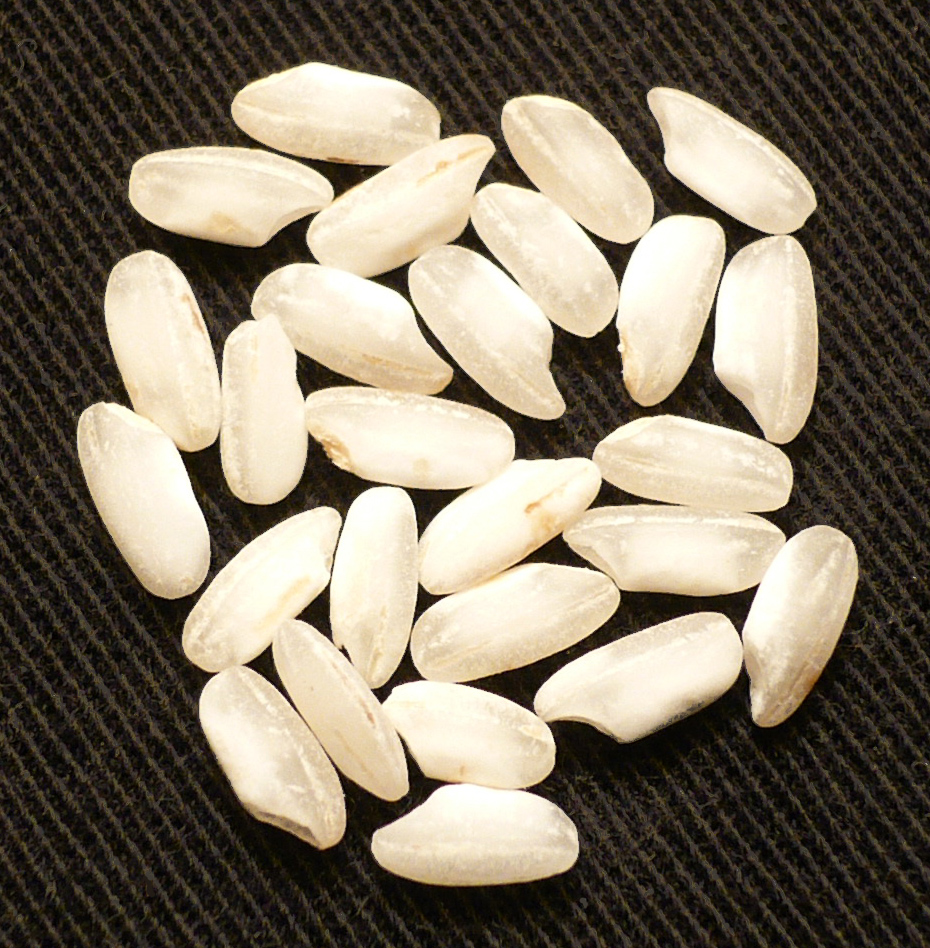
Carnaroli is an Italian medium-grained rice grown in the Pavia, Novara, and Vercelli provinces of northern Italy. Carnaroli is used for making risotto, differing from the more common arborio rice due to its higher starch content and firmer texture, as well as having a longer grain.[1] Carnaroli rice keeps its shape better than other forms of rice during the slow cooking required for making risotto due to its higher amylose content. It is the most widely used rice in Italian cuisine, and is highly prized.
History
[edit]The history of Carnaroli is not well defined,[2] the sources date its birth to 1945 thanks to the crossing between Vialone and Lencino, following the numerous attempts made in various provinces. This variety was named after Professor Emiliano Carnaroli, President of the "Ente Nazionale Risi" (National Rice Body) at that time.[3]
The first registration of the Carnaroli variety in the Varietal Register is from 1974 and the responsibility for the conservation in purity was entrusted to Achille De Vecchi. In 1983, after the conservation tasks were passed to the "Ente Nazionale Risi",[2] it was re-registered in the national register and the person responsible for conservation in purity became the National Organism itself.[4]
It is often described as a superfino rice or as "the king of rices".[1]
See also
[edit]References
[edit]- ^ a b Ponzio, Michael (2011). Cibo: Anybody's Guide to Italian Cooking. AuthorHouse. p. 64. ISBN 9781452039015.
- ^ a b di chiamarsi carnaroli
- ^ "Tutti vogliono il Carnaroli". La Stampa (in Italian). 28 June 1987.
The merit is of the farm "De Vecchi" of Paullo (Milan) which decided to baptize the new variety with the name of a manager of the National Rice Authority, Carnaroli.
- ^ "Caratterizzazione sensoriale e chimico-merceologica di risi (III)" (PDF). ERSAF. 2015. Retrieved 6 April 2020.
External links
[edit]

Carnaroli
View on GrokipediaCharacteristics
Physical properties
Carnaroli rice grains are classified as long A type under European regulations, featuring a plump, elongated shape with a length of approximately 7.2 mm and a width of 3.4 mm (length/width ratio ~2.15).[1] This morphology contributes to its distinctive appearance and handling during processing and cooking.[1] The starch composition of Carnaroli rice is characterized by a high amylose content, typically ranging from 20% to 24% of total starch, which is higher than many other risotto varieties.[5][6][7] This elevated amylose level promotes a firm, non-sticky texture upon cooking by limiting the leaching of amylopectin, the branched starch component responsible for mushiness in lower-amylose rices.[5] The grains also exhibit high hardness (approximately 0.91 kg/cm²) and low stickiness (1 g·cm), enhancing structural integrity.[1] During cooking, Carnaroli grains exhibit robust absorption properties, capable of taking up to three times their volume in liquid while preserving an al dente core.[8] The grains elongate slightly, by about 10-15%, without fracturing, resulting in a cooking time of around 17-18 minutes to achieve optimal firmness.[5] This behavior ensures structural integrity even in prolonged simmering, such as in risotto preparation. Visually, Carnaroli rice displays a pearly white hue with a translucent outer layer encasing an opaque center, giving the grains a luminous, semi-crystalline appearance that remains consistent post-milling.[9]Nutritional profile
Carnaroli rice is predominantly a source of carbohydrates, with total carbohydrates comprising approximately 75.9 g per 100 g of raw grain, primarily in the form of starch. This composition provides an energy value of 348 kcal per 100 g dry weight. Protein content is around 7.2 g per 100 g, while fat is low at 1.6 g per 100 g, and dietary fiber is minimal at 0.7 g per 100 g.[10] The starch in Carnaroli rice consists of amylose and amylopectin, with an average amylose content of about 20-25% of the total starch, or roughly 19.8-24.4 g per 100 g raw grain. This amylose proportion contributes to a medium glycemic index of approximately 64-70, indicating a relatively moderate impact on blood glucose levels. The higher amylose leads to slower starch breakdown during digestion, which can support better blood sugar management compared to lower-amylose varieties.[11][10] Carnaroli rice contains trace amounts of micronutrients typical of white rice varieties, including B vitamins such as thiamine and niacin, as well as minerals like iron (approximately 1.3 mg per 100 g) and magnesium (around 25 mg per 100 g). It is naturally gluten-free, making it suitable for individuals with gluten sensitivities or celiac disease. These nutritional attributes position Carnaroli as a staple grain with balanced macronutrients and modest micronutrient contributions in a gluten-free diet.[10][12]| Nutrient (per 100 g raw) | Amount | Source |
|---|---|---|
| Energy | 348 kcal | [10] |
| Carbohydrates | 75.9 g | [10] |
| Protein | 7.2 g | [10] |
| Fat | 1.6 g | [10] |
| Dietary Fiber | 0.7 g | [10] |
| Amylose | 19.8-24.4 g | [11][10] |
| Glycemic Index | 64-70 | [11] |
| Iron | 1.3 mg | [12] |
| Magnesium | ~25 mg | [10] |
History and origin
Development
Carnaroli rice was developed in 1945 by Italian agronomist and rice grower Ettore De Vecchi through selective breeding, involving the cross-pollination of two established varieties: the sturdy Lencino and the semi-fine Vialone Nero.[2][1] This hybridization aimed to create a grain optimized for risotto production, combining resilience with desirable cooking qualities, and took place on De Vecchi's rice fields near Paullo in the province of Milan.[13][14] Initial experimental cultivation began shortly after its creation. These efforts were supported by early involvement from agricultural institutions, reflecting post-World War II priorities to enhance food security through improved crop varieties. Carnaroli demonstrated superior yields and quality compared to existing types, leading to its adoption among farmers in regions like Pavia, Novara, and Vercelli.[15][1] As a proprietary variety maintained by the De Vecchi family, Carnaroli remained under private conservation until the 1970s, when it transitioned toward broader availability. It received its first official registration in the Italian National Register of Varieties in 1974, with responsibility for purity conservation initially assigned to Achille De Vecchi.[2] In 1983, following a re-registration, oversight passed to the Ente Nazionale Risi, marking its stabilization as a publicly accessible cultivar.[2] By the 1980s, Carnaroli had evolved from an experimental hybrid to the dominant risotto rice in Italy, accounting for a significant portion of premium production due to its proven agronomic and culinary advantages.[15][16]Naming and recognition
The name Carnaroli derives from Emiliano Carnaroli, the commissioner and president of the Ente Nazionale Risi (National Rice Board) who supported the hybridization project led by Ettore De Vecchi that created this rice variety in 1945 as a cross between Lencino and Vialone Nero varieties.[15][17] Officially registered in Italy's National Varietal Register in 1974, Carnaroli quickly earned acclaim in culinary circles for its superior qualities, becoming known as the "king of risottos" by the 1970s due to its high amylose content, firm texture, and ability to absorb flavors while maintaining grain integrity.[1][2] In 2007, Carnaroli rice produced in the Baraggia Biellese e Vercellese area received Protected Designation of Origin (PDO) status from the European Union, recognizing its unique terroir-linked production methods and ensuring authenticity for regional cultivation in Piedmont and Lombardy provinces.[18][19] In 2018, the Ente Nazionale Risi established a dedicated producer chain for "Carnaroli classico" to preserve its traditional characteristics.[17] Classified as a superfino rice under Italian regulations—the highest grade for its elongated, pearly grains—Carnaroli symbolizes Italy's rice heritage and has been celebrated in gastronomic literature and events like Novara's ExpoRice festival, contributing to its global prestige through expanded exports in the 1990s.[20][21][22]Cultivation
Growing regions
Carnaroli rice is primarily cultivated in northern Italy within the Po Valley, which accounts for over 90% of the country's total rice production. The key growing provinces include Vercelli and Novara in Piedmont, Pavia in Lombardy, and regions in Veneto, where the flat, fertile terrain supports extensive paddy fields.[23][24][25][26] This variety flourishes in the temperate and humid climate of the Po Valley, characterized by mild temperatures and adequate rainfall, paired with alluvial soils rich in silt that provide excellent drainage and nutrient retention. Irrigation from the Po River and associated canal systems, such as the Canale Cavour, is crucial for maintaining the flooded conditions required for paddy cultivation.[27][28][29] Italy's overall rice production reached approximately 1.3 to 1.5 million tons annually in the 2020s, with Carnaroli comprising a significant portion as a leading superfino variety; specific outputs for Carnaroli are estimated in the tens of thousands of tons, concentrated in protected zones. Production has varied in recent years due to climate impacts, with a low of approximately 714,000 tonnes of milled rice equivalent in 2022 due to drought, recovery to 1.5 million tonnes of paddy in 2023, and challenges persisting into 2024, though cultivated area increased in 2025.[29][30][31][32][33][34][35][36] Certain Carnaroli rice productions from areas such as Baraggia Biellese and Vercellese in Piedmont hold Protected Designation of Origin (PDO) status, which enforces strict geographical and production controls to maintain quality standards. The variety is, however, cultivated more extensively across northern Italy.[37] While nearly all commercial Carnaroli is grown in Italy, minor experimental cultivation of the variety has occurred outside Europe since the 2000s, including in California, where breeders at the Rice Experiment Station developed adapted strains for local conditions to replicate Italian risotto rice qualities.[38]Agronomic practices and challenges
Carnaroli rice is typically sown directly into prepared fields via broadcast or row methods in late April to early May in northern Italy, with harvesting occurring from September to mid-October, completing a growth cycle of approximately 165 days.[39][40][41] This extended vegetative phase, including germination, tillering, and heading stages, relies on flooded conditions maintained from shortly after sowing to promote anaerobic soil environments that suppress weeds like barnyardgrass and red rice, while supporting robust root development.[39][42] Irrigation practices for Carnaroli emphasize continuous flooding at a depth of 10-15 cm throughout most of the growing season to ensure optimal nutrient uptake and temperature regulation, requiring seasonal water volumes of 13,000-20,000 m³/ha in the Po Valley region.[39] Fertilization focuses on nitrogen applications averaging 100-150 kg/ha, often split into basal and top-dressings during tillering to maximize uptake and achieve paddy yields of 6-8 tons/ha under favorable conditions.[43][39] Phosphorus and potassium are applied basally at rates of around 60-70 kg/ha and 150-160 kg/ha, respectively, to support the variety's high starch content and structural integrity.[43] Carnaroli exhibits high vulnerability to fungal pathogens, particularly rice blast caused by Pyricularia oryzae, which manifests as lesions on leaves and panicles during humid conditions, and sheath blight from Rhizoctonia solani, leading to girdling and lodging in dense stands.[42][44] Management involves breeding for partial resistance in strains like those derived from the original Carnaroli and applications of systemic fungicides such as tricyclazole during tillering and booting stages.[42] The variety is also sensitive to abiotic stresses, including cold snaps below 15°C at sowing or flowering that delay maturity, and summer droughts or heat spikes above 30°C that reduce grain filling, exacerbated by climate variability in recent decades.[39][45] Sustainability initiatives for Carnaroli cultivation have gained traction since the 2010s, with integrated pest management (IPM) strategies incorporating biological controls and crop rotation to minimize herbicide reliance, alongside the development of organic variants that achieve comparable yields through enhanced soil fertility via cover crops and compost.[27][46] These efforts, supported by EU policies, aim to cut chemical inputs by 20-30% while addressing methane emissions from flooded fields through alternate wetting-drying irrigation trials.[27][46]Culinary uses
In risotto
Carnaroli rice is prized in risotto preparation for its ability to achieve a creamy exterior while maintaining a firm, al dente center. The grains are typically toasted in butter or oil with aromatics like onions for 5-10 minutes until opaque, which seals the exterior and prepares them for liquid absorption without browning.[47] Broth is then added gradually in hot increments, stirred until fully absorbed, over a total cooking time of about 20 minutes, resulting in the desired texture.[47][48] The high amylose content in Carnaroli rice enables it to absorb stocks, wines, and aromatics deeply, infusing robust flavors throughout the dish without the grains disintegrating.[49][50] This property makes it particularly suitable for complex risottos such as Milanese with saffron or those featuring mushrooms, where the rice enhances the overall taste profile.[51] In traditional recipes like risotto alla parmigiana, Carnaroli serves as the core ingredient, combined with a 1:3 ratio of rice to liquid, typically vegetable or meat broth, and finished with Parmesan for creaminess.[52][47] After cooking, the risotto rests for 2-3 minutes off the heat, allowing starch redistribution for optimal consistency.[47] Professional chefs favor Carnaroli for its reliable consistency in high-end Italian cuisine, as the rice's firm grain structure resists overcooking and delivers a stable, creamy result even in demanding preparations.[53][54] This preference underscores its role in Italy's recognized gastronomic heritage, where risotto techniques emphasize precision and quality ingredients.[51]Other applications
Carnaroli rice's firm texture and high starch content make it suitable for baked and stuffed preparations where structural integrity is essential. In traditional Sicilian arancini, fried rice balls stuffed with fillings like mozzarella, meat ragù, or peas, Carnaroli is preferred for its ability to hold shape during frying without becoming mushy.[55][56] Similarly, it is used in timballo, a layered molded dish often featuring rice encasing meats, cheeses, and vegetables, baked to form a cohesive crust while maintaining distinct grains inside.[57][58] Beyond frying and baking, Carnaroli adds body to soups and salads through its absorbent yet al dente quality. In Italian minestrone, a vegetable and bean soup, Carnaroli is incorporated toward the end of cooking to thicken the broth without disintegrating, typically requiring about 12-15 minutes to reach tenderness.[59][60] For cold rice salads, known as insalata di riso, it is boiled briefly for 12-17 minutes to preserve firmness, then mixed with vegetables, tuna, or cheeses for a light, separable grain texture.[61][62] Internationally, Carnaroli has been adapted in fusion cuisines leveraging its versatility. In paella variants, particularly Italian-influenced versions, it substitutes for traditional Bomba rice, absorbing saffron-infused broths while retaining shape during the one-pot simmer.[63][64] In modern fusion dishes, such as Japanese-Italian risottos or experimental sushi rolls, its sticky yet firm profile mimics sushi rice, as seen in recipes blending it with sake, lemon, and herbs.[65][66] Exported to gourmet markets in the US and Europe since the 1990s, Carnaroli has gained popularity for these adaptations, with importers like Manicaretti distributing it for high-end applications.[67][68] For preservation, Carnaroli is well-suited to drying post-harvest, a standard process that enhances shelf life while preserving its amylose content for later use. It can also be milled into fine flour, retaining nutritional elements like proteins and minerals, which is employed in gluten-free desserts such as batters for fried pastries or enriched puddings.[69][70] While rice pudding (budino di riso) traditionally uses whole grains simmered in milk, the flour variant allows for smoother, allergen-free incorporations in baked sweets.[71][72]Comparisons with other varieties
Versus Arborio
Carnaroli rice grains exhibit a higher amylose content relative to total carbohydrates after cooking, typically around 39.83% in boiled preparations, compared to approximately 27.80% in Arborio, which contributes to firmer, more intact grains in Carnaroli versus the softer, starchier texture of Arborio's shorter grains. This elevated amylose level in Carnaroli—stemming from its raw content of about 24.41 g per 100 g—resists breakdown during absorption, while Arborio's higher amylopectin proportion leads to greater stickiness and tenderness.[73] In cooking outcomes, Carnaroli maintains its shape superiorly during extended simmers required for risotto, with lower risk of overcooking due to its robust structure and amylose retention (up to 63.07% after boiling), resulting in an al dente core. Arborio, conversely, releases more starch for a creamier consistency but is prone to becoming mushy if not monitored closely, as its lower post-cooking amylose percentage facilitates quicker softening.[73][74] Carnaroli is preferred for risottos highlighting delicate flavors, such as those with seafood or asparagus, where its firmness preserves subtle tastes without overpowering creaminess. Arborio suits robust, cheesy varieties like those with mushrooms or sausage, offering a bolder, more enveloping texture; both varieties originate from Italy's Po Valley, with Arborio being a traditional medium-grain variety named after the town of Arborio.[75] Arborio is a traditional Italian variety originating from the Po Valley, named after the town of Arborio. Carnaroli is noted for better disease resistance, making it more reliable for consistent yields in modern cultivation.[76]Versus Vialone Nano and Baldo
Carnaroli, Vialone Nano, and Baldo are all Italian japonica rice varieties prized for risotto preparation, but they differ in grain morphology, starch composition, textural attributes, and cooking behavior, influencing their performance in culinary applications.[77] Carnaroli features a long, slender grain (length: 6.60 mm, width: 3.10 mm), classifying it as Long A type, with medium amylose content (20.6 g/100g). This contributes to its moderate hardness (1.11 kg/cm²) and stickiness (0.93 g·cm), allowing it to maintain firmness during extended cooking while absorbing flavors effectively; its gel-time is 19.72 minutes, and typical cooking time is around 17 minutes.[77] In contrast, Vialone Nano has a shorter, rounder medium grain (length: 5.60 mm, width: 3.30 mm), higher amylose (22.4 g/100g), similar moderate hardness (1.10 kg/cm²) and stickiness (0.91 g·cm), but a shorter gel-time (15.95 minutes) and cooking time (13 minutes), making it more prone to quicker starch release for a creamier texture without becoming mushy.[77] Baldo, also Long A (length: 6.90 mm, width: 3.10 mm), has lower amylose (17.9 g/100g), resulting in softer hardness (0.86 kg/cm²) and notably higher stickiness (3.87 g·cm), with a gel-time of 19.85 minutes and the shortest cooking time (12 minutes) among the three, yielding a more cohesive, sticky consistency ideal for richer risottos.[77] Sensory evaluations confirm these instrumental differences: Carnaroli and Vialone Nano cluster together for balanced firmness and creaminess, suiting traditional al dente risottos, while Baldo aligns with stickier varieties, offering enhanced mouthfeel but requiring careful monitoring to avoid over-softening.[77] All three varieties exhibit high resistance to breakage and good flavor absorption due to their amylopectin-rich exteriors, but Vialone Nano's protected geographical indication (IGP) status in Veneto emphasizes its regional specificity for lighter, more delicate dishes, whereas Carnaroli (from Piedmont and Lombardy) and Baldo (widely grown in northern Italy) provide versatility for bolder flavor profiles.[77]| Property | Carnaroli | Vialone Nano | Baldo |
|---|---|---|---|
| Grain Length (mm) | 6.60 | 5.60 | 6.90 |
| Grain Width (mm) | 3.10 | 3.30 | 3.10 |
| Amylose (g/100g) | 20.6 | 22.4 | 17.9 |
| Hardness (kg/cm²) | 1.11 | 1.10 | 0.86 |
| Stickiness (g·cm) | 0.93 | 0.91 | 3.87 |
| Cooking Time (min) | 17 | 13 | 12 |