


Community hub
Recent from talks
Contribute something
Nothing was collected or created yet.
Champorado
View on Wikipedia
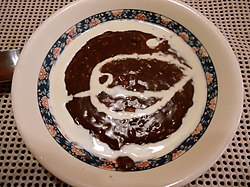
  Top: A bowl of champorado with milk; Bottom: Tableya, locally made tablets of pure chocolate made from fermented, toasted, and ground cocoa beans | |||||||
| Alternative names | Tsampurado | ||||||
|---|---|---|---|---|---|---|---|
| Type | Porridge | ||||||
| Place of origin | Philippines | ||||||
| Region or state | Manila | ||||||
| Serving temperature | Hot or cold | ||||||
| Main ingredients | Glutinous rice, tabliya, milk or coconut milk, sugar | ||||||
| Ingredients generally used | Daing or Tuyô and roasted cocoa beans | ||||||
| Variations | Tinughong | ||||||
| 244.30 kcal (1,022.2 kJ) | |||||||
| |||||||
| Similar dishes | Champurrado | ||||||

Champorado or tsampurado[1] (from Spanish: champurrado[1] from champurrar 'to mix'[2]) is a sweet chocolate rice porridge in Filipino cuisine.
Ingredients
[edit]It is traditionally made by boiling sticky rice with tablea (traditional tablets of pure ground roasted cocoa beans). It can be served hot or cold, usually for breakfast or merienda, with a drizzle of milk (or coconut milk) and sugar to taste. It is usually eaten as is, but a common pairing is with salted dried fish (daing or tuyo).
Tinughong is a variant of champorado in the Visayan-speaking regions of the Philippines. It is usually made by boiling sticky rice with sugar instead of tablea. Coffee or milk are sometimes added to it.[3][4]
A popular new variant of champorado is ube champorado, which has a purple yam (ube) flavoring and ube halaya. It is characteristically purple like all ube-based dishes.[5] Other contemporary variants include white, pandan and strawberry flavors.
History
[edit]Its history can be traced back from the Spanish colonial period of the Philippines. During the galleon trade between Mexico and the Philippines, Mexican traders brought the knowledge of making champurrado to the Philippines (while tuba was introduced back in Mexico). Through the years, the recipe changed; Filipinos eventually found ways to make the Mexican champurrado a Philippine champorado by replacing masa with sticky rice.[6]
See also
[edit]
References
[edit]- ^ a b Almario, Virgilio, et al. 2010. UP Diksiyonaryong Filipino, 2nd ed. Anvil: Pasig.
- ^ "champurrado". Diccionario de la lengua española. Royal Spanish Academy & Association of Academies of the Spanish Language. Retrieved December 16, 2024.
- ^ Rose Catherine S. Tejano (December 16, 2012). "Sikwate Stories". The Bohol Chronicle (344). Archived from the original on August 13, 2016. Retrieved July 28, 2016.
- ^ "Bisaya English Translation of "tinughong"". Cebuano Dictionary. Sandayong.com. Archived from the original on September 14, 2016. Retrieved July 28, 2016.
- ^ "Ube Champorado". yummy.ph. October 18, 2017. Retrieved August 18, 2024.
- ^ "Mexico Champorado". January 31, 2011. Retrieved May 8, 2018.


| North America |
| ||||||||||||
|---|---|---|---|---|---|---|---|---|---|---|---|---|---|
| South America | |||||||||||||
| Europe | |||||||||||||
| Africa | |||||||||||||
| West Asia | |||||||||||||
| Central Asia | |||||||||||||
| South Asia |
| ||||||||||||
| East Asia |
| ||||||||||||
| Southeast Asia |
| ||||||||||||
| Other | |||||||||||||


Champorado
View on GrokipediaOverview and Etymology
Description
Champorado is a sweet, chocolate-flavored sticky rice porridge central to Filipino cuisine, characterized by its thick and creamy consistency derived from glutinous rice cooked in a chocolate-infused broth.[1][4] The dish features a smooth, pudding-like texture and an earthy, bittersweet cocoa profile from tablea, the traditional pure cacao tablets, balanced by added sweetness for a rich, indulgent taste.[1][5] It is typically served warm, evoking a comforting warmth ideal for breakfast or as a merienda snack.[6][4] As a dessert-like counterpart to savory rice porridges, champorado holds a special place as a nostalgic comfort food in Filipino households, often paired with evaporated milk for creaminess or dried salted fish to provide a contrasting salty bite.[1][4] Its name derives from the Spanish colonial-era champurrado, adapted during that period to local ingredients.[1]Name and Linguistic Origins
Champorado derives its name from the Spanish term champurrado, a thick chocolate-based beverage originating in Mexico, which itself comes from the verb champurrar, meaning "to mix" or "to muddle," reflecting the blending of ingredients like corn masa, chocolate, and spices in its preparation. This Mexican drink was introduced to the Philippines during the Spanish colonial era through the Manila-Acapulco galleon trade, established in 1565, which facilitated the transpacific exchange of goods including cacao in the late 17th century. Cacao, the key ingredient for such chocolate preparations, arrived in the Philippines around the 1660s–1670s, likely via Jesuit missionaries and traders from Acapulco, marking the beginning of local chocolate consumption among Spanish elites and eventually the broader population.[7][8] In Filipino languages, the term evolved into tsampurado (or champorado), a phonetic adaptation in Tagalog that preserves the Spanish root while aligning with Austronesian phonology, where the "ch" sound is rendered as "ts" and the word integrates as a loanword for the rice-based porridge version of the drink. This adaptation exemplifies the broader linguistic influence of Spanish on Tagalog, with an estimated 20–33% of modern Tagalog vocabulary derived from Spanish terms introduced during over three centuries of colonization, often modified to fit native sound systems and grammatical structures. There were no pre-colonial equivalents for champurrado or tsampurado in Philippine languages, as chocolate and cacao were unknown in the archipelago prior to Spanish introduction in the 16th century.[7][9] Regional variations in naming further illustrate linguistic diversity across the Philippines. In Visayan-speaking areas, the dish is known as tinughong, a term derived from Cebuano for a sweet rice gruel typically made by reboiling leftover rice with sugar, which may or may not include chocolate, highlighting local adaptations without direct reliance on the Spanish loanword. This Visayan name underscores how colonial introductions blended with indigenous porridge traditions, using native Austronesian roots like those for "gruel" or "sweetened boil" to describe similar preparations.[10]Historical Development
Spanish Colonial Roots
The introduction of champorado to the Philippines occurred during the Spanish colonial era through the Manila-Acapulco Galleon Trade, which operated from 1565 to 1815 and facilitated the exchange of goods and culinary traditions between Mexico and the Philippine islands.[11] Mexican traders and settlers, missing familiar foods from home, brought recipes for champurrado—a thick, corn-based atole made with masa harina, chocolate, and spices—prompting local adaptations to available ingredients.[3] In the Philippines, where corn was less prevalent than rice, glutinous rice (malagkit) was substituted for masa, transforming the beverage into a porridge-like dish that aligned with indigenous rice-centric cooking practices.[12] This adaptation exemplified broader Spanish influences on Filipino cuisine, particularly the dissemination of cacao, which originated in Mesoamerica and was transported via the galleon trade. Cacao beans arrived in the Philippines in the 17th century, initially as imports, and were soon cultivated locally in regions like Laguna, Cebu, and Bohol.[13][14] Indigenous methods of roasting and grinding the beans into solid disks known as tablea integrated pre-colonial processing techniques with the Spanish-introduced ingredient, creating a uniquely Filipino form of chocolate used in early versions of champorado.[15] Historical accounts from the colonial period document the galleon trade's role in supplying cocoa beans, which were prized commodities exchanged alongside silks and spices, embedding chocolate into elite Spanish-Filipino households by the 1700s and 1800s.[11] Early recipes for champorado-like preparations emerged in these Spanish-Filipino households during the 18th and 19th centuries, often as a comforting breakfast or snack blending Mexican and local flavors.[3] Initially perceived as an elite dish due to the high cost of imported cocoa, champorado was reserved for affluent families and religious occasions, but local cacao cultivation gradually made the ingredient more accessible, democratizing its consumption across social classes by the late colonial period.[16]Post-Colonial Adaptations
During the American colonial period from 1898 to 1946, the introduction of canned goods significantly influenced Filipino cuisine, including champorado, by making evaporated and condensed milk widely available as affordable alternatives to fresh or coconut milk, thereby enhancing the dish's creaminess and accessibility for everyday preparation. Refined sugar, also imported in greater quantities during this era, allowed for easier sweetening compared to traditional muscovado, further integrating champorado into urban and working-class diets. In urban areas, the availability of imported cocoa powder began to supplement or replace tablea, offering a quicker preparation method suited to modern lifestyles.[17][18] Following World War II and Philippine independence in 1946, champorado adapted to post-war economic recovery through regional mass production of tablea, particularly in Bohol, where family-run operations like El Tablea scaled up output using local cacao farms to meet domestic demand. The Filipino diaspora, growing rapidly from the 1960s onward, spread champorado recipes globally, with adaptations in communities abroad such as using readily available cocoa powder or pairing it with local ingredients in Filipino American households. By the late 20th century, branded evaporated and condensed milk products became standard toppings, solidifying champorado's role as a comforting staple in both homeland and expatriate kitchens.[19][20] In the 21st century, champorado has seen renewed emphasis on sustainability amid health trends and heritage revival, with initiatives promoting eco-friendly cacao farming in regions like Mindanao and Bicol to reduce imports and preserve tablea quality. Projects such as The Cacao Project have supported over 300 farmers in planting more than 350,000 trees across 800 acres, fostering biodiverse agroforestry that enhances soil health and yields for traditional ingredients.[21][22][23] This revival aligns with broader efforts to commercialize local chocolate products, blending cultural preservation with nutritional awareness by highlighting champorado's antioxidant-rich cacao benefits. As of 2025, the Philippine Cacao Industry Roadmap 2026-2030 targets P1 billion in investments and expansion to 52,500 hectares of cacao land by 2030, while the National Cacao Congress in October 2025 emphasized intercropping with coconuts and other cash crops for sustainability.[24][25]Ingredients and Preparation
Core Ingredients
The core ingredient in traditional champorado is glutinous rice, known locally as malagkit, a sticky variety cultivated in Philippine rice paddies that provides the essential carbohydrates and contributes to the dish's signature creamy, porridge-like texture.[26] Varieties such as NSIC Rc13, developed by Philippine agricultural research institutions, are commonly used for their high starch content and suitability for sticky rice dishes.[27] Tablea, or cacao tablets, form the chocolate base and are made from minimally processed, roasted, and ground cocoa beans sourced primarily from cacao-growing regions like Davao and Bohol in the Philippines, imparting a natural, bittersweet flavor without modern additives.[26][28] These tablets trace their introduction to Spanish colonial trade routes but are now produced locally using native cacao varieties.[26] Sweeteners in traditional champorado typically include brown sugar or muscovado, unrefined cane sugars harvested from Philippine plantations that add caramel-like notes to balance the cacao's bitterness.[29][30] While white sugar appears in some contemporary preparations, muscovado remains preferred for its authentic, molasses-rich profile in classic recipes.[31] The liquid base begins with water for initial boiling, often enriched with coconut milk for added creaminess or topped with evaporated milk upon serving to enhance richness and smoothness.[26][1] Coconut milk, derived from local coconuts, is a staple in many traditional versions, while evaporated milk reflects post-colonial influences.[26] Optional add-ins provide contrast and are not always included but feature prominently in savory pairings; salted dried fish such as daing na bangus (milkfish) or tuyo (salted herring) offers a umami, salty element to offset the sweetness.[26][32] In some recipes, saba bananas are incorporated for subtle sweetness and texture, drawing from abundant Philippine banana varieties.[33]Cooking Process
The traditional preparation of champorado involves a straightforward simmering process that transforms glutinous rice into a creamy, chocolate-infused porridge, typically taking about 30 to 45 minutes from start to finish and yielding 4 to 6 servings.[34][1][35] To begin, rinse 1 cup of glutinous rice under cold water once or twice to remove surface starch, which helps prevent excessive gumminess during cooking; drain well.[35] In a deep pot over medium heat, bring 4 to 6 cups of water to a boil, depending on the desired final consistency—more water yields a thinner porridge suitable for hot serving, while less produces a thicker texture ideal for chilling.[1][34] Add the rinsed rice to the boiling water, stirring to distribute evenly, and reduce the heat to medium-low; cook for about 10 minutes, stirring occasionally, until the rice grains begin to expand and soften but are not fully tender.[1][35] Next, crush or chop 4 to 5 pieces of tablea chocolate tablets to facilitate melting, and add them directly to the pot; stir vigorously and continuously for 2 to 3 minutes until the tablea fully dissolves into the mixture, avoiding lumps by ensuring no solid pieces remain.[34][26] Incorporate ½ to ¾ cup of sugar, stirring until it dissolves completely, then simmer the porridge uncovered for an additional 15 to 25 minutes, stirring frequently to prevent the rice from sticking to the pot bottom and to promote even thickening as the starch releases.[1][35] The mixture is ready when the rice becomes translucent, the porridge achieves a smooth, pudding-like consistency that coats the back of a spoon, and it pulls away slightly from the pot sides.[34] Key techniques include constant stirring, especially after adding the tablea and sugar, to maintain creaminess and avoid clumping or scorching, which can occur if the heat is too high.[1][36] For authentic flavor, traditional cooks use a heavy-bottomed clay or metal pot like a caldero over a wood fire, which imparts a subtle smoky note, though modern adaptations employ a standard stovetop pot or even a rice cooker for convenience and consistent heat distribution.[1] If preparing a chilled version, allow the champorado to cool at room temperature for 30 minutes before refrigerating, adjusting the initial water quantity to make it denser to prevent separation upon cooling.[35]Variations
Regional Styles
In the Visayan regions, such as Cebu and Bohol, a popular variant known as tinughong diverges from the chocolate-focused standard by boiling sticky rice with sugar, and occasionally incorporating coffee or milk for flavor, resulting in a simpler sweet porridge.[37][38] Luzon styles show subtle distinctions, with the Tagalog version adhering closely to the core recipe using tablea chocolate and often served alongside dried salted fish like tuyo for contrast.[39] Toasted rice flakes called pinipig may be added as a crunchy topping or mix-in to enhance texture in some preparations.[40] Mindanao variations leverage the region's prominent cacao production, particularly from Davao, where high-quality local tablea or chocolate is used to intensify the dish's flavor; some iterations incorporate fresh coconut milk for a tropical twist.[41][42][43] Regional differences often center on dairy choices, with southern areas favoring fresh coconut milk for its natural creaminess and availability from abundant palms, while northern and urban Luzon preparations more commonly use evaporated milk for convenience and a milder taste.[1][26]Modern Interpretations
In recent years, ube champorado has emerged as a prominent modern variation, incorporating purple yam (ube) to impart a vibrant lavender hue and a nutty, earthy flavor that complements the traditional chocolate base. This adaptation gained traction in the 2010s, particularly through social media platforms where its photogenic color appealed to younger audiences and food influencers, transforming it from a simple porridge into an Instagram-worthy dessert or breakfast option.[44][45] Entrepreneurs in the Philippines have capitalized on this trend by offering ready-to-eat versions, such as ube-infused mixes, further popularizing it in urban settings and abroad.[45] Flavor innovations have expanded champorado's appeal by blending it with unexpected ingredients, including pandan leaves for a subtle aromatic grassiness, fresh strawberries for a tangy fruit twist, or white chocolate for a milder, creamier profile. These versions often replace or supplement the classic cacao with alternative sweeteners and add-ins, while vegan adaptations substitute dairy with plant-based milks like coconut or almond to maintain the porridge's creamy texture without animal products.[46][47][48][49] Adaptations such as substituting glutinous rice with quinoa have introduced gluten-free options, aligning with health-focused dietary preferences while preserving the dish's comforting essence; these are often served cafe-style with toppings like chopped nuts, fresh fruits, or a drizzle of condensed plant milk. Recent trends emphasize health and sustainability, including low-sugar formulations sweetened with stevia to reduce glycemic impact, instant mixes from brands like White King developed in the post-2000s era for convenience, and a growing preference for fair-trade cacao sourced from Philippine farms to support ethical production.[50][51][52][53]Cultural Significance
Traditional Serving Practices
Champorado is traditionally drizzled with evaporated milk or condensed milk to add creaminess and sweetness, enhancing its chocolatey flavor. It is commonly paired with tuyo, dried salted fish, creating a classic sweet-salty contrast that balances the porridge's richness.[1][54] As a staple in Filipino meals, champorado serves as an energizing breakfast dish, often prepared in homes to start the day. It also features as a merienda, or afternoon snack, available at street food stalls or shared among family members during breaks. Particularly favored as comfort food on rainy days, it provides warmth and satisfaction during the wet season.[1][55][56] In social settings, champorado is served family-style in shared bowls, promoting communal eating and bonding during mealtimes. In rural areas, it is frequently enjoyed alongside strong black coffee, complementing its bold taste. The dish occasionally appears at town fiestas, offered as a simple, nostalgic treat amid celebrations.[57][58] Traditionally presented hot to evoke comfort in cooler or rainy weather, champorado can also be served chilled in the tropical climate for a refreshing option. Portion sizes are modest, typically around one cup per serving, allowing for easy sharing.[1][39][59]Nutritional and Health Aspects
Champorado offers a balanced nutritional profile derived from its primary ingredients of glutinous rice, cacao tablea, sugar, and milk, providing a mix of macronutrients suitable for a comforting meal. A typical 1-cup serving (approximately 240g) contains about 307 kcal, including 5.9g of protein, 3.9g of fat, 64g of carbohydrates, and 2g of dietary fiber, though values can vary based on exact proportions and milk type used.[60] The dish is notably high in antioxidants from the cacao in tablea, particularly flavonoids such as epicatechin, which have been linked to improved cardiovascular health by reducing blood pressure and enhancing endothelial function.[61] The energy provided by champorado comes largely from the carbohydrates in glutinous rice, which has a high glycemic index (typically 75–98) and offers a quick release of glucose, suitable for immediate energy needs but potentially causing sharp blood sugar spikes.[62] Additionally, the tablea contributes essential minerals like iron for oxygen transport in the blood and magnesium for muscle function and nerve health, making the porridge a nutrient-dense option when prepared traditionally.[63] As a warm, soft-textured comfort food, champorado, especially when paired with milk, can aid digestion by soothing the gastrointestinal tract and promoting easier nutrient absorption, similar to other rice-based porridges.[64] Despite its benefits, champorado's high sugar content from added sweeteners poses potential drawbacks, including increased risk of dental caries and type 2 diabetes with frequent consumption.[65] The dish is naturally gluten-free due to its rice base, but its calorie density requires moderation to support weight management, as excessive intake can contribute to energy surplus.[66] Health-conscious adaptations include opting for dark, unsweetened tablea to minimize added sugars while retaining cacao's benefits, resulting in a lower-glycemic version. Compared to oatmeal, champorado shares a similar carbohydrate-driven energy profile but distinguishes itself with cacao's unique tropical-derived flavonoids and minerals, offering complementary heart-protective effects alongside oatmeal's soluble fiber advantages.[35]References
- https://en.wiktionary.org/wiki/tinughong