Hubbry Logo
CeBITCeBITMain
Open search
CeBIT
Community hub
CeBIT
logo
8 pages, 0 posts
0 subscribers
Be the first to start a discussion here.
CeBIT
CeBIT
from Wikipedia

CEBIT
Logo
StatusDefunct
GenreComputer Expo
FrequencyAnnually
VenueHanover fairground
LocationHanover
CountryGermany
Inaugurated1970
Most recent2018
Attendance120,000 (2018)[1]
Organized byDeutsche Messe AG
Websitewww.cebit.de
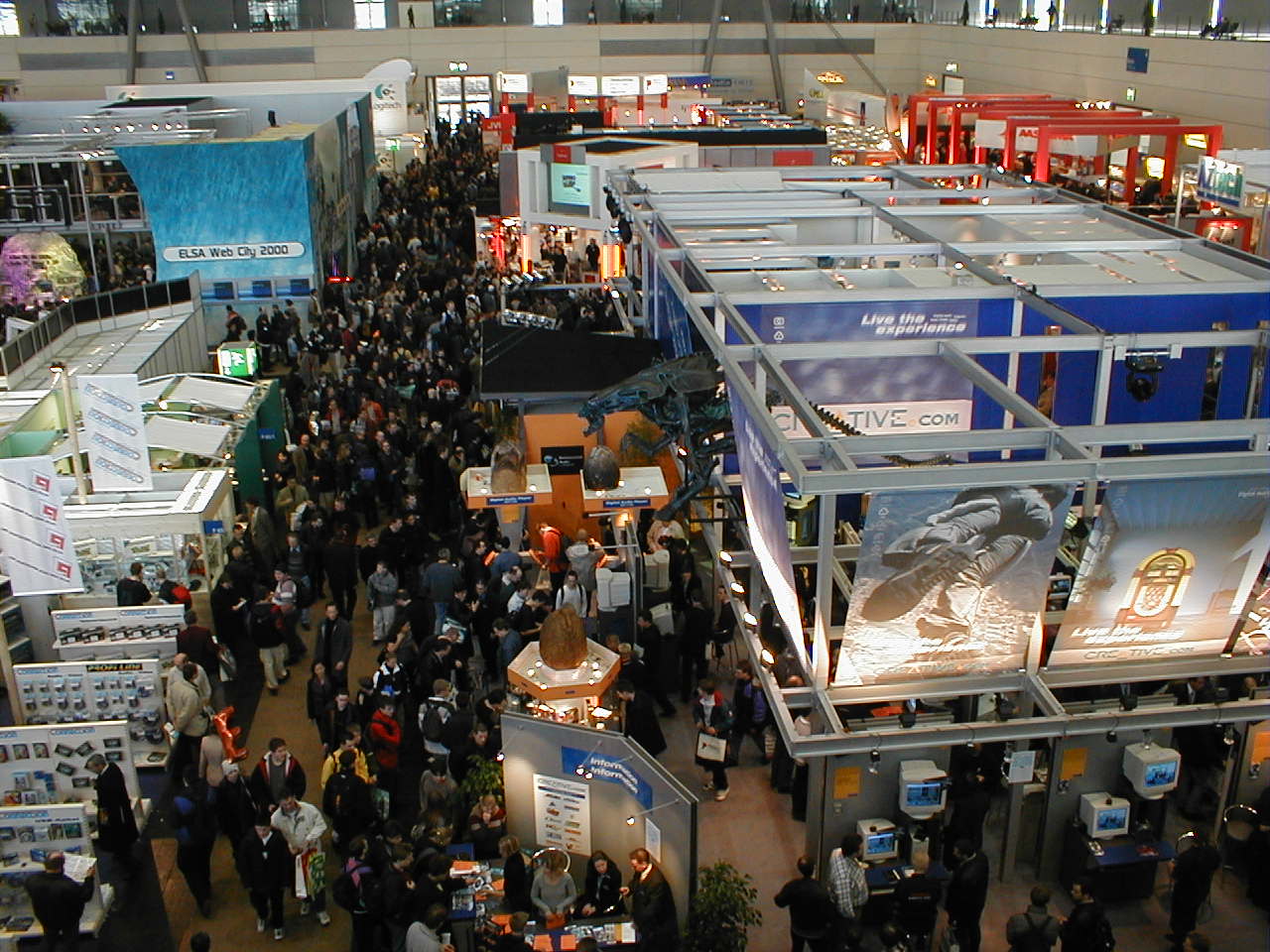
A crowded exhibition hall during CeBIT 2000
IBM stand during CeBIT 2010
Jimmy Wales 2014 on CeBIT Global Conferences, Wikipedia Zero
Number of CeBIT visitors 1986–2013
Logo used until 2017

CeBIT was a computer expo which, at its peak[when?], was the largest and most internationally representative. The trade fair was held each year on the Hanover fairground, the world's largest fairground, in Hanover, Germany. In its day, it was considered a barometer of current trends and a measure of the state of the art in information technology. It was organized by Deutsche Messe AG.[2]

With an exhibition area of roughly 450,000 m2 (4.8 million sq ft) and a peak attendance of 850,000 visitors during the dot-com boom, it was larger both in area and attendance than its Asian counterpart COMPUTEX and its no-longer held American equivalent COMDEX. CeBIT is a German language acronym for Centrum für Büroautomation, Informationstechnologie und Telekommunikation,[3] which translates as "Center for Office Automation, Information Technology and Telecommunication".

The final CeBIT took place in 2018.

History

[edit]

CeBIT was traditionally the computing part of the Hanover Fair, a big industry trade show held every year. It was established in 1970, with the opening of the Hanover fairground's new Hall 1, then the largest exhibition hall in the world.[4] However, in the 1980s the information technology and telecommunications part was straining the resources of the trade fair so much that it was given a separate trade show starting in 1986, which was held four weeks earlier than the main Hanover Fair.

The number of visitors for the new exhibition increased to 830,000 in 2001, but by 2007 the CeBIT expo attendance had shrunk to around 200,000,[5] then attendance rebounded to 334,000 by 2010.[6] The 2008 expo was marred by police raids of 51 exhibitors for patent infringement.[7] In 2009, the U.S. state of California became official Partner State of Germany's IT and telecommunications industry association, BITKOM, and of CeBIT 2009. focusing on environmentally-friendly technologies.[8]

From 2007 till 2013, the fair acted as the World Championship (Grand Final) of Intel Extreme Masters. The championship was reallocated to Katowice, Poland in 2014.[citation needed]

On 28 November 2018, Deutsche Messe AG announced that due to declining visitor and exhibitioner attendance, CeBIT would be canceled for the foreseeable future.[9][10] This makes CeBIT 2018 the final event.[11]

Other CeBIT-branded shows

[edit]

As CeBIT continued to grow quickly and was becoming too big on its own, it was decided to concentrate on the professional market, while the home and entertainment market was given a separate show, CeBIT Home, during summer, planned to be biennial. However, after being held twice (in 1996 and 1998), the 2000 CeBIT Home (had originally been scheduled to be held in Leipzig due to the Expo 2000 being held in Hanover) was cancelled and the project was abandoned.

Since 1999 the CeBIT sponsor Deutsche Messe AG ("German Trade Show, Inc.") has organized trade shows outside of Germany bearing the CeBIT name:

CeBIT Global Conferences

[edit]

Running over a five-day period in Hanover, Germany, the CeBIT Global Conferences (CGC) are staged congruently with the CeBIT exhibition. The conferences are dedicated to providing a 360° overview of the digital industry's four core markets: IT, Telecommunications, Digital Media and Consumer Electronics. Noted industry figures and researchers from across the globe are invited to speak on the latest relevant trends and innovations as well as their impact on society and the working world. The conference is divided up into keynote speeches, talks and panel discussions. The CGC conferences are produced by Deutsche Messe AG, with the German BITKOM association acting as the CGC patron since 2009. In 2014, the CGC were staged with 140 speakers on three stages with a program of 70 conference hours and 3000 participants. Target groups of the conference are CXOs, managers, experts, visionaries and out-of-the-box thinkers, Conference languages are English and German.[citation needed]

Recent conferences have featured the following keynote themes:

  • 2008: "Improving Life in the Global Village". This installment of CGC attracted 1900 visitors and 43 speakers attending the keynotes and discussion sessions.
  • 2009: "How Will We Be Working, Living and Communicating in the Coming Years?" This CGC drew 3,133 visitors from 88 nations, with some 2,200 guests following the conference via live streaming.
  • 2010: "The Challenges of a Changing World – ICT for Better Lives and Better Business", attracting some 4,000 guests from more than 100 nations. Just under 4,000 guests also visited the conference via live streaming.[citation needed]

The motto of the CeBIT Global Conferences for 2011 was "The Power of Creativity and Innovation".

Speaker list 2014

[edit]

Over the past years, speakers at the CeBIT Global Conferences have included Gov. Arnold Schwarzenegger, Governor of California; Kevin Turner, COO, Microsoft, Craig Barrett, Chairman of the Board, Intel, Jon Iwata SVP Marketing & Communications, IBM, Reid Hoffman, Chairman and CEO, LinkedIn; Mukund Krishna, CEO Suyati Inc; Scott Durchslag, COO, Skype; Werner Vogels, Vice President & CTO, Amazon, Stewart Butterfield, Co-founder of Flickr.com, Michael T. Jones, Chief Technology Advocate, Google & Founder of Google Earth; Mark Kingdon, CEO, LindenLab.[citation needed]

CeBIT Awards

[edit]

CeBIT was a platform for recognising achievement by ICT businesses, particularly in Australia.[14] The awards include the Excellence in Communications Award, the Advanced Retail Technology Award, the Innovative IT Security Award, and the Early Innovators Award. Notable past winners include Motorola,[15] McAfee[16] and eWAY.[17]

See also

[edit]

References

[edit]
[edit]
Revisions and contributorsEdit on WikipediaRead on Wikipedia
from Grokipedia
CeBIT was an annual international trade fair dedicated to , , and digital business, held in , , and recognized as one of the world's largest events of its kind until its discontinuation in 2018. Originating in 1961 as a specialist exhibition for office equipment within the broader German Industrial Fair (later known as HANNOVER MESSE), CeBIT evolved rapidly with the growth of the computer industry and became an independent event in 1986 under the full name Center for , and . Organized by Deutsche Messe AG, it occupied a vast exhibition space of 70,300 square meters in Hanover's Hall 1—the world's largest exhibition hall at the time of its 1970 opening, as recognized by the Guinness Book of Records in 1984—and served as a global platform for showcasing innovations, fostering business connections, and driving advancements in digital technologies. At its peak in the early , CeBIT attracted around 8,100 exhibitors from around the world in and drew record crowds of 860,000 visitors in , solidifying its status as the leading IT trade fair and a key venue for announcements on emerging trends like the and mobile computing. The event expanded internationally starting in with spin-off editions such as CeBIT Asia in and CeBIT Eurasia in , further amplifying its influence on global digital markets. In response to shifting industry dynamics, including the aftermath of the , CeBIT adapted by emphasizing themes like Green IT in 2008 and shortening its duration to six days to prioritize quality over quantity. However, facing persistent challenges such as declining visitor numbers—down to around 120,000 in —and reduced exhibitor bookings amid the ubiquity of across other trade fairs, Deutsche Messe AG announced the permanent cancellation of the Hannover CeBIT in November , marking the end of a 32-year era in international IT exhibitions. While the flagship Hannover event was discontinued, CeBIT-branded trade shows continue internationally, such as CeBIT and CeBIT as of 2025.

History

Inception and Early Years

A forerunner of CeBIT originated in 1961 as a specialist exhibition for office equipment within the German Industrial Fair (later known as HANNOVER MESSE). It was formally named CeBIT (Centrum für Büro- und Informations-Technik) and established as the "Office and " section in 1970 within the annual HANNOVER MESSE, coinciding with the opening of the newly constructed Hall 1 at the . This hall, measuring 70,300 square meters, was recognized by the Book of Records as the world's largest exhibition hall at the time, underscoring the growing importance of the IT sector. The section, named CeBIT (Centrum für Büro- und Informations-Technik) by the exhibitors' advisory committee, initially emphasized office equipment, , and technologies. In its early years, CeBIT benefited from the economic recovery in and the emerging demand for information technologies, attracting exhibitors focused on hardware and early computing solutions. By the late , the section's popularity necessitated the allocation of additional venues, including Halls 2 and 18, to handle the influx of participants driven by advancements in and the advent of personal computing. A key milestone came in 1978 with the introduction of displays, broadening the event's scope beyond professional office tools to include home-oriented innovations. The 1980s saw further expansion into Hall 3 amid surging interest from software developers and PC manufacturers, reflecting the global shift toward digital technologies. In 1982, CeBIT forged its first international partnerships, enhancing its appeal to foreign exhibitors and visitors. By 1985, the IT segment boasted 1,300 exhibitors—with 870 more on a waiting list—and drew 293,000 visitors to the IT section, accounting for a substantial portion amid rapid industry growth. Logistical challenges, including chronic space shortages and exhibitor overcrowding, culminated in the decision to detach CeBIT from HANNOVER MESSE. Announced in November 1984, the separation took effect in 1986 to allow the IT event dedicated facilities, enabling it to operate independently and accommodate the sector's explosive expansion without straining the broader industrial fair's resources.

Growth and Peak Era

In 1986, CeBIT achieved full independence from the HANNOVER FAIR, marking a pivotal shift as it transitioned to a standalone event held from March 12 to 18, occupying over 200,000 square meters across dedicated exhibition halls and incorporating for the first time with 190 exhibitors, adopting the full name Center for , and . This separation allowed for rapid scaling, with initial attendance reaching 334,400 visitors and 2,142 exhibitors, reflecting the burgeoning demand for IT-focused showcases amid the industry's growth. By the late , the event had expanded its scope beyond office technology to encompass broader , , and emerging sectors, solidifying its role as a global platform for innovation. The 1990s saw CeBIT's thematic evolution, introducing specialized pavilions that highlighted key trends such as client-server computing, data warehousing, , and the Internet's international breakthrough, despite periodic IT recessions. A dedicated "home" pavilion debuted in 1996 as CeBIT Home, a separate summer event targeting consumer electronics, distributors, and small office/home office users, attracting 632 exhibitors and 215,000 visitors over 52,248 square meters. By 2000, e-business emerged as a central theme, with extensive focus on applications and electronic commerce amid the dot-com boom. International participation intensified, exemplified by partnerships and pavilions from regions like the U.S., laying groundwork for later state-level collaborations such as California's official partnership in 2009. CeBIT reached its zenith in the late and early , with attendance peaking at 830,000 visitors in 2001—up from 755,000 in 1995—and over 6,000 exhibitors from more than 60 countries by the mid-, underscoring its status as the world's largest IT trade fair. Exhibitor numbers surpassed 7,800 in 2000, spanning 450,000 square meters and drawing professionals from diverse nations. Notable innovations included early previews of gaming and elements, culminating in the integration of the tournament from 2007 to 2013, which hosted global championships at the event and boosted its appeal to emerging sectors. Economically, CeBIT significantly bolstered the region's profile as an IT hub, fostering international networking and trade while generating substantial local revenue through visitor spending and contracts, though exact figures varied annually.

Decline and Discontinuation

Following the dot-com boom, CeBIT experienced a significant decline in attendance starting in 2001, when it peaked at 830,000 visitors. By 2007, visitor numbers had dropped to around 480,000, largely due to the emergence of more specialized trade shows such as the Consumer Electronics Show (CES) and (MWC), which offered targeted platforms for sectors like and , drawing away exhibitors and audiences seeking focused networking opportunities. Although attendance briefly rebounded to about 334,000 in 2010 amid economic recovery efforts, it continued to fall sharply thereafter, reaching just 120,000 by the 2018 edition. Several factors contributed to this downturn. The 2008 global financial crisis exacerbated the decline, leading to a 20% reduction in exhibitors as companies cut budgets amid economic uncertainty. Additionally, the 2008 event suffered reputational damage from police raids on 51 booths, where authorities seized products suspected of , involving 180 officers and highlighting issues with counterfeit goods at the fair. Over time, the shift toward online product launches and diminished the appeal of large-scale physical trade shows, while the in 2020 further accelerated the adoption of virtual alternatives, underscoring the obsolescence of traditional formats like CeBIT. In response, organizers attempted revitalization through rebranding and downsizing. Starting around 2013 with themes like "Shareconomy" to emphasize collaborative digital economies, CeBIT later refined its focus on "d!igital" innovation in subsequent years, aiming to attract startups and highlight digital transformation. By 2018, the event had been significantly reduced in scale, utilizing only 12 halls compared to its historical peak of 27, to concentrate on high-impact areas like cybersecurity and AI. Despite these efforts, the decline proved irreversible. On November 28, 2018, Deutsche Messe AG announced the discontinuation of CeBIT, citing persistently low visitor and exhibitor numbers as unsustainable for a horizontal IT in an increasingly specialized and digital landscape. The final edition, held from June 11 to 15, 2018, drew 120,000 visitors and 2,700 exhibitors from 70 countries. In the immediate aftermath, relevant CeBIT assets and themes—particularly those related to , energy, and —were integrated into the HANNOVER MESSE portfolio beginning in 2019, allowing the parent event to absorb key elements without standalone operations.

Organization and Format

Venue and Structure

CeBIT was primarily hosted at the Hanover Exhibition Center, operated by Deutsche Messe AG, recognized as the world's largest trade fair venue with 496,000 square meters of covered indoor space across 27 halls and pavilions. At its peak, the event utilized up to 27 of these halls to accommodate its scale. Originally held in spring, typically March, the fair's timing shifted to June starting with the 2018 edition to better align with global tech calendars and avoid overlap with other major events. The event's structure was organized into thematic zones that grouped exhibitors by focus areas, such as ICT infrastructure for networking and data centers, digital business solutions for and services, and lifestyle sections highlighting consumer technologies like mobile devices and home . These zones facilitated targeted for visitors, encompassing categories ranging from hardware components and peripherals to software applications and IT services. Over its history, CeBIT attracted more than 6,000 exhibitors at peak years, with a high of 8,093 in 2001, representing diverse sectors in and . Operational logistics were meticulously managed to handle the venue's vast scale. Transportation infrastructure integrated directly with the site, featuring the Hannover Messe/Laatzen railway station for seamless rail access from and a dedicated line from , just 25 kilometers away, enabling quick arrival for international attendees. Visitor flow was optimized for capacities exceeding 850,000, with the event structured around trade-only days for professionals followed by public access days to balance B2B networking and consumer engagement. From its in 1986 as an independent event, CeBIT began utilizing four halls at the site before expanding significantly, reaching approximately 450,000 square meters of exhibition space by 2000 to support growing participation. In the , sustainability enhancements were incorporated into the venue, including energy-efficient hall designs and a shift to 100% green electricity sourced from since 2018, aligning with broader environmental goals like achieving carbon neutrality by 2035.

Key Features and Activities

CeBIT was renowned for its hands-on product launches and demonstrations, where exhibitors presented to industry professionals and the public. In the , the fair highlighted early devices and connectivity solutions, such as modems and web browsers, allowing visitors to interact with prototypes that foreshadowed the digital revolution. By the , the focus shifted to advanced demos of , including AI-driven applications for and showcased at events like CeBIT . A dedicated area for startups featured emerging companies demonstrating innovations in various sectors, providing hands-on access to business visitors. Later initiatives like the d!conomy zone, introduced in , highlighted startups in the . Networking and business opportunities formed a core pillar of the event, with structured B2B matchmaking sessions facilitating connections between exhibitors, buyers, and decision-makers. These initiatives enabled targeted meetings in business and sectors, often through dedicated platforms that matched participants based on industry needs. The fair also hosted an extensive conference program, including hundreds of lectures and sessions annually across multiple stages, covering topics from to cybersecurity. International partner country pavilions further enhanced networking, with cultural exchanges and collaborative exhibits promoting global trade; for instance, dedicated zones highlighted innovations from focus nations like and . Media events drew over 5,000 journalists from around the world each year, amplifying business announcements and fostering press partnerships. Special activities added unique experiential elements to CeBIT, blending entertainment with professional development. From 2007 to 2012, the fair hosted the (IEM) esports tournaments, culminating in world championships that attracted top gamers in titles like and , with prize pools exceeding €160,000 in the inaugural 2007 event at the venue. These competitions drew massive crowds and highlighted gaming's intersection with technology. Additionally, initiatives like , aligned with Germany's national STEM promotion effort launched in 2001, encouraged young women to explore IT careers through interactive workshops at the fair. Public engagement was amplified through consumer-oriented zones and immersive experiences, making advanced tech accessible beyond B2B audiences. The CeBIT Life area, focused on everyday ICT solutions for personal and work environments, showcased consumer technologies like mobile devices and smart home systems since at least the early . In 2017, tours and demonstrations became prominent features, with booths offering immersive VR experiences such as simulated environments and interactive simulations, positioning CeBIT as a hub for next-generation consumer interfaces.

International Extensions

Branded Regional Shows

Although the main CeBIT event in Hannover was discontinued in , the brand had already been extended internationally since through spin-off editions, and Deutsche Messe AG licensed it to regional partners to allow pre-existing and new localized trade fairs focused on IT and digital to continue. These shows adapt the original CeBIT format to regional needs, emphasizing networking, exhibitions, and conferences tailored to local technological priorities, while operating on a smaller scale without direct oversight from the German parent organization. CeBIT Australia, the longest-running regional variant, was launched in 2002 as a spin-off of the Hannover event and continues annually at the Showground. It serves as a key platform for tech innovation, drawing professionals from sectors like finance, , and enterprise IT. The 2025 edition, held October 29–31, featured a multi-track conference with over 200 speakers addressing topics such as AI, cybersecurity, , and digital . The event typically attracts around 15,000 attendees, with 75% from and the remainder from and other regions. CeBIT ASEAN in began in 2019 and is held annually in at the IMPACT Exhibition and Convention Centre, positioning itself as a hub for Southeast Asia's . It highlights advancements in areas like cloud services, solutions, and data analytics, fostering collaboration among startups, SMEs, and multinational firms. The 2024 edition, which evolved into the DigiTech ASEAN format, included over 350 exhibitors showcasing digital solutions and drew over 8,600 trade visitors and buyers. Other CeBIT-branded events have varied in longevity and frequency. CeBIT India, launched in the early in Bangalore, concluded after its 2017 edition but left a lasting influence on subsequent local IT expositions by promoting innovation in software and ICT services. CeBIT Indonesia operated sporadically during the , often as pavilions or partnerships within broader regional tech events, focusing on mobile technologies and emerging market applications, though it has not maintained a regular schedule post-2018. These adaptations generally host 1,000 to 10,000 visitors and prioritize themes relevant to developing economies, such as affordable mobile tech and digital inclusion.

Global Conferences

The CeBIT Global Conferences series was integrated into the main CeBIT trade fair during the as a program of expert talks and panels on emerging IT trends, and it was formalized under the "CeBIT Global Conferences" branding by 2010. This multi-track format featured keynotes, roundtables, and discussions held over five days, attracting top ICT innovators, entrepreneurs, and policymakers as speakers. In its early formalized years, the conferences emphasized thought leadership, providing a platform for strategic insights rather than direct sales pitches, with free access for registered trade fair visitors. The conferences covered core themes in , , and , evolving to address pressing industry challenges such as the impact of data-driven technologies. For instance, the 2010 edition centered on "The challenges of a changing world – ICT for better lives and better business," featuring daily sessions from 10:00 a.m. to 1:00 p.m. in dedicated venues like the Hannover Exhibition Center's Convention Center. By 2014, under the overarching "Datability" theme highlighting and the (IoT), the program expanded to 140 speakers across three stages, delivering 70 hours of content and drawing 3,000 participants for discussions on , connectivity, and innovative applications. Notable speakers in 2014 included executives from major firms like and , alongside figures such as CEO and Founder , who addressed topics in analytics, mobile ecosystems, and global digital strategies. Held concurrently with the CeBIT exhibition in dedicated halls, the format included interactive elements like workshops, Q&A sessions, and special events to foster networking among decision-makers in ICT and related sectors. The series peaked in scale around 2015, with expanded offerings providing a 360° overview of digital industry trends through dozens of sessions featuring over 200 international speakers from companies including , , and . However, following the discontinuation of the main CeBIT event in Hannover after due to declining attendance, the Global Conferences program ended there as well. Elements of the series, such as themed keynotes and panel discussions on topics, were subsequently absorbed into regional CeBIT extensions, including conference programs at CeBIT events post-2018.

Awards and Legacy

CeBIT Awards

The CeBIT Awards program was introduced in the as the "CeBIT Award" to honor outstanding products in information and communication technology (ICT), serving as a key mechanism to spotlight groundbreaking developments at the trade fair. Over time, the program expanded to include diverse categories such as Innovative IT , Early Innovators, Excellence in Communications, and Advanced Retail Technology, reflecting the evolving focus on innovative applications in emerging fields. This evolution allowed the awards to adapt to technological advancements, from hardware innovations to software solutions addressing global challenges. The selection process was overseen by panels of industry experts who evaluated nominations submitted primarily by exhibitors, ensuring a rigorous assessment of technical merit, market potential, and originality. Each year, the program typically received more than 50 entries, culminating in an annual ceremony integrated into the fair's schedule, where winners were announced to an international audience of professionals and media. The primary purpose of the CeBIT Awards was to highlight and elevate the visibility of innovative companies, often propelling recipients to greater market recognition. Notable examples include Motorola's innovations in in the early , which received acclaim for design and functionality, and McAfee's security solutions, honored in the for advancing cybersecurity standards. By 2018, the Hannover edition had concluded, with the final ceremony emphasizing innovations in and to underscore the fair's forward-looking legacy; the program continues in regional CeBIT-branded events.

Impact and Current Status

CeBIT exerted a profound influence on the global IT industry, serving as a pivotal platform for and over its five-decade history. At its peak in the and early 2000s, the event drew over 850,000 visitors and thousands of exhibitors annually, fostering advancements in areas such as wireless technology, , and . It played a crucial role in shaping industry trends, including the rise of solutions in the and AI applications in the , while providing a launchpad for emerging companies like , which credits early participation for its international breakthrough. The fair's emphasis on practical demonstrations and global collaboration influenced subsequent events, such as the (MWC), which absorbed much of CeBIT's focus on mobile telecommunications as the latter's influence waned. Economically, CeBIT contributed substantially to Germany's digital sector and the local economy of by generating revenue, creating temporary during exhibitions, and stimulating IT-related investments. While exact cumulative figures are not publicly detailed, the event's scale—spanning 314,000 square meters and involving 6,000 companies from 57 countries in alone—underscored its role in boosting regional business activity and establishing standards for international IT trade fairs. Culturally, CeBIT promoted broader digital engagement by highlighting societal applications of , though it faced for logistical challenges like and vast exhibition halls that complicated for attendees. Despite these drawbacks, it was widely regarded as an innovation barometer, inspiring trends in integration across industries. As of 2025, the flagship Hannover CeBIT has been defunct since its discontinuation in 2018, driven by declining visitor numbers and the pervasive integration of into other fairs, with its digital elements merged into the ongoing HANNOVER MESSE, which features industrial transformation and innovation tracks from March 31 to April 4. The CeBIT brand endures through international extensions, notably CeBIT 2025, a three-day expo in showcasing cutting-edge business technologies and attracting approximately 15,000 professionals as of recent events. This evolution reflects a shift toward regional, specialized events amid post-pandemic adaptations, with no reported plans for reviving the original Hannover format but an emphasis on hybrid virtual elements in licensed shows to sustain global reach.

References

  1. https://commons.wikimedia.org/wiki/Data:Cebit_Besucherzahlen.tab
Add your contribution
Related Hubs
User Avatar
No comments yet.