


Community hub
Recent from talks
Contribute something
Nothing was collected or created yet.
Cellana
View on Wikipedia
| Cellana | |
|---|---|

| |
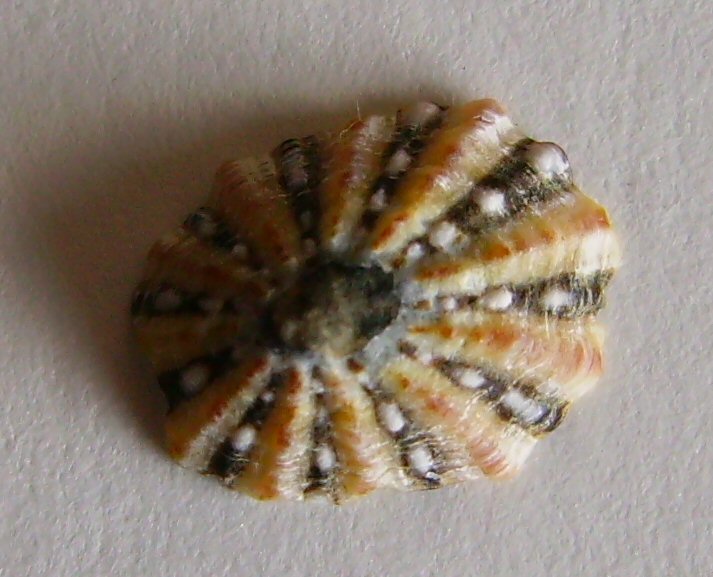
| A shell of Cellana ornata | |
Scientific classification 
| |
| Kingdom: | Animalia |
| Phylum: | Mollusca |
| Class: | Gastropoda |
| Subclass: | Patellogastropoda |
| Superfamily: | Lottioidea |
| Family: | Nacellidae |
| Genus: | Cellana Adams, 1869 |
| Type species | |
| Nacella cernica Adams, 1869
| |
| Synonyms | |
| |
Cellana is a genus of sea snails or limpets, marine gastropod molluscs in the family Nacellidae, the true limpets.[1]
Distribution
[edit]This genus occurs in the temperate and tropical Indo-Pacific oceans, Hawaii (where they are known as ‘opihi and considered a delicacy) and around Australia and New Zealand. Species are also found around the coasts of Japan, the Red Sea, Mauritius, Madagascar, South Africa and the sub-Antartarctic Islands. One species, Cellana radiata, is cosmopolitan.
These sea snails feed by grazing on green macroalgae growing on rocky substrate in the intertidal zone. Some of these limpets can live up to 7 years, however most do not get older than 2–3 years. They reproduce by broadcasting their spawn in large, yolky eggs in great numbers (between 20,000 for C. flava and C. denticulata to 230,000 for C. ornata).
Species
[edit]


Species within the genus Cellana include:[1]
- Cellana analogia Iredale, 1940
- Cellana ardosiaea (Hombron & Jacquinot, 1841)
- † Cellana bosoensis Kase, T. Nakano, Kurihara & Haga, 2013
- Cellana capensis (Gmelin, 1791)
- † Cellana carpenteriana Skwarko, 1966
- Cellana conciliata Iredale, 1940 - Rainbow limpet
- † Cellana cophina Powell, 1973
- Cellana craticulata Suter, 1905
- † Cellana cudmorei Chapman & Gabriel, 1923
- Cellana cylindrica (Gmelin, 1791)
- † Cellana deformis (K. Martin, 1883)Powell
- Cellana denticulata Martyn, 1784
- Cellana dira (Reeve, 1855)
- Cellana enneagona (Reeve, 1854)
- Cellana eucosmia Pilsbry, 1891 (possibly synonym of C. grata)
- Cellana exarata - Hawaiian blackfoot opihi
- Cellana flava Hutton, 1873
- Cellana granostriata (Reeve, 1855)
- Cellana grata Gould, 1859
- † Cellana hentyi Chapman & Gabriel, 1923
- Cellana howensis Iredale, 1940 Indo-Pacific
- † Cellana igniculus Kase, T. Nakano, Kurihara & Haga, 2013
- † Cellana kamatakiensis Kase, T. Nakano, Kurihara & Haga, 2013
- Cellana karachiensis Winckworth, 1930 Red Sea
- † Cellana kobayashii Kase, T. Nakano, Kurihara & Haga, 2013
- Cellana livescens (Reeve, 1855)
- Cellana mazatlandica Sowerby, 1839
- Cellana melanostoma Pilsbry, 1891
- Cellana nigrolineata Reeve, 1854
- Cellana oliveri Powell, 1955
- Cellana orientalis (Pilsbry, 1891)
- Cellana ornata Dillwyn, 1817
- Cellana pricei Powell, 1973
- Cellana radians (Gmelin, 1791)
- Cellana radiata I. von Born, 1778
- Cellana radiata capensis (Gmelin, 1791)
- Cellana radiata radiata (Born, 1778)
- Cellana rota (Gmelin, 1791)
- Cellana sandwicensis (Pease, 1861)
- Cellana solida Blainville, 1825
- Cellana sontica Iredale, 1940
- Cellana stellifera Gmelin, 1791
- Cellana strigilis Powell, 1955
- Cellana strigilis strigilis Hombron & Jacquinot, 1841
- Cellana strigilis bollonsi Powell, 1955
- Cellana strigilis chathamensis (Pilsbry, 1891)
- Cellana strigilis flemingi Powell, 1955
- Cellana strigilis oliveri Powell, 1955
- Cellana strigilis redimiculum (Reeve, 1854)
- † Cellana taberna Powell, 1973
- Cellana taitensis Röding, 1798
- Cellana talcosa Gould, 1846
- Cellana testudinaria Linnaeus, 1758
- † Cellana thomsoni Powell & Bartrum, 1929
- Cellana toreuma Reeve, 1855
- Cellana tramoserica Holten, 1802
- Cellana turbator Iredale, 1940
- Cellana vitiensis Powell, 1973
- † Cellana yamamotoi Kase, T. Nakano, Kurihara & Haga, 2013
The sources given below, also mention the following species :
- Cellana ampla
- Cellana ardosioea Hombron & Jacquinot, 1841
- Cellana argentata Sowerby, 1839
- Cellana enneagona Reeve, 1854
- Cellana nigrisquamata Reeve, 1854
- Species brought into synonymy
- Cellana capensis (Gmelin, 1791): synonym of Cellana radiata (Born, 1778)
- Cellana cernica (Adams, 1869): synonym of Cellana livescens (Reeve, 1855)
- Cellana eudora Iredale, 1940: synonym of Cellana radiata orientalis (Pilsbry, 1891)
- Cellana garconi (Deshayes, 1863): synonym of Cellana livescens (Reeve, 1855)
- Cellana hedleyi W. R. B. Oliver, 1915: synonym of Cellana craticulata (Suter, 1905)
- Cellana laticostata (Blainville, 1825): synonym of Scutellastra laticostata (Blainville, 1825)
- Cellana sagittata A. A. Gould, 1846 : synonym of Cellana vitiensis Powell, 1973
- Cellana scopulina W. R. B. Oliver, 1926: synonym of Cellana craticulata (Suter, 1905)
- Cellana vulcanicus W. R. B. Oliver, 1915: synonym of Cellana craticulata (Suter, 1905)
References
[edit]- ^ a b WoRMS (2010). Cellana H. Adams, 1869. In: Bouchet, P.; Gofas, S.; Rosenberg, G. (2010) World Marine Mollusca database. Accessed through: World Register of Marine Species at http://www.marinespecies.org/aphia.php?p=taxdetails&id=205749 on 2010-10-31
External links
[edit]
- Shell-bearing Mollusca: Gastropoda: Archeogastropoda & Mesogastropoda
- Goldstien S. J. (2005). "Phylogeography of the Cellana limpets of New Zealand: Investigating Barriers to Marine Dispersal and Historical Biogeography". Thesis, School of Biological Sciences, University of Canterbury, Christchurch, New Zealand, 162 pp.
- Powell A. W. B., New Zealand Mollusca, William Collins Publishers Ltd, Auckland, New Zealand 1979 ISBN 0-00-216906-1
- Powell A. W. B. (1973). The patellid limpets of the world (Patellidae). Indo-Pacific Mollusca, 3(15): 75-206.
- Willassen E., Williams A. B. & Oskars T. R. (2016). "New observations of the enigmatic West African Cellana limpet (Mollusca: Gastropoda: Nacellidae)". Marine Biodiversity Records 9: 60. doi:10.1186/s41200-016-0059-9.
Cellana
View on GrokipediaTaxonomy and classification
Etymology and history
The genus Cellana was first described by British malacologist Henry Adams in 1869, in his paper "Descriptions of a new genus and fourteen new species of marine shells" published in the Proceedings of the Zoological Society of London. Adams introduced Cellana as a subgenus of Nacella, with the type species Nacella (Cellana) cernica H. Adams, 1869, designated by monotypy; this species is now regarded as a junior synonym of Cellana livescens (Reeve, 1855).[6] Initially classified within the family Patellidae, the broad group of true limpets, Cellana was recognized for its ribbed shells and Indo-Pacific distribution, distinguishing it from more temperate Patella species. The family Nacellidae, encompassing Cellana and the southern hemisphere genus Nacella, was formally established by Johannes Thiele in 1891 to accommodate these morphological differences, though early adoption was limited.[7] Significant contributions to the taxonomy of Cellana came from American conchologist Henry Augustus Pilsbry in the 1890s, who described numerous species and subspecies—such as Patella eucosmia (now Cellana eucosmia) and Patella orientalis (now Cellana orientalis)—in volumes 13 and 14 of his Manual of Conchology (1891–1893), refining classifications based on shell sculpture and radular features.[8] The reclassification of Cellana into Nacellidae was solidified in the late 20th century through combined morphological and molecular analyses. Studies in the 1990s, including those establishing the subclass Patellogastropoda, highlighted distinctions in soft anatomy and genetics separating Nacellidae from Patellidae. By the 2000s, phylogenetic research confirmed the monophyly of Nacellidae within the superfamily Lottioidea; for instance, a 2005 molecular study using mitochondrial 12S and 16S rRNA genes supported the Indo-Pacific Cellana as sister to Antarctic Nacella, justifying the family's separation from Patelloidea.[9] Modern taxonomic authority rests with the World Register of Marine Species (WoRMS), which accepts Cellana in Nacellidae, with the genus comprising 39 valid species as of November 2025; the most recent major revisions to its classification occurred around 2010, incorporating DNA barcoding data to resolve synonyms and distributions.[6]Phylogenetic relationships
Cellana is classified in the kingdom Animalia, phylum Mollusca, class Gastropoda, subclass Patellogastropoda, order Nacellida, superfamily Nacelloidea, family Nacellidae.[6][10] This placement reflects its position among true limpets, characterized by a cap-shaped shell and a distinct foot morphology adapted for intertidal adhesion.[11] At the genus level, Cellana has several historical synonyms, including Bertinia Jousseaume, 1883, Granopatella Iredale, 1933, and Helcioniscus Dall, 1871, which were later subsumed based on morphological and molecular reassessments.[12][7] There is also partial historical synonymy with Nacella, though current taxonomy recognizes them as distinct sister genera within Nacellidae.[13] Molecular evidence from 18S rRNA gene sequences and mitochondrial markers such as COI, 12S rRNA, and 16S rRNA has firmly established the phylogenetic position of Cellana. Studies in the 2000s, including analyses by Yoon et al. (2007) using 18S rDNA and by Nakano and Ozawa (2007) employing multiple mitochondrial genes, support the monophyly of Patellogastropoda and place Nacellidae as sister to Patellidae.[14][15] These datasets reveal Cellana as closely related to Nacella in the Southern Hemisphere and to Patella species in the Mediterranean and Atlantic, with mitogenomic comparisons further confirming Nacellidae's basal position within Patelloidea.[16][17] Divergence time estimates derived from molecular clock analyses of these markers indicate that the split between Cellana and Nacella occurred approximately 50 million years ago during the Paleogene, with the crown age of Cellana dating back approximately 24 million years to the Oligocene-Miocene boundary, though estimates vary with fossil constraints.[16][17] Earlier mitogenomic studies suggest the broader diversification of patellogastropod lineages began in the Cretaceous, with Cellana-Nacella splits occurring approximately 50 million years ago.[15]Description
Shell characteristics
The shells of Cellana species are characteristically conical and patelliform, featuring a low to medium apex positioned slightly anteriorly, typically at about one-third the distance from the anterior margin.[18] The height-to-length ratio ranges from 0.29 to 0.45, contributing to a low-profile design that facilitates secure attachment to rocky substrates in wave-exposed environments.[19] Basal diameters vary widely across the genus, generally spanning 2–10 cm, with species-specific maxima such as up to 9 cm for C. testudinaria.[18] For instance, C. radiata commonly reaches 3–4 cm, though larger individuals up to 4.5 cm have been recorded.[20] The external surface is ornamented with radiating ribs or costae, numbering 10–50 depending on the species, often accompanied by fine sculptured growth lines that enhance grip and structural integrity.[21] Examples include 20–25 low radial ribs in C. radians and 30–40 strong ribs in C. tramoserica.[22][23] The interior is smooth and iridescent, typically bluish-silver or white, with a prominent horseshoe-shaped muscle scar that reflects the attachment site of the foot.[18][24] Exterior coloration shows considerable variation, ranging from olive-green to brown, frequently patterned with darker radial stripes or bands that align with the ribs.[25] Species like C. tramoserica may exhibit orange-brown hues with reddish ribs, while C. radiata displays grayish-white to dark brown tones with contrasting darker costae.[26]Radula and soft anatomy
The radula of Cellana species is of the docoglossan type, characterized by a reduced central rachidian tooth and 4–5 large lateral teeth per transverse row, enabling efficient rasping and scraping of algal films from rock surfaces.[27] The rachidian tooth is small and spear-shaped, while the lateral teeth feature robust cusps adapted for gripping and abrading substrata, with the radular ribbon often extending 4–5 times the length of the animal.[20] This structure contrasts with more derived radular types in other gastropods by emphasizing fewer, stronger teeth for targeted grazing rather than broad filtration.[28] The soft body of Cellana limpets includes a large, muscular foot that facilitates strong adhesion to rocky substrates through a combination of suction generated by pedal musculature and adhesive properties of pedal mucus, which forms a glue-like seal during periods of immobility.[29] The mantle edge bears sensory tentacles and pallial lobes that extend around the shell margin, aiding in environmental monitoring and contributing to the overall sealing mechanism against the substratum.[30] The gills are bipectinate, arranged in a single row within the mantle cavity, which supports efficient gas exchange during intermittent submersion in the intertidal zone.[31] The visceral mass is compact and positioned dorsally within the shell, housing the digestive gland for processing algal material and the gonads for reproductive functions, with these organs showing seasonal variations in size tied to gametogenesis.[32] The nervous system features a well-developed osphradium, a chemosensory organ in the mantle cavity that detects water-borne stimuli such as food odors or pollutants, relaying signals via the osphradial nerve to the central ganglia for behavioral responses.[33] These anatomical features enable Cellana species to seal their shells tightly against the substrate using the foot and mucus, thereby tolerating desiccation for up to several hours during low tide exposure by minimizing water loss through the mantle cavity.[34] This adaptation, in conjunction with the protective conical shell, allows survival in harsh intertidal conditions.[35]Habitat and distribution
Geographic range
The genus Cellana is primarily distributed across temperate and tropical waters of the Indo-Pacific region, encompassing a vast area from the Hawaiian Islands in the central Pacific to Japan in the northwest, extending eastward to oceanic islands such as Juan Fernández off Chile and westward to the Red Sea.[2][9] This range further includes southern extensions to Australia, New Zealand, Mauritius, Madagascar, and South Africa along the African coast, as well as sub-Antarctic islands like Campbell Island.[2][36] Species such as C. exarata, C. talcosa, and C. sandwicensis are recorded in Hawaii, while C. tramoserica and C. solida occur in Australia, and C. flava, C. radians, C. stellifera, and members of the C. strigilis complex inhabit New Zealand and its associated islands.[2] In the western Indo-Pacific, C. eucosmia is found in the Red Sea, and C. capensis along South African shores.[2] A notable exception to the predominantly regional patterns is C. radiata, which exhibits a more cosmopolitan distribution as a tropical outlier, spanning wider zones including the Indian Ocean extensions from Sri Lanka and the Arabian Sea to the Seychelles and Mauritius.[37][38] Subspecies such as C. radiata capensis extend this presence southward to South Africa, highlighting greater dispersal tolerance compared to other congeners.[38] Endemism is particularly pronounced in isolated locales within this range, with Hawaii hosting three to four endemic species (C. exarata, C. talcosa, C. sandwicensis, and occasionally C. melanostoma in the northwest islands), reflecting limited gene flow across oceanic barriers.[2] Similarly, Australasia shows high regional endemism, including multiple species restricted to Australia (e.g., C. solida in Tasmania) and New Zealand (e.g., C. denticulata on the northeast coast).[9][2] The genus's distribution has been shaped by historical expansions, primarily through post-Pleistocene long-distance dispersal facilitated by planktonic larval stages and potential rafting events, enabling colonization of remote islands despite generally limited dispersal capacity.[2][36] No native populations occur in the Atlantic Ocean, underscoring the Indo-Pacific as the core biogeographic domain.[9]Environmental preferences
Species of the genus Cellana primarily occupy the mid- to upper intertidal zones on exposed rocky shores, typically ranging from 0.5 to 1.5 meters above mean low water neaps, where they experience periodic submersion and emersion with the tides.[39] This zonation allows them to exploit wave-surged environments that provide oxygenation while minimizing prolonged submersion risks. They are most abundant around mean sea level on stable substrates, with smaller individuals often dominating higher elevations and larger ones lower down.[39] Cellana limpets adhere to firm rock surfaces, boulders, or platforms, avoiding soft sediments or shifting substrates that could dislodge them.[39][40] They prefer areas with moderate to high wave exposure, which enhances water flow and reduces stagnation, though they can tolerate semi-protected conditions.[41] These microhabitats, often bare or lightly algaled rock, support their attachment and reduce competition from dense macroalgae.[40] These limpets withstand typical marine salinities of 25–35 ppt, with broader tolerance to fluctuations up to 40 ppt in tide pools during emersion.[42] Habitat temperatures range from 10–30°C across their Indo-Pacific distribution, reflecting adaptations to both subtropical and temperate conditions.[18][23] Desiccation resistance is achieved by clamping the shell tightly to the substrate, sealing a moist chamber beneath during low tide.[5] In these niches, Cellana species co-occur with barnacles and mussels, particularly in the upper intertidal, but they dominate open rock surfaces where space is not densely colonized by sessile competitors.[43][44]Ecology and life history
Feeding behavior
Cellana limpets employ a radula-based grazing mechanism to scrape microalgae, biofilms, and associated epibenthic organisms from intertidal rock surfaces. The radula's robust teeth, noted for their exceptional tensile strength among biological materials, enable effective rasping of tough substrates like crustose coralline algae, facilitating the removal of thin algal layers without deeper excavation. This feeding strategy is primarily herbivorous, with no evidence of carnivory, and activity peaks during nocturnal or crepuscular periods to minimize desiccation risk and predation exposure during emersion at low tide.[45][46][45] The diet of Cellana species centers on microalgae, particularly diatoms such as Navicula spp., Amphora spp., Nitzschia spp., and Gryosigma spp., supplemented by green macroalgae including Ulva spp. (formerly Enteromorpha). Gut content analyses from field and laboratory studies reveal these components as dominant, with occasional ingestion of detritus like sand grains, reflecting opportunistic scavenging during grazing bouts. Cyanobacteria such as Lyngbya spp. may also contribute minor nutritional value, but the overall reliance on algal biofilms underscores their role as key regulators of microalgal standing stocks in intertidal zones.[47][45][47] Foraging patterns in Cellana are characterized by limited mobility within small home ranges around preferred resting scars, where individuals return after tidal-driven excursions. These movements are density-dependent, with higher population densities promoting competition that restricts foraging extent and enhances homing behavior to conserve energy. Grazing excursions typically occur when awash or immersed, covering distances up to 0.5–1 m from refuges in species like C. grata, but overall activity remains confined to optimize energy intake against environmental risks.[48][49][50] Through persistent radular scraping, Cellana individuals achieve high grazing efficiency, thereby exerting top-down control on algal community structure and preventing dominance by foliose forms. This consumption rate, inferred from radular mark density and microalgal depletion studies, highlights their ecological impact in maintaining bare rock patches and influencing intertidal biodiversity.[51][52]Reproduction and larval development
Species in the genus Cellana are dioecious broadcast spawners that undergo external fertilization in seawater.[53][54] Sex ratios in populations are typically near 1:1, with males and females lacking obvious external dimorphism and requiring gonad examination for determination.[45][55] Spawning events are often synchronized, influenced by environmental cues such as lunar cycles and seasonal temperature increases, which promote gamete release during periods favorable for larval survival.[45][56] Females produce large numbers of yolky eggs, with output varying by species and size; for example, C. flava females release approximately 20,000 eggs per spawning event, while C. ornata females can produce 200,000–360,000 eggs from larger individuals (40–49 mm shell length).[56][57] Overall fecundity across the genus ranges from 20,000 to 230,000 yolky eggs per female, supporting high reproductive output despite partial spawning in some cases.[57] Fertilized eggs develop into planktonic trochophore larvae within 1–2 days, which are non-feeding and lecithotrophic, relying on yolk reserves.[56] These larvae transition to veliger stages and remain pelagic for 2–10 days (typically 5–10 days), during which dispersal occurs before settlement on intertidal rocky substrates.[56][58] Settlement is followed by metamorphosis into juvenile limpets, which crawl to suitable microhabitats and begin benthic life.[56] Individuals reach sexual maturity at 1–2 years of age or when shell length attains 1–2 cm, depending on growth rates influenced by environmental conditions.[59][54] Lifespans vary across species but generally range from 2–7 years.[60][61][62]Species diversity
List of accepted species
The genus Cellana currently includes 39 accepted species, all extant with no known extinct taxa.[1] These species exhibit a primarily Indo-Pacific distribution, with regional concentrations such as 3 Hawaiian endemics (C. exarata, C. melanostoma, C. talcosa), 4 Australasian species (C. solida, C. strigilis, C. flava, C. howensis), approximately 5–6 Indo-Pacific endemics (e.g., C. enneagona, C. grata), and others like the South African C. capensis and the widespread C. radiata.[1][63] Species identification is based on shell morphology, including rib count and form, apex position, and coloration.[64]| Scientific Name | Author(s) | Year |
|---|---|---|
| Cellana analogia | Iredale | 1940 |
| Cellana ardosiaea | Hombron & Jacquinot | 1841 |
| Cellana capensis | Gmelin | 1791 |
| Cellana conciliata | Iredale | 1940 |
| Cellana craticulata | Suter | 1905 |
| Cellana cylindrica | Gmelin | 1791 |
| Cellana denticulata | Martyn | 1784 |
| Cellana dira | Reeve | 1855 |
| Cellana enneagona | Reeve | 1854 |
| Cellana eucosmia | Pilsbry | 1892 |
| Cellana exarata | Reeve | 1854 |
| Cellana flava | F. W. Hutton | 1873 |
| Cellana granostriata | Reeve | 1855 |
| Cellana grata | A. A. Gould | 1859 |
| Cellana howensis | Iredale | 1940 |
| Cellana karachiensis | Winckworth | 1930 |
| Cellana livescens | Reeve | 1855 |
| Cellana mazatlandica | G. B. Sowerby I | 1839 |
| Cellana melanostoma | Pilsbry | 1891 |
| Cellana nigrolineata | Reeve | 1854 |
| Cellana oliveri | A. W. B. Powell | 1955 |
| Cellana orientalis | Pilsbry | 1891 |
| Cellana ornata | Dillwyn | 1817 |
| Cellana pricei | A. W. B. Powell | 1973 |
| Cellana radians | Gmelin | 1791 |
| Cellana radiata | Born | 1778 |
| Cellana rota | Gmelin | 1791 |
| Cellana sandwicensis | Pease | 1861 |
| Cellana solida | Blainville | 1825 |
| Cellana sontica | Iredale | 1940 |
| Cellana stellifera | Gmelin | 1791 |
| Cellana strigilis | Hombron & Jacquinot | 1841 |
| Cellana taitensis | Röding | 1798 |
| Cellana talcosa | A. A. Gould | 1846 |
| Cellana testudinaria | Linnaeus | 1758 |
| Cellana toreuma | Reeve | 1855 |
| Cellana tramoserica | Holten | 1802 |
| Cellana turbator | Iredale | 1940 |
| Cellana vitiensis | A. W. B. Powell | 1973 |