Hubbry Logo
Census geographic units of CanadaCensus geographic units of CanadaMain
Open search
Census geographic units of Canada
Community hub
Census geographic units of Canada
logo
8 pages, 0 posts
0 subscribers
Be the first to start a discussion here.
Census geographic units of Canada
from Wikipedia

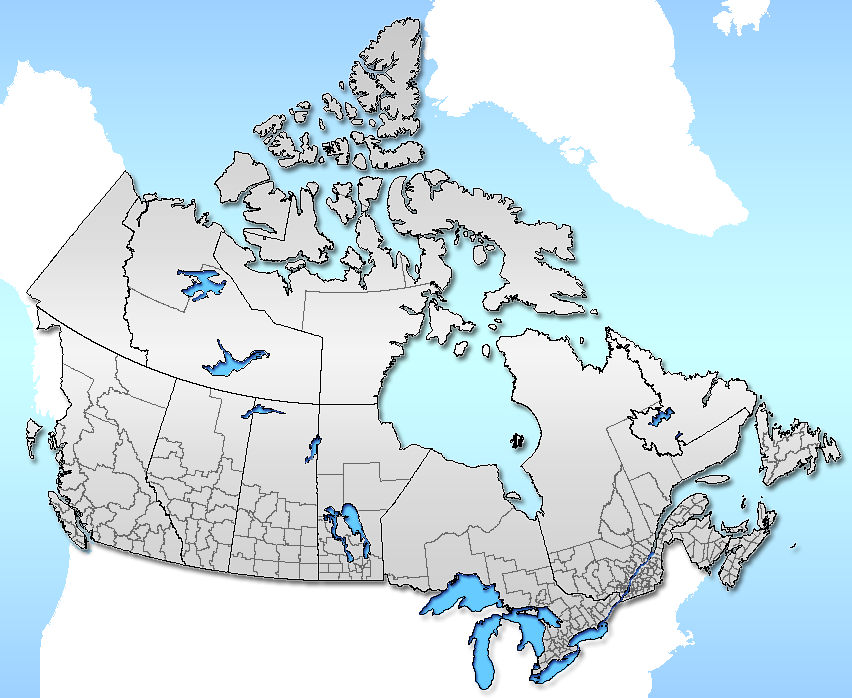
Census divisions by province and territory

The census geographic units of Canada are the census subdivisions defined and used by Canada's federal government statistics bureau Statistics Canada[1] to conduct the country's quinquennial census. These areas exist solely for the purposes of statistical analysis and presentation; they have no government of their own. They exist on four levels: the top-level (first-level) divisions are Canada's provinces and territories; these are divided into second-level census divisions, which in turn are divided into third-level census subdivisions (often corresponding to municipalities) and fourth-level dissemination areas.

In some provinces, census divisions correspond to the province's second-level administrative divisions such as a county or another similar unit of political organization. In the prairie provinces, census divisions do not correspond to the province's administrative divisions, but rather group multiple administrative divisions together. In Newfoundland and Labrador, the boundaries are set by Statistics Canada as no such level of government exists. Two of Canada's three territories are also divided into census divisions.

Census divisions

[edit]

According to Statistics Canada, Census divisions "are intermediate geographic areas between the province/territory level and the municipality (census subdivision)."[2] In six provinces, they are legislated groupings of adjacent census subdivisions (municipalities or municipal equivalents) that share in regional planning and management of certain services such as emergency response.[2] In four provinces and all three territories, legislation for equivalent intermediate geographic areas do not exist.[2] Statistics Canada therefore collaborates with the four provinces and three territories in the creation of statistical equivalents.[2] Classifications of census divisions includes county, district, district municipality, region, regional county municipality, regional district, regional municipality, territory, territory equivalent, united counties, and simply census divisions.[3]

Canada's census divisions by province or territory
Province/territory[3] Census division types[3] Quantity[3]
Alberta Census divisions 19
British Columbia Region 1
Regional districts 28
Manitoba Census divisions 23
New Brunswick Counties 18
Newfoundland and Labrador Census divisions 11
Northwest Territories Regions 6
Nova Scotia Counties 18
Nunavut Regions 3
Ontario Census divisions 9
Counties 20
Districts 10
District municipality 1
Regional municipalities 6
United counties 3
Prince Edward Island Counties 3
Quebec Census divisions 5
Regional county municipalities 81
Territory equivalents 12
Saskatchewan Census divisions 18
Yukon Territory 1

Census consolidated subdivisions

[edit]

A census consolidated subdivision is a geographic unit between census division and census subdivision. It is a combination of adjacent census subdivisions typically consisting of larger, more rural census subdivisions and smaller, more densely populated census subdivisions.[4]

Census subdivisions

[edit]

Census subdivisions generally correspond to the municipalities of Canada, as determined by provincial and territorial legislation.[5] They can also correspond to area which are deemed to be equivalents to municipalities for statistical reporting purposes, such as Indian reserves, Indian settlements, and unorganized territories where municipal level government may not exist.[5] Statistics Canada has created census subdivisions in cooperation with the provinces of British Columbia, Newfoundland and Labrador, and Nova Scotia as equivalents for municipalities.[6] The Indian reserve and Indian settlement census subdivisions are determined according to criteria established by Indigenous and Northern Affairs Canada.[7]

Dissemination areas

[edit]

Dissemination areas are the smallest standard geographic unit in Canada and cover the entire country.[8] As small areas, they comprise one or more dissemination blocks and have a population between 400 and 700 people.[8]

Specially-defined geographic units

[edit]

Census metropolitan areas

[edit]

A "census metropolitan area" (CMA) is a grouping of census subdivisions comprising a large urban area (the "urban core") and those surrounding "urban fringes" with which it is closely integrated. To become a CMA, an area must register an urban core population of at least 100,000 at the previous census. CMA status is retained even if this core population later drops below 100,000.

CMAs may cross census division and therefore provincial boundaries, although the Ottawa-Gatineau metropolitan area in Ontario and Quebec is the only one that currently crosses a provincial border.

The methodology used by Statistics Canada does not allow for CMA-CMA mergers into larger statistical areas; consequently, there is no Canadian equivalent to the combined statistical areas of the United States. Statistics Canada has stated that Toronto, Oshawa and Hamilton could be merged into a single CSA were such an approach utilized.[9] Statistics Canada has described the Greater Golden Horseshoe as the country's largest urban area.[10]

Census agglomerations

[edit]

A "census agglomeration" (CA) is a smaller version of a CMA in which the urban core population at the previous census was greater than 10,000 but less than 100,000. If the population of an urban core is less than 50,000, it is the starting point for the construction of a 'census agglomeration'.[11]

Census tracts

[edit]

CMAs and CAs with a population greater than 50,000 are subdivided into census tracts which have populations ranging from 2,500 to 8,000.

Population centres

[edit]

A population centre (PC), formerly known as an urban area (UA), is any grouping of contiguous dissemination areas that has a minimum population of 1,000 and an average population density of 400 persons per square kilometre or greater.[12] For the 2011 census, urban area was renamed "population centre".[12][13] In 2011, Statistics Canada identified 942 population centres in Canada. Some population centres cross municipal boundaries and not all municipalities contain a population centre while others have more than one.[14]

The population centre level of geography is further divided into the following three groupings based on population:[12]

  • "small population centre" – 1,000 to 29,999
  • "medium population centre" – 30,000 to 99,999
  • "large urban population centre" – 100,000 and greater

Designated places

[edit]

A "designated place" (DPL) is usually a small community that does not meet the criteria used to define incorporated municipalities or urban areas (areas with a population of at least 1,000 and no fewer than 400 persons per square kilometre), but for which Statistics Canada or a provincial government has requested that similar demographic data be compiled.[15]

Localities

[edit]

A "locality" (LOC) is a historical named location or place. The named location may be a former census subdivision, a former urban area, or a former designated place. It may also refer to neighbourhoods, post offices, communities and unincorporated places among other entities.[16]

Electoral districts

[edit]

Statistics Canada also aggregates data by federal electoral districts, one purpose for which is the redrawing of district boundaries every ten years. Federal electoral districts are numerically indexed; each district receives a unique five-digit code, with the first two digits being the Standard Geographical Classification code for the province or territory in which the district is located.

See also

[edit]

Notes

[edit]

References

[edit]
[edit]
Revisions and contributorsEdit on WikipediaRead on Wikipedia
from Grokipedia
Census geographic units of Canada are the standardized spatial divisions used by to collect, tabulate, and disseminate data from the Census of Population and other statistical programs. These units form a hierarchical structure that partitions the country from the national level down to the smallest dissemination blocks, enabling consistent and integrated geographic referencing across datasets. The core hierarchy of standard geographic areas (SGAs) begins with provinces and territories, the largest units comprising Canada's 10 provinces and 3 territories, which serve as the primary political and administrative divisions for data aggregation. Below them are census divisions (CDs), which generally align with municipal counties, regional municipalities, or regional districts and number around 293 across the country. Census subdivisions (CSDs) form the next level, representing incorporated municipalities, Indian reserves, unorganized territories, or equivalents, totaling over 5,000 units that closely match boundaries. Smaller-scale units include dissemination areas (DAs), stable polygons with an average of 400 to 700 people designed for detailed socioeconomic data release, and dissemination blocks (DBs), the finest level consisting of adjacent blocks with typically 150 to 200 dwellings to protect privacy through suppression rules. This hierarchy is defined and coded under the Standard Geographical Classification (SGC), Statistics Canada's official system for naming and numbering these areas to ensure uniformity in statistical outputs. Complementing the SGAs are non-standard geographic areas such as census metropolitan areas (CMAs) and census agglomerations (CAs), which aggregate multiple CSDs around urban cores with populations of at least 100,000 and 10,000 respectively to analyze metropolitan influences, as well as economic regions (ERs) that group CDs for labor market studies. These units support diverse applications, including policy-making, , and demographic research, with boundary files, reference maps, and spatial products available in formats compatible with geographic information systems (GIS). Updates to boundaries occur periodically to reflect administrative changes, with the 2021 Census version incorporating revisions based on municipal amalgamations and population shifts.

Overview

Purpose and history

Census geographic units are standardized areas defined and maintained by to facilitate the collection, aggregation, and dissemination of across various scales, from national to local levels, while aligning with administrative boundaries and ensuring respondent through aggregation rules that prevent identification of individuals. These units enable the release of statistical information in a manner that supports comparability over time and space, aiding in development, urban and , , and demographic by providing consistent frameworks for analyzing trends and socioeconomic characteristics. By , for smaller units are often suppressed or rounded if counts fall below thresholds, such as 10 persons for certain variables, to uphold confidentiality as mandated by the Statistics Act. The origins of census geographic units trace back to Canada's inaugural national in 1871, which primarily relied on broad provincial and territorial divisions, along with municipal or county-level subdivisions, to enumerate the population following . This basic structure reflected the administrative realities of the time, focusing on larger aggregates to capture essential demographic data without advanced subdivision capabilities. Over the subsequent decades, as Canada's population grew and urbanized, the need for finer-grained geographic detail became evident, leading to incremental expansions in the system. Significant advancements occurred in the mid-20th century; for instance, the 1951 adopted the term 'census tracts' for these stable, small-area units within larger urban centers—previously known as 'social areas' since 1941—to better support socioeconomic analysis in metropolitan settings, marking a shift toward more detailed . The Standard Geographical Classification (SGC), established in the early and first published as a formal manual in 1974, provided a systematic coding and hierarchical framework for these units, evolving from earlier working versions released in 1964 and 1966 to standardize names and codes for provinces, census divisions, and subdivisions nationwide. Further refinements came with the 2001 , which replaced enumeration areas with dissemination areas as the primary small-scale dissemination unit, optimizing for privacy and data utility. The 2016 incorporated updates to the SGC 2016, harmonizing geographic codes and boundaries to reflect administrative changes and improve data integration across programs. These units form a nested hierarchy, with smaller areas aggregating into larger ones for scalable analysis, as detailed in Statistics Canada's Census Dictionary and standard geographic area resources, which serve as primary references for definitions, codes, and boundary files.

Hierarchy and classification

The hierarchy of standard geographic areas for the dissemination of census data in Canada is structured in a nested manner, beginning with the highest level of provinces and territories (10 provinces and 3 territories), which encompass all lower levels. Within each province or territory, census divisions (CDs)—such as counties, regional municipalities, or districts—form the next tier, aggregating multiple census subdivisions (CSDs). Census subdivisions, including municipalities, Indian reserves, and unorganized territories, are nested within CDs and represent the municipal or equivalent level. At the base of the dissemination hierarchy, dissemination areas (DAs)—small, stable units typically containing 400 to 700 persons—are nested within CSDs, while dissemination blocks (DBs), the smallest non-hierarchical units resembling city blocks, are nested within DAs. Parallel to this nested structure, special units such as census metropolitan areas (CMAs) and census agglomerations (CAs) overlay the hierarchy, defined by commuting patterns and urban core populations rather than administrative boundaries, to facilitate analysis of urban-rural dynamics. Statistics Canada employs the Standard Geographical Classification (SGC) 2021 as the official framework for naming and coding these geographic areas, providing a standardized two-level code system for provinces/territories and CDs, with separate codes for CSDs to maintain hierarchical relationships. For example, the SGC code consists of a two-digit province/territory code (e.g., 35 for ) followed by a three-digit CD code (e.g., 001 for Stormont, Dundas and ), enabling precise identification and linkage of areas; CSDs receive unique five-digit codes within their CD context. This classification supports four primary levels: geographical regions of , provinces/territories, CDs, and CSDs, with variants for specialized groupings like economic regions. The National Geographic Database (NGD), jointly maintained by and since 1997, serves as the foundational integrating all census geographic units, incorporating attributed road networks, boundary polygons, and coordinates to delineate entities from provinces to blocks. The NGD links socioeconomic data to these features, using address ranges and GPS-compliant data for accurate geocoding, and is projected in the Lambert Conformal Conic system based on NAD83 datum. By 2021, the NGD had been enhanced with CanVec data for improved boundary precision across all provinces. For the 2021 Census, the was refined to enhance integration with administrative sources, incorporating updates to the SGC for alignment with legal and municipal changes effective as of , 2021, the geographic reference date. Boundaries for standard areas are generally fixed between censuses to ensure comparability, with changes only implemented for legally mandated administrative adjustments, such as municipal amalgamations or dissolutions, and flagged in outputs for user awareness. Specific 2021 SGC revisions included updated codes for new or modified CSDs involving Indigenous territories, reflecting boundary changes on reserves and the addition of self-governing Indigenous communities as distinct subdivisions.

Administrative hierarchy units

Census divisions

Census divisions (CDs) are provincially defined upper-tier administrative units that function as intermediate geographic areas between the or level and the census subdivision () level. They represent groups of neighbouring municipalities joined together for purposes such as and the provision of like police and ambulance operations. These units are equivalent to legal entities such as counties, regional municipalities, municipalités régionales de comté (MRCs), or regional districts. As of the 2021 Census, is divided into 293 census divisions. Census divisions must encompass entire census subdivisions, with boundaries generally aligned to legal administrative lines established by provincial as of of the census reference year. In the three territories, where no provincial laws govern such divisions, defines equivalent units based on existing administrative regions or land districts; for example, the Territory comprises a single census division covering its entirety. Census divisions facilitate the aggregation of census data to support regional socioeconomic analysis and planning. They are identified by unique codes within Statistics Canada's Standard Geographical Classification (SGC), which combines a two-digit for the province or territory (e.g., 35 for ) with a two-digit for the specific division (e.g., 01 for the first census division in , yielding 3501). There are 12 recognized types of census divisions, reflecting variations in provincial nomenclature and structure. The form of census divisions differs across provinces and territories to match local administrative practices; for example, British Columbia employs regional districts, while the Prairie provinces—Manitoba, Saskatchewan, and Alberta—use sequentially numbered census divisions such as Division No. 1. Boundaries are designed for stability to enable consistent longitudinal comparisons of census data over time, though minor adjustments occur periodically to reflect legislative changes. For the 2021 Census, updates included boundary shifts in due to extensive municipal restructuring and adjustments in stemming from municipal mergers. Between the 2016 and 2021 censuses, changes affected a limited number of divisions, maintaining overall stability.

Census consolidated subdivisions

Census consolidated subdivisions (CCSs) are artificial geographic units established by to facilitate data dissemination at an intermediate level between census subdivisions and census divisions. They consist of groups of adjacent census subdivisions located within the same census division, typically merging smaller, densely populated urban areas—such as towns, villages, or cities—with larger surrounding rural areas, like townships or counties, to create cohesive statistical regions without altering any legal municipal boundaries. This structure supports regional analysis in areas where administrative divisions alone may not align with functional economic or social patterns. As of the , had 1,757 CCSs, a slight decrease from 1,768 in , reflecting minor boundary adjustments for stability. These units are coded using a seven-digit Standard Geographical Classification (SGC) identifier, incorporating the province/territory code (two digits), census division code (two digits), and CCS code (three digits), but they do not form a standard level in the primary geographic hierarchy, serving instead as a supplementary tool for targeted data release. CCSs have been in use since the and are designed for relative stability, with changes occurring infrequently to enable reliable longitudinal comparisons. The primary purpose of CCSs is the dissemination of data from the , where they act as foundational building blocks for defining larger census agricultural regions, allowing for detailed reporting on farm operations, , and rural economies. Beyond agriculture, they support broader economic and labor market analyses by grouping municipalities that function as integrated economic units, particularly in provinces with fragmented or complex municipal structures. For instance, criteria for forming CCSs include allowing census subdivisions larger than 25 square kilometers to stand alone, while smaller ones are combined with adjacent larger units; census subdivisions with populations exceeding 100,000 also form independent CCSs, and those with fewer than 16 farms may be merged with neighboring CCSs to ensure analytical viability. The name and code of a CCS are derived from the census subdivision with the largest land area within it. Provincially, CCSs vary in application and number to accommodate local administrative complexities. In Newfoundland and Labrador, with 20 CCSs in 2021, they often combine incorporated towns with unincorporated local service districts to better represent regional service and economic integration. Alberta, featuring 72 CCSs, employs them to encompass specialized municipalities—such as municipal districts or improvement districts—that blend urban and rural governance within a single statistical unit. In contrast, provinces like (688 CCSs) and (273 CCSs) use them more extensively due to denser networks of municipalities, while saw a reduction from 45 to 34 CCSs in 2021 following census subdivision redesigns. Most other provinces and territories maintain CCSs primarily for agricultural and rural data needs, with minimal numbers in the territories (e.g., 6 in the ). In the 2021 , CCS boundaries were applied to emerging consolidated areas under Indigenous governance structures, enhancing data relevance for self-governing First Nations communities.

Census subdivisions

Census subdivisions (CSDs) are the general term for municipalities as determined by provincial or territorial legislation, or areas treated as municipal equivalents for statistical purposes, such as Indian reserves, Indian settlements, and unorganized territories. These units form the lowest level of the administrative hierarchy within census divisions and serve as the primary building blocks for disseminating local-level data across . In the 2021 Census, there were 5,161 census subdivisions covering the entire country. CSDs encompass a variety of types reflecting municipal structures and Indigenous governance, including cities, towns, villages, townships, municipal districts, Indian reserves, and unorganized parts of sparsely populated regions. classifies CSDs into 57 distinct types based on official designations from provincial, territorial, or federal authorities. For instance, incorporated urban areas include cities (often denoted as CV in coding), towns (T), and villages (VL), while rural and Indigenous examples comprise townships (TP), reserves (IRI), and settlements (S-É). Unorganized territories, used mainly in northern or remote areas without formal municipal government, account for portions of provinces like and where local administration is minimal. The boundaries of CSDs are aligned with legal municipal limits established by provincial or territorial laws, with updates occurring every census to incorporate changes such as incorporations, dissolutions, or amalgamations. Each CSD is assigned a unique code under the Standard Geographical Classification (SGC) 2021, formatted as a seven-digit identifier: the first two digits represent the or territory, the next two the parent census division, and the final three the CSD type and sequence (e.g., 35 12 101 for a specific in ). Classifications like "" or "town" often involve population thresholds set by provincial legislation—for example, in , a typically requires a population exceeding 10,000, while in , towns must have at least 5,000 residents—though adopts these designations without imposing its own criteria. Indigenous CSDs, including reserves and settlements, may also reflect self-governed areas established under modern treaties or self-government agreements that grant land ownership and administrative autonomy. CSDs are the primary geographic level for reporting data on local governments, demographics, and socio-economic characteristics, enabling detailed analysis of and profiles. They aggregate to form higher-level units like census divisions and support planning for , , and at the scale. For the 2021 Census, updates included the incorporation of new and settlements as CSDs, reflecting ongoing recognition of Indigenous land claims and governance structures. Between the 2016 and 2021 censuses, 1,806 changes to CSD boundaries, names, or status occurred due to municipal reforms. Boundaries and counts are updated periodically to reflect administrative changes; as of the geographic reference date of January 1, 2025, there are 5,054 census subdivisions.

Small-area dissemination units

Dissemination blocks

Dissemination blocks (DBs) represent the smallest standard geographic units employed by for disseminating data, serving as the foundational building blocks for higher-level areas like dissemination areas. Typically equivalent to a single or a small cluster of buildings in urban settings, DBs are delineated as areas bounded on all sides by roads, rivers, shorelines, railways, or boundaries of other standard geographic areas such as subdivisions. In rural or sparsely populated regions, these units may encompass larger territories to accommodate varying densities while maintaining consistency in data reporting. Introduced for the 2001 (initially termed "block") to enhance spatial precision, with the official name adopted in , DBs ensure comprehensive coverage of all Canadian territory and are designed to align seamlessly with visible and physical features, avoiding arbitrary divisions that could compromise data utility or confidentiality. The delineation of DBs follows strict criteria to support reliable geographic analysis without disclosing sensitive individual information. Boundaries are drawn using up-to-date road networks and must respect higher-level standard geographic areas, ensuring that DBs do not cross provincial, territorial, or census division lines. Starting with the 2016 Census, dissemination block boundaries are required to follow additional units, such as health regions and local health integration networks, to facilitate specialized applications like mapping. Only basic and dwelling counts are disseminated at this level, with values subject to random rounding to a base of 5 or 10 to protect ; more detailed socioeconomic data is unavailable to prevent identification of small groups. In the 2021 Census, comprised 498,786 DBs, reflecting population growth and urban expansion since their inception. DBs play a critical role in enabling custom geographic area construction and high-resolution spatial mapping for researchers and policymakers. They allow for the aggregation into user-defined regions tailored to specific studies, such as environmental risk assessments or , while providing the granularity needed for precise geocoding of addresses through integration with Statistics Canada's address register and the Postal Code Conversion File. This linkage supports applications in , where DB-level data has been used to examine neighborhood-scale disparities, for instance, in access to services across urban and rural divides. By offering this fine-grained detail without compromising , DBs enhance the ability to conduct targeted analyses of social and economic patterns at the level.

Dissemination areas

A dissemination area (DA) is a small, relatively stable geographic unit composed of one or more adjacent dissemination blocks, designed to have an average population of 400 to 700 persons based on the previous census. Introduced in the 2001 Census, DAs replaced enumeration areas as the basic dissemination unit, covering all territory in Canada and enabling detailed statistical release at a fine scale. For the 2021 Census, Canada had 57,936 DAs, reflecting adjustments to accommodate population growth and align with updates to higher-level boundaries like census subdivisions and tracts. DAs are delineated to respect census subdivision and boundaries where applicable, follow visible features such as roads, railways, or water bodies, and form compact, single-piece polygons to facilitate analysis. They are nested entirely within census subdivisions, ensuring hierarchical consistency across the census geography system, and their boundaries are intended to remain stable between censuses, with changes limited to necessary updates for accuracy and growth. In the 2021 Census, boundary modifications were made primarily where or subdivision boundaries shifted, incorporating input from local experts such as municipal planners to refine delineations based on recent developments. As the primary level for small-area data dissemination, DAs support census profiles on demographics, , , labor, and other topics, with (GIS) shapefiles available for . However, to protect , certain data like estimates are suppressed in DAs with fewer than 250 persons in private households or fewer than 40 private households, preventing disclosure risks in sparse areas. This suppression applies across all standard geographic areas, ensuring reliable yet privacy-safe statistics at the DA level.

Urban and population units

Census metropolitan areas

Census metropolitan areas (CMAs) represent large integrated economic regions in , formed by one or more adjacent municipalities centred on a population centre—known as the core—with a total of at least , of which 50,000 or more reside in the core. These areas capture urban cores and their surrounding zones characterized by strong socioeconomic ties, primarily measured through commuting patterns, to facilitate analysis of regional labour markets and urban development. In the 2021 Census, had 41 CMAs, including major ones like and , which together housed a significant portion of the national . The delineation of follows specific criteria established by . The core must be a population centre with at least 50,000 inhabitants, and adjacent census subdivisions (CSDs) are included only if they demonstrate high integration with the core, such as through forward flows where at least 50% of the employed labour force in the CSD (minimum 100 commuters) works in the core. Reverse commuting flows, where at least 25% of the core's employed labour force resides in the adjacent CSD (minimum 100 commuters), may also apply. encompass complete CSDs to maintain administrative integrity and spatial contiguity, including any necessary enclaves or holes to avoid fragmentation. Boundaries are reviewed and potentially updated every five years following each , with annual population estimates used to monitor growth and assess possible changes, ensuring the units reflect evolving urban-rural integration. Within the Standard Geographical Classification (SGC), occupy a distinct level in the geographic hierarchy, assigned a unique three-digit code—for instance, for Montréal—and are composed of one or more centres along with associated rural areas, but they do not contain census agglomerations, as and census agglomerations remain mutually exclusive. Once designated as a CMA, an area retains this status even if its temporarily falls below thresholds, promoting stability in . In the 2021 Census, updates included a from Belleville to Belleville–Quinte West, reflecting growth and integration patterns. CMAs serve critical roles in socioeconomic planning, particularly for labour market studies where disseminates detailed employment, unemployment, and participation rates by CMA to track regional economic performance. They also inform development and decisions by delineating areas with shared economic dependencies, including exurban zones where to the core exceeds delineation thresholds, as observed in 2021 expansions driven by suburban and rural growth. This focus on functional urban regions underscores CMAs' utility in understanding broader metropolitan dynamics beyond strict urban boundaries.

Census agglomerations

A census agglomeration (CA) is a geographic unit defined by Statistics Canada as one or more adjacent municipalities centred on an urban core population centre with at least 10,000 residents, where the core has fewer than 50,000 people and the total population is at least 10,000. Unlike census metropolitan areas (CMAs), which require a larger core of at least 50,000, CAs represent mid-sized urban regions integrated through economic and commuting patterns. In the 2021 Census, there were 111 CAs across Canada, some of which exist as components within larger CMAs. The delineation criteria for CAs mirror those of CMAs but apply to smaller scales: the core must exceed 10,000 residents based on the previous census, and surrounding municipalities are included if at least 50% of their employed labour force commutes to or from the core (with a minimum of 100 commuters), or through rules ensuring spatial contiguity and historical comparability. A CA may be promoted to CMA status if its total population reaches 100,000, with at least 50,000 in the core, as determined by five-year census data; for example, Oshawa was promoted from CA to CMA in 2016 due to such growth. Boundaries are reviewed and adjusted prior to each census using commuting data from the prior enumeration, with manual interventions to maintain delineation integrity. Structurally, a CA encompasses the urban core, any secondary cores, a fringe of closely settled areas, and surrounding rural components tied by integration measures. These units are assigned three-digit codes in Statistics Canada's Standard Geographical Classification (SGC), where the first digit corresponds to the province or territory, paralleling the coding for CMAs. CAs are used for compiling statistics, labour market analysis, and policy planning at intermediate urban scales. For the 2021 Census, updates reflected urban sprawl and population shifts, resulting in five new CAs—Amos and Sainte-Agathe-des-Monts (Quebec), Essa (Ontario), Trail and Ladysmith (British Columbia)—while two existing CAs (Bay Roberts and Cold Lake) were retired due to cores falling below 10,000 residents. Additionally, six CAs were promoted to CMA status: Fredericton (New Brunswick), Drummondville (Quebec), Red Deer (Alberta), Kamloops (British Columbia), Chilliwack (British Columbia), and Nanaimo (British Columbia). These changes ensure CAs capture evolving mid-sized economic areas without overlapping larger metropolitan boundaries.

Census tracts

Census tracts (CTs) are small, relatively stable geographic areas designed for socioeconomic analysis within larger urban centers in Canada. They typically encompass populations ranging from 2,500 to 8,000 persons, with a preferred average of around 5,000, though this can vary in central business districts or high-density zones where smaller populations are permitted to maintain homogeneity. According to the 2021 Census, there were 6,247 census tracts across all 41 census metropolitan areas (CMAs) and 9 of the 111 census agglomerations (CAs), covering urban cores with populations of 50,000 or more. These units are exclusively defined within CMAs and qualifying CAs, providing a framework for intra-urban neighborhood-level data that complements broader geographic hierarchies. The boundaries of census tracts are delineated to reflect relatively homogeneous socioeconomic characteristics, including similar economic status, social living conditions, , dwelling types, and access to amenities. Key delineation rules ensure alignment with major roads, railways, water bodies, and administrative limits, while prioritizing stability between censuses—typically maintained for five to ten years to allow consistent longitudinal analysis. In urban settings, census tracts average about 3 to 4 square kilometers, though sizes adjust in high-density areas to accommodate population distribution. For the Census, boundary refinements were applied in densely populated cities like to better capture growth in high-rise and mixed-use developments, ensuring continued relevance for . Census tracts facilitate detailed , such as patterns of residential segregation, economic disparities, and demographic shifts, by enabling the dissemination of granular data while adhering to privacy protections through statistical disclosure control. They support applications in , , and social sciences, with boundary files available in GIS formats for and mapping. In the 2021 long-form , census tract-level data on topics like status and composition have been integrated into health research frameworks, allowing linkages to broader health indicators for small-area studies of and access to services. Historically, census tracts originated in the 1941 Census, where they were initially termed "social areas" to tabulate urban socioeconomic data, with early implementations focused on major centers like . The program expanded nationally after 1951, incorporating more CMAs and CAs as urban populations grew, and has evolved to include provincial equivalents in non-tracted areas until 1996. By 2021, enhancements emphasized digital accessibility and alignment with emerging urban forms, solidifying their role in evidence-based urban analysis.

Population centres

Population centres are areas defined by Statistics Canada as contiguous built-up land areas with a core population of at least 1,000 persons and an overall population density of at least 400 persons per square kilometre, based on census data. These units represent the urban portions of Canada and form the basis for distinguishing urban from rural populations in census reporting. In the 2021 Census of Population, Canada had 1,026 population centres, which collectively housed approximately 82.2% of the national population and included the central cores of all census metropolitan areas (CMAs) and census agglomerations (CAs). The delineation of population centres relies on the smallest census geographic units, dissemination blocks, which are aggregated if they exhibit urban land use characteristics—defined as a of at least 200 persons per or an employment density of 400 employees per . Contiguous dissemination blocks meeting these criteria are then connected using the street network file to form a single, unbroken built-up area, ensuring that the resulting boundaries reflect physical urban extent rather than administrative divisions like municipal lines. centres are further classified by size: small (1,000 to 29,999 population), medium (30,000 to 99,999), and large urban (100,000 or more), with 934 small, 58 medium, and 34 large centres identified in 2021. For the 2021 Census, the primary density threshold of 400 persons per was retained, while the secondary threshold of 200 persons per continued to guide boundary extensions, providing flexibility in capturing transitional urban edges without altering core criteria. Population centres play a key role in establishing the urban-rural across , with all territory outside these units classified as rural areas regardless of local if the population falls below 1,000. This classification supports the integration of data into urban-rural analyses and serves as the foundational input for delineating higher-level geographic units like and CAs, where the largest population centre acts as the core around which zones are defined. The boundaries remain independent of provincial, territorial, or municipal administrative structures, allowing for a consistent national standard that prioritizes built-up over governance lines. As of 2025, the boundaries for , CAs, census tracts, and population centres from the 2021 remain in use, with annual population estimates provided but no boundary revisions until the 2026 .

Special and residual units

Designated places

Designated places (DPLs) are statistical geographic units used by to represent small, unincorporated communities or settlements that lack municipal status but possess a recognizable community identity, enabling the dissemination of data at a submunicipal level. These areas are typically located within census subdivisions and are delineated to capture built-up or populated clusters without formal municipal boundaries, such as rural locales or administrative hamlets in remote regions. DPLs do not qualify as census subdivisions or centres due to failing criteria like thresholds or density requirements for those units. Provinces and territories propose DPL boundaries in collaboration with Statistics Canada, approximating the extent of built-up areas while respecting existing census block structures and generally limiting the area to 10 square kilometres or less. Population criteria are flexible but historically target communities between 100 and 1,000 residents, with exceptions allowed for larger or smaller groups if they demonstrate sufficient community cohesion; however, DPLs up to 10,000 residents may be included in cases of dispersed rural populations. These boundaries are reviewed and updated every five years in conjunction with each census to reflect changes in settlement patterns or administrative needs, ensuring alignment with current demographic realities. For example, within a parent census subdivision, a DPL might encompass a cluster of dwellings around a central facility like a school or store. DPLs vary by region, with southern types often delineating informal rural clusters of homes and services, while northern types align with administrative divisions such as hamlets in the or , accommodating larger areas due to sparse populations and vast landscapes. In the 2021 Census, had 1,685 designated places, an increase from 1,629 in the 2016 Census, reflecting additions in northern and Indigenous communities to better capture evolving settlement dynamics. These units are crucial for providing localized statistical data on , , and socioeconomic characteristics for communities that would otherwise lack granular reporting.

Localities

Prior to , localities in Canadian census geography referred to minor populated places or historical sites that fell below the level of designated places in the of standard geographic areas. These encompassed small communities, such as ghost towns or seasonal settlements, that did not qualify for formal statistical treatment due to their limited size and lack of municipal status. Unlike census subdivisions or designated places, localities had no assigned or counts and served primarily as reference points for geographic coding, mapping, and validation. The criteria for recognizing localities included having fewer than 100 residents, with identification drawn from provincial or territorial gazetteers, postal authorities, and field reports by census representatives. They were not integrated into the standard dissemination and were represented solely by coordinates rather than defined boundaries. This approach ensured they could be linked to larger geographic areas via point-in-polygon methods for purposes like migration or place-of-work , without generating independent statistical data. Localities were more prevalent in the Prairie provinces (Alberta, Saskatchewan, and Manitoba) and the northern territories, where vast rural and remote areas host numerous unincorporated or abandoned settlements from historical resource booms, such as mining or homesteading eras. Examples include former rail stops or mining camps that persist as named points on maps but lack ongoing population enumeration. Since 2011, the concept of localities has been subsumed under the broader "place name" (PN) category, which includes over 40,000 references to active or retired geographic areas and names from the Canadian Geographical Names Database, without boundary files or statistical outputs for minor entries. This framework continues for the 2026 Census to maintain comprehensive geographic reference coverage.

Electoral districts

Electoral districts in encompass both federal and provincial geographic areas designated for electing representatives to legislative assemblies, serving as key units for aggregating and analyzing data related to . Federal electoral districts (FEDs), commonly referred to as ridings, are standardized geographic units maintained by , with boundaries that may cross census subdivisions to form contiguous areas represented by a in the . For the 2021 , utilized 338 FEDs established under the 2013 Representation Order, which took effect in 2015 following the 2011 redistribution. The delineation of FED boundaries occurs every decade after a census through independent electoral boundaries commissions appointed for each province and territory, as stipulated by the Electoral Boundaries Readjustment Act. These commissions prioritize relative parity in population to ensure equitable representation, aiming for variances no greater than 25% from the provincial electoral quotient, while balancing considerations of geography, communities of interest or identity, and historical electoral patterns; this often results in districts blending urban and rural components to reflect diverse constituencies. Based on the 2021 Census, the subsequent redistribution process in 2022 culminated in the 2023 Representation Order, expanding the total to 343 FEDs to account for population shifts, with these new boundaries integrated into Statistics Canada's Standard Geographical Classification for updated boundary files and data dissemination. These boundaries took effect for the 2025 federal election. To support ongoing analysis, 2021 Census data has been apportioned to the 2023 FED boundaries, enabling comparisons despite the changes. Census data tabulated at the FED level, including demographics, , and socioeconomic indicators, facilitates policy development, electoral strategy, and research into representation dynamics across . Provincial electoral districts operate under analogous frameworks managed by each province's elections authority, with periodic redistributions tied to results to maintain population balance, though they are not uniform national census units; for instance, Ontario delineates 124 such districts for its . Where available, provincial data aggregation supports localized governance and planning, often drawing from federal sources for consistency.

References

Add your contribution
Related Hubs
User Avatar
No comments yet.