


Community hub
Recent from talks
Contribute something
Nothing was collected or created yet.
Chanthaburi
View on Wikipedia | You can help expand this article with text translated from the corresponding article in Thai. Click [show] for important translation instructions.
|
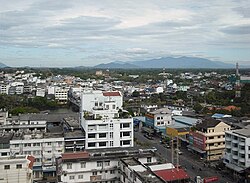
Chanthaburi (Thai: จันทบุรี, pronounced [tɕān.tʰá(ʔ).bū.rīː]) is a town (thesaban mueang) in the east of Thailand, on the banks of the Chanthaburi River. It is the capital of the Chanthaburi Province and the Mueang Chanthaburi District.
Key Information


The town covers the two tambons Talat and Wat Mai of Mueang Chanthaburi District. As of 2005, the town had a population of 27,602. The town figures in the legacy of King Taksin. In 1981 the Thai cabinet passed a resolution to bestow on him the honorary title of the Great. When the Bank of Thailand issued the 12th Series of banknotes, called The Great Series, the monument of King Taksin the Great in the town's Tungnachaey recreational park appeared on the back of the 20 baht note issued 28 December 1981,[1] the 214th anniversary of his coronation.

The Cathedral of the Immaculate Conception, the principal church of the Roman Catholic Diocese of Chanthaburi, is the largest church in Thailand.
Climate
[edit]Chanthaburi has a tropical monsoon climate (Köppen climate classification Am), with little variation in temperature throughout the year. Rainfall, however, varies dramatically by season. Rainfall is light and infrequent in the short dry season (December to February), but the wet season (April to October) features torrential rain. March and November are transitional months, during which significant rainfall may occur in some years, while in other years little rain falls.
| Climate data for Chanthaburi (1991–2020, extremes 1951-present) | |||||||||||||
|---|---|---|---|---|---|---|---|---|---|---|---|---|---|
| Month | Jan | Feb | Mar | Apr | May | Jun | Jul | Aug | Sep | Oct | Nov | Dec | Year |
| Record high °C (°F) | 36.6 (97.9) |
37.7 (99.9) |
37.2 (99.0) |
37.3 (99.1) |
37.5 (99.5) |
35.0 (95.0) |
36.0 (96.8) |
35.7 (96.3) |
35.5 (95.9) |
35.6 (96.1) |
36.3 (97.3) |
35.5 (95.9) |
37.7 (99.9) |
| Mean daily maximum °C (°F) | 32.6 (90.7) |
32.9 (91.2) |
33.3 (91.9) |
34.1 (93.4) |
33.3 (91.9) |
32.2 (90.0) |
31.7 (89.1) |
31.5 (88.7) |
31.6 (88.9) |
32.4 (90.3) |
32.6 (90.7) |
32.1 (89.8) |
32.5 (90.6) |
| Daily mean °C (°F) | 26.7 (80.1) |
27.4 (81.3) |
28.4 (83.1) |
28.9 (84.0) |
28.6 (83.5) |
28.2 (82.8) |
27.9 (82.2) |
27.8 (82.0) |
27.4 (81.3) |
27.3 (81.1) |
27.3 (81.1) |
26.5 (79.7) |
27.7 (81.9) |
| Mean daily minimum °C (°F) | 22.1 (71.8) |
23.2 (73.8) |
24.4 (75.9) |
25.0 (77.0) |
25.3 (77.5) |
25.2 (77.4) |
25.0 (77.0) |
25.0 (77.0) |
24.6 (76.3) |
24.2 (75.6) |
23.4 (74.1) |
22.1 (71.8) |
24.1 (75.4) |
| Record low °C (°F) | 11.2 (52.2) |
14.8 (58.6) |
14.5 (58.1) |
17.9 (64.2) |
21.8 (71.2) |
21.9 (71.4) |
21.4 (70.5) |
21.4 (70.5) |
21.2 (70.2) |
18.7 (65.7) |
13.0 (55.4) |
8.9 (48.0) |
8.9 (48.0) |
| Average precipitation mm (inches) | 28.0 (1.10) |
36.0 (1.42) |
83.8 (3.30) |
128.1 (5.04) |
372.1 (14.65) |
499.7 (19.67) |
511.2 (20.13) |
456.2 (17.96) |
538.3 (21.19) |
272.5 (10.73) |
57.3 (2.26) |
8.4 (0.33) |
2,991.6 (117.78) |
| Average precipitation days (≥ 1.0 mm) | 1.9 | 3.1 | 5.1 | 8.2 | 18.4 | 21.3 | 21.4 | 20.8 | 21.6 | 14.6 | 4.4 | 1.0 | 141.8 |
| Average relative humidity (%) | 69.2 | 73.8 | 76.9 | 78.4 | 82.5 | 84.2 | 84.3 | 84.4 | 86.0 | 81.9 | 72.3 | 66.5 | 78.4 |
| Average dew point °C (°F) | 20.1 (68.2) |
21.9 (71.4) |
23.6 (74.5) |
24.5 (76.1) |
25.1 (77.2) |
25.1 (77.2) |
24.8 (76.6) |
24.8 (76.6) |
24.6 (76.3) |
23.7 (74.7) |
21.6 (70.9) |
19.3 (66.7) |
23.3 (73.9) |
| Mean monthly sunshine hours | 229.4 | 180.8 | 201.5 | 204.0 | 117.8 | 57.0 | 58.9 | 58.9 | 54.0 | 145.7 | 189.0 | 226.3 | 1,723.3 |
| Mean daily sunshine hours | 7.4 | 6.4 | 6.5 | 6.8 | 3.8 | 1.9 | 1.9 | 1.9 | 1.8 | 4.7 | 6.3 | 7.3 | 4.7 |
| Source 1: World Meteorological Organization[2] | |||||||||||||
| Source 2: Office of Water Management and Hydrology, Royal Irrigation Department (sun 1981–2010)[3](extremes)[4] | |||||||||||||
Transportation
[edit]Route 3 (Sukhumvit Road) passes near Chanthaburi and connects the city to Rayong, Pattaya, Chonburi, and Bangkok to the northwest and Trat to the southeast. Route 317 connects Chanthaburi to Sa Kaeo.
References
[edit]- ^ Wararat; Sumit (February 23, 2012). "The Great Series". Banknotes > History and Series of Banknotes > Banknotes, Series 12. Bank of Thailand. Archived from the original on May 18, 2019. Retrieved June 7, 2013.
20 Baht Back - Notification Date November 2, 1981 Issue Date December 28, 1981
- ^ "World Meteorological Organization Climate Normals for 1991–2020". World Meteorological Organization. Retrieved 12 October 2023.
- ^ "ปริมาณการใช้น้ำของพืชอ้างอิงโดยวิธีของ Penman Monteith (Reference Crop Evapotranspiration by Penman Monteith)" (PDF) (in Thai). Office of Water Management and Hydrology, Royal Irrigation Department. p. 100. Retrieved 6 August 2016.
- ^ "Climatological Data for the Period 1981–2010". Thai Meteorological Department. Retrieved 4 August 2016.
External links
[edit] Chanthaburi travel guide from Wikivoyage


12°36′31″N 102°06′14″E / 12.60861°N 102.10389°E
| International | |
|---|---|
| National | |
| Other | |

Chanthaburi
View on GrokipediaHistory
Early settlement and development
The early settlement of Chanthaburi traces its origins to indigenous Chong communities, a Mon-Khmer ethnic group known for hunting and gathering, who inhabited the eastern forests of present-day Chanthaburi, Trat, and Rayong provinces as early as the 14th century.[8] These Chong people established initial communities in forested areas, relying on local resources like sugar cane, wood oil, honey, and rice farming, laying the foundation for human presence in the region before broader Siamese integration.[9] During the Ayutthaya Kingdom period (14th–18th centuries), Chanthaburi came under Siamese influence, with administrative oversight from the capital, fostering gradual expansion through tribute systems and local governance.[10] By the late 18th century, Chinese merchants began settling in Chanthaburi, drawn by opportunities in regional trade networks connecting Siam to Indo-China routes.[11] These arrivals contributed to the formation of mixed communities along the Chantaburi River, where early economic activities included the exchange of agricultural goods and forest products. The development of the Chantaboon Waterfront Community during the Ayutthaya period transformed the riverside area into a vital trading hub for commodities such as pepper, with structures like wooden shophouses emerging to support commerce and transportation.[12] This period marked Chanthaburi's emergence as a key port for eastern Siam, blending indigenous, Siamese, and immigrant influences into a cohesive settlement pattern. Chanthaburi holds a prominent place in the legacy of King Taksin the Great (1734–1782), who is traditionally associated with the province through his mother's roots and the strategic base he established there after the fall of Ayutthaya in 1767.[13] To honor this connection, an equestrian monument to King Taksin was unveiled in Chanthaburi's Tungnachaey recreational park in 1981, symbolizing his role in reunifying Siam from the region.[13] This monument features on the reverse of the 20 baht banknote, issued by the Bank of Thailand on December 28, 1981, alongside the Royal Garuda emblem, underscoring Chanthaburi's historical significance in national narratives.[14] In the early 19th century, waves of Vietnamese refugees, primarily Roman Catholics fleeing religious persecution under the Nguyễn dynasty, arrived in Chanthaburi, bolstering its multicultural fabric.[15] Initial migrations dated back to the late 17th century, but intensified in the 1830s during Emperor Minh Mạng's anti-Catholic decrees, with approximately 1,350 Vietnamese Catholics settling under the protection of King Rama III (Nangklao).[16] By the 1830s, these refugees had established a significant Catholic community near the Chantaboon Waterfront and Noen Wong Fort, engaging in fishing, weaving, and agriculture while integrating with local Thai and Chinese populations; this group constructed enduring institutions, including precursors to the Cathedral of the Immaculate Conception.[12]Colonial influences and 19th-20th century events
During the Franco-Siamese crisis of 1893, triggered by border disputes along the Mekong River, French forces occupied Chanthaburi as a strategic outpost on Siam's eastern frontier.[17] Following the Paknam Incident, where French gunboats blockaded Bangkok, Siam ceded territories east of the Mekong and allowed the French to establish a military garrison in Chanthaburi to enforce compliance and secure the frontier.[17] The occupation, lasting from August 1893 to January 1905, involved a rotating force of 200–700 troops, primarily Annamese riflemen and colonial infantry, who administered the area under military-civil governance directed from Indochina.[17] This period introduced French administrative practices and European-style fortifications, influencing local infrastructure while heightening Siamese resolve to modernize its defenses.[18] This influx of Vietnamese migrants continued through the 19th century under King Tu Duc's persecutions (1848–1883) and extended into the 20th century, including post-1975 refugees, fostering a vibrant Catholic presence that shaped the town's multicultural identity.[19] The establishment of the Apostolic Vicariate of Chantaburi in 1944 formalized this community, splitting from the Vicariate of Bangkok to oversee the growing Catholic population in eastern Siam.[20] After World War II, Chanthaburi underwent economic recovery, with its gem trade rebounding amid global demand for corundum.[21] The town integrated fully into modern Thailand following the French withdrawal in 1905, shifting from frontier outpost to a key node in the national economy as local mines depleted by the late 20th century.[18] This evolution emphasized gem processing and treatment techniques, positioning Chanthaburi as a global hub since the 1950s for enhancing sapphires and rubies sourced internationally.[22] A devastating fire in 1990 destroyed much of the historic riverside district, prompting community-led restoration that preserved and highlighted French-influenced Sino-European architecture, revitalizing the area's cultural heritage.[23]Geography
Location and physical features
Chanthaburi Province is located in the eastern region of Thailand, bordering Cambodia to the east and the Gulf of Thailand to the west, with a total area of 6,338 km² (3,961,250 rai).[1] It lies along the Chanthaburi River, which flows into the Gulf of Thailand near the provincial capital. This strategic location has historically facilitated trade and connectivity in eastern Thailand, with the river serving as a key transportation artery for goods such as gems and agricultural products during the colonial era and beyond.[24] As part of eastern Thailand's coastal plains, the province features low-lying terrain that transitions into more rugged landscapes, including the Chanthaburi Mountains; the highest peak, Khao Soi Dao Tai, rises to 1,675 m and influences regional topography and biodiversity.[25] The province's natural environment includes significant forested areas, with forest coverage comprising approximately 32.4% of the total land, or over 1,297,317 rai, which supports local ecology through diverse habitats and watershed protection.[26] The Chanthaburi River plays a dual role in this setting, acting as a vital waterway while contributing to seasonal flooding patterns that affect the surrounding plains, prompting infrastructure like flood relief channels constructed since 2014 to mitigate inundation in low-elevation zones.[27]Urban layout and river influence
The urban layout of Chanthaburi is prominently centered on the Chanthaburi River, which flows through the heart of the municipality and has historically dictated the spatial organization of the town. The town lies at coordinates 12°36′35″N 102°06′16″E.[28] The core historic district, known as the Chanthaboon Waterfront or Chanthaboon Riverside Community, stretches along the western bank of the river, featuring a linear arrangement of preserved shophouses in Sino-Portuguese and French colonial styles that reflect multicultural influences from Chinese, Vietnamese, and European settlers. This waterfront area, originally settled by Vietnamese immigrants in the upper reaches and local Thais in the lower sections during the 19th century, serves as a vibrant cultural and commercial hub with narrow alleys, elevated walkways, and riverfront promenades designed to accommodate both daily foot traffic and seasonal water levels.[29][30] Administratively, the Chanthaburi municipality spans two tambons: Talat, encompassing the bustling market district with commercial activities clustered on slightly elevated terrain to mitigate flooding, and Wat Mai, focused on temple precincts and residential zones along the river's edges. It occupies an area of 10.25 km² (3.96 sq mi).[1] The town recorded a population density of 5,844.5 people per square mile in 2018, reflecting a compact urban form shaped by the river's constraints and the need for resilient infrastructure in low-lying areas. The river's meandering path has influenced zoning, with flood-prone lowlands reserved for open spaces or agriculture, while higher grounds host key markets and transport nodes, ensuring accessibility during monsoons.[31] Historically, the Chanthaburi River facilitated vital trade routes linking the town to Cambodia and inland regions, promoting a ribbon-like development pattern along its banks that supported gemstone commerce and agricultural transport from the 18th century onward. In modern times, urban expansions have extended residential neighborhoods and commercial strips outward from the riverbanks, incorporating flood mitigation measures such as embankments and drainage systems to accommodate growing tourism and local economies while preserving the waterfront's heritage character. These developments highlight the river's ongoing role in balancing economic vitality with environmental adaptation in Chanthaburi's spatial planning.[32][31]Demographics
Population trends
The population of Chanthaburi Province in eastern Thailand has exhibited steady but modest growth since the late 20th century, reflecting broader national demographic shifts toward slower expansion due to declining fertility rates and aging populations. According to official census data, the province's total population stood at 480,064 in 2000 and increased to 485,611 by 2010, marking an annual growth rate of approximately 0.1%. This period aligns with Thailand's overall transition to lower population growth, influenced by urbanization and economic factors pulling residents toward larger cities like Bangkok.[33] Post-2010 estimates, derived from population registration records maintained by Thailand's National Statistical Office, indicate a more pronounced rise, peaking at 537,698 in 2019 before stabilizing. By 2022, the figure dipped slightly to 536,144, followed by a marginal increase to 536,436 in 2023, suggesting a growth rate of about 0.05% in the most recent year. Over the longer term from 1993 to 2023, the population grew from 459,955 to 536,436, representing an overall increase of roughly 16.6% or an average annual rate of approximately 0.5%. These trends highlight a pattern of initial acceleration in the 2010s, possibly driven by local economic opportunities in gem trading and agriculture, followed by recent plateauing amid national challenges like labor migration and an aging demographic structure.[34]| Year | Population | Source |
|---|---|---|
| 2000 | 480,064 | Census (NSO)[33] |
| 2010 | 485,611 | Census (NSO)[33] |
| 2019 | 537,698 | Registration estimate (NSO via CEIC)[34] |
| 2022 | 536,144 | Registration estimate (NSO via CEIC)[34] |
| 2023 | 536,436 | Registration estimate (NSO via CEIC)[34] |