Hubbry Logo
Chea SimChea SimMain
Open search
Chea Sim
Community hub
Chea Sim
logo
8 pages, 0 posts
0 subscribers
Be the first to start a discussion here.
Contribute something
Chea Sim
Chea Sim
from Wikipedia

Key Information

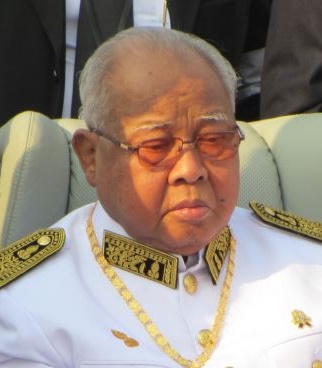
Chea Sim (Khmer: ជា ស៊ីម; 15 November 1932 – 8 June 2015) was a Cambodian politician.[3] He was President of the Cambodian People's Party from 1991 to 2015, President of the National Assembly of Cambodia from 1981 to 1998 (Vice President from June to October 1993) and President of the Senate from 1999 to 2015.[4] His official title was Samdech Akka Moha Thamma Pothisal Chea Sim (Khmer: សម្តេចអគ្គមហាធម្មពោធិ៍សាល ជា ស៊ីម).

Life and career

[edit]

Chea Sim was born on 15 November 1932, in Romeas Haek, Svay Rieng Province to an ethnic Chinese family.[5] As a young man, he partook in one of the first revolutionary movement by the communist Khmer People's Revolutionary Party (Khmer: គណបក្សប្រជាជនបដិវត្តន៍កម្ពុជា, KPRP), currently the ruling party of Cambodia. The movement which he joined was against Colonial France in the early 1950s. He later became a military commander of the communist Khmer Rouge even before it finally toppled the US-backed Lon Nol government in 1975.[6]

Like Heng Samrin and Hun Sen, he defected in 1978 from the Khmer Rouge, which was backed by China, and fled to Vietnam to join an anti-Khmer Rouge movement known as a resistance faction groomed by Vietnam. He later held positions in the new party and People's Republic of Kampuchea government, installed and backed by Vietnam after it invaded Cambodia and ousted the Khmer Rouge in 1979.[6] He was among the founding members of the United Front for the National Salvation of Kampuchea, the Vietnam-backed group that defeated the Khmer Rouge in 1979.[7]

Chea Sim was considered an important figure when negotiations happened, resulting in the 1991 Paris Peace Accord, which brokered a deal supposed to end three decades of civil war and paved the way for the U.N.-organized elections in 1993. After the elections, even though the royalist FUNCINPEC party topped the polls at that time, Hun Sen insisted that it share power with his Cambodian People's Party, and four years later grabbed the sole power for his Cambodia People's Party.

From 6 April 1992 to 14 June 1993, Chea Sim served as the nation's interim leader (Chairman of the Council of State) before Cambodia became a constitutional monarchy. He also acted as Head of State on behalf of King Norodom Sihanouk for brief periods in 1993, 1994, 1995 and 2004. Sihanouk awarded Chea Sim the honorary title of Sâmdech in 1993.

After the King announced his permanent abdication on 7 October 2004, Chea Sim once again became acting Head of State. In the same year, he was escorted out of the country after refusing to sign off as acting head of state on changing the constitution, which would eventually help the CPP and the Funcinpec parties form a coalition government under the deal between Hun Sen and prince Norodom Ranariddh.[8]

Many saw it as the first-ever public display of power struggle and infighting between Hun Sen and Chea Sim. Subsequently, Hun Sen continued his tactic of replacing Chea Sim's loyalists with his favourite candidates for important roles in the party and government.[8] Chea Sim had led a powerful faction within the ruling CPP party which was at times at odds with Hun Sen and his supporters, but many describe Sim's role after that as little more than symbolic.[8]

Illness and death

[edit]

Chea Sim left the position of acting Head of State on 14 October 2004, when Norodom Sihamoni became king. He was absent from the 63rd anniversary celebrations of the CPP in June 2014, following years in which age and illness from high blood pressure, diabetes, and other chronic ailments forced him to back away from his roles and receive medical care in Vietnam. The Phnom Penh Post reported that Hun Sen was publicly referred to as “acting CPP president” for the first time at the anniversary event. In the months leading to his death, Chea Sim's signature continued to appear on documents passed by the Senate, of which he was president, but which was in practice presided over by his Deputy President, Say Chhum.[8]

He died on 8 June 2015.[8][9] Norodom Sihamoni, King of Cambodia, signed a royal decree to establish a commission to organize the funeral of Chea Sim. The commission was chaired by Heng Samrin, President of the National Assembly along with three vice chairmen, including Prime Minister Hun Sen; Say Chhum, Acting President of Senate; Kong Sam Ol, Deputy Prime Minister and Minister of the Royal Palace. Cambodia scheduled a formal mourning ceremony for Chea Sim for 19 June 2015.[10]

Commentary

[edit]

Human Rights Watch Asia Director Brad Adams described it as a "mockery of justice" that Chea Sim was able to continue being one of the rulers of the post-Khmer Rouge government without being brought to justice, as Chea Sim was accused of overseeing atrocities committed under his role as a military commander. Brad Adams also accused Chea Sim of operating "a police state" in the 1980s that arrested, imprisoned, and tortured Cambodian political activists without trial.[11]

Minister of Information Khieu Kanharith criticized The Phnom Penh Post for publishing an article which accused Chea Sim of violating human rights under the Khmer Rouge regime. Khieu Kanharith said that in the Cambodian tradition, respect for the dead is very important during the mourning ceremony and that The Phnom Penh Post could be sued if Chea Sim's family members wished to do so.[12]

AKP argued, in that barbaric regime, Samdech Chea Sim was just a simple local official. AKP argued Chea Sim and his family members were also victims (of the regime) as other Cambodian people. The spokesperson of the Ministry of Interior strongly rejected the comments made by Director of Asia Division for Human Rights Watch and quoted by The Phnom Penh Post.[13]

Sam Rainsy, the leader and co-founder of the main opposition party, Cambodia National Rescue Party, and a member of Parliament (MP) for Kampong Cham since July 2014, hailed Chea Sim as a national hero and likened him to the popular late king Norodom Sihanouk who, Rainsy said, considered Chea Sim as his "little brother". Once considered as the second most powerful man in the government after Hun Sen, Chea Sim, as Rainsy said, was highly regarded for his patriotic ideals and national reconciliation after the Khmer Rouge.[14]

See also

[edit]

References

[edit]
Revisions and contributorsEdit on WikipediaRead on Wikipedia
from Grokipedia
Chea Sim (15 November 1932 – 8 June 2015) was a Cambodian who served as president of the from its formation in 1991 until his death, president of the from 1981 to 1998, and from 1999 to 2015. Born to a peasant family in , he joined anti-colonial revolutionary movements in the early 1950s and later became a cadre in the Eastern Zone, defecting to in 1978 amid internal purges before the regime's overthrow. As a key ally of Prime Minister in the Vietnamese-backed government, Sim rose to prominence in post- , overseeing the state security apparatus during the , a period marked by widespread political imprisonment and torture of dissenters. His long tenure in the helped consolidate power for the CPP, though his leadership has been criticized for enabling authoritarian practices and evading accountability for potential -era crimes.

Early Life and Entry into Politics

Origins and Pre-Revolutionary Involvement

Chea Sim was born on November 15, 1932, in Romeas Hek district, , to a of modest means. His father, Chea Sao, and mother, Pen Nao, raised him as the third of five children in a rural environment dominated by agriculture and traditional Khmer village life. Formal education was limited; he attended a local Buddhist school, where he was ordained as a novice monk and completed studies equivalent to junior high level under the pagoda system common in rural at the time. This background reflected the typical path for many young men in pre-independence , blending religious instruction with basic literacy in , though it provided no advanced secular training. In the early 1950s, amid growing anti-colonial sentiment, Chea Sim engaged in revolutionary activities as part of the movement, which sought independence from French rule through armed resistance and political agitation from 1951 to 1954. These efforts aligned with broader Issarak networks influenced by Vietnamese communists, operating in eastern provinces like Svay Rieng near the border, where local grievances against colonial exploitation fueled participation. By 1959, he affiliated with the Khmer People's Revolutionary Party (KPRP), a communist organization established in 1951 under Vietnamese guidance as a vehicle for anti-monarchical and radical agrarian reform, distinct from the royalist government in . Within the KPRP, he advanced to district-level secretary roles in Svay Rieng, leveraging local networks for clandestine organizing against perceived feudal structures. This progression underscored the party's strategy of embedding in rural bases, drawing on Vietnamese precedents to build cadres from peasant origins.

Alignment with Anti-Khmer Rouge Forces

During the regime (1975–1979), Chea Sim held a position as a regional military commander in the Eastern Zone, a region encompassing provinces like Kampong Cham where he served as party secretary. This zone harbored networks sympathetic to due to historical cross-border ties and ethnic Vietnamese populations, fostering latent dissent against Pol Pot's center. As purges intensified in the Eastern Zone from mid-1977, targeting perceived pro-Vietnamese elements and resulting in mass executions estimated at over 100,000 deaths, Chea Sim aligned with emerging resistance factions. In response to these purges, Chea Sim participated in a regional against the leadership, organizing defections among Eastern Zone cadres and troops who viewed Vietnamese support as a viable alternative to the regime's extremism. By mid-1978, amid escalating internal violence and Vietnamese border incursions, he defected to , leading a group of followers across the border to join networks. From bases in , these defectors engaged in guerrilla preparations, coordinating with Hanoi-backed insurgents to undermine control through sabotage and recruitment drives in border areas. Chea Sim emerged as a prominent figure in the Kampuchean for National Salvation (KUFNS), established on December 2, 1978, in Kratie Province near the Vietnamese border by Cambodian dissidents under Vietnamese auspices. As vice president of the front's central committee—second only to president —he helped mobilize anti- forces, including former regime elements, for the January 7, 1979, overthrow of alongside Vietnamese troops. This alignment positioned Eastern Zone survivors like Chea Sim as foundational to the post-1979 order, leveraging their local knowledge and cadre networks against Khmer Rouge remnants.

Career in the People's Republic of Kampuchea

Ministerial Roles and Security Apparatus

Chea Sim was appointed Minister of the Interior in the (PRK) shortly after the Vietnamese overthrow of the on January 7, 1979, serving in this role until 1981. The position placed him in charge of internal security, police operations, and local administrative governance at a time when the country faced widespread institutional collapse and persistent threats from guerrillas backed by external coalitions. His ministry focused on reconstituting basic security frameworks, including the recruitment and training of personnel for district-level administrations amid ongoing . During his tenure, Chea Sim oversaw the organization of local militias and units integrated into the PRK's apparatus to counter insurgent activities in rural provinces, where remnants conducted ambushes and sabotage operations into the early 1980s. These efforts supported the PRK's strategy of combining military defense with administrative control, enabling the extension of central authority to previously ungoverned areas through coordinated patrols and intelligence networks. By , as the PRK transitioned from the initial Revolutionary Council to a following national elections, Chea Sim's prior work in contributed to stabilizing governance structures, with over 1,000 communal councils reestablished to manage local affairs and resist subversion. This reorganization facilitated incremental land distribution initiatives, allocating approximately 4.5 million hectares to peasant cooperatives by the mid-1980s, which bolstered rural productivity and loyalty to the regime despite wartime constraints.

Suppression of Dissent in the 1980s

During his tenure as Minister of the Interior in the People's Republic of Kampuchea (PRK) starting in the early 1980s, Chea Sim oversaw the national police and intelligence services, which enforced stringent measures against perceived internal threats to the Vietnamese-backed regime. These entities conducted systematic arrests targeting individuals suspected of collaborating with armed opposition factions, including Khmer Rouge remnants, the Khmer People's National Liberation Front (KPNLF), and FUNCINPEC, amid a civil war that persisted through the decade and threatened PRK consolidation of power. By the mid-1980s, estimates indicated approximately 5,000 political prisoners held in PRK facilities, often without formal charges or trials, as security forces prioritized rapid neutralization of espionage and sabotage risks in a state still recovering from genocide and foreign invasion. Key operations under Chea Sim's ministry included intelligence-driven sweeps that linked detentions to reeducation programs and prisons, where suspects underwent interrogation for alleged ties to the 1982-formed Democratic Kampuchea Government in Exile coalition, which coordinated guerrilla activities against PRK control. In 1986, the ministry formalized the A-3 Combat Police unit as a specialized intelligence force explicitly tasked with uprooting internal enemies, enhancing surveillance and preemptive arrests to safeguard regime stability during Vietnamese troop withdrawals and escalating border incursions. State media documented hundreds of such arrests annually; for instance, 412 individuals were reported apprehended in Siem Reap-Utdar Meanchey province alone in the first nine months of 1988 for security violations, reflecting broader patterns of detention without due process to deter infiltration in frontline provinces. These policies directly bolstered PRK territorial control by disrupting opposition networks, as evidenced by reduced insurgent penetration in urban centers and along supply routes, though they occurred in the context of existential threats from armed non-state actors backed by external powers like and . organizations, including , documented associated abuses such as in facilities like those inherited from the era, attributing them to the security apparatus's emphasis on loyalty enforcement over judicial oversight in a wartime environment. Chea Sim's in structuring this apparatus, credited with professionalizing post-1979 policing amid chaos, prioritized causal deterrence against subversion, enabling the PRK to withstand coalition offensives until the late 1980s.

Leadership of the Cambodian People's Party

Formation of the CPP and Party Presidency

The Kampuchean People's Revolutionary Party (KPRP), the ruling since 1979, underwent a to the (CPP) in 1991 as part of 's shift toward multiparty democracy amid the -sponsored peace process. This transformation occurred in the context of the Paris Peace Agreements signed on October 23, 1991, which established the Transitional Authority in (UNTAC) to oversee a , , and free elections, necessitating the abandonment of the KPRP's Marxist-Leninist commitments to align with the accords' emphasis on political pluralism. On October 17, 1991, during the 14th Plenum of the , Chea Sim was elected as the inaugural president of the CPP, marking a formal transition from the KPRP's structure to the new entity. In this capacity, Chea Sim guided the party's nominal direction through the UNTAC-supervised transitional period, focusing on organizational adaptation to compete in the inaugural multiparty elections. Under Chea Sim's presidency, the CPP consolidated its internal framework by cultivating networks that integrated allegiance with control over local administration and resource allocation, bolstering organizational resilience against emerging political rivals. These efforts enabled the CPP to secure 51 seats in the 120-seat during the May 1993 UNTAC-supervised elections, establishing a foundation for enduring dominance despite the introduction of competitive .

Internal Power Dynamics with Hun Sen

Within the (CPP), Chea Sim served as a significant counterweight to 's ambitions, fostering factional tensions that originated in the early . Disputes between the two reportedly intensified during the 1990 informal meeting on Cambodian peace, where 's nomination of CPP candidates for the Supreme National Council without broader consultation alienated Chea Sim and his allies. These frictions persisted into the mid-, culminating in the July 1997 , which executed against FUNCINPEC's ; Chea Sim, as CPP president, and his brother-in-law , co-minister of the interior, opposed 's aggressive tactics but avoided direct confrontation, allowing Chea Sim to retain his party leadership and presidency amid the power consolidation. Chea Sim's influence post-1997 manifested through a de facto triumvirate with and honorary CPP president , requiring consensus on major decisions to prevent unilateral dominance. This arrangement constrained 's centralization efforts, as Chea Sim leveraged his role—established after the 1998 constitutional amendments—and control over patronage networks in eastern to balance power. Diplomatic analyses noted that Chea Sim's faction, including security loyalists, blocked initiatives like post-2003 constitutional changes favoring 's preferences. Hun Sen gradually eroded this equilibrium through targeted purges of Chea Sim's supporters, exemplified by the February 2009 dismissal of General Ke Kim Yan, of the Royal Cambodian Armed Forces and a known Chea Sim ally who had opposed the 1997 coup. Official CPP announcements framed the reshuffle as routine, replacing Ke Kim Yan with loyalist Pol Saroeun, but observers linked it to factional rivalry and Ke Kim Yan's resistance to military integration under 's command. Similar actions followed, including the 2011 removal of Chea Sim's bodyguard chief, signaling incremental weakening of the without fully dismantling Chea Sim's institutional leverage until his health declined.

Major Political Positions and Influence

National Assembly and Co-Prime Ministership

Chea Sim was elected President of the on October 25, 1993, during the inaugural session of the first legislature following the May 1993 UN-supervised elections, a position he held until 1998. In this role, he presided over the assembly's transition from a constituent body that had drafted the September 21, 1993, —establishing Cambodia as a with a multiparty liberal democratic system—to a functioning legislative chamber responsible for enacting laws amid fragile coalition governance. As head of the (CPP), which had secured the second-highest vote share in the elections behind FUNCINPEC's plurality, Chea Sim played a pivotal role in negotiations that averted CPP threats of provincial secession and enabled power-sharing. Alongside Prime Minister , he engaged King Norodom Sihanouk in talks that resulted in a dual premiership: FUNCINPEC's as First Prime Minister and as Second Prime Minister, forming a with CPP retaining significant ministerial portfolios. This arrangement, formalized in September , balanced royalist and CPP interests, with Chea Sim's support for the transitional framework credited by observers for stabilizing the post-election impasse despite CPP's initial rejection of results alleging irregularities. Throughout his National Assembly presidency, Chea Sim mediated legislative proceedings between coalition partners, facilitating passage of key bills on and administrative reforms while navigating tensions over security and . His tenure coincided with efforts to consolidate the 1993 constitutional framework, including provisions for parliamentary oversight of the executive, though coalition frictions—exemplified by the March 30, 1997, grenade attack on an opposition rally—tested institutional neutrality without direct attribution in assembly records. By 1998, amid escalating CPP-FUNCINPEC rivalries, his leadership helped maintain procedural continuity until the assembly's dissolution for fresh elections.

Senate Presidency and Acting Head of State

Chea Sim was elected as the first President of the of on October 25, 1999, following the establishment of the as part of the country's bicameral parliament under the 1993 Constitution. He held this position continuously until his death in 2015, chairing Senate sessions and representing the chamber in official capacities within a body dominated by members of the (CPP), which held a of seats throughout his tenure. Under Chea Sim's leadership, the functioned primarily as a deliberative body reviewing legislation from the , often approving bills that aligned with CPP priorities, including to electoral laws and judicial reforms that centralized authority in ruling party institutions. For instance, in 2004, as acting head of state during King Norodom Sihanouk's absence, Chea Sim signed into law a supplemental to the enabling the selection of a new monarch, which facilitated Norodom Sihamoni's ascension later that year. The 's composition, with 62 members indirectly elected or appointed largely from CPP ranks, ensured that such measures passed with minimal opposition, reinforcing the one-party dominance in Cambodian governance. Constitutionally, as Senate President, Chea Sim assumed the role of acting during King Norodom Sihamoni's absences abroad, performing ceremonial duties such as signing royal decrees and receiving foreign dignitaries. This included periods in late , when Sihamoni traveled to and for official visits and medical checkups, during which Chea Sim issued statements on national unity and continuity of state functions. These interim responsibilities underscored the Senate President's symbolic authority in Cambodia's monarchical framework, though executive power remained with the in practice.

Controversies and Criticisms

Allegations of Human Rights Abuses

During his tenure as Minister of the Interior from 1979 to 1981 in the (PRK), Chea Sim oversaw the creation of new security forces, police units, intelligence networks, and prison systems that (HRW) alleges facilitated widespread arbitrary arrests and indefinite detention without charge or trial of suspected political opponents, including remnants and dissidents. These structures enabled practices such as incommunicado detention and torture in facilities like "dark cells," contributing to a repressive apparatus characterized by HRW as a "" designed to eliminate perceived internal threats following the Khmer Rouge overthrow. HRW further contends that extrajudicial killings occurred under these security mechanisms, with detainees often subjected to execution without , and that Chea Sim protected former cadres by integrating them into administrative and security roles, perpetuating impunity for abuses. PRK-era policies under his influence reportedly extended into the 1990s State of Cambodia period, where opposition figures faced similar fates—arbitrary detention, , and denial of fair trials—amid ongoing suppression of non-communist political elements. Cambodian government officials, including the Ministry of Interior, have rebuked HRW's claims linking Chea Sim to such violations, dismissing them as unsubstantiated attempts to tarnish post- stabilization efforts without acknowledging the context of combating armed subversion and Vietnamese-backed security necessities. CPP-aligned sources frame these measures as essential countermeasures against insurgency and external aggression, though they do not publicly detail or deny specific incidents of detention or killings. No prosecutions or independent investigations into Chea Sim's role have occurred, highlighting persistent impunity in Cambodia's framework.

Factionalism and Corruption Claims

Chea Sim led one of two primary factions within the (CPP), the other headed by , with tensions manifesting in the 1990s through opposition to 's aggressive tactics, including disapproval of the 1997 coup against coalition partners by Chea Sim and his ally Sar Kheng. This factional divide, rooted in differing approaches to power consolidation, saw Chea Sim's group prioritize restraint against 's expansionist moves, though the latter's faction gradually dominated intraparty dynamics. In the , efforts to marginalize Chea Sim's supporters included the removal of General Ke Kim Yan, a key ally, and the 2011 of Chea Sim's chief on charges, actions that bolstered Hun Sen's control and entrenched crony networks favoring loyalists over institutional merit. These purges, while framed by the CPP as necessary for and unity through personal allegiance, drew opposition accusations of fostering systemic favoritism that prioritized factional ties over transparent governance. Corruption allegations against Chea Sim centered on networks enabling elite enrichment, particularly in , where documented his son Chea Thea's control of firms like Mieng Ly Heng involved in timber extraction and associate Che Lain's forceful role in the trade. Such ties exemplified claims of , with international analyses arguing they eroded legal accountability by intertwining family interests with state concessions in extractive sectors. The CPP defended these arrangements as loyalty-driven mechanisms supporting economic stability and party cohesion, contrasting opposition and watchdog critiques that highlighted entrenched graft over rule-of-law principles, though reports noted Chea Sim's personal involvement appeared lesser than Hun Sen's.

Death and Posthumous Impact

Illness and Passing

Chea Sim's health issues began prominently with a in October 2000, after which he was hospitalized in for recovery, signaling the onset of a gradual decline that reduced his public engagements in subsequent years. He had been managing chronic ailments including and high for an extended period, with hospitalizations in the months prior to his passing. Chea Sim died on June 8, 2015, at the age of 82 at his residence in 's Chamkarmon district, succumbing to complications from his prolonged illnesses. A took place on June 19, 2015, in central , featuring a 3-kilometer and Buddhist rites at Wat Botum Pagoda, attended by thousands of mourners, King , and dignitaries including Vietnamese Politburo representatives.

Legacy in Cambodian Politics

Chea Sim's leadership within the (CPP) from 1991 to 2015 helped solidify the party's electoral dominance, which provided a framework for relative political stability after the era and the 1993 UN-supervised elections, enabling economic recovery and institutional continuity despite ongoing factional tensions. His role as a senior figure in the "old guard" maintained a degree of intraparty pluralism that constrained unilateral decision-making, fostering CPP cohesion through negotiated power-sharing rather than outright dominance by any single leader. Following his death on June 8, 2015, Hun Sen's swift ascension to CPP presidency on June 20 eliminated this internal check, accelerating power centralization within the party and state apparatus, as evidenced by subsequent leadership transitions that prioritized familial and loyalist continuity over broader consultation. This shift correlated with intensified suppression of opposition, including the 2017 dissolution of the (CNRP) and the CPP's sweep of all 125 seats in the 2018 elections, outcomes attributed by analysts to reduced factional resistance post-Chea Sim. Chea Sim's legacy elicits divided assessments: CPP allies and some legislative observers praised him as a principled who advanced parliamentary functionality without partisan favoritism, crediting his tenure with preventing deeper instability. In contrast, human rights groups and opposition remnants condemn his influence for perpetuating unaddressed authoritarian structures, arguing that CPP hegemony under his watch eroded democratic and enabled enduring curbs on , a pattern intensified after . These critiques, often from Western-funded monitors, highlight systemic biases toward highlighting abuses while underemphasizing stabilization gains, yet align with empirical records of post-1993 and media restrictions.

References

Add your contribution
Related Hubs
Contribute something
User Avatar
No comments yet.