


Community hub
Recent from talks
Contribute something
Nothing was collected or created yet.
Cheviot Beach
View on Wikipedia
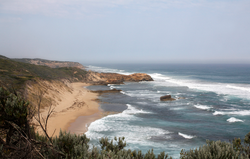
Cheviot Beach is a beach near Point Nepean in Victoria, Australia. It was named after the SS Cheviot, which broke up and sank nearby with the loss of 35 lives on 20 October 1887.[1][2]
Key Information


It was the site of the disappearance of Prime Minister Harold Holt; on 17 December 1967, Holt went swimming at the beach, disappeared, and was presumed drowned. He was last seen in the ocean and was then dragged under a wave, never to be seen again. His body was never recovered.[3] Point Nepean had long been a restricted area, initially for quarantine and then later for defence purposes; at the time, it was used by the officer training school of the Australian Army, and Holt had reportedly been issued a special pass to use the beach.[2]

A lookout and memorial to Holt overlook the beach on Cheviot Hill, accessible via a self-guided walk from Point Nepean; however, there remains no beach access, with swimming prohibited for safety reasons. Surf Life Saving Australia rates it as "extremely hazardous" for swimming, noting "at high tide the rocks and reefs lie immediately off the beaches and, as the tide drops, strong permanent rips intensify off the rocks and amongst the reefs."[4][5][2]
References
[edit]- ^ Brad Duncan & Martin Gibbs (2015). Please God Send Me a Wreck: Responses to Shipwreck in a 19th Century Australian Community. Springer. p. 100. ISBN 9781493926428.
- ^ a b c "Point Nepean - The Silent Sands of Cheviot Beach" (PDF). Victoria's Heritage. Parks Victoria. Archived from the original (PDF) on 27 June 2012. Retrieved 8 February 2016.
- ^ "Harold Holt's disappearance - Fact sheet8 February 2016". Archived from the original on 25 February 2015.
- ^ "Cheviot". Beachsafe. Surf Live Saving Australia. Retrieved 8 February 2016.
- ^ "Park Note: Point Nepean National Park" (PDF). Parks Victoria. Archived from the original (PDF) on 23 October 2015. Retrieved 8 February 2016.
 | This article about a location in Victoria, Australia is a stub. You can help Wikipedia by adding missing information. |
Cheviot Beach
View on GrokipediaCheviot Beach is a secluded, reef-dominated stretch of coastline located within Point Nepean National Park on the Mornington Peninsula, Victoria, Australia, characterized by high limestone cliffs, rocky platforms, and narrow sandy areas that become awash at high tide.[1][2]
Named for the SS Cheviot, a coastal steamship that wrecked nearby in October 1887 with the loss of 35 lives out of 48 on board, the site marks one of Victoria's most significant maritime disasters due to the vessel striking uncharted rocks amid poor visibility.[1][3]
The beach's geography features strong rip currents, turbulent waters from the interaction of Port Phillip Bay and Bass Strait, and diverse marine habitats in shallow rock pools, rendering it hazardous for swimming despite its scenic appeal.[2][4]
Access is via walking tracks from Cheviot Hill, the park's highest vantage point offering views over the beach, though public entry to the beach itself remains restricted to protect its environmental and heritage values.[5][1]
Historically, the area served defensive and quarantine purposes, but the beach's defining notoriety stems from empirical records of shipwrecks and drownings attributable to its causal dynamics of wave refraction, reef structures, and current flows rather than unsubstantiated narratives.[1][3]
Geography and Location
Physical Description
Cheviot Beach is a 0.7 km long stretch of coastline situated within Point Nepean National Park on the southern tip of the Mornington Peninsula in Victoria, Australia.[6] The beach is characterized by narrow strips of sand that become awash at high tide, backed by prominent calcarenite bluffs rising 30 to 40 meters in height.[6][7]
Fronting the sandy areas are extensive intertidal rock platforms that emerge at low tide, featuring shallow rock pools teeming with marine life and patchy reefs extending offshore.[6][8] These platforms contribute to a rugged coastal profile, with the beach classified as a platform type dominated by rocky substrates rather than broad sandy expanses.[6] The calcarenite cliffs, composed of lithified dune sands from Pleistocene aeolian deposits, reflect the region's geological history of coastal dune formation and subsequent erosion.[7] Sand composition varies, with descriptions noting both golden hues and darker tones, likely influenced by local sediment sources including basalt-derived materials from the broader peninsula geology.[9][8] The beach's orientation exposes it to Bass Strait swells, enhancing its dynamic interaction between wave action, rock erosion, and sediment transport.[6]