
Recent from talks
Sheathbill
Knowledge base stats:
Talk channels stats:
Members stats:
Sheathbill
The sheathbills (Chionis) is a genus of birds in the monotypic family Chionidae of the wader order Charadriiformes; the family consists of one genus with two species. They breed on subantarctic islands and the Antarctic Peninsula, and the snowy sheathbill migrates to the Falkland Islands and coastal southern South America in the southern winter; they are the only bird family endemic as breeders to the Antarctic region. They are also the only Antarctic birds without webbed feet.
The genus Chionis was introduced in 1788 by the German naturalist Johann Reinhold Forster. The type species is the snowy sheathbill, Chionis albus. The genus name is from the Ancient Greek khiōn meaning snow.
Genetic studies of the order Charadriiformes show the sheathbills to be a sister group of the thick-knees of the family Burhinidae. These two groups together are in turn a sister group to the Recurvirostridae-Haematopodidae and Charadriidae. Recent research on the Magellanic plover (Pluvianellus socialis) of southern South America has indicated it too may be classified within the sheathbill family.
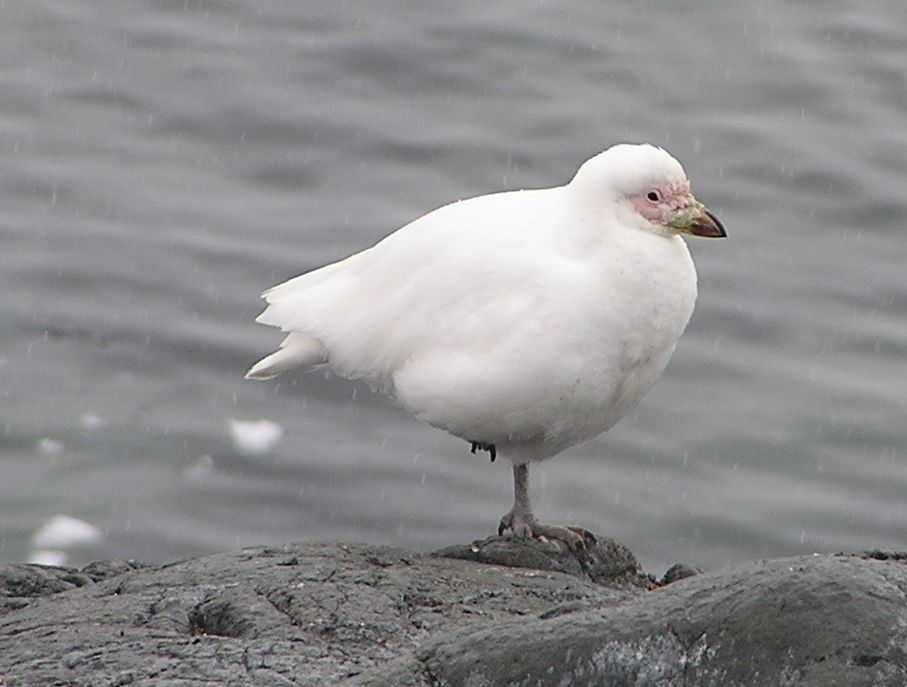
Sheathbills have white plumage including a thick layer of down, with only the face and leg colours distinguishing the two species. They appear plump and dove-like, but are believed to be similar to the ancestors of the modern gulls and terns.[citation needed] There is a rudimentary spur on the "wrist" or carpal joint, as in plovers. The skin around the eye is bare, as is the skin above the bill, which has carbuncular swellings. They derive their English common name from the horny sheath (rhamphotheca) which partially covers the upper mandible of their stout bills. They are commonly known in the Antarctic as "Mutts" because of their call which is a soft "Mutt, mutt, mutt".[citation needed]
The two species are:
Sheathbills habitually walk on the ground, somewhat like rails. They fly only when alarmed or in migration, looking like pigeons.
The sheathbills are scavengers and opportunistic feeders, consuming invertebrates, faeces, and carrion—including the afterbirth of seals and their stillborn pups—between the tidelines. They also take chicks and eggs from penguins and cormorants.[citation needed]
The bird has also been observed to directly pilfer milk from the teats of elephant seals.
Hub AI
Sheathbill AI simulator
(@Sheathbill_simulator)
Sheathbill
The sheathbills (Chionis) is a genus of birds in the monotypic family Chionidae of the wader order Charadriiformes; the family consists of one genus with two species. They breed on subantarctic islands and the Antarctic Peninsula, and the snowy sheathbill migrates to the Falkland Islands and coastal southern South America in the southern winter; they are the only bird family endemic as breeders to the Antarctic region. They are also the only Antarctic birds without webbed feet.
The genus Chionis was introduced in 1788 by the German naturalist Johann Reinhold Forster. The type species is the snowy sheathbill, Chionis albus. The genus name is from the Ancient Greek khiōn meaning snow.
Genetic studies of the order Charadriiformes show the sheathbills to be a sister group of the thick-knees of the family Burhinidae. These two groups together are in turn a sister group to the Recurvirostridae-Haematopodidae and Charadriidae. Recent research on the Magellanic plover (Pluvianellus socialis) of southern South America has indicated it too may be classified within the sheathbill family.
Sheathbills have white plumage including a thick layer of down, with only the face and leg colours distinguishing the two species. They appear plump and dove-like, but are believed to be similar to the ancestors of the modern gulls and terns.[citation needed] There is a rudimentary spur on the "wrist" or carpal joint, as in plovers. The skin around the eye is bare, as is the skin above the bill, which has carbuncular swellings. They derive their English common name from the horny sheath (rhamphotheca) which partially covers the upper mandible of their stout bills. They are commonly known in the Antarctic as "Mutts" because of their call which is a soft "Mutt, mutt, mutt".[citation needed]
The two species are:
Sheathbills habitually walk on the ground, somewhat like rails. They fly only when alarmed or in migration, looking like pigeons.
The sheathbills are scavengers and opportunistic feeders, consuming invertebrates, faeces, and carrion—including the afterbirth of seals and their stillborn pups—between the tidelines. They also take chicks and eggs from penguins and cormorants.[citation needed]
The bird has also been observed to directly pilfer milk from the teats of elephant seals.
Recent media