Hubbry Logo
Church KeyChurch KeyMain
Open search
Church Key
Community hub
Church Key
logo
8 pages, 0 posts
0 subscribers
Be the first to start a discussion here.
Church Key
Church Key
from Wikipedia
"Church Key"
Single by The Revels
B-side"Vesuvius"
ReleasedNovember 1960
GenreSurf
Length2:03
LabelImpact 1-IM / 1-IMX
SongwritersDan Darnold, Norman Knowles
The Revels singles chronology
"Six Pak"
(1959)
"Church Key"
(1960)
"Intoxica"
(1961)
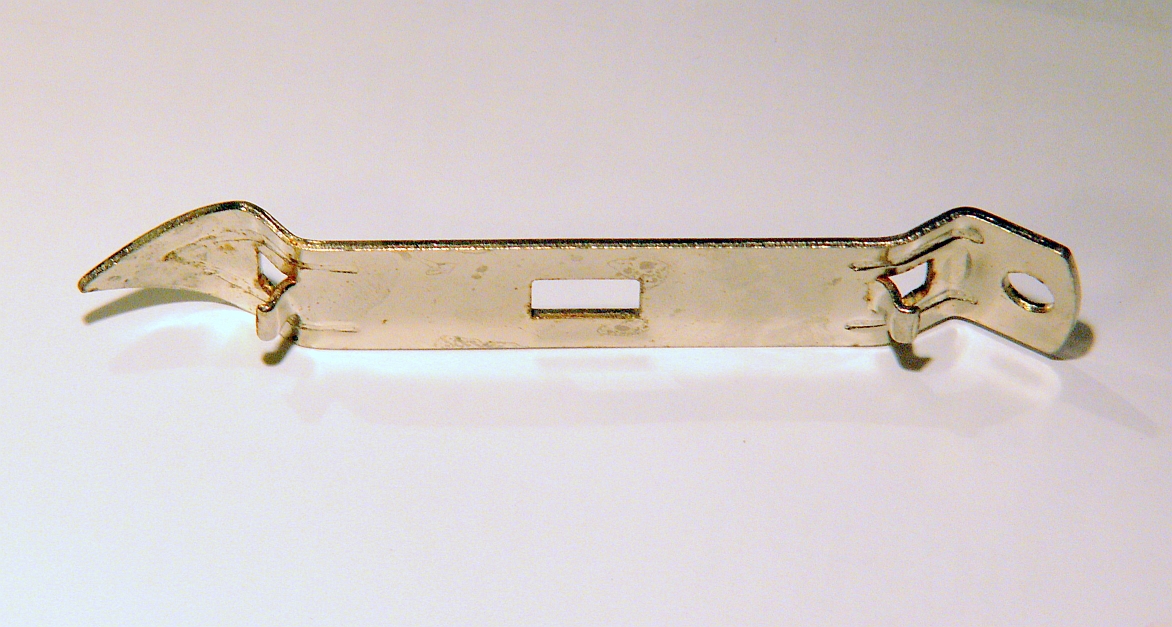
A church key beer opener

"Church Key" is an instrumental single that was released by California surf group The Revels on Tony Hilder's Impact Records label in 1960. It was a hit for the group and later a hit for Dave Myers and his Surf-Tones.

The title refers to the slang use of "church key" to mean a device for opening beer cans or beer bottles.

Background

[edit]

The song was written by Dan Darnold and Norman Knowles.[1][2]

A version of the song by The Biscaynes appears on the Surf's Up! At Banzai Pipeline compilation album.[3]

The Revels version

[edit]

History

[edit]

The involvement with Tony Hilder came about as a result of meeting him early in 1960. The group were playing for a March of Dimes benefit in San Luis Obispo at a Chevrolet dealership. Hilder had come into town to promote a couple of his artists, Billy Watkins and Charles Wright. He was looking for a band to back them while on tour. Knowles wanted Hilder to think about The Revels as the backing group. It didn't happen but Hilder still left his business card. The second time that the group came across Hilder was in the summer of 1960. The group had driven down to LA for what was to be their second recording session. They were at a small studio located on the corner of Santa Monica and Western.[4] The session wasn't too fruitful so Knowles decided to ring Hilder with his experience to come over to help them with the session. Soon Hilder arrived with Robert Hafner who was his partner and songwriter. Hilder's attention was drawn to Dan Darnold's playing around with the vibrato bar. Hafner helped with a melody centering around a hook with the vibrato. An arrangement was developed and later the title "Church Key" came about. Barbara Adkins, Hilder's girlfriend and future wife provided the giggles on the recording. Robert Hafner had some other tunes with him, one of which was "Vesuvius". The band learnt it in the studio and recorded it. Not having his own label to release the recording at the time, Hilder and Norman Knowles started their own co. as partners, splitting the costs as well as the profits.[5]

The A side which was credited to The Revels with Barbara Adkins. The B side to the single was "Vesuvius which was written by Robert J. Hafner[6] However, the 1959 release on CT 1-IM, 1-IMX credits Norman Knowles as the composer.[7] Knowles' involvement as well As Hafner's is confirmed in Catalog of Copyright Entries: Third series.[8] This was the first release on Hilder's Impact Records label.[9] It was also previously released on the CT label which was another record label of Hilders.[10][11] According to Norman Knowles, the song was banned in some cities because of it being "derogatory of religion."[12] According to the liner notes in the CD release of Intoxica! The Best Of The Revels by John Blair (author of The Illustrated Discography of Surf Music, 1961-1965), Adkins who did the female giggling voice on the recording was Tony Hilder's girlfriend and future wife.[13]

Appearances

[edit]

It appears on The Revels 1964 album Revels on a Rampage, Intoxica!!! The Best of the Revels in 1995 and various artist compilations Kahuna Classics: Surf Music, Surf Wax: Songs of the Beach and Instro Poker of Aces.[14] The single was picked up by Liberty Records for national distribution. The banner that it was released under was that of Impact. This was to retain the identity of Tony Hilder's label.[15]

The track

[edit]

The track starts off with a guitar intro, following with the main theme of the number is handled by the guitar in a 12 bar blues progression. There is a party atmosphere in the track. The title of the track is spoken. There is the sound of a beer can being opened as well as a voice of giggling female.[16] The piano player on the track is said to be Langdon Winner.[17][18]

The group

[edit]

"Church Key" and "Comanche" were the tracks The Revels were best known for.[19] "Church Key" was a hit for them in 1960.[20][21] The band's next single was "Intoxica" / "Tequila" which was released in 1961.[22]

Dave Myers and his Surf-Tones version

[edit]
"Church Key"
Single by Dave Myers and His Surf-Tones
B-side"Passion"
Released1963
GenreSurf
Length2:18
LabelImpact 27 / 27-IM / 27-IMX
SongwritersDan Darnold, Norman Knowles
Dave Myers and His Surf-Tones singles chronology
"Church Key"
(1963)
"Gear!"
(1964)

Dave Myers and The Surftones had their version released on Impact records as well. Their version which was backed with "Passion" was released on Impact 27 / 27-IM / 27-IMX. The B side composition was credited to Robert J. Hafner and Anthony Hilder.[23][24] They managed to have a local hit with it in L.A. in 1963.[25] The version of "Church Key" by Dave Myers & The Surftones is on the ultimate surf music playlist by SurferToday.com.[26]

Releases including other versions

[edit]
List of singles
Act Title Catalogue Year Notes
The Revels "Church Key" / "Vesuvius" CT 1-IM, 1-IMX 1959 / 1960 ? [27][28]
The Revels with Barbara Adkins "Church Key" / "Vesuvius" Impact 1-IM / 1-IMX 1960
The Gonzos "Church Key" / "Very Muddy Waters" Donna 1330 1960 [29]
The Surfaris
* The Biscaynes
"Moment Of Truth" / * "Church Key" Northridge 1001 1963 [30]
Jim Waller And The Deltas "Surfin' Wild" / "Church Key" Arvee A-5072 1963 [31][32]
Dave Myers and his Surf-Tones "Church Key" / "Passion" Impact 27-IMX 1963 [33]
Dave Cooper and the Continentals "Church Key" / "Continental Surf" Westco WC - 7 1964 [34]
Opposite Six "Church Key Pt. 68" / "Continental Surf" South Shore SS45-721 [35][36]
The Lone Surfer And His Super Pals "Church Key" / "Horror Beach" Planet Pimp Records – PP-003 1993 [37]
* The Trashmen
The Wailers
* "Church Key" / "Wailin'" Sundazed / Norton LV-1 1999 [38]
List of EPs
Act Title Catalogue Year Notes
The Surf Raiders Surfin' "81": Live At The Ice House Moxie Records M-1039 1981 [39]
Appears on album
Act Title Catalogue Year Notes
Centurians Surfers' Pajama Party Del-Fi Records DFLP 1228 1963 [40]
The Impacts Wipe Out! Del-Fi Records DFLP 1234 1963 [41][42]
The Rivieras Let's Have a Party U.S.A. 102 1964 [43]
Various Artists Jet Set Dance Discothèque Vol. 3 Audio Fidelity DFS 7041 1964 "Church Key" by unknown artist[44]
Jon and the Nightriders Recorded Live At Hollywood's Famous Whisky A Go-Go Voxx Records VXS 200.005 1981 [45]
The Halibuts Halibut Beach What Records? W12-2407 1984 [46]
The Original Surfaris Bombora! Sundazed Music SC 6063 1995 [47]
The Surf Teens Surf Mania Bacchus Archives BA 1127 1998 [48]
The Phantom Surfers The Exciting Sounds Of Model Road Racing Hobby Hut Records – HH-124, Lookout! Records LK183 1998 [49]
Al Garcia and the Rhythm Kings Exotic And Rockin' Instrumentals, 1963-1964 Bacchus Archives BA1135 1999 [50]
Detroit Bros. Murdered by the Surf Music PPDET-0004 2000 [51][52]
Naked City Live In Quebec '88 Air Cuts AC2CD8042 2017 [53]

Note: "Church Key" by The Fabulous Pharaohs released in 1966 is a different track all together and was credited to Fisher-Stevenson.[54]

References

[edit]
Revisions and contributorsEdit on WikipediaRead on Wikipedia
from Grokipedia
A church key is a colloquial North American term for a simple metal tool used as a or , featuring a hooked or pointed end to pry off bottle caps or punch triangular holes in the tops of flat-top beverage cans, such as those for or soda. The device emerged in the late 19th century alongside the crown cork bottle closure, invented by William Painter in 1892, with early patented versions appearing in around 1900 to lever open the crimped metal caps on glass bottles. Following the end of in 1933, the tool was adapted for the newly introduced flat-top steel beer cans, which required puncturing two holes—one for pouring and one for air intake—with instructions often printed on the cans themselves. The term "church key" first appeared in print around the , though its usage may date to . The origin of the name remains uncertain, with the most widely accepted theory attributing it to the visual similarity between early cast-iron church keys—large, hoop-handled openers—and the oversized, ornate keys traditionally used to lock church doors. Other explanations include a historical link to European monks who brewed and secured cellars with large keys, or a post-Prohibition jab at religious opponents of alcohol, implying that using the opener for might lead one to skip church services. Despite the rise of twist-off caps and cans in the late , the church key persists as a vintage bar tool and cultural reference, evoking mid-20th-century American drinking habits.

Definition and Terminology

Primary Meaning

A church key is a North American slang term for a handheld tool designed to open beverage containers, specifically by removing crown caps from bottles or puncturing flat-top cans. The device's primary functionality involves a : one end features a rounded or slotted edge to pry off metal bottle caps, while the other has a sharp, triangular point to pierce two holes in the top of flat-top cans, allowing liquid to be poured or drunk directly. This simple mechanism made it an essential item for accessing beer and soda before the widespread adoption of twist-off caps and pull-tabs. In contemporary usage, the term church key has broadened to refer to any basic opener, regardless of whether it resembles a traditional key . Despite its name, the tool has no religious significance and serves purely as a practical aid for opening non-alcoholic and alcoholic beverages alike.

Regional Variations

The term "church key" for a combined and has been predominant in the United States and since the mid-20th century, particularly in reference to the two-ended tool used for puncturing pre-pull-tab beverage cans and prying caps. Outside , the term has limited recognition, with equivalents such as " opener" commonly used in the for the bottle-prying function and "tin opener" for can-piercing tools. In Spanish-speaking countries, the tool is typically referred to as "abridor de botellas" for openers, reflecting a more literal descriptive naming convention. In the United States, church keys were especially associated with can-opening styles featuring two-hole piercers, which were standard for steel beverage cans before the introduction of pull-tab cans in 1963. This contrasted with the shift to ring-pull mechanisms in 1975, which diminished the need for piercing tools and reduced the relevance of traditional church keys for cans. In , similar tools faced early obsolescence due to the introduction of ring-pull cans in 1969 by breweries like , leading to a preference for modern "bottle openers" over piercing-style church keys.

Etymology

Origin of the Name

The term "church key" as for a bottle opener first appeared in the mid-20th century, with the earliest recorded use dating to 1954 in , likely originating among U.S. college students. This usage built on the much older literal meaning of "church key," referring to a large key for locking or unlocking church doors, which dates back to the early . The primary etymology traces to the visual resemblance between the opener's design—particularly its large and sturdy form—and traditional church keys used for medieval European church doors. Another theory links the name to European who brewed beer and used large keys to secure their cellars. An alternative interpretation posits an ironic connotation, suggesting the name arose as derisive during the era (1920–1933), implying that opening and consuming beer with the tool might lead one to skip church services in favor of . However, this theory remains less substantiated compared to the shape-based origin. Although the earliest recorded use is from 1954, the term's colloquial usage may date to , following the introduction of canned in 1935, when it extended to can-piercing openers due to their similar triangular piercing function, solidifying "church key" as a versatile descriptor for both and can openers in North American vernacular. Alternative names for the church key, a tool primarily used for opening and cans, include " opener" and "cap lifter," which emphasize its role in removing crown caps from and soda . In bartending, terms like "popper" and "speed opener" refer to quick-action mechanisms for cap removal, though these often describe flat bar openers distinct from the traditional church key design. For its can-opening function, particularly in the pre-pull-tab era before the , the church key was known as a "can piercer," referring to the triangular end that punched two holes in the top of metal cans for pouring and venting. Brand-influenced terminology includes "crown opener," derived from the crown cork bottle closure patented in , which became a standard design feature in many church keys. In collecting communities focused on vintage barware, the term "two-prong church key" specifically denotes models equipped with a can-piercing triangular tip, distinguishing them from bottle-only variants.

Historical Development

Invention of the Bottle Opener

The invention of the bottle opener, commonly known as the church key, is closely tied to the development of the crown cork bottle cap, which addressed longstanding challenges in sealing carbonated beverages. In 1892, American inventor William Painter patented the crown cork (U.S. Patent No. 468,258), a metal cap with a cork liner designed to create an airtight, leak-proof seal on glass bottles, replacing unreliable corks that often popped out under the pressure of in sodas and beers. This innovation was crucial for the growing and industries, as prior closures like corks led to frequent leaks, flat drinks, and safety hazards from exploding bottles. Painter's cap standardized bottle necks and enabled safer, more efficient mass bottling of effervescent liquids. Two years later, in 1894, Painter patented the accompanying bottle opener (U.S. Patent No. 514,200), specifically engineered to remove these crown corks from bottles featuring locking shoulders. The device consisted of a simple mechanism made from durable materials such as iron or , incorporating a handle for leverage, a centering gauge (an open loop) to align precisely with the cap's top, and a sharp lip or tooth that engaged under the cap's edge to pry it off without damaging the bottle. This design provided through fulcrum action, allowing easy removal of the crimped metal caps that earlier tools struggled with. The opener's straightforward construction—often cast as a single piece—made it inexpensive to produce and highly effective for everyday use. To promote adoption of his crown cork system, Painter founded the Crown Cork & Seal Company in , , in 1892, which rapidly scaled up manufacturing of both caps and openers. The company developed specialized machinery for bottling lines, enabling high-volume production, and openers were mass-produced in large quantities, often distributed freely by bottlers and breweries as promotional items alongside cases of and soda to encourage consumer use of the new closure. This strategy helped the crown cork become the industry standard within years, with Painter's firm supplying major producers and solidifying the church key's role in opening sealed bottles. The term "church key" later emerged as slang for the opener, evoking its key-like shape.

Emergence of the Can Opener

The introduction of flat-top steel beer cans in 1935 marked a significant shift in beverage packaging, prompting the adaptation of the church key from a bottle opener to a dual-purpose puncturing tool. On January 24, 1935, the , in partnership with the , delivered the first 2,000 cans of to consumers in , using these innovative flat-top designs made from heavy-gauge . This development followed Prohibition's repeal in 1933 and addressed the need for a portable, durable alternative to glass , quickly gaining traction among major brewers like , Pabst, and Schlitz. To facilitate opening these solid-lidded cans, which lacked any self-opening mechanism, the tasked engineer D.F. Sampson with designing a specialized tool. Sampson, along with John M. Hothersall, patented a simple stamped-metal device on April 2, 1935 (US Patent 1996550), featuring a pointed triangular piercer on one end—opposite the traditional bottle-opener notch—for punching two holes in the can top: one for pouring and drinking, and a smaller vent hole to allow smooth flow without excessive foaming. This five-inch-long tool, leveraging a principle against the can's rim, enabled users to create substantial openings in a single motion, making it suitable for effervescent beverages like . The design built upon the existing church key's bottle-opening functionality, effectively transforming it into an essential companion for the new canned format. Early adoption faced practical hurdles, as the thick steel lids resisted easy puncturing without the proper tool, often leading to jagged edges or spills if improvised openers were used. To address this, initial cans featured printed "opening instructions" (known as OI cans) with diagrams illustrating the church key's use, guiding consumers to puncture specific spots on the unmarked top. The American Can Company responded by distributing over 30 million church keys by the mid-1930s, typically one per case of beer sold, ensuring widespread access and educating users unfamiliar with the technology. These challenges were compounded by the rapid scale-up in production; by the end of 1935, over 200 million cans had been produced and sold annually, necessitating efficient tool dissemination to support the burgeoning market.

Popularization in the 20th Century

The repeal of in 1933 marked a pivotal moment for the American beer industry, leading to a rapid resurgence in alcohol production and consumption. Shortly thereafter, in 1935, the introduced the first commercially successful canned beer, using heavy steel flat-top cans that required a church key to puncture triangular openings for drinking and ventilation. This innovation coincided with a surge in canned beer's popularity, as consumers favored the portable, unbreakable format over glass bottles, with early surveys showing a 9-to-1 preference for cans among Krueger drinkers. By the late , major breweries had adopted canning technology, transforming church keys from niche tools into essential accessories for everyday beer enjoyment. Breweries capitalized on this trend through aggressive strategies, distributing branded church keys as promotional giveaways to build and encourage at-home consumption. Companies like Pabst and Schlitz, key players in the post-Prohibition era, produced millions of these openers emblazoned with their logos, often including them in multi-packs or offering them at taverns and events. These efforts positioned canned as a modern, convenient alternative, appealing to the growing and aligning with the era's emphasis on and social drinking. Such promotions not only facilitated access but also embedded church keys in as symbols of casual refreshment. The 1950s and represented the peak era for church keys, as canned became a dominant format in , surpassing bottled in sales by 1969. By 1960, these tools had evolved into household staples, frequently pocket-carried by adults for picnics, fishing trips, and backyard gatherings, reflecting the era's booming consumer culture and widespread adoption of mass-produced lagers. However, the introduction of cans in the early —first with detachable "zip tops" in 1962 and ring-pull tabs by 1965—began eroding the need for piercers, culminating in the 1975 debut of stay-on tabs that minimized litter and further diminished church keys' utility for cans.

Design and Functionality

Components and Mechanism

The traditional church key is a compact, dual-purpose tool consisting of two primary functional components connected by a central handle. The bottle-opening end features a semi-circular notch equipped with a protruding pry , designed to hook under the crimped edge of a standard crown . The can-opening end incorporates a sharp, triangular blade, honed to penetrate metal can lids efficiently. In operation for bottles, the pry is inserted beneath the 's raised , positioning the tool's body against the bottle's lip as a fulcrum; downward on the then applies leverage to progressively lift and dislodge the without damaging the bottle mouth. For cans, the triangular is aligned on the lid's surface and driven through with a firm tap or push, after which it is rotated in an arcuate motion to sever and fold back a flap of metal, creating a clean triangular —typically two such holes are made, one for pouring and one offset for venting to facilitate smooth flow and minimize jagged remnants. The handle, often ergonomically shaped for grip and frequently embossed with manufacturer logos for branding, measures approximately 4 to 6 inches in total length, ensuring portability and ease of use in various settings. This , rooted in early 20th-century patents, emphasizes simplicity and in a single-piece .

Types and Variations

The classic church key is a flat, two-sided manual tool with a notched lifter on one end and a pointed triangular piercer for creating drinking holes in cans on the other, a design that dominated usage before the mid-1970s. These tools were typically constructed from stamped or early alloys for durability and portability, often carried in pockets or on keychains. After the introduction and popularization of pull-tabs on cans in the 1970s, church key designs largely shifted away from can-piercing functions toward bottle-opening only, reflecting the obsolescence of pre-tab methods while retaining the traditional flat profile for crown caps. Modern variations emphasize convenience and integration; for instance, bottle-only openers frequently feature magnetic backs to adhere to refrigerators or bar surfaces, preventing loss and enabling quick access. Other contemporary forms include multi-tools that combine the church key's bottle lifter with corkscrews for wine bottles or flathead/phillips screwdrivers for added utility in everyday or outdoor settings. Specialized church keys cater to professional or aesthetic needs, such as heavy-duty models forged from thick for high-volume commercial environments like bars and restaurants, where they endure thousands of openings without bending or dulling. Decorative versions, also often in polished , incorporate engravings, wooden handles, or novelty shapes while maintaining the core prying mechanism. In response to recycling demands in the post-pull-tab era, some integrated designs pair the bottle opener with a manual can crusher, typically wall-mounted, to compact empty aluminum cans for efficient storage and environmental compliance.

Cultural and Collectible Aspects

The term "church key" became established in the for a bottle or can opener, often appearing idiomatically in American films and novels of the and to casually offer someone a , such as the "Need a church key?". For instance, in John Buxton Hilton's 1971 novel The Innocents at Home, a character muses on "getting hold of a church key," reflecting the tool's everyday cultural resonance in mid-century British and influenced by transatlantic . In media, church keys symbolized post-Prohibition liberation and casual rebellion in stories set during or after the era, evoking the illicit thrill of opening a amid legal restrictions. Breweries like prominently featured the tool in advertisements, such as a 1959 print ad depicting the use of a church key to puncture cans for easy access at social gatherings. A notable musical reference appears in the instrumental surf rock track "Church Key" by The Revels, which became a hit and captured the era's lighthearted road-trip vibe, portraying the opener as a quintessential bar tool for youthful adventures.

As Collectibles

The hobby of collecting church keys, a term traditionally referring to early bottle and can openers, gained significant momentum in the late 1970s and 1980s through organized groups dedicated to preserving breweriana. Just For Openers (JFO), founded in 1979 by collector Donald A. Bull, emerged as a pivotal organization, attracting over 200 members worldwide and serving as a chapter of the National Association of Breweriana Advertising (NABA). This period marked a surge in interest, driven by for mid-20th-century advertising artifacts, with JFO's annual conventions—held consistently since 1979—providing platforms for trading, displays, and education on opener history. JFO continues to hold annual conventions, with the 2025 event scheduled for July 21-26 in . Among the most sought-after items are vintage branded church keys from to , often embossed with brewery logos and produced in limited runs for promotional purposes. For instance, rare editions tied to brands like or Falstaff can command values exceeding $50 in good condition, depending on and , as documented in collector guides. Overall, more than 32,000 distinct variations of openers, including church keys, have been cataloged, highlighting the vast scope of the hobby and the allure of unique historical pieces showcased at events like JFO's gatherings. Valuation in church key collecting hinges primarily on rarity, physical condition, and elements such as embossed or incised logos that reflect era-specific branding. Pristine examples with minimal wear or original fetch higher prices, while common mass-produced models from the period typically sell for under $10. Online platforms like have facilitated global trade since the , enabling collectors to access auctions and fixed-price listings that often reveal market trends for these items.

References

Add your contribution
Related Hubs
User Avatar
No comments yet.