Hubbry Logo
search
logo
2016615

Circumcircle

logo
Community Hub0 Subscribers
Read side by side
from Wikipedia
The perpendicular bisectors of the three sides of a triangle pass through the triangle's circumcenter.

In geometry, the circumscribed circle or circumcircle of a triangle is a circle that passes through all three vertices. The center of this circle is called the circumcenter of the triangle, and its radius is called the circumradius. The circumcenter is the point of intersection between the three perpendicular bisectors of the triangle's sides, and is a triangle center.

More generally, an n-sided polygon with all its vertices on the same circle, also called the circumscribed circle, is called a cyclic polygon, or in the special case n = 4, a cyclic quadrilateral. All rectangles, isosceles trapezoids, right kites, and regular polygons are cyclic, but not every polygon is.

Straightedge and compass construction

[edit]

The circumcircle of a triangle can be constructed using straightedge and compass by first constructing any two of the three perpendicular bisectors of the sides; their point of intersection is the circumcenter. The circumcircle can immediately be drawn as the circle centered there and passing through one of the triangle's vertices; its radius is the circumradius.

Any point on a perpendicular bisector of one side is equidistant from the two adjacent vertices of the triangle. Therefore any point which is simultaneously on two of the perpendicular bisectors must be equidistant from all three vertices.

Alternative construction

[edit]
Alternative construction of the circumcenter (intersection of broken lines)

An alternative method to determine the circumcenter is to draw any two lines each one departing from one of the vertices at an angle with the common side, the common angle of departure being 90° minus the angle of the opposite vertex. (In the case of the opposite angle being obtuse, drawing a line at a negative angle means going outside the triangle.)

In coastal navigation, a triangle's circumcircle is sometimes used as a way of obtaining a position line using a sextant when no compass is available. The horizontal angle between two landmarks defines the circumcircle upon which the observer lies.

Location relative to the triangle

[edit]

The circumcenter's position depends on the type of triangle:

  • For an acute triangle (all angles smaller than a right angle), the circumcenter always lies inside the triangle.
  • For a right triangle, the circumcenter always lies at the midpoint of the hypotenuse. This is one form of Thales' theorem.
  • For an obtuse triangle (a triangle with one angle bigger than a right angle), the circumcenter always lies outside the triangle.
The circumcenter of an acute triangle is inside the triangle
The circumcenter of a right triangle is at the midpoint of the hypotenuse
The circumcenter of an obtuse triangle is outside the triangle

These locational features can be seen by considering the trilinear or barycentric coordinates given above for the circumcenter: all three coordinates are positive for any interior point, at least one coordinate is negative for any exterior point, and one coordinate is zero and two are positive for a non-vertex point on a side of the triangle.

Angles

[edit]

The angles which the circumscribed circle forms with the sides of the triangle coincide with angles at which sides meet each other. The side opposite angle α meets the circle twice: once at each end; in each case at angle α (similarly for the other two angles). This is due to the alternate segment theorem, which states that the angle between the tangent and chord equals the angle in the alternate segment.

Circumcircle equations

[edit]

Cartesian coordinates

[edit]

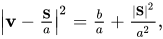
In the Euclidean plane, it is possible to give explicitly an equation of the circumcircle in terms of the Cartesian coordinates of the vertices of the inscribed triangle. Suppose that
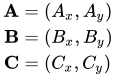
are the coordinates of points A, B, C. The circumcircle is then the locus of points in the Cartesian plane satisfying the equations

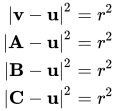
guaranteeing that the points A, B, C, v are all the same distance r from the common center of the circle. Using the polarization identity, these equations reduce to the condition that the matrix

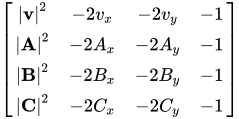
has a nonzero kernel. Thus the circumcircle may alternatively be described as the locus of zeros of the determinant of this matrix:
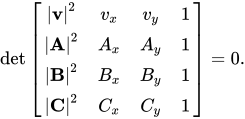
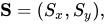
Using cofactor expansion, let

we then have where and – assuming the three points were not in a line (otherwise the circumcircle is that line that can also be seen as a generalized circle with S at infinity) – giving the circumcenter and the circumradius A similar approach allows one to deduce the equation of the circumsphere of a tetrahedron.

Parametric equation

[edit]

A unit vector perpendicular to the plane containing the circle is given by
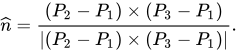
Hence, given the radius, r, center, Pc, a point on the circle, P0 and a unit normal of the plane containing the circle, one parametric equation of the circle starting from the point P0 and proceeding in a positively oriented (i.e., right-handed) sense about is the following:

Trilinear and barycentric coordinates

[edit]

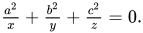
An equation for the circumcircle in trilinear coordinates x : y : z is[1] An equation for the circumcircle in barycentric coordinates x : y : z is
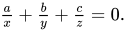
The isogonal conjugate of the circumcircle is the line at infinity, given in trilinear coordinates by and in barycentric coordinates by


Higher dimensions

[edit]

Additionally, the circumcircle of a triangle embedded in three dimensions can be found using a generalized method. Let A, B, C be three-dimensional points, which form the vertices of a triangle. We start by transposing the system to place C at the origin:
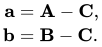
The circumradius r is then

where θ is the interior angle between a and b. The circumcenter, p0, is given by

This formula only works in three dimensions as the cross product is not defined in other dimensions, but it can be generalized to the other dimensions by replacing the cross products with following identities:

This gives us the following equation for the circumradius r:

and the following equation for the circumcenter p0:

which can be simplified to:

Circumcenter coordinates

[edit]

Cartesian coordinates

[edit]

The Cartesian coordinates of the circumcenter are
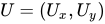
with

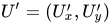
Without loss of generality this can be expressed in a simplified form after translation of the vertex A to the origin of the Cartesian coordinate systems, i.e., when In this case, the coordinates of the vertices and represent the vectors from vertex A' to these vertices. Observe that this trivial translation is possible for all triangles, and the coordinates of the circumcenter of the triangle A'B'C' follow as

with

Due to the translation of vertex A to the origin, the circumradius r can be computed as

and the actual circumcenter of ABC follows as

Trilinear coordinates

[edit]

The circumcenter has trilinear coordinates[2]

where α, β, γ are the angles of the triangle.

In terms of the side lengths a, b, c, the trilinears are[3]

Barycentric coordinates

[edit]

The circumcenter has barycentric coordinates[4]

where a, b, c are edge lengths BC, CA, AB respectively) of the triangle.

In terms of the triangle's angles α, β, γ, the barycentric coordinates of the circumcenter are[3]

Circumcenter vector

[edit]

Since the Cartesian coordinates of any point are a weighted average of those of the vertices, with the weights being the point's barycentric coordinates normalized to sum to unity, the circumcenter vector can be written as

Here U is the vector of the circumcenter and A, B, C are the vertex vectors. The divisor here equals 16S 2 where S is the area of the triangle. As stated previously

Cartesian coordinates from cross- and dot-products

[edit]

In Euclidean space, there is a unique circle passing through any given three non-collinear points P1, P2, P3. Using Cartesian coordinates to represent these points as spatial vectors, it is possible to use the dot product and cross product to calculate the radius and center of the circle. Let
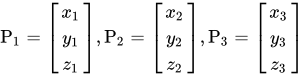
Then the radius of the circle is given by

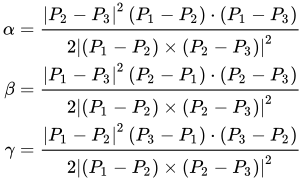
The center of the circle is given by the linear combination

where
Triangle centers on the circumcircle

[edit]

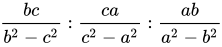
In this section, the vertex angles are labeled A, B, C and all coordinates are trilinear coordinates:

  • Steiner point: the non-vertex point of intersection of the circumcircle with the Steiner ellipse.
(The Steiner ellipse, with center = centroid (ABC), is the ellipse of least area that passes through A, B, C. An equation for this ellipse is .)
Other properties

[edit]

The diameter of the circumcircle, called the circumdiameter and equal to twice the circumradius, can be computed as the length of any side of the triangle divided by the sine of the opposite angle:

As a consequence of the law of sines, it does not matter which side and opposite angle are taken: the result will be the same.

The diameter of the circumcircle can also be expressed as

where a, b, c are the lengths of the sides of the triangle and is the semiperimeter. The expression above is the area of the triangle, by Heron's formula.[5] Trigonometric expressions for the diameter of the circumcircle include[6]


The triangle's nine-point circle has half the diameter of the circumcircle.

In any given triangle, the circumcenter is always collinear with the centroid and orthocenter. The line that passes through all of them is known as the Euler line.

The isogonal conjugate of the circumcenter is the orthocenter.

The useful minimum bounding circle of three points is defined either by the circumcircle (where three points are on the minimum bounding circle) or by the two points of the longest side of the triangle (where the two points define a diameter of the circle). It is common to confuse the minimum bounding circle with the circumcircle.

The circumcircle of three collinear points is the line on which the three points lie, often referred to as a circle of infinite radius. Nearly collinear points often lead to numerical instability in computation of the circumcircle.

Circumcircles of triangles have an intimate relationship with the Delaunay triangulation of a set of points.

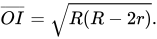
By Euler's theorem in geometry, the distance between the circumcenter O and the incenter I is
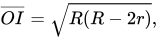
where r is the incircle radius and R is the circumcircle radius; hence the circumradius is at least twice the inradius (Euler's triangle inequality), with equality only in the equilateral case.[7][8]

The distance between O and the orthocenter H is[9][10]

For centroid G and nine-point center N we have
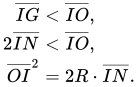
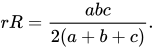
The product of the incircle radius and the circumcircle radius of a triangle with sides a, b, c is[11]
With circumradius R, sides a, b, c, and medians ma, mb, mc, we have[12]

If median m, altitude h, and internal bisector t all emanate from the same vertex of a triangle with circumradius R, then[13]

Carnot's theorem states that the sum of the distances from the circumcenter to the three sides equals the sum of the circumradius and the inradius.[14] Here a segment's length is considered to be negative if and only if the segment lies entirely outside the triangle.

If a triangle has two particular circles as its circumcircle and incircle, there exist an infinite number of other triangles with the same circumcircle and incircle, with any point on the circumcircle as a vertex. (This is the n = 3 case of Poncelet's porism). A necessary and sufficient condition for such triangles to exist is the above equality [15]
Cyclic polygons

[edit]
Cyclic quadrilaterals

A set of points lying on the same circle are called concyclic, and a polygon whose vertices are concyclic is called a cyclic polygon. Every triangle is concyclic, but polygons with more than three sides are not in general.

Cyclic polygons, especially four-sided cyclic quadrilaterals, have various special properties. In particular, the opposite angles of a cyclic quadrilateral are supplementary angles (adding up to 180° or π radians).

See also

[edit]

References

[edit]
[edit]
Revisions and contributorsEdit on WikipediaRead on Wikipedia
from Grokipedia
In geometry, the circumcircle of a triangle is the unique circle that passes through all three vertices of the triangle.[1] Its center, known as the circumcenter, is the point equidistant from all vertices and lies at the intersection of the perpendicular bisectors of the triangle's sides.[1] The radius of this circle, called the circumradius and denoted by R, measures the distance from the circumcenter to any vertex.[2] The existence and uniqueness of the circumcircle for any triangle were established in ancient Greek geometry, specifically in Proposition 5 of Book IV of Euclid's Elements, which provides a construction using the perpendicular bisectors to locate the circumcenter and draw the circle. Key properties include the fact that the circumcenter's position relative to the triangle varies: it lies inside acute triangles, on the hypotenuse of right triangles, and outside obtuse triangles.[3] Additionally, the circumcircle plays a central role in triangle theorems, such as the extended law of sines, which states that for a triangle with sides a, b, c opposite angles A, B, C respectively, $ a / \sin A = b / \sin B = c / \sin C = 2R $. Notable applications of the circumcircle extend to cyclic polygons, where all vertices lie on the circle, enabling properties such as opposite angles in cyclic quadrilaterals summing to 180 degrees.[4] It also underlies advanced concepts, such as the empty circumcircle property in Delaunay triangulations, in which the circumcircle of every triangle contains no other points in its interior.[5] The circumradius formula $ R = \frac{abc}{4K} $, where K is the triangle's area, further quantifies its size based on side lengths and area.[2] For a triangle with sides $ a=7 $, $ b=8 $, $ c=9 $, the semi-perimeter $ s = (7+8+9)/2 = 12 $, the area $ K = \sqrt{12(12-7)(12-8)(12-9)} = \sqrt{12 \times 5 \times 4 \times 3} = \sqrt{720} = 12\sqrt{5} $, and thus $ R = \frac{7 \times 8 \times 9}{4 \times 12\sqrt{5}} = \frac{504}{48\sqrt{5}} = \frac{21\sqrt{5}}{10} $ (approximately 4.696).

Fundamentals

Definition

In geometry, the circumcircle of a triangle is defined as the unique circle that passes through all three vertices of the triangle.[6] This circle is said to circumscribe the triangle, or equivalently, the triangle is inscribed within the circle.[7] The center of the circumcircle is known as the circumcenter, which is the point equidistant from all three vertices.[8] The distance from the circumcenter to any vertex is the circumradius, representing the radius of the circumcircle.[9] Visually, the inscribed triangle divides the circumcircle into three arcs, each corresponding to the segment between two vertices, with the sides of the triangle serving as chords of the circle.[10] The concept of the circumcircle originates in ancient Greek geometry, where Euclid described its construction in his Elements, Book IV, Proposition 5, around 300 BCE.[8] In contrast, the incircle of a triangle is the circle tangent to all three sides.

Existence and Uniqueness

The existence of a circumcircle for a triangle relies on the fundamental assumption that the triangle is non-degenerate, meaning its three vertices are not collinear. In Euclidean geometry, any three non-collinear points in the plane determine a unique circle that passes through all three, which serves as the circumcircle of the triangle formed by those points.[11] To establish existence, consider the perpendicular bisectors of the triangle's sides—these are lines perpendicular to each side at its midpoint. The intersection of any two such bisectors yields a point equidistant from all three vertices, forming the center of a circle that passes through them. This point lies on the third bisector as well, confirming the circle's validity for the entire triangle.[12][11] Uniqueness follows directly from the geometric property that only one point in the plane can be equidistant from three given non-collinear points. If another circle existed with a different center equidistant from the vertices, it would contradict the sole intersection of the perpendicular bisectors, as proven by assuming a second center and showing it must coincide with the first.[11][12] In degenerate cases, such as three collinear points, no circumcircle exists because no finite circle can pass through all three without violating the non-collinear requirement; the perpendicular bisectors would be parallel or coincident, failing to intersect at a single point. For an equilateral triangle, the circumcenter coincides with the centroid, reinforcing the theorem's applicability across all non-degenerate configurations.[12]

Constructions

Straightedge and Compass Construction

The straightedge and compass construction of the circumcircle for a given triangle ABC proceeds by first locating the circumcenter, the point equidistant from all three vertices, through the intersection of perpendicular bisectors. Begin by drawing the triangle using the straightedge. Then, construct the perpendicular bisector of at least two sides, say AB and BC. To construct the perpendicular bisector of AB, place the compass point at A and draw an arc with radius greater than half of AB; repeat from B with the same radius to intersect the previous arc at two points, then connect these points with the straightedge to form the bisector line. Repeat the process for side BC. The intersection of these two bisectors is the circumcenter O. Finally, place the compass point at O with radius equal to the distance from O to any vertex, such as A, and draw the circle, which passes through A, B, and C.[13] This method works because the perpendicular bisector of a side, such as AB, is the locus of all points equidistant from A and B, as any point on the bisector forms congruent right triangles with the endpoints by the SAS congruence criterion. Thus, the intersection O of two such bisectors is equidistant from A and B (from the first bisector) and from B and C (from the second), and by extension equidistant from A and C, ensuring the circle centered at O with radius OA passes through all vertices. The construction adheres strictly to Euclidean tools: an unmarked straightedge for drawing lines between existing points and a collapsible compass for transferring distances without numerical measurement, limiting operations to intersections of lines and circles.[13] A common pitfall arises in obtuse triangles, where the circumcenter lies outside the triangle, potentially making the bisectors' intersection harder to locate accurately if arcs are not drawn with sufficient radius or if the external position is overlooked, leading to imprecise vertex-to-center distances.[14]

Alternative Constructions

One efficient geometric method to locate the circumcenter involves constructing only two perpendicular bisectors of the triangle's sides, as their intersection determines the center; the third bisector serves merely for verification and is unnecessary for the construction itself.[13] This approach reduces steps compared to drawing all three, while preserving the standard straightedge and compass tools.[15] In special cases, such as equilateral triangles, the circumcenter coincides with the incenter, allowing the use of angle bisectors alongside or instead of perpendicular bisectors for efficiency, since the angle bisector from any vertex passes through the midpoint of the opposite side and the circumcenter.[16] An alternative to the straightedge and compass method is the compass-only construction, enabled by the Mohr-Mascheroni theorem, which states that any Euclidean construction achievable with both tools can be performed using a compass alone.[17] To construct the circumcircle this way, first use intersecting circles to find midpoints of the sides (simulating perpendicular bisectors via circle inversions and intersections), then locate their concurrency point as the center, and finally draw the circle with radius equal to the distance from the center to a vertex—all without straight lines.[18] This pure geometric approach highlights the theorem's power for theoretical or constrained settings, such as when a straightedge is unavailable. Historically, Euclid provided the foundational construction in his Elements (Book IV, Proposition 5), where the circumcircle is obtained by erecting perpendicular bisectors at the midpoints of two sides (found via equal-radius circles centered at endpoints) and drawing the circle through the vertices from their intersection.[8] This method, dating to around 300 BCE, remains the seminal ancient technique and differs subtly from modern presentations by integrating midpoint constructions explicitly. For special cases involving advanced figures, the Simson line—formed by the feet of perpendiculars from a point on the circumcircle to the triangle's sides—can aid verification or reconstruction in configurations where the point is known, though it is not a primary construction tool.[19] In modern computational geometry, software like GeoGebra approximates the circumcircle by solving for the perpendicular bisector intersections algebraically from vertex coordinates, offering rapid visualization but diverging from classical geometric purity.

Geometric Location

Position Relative to the Triangle

The position of the circumcenter, defined as the center of the circle passing through all three vertices of a triangle, varies depending on the triangle's angle measures.[20] In an acute triangle, where all angles are less than 90 degrees, the circumcenter lies inside the triangle, typically near the centroid due to the balanced distribution of perpendicular bisectors.[20][21] This internal placement ensures the circumcircle encompasses the triangle without extending beyond its boundaries in a way that displaces the center outward. For a right triangle, with one angle exactly 90 degrees, the circumcenter is located at the midpoint of the hypotenuse, positioning it on the boundary of the triangle rather than inside or outside.[20][22] This specific location arises because the hypotenuse serves as the diameter of the circumcircle, as established by the theorem that an angle inscribed in a semicircle is a right angle. In an obtuse triangle, featuring one angle greater than 90 degrees, the circumcenter resides outside the triangle, generally on the side opposite the obtuse angle, where the extension of the perpendicular bisectors intersects beyond the vertices.[20][21] This external position reflects the elongated geometry caused by the large angle, pulling the center away from the triangle's interior. A special case occurs in equilateral triangles, where all angles are 60 degrees; here, the circumcenter coincides exactly with the centroid, orthocenter, and incenter at the triangle's geometric center, owing to the high degree of symmetry.[23] Diagrams illustrating these positions typically depict the triangle with its perpendicular bisectors drawn as dashed lines converging at the circumcenter: for acute triangles, the intersection is centrally within the shaded interior; for right triangles, it marks the midpoint on the hypotenuse with the circle's diameter aligned; for obtuse triangles, the point lies externally near the acute angles' extension; and for equilateral, a single central point surrounded by symmetric bisectors.[20][22]

Circumradius and Circumcenter

The circumcenter $ O $ of a triangle is the point of intersection of the perpendicular bisectors of its sides, serving as the center of the circumcircle that passes through all three vertices.[20] The circumradius $ R $, denoted as the radius of this circumcircle, is the constant distance from the circumcenter to each vertex, ensuring all vertices lie equidistant on the circle's circumference.[2] A fundamental geometric relation for the circumradius in a triangle with side length $ a $ opposite angle $ A $ is given by
R=a2sinA. R = \frac{a}{2 \sin A}.
This formula highlights the direct proportionality between the side length and the radius, modulated by the sine of the opposite angle.[2] Consequently, for a fixed side length a, R is minimized when angle A = 90°, with R = a/2, and increases as A deviates from 90° in either direction (toward more acute or more obtuse), reflecting the circle's adjustment to encompass the vertices.[2] Key properties of the circumcenter and circumradius include the equidistance of vertices from $ O $, which defines the circle uniquely.[20] Additionally, if one side of the triangle serves as the diameter of the circumcircle, the angle subtended at the opposite vertex is a right angle, as per Thales' theorem, which states that an inscribed angle in a semicircle measures 90 degrees.[24] In obtuse triangles, where the circumcenter lies outside the triangle, the circumradius tends to be larger compared to acute triangles of similar side lengths, due to the extended positioning required to pass through all vertices.[1] This relation underscores how the circumradius provides insight into the triangle's angular configuration and overall scale relative to its area.[2]

Angular Properties

Inscribed Angles

An inscribed angle is formed by two chords sharing a common endpoint on the circumference of a circle, with the angle subtending a specific arc between the other two endpoints. The inscribed angle theorem states that the measure of such an angle is half the measure of the central angle that subtends the same arc.[25] This relationship holds because the central angle encompasses the full arc, while the inscribed angle views it from the periphery.[26] In the context of a triangle inscribed in its circumcircle, each interior angle at a vertex serves as an inscribed angle subtending the arc formed by the opposite side. Thus, the measure of each triangle angle is half the measure of the arc opposite to it on the circumcircle.[26] For example, in triangle $ \triangle ABC $ with circumcircle centered at $ O $, the angle at vertex $ A $ subtends arc $ BC $, so $ \angle BAC = \frac{1}{2} $ (measure of arc $ BC $). Similarly, $ \angle ABC = \frac{1}{2} $ (arc $ AC $) and $ \angle ACB = \frac{1}{2} $ (arc $ AB $).[25] This property directly links the triangle's angular measures to the geometry of its circumcircle. A standard proof of the inscribed angle theorem relies on properties of isosceles triangles. Consider points $ A $, $ B $, and $ C $ on the circle with center $ O $, where $ \angle ABC $ is the inscribed angle subtending arc $ AC $ (assuming $ B $ is on the major arc for the minor arc $ AC $). Draw radii $ OA $, $ OB $, and $ OC $, each equal in length. Triangles $ \triangle OAB $ and $ \triangle OCB $ are isosceles, so their base angles are equal: let $ \angle OAB = \angle OBA = \alpha $ in $ \triangle OAB $, and $ \angle OCB = \angle OBC = \beta $ in $ \triangle OCB $. The inscribed angle $ \angle ABC = \alpha + \beta $. The central angles are $ \angle AOB = 180^\circ - 2\alpha $ and $ \angle COB = 180^\circ - 2\beta $, so their sum $ \angle AOB + \angle COB = 360^\circ - 2(\alpha + \beta) $, which equals the major arc from $ A $ to $ C $ via $ B $. Thus, the minor central angle $ \angle AOC = 360^\circ - (\angle AOB + \angle COB) = 2(\alpha + \beta) = 2 \angle ABC $.[27]

Central Angles and Arcs

In the context of a triangle's circumcircle, a central angle is formed by two radii connecting the circumcenter OO to two vertices of the triangle, subtending the arc between those vertices on the circumcircle. The measure of this central angle is equal to the measure of the arc it subtends, providing a direct way to quantify portions of the circle.[26] For a triangle ABCABC with circumcenter OO, the central angle BOC\angle BOC subtended by side BCBC (opposite vertex AA) measures twice the inscribed angle BAC\angle BAC at vertex AA, as established by the inscribed angle theorem. This relationship holds because both angles intercept the same arc BCBC, with the central angle capturing the full arc measure while the inscribed angle captures half. Thus, BOC=2A\angle BOC = 2\angle A, and similarly for the other central angles COA=2B\angle COA = 2\angle B and AOB=2C\angle AOB = 2\angle C. The sum of these central angles is 2(A+B+C)=3602(\angle A + \angle B + \angle C) = 360^\circ, confirming that the arcs between the vertices partition the full circumcircle.[28][26] The arcs between the vertices exhibit properties tied to the triangle's geometry: the intercepted arc BCBC (subtended by A\angle A, not containing AA) has measure 2A2\angle A; the other arc BCBC (containing AA) has measure 3602A360^\circ - 2\angle A. The intercepted arc is minor if A<90\angle A < 90^\circ, major if A>90\angle A > 90^\circ. The three intercepted arcs sum to 360360^\circ. These arc measures facilitate applications in circle theorems and trigonometric identities within the triangle.[26] A key theorem linking central angles, sides, and the circumradius RR is the extended law of sines, stated as asinA=bsinB=csinC=2R\frac{a}{\sin A} = \frac{b}{\sin B} = \frac{c}{\sin C} = 2R, where a,b,ca, b, c are the sides opposite angles A,B,CA, B, C. To derive R=a2sinAR = \frac{a}{2 \sin A}, consider isosceles triangle AOBAOB where OA=OB=ROA = OB = R and base AB=cAB = c. The central angle AOB=2C\angle AOB = 2\angle C, so dropping a perpendicular from OO to ABAB at midpoint MM bisects AOB\angle AOB into two angles of C\angle C and AM=c2AM = \frac{c}{2}. In right triangle AOMAOM, sinC=AMOA=c/2R\sin C = \frac{AM}{OA} = \frac{c/2}{R}, yielding R=c2sinCR = \frac{c}{2 \sin C}. Cyclic permutation gives the full form, establishing the diameter 2R2R as the constant ratio in the law of sines. This derivation applies to acute, right, and obtuse triangles, with adjustments for obtuse angles using supplementary properties in the cyclic quadrilateral formed by the diameter.[29][26][28]

Equations

Cartesian Coordinates

The circumcenter O(x,y)O(x, y) of a triangle with vertices A(xa,ya)A(x_a, y_a), B(xb,yb)B(x_b, y_b), and C(xc,yc)C(x_c, y_c) in the Cartesian plane is the unique point equidistant from all three vertices, serving as the center of the circumcircle. To derive its coordinates, set the squared distances equal: OA2=OB2OA^2 = OB^2 and OB2=OC2OB^2 = OC^2. This yields the linear equations
2x(xbxa)+2y(ybya)=xb2+yb2xa2ya2, 2x(x_b - x_a) + 2y(y_b - y_a) = x_b^2 + y_b^2 - x_a^2 - y_a^2,
2x(xcxb)+2y(ycyb)=xc2+yc2xb2yb2. 2x(x_c - x_b) + 2y(y_c - y_b) = x_c^2 + y_c^2 - x_b^2 - y_b^2.
Solving this 2×2 system via Cramer's rule or matrix inversion produces the explicit coordinates of OO.[30] The closed-form expressions are
x=(xa2+ya2)(ybyc)+(xb2+yb2)(ycya)+(xc2+yc2)(yayb)D,y=(xa2+ya2)(xcxb)+(xb2+yb2)(xaxc)+(xc2+yc2)(xbxa)D, \begin{align*} x &= \frac{(x_a^2 + y_a^2)(y_b - y_c) + (x_b^2 + y_b^2)(y_c - y_a) + (x_c^2 + y_c^2)(y_a - y_b)}{D}, \\ y &= \frac{(x_a^2 + y_a^2)(x_c - x_b) + (x_b^2 + y_b^2)(x_a - x_c) + (x_c^2 + y_c^2)(x_b - x_a)}{D}, \end{align*}
where D=2[xa(ybyc)+xb(ycya)+xc(yayb)]=4×D = 2[x_a(y_b - y_c) + x_b(y_c - y_a) + x_c(y_a - y_b)] = 4 \times (signed area of ABC\triangle ABC). These formulas arise directly from expanding and solving the perpendicular bisector intersections in coordinate form, avoiding trigonometric functions.[30] For illustration, consider ABC\triangle ABC with A(0,0)A(0,0), B(4,0)B(4,0), C(0,3)C(0,3). Compute D=2[0(03)+4(30)+0(00)]=24D = 2[0(0-3) + 4(3-0) + 0(0-0)] = 24. Then,
x=(0+0)(03)+(16+0)(30)+(0+9)(00)24=4824=2, x = \frac{(0+0)(0-3) + (16+0)(3-0) + (0+9)(0-0)}{24} = \frac{48}{24} = 2,
y=(0+0)(04)+(16+0)(00)+(0+9)(40)24=3624=1.5. y = \frac{(0+0)(0-4) + (16+0)(0-0) + (0+9)(4-0)}{24} = \frac{36}{24} = 1.5.
Thus, O=(2,1.5)O = (2, 1.5), which matches the midpoint of hypotenuse BCBC since ABC\triangle ABC is right-angled at AA. This example confirms the formula's accuracy for a standard case.[30] Numerical implementation of these formulas requires caution, as DD approaches zero for nearly collinear points, causing division by a small number and magnifying rounding errors in floating-point computations. Such instability is well-documented in geometric algorithms, where degenerate or near-degenerate triangles demand robust predicates or alternative methods like exact arithmetic.[31]

Parametric Equations

The parametric equations of the circumcircle of a triangle provide a way to describe points on the circle using a parameter θ, typically ranging from 0 to 2π, with the circle centered at the circumcenter (h, k) and radius R equal to the circumradius. These equations are given by
x(θ)=h+Rcosθ,y(θ)=k+Rsinθ. x(\theta) = h + R \cos \theta, \quad y(\theta) = k + R \sin \theta.
This form traces the entire circle as θ varies, starting from the point (h + R, k) when θ = 0 and proceeding counterclockwise.[32] The vertices of the triangle lie on this circumcircle at specific values of θ, determined by the directions from the circumcenter to each vertex. The angular separation between the parameters θ corresponding to two vertices equals the central angle subtended by the arc between them, which is twice the measure of the inscribed angle at the third vertex subtended by the same arc, according to the central angle theorem.[33] For example, if the vertices are labeled A, B, and C, one can assign θ_A, θ_B, and θ_C such that the differences θ_B - θ_A = 2∠C and similarly for the other pairs, ensuring the parametrization aligns with the triangle's geometry.[33] In computational geometry, this parametric representation offers advantages for dynamic applications, such as animating rotations around the circumcenter or interpolating points along arcs between vertices for smooth transitions in visualizations.[34] It allows efficient computation of positions at arbitrary angles without solving implicit equations, facilitating tasks like path planning or graphical rendering.[34] Equivalently, the position of a point on the circumcircle can be expressed in vector form as P(θ)=O+R(cosθ,sinθ)\mathbf{P}(\theta) = \mathbf{O} + R (\cos \theta, \sin \theta), where O=(h,k)\mathbf{O} = (h, k) is the position vector of the circumcenter. This notation is particularly useful in vector-based computations, such as those involving transformations or simulations in computer graphics.[32]

Trilinear and Barycentric Coordinates

In trilinear coordinates x:y:zx : y : z, the equation of the circumcircle of a triangle with side lengths aa, bb, cc opposite vertices AA, BB, CC respectively is given by
ayz+bzx+cxy=0. a y z + b z x + c x y = 0.
This homogeneous quadratic equation defines the locus of points on the circumcircle relative to the reference triangle, where the coordinates represent signed distances to the sides.[1][35] In barycentric coordinates α:β:γ\alpha : \beta : \gamma, which are proportional to the signed areas of the sub-triangles formed by a point and the vertices, the circumcircle equation takes the form
a2βγ+b2γα+c2αβ=0. a^2 \beta \gamma + b^2 \gamma \alpha + c^2 \alpha \beta = 0.
This representation arises naturally from the area-based nature of barycentric coordinates and is equivalent to the trilinear form under the standard transformation.[1][35] The relationship between trilinear and barycentric coordinates is given by α=ax\alpha = a x, β=by\beta = b y, γ=cz\gamma = c z, allowing direct conversion between the two systems while preserving the intrinsic geometry of the triangle.[36] These coordinate systems offer advantages in triangle geometry, as their equations depend solely on the side lengths a,b,ca, b, c and are independent of any external Cartesian embedding, facilitating computations invariant under similarity transformations.[37]

Higher Dimensions

In higher dimensions, the concept of the circumcircle generalizes to the circumhypersphere of an n-simplex, which is the unique (n-1)-sphere passing through all n+1 vertices of the simplex in n-dimensional Euclidean space.[38] This hypersphere, often simply called the circumsphere, serves as the higher-dimensional analogue to the circumcircle of a triangle, with its center known as the circumcenter.[39] The circumcenter of an n-simplex with vertices $ \mathbf{v}_0, \mathbf{v}_1, \dots, \mathbf{v}_n $ is the point $ \mathbf{C} $ equidistant from all vertices, satisfying $ |\mathbf{C} - \mathbf{v}_i| = r $ for all $ i $, where $ r $ is the circumradius. This condition leads to a system of equations derived from the perpendicular bisector hyperplanes of the edges: for $ 1 \leq i \leq n $,
(viv0)(Cv0)=12viv02. (\mathbf{v}_i - \mathbf{v}_0) \cdot (\mathbf{C} - \mathbf{v}_0) = \frac{1}{2} \|\mathbf{v}_i - \mathbf{v}_0\|^2.
In matrix form, this is $ M (\mathbf{C} - \mathbf{v}_0) = \mathbf{b} $, where $ M $ is the $ n \times n $ matrix with rows $ \mathbf{v}_i - \mathbf{v}_0 $ and $ \mathbf{b} $ has entries $ \frac{1}{2} |\mathbf{v}_i - \mathbf{v}_0|^2 $; solving yields $ \mathbf{C} = \mathbf{v}_0 + M^{-1} \mathbf{b} $, assuming $ M $ is invertible.[38] For non-degenerate simplices, where the vertices are affinely independent, the circumhypersphere exists and is unique, as the perpendicular bisector hyperplanes intersect at a single point. The circumradius $ r $ can be computed as $ r = |\mathbf{C} - \mathbf{v}_0| $, or more directly via determinant-based formulas involving the Cayley-Menger matrix of squared edge lengths, such as those using the inner Cayley-Menger determinant for the general n-dimensional case.[39] In computational geometry, circumspheres of simplices, particularly tetrahedra in 3D, are essential for algorithms like Delaunay triangulation and Voronoi diagrams, where they determine empty sphere criteria for mesh generation and proximity computations.[38]

Circumcenter Coordinates

Cartesian Coordinates

The circumcenter O(x,y)O(x, y) of a triangle with vertices A(xa,ya)A(x_a, y_a), B(xb,yb)B(x_b, y_b), and C(xc,yc)C(x_c, y_c) in the Cartesian plane is the unique point equidistant from all three vertices, serving as the center of the circumcircle. To derive its coordinates, set the squared distances equal: OA2=OB2OA^2 = OB^2 and OB2=OC2OB^2 = OC^2. This yields the linear equations
2x(xbxa)+2y(ybya)=xb2+yb2xa2ya2, 2x(x_b - x_a) + 2y(y_b - y_a) = x_b^2 + y_b^2 - x_a^2 - y_a^2,
2x(xcxb)+2y(ycyb)=xc2+yc2xb2yb2. 2x(x_c - x_b) + 2y(y_c - y_b) = x_c^2 + y_c^2 - x_b^2 - y_b^2.
Solving this 2×2 system via Cramer's rule or matrix inversion produces the explicit coordinates of OO.[40] The closed-form expressions are
x=(xa2+ya2)(ybyc)+(xb2+yb2)(ycya)+(xc2+yc2)(yayb)D,y=(xa2+ya2)(xcxb)+(xb2+yb2)(xaxc)+(xc2+yc2)(xbxa)D, \begin{align*} x &= \frac{(x_a^2 + y_a^2)(y_b - y_c) + (x_b^2 + y_b^2)(y_c - y_a) + (x_c^2 + y_c^2)(y_a - y_b)}{D}, \\ y &= \frac{(x_a^2 + y_a^2)(x_c - x_b) + (x_b^2 + y_b^2)(x_a - x_c) + (x_c^2 + y_c^2)(x_b - x_a)}{D}, \end{align*}
where D=2[xa(ybyc)+xb(ycya)+xc(yayb)]=4×D = 2[x_a(y_b - y_c) + x_b(y_c - y_a) + x_c(y_a - y_b)] = 4 \times (signed area of ABC\triangle ABC). These formulas arise directly from expanding and solving the perpendicular bisector intersections in coordinate form, avoiding trigonometric functions.[40] For illustration, consider ABC\triangle ABC with A(0,0)A(0,0), B(4,0)B(4,0), C(0,3)C(0,3). Compute D=2[0(03)+4(30)+0(00)]=24D = 2[0(0-3) + 4(3-0) + 0(0-0)] = 24. Then,
x=(0+0)(03)+(16+0)(30)+(0+9)(00)24=4824=2, x = \frac{(0+0)(0-3) + (16+0)(3-0) + (0+9)(0-0)}{24} = \frac{48}{24} = 2,
y=(0+0)(04)+(16+0)(00)+(0+9)(40)24=3624=1.5. y = \frac{(0+0)(0-4) + (16+0)(0-0) + (0+9)(4-0)}{24} = \frac{36}{24} = 1.5.
Thus, O=(2,1.5)O = (2, 1.5), which matches the midpoint of hypotenuse BCBC since ABC\triangle ABC is right-angled at AA. This example confirms the formula's accuracy for a standard case.[40] Numerical implementation of these formulas requires caution, as DD approaches zero for nearly collinear points, causing division by a small number and magnifying rounding errors in floating-point computations. Such instability is well-documented in geometric algorithms, where degenerate or near-degenerate triangles demand robust predicates or alternative methods like exact arithmetic.[31]

Trilinear Coordinates

In trilinear coordinates, the circumcenter OO of a triangle ABCABC with side lengths a=BCa = BC, b=ACb = AC, c=ABc = AB, and angles AA, BB, CC opposite these sides respectively, is given by the homogeneous coordinates cosA:cosB:cosC\cos A : \cos B : \cos C.[20][41] These coordinates represent the ratios of the signed perpendicular distances from OO to the sides of the triangle.[42] The derivation arises from the geometric properties of the circumcircle. The perpendicular distance from OO to side BCBC (opposite vertex AA) is RcosAR \cos A, where RR is the circumradius, because the projection of the radius OBOB (or OCOC) onto the perpendicular to BCBC yields this value via the angle at AA.[42] Similarly, the distances to sides ACAC and ABAB are RcosBR \cos B and RcosCR \cos C. Since trilinear coordinates are homogeneous, the common factor RR cancels, resulting in cosA:cosB:cosC\cos A : \cos B : \cos C.[20] For acute triangles, all cosines are positive, placing OO inside the triangle; in obtuse triangles, the negative cosine for the obtuse angle indicates a signed distance outside.[42] The "exact" or actual-distance trilinear coordinates, which specify the absolute signed distances rather than ratios, are RcosA:RcosB:RcosCR \cos A : R \cos B : R \cos C.[20] Normalization may vary by context: the homogeneous form is scale-invariant and preferred for barycentric conversions or cevian computations, while normalized forms (e.g., dividing by the sum cosA+cosB+cosC\cos A + \cos B + \cos C) are used when areal interpretations are needed.[41] These coordinates remain invariant under similarity transformations, emphasizing their utility in triangle geometry relative to the sides.[42]

Barycentric Coordinates

In a triangle with side lengths aa, bb, and cc opposite vertices AA, BB, and CC respectively, the homogeneous barycentric coordinates of the circumcenter OO are given by
(a2(b2+c2a2):b2(c2+a2b2):c2(a2+b2c2)). (a^2 (b^2 + c^2 - a^2) : b^2 (c^2 + a^2 - b^2) : c^2 (a^2 + b^2 - c^2)).
[http://www.journal-1.eu/2016-2/Grozdev-Dekov-Barycentric-Coordinates-pp.75-82.pdf] These coordinates reflect the weighted areas associated with the vertices, where the weights incorporate the geometry of the perpendicular bisectors intersecting at OO.[https://mathwo.github.io/assets/files/barycentric/introduction_to_the_geometry_of_the_triangle.pdf] An equivalent trigonometric form expresses the coordinates as (sin2A:sin2B:sin2C)(\sin 2A : \sin 2B : \sin 2C), leveraging the law of sines and double-angle identities to relate side lengths to angles.[https://web.evanchen.cc/handouts/bary/bary-full.pdf] This form arises because acosA=2RsinAcosA=Rsin2Aa \cos A = 2R \sin A \cos A = R \sin 2A, where RR is the circumradius, linking the barycentric weights directly to angular measures at the vertices.[https://mathwo.github.io/assets/files/barycentric/introduction_to_the_geometry_of_the_triangle.pdf] The derivation of these coordinates can proceed via area proportions: the areas of triangles OBCOBC, OCAOCA, and OABOAB are proportional to sinAcosA:sinBcosB:sinCcosC\sin A \cos A : \sin B \cos B : \sin C \cos C, which simplifies to the sin2A\sin 2A form after accounting for the twice-area factor 2Δ=bcsinA2\Delta = bc \sin A.[43] Alternatively, since OO is the isogonal conjugate of the orthocenter HH (with barycentric coordinates (tanA:tanB:tanC)(\tan A : \tan B : \tan C)), applying the isogonal map (x:y:z)(a2/x:b2/y:c2/z)(x : y : z) \mapsto (a^2 / x : b^2 / y : c^2 / z) yields the side-length formula for OO.[43] In absolute (normalized) barycentric coordinates, these weights sum to 1, providing the position vector O=αA+βB+γC\mathbf{O} = \alpha \mathbf{A} + \beta \mathbf{B} + \gamma \mathbf{C} with α+β+γ=1\alpha + \beta + \gamma = 1.[44] The circumcenter OO lies on the Euler line, collinear with the centroid GG (coordinates 1:1:11:1:1) and orthocenter HH, such that GG divides the segment OHOH in the ratio OG:GH=1:2OG : GH = 1 : 2.[43] Unlike the centroid, which equally weights the vertices as the balance point of uniform masses, the circumcenter's coordinates vary with side lengths or angles, emphasizing its role as the equidistant center from the vertices rather than a mass average.[43] Barycentric coordinates differ from the dual trilinear system by using area-based weights instead of distances to sides.[44]

Vector and Product Formulations

The circumcenter O\mathbf{O} of a triangle with vertices at position vectors A\mathbf{A}, B\mathbf{B}, and C\mathbf{C} can be determined using vector algebra by leveraging the equidistance property OA=OB=OC|\mathbf{O} - \mathbf{A}| = |\mathbf{O} - \mathbf{B}| = |\mathbf{O} - \mathbf{C}|. Expanding OA2=OB2|\mathbf{O} - \mathbf{A}|^2 = |\mathbf{O} - \mathbf{B}|^2 yields the equation 2O(AB)=A2B22\mathbf{O} \cdot (\mathbf{A} - \mathbf{B}) = |\mathbf{A}|^2 - |\mathbf{B}|^2, where \cdot denotes the dot product and 2|\cdot|^2 is the squared magnitude. Similar equations follow from the other vertex pairs: 2O(BC)=B2C22\mathbf{O} \cdot (\mathbf{B} - \mathbf{C}) = |\mathbf{B}|^2 - |\mathbf{C}|^2 and 2O(CA)=C2A22\mathbf{O} \cdot (\mathbf{C} - \mathbf{A}) = |\mathbf{C}|^2 - |\mathbf{A}|^2. These form a linear system that can be solved for O\mathbf{O} in the plane of the triangle, providing a direct method to compute the position without explicit coordinate solving.[45] A closed-form vector expression for the circumcenter is given by
O=A2(BC)+B2(CA)+C2(AB)2(A×B+B×C+C×A), \mathbf{O} = \frac{|\mathbf{A}|^2 (\mathbf{B} - \mathbf{C}) + |\mathbf{B}|^2 (\mathbf{C} - \mathbf{A}) + |\mathbf{C}|^2 (\mathbf{A} - \mathbf{B})}{2 (\mathbf{A} \times \mathbf{B} + \mathbf{B} \times \mathbf{C} + \mathbf{C} \times \mathbf{A})},
where ×\times represents the cross product (a scalar in 2D via the determinant AxByAyBxA_x B_y - A_y B_x, or a vector perpendicular to the plane in 3D for coplanar points). This formula arises from combining the perpendicular bisector conditions in vector form and is applicable in both 2D and 3D settings for planar triangles. In 2D, the cross products serve as oriented areas, with the denominator equaling twice the signed area of the triangle multiplied by 2.[46] These vector and product formulations offer computational efficiency, particularly in programming and physics simulations, as dot and cross products are primitive operations in linear algebra libraries, enabling robust numerical implementation with reduced risk of division by zero through area checks. For instance, in graphics engines, this approach facilitates real-time computation of circumcircles for mesh processing or collision detection.[47]

Special Points

Triangle Centers on the Circumcircle

The three vertices of a triangle are the fundamental triangle centers located on its circumcircle, as the circumcircle is defined as the unique circle passing through all three vertices. These points serve as the foundational anchors for the circle's geometry and are essential for defining other properties, such as the circumradius R=a/(2sinA)R = a / (2 \sin A), where aa is the side opposite angle AA.[1] The reflections of the orthocenter HH (X(4) in the Encyclopedia of Triangle Centers) over the triangle's sides lie on the circumcircle for any triangle, a property arising from the symmetries of the orthocentric system. Specifically, the reflection of HH over side BCBC coincides with the second intersection of the altitude from AA with the circumcircle. These points satisfy key properties, including forming 90-degree arcs with the vertices and serving as centers for certain spiral similarities mapping the triangle to itself.[48] Another notable example is the Tarry point (X(98) in the Encyclopedia of Triangle Centers), which lies on the circumcircle and represents the point diametrically opposite to the Steiner point (X(99)) on that circle. The Tarry point is the intersection of the lines joining each vertex to the opposite Steiner point in the tangential triangle and exhibits properties related to Brocard geometry, such as being the perspector for the reference triangle and its circumcevian triangle. It satisfies trigonometric conditions like barycentric coordinates sec(A+ω):sec(B+ω):sec(C+ω)\sec(A + \omega) : \sec(B + \omega) : \sec(C + \omega), where ω\omega is the Brocard angle. The Encyclopedia of Triangle Centers, maintained by Clark Kimberling and updated regularly since the early 2000s, catalogs thousands of such points on the circumcircle. As of 2025, it lists over 68,000 triangle centers, many of which lie on the circumcircle, including intersections with conics like the Jerabek hyperbola (e.g., X(74)) and various Euler-related configurations. These centers often share properties involving equal angular distances or isogonal symmetries, enabling classifications based on their trilinear or barycentric coordinates. Modern extensions emphasize computational discovery of points satisfying distance or angle conditions on the circumcircle, expanding beyond classical examples like those from Euler.[37]

Intersections with Other Elements

The circumcircle of a triangle intersects each of the three sides only at the vertices, as each side forms a chord of the circle connecting two vertices.[1] Each altitude of the triangle intersects the circumcircle at the corresponding vertex and a second point. This second intersection point is the reflection of the orthocenter over the opposite side.[48] The segment joining the orthocenter to this second point is bisected by the nine-point circle.[49] In a right triangle with the right angle at vertex CC and hypotenuse ABAB, the altitude from CC to ABAB passes through the circumcenter (the midpoint of ABAB) and intersects the circumcircle again at the point diametrically opposite to CC.[50] The Euler line, which passes through the circumcenter and orthocenter, intersects the circumcircle at two points symmetric with respect to the circumcenter, located at a distance equal to the circumradius along the line from the circumcenter.[51] The nine-point circle and the circumcircle generally do not intersect, but they are related through the Euler points—the midpoints of the segments joining each vertex to the orthocenter—which lie on the nine-point circle and connect to points on the circumcircle via the altitudes.[49] The Simson line arises in connection with the circumcircle: for any point PP on the circumcircle, the feet of the perpendiculars from PP to the sides (or their extensions) are collinear, forming the Simson line. When PP is the orthocenter (which lies on the circumcircle in a right triangle), this projection degenerates into the altitude from the right-angled vertex.[52] The circumcircle intersects each excircle at two points in general, though these points lack specific geometric significance in standard triangle theory beyond the circles' relative positions determined by the excenters.

Generalizations

Cyclic Polygons

A cyclic polygon is a polygon whose vertices all lie on a single circle, called the circumcircle.[53] This property generalizes the case of triangles, where every triangle possesses a circumcircle, to polygons with n4n \geq 4 sides.[53] For such polygons, the circumcircle is unique when it exists, and the vertices are said to be concyclic. A necessary and sufficient condition for a quadrilateral to be cyclic is that the sums of its opposite interior angles each equal 180180^\circ.[54] Ptolemy's theorem provides another characterization: in a cyclic quadrilateral with side lengths a,b,c,da, b, c, d and diagonals p,qp, q, the product of the diagonals equals the sum of the products of opposite sides, pq=ac+bdpq = ac + bd.[55] For even-sided cyclic polygons more generally, the sums of alternating interior angles are equal.[56] Key properties of cyclic polygons include the inscribed angle theorem, whereby angles subtended by the same arc at the circumference are equal, leading to symmetries in angle measures across the polygon.[54] The area of a cyclic quadrilateral with side lengths a,b,c,da, b, c, d and semiperimeter s=(a+b+c+d)/2s = (a + b + c + d)/2 is given by Brahmagupta's formula:
(sa)(sb)(sc)(sd), \sqrt{(s - a)(s - b)(s - c)(s - d)},
which yields the maximum possible area for given side lengths among all quadrilaterals.[57] These properties extend to higher even nn, where conformable cyclic polygons with identical angle sequences exist infinitely many.[56] The circumcircle of a cyclic polygon can be constructed by finding the circumcenter, the point equidistant from all vertices, as the intersection of perpendicular bisectors of the sides.[58] For polygons with an even number of sides, this involves selecting bisectors from non-adjacent sides to ensure concurrency, analogous to the triangular case but requiring verification of cyclicity.[58] The perpendicular bisectors are concurrent if and only if the polygon is cyclic.[58] In computational geometry, methods for fitting circles to point sets, including those forming irregular polygons, are used in spatial analysis applications.

Extensions to Other Figures

In the context of quadrilaterals, extensions of the circumcircle concept include analogs involving the nine-point circle for tangential quadrilaterals, where the figure admits an incircle tangent to all four sides. A quadrilateral ABCD is tangential if and only if the sums of the radii of the nine-point circles of its opposite triangles (ABC and ADC, or ABD and BCD) are equal, providing a geometric condition that parallels triangle properties but adapted to the quadrilateral's tangential nature.[59] For cyclic quadrilaterals, which lie on a single circumcircle by definition, further extensions explore interactions like the concurrence of nine-point circles of the quadrilateral's triangular partitions at specific points, enhancing concurrency properties beyond triangular cases.[60] For conics and other curves, the smallest enclosing circle serves as a practical analog to the circumcircle, representing the minimal-radius circle that contains all points of the curve or set of curves. This problem, computationally significant for bounding irregular shapes, can be solved iteratively by considering the minimum enclosing circle of incrementally added curves, ensuring the final circle passes through boundary points analogous to a circumcircle's vertices.[61] Algorithms for this extension, such as those based on Welzl's method adapted for curves, achieve expected linear time complexity for planar sets, highlighting its efficiency over exhaustive searches.[62] In complex geometry, the Argand plane treats points as complex numbers, allowing the circumcircle of three non-collinear points $ z_1, z_2, z_3 $ to be defined by the equation $ |z - c| = r $, where the center $ c $ is computed via the intersection of perpendicular bisectors expressed in complex arithmetic. This formulation leverages the geometry of complex numbers to determine the circle passing through the points, with the circumradius $ r $ derived from distances in the plane.[63] Such representations facilitate algebraic manipulations of circumcircle properties, including transformations under Möbius mappings that preserve circles. Modern applications in machine learning since the 2010s utilize the circumcircle criterion of Delaunay triangulation—the empty circle property ensuring no other point lies inside a triangle's circumcircle—for tasks like spatial data analysis. In facial expression recognition, Delaunay triangulation extracts feature points via circumcircle constraints, enabling machine learning classifiers to achieve accuracies exceeding 90% on benchmark datasets.[64] In non-Euclidean geometry, particularly hyperbolic spaces, the circumcircle of a hyperbolic triangle in the Poincaré disk model appears as a Euclidean circle entirely within the unit disk, but its hyperbolic radius $ r_h $ satisfies $ \sinh(r_h) = \frac{r_e}{\sqrt{1 - r_e^2}} $, where $ r_e $ is the Euclidean radius, adapting the circumcircle to the constant negative curvature.[65] This extension preserves concyclicity for hyperbolic polygons while altering metric properties, as explored in cyclic configurations within the model.[66]

References

User Avatar
No comments yet.