Hubbry Logo
Clifford P. CaseClifford P. CaseMain
Open search
Clifford P. Case
Community hub
Clifford P. Case
logo
8 pages, 0 posts
0 subscribers
Be the first to start a discussion here.
Clifford P. Case
Clifford P. Case
from Wikipedia

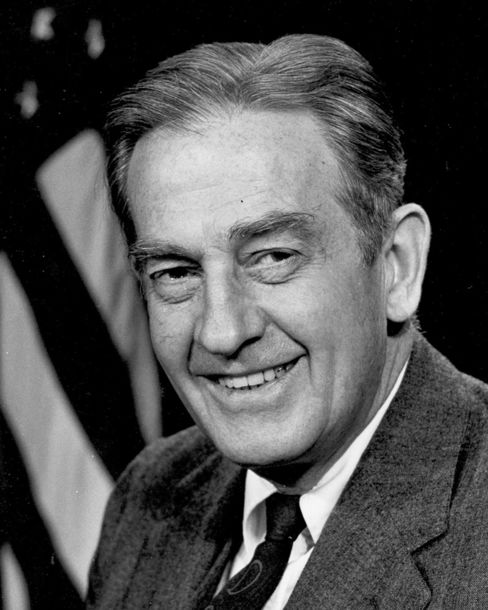
Clifford Philip Case Jr. (April 16, 1904 – March 5, 1982), was an American lawyer and politician. For over 30 years, Case represented the state of New Jersey as a member of the Republican Party in both the U.S. House of Representatives (1945–1953) and the U.S. Senate (1955–1979).

Key Information

Case began his life in politics in 1937, serving in the Rahway Common Council from 1938 to 1942. He then served one term in the New Jersey General Assembly, from 1943 to 1945, before being elected to represent New Jersey's 6th congressional district from 1945 to 1953. As one of the most left-leaning Republicans of the House, Case was supportive of President Harry S. Truman's Fair Deal and Marshall Plan programs. After an unsuccessful attempt at the Republican nomination for the 1953 New Jersey gubernatorial election, Case became president of the Ford Foundation's Fund for the Republic.

After Robert C. Hendrickson's retirement, Case defeated fellow U.S. Representative Charles R. Howell for Hendrickson's seat in the United States Senate. In the Senate, Case was one of the strongest supporters of Democratic presidents John F. Kennedy and Lyndon B. Johnson's New Frontier and Great Society programs. Case's support of civil rights for African-Americans and welfare programs often put him at odds with the right wing of the Republican Party. Initially supportive of the Vietnam War, Case began to have doubts about the war, supporting the McGovern-Hatfield Amendment, and co-sponsoring the Case-Church Amendment with Idaho Senator Frank Church. In 1978, Case lost renomination to his Senate seat against fellow Republican Jeffrey Bell, who ran to his right. After leaving the Senate, Case returned to practicing law. A heavy smoker, Case died of lung cancer in 1982.

Early life and education

[edit]

The oldest of six children, Clifford Case was born in the Franklin Park section of Franklin Township, New Jersey, to Clifford Philip and Jeannette McAlpin (née Benedict) Case.[1] His father was a minister in the Dutch Reformed Church.[2] His father was also a staunch Republican who even canceled his subscription to The New York Times after it endorsed Woodrow Wilson in the 1912 presidential election.[3] His uncle, Clarence E. Case, served as a member of the New Jersey Senate and as Chief Justice of the New Jersey Supreme Court.[4] His great-grandfather was a court crier in Somerset County.[3]

After serving at Six Mile Run Reformed Church in Franklin Park, his father accepted a position as pastor in Poughkeepsie, New York, in 1907.[4] Case received his early education at public schools in Poughkeepsie, and graduated from Poughkeepsie High School in 1921.[5] His class predicted he would become vice president of the United States, adding, "His good nature, however, and his stubborn hair will keep the Cabinet happy and harmonious."[3] Following his high school graduation, he enrolled at Rutgers University in 1921.[5] His father died the year before, and Case helped pay for his tuition by working part-time jobs, including playing the pipe organ in church on Sundays.[4] At Rutgers, he was a member of the varsity lacrosse team, the Glee Club, the Rutgers chapter of Delta Upsilon, Phi Beta Kappa society, and Cap and Skull.[6] He graduated with a Bachelor of Arts degree in 1925.[1]

Case then studied at Columbia Law School, receiving his Bachelor of Laws degree in 1928.[5] That same year, he married Ruth Miriam Smith, whom he had met in his junior year at Rutgers.[6] The couple remained married until his death; they had two daughters, Mary Jane and Ann, and one son, Clifford Philip III.[1]

Early career

[edit]

In 1928, Case was admitted to the bar in New York and joined the law firm of Simpson Thacher & Bartlett in New York City, where he remained until 1953.[4] He returned to New Jersey, living in Rahway while commuting to work in New York City.[1] He entered politics in 1937, when he was elected to the Rahway Common Council, serving from 1938 to 1942.[5] From 1943 to 1945, he was a member of the New Jersey General Assembly.[5]

U.S. Representative

[edit]

In 1944, Case successfully ran for the United States House of Representatives from New Jersey's 6th congressional district.[2] He defeated his Democratic opponent, Walter H. Van Hoesen, by a margin of 55%-43%.[7] He was subsequently re-elected to four more terms, never receiving less than 55% of the vote.[3] In 1952, he won 20,000 more votes than any other candidate ever received in his district and won 10,000 more votes than Dwight D. Eisenhower's majority.[3] During his entire tenure, Case's district was coterminous with Union County.

As a member of the House, Case earned a reputation as a liberal Republican, frequently receiving the endorsement of the Americans for Democratic Action, Congress of Industrial Organizations, and American Federation of Labor.[2] He once said, "If the needs of this country are not met by middle-of-the-road progressivism, the problems won't be met, and the time will come when only extremist solutions are possible."[4] A strong supporter of the Civil Rights Movement, he voted in favor of an anti-poll tax measure, a proposal to prevent segregation in the Women's Reserve of the Coast Guard, and the creation of a Fair Employment Practices Commission to prohibit discrimination in the workforce.[4] He also opposed the establishment of a permanent House Un-American Activities Committee and the overriding of President Harry S. Truman's veto of the Immigration and Nationality Act of 1952.[2] He served on the Civil Service, Education, and Judiciary Committees.[6]

In 1953, Case was an unsuccessful candidate for the Republican nomination for Governor of New Jersey.[6] In August of that year, he resigned from the House to become president of the Ford Foundation's Fund for the Republic, an organization dedicated to protecting freedom of speech and other civil liberties in the United States.[2] He served in that position until March 1954.[5]

U.S. Senate

[edit]

In 1954, after Republican incumbent Robert C. Hendrickson declined to run for re-election, Case announced his candidacy for Hendrickson's seat in the United States Senate.[6] After winning the Republican primary, he faced fellow U.S. Representative Charles R. Howell in the general election.[8] During the campaign, Case openly criticized Senator Joseph McCarthy, and pledged to vote against seating McCarthy on any committee with investigative functions.[4] McCarthy's supporters called him "a pro-Communist Republicrat" and "Stalin's choice for Senator."[1] The Star-Ledger quoted former Communist Party leader Bella Dodd as saying that Case's sister Adelaide was "an active member of several Communist front groups." It was later revealed, however, that the Adelaide Case in question was not the candidate's sister but a college professor who had died in 1948.[9][10] A conservative faction within the Republican Party unsuccessfully attempted to force Case off the ballot, also proposing a write-in campaign for former U.S. Representative Fred A. Hartley Jr., co-author of the Taft-Hartley Act.[3] Case was endorsed by President Eisenhower and Vice President Richard M. Nixon.[6] In 1959, William F. Buckley Jr.'s National Review magazine in the article "Hopeless Case" appraised Case's liberal positions within the Republican Party.[11]

On November 2, 1954, Case narrowly defeated Howell by a margin of 3,369 votes.[8] It was the closest Senate election in New Jersey's history, and a recount was held on December 14.[4] Case won the recount by 3,507 votes.[1] In the Senate, he compiled one of the most liberal records of any Republican, being one of the most supportive Republicans of the New Frontier and the Great Society. Notoriously, Case was the only Republican in the Senate to support Senator Clinton Anderson's medical care bill proposal supported by President Kennedy. He was re-elected in 1960, 1966 and 1972. Case voted in favor of the Civil Rights Acts of 1957,[12] 1960,[13] 1964,[14] and 1968,[15] as well as the 24th Amendment to the U.S. Constitution,[16] the Voting Rights Act of 1965,[17] and the confirmation of Thurgood Marshall to the U.S. Supreme Court.[18] Case was one of thirteen Republicans in the Senate to vote in favor of the creation of the Medicare program for the aged.[19] During his time in the Senate, Case received zero ratings from the Americans for Constitutional Action in 1971, 1974 and 1976 and often got ratings in the high nineties from the Americans for Democratic Action organization. From 1973 to 1978, Case, along with fellow Republican senators Jacob Javits and Edward Brooke, is seen by GovTrack as being to the left of Democrats like Hubert Humphrey, George McGovern, Edmund Muskie and Gaylord Nelson.[20]

When Case was asked why he was a member of the Republican Party instead of the Democratic Party, he replied: "I am a Republican, and I believe in the Republican Party. But I have my own convictions as to what the Republican Party should stand for, and I intend to fight for them as hard as I can. And I will not be driven away from my Republicanism simply because some Democrats happen to agree with me on certain issues - and some Republicans don't."

Despite his liberalism, Case saw himself as a conservative in the vein of Edmund Burke, Benjamin Disraeli, Winston Churchill, and the Federalist Papers.[21]

In 1966, along with two other Republican senators and five Republican representatives, Case signed a telegram sent to Georgia Governor Carl E. Sanders regarding the Georgia legislature's refusal to seat the recently elected Julian Bond in their state House of Representatives. This refusal, said the telegram, was "a dangerous attack on representative government. None of us agree with Mr. Bond's views on the Vietnam War; in fact we strongly repudiate these views. But unless otherwise determined by a court of law, which the Georgia Legislature is not, he is entitled to express them."[22]

At the 1968 Republican National Convention, Case attempted to hold the New Jersey's delegation's 40 votes as a favorite son candidate to prevent Richard Nixon being selected on the first ballot and thus give Case's preferred candidate, Nelson Rockefeller, a chance of being chosen in later ballots. Case failed to hold the delegation together and 18 delegates deserted Case's favorite son candidacy for Nixon. Nixon was nominated on the first ballot. Case was a co-author of the Case-Zablocki Act of 1972 which required that executive agreements by the president be reported to Congress in 60 days. Originally supportive of the Vietnam War in the 60's, he grew more critical of American involvement in Vietnam, supporting the McGovern-Hatfield Amendment in 1970 and co-sponsored the Case–Church Amendment which prohibited further U.S. military activity in Vietnam, Laos and Cambodia in 1973.

Alongside Jacob Javits, John Sherman Cooper and William B. Saxbe, Case was one of four Republican co-sponsors of Ted Kennedy's "Health Security Act" in 1971, which would have provided health coverage to every American through an insurance program run by the federal government. In a speech advocating for universal coverage through the Health Security Act, Case stated:

Mr. President, I am pleased to join Senators Kennedy, Cooper, and Saxbe as cosponsor of S.3, the Health Security Act of 1971. Today the question of national health insurance is not whether we should have a national health program. The facts dictate that we do. It is rather, what kind of program, will best serve all our people. It is shocking that medical care is so difficult to obtain, and that so many people have little or no health coverage at all, when America is spending $63 billion a year on health care. This sum amounts to 7 percent of our gross national product, or about $300 for every man, woman, and child. Despite the fact that we spend more on health care than any other nation, America lags behind most industrial nations in health standards. Clearly something must be done to change the system by which medical care and services are delivered. It must be made more equitable and much more efficient. In a country as wealthy and resourceful as ours, there is no reason why every citizen, rich or poor, young or old, working or unemployed, should be denied the right to good healthcare. As one of the earliest supporters of Medicare and as a member of the Senate Appropriations Subcommittee dealing with health, I have long believed that we must do better in making health care a matter of national priority. The Health Security Act of 1971 is the product of months of study by outstanding citizens involved in health care and many other areas of human and social concern. It is my hope that the proposal will be carefully considered this year and that the 92nd Congress will enact legislation establishing a system capable of making quality health care available to every citizen of the United States.[23]

Case sought a fifth Senate term in 1978, but lost the Republican primary to Jeffrey Bell, an anti-tax conservative. Case criticized Bell's support of a tax cut bill introduced by Congressman Jack Kemp, believing that it would cause tremendous inflation.[24] Bell went on to lose the general election to Democrat Bill Bradley, a former professional basketball player. No Republican has been elected to represent New Jersey in the Senate since Case's last victory in 1972 (though Republicans Nicholas F. Brady and Jeffrey Chiesa have served as appointees).

Later life and death

[edit]

After leaving the Senate, Case resumed the practice of law with Curtis, Mallet-Prevost, Colt & Mosle, a New York law firm. Case also lectured at Rutgers University's Eagleton Institute of Politics. He died from lung cancer at Georgetown University Hospital in Washington on March 5, 1982,[1] and was interred at the Somerville New Cemetery in Somerville, New Jersey.

After Case's death, friend and colleague Peter Rodino said of him:

Speaking personally, I have never met a more decent human being than Clifford Case. He taught us how to live with dignity, and how to serve the people with integrity and honor. I join with his wife Ruth, the rest of his family and all the citizens of New Jersey in mourning the loss of this giant of a man. I hope that as we honor Cliff Case today we can learn from the man and his principles which helped to chart a certain portion of our Nation's history——for they are timeless in their simplicity and strength.[25][better source needed]

His grandson, former Clinton Mayor Matthew Holt, was elected to the Hunterdon County Board of Chosen Freeholders in 2005. He ran for the General Assembly seat in the 23rd legislative district that was vacated by Marcia A. Karrow in January 2009.[26]

References

[edit]
[edit]
Revisions and contributorsEdit on WikipediaRead on Wikipedia
from Grokipedia
Clifford Philip Case (April 16, 1904 – March 5, 1982) was an American lawyer and Republican politician who served as a U.S. Representative from from 1945 to 1955 and as a U.S. Senator from 1955 to 1979. A self-described liberal within his party, Case championed civil rights, labor interests, conservation, and throughout his congressional tenure. He played a pivotal role in advancing landmark legislation, including the Civil Rights Acts of 1957 and 1964 as well as the Voting Rights Act of 1965. In , he prioritized bipartisan approaches, advocacy, and strong support for , eventually rising to ranking Republican on the Foreign Relations Committee and aiding the of the Treaties. Case's independent stances often put him at odds with conservative elements in the Republican Party, such as his opposition to Barry Goldwater's 1964 presidential nomination and efforts to influence party leadership selections in later years. His Senate career concluded after a narrow defeat in the 1978 Republican primary by conservative challenger Jeffrey Bell, reflecting the party's shifting dynamics toward .

Early Life and Background

Family Origins and Upbringing

Clifford Philip Case Jr. was born on April 16, 1904, in Franklin Park, a small rural community in , characterized by farmers, craftsmen, and merchants. He was the eldest of six children born to Reverend Clifford P. Case Sr., a graduate of Rutgers College who served as a in the Reformed Church, and Jeannette McAlpin Benedict Case. The family traced its roots to early American settlers, reflecting a lineage of modest, community-oriented Protestant heritage. When Case was three years old, the family relocated to Poughkeepsie, New York, where his father assumed the pastorate of the First Dutch Reformed Church, exposing the children to a disciplined, religious environment centered on pastoral duties and local church activities. Case attended public schools in Poughkeepsie, where he developed an early interest in academics amid the stability of a minister's household, though the family's circumstances were typical of middle-class clergy without notable wealth. The death of his father from in , when Case was 16 and a high school junior, marked a significant disruption, leaving Jeannette Case to raise the six children alone and necessitating Case's assumption of greater family responsibilities during his formative teenage years. This event, occurring in the context of post-World War I economic pressures, instilled in him a sense of resilience shaped by Protestant values of duty and , as later reflected in his ethos.

Education and Early Influences

Clifford P. Case was born on April 16, 1904, in Franklin Park, , to Reverend Clifford P. Case, a graduate of Rutgers College, and Jeannette McAlpin Case. His father's clerical profession and academic background instilled an early emphasis on education and , shaping Case's formative years amid a modest family environment in rural . Case attended public schools in , and , completing his secondary education despite the sudden death of his father from in 1920, when Case was 16 and a high school junior. This loss likely reinforced his self-reliance, as he pursued higher education at in , graduating with an A.B. degree in 1925. At Rutgers, Case engaged in extracurricular activities that honed his leadership skills, including participation in student governance and debate, reflecting the institution's tradition of fostering civic responsibility among its students. Following graduation, he enrolled at , earning an LL.B. in 1928, which provided rigorous training in legal reasoning and constitutional principles that would underpin his later political career. These academic experiences, combined with his familial Presbyterian roots, cultivated Case's commitment to moderate and institutional integrity, evident in his avoidance of partisan extremism from an early age.

Pre-Congressional Career

After obtaining his LL.B. from in 1928, Clifford P. Case was admitted to the bar that same year and commenced his legal practice in . He joined the Wall Street firm , a prominent practice specializing in mergers, acquisitions, and business transactions, where he worked as an associate and later partner until entering federal office. Residing in , Case balanced his professional commitments with local , though no specific litigation or landmark cases from his firm tenure are prominently documented in congressional biographies or contemporary accounts. Case's legal work reflected the era's focus on corporate advisory services amid New York's financial hub status, contributing to his reputation as a scholarly and methodical attorney prior to his political ascent. By 1944, as he campaigned successfully for the U.S. , his professional foundation at Simpson Thacher had established and networks that supported his transition to .

Initial Political Involvement

Case entered elective politics as a Republican in , winning election to the Rahway Common Council in 1937 and serving from 1938 to 1942. During this period, he focused on local governance issues in Union County, building a reputation for and administrative efficiency within the Republican Party. Seeking higher office, Case unsuccessfully campaigned in the 1941 Republican primary for a seat in the , representing Union County; this marked his only electoral defeat prior to a failed Senate primary in 1978. He ran again in the 1942 Republican primary for the Assembly, securing the nomination alongside running mates Milton A. Feller and Kenneth C. Hand, as documented in official election records. Case won the general election that year, beginning his service in the from 1942 to 1944 (noted variably as 1943–1944 in congressional records). In the Assembly, Case served as vice-chairman of the Joint Commission on State Personnel, where he sponsored legislation reforming civil service compensation to enhance merit-based hiring and efficiency in state government. His work emphasized practical governance reforms, aligning with his legal background and Republican principles of limited government intervention. This state-level experience positioned him for a successful 1944 congressional bid, during which he resigned from the Assembly upon election to the U.S. House of Representatives.

House of Representatives Service

Elections and Tenure (1945–1953)

Case won election to the in November 1944 as a Republican, representing , which encompassed Union County and surrounding areas. He assumed office on January 3, 1945, at the start of the 79th Congress. Case was reelected in the general elections of 1946, 1948, 1950, and 1952, securing five terms in total. During his House service, spanning the 79th through 83rd Congresses, Case served on the Committees on , Claims, , and the . As a representative from a competitive district, he positioned himself as a moderate Republican, advocating for policies aligned with organized labor and supporting Dwight D. Eisenhower's presidential bid. His legislative record emphasized reforms and educational initiatives, reflecting an independent streak that occasionally diverged from strict party orthodoxy. Case resigned from the House on August 16, 1953, midway through the 83rd Congress, to assume the presidency of the Fund for the Republic, a nonprofit focused on civil liberties and free inquiry. This move preceded his successful 1954 campaign for the U.S. Senate.

Key Legislative Actions and Positions

In the 79th Congress (1945–1946), amid widespread postwar strikes disrupting key industries such as railroads and coal, Case sponsored H.R. 3488, known as the Case bill, which sought to establish emergency procedures including a mandatory 30-day cooling-off period prior to strikes, appointment of fact-finding boards, and government seizure of facilities as a final measure to ensure continuity in essential services. The proposal reflected Republican efforts to curb labor disruptions without fully repealing wartime controls, though it did not advance to enactment amid competing measures. Case served on the House Committees on , Claims, and during his tenure, with assignment from 1947 onward, where he contributed to deliberations on legal and constitutional matters. In the 80th (1947–1948), he voted for the Labor-Management Relations Act (Taft-Hartley Act), which amended the National Labor Relations Act to prohibit closed shops, authorize states to ban union security agreements, curb secondary boycotts, and require union leaders to affirm non-Communist affiliations; the bill passed the House 319–71 on April 17, 1947, and became law on June 23, 1947, despite President Truman's veto. On civil rights, Case sponsored federal anti-lynching in the late , aligning with bipartisan pushes to criminalize mob violence and address failures of state enforcement, though such bills faced Southern Democratic opposition and stalled in committee. His positions emphasized constitutional protections against extrajudicial racial killings, consistent with his Judiciary Committee role.

Senate Career

Elections and Early Senate Years (1955–1960s)

In March 1954, Clifford P. Case announced his candidacy for the U.S. Senate seat held by Democrat Robert C. Hendrickson, emphasizing opposition to extremism exemplified by Senator Joseph McCarthy. Case's campaign highlighted his House record on civil rights and labor issues, positioning him as a moderate Republican amid a national midterm election where Democrats gained Senate seats. On November 2, 1954, he narrowly defeated Democratic opponent Charles S. Howell by 3,507 votes out of over 1.3 million cast, following a recount requested by both parties due to the close margin. Case was sworn in on January 3, 1955, beginning his Senate tenure. During his initial Senate years, Case aligned with President Dwight D. Eisenhower's moderate agenda, supporting foreign aid and economic policies while advocating for congressional reforms, including financial disclosure requirements for members in the late . He served on key committees such as Labor and Public Welfare, where he advanced legislation on education and welfare, reflecting his prior experience. Case consistently opposed McCarthy-style tactics, contributing to the 's broader repudiation of unchecked anti-communist investigations post-1954 . Case sought re-election in 1960 amid a national contest influenced by the Kennedy-Nixon presidential race. On November 8, , he defeated Democratic challenger Thorn Lordi, securing a second term with a comfortable margin in a year when Republicans held ground despite Democratic presidential gains. This victory marked his thirteenth consecutive electoral success, underscoring his appeal as a pragmatic Republican in New Jersey's politically competitive landscape. Into the early , Case continued focusing on bipartisan priorities like civil rights advancements and , establishing his reputation as a liberal within the Republican caucus.

Major Policy Contributions

Case served as a key Republican supporter and collaborator in the passage of landmark civil rights legislation, including the , which established the U.S. Commission on Civil Rights and aimed to enforce voting rights; the , prohibiting discrimination in public accommodations, employment, and other areas; and the , which suspended literacy tests and other barriers to Black voter registration in discriminatory jurisdictions. His efforts involved working with centrist Republicans and Democrats to build bipartisan coalitions amid Southern Democratic filibusters. In foreign policy, Case co-sponsored the Case-Church Amendment, enacted in 1973 as part of a defense appropriations bill, which barred the use of U.S. funds for combat activities in Southeast Asia after August 15, 1973, without explicit congressional authorization, effectively contributing to the winding down of U.S. military involvement in Vietnam following the Paris Peace Accords. As ranking minority member of the Senate Foreign Relations Committee, he also advocated for the ratification of the Panama Canal Treaties in 1978, which transferred control of the canal to Panama by 1999, and co-sponsored legislation establishing a U.S. commission to monitor compliance with the 1975 Helsinki Accords on human rights. Domestically, Case authored the Case Act of 1972, requiring the executive branch to submit all international executive agreements to Congress within 60 days of entry, enhancing legislative oversight of foreign commitments outside formal treaties. He sponsored early financial disclosure requirements for members of Congress in the late 1950s to promote transparency and combat corruption. Additionally, he pushed for federal aid to elementary and secondary education, workplace safety enhancements leading to stronger regulations, and conservation measures, including proposals for a cabinet-level environmental department and opposition to ocean dumping.

Foreign Policy Engagements

Case served on the Foreign Relations Committee from 1965 to 1979, rising to the position of ranking Republican member from 1975 onward. In this capacity, he advocated for a bipartisan approach to U.S. , emphasizing across party lines to advance national interests. He played a pivotal role in brokering compromises, including a key behind-the-scenes agreement in the 1970s that facilitated ratification of the Treaties on September 7, 1978, despite opposition from conservative Republicans. A strong proponent of in international affairs, Case co-sponsored legislation in 1976 with Representative to establish a U.S. commission for monitoring compliance with the human rights provisions of the , signed in 1975. This initiative aimed to hold the and other signatories accountable for commitments on individual freedoms and humanitarian concerns. He also demonstrated firm support for , representing the U.S. Congress at the opening of the new building in on August 30, 1966. In 1972, Case authored the Case Act, which mandated that the executive branch submit all international executive agreements to within 60 days of their entry into force, enhancing legislative oversight of foreign commitments without formal status. He opposed certain arms sales proposed by the Carter administration, criticizing the 1978 plan to sell warplanes to and as potentially destabilizing to U.S. alliances in the . These positions reflected his commitment to balancing strategic alliances with scrutiny of executive actions in .

Political Ideology and Controversies

Liberal Republican Stance

Clifford P. Case represented the liberal wing of the Republican Party, characterized by strong advocacy for civil rights and social welfare measures that frequently aligned him with Democratic priorities on domestic policy. He voted in favor of the , which aimed to protect voting rights in federal elections, and played a key role in advancing the , prohibiting discrimination based on race, color, religion, sex, or national origin. Case also supported the , enforcing constitutional protections against racial discrimination in voting, and backed extensions of anti-poverty and urban renewal programs under President Lyndon B. Johnson's agenda. His commitment to organized labor further underscored his moderate-to-liberal stance, as he consistently championed workers' rights, workplace safety enhancements, and full funding for social programs benefiting the elderly, infirm, and minorities. Case earned repeated endorsements from labor unions, which contributed to his electoral successes, and maintained a legislative record sympathetic to union priorities despite his Republican affiliation. On , he advocated for conservation efforts and controls, reflecting a progressive approach to resource management that diverged from more conservative views within the GOP. In , Case's liberalism manifested in support for bipartisan initiatives emphasizing and international engagement, including aid to and ratification of the Treaties in 1977–1978. As the ranking Republican on the Senate Foreign Relations Committee, he prioritized multilateral cooperation over , often critiquing excessive executive overreach while endorsing foreign assistance programs. This positioning frequently clashed with the party's emerging conservative faction, exemplified by his vocal opposition to Barry Goldwater's 1964 presidential nomination, which he viewed as too ideologically rigid. Despite these tensions, Case's ideology balanced liberal domestic activism with Republican emphases on —tempered by rejection of McCarthyist excesses—and fiscal oversight, earning him a reputation as a principled moderate in a polarizing era.

Opposition to McCarthyism and Anti-Communism Critiques

Case openly criticized Senator Joseph McCarthy's tactics during his 1954 campaign for the U.S. Senate, describing the senator's communist investigations as a "witch-hunt" that undermined due process and civil liberties. He pledged to vote against McCarthy's placement on any Senate committee, arguing that such methods blurred the lines between legislative oversight and executive functions while eroding public trust in government institutions. This stance, taken amid McCarthy's peak influence, positioned Case as a defender of procedural fairness, rooted in his view that anti-communist efforts must adhere to constitutional standards rather than rely on unsubstantiated accusations. In the House of Representatives from 1945 to 1953, Case had already demonstrated reservations about aggressive anti-communist probes, supporting measures to protect individual rights amid the Second Red Scare. Upon entering the Senate in 1955, shortly after McCarthy's censure in December 1954, he continued to advocate for restrained approaches to domestic security threats, critiquing excesses that prioritized ideological purity over evidence-based inquiry. Case distinguished legitimate anti-communism—such as containment policies abroad—from McCarthy-era tactics, which he saw as counterproductive and damaging to republican principles of justice. His positions drew opposition from conservative Republicans who accused him of insufficient vigilance against , yet Case maintained that unchecked risked mirroring the it sought to combat. This critique emphasized causal links between procedural overreach and diminished national unity, prioritizing empirical adherence to over partisan fervor.

Civil Rights and Domestic Policy Debates

Case consistently supported major civil rights legislation during his Senate tenure, including serving as a key collaborator in the passage of the , which aimed to enforce voting rights protections amid Southern resistance. He acted as one of the bipartisan floor managers for the , which prohibited discrimination in public accommodations, employment, and federally assisted programs, helping to secure Republican votes despite internal party divisions over federal intervention in state matters. Case also backed the , endorsing measures to suspend literacy tests and authorize federal oversight of elections in discriminatory jurisdictions. His advocacy extended to the Fair Housing Act of 1968, where he joined other Republicans in supporting bans on housing discrimination based on race, religion, or national origin, appearing at President Lyndon B. Johnson's signing ceremony alongside key co-sponsors. These positions aligned Case with a minority of Senate Republicans willing to prioritize enforcement of constitutional equal protection over states' rights arguments prevalent in conservative circles, sparking debates within the GOP about the extent of federal authority to redress historical injustices. Critics from the party's right wing, including figures like Barry Goldwater, contended that such laws overreached into private spheres and economic freedoms, viewing them as precursors to expanded government control. On broader domestic policy, Case maintained a record favoring progressive reforms, consistently voting for pro-labor initiatives such as workplace safety enhancements and organized labor protections, which positioned him against GOP fiscal conservatives advocating . He endorsed elements of the agenda, including anti-poverty and job-training programs, defending their continuation into the 1970s amid debates over welfare expansion's fiscal sustainability and potential to foster dependency. These stances fueled intra-party tensions, as Case's willingness to cross aisles with Democrats on issues like federal aid to education and housing subsidies drew accusations of diluting Republican principles of , ultimately contributing to challenges from anti-government sentiment in his 1978 primary. Despite such criticisms, his votes reflected a commitment to empirical needs in urban constituencies affected by economic disparity and discrimination. As a Republican member of the Senate Foreign Relations Committee from 1966 to 1971, Case contributed to oversight hearings, including the Fulbright hearings initiated in February 1966, which interrogated the executive branch's justifications, tactics, and effectiveness of U.S. military operations in through televised sessions and testimony analysis. In May 1967, Case joined a committee delegation touring and seven other Asian nations, leading him to assess that the Republic of Vietnam lacked the capability or willingness to manage the war effort independently. On September 26, 1967, he addressed the floor, condemning the Johnson administration's war management and the expansive interpretation of the 1964 as enabling unchecked executive actions. Though Case initially backed U.S. intervention in during the and to contain , he adopted a more critical stance by the late , culminating in advocacy for troop withdrawal under President Nixon as casualties mounted and strategic setbacks emerged. Case co-sponsored the Case-Church Amendment, enacted via a vote of 67 to 15 on June 14, 1973, as part of a $609.1 million State Department appropriations bill; it barred funding for U.S. combat activities in Indochina—including , , and —after August 15, 1973, absent explicit congressional approval, thereby curtailing bombing campaigns and ground operations in those theaters. This legislation marked a pivotal congressional reassertion of war powers oversight, applying to Vietnam's primary conflict and adjacent insurgencies in Laos and Cambodia, where U.S. support had fueled escalations without sufficient legislative consent.

Electoral Defeat and Later Years

1978 Primary Loss

In the 1978 Republican primary for the U.S. Senate in New Jersey, incumbent Senator Clifford P. Case sought a fifth full term after initially winning a special election in 1955 and subsequent re-elections in 1956, 1962, 1968, and 1974. Case, a moderate-to-liberal Republican known for bipartisan support on issues like civil rights and foreign aid, faced a challenge from Jeffrey K. Bell, a 30-year-old conservative former congressional aide and speechwriter who emphasized supply-side economics, tax cuts, and opposition to Case's voting record on abortion and government spending. The primary, held on June 6, 1978, saw unusually low turnout amid a broader national trend of voter discontent with incumbents and federal government efficacy. Case campaigned minimally, relying on his long incumbency and avoiding television advertising, which aides later attributed to overconfidence in his primary security despite warnings of conservative unrest. Bell, supported by emerging Reagan-aligned conservatives and focusing on Proposition 13-style tax revolt sentiments, mobilized a grassroots effort targeting Case's perceived liberalism and votes against anti-abortion measures. Case himself cited the outcome as reflecting "the dissatisfaction of people with government" rather than personal failings. Bell secured a narrow upset victory with 118,555 votes (50.74%) to Case's 115,082 (49.26%), a margin of 3,473 votes out of 233,637 total cast. This defeat marked the first primary loss of Case's career, ending his 24-year tenure and signaling the Republican Party's rightward shift in , though Bell subsequently lost the general election to Democrat Bill by a wide margin.

Post-Senate Activities and Death

Following his departure from the on January 3, 1979, Clifford P. Case served as a visiting lecturer on political affairs at . He resumed the practice of law as counsel with the firm Curtis, Mallet-Prevost, Colt & Mosle. Case also engaged in public service roles, including membership on the Committee and chairmanship of the Board of Directors of . Additionally, he published articles on , government ethics, and foreign policy in scholarly journals. In 1981, Case was diagnosed with lung cancer and underwent surgery in August to remove a tumor from one lung. He was hospitalized on February 10, 1982, at Georgetown University Hospital in Washington, D.C., due to breathing difficulties, by which time the cancer had metastasized. Case died there on March 5, 1982, at the age of 77. His funeral was held at Rutgers University's Kirkpatrick Chapel, after which he was buried in New Cemetery, Somerville, New Jersey.

Legacy and Evaluations

Legislative Achievements

Case served as a key Republican supporter in the passage of the Civil Rights Act of 1957, collaborating with centrist colleagues across party lines to overcome Southern Democratic opposition and establish the first civil rights legislation since Reconstruction. He played an instrumental role in the Senate debates and cloture vote for the Civil Rights Act of 1964, which prohibited discrimination in public accommodations, employment, and voting based on race, color, religion, or national origin. Similarly, Case contributed significantly to the Voting Rights Act of 1965 by advocating for federal oversight of voter registration in discriminatory jurisdictions, helping secure its bipartisan approval. In foreign policy oversight, Case co-sponsored the Case-Church Amendment in 1973, which barred the use of U.S. funds for combat activities in after the withdrawal of American combat troops, effectively limiting executive war powers in , , and . He also authored the Case-Zablocki Act of 1972, requiring the executive branch to notify within 60 days of any international , thereby enhancing legislative transparency in diplomacy without restricting presidential flexibility. As ranking Republican on the Senate Foreign Relations Committee, Case supported ratification of the Panama Canal Treaties in 1978, which transferred control of the canal to Panama by 1999 while preserving U.S. navigation rights, reflecting his commitment to pragmatic internationalism. Earlier, he co-sponsored with Representative legislation establishing a U.S. commission to monitor global compliance, advancing congressional scrutiny of foreign aid recipients. Case consistently backed environmental and conservation measures, including key votes for clean air and water protections, though he did not lead major standalone bills in those areas.

Conservative Criticisms and Failures

Conservatives criticized Senator Clifford P. Case for his consistently liberal voting record within the Republican Party, often ranking him among the least aligned with GOP orthodoxy on fiscal and social issues. His support for expansive federal programs, including elements of the , and opposition to amendments like , drew accusations of prioritizing big government over traditional Republican principles of limited intervention. Case's early and vocal opposition to Senator Joseph McCarthy's anti-communist investigations, which he labeled a "communist witch-hunt," alienated conservative Republicans who viewed such scrutiny as essential to amid threats. Similarly, his rejection of Barry Goldwater's 1964 presidential nomination and advocacy for the GOP as a "center" party rather than shifting rightward underscored a philosophical divide, with critics arguing it undermined party cohesion against Democratic dominance. These tensions manifested in repeated primary challenges from conservative factions, whom Case repeatedly fended off until his 1978 defeat by Jeffrey Bell, an anti-tax challenger emphasizing Case's deviation from and fiscal restraint. The upset, attributed to Case's lax engagement with rising conservative militancy and his prioritization of liberal crossover appeal over intraparty unity, highlighted his failure to adapt to the GOP's rightward evolution. Bell's campaign spotlighted Case's resistance to tax cuts like Jack Kemp's, which Case opposed fearing , further fueling perceptions of economic heterodoxy. From a conservative vantage, Case's career exemplified the vulnerabilities of liberal Republicans, whose legislative influence waned as the party prioritized ideological purity, culminating in his ouster and the broader marginalization of his wing by the late 1970s. Low party unity scores, such as frequent opposition to Republican positions on key votes, reinforced critiques that he functioned more as a bipartisan enabler of Democratic agendas than a counterweight.

Broader Historical Impact

Case's embodiment of "modern Republicanism"—a blend of fiscal restraint with support for social welfare and civil liberties—influenced the post-World War II Republican Party's moderate faction, advocating for progressive stances on social issues alongside internationalist foreign policy commitments. His opposition to the 1964 Barry Goldwater nomination and subsequent alignment against conservative nominees highlighted internal party tensions, helping to sustain a vision of the GOP as a big-tent coalition until the late 1970s conservative resurgence. This stance positioned him as a bridge between Eisenhower-era moderation and emerging ideological divides, though it ultimately alienated the party's right wing. In foreign policy, Case's service as ranking Republican on the Senate Foreign Relations Committee advanced bipartisan approaches, including support for initiatives, aid to , and ratification of the Treaties in , which facilitated U.S. diplomatic realignments in the hemisphere. He co-authored the of 1973, which sought to reassert congressional authority over military engagements following , establishing a framework for executive-legislative checks that has shaped debates on war powers into the . Domestically, his pivotal votes for the , , and environmental measures contributed to enduring federal expansions in equality and conservation, reflecting a commitment to principled governance over partisan loyalty. The 1978 primary defeat by conservative challenger Jeffrey Bell, backed by national figures like , symbolized the decline of liberal Republicans in the Northeast, accelerating the party's ideological homogenization and paving the way for the conservative dominance evident in the elections. Case's replacement by a moderate Democrat underscored how his ouster reflected broader voter realignments toward conservatism amid economic and cultural shifts, diminishing the influence of centrist voices and altering the Senate's partisan dynamics. Post-Senate, his involvement with organizations like the Committee and extended his advocacy for oversight, influencing nongovernmental monitoring of authoritarian regimes during the Cold War's final decades.

References

Add your contribution
Related Hubs
User Avatar
No comments yet.