



Community hub
Recent from talks
Contribute something
Nothing was collected or created yet.
Closed system
View on WikipediaA closed system is a natural physical system that does not allow transfer of matter in or out of the system, although the transfer of energy is allowed in the contexts of certain fields (e.g. physics, chemistry, engineering, etc).
Physics
[edit]In classical mechanics
[edit]In nonrelativistic classical mechanics, a closed system is a physical system that does not exchange any matter with its surroundings, and is not subject to any net force whose source is external to the system.[1][2] A closed system in classical mechanics would be equivalent to an isolated system in thermodynamics. Closed systems are often used to limit the factors that can affect the results of a specific problem or experiment.
In thermodynamics
[edit]
In thermodynamics, a closed system can exchange energy (as heat or work) but not matter, with its surroundings. An isolated system cannot exchange any heat, work, or matter with the surroundings, while an open system can exchange energy and matter.[3][4][5][6][7][8][9] (This scheme of definition of terms is not uniformly used, though it is convenient for some purposes. In particular, some writers use 'closed system' where 'isolated system' is used here.[10][11])
For a simple system, with only one type of particle (atom or molecule), a closed system amounts to a constant number of particles. However, for systems which are undergoing a chemical reaction, there may be all sorts of molecules being generated and destroyed by the reaction process. In this case, the fact that the system is closed is expressed by stating that the total number of each elemental atom is conserved, no matter what kind of molecule it may be a part of. Mathematically:
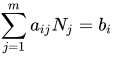
where is the number of j-type molecules, is the number of atoms of element in molecule and is the total number of atoms of element in the system, which remains constant, since the system is closed. There will be one such equation for each different element in the system.


In thermodynamics, a closed system is important for solving complicated thermodynamic problems. It allows the elimination of some external factors that could alter the results of the experiment or problem thus simplifying it. A closed system can also be used in situations where thermodynamic equilibrium is required to simplify the situation.
In quantum physics
[edit]This equation, called Schrödinger's equation, describes the behavior of an isolated or closed quantum system, that is, by definition, a system which does not interchange information (i.e. energy and/or matter) with another system. So if an isolated system is in some pure state |ψ(t) ∈ H at time t, where H denotes the Hilbert space of the system, the time evolution of this state (between two consecutive measurements).[12]
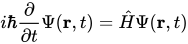
where i is the imaginary unit, ħ is the Planck constant divided by 2π, the symbol ∂/∂t indicates a partial derivative with respect to time t, Ψ (the Greek letter psi) is the wave function of the quantum system, and Ĥ is the Hamiltonian operator (which characterizes the total energy of any given wave function and takes different forms depending on the situation).
In chemistry
[edit]In chemistry, a closed system is where no reactants or products can escape, only heat can be exchanged freely (e.g. an ice cooler). A closed system can be used when conducting chemical experiments where temperature is not a factor (i.e. reaching thermal equilibrium).
In engineering
[edit]In an engineering context, a closed system is a bound system, i.e. defined, in which every input is known and every resultant is known (or can be known) within a specific time.
See also
[edit]References
[edit]- ^ Rana, N.C.; P.S. Joag (1991). Classical Mechanics. McGraw-Hill Education (India) Pvt Limited. p. 78. ISBN 978-0-07-460315-4.
- ^ Landau, L.D.; E.M. Lifshitz (1976). Mechanics (third ed.). Butterworth-Heinemann. p. 8. ISBN 978-0-7506-2896-9.
- ^ Prigogine, I., Defay, R. (1950/1954). Chemical Thermodynamics, Longmans, Green & Co, London, p. 66.
- ^ Tisza, L. (1966). Generalized Thermodynamics, M.I.T Press, Cambridge MA, pp. 112–113.
- ^ Guggenheim, E.A. (1949/1967). Thermodynamics. An Advanced Treatment for Chemists and Physicists, (1st edition 1949) 5th edition 1967, North-Holland, Amsterdam, p. 14.
- ^ Münster, A. (1970). Classical Thermodynamics, translated by E.S. Halberstadt, Wiley–Interscience, London, pp. 6–7.
- ^ Haase, R. (1971). Survey of Fundamental Laws, chapter 1 of Thermodynamics, pages 1–97 of volume 1, ed. W. Jost, of Physical Chemistry. An Advanced Treatise, ed. H. Eyring, D. Henderson, W. Jost, Academic Press, New York, lcn 73–117081, p. 3.
- ^ Tschoegl, N.W. (2000). Fundamentals of Equilibrium and Steady-State Thermodynamics, Elsevier, Amsterdam, ISBN 0-444-50426-5, p. 5.
- ^ Silbey, R.J., Alberty, R.A., Bawendi, M.G. (1955/2005). Physical Chemistry, fourth edition, Wiley, Hoboken NJ, p. 4.
- ^ Callen, H.B. (1960/1985). Thermodynamics and an Introduction to Thermostatistics, (1st edition 1960) 2nd edition 1985, Wiley, New York, ISBN 0-471-86256-8, p. 17.
- ^ ter Haar, D., Wergeland, H. (1966). Elements of Thermodynamics, Addison-Wesley Publishing, Reading MA, p. 43.
- ^ Rivas, Ángel; Huelga, Susana F. (October 2011). Open Quantum Systems. Berlin Heidelberg: Springer-Verlag. ISBN 978-3-642-23354-8.
Closed system
View on GrokipediaFundamental Concepts
Basic Definition
A closed system is defined as a physical system that can exchange energy, such as heat or work, with its surroundings but does not allow the transfer of matter across its boundaries.[6] This concept is fundamental in thermodynamics, where the system's mass remains constant while energy interactions influence its internal state.[7] Key attributes of a closed system include boundaries that are impermeable to matter but permeable to energy forms like thermal radiation, mechanical work, or pressure-volume changes.[8] This contrasts with common intuition, where "sealed" or "closed" might suggest no interactions whatsoever; in scientific terms, closure pertains specifically to matter conservation, permitting controlled energy flows. Representative examples illustrate these attributes: a sealed piston-cylinder assembly containing gas, where the piston enables work through volume changes and heat transfer via the cylinder walls, but no gas escapes.[9] Similarly, a thermos bottle approximates a closed system for short durations, retaining liquid matter while slowly exchanging minimal heat with the environment.[10] The system boundary is conceptualized as a real or imaginary mathematical surface that delineates the system from its surroundings, facilitating analysis of exchanges without matter crossing. This boundary enables precise modeling of energy transfers in theoretical and practical contexts.System Classifications
In thermodynamics and physics, systems are classified into three primary categories based on their exchanges with the surroundings: open systems, which can exchange both matter and energy; closed systems, which exchange energy but not matter; and isolated systems, which exchange neither matter nor energy. This typology builds on the concept of a system boundary that delineates interactions with the external environment. Isolated systems represent theoretical idealizations, as achieving complete isolation from all external influences is unattainable in reality; a conceptual example is a perfect vacuum chamber with no thermal, mechanical, or radiative contact with the outside. Closed systems, while also approximations, are more feasible in controlled settings, such as a laboratory beaker sealed with a lid to block matter transfer while permitting heat exchange through the boundary. The classification into open, closed, and isolated systems is a standard convention in modern thermodynamics, evolving from 19th-century foundational work on energy conservation. To illustrate the distinctions, the following table compares the permissible exchanges across system types:| System Type | Matter Exchange | Energy Exchange (e.g., heat or work) |
|---|---|---|
| Open | Yes | Yes |
| Closed | No | Yes |
| Isolated | No | No |