



Community hub
Recent from talks
Knowledge base stats:
Talk channels stats:
Members stats:
Cnidaria
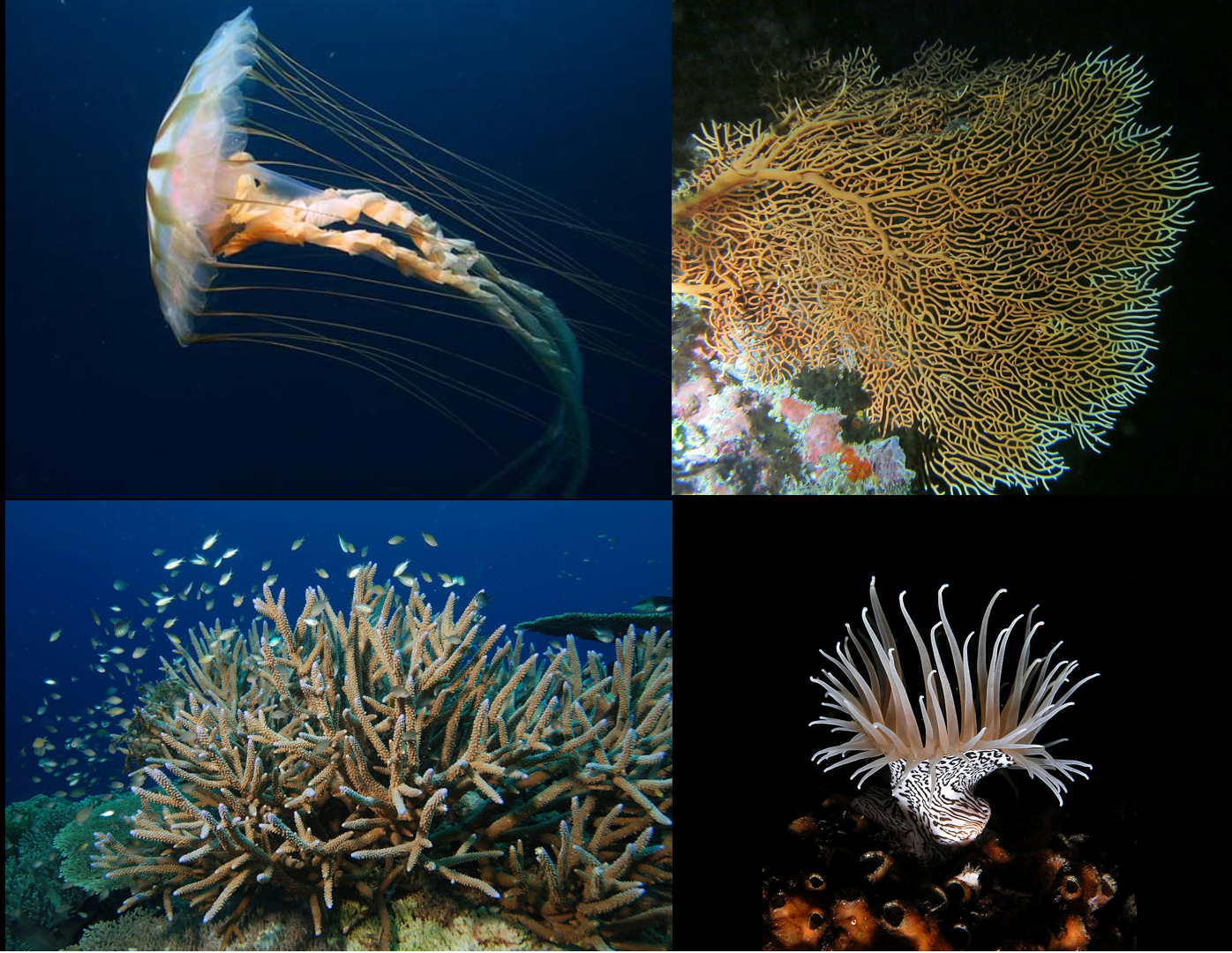
Cnidaria (/nɪˈdɛəriə, naɪ-/ nih-DAIR-ee-ə, ny-) is a phylum under kingdom Animalia containing over 11,000 species of aquatic invertebrates found both in freshwater and marine environments (predominantly the latter), including jellyfish, hydroids, sea anemones, corals and some of the smallest marine parasites. Their distinguishing features are an uncentralized nervous system distributed throughout a gelatinous body and the presence of cnidocytes or cnidoblasts, specialized cells with ejectable organelles used mainly for envenomation and capturing prey. Their bodies consist of mesoglea, a non-living, jelly-like substance, sandwiched between two layers of epithelium that are mostly one cell thick. Many cnidarian species can reproduce both sexually and asexually.
Cnidarians mostly have two basic body forms: swimming medusae and sessile polyps, both of which are radially symmetrical with mouths surrounded by tentacles that bear cnidocytes, which are specialized stinging cells used to capture prey. Both forms have a single orifice and body cavity that are used for digestion and respiration. Many cnidarian species produce colonies that are single organisms composed of medusa-like or polyp-like zooids, or both (hence they are trimorphic). Cnidarians' activities are coordinated by a decentralized nerve net and simple receptors. Cnidarians also have rhopalia, which are involved in gravity sensing and sometimes chemoreception. Several free-swimming species of Cubozoa and Scyphozoa possess balance-sensing statocysts, and some have simple eyes. Not all cnidarians reproduce sexually, but many species have complex life cycles of asexual polyp stages and sexual medusae stages. Some, however, omit either the polyp or the medusa stage, and the parasitic classes evolved to have neither form.
Cnidarians were formerly grouped with ctenophores, also known as comb jellies, in the phylum Coelenterata, but increasing awareness of their differences caused them to be placed in separate phyla. Most cnidarians are classified into four main groups: the almost wholly sessile Anthozoa (sea anemones, corals, sea pens); swimming Scyphozoa (jellyfish); Cubozoa (box jellies); and Hydrozoa (a diverse group that includes all the freshwater cnidarians as well as many marine forms, and which has both sessile members, such as Hydra, and colonial swimmers (such as the Portuguese man o' war)). Staurozoa have recently been recognised as a class in their own right rather than a sub-group of Scyphozoa, and the highly derived parasitic Myxozoa and Polypodiozoa were firmly recognized as cnidarians only in 2007.
Most cnidarians prey on organisms ranging in size from plankton to animals several times larger than themselves, but many obtain much of their nutrition from symbiotic dinoflagellates, and a few are parasites. Many are preyed on by other animals including starfish, sea slugs, fish, turtles, and even other cnidarians. Many scleractinian corals—which form the structural foundation for coral reefs—possess polyps that are filled with symbiotic photo-synthetic zooxanthellae. While reef-forming corals are almost entirely restricted to warm and shallow marine waters, other cnidarians can be found at great depths, in polar regions, and in freshwater.
Cnidarians are a very ancient phylum, with fossils having been found in rocks formed about 580 million years ago during the Ediacaran period, preceding the Cambrian Explosion. Other fossils show that corals may have been present shortly before 490 million years ago and diversified a few million years later. Molecular clock analysis of mitochondrial genes suggests an even older age for the crown group of cnidarians, estimated around 741 million years ago, almost 200 million years before the Cambrian period, as well as before any fossils. Recent phylogenetic analyses support monophyly of cnidarians, as well as the position of cnidarians as the sister group of bilaterians.
The term cnidaria derives from the Ancient Greek word knídē (κνίδη "nettle"), signifying the coiled thread reminiscent of cnidocytes.
Cnidarians form a phylum of animals that are more complex than sponges, about as complex as ctenophores (comb jellies), and less complex than bilaterians, which include almost all other animals. Both cnidarians and ctenophores are more complex than sponges as they have: cells bound by inter-cell connections and carpet-like basement membranes; muscles; nervous systems; and some have sensory organs. Cnidarians are distinguished from all other animals by having cnidocytes that fire harpoon-like structures that are mainly used to capture prey. In some species, cnidocytes can also be used as anchors. Cnidarians are also distinguished by the fact that they have only one opening in their body for ingestion and excretion i.e. they do not have a separate mouth and anus.
Like sponges and ctenophores, cnidarians have two main layers of cells that sandwich a middle layer of jelly-like material, which is called the mesoglea in cnidarians; more complex animals have three main cell layers and no intermediate jelly-like layer. Hence, cnidarians and ctenophores have traditionally been labelled diploblastic, along with sponges. However, both cnidarians and ctenophores have a type of muscle that, in more complex animals, arises from the middle cell layer. As a result, some recent text books classify ctenophores as triploblastic, and it has been suggested that cnidarians evolved from triploblastic ancestors.
Hub AI
Cnidaria AI simulator
(@Cnidaria_simulator)
Cnidaria
Cnidaria (/nɪˈdɛəriə, naɪ-/ nih-DAIR-ee-ə, ny-) is a phylum under kingdom Animalia containing over 11,000 species of aquatic invertebrates found both in freshwater and marine environments (predominantly the latter), including jellyfish, hydroids, sea anemones, corals and some of the smallest marine parasites. Their distinguishing features are an uncentralized nervous system distributed throughout a gelatinous body and the presence of cnidocytes or cnidoblasts, specialized cells with ejectable organelles used mainly for envenomation and capturing prey. Their bodies consist of mesoglea, a non-living, jelly-like substance, sandwiched between two layers of epithelium that are mostly one cell thick. Many cnidarian species can reproduce both sexually and asexually.
Cnidarians mostly have two basic body forms: swimming medusae and sessile polyps, both of which are radially symmetrical with mouths surrounded by tentacles that bear cnidocytes, which are specialized stinging cells used to capture prey. Both forms have a single orifice and body cavity that are used for digestion and respiration. Many cnidarian species produce colonies that are single organisms composed of medusa-like or polyp-like zooids, or both (hence they are trimorphic). Cnidarians' activities are coordinated by a decentralized nerve net and simple receptors. Cnidarians also have rhopalia, which are involved in gravity sensing and sometimes chemoreception. Several free-swimming species of Cubozoa and Scyphozoa possess balance-sensing statocysts, and some have simple eyes. Not all cnidarians reproduce sexually, but many species have complex life cycles of asexual polyp stages and sexual medusae stages. Some, however, omit either the polyp or the medusa stage, and the parasitic classes evolved to have neither form.
Cnidarians were formerly grouped with ctenophores, also known as comb jellies, in the phylum Coelenterata, but increasing awareness of their differences caused them to be placed in separate phyla. Most cnidarians are classified into four main groups: the almost wholly sessile Anthozoa (sea anemones, corals, sea pens); swimming Scyphozoa (jellyfish); Cubozoa (box jellies); and Hydrozoa (a diverse group that includes all the freshwater cnidarians as well as many marine forms, and which has both sessile members, such as Hydra, and colonial swimmers (such as the Portuguese man o' war)). Staurozoa have recently been recognised as a class in their own right rather than a sub-group of Scyphozoa, and the highly derived parasitic Myxozoa and Polypodiozoa were firmly recognized as cnidarians only in 2007.
Most cnidarians prey on organisms ranging in size from plankton to animals several times larger than themselves, but many obtain much of their nutrition from symbiotic dinoflagellates, and a few are parasites. Many are preyed on by other animals including starfish, sea slugs, fish, turtles, and even other cnidarians. Many scleractinian corals—which form the structural foundation for coral reefs—possess polyps that are filled with symbiotic photo-synthetic zooxanthellae. While reef-forming corals are almost entirely restricted to warm and shallow marine waters, other cnidarians can be found at great depths, in polar regions, and in freshwater.
Cnidarians are a very ancient phylum, with fossils having been found in rocks formed about 580 million years ago during the Ediacaran period, preceding the Cambrian Explosion. Other fossils show that corals may have been present shortly before 490 million years ago and diversified a few million years later. Molecular clock analysis of mitochondrial genes suggests an even older age for the crown group of cnidarians, estimated around 741 million years ago, almost 200 million years before the Cambrian period, as well as before any fossils. Recent phylogenetic analyses support monophyly of cnidarians, as well as the position of cnidarians as the sister group of bilaterians.
The term cnidaria derives from the Ancient Greek word knídē (κνίδη "nettle"), signifying the coiled thread reminiscent of cnidocytes.
Cnidarians form a phylum of animals that are more complex than sponges, about as complex as ctenophores (comb jellies), and less complex than bilaterians, which include almost all other animals. Both cnidarians and ctenophores are more complex than sponges as they have: cells bound by inter-cell connections and carpet-like basement membranes; muscles; nervous systems; and some have sensory organs. Cnidarians are distinguished from all other animals by having cnidocytes that fire harpoon-like structures that are mainly used to capture prey. In some species, cnidocytes can also be used as anchors. Cnidarians are also distinguished by the fact that they have only one opening in their body for ingestion and excretion i.e. they do not have a separate mouth and anus.
Like sponges and ctenophores, cnidarians have two main layers of cells that sandwich a middle layer of jelly-like material, which is called the mesoglea in cnidarians; more complex animals have three main cell layers and no intermediate jelly-like layer. Hence, cnidarians and ctenophores have traditionally been labelled diploblastic, along with sponges. However, both cnidarians and ctenophores have a type of muscle that, in more complex animals, arises from the middle cell layer. As a result, some recent text books classify ctenophores as triploblastic, and it has been suggested that cnidarians evolved from triploblastic ancestors.