


Compact group
View on Wikipedia
In mathematics, a compact (topological) group is a topological group whose topology realizes it as a compact topological space. Compact groups are a natural generalization of finite groups with the discrete topology and have properties that carry over in significant fashion. Compact groups have a well-understood theory, in relation to group actions and representation theory.
In the following we will assume all groups are Hausdorff spaces.
Compact Lie groups
[edit]Lie groups form a class of topological groups, and the compact Lie groups have a particularly well-developed theory. Basic examples of compact Lie groups include[1]
- the circle group T and the torus groups Tn,
- the orthogonal group O(n), the special orthogonal group SO(n) and its covering spin group Spin(n),
- the compact symplectic group USp(n),
- the unitary group U(n) and the special unitary group SU(n),
- the compact forms of the exceptional Lie groups: G2, F4, E6, E7, and E8.
The classification theorem of compact Lie groups states that up to finite extensions and finite covers this exhausts the list of examples (which already includes some redundancies). This classification is described in more detail in the next subsection.
Classification
[edit]Given any compact Lie group G one can take its identity component G0, which is connected. The quotient group G/G0 is the group of components π0(G) which must be finite since G is compact. We therefore have a finite extension

Meanwhile, for connected compact Lie groups, we have the following result:[2]
- Theorem: Every connected compact Lie group is the quotient by a finite central subgroup of a product of a simply connected compact Lie group and a torus.
Thus, the classification of connected compact Lie groups can in principle be reduced to knowledge of the simply connected compact Lie groups together with information about their centers. (For information about the center, see the section below on fundamental group and center.)
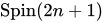
Finally, every compact, connected, simply-connected Lie group K is a product of finitely many compact, connected, simply-connected simple Lie groups Ki each of which is isomorphic to exactly one of the following:
- The compact symplectic group
- The special unitary group
- The spin group
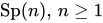
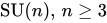

or one of the five exceptional groups G2, F4, E6, E7, and E8. The restrictions on n are to avoid special isomorphisms among the various families for small values of n. For each of these groups, the center is known explicitly. The classification is through the associated root system (for a fixed maximal torus), which in turn are classified by their Dynkin diagrams.
The classification of compact, simply connected Lie groups is the same as the classification of complex semisimple Lie algebras. Indeed, if K is a simply connected compact Lie group, then the complexification of the Lie algebra of K is semisimple. Conversely, every complex semisimple Lie algebra has a compact real form isomorphic to the Lie algebra of a compact, simply connected Lie group.
Maximal tori and root systems
[edit]A key idea in the study of a connected compact Lie group K is the concept of a maximal torus, that is a subgroup T of K that is isomorphic to a product of several copies of and that is not contained in any larger subgroup of this type. A basic example is the case , in which case we may take to be the group of diagonal elements in . A basic result is the torus theorem which states that every element of belongs to a maximal torus and that all maximal tori are conjugate.


The maximal torus in a compact group plays a role analogous to that of the Cartan subalgebra in a complex semisimple Lie algebra. In particular, once a maximal torus has been chosen, one can define a root system and a Weyl group similar to what one has for semisimple Lie algebras.[3] These structures then play an essential role both in the classification of connected compact groups (described above) and in the representation theory of a fixed such group (described below).

The root systems associated to the simple compact groups appearing in the classification of simply connected compact groups are as follows:[4]
- The special unitary groups correspond to the root system
- The odd spin groups correspond to the root system
- The compact symplectic groups correspond to the root system
- The even spin groups correspond to the root system
- The exceptional compact Lie groups correspond to the five exceptional root systems G2, F4, E6, E7, or E8




Fundamental group and center
[edit]It is important to know whether a connected compact Lie group is simply connected, and if not, to determine its fundamental group. For compact Lie groups, there are two basic approaches to computing the fundamental group. The first approach applies to the classical compact groups , , , and and proceeds by induction on . The second approach uses the root system and applies to all connected compact Lie groups.


It is also important to know the center of a connected compact Lie group. The center of a classical group can easily be computed "by hand," and in most cases consists simply of whatever roots of the identity are in . (The group SO(2) is an exception—the center is the whole group, even though most elements are not roots of the identity.) Thus, for example, the center of consists of nth roots of unity times the identity, a cyclic group of order .

In general, the center can be expressed in terms of the root lattice and the kernel of the exponential map for the maximal torus.[5] The general method shows, for example, that the simply connected compact group corresponding to the exceptional root system has trivial center. Thus, the compact group is one of very few simple compact groups that are simultaneously simply connected and center free. (The others are and .)


Further examples
[edit]Amongst groups that are not Lie groups, and so do not carry the structure of a manifold, examples are the additive group Zp of p-adic integers, and constructions from it. In fact any profinite group is a compact group. This means that Galois groups are compact groups, a basic fact for the theory of algebraic extensions in the case of infinite degree.
Pontryagin duality provides a large supply of examples of compact commutative groups. These are in duality with abelian discrete groups.
Haar measure
[edit]Compact groups all carry a Haar measure,[6] which will be invariant by both left and right translation (the modulus function must be a continuous homomorphism to positive reals (R+, ×), and so 1). In other words, these groups are unimodular. Haar measure is easily normalized to be a probability measure, analogous to dθ/2π on the circle.
Such a Haar measure is in many cases easy to compute; for example for orthogonal groups it was known to Adolf Hurwitz, and in the Lie group cases can always be given by an invariant differential form. In the profinite case there are many subgroups of finite index, and Haar measure of a coset will be the reciprocal of the index. Therefore, integrals are often computable quite directly, a fact applied constantly in number theory.
If is a compact group and is the associated Haar measure, the Peter–Weyl theorem provides a decomposition of as an orthogonal direct sum of finite-dimensional subspaces of matrix entries for the irreducible representations of .


Representation theory
[edit]The representation theory of compact groups (not necessarily Lie groups and not necessarily connected) was founded by the Peter–Weyl theorem.[7] Hermann Weyl went on to give the detailed character theory of the compact connected Lie groups, based on maximal torus theory.[8] The resulting Weyl character formula was one of the influential results of twentieth century mathematics. The combination of the Peter–Weyl theorem and the Weyl character formula led Weyl to a complete classification of the representations of a connected compact Lie group; this theory is described in the next section.
A combination of Weyl's work and Cartan's theorem gives a survey of the whole representation theory of compact groups G. That is, by the Peter–Weyl theorem the irreducible unitary representations ρ of G are into a unitary group (of finite dimension) and the image will be a closed subgroup of the unitary group by compactness. Cartan's theorem states that Im(ρ) must itself be a Lie subgroup in the unitary group. If G is not itself a Lie group, there must be a kernel to ρ. Further one can form an inverse system, for the kernel of ρ smaller and smaller, of finite-dimensional unitary representations, which identifies G as an inverse limit of compact Lie groups. Here the fact that in the limit a faithful representation of G is found is another consequence of the Peter–Weyl theorem.
The unknown part of the representation theory of compact groups is thereby, roughly speaking, thrown back onto the complex representations of finite groups. This theory is rather rich in detail, but is qualitatively well understood.
Representation theory of a connected compact Lie group
[edit]Certain simple examples of the representation theory of compact Lie groups can be worked out by hand, such as the representations of the rotation group SO(3), the special unitary group SU(2), and the special unitary group SU(3). We focus here on the general theory. See also the parallel theory of representations of a semisimple Lie algebra.
Throughout this section, we fix a connected compact Lie group K and a maximal torus T in K.
Representation theory of T
[edit]Since T is commutative, Schur's lemma tells us that each irreducible representation of T is one-dimensional:


Since, also, T is compact, must actually map into .

To describe these representations concretely, we let be the Lie algebra of T and we write points as



In such coordinates, will have the form
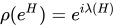
for some linear functional on .

Now, since the exponential map is not injective, not every such linear functional gives rise to a well-defined map of T into . Rather, let denote the kernel of the exponential map:



where is the identity element of T. (We scale the exponential map here by a factor of in order to avoid such factors elsewhere.) Then for to give a well-defined map , must satisfy


where is the set of integers.[9] A linear functional satisfying this condition is called an analytically integral element. This integrality condition is related to, but not identical to, the notion of integral element in the setting of semisimple Lie algebras.[10]

Suppose, for example, T is just the group of complex numbers of absolute value 1. The Lie algebra is the set of purely imaginary numbers, and the kernel of the (scaled) exponential map is the set of numbers of the form where is an integer. A linear functional takes integer values on all such numbers if and only if it is of the form for some integer . The irreducible representations of T in this case are one-dimensional and of the form





Representation theory of K
[edit]


We now let denote a finite-dimensional irreducible representation of K (over ). We then consider the restriction of to T. This restriction is not irreducible unless is one-dimensional. Nevertheless, the restriction decomposes as a direct sum of irreducible representations of T. (Note that a given irreducible representation of T may occur more than once.) Now, each irreducible representation of T is described by a linear functional as in the preceding subsection. If a given occurs at least once in the decomposition of the restriction of to T, we call a weight of . The strategy of the representation theory of K is to classify the irreducible representations in terms of their weights.


We now briefly describe the structures needed to formulate the theorem; more details can be found in the article on weights in representation theory. We need the notion of a root system for K (relative to a given maximal torus T). The construction of this root system is very similar to the construction for complex semisimple Lie algebras. Specifically, the weights are the nonzero weights for the adjoint action of T on the complexified Lie algebra of K. The root system R has all the usual properties of a root system, except that the elements of R may not span .[11] We then choose a base for R and we say that an integral element is dominant if for all . Finally, we say that one weight is higher than another if their difference can be expressed as a linear combination of elements of with non-negative coefficients.


The irreducible finite-dimensional representations of K are then classified by a theorem of the highest weight,[12] which is closely related to the analogous theorem classifying representations of a semisimple Lie algebra. The result says that:
- every irreducible representation has highest weight,
- the highest weight is always a dominant, analytically integral element,
- two irreducible representations with the same highest weight are isomorphic, and
- every dominant, analytically integral element arises as the highest weight of an irreducible representation.
The theorem of the highest weight for representations of K is then almost the same as for semisimple Lie algebras, with one notable exception: The concept of an integral element is different. The weights of a representation are analytically integral in the sense described in the previous subsection. Every analytically integral element is integral in the Lie algebra sense, but not the other way around.[13] (This phenomenon reflects that, in general, not every representation of the Lie algebra comes from a representation of the group K.) On the other hand, if K is simply connected, the set of possible highest weights in the group sense is the same as the set of possible highest weights in the Lie algebra sense.[14]

The Weyl character formula
[edit]If is representation of K, we define the character of to be the function given by



- .

This function is easily seen to be a class function, i.e., for all and in K. Thus, is determined by its restriction to T.



The study of characters is an important part of the representation theory of compact groups. One crucial result, which is a corollary of the Peter–Weyl theorem, is that the characters form an orthonormal basis for the set of square-integrable class functions in K. A second key result is the Weyl character formula, which gives an explicit formula for the character—or, rather, the restriction of the character to T—in terms of the highest weight of the representation.
In the closely related representation theory of semisimple Lie algebras, the Weyl character formula is an additional result established after the representations have been classified. In Weyl's analysis of the compact group case, however, the Weyl character formula is actually a crucial part of the classification itself. Specifically, in Weyl's analysis of the representations of K, the hardest part of the theorem—showing that every dominant, analytically integral element is actually the highest weight of some representation—is proved in a totally different way from the usual Lie algebra construction using Verma modules. In Weyl's approach, the construction is based on the Peter–Weyl theorem and an analytic proof of the Weyl character formula.[15] Ultimately, the irreducible representations of K are realized inside the space of continuous functions on K.
The SU(2) case
[edit]We now consider the case of the compact group SU(2). The representations are often considered from the Lie algebra point of view, but we here look at them from the group point of view. We take the maximal torus to be the set of matrices of the form
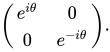
According to the example discussed above in the section on representations of T, the analytically integral elements are labeled by integers, so that the dominant, analytically integral elements are non-negative integers . The general theory then tells us that for each , there is a unique irreducible representation of SU(2) with highest weight .
Much information about the representation corresponding to a given is encoded in its character. Now, the Weyl character formula says, in this case, that the character is given by

We can also write the character as sum of exponentials as follows:

(If we use the formula for the sum of a finite geometric series on the above expression and simplify, we obtain the earlier expression.)
From this last expression and the standard formula for the character in terms of the weights of the representation, we can read off that the weights of the representation are

each with multiplicity one. (The weights are the integers appearing in the exponents of the exponentials and the multiplicities are the coefficients of the exponentials.) Since there are weights, each with multiplicity 1, the dimension of the representation is . Thus, we recover much of the information about the representations that is usually obtained from the Lie algebra computation.

An outline of the proof
[edit]We now outline the proof of the theorem of the highest weight, following the original argument of Hermann Weyl. We continue to let be a connected compact Lie group and a fixed maximal torus in . We focus on the most difficult part of the theorem, showing that every dominant, analytically integral element is the highest weight of some (finite-dimensional) irreducible representation.[16]
The tools for the proof are the following:
- The torus theorem.
- The Weyl integral formula.
- The Peter–Weyl theorem for class functions, which states that the characters of the irreducible representations form an orthonormal basis for the space of square integrable class functions on .
With these tools in hand, we proceed with the proof. The first major step in the argument is to prove the Weyl character formula. The formula states that if is an irreducible representation with highest weight , then the character of satisfies:
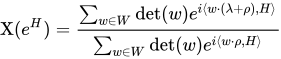
for all in the Lie algebra of . Here is half the sum of the positive roots. (The notation uses the convention of "real weights"; this convention requires an explicit factor of in the exponent.) Weyl's proof of the character formula is analytic in nature and hinges on the fact that the norm of the character is 1. Specifically, if there were any additional terms in the numerator, the Weyl integral formula would force the norm of the character to be greater than 1.


Next, we let denote the function on the right-hand side of the character formula. We show that even if is not known to be the highest weight of a representation, is a well-defined, Weyl-invariant function on , which therefore extends to a class function on . Then using the Weyl integral formula, one can show that as ranges over the set of dominant, analytically integral elements, the functions form an orthonormal family of class functions. We emphasize that we do not currently know that every such is the highest weight of a representation; nevertheless, the expressions on the right-hand side of the character formula gives a well-defined set of functions , and these functions are orthonormal.

Now comes the conclusion. The set of all —with ranging over the dominant, analytically integral elements—forms an orthonormal set in the space of square integrable class functions. But by the Weyl character formula, the characters of the irreducible representations form a subset of the 's. And by the Peter–Weyl theorem, the characters of the irreducible representations form an orthonormal basis for the space of square integrable class functions. If there were some that is not the highest weight of a representation, then the corresponding would not be the character of a representation. Thus, the characters would be a proper subset of the set of 's. But then we have an impossible situation: an orthonormal basis (the set of characters of the irreducible representations) would be contained in a strictly larger orthonormal set (the set of 's). Thus, every must actually be the highest weight of a representation.
Duality
[edit]The topic of recovering a compact group from its representation theory is the subject of the Tannaka–Krein duality, now often recast in terms of Tannakian category theory.
From compact to non-compact groups
[edit]The influence of the compact group theory on non-compact groups was formulated by Weyl in his unitarian trick. Inside a general semisimple Lie group there is a maximal compact subgroup, and the representation theory of such groups, developed largely by Harish-Chandra, uses intensively the restriction of a representation to such a subgroup, and also the model of Weyl's character theory.
See also
[edit]References
[edit]- ^ Hall 2015 Section 1.2
- ^ Bröcker & tom Dieck 1985, Chapter V, Sections 7 and 8
- ^ Hall 2015 Chapter 11
- ^ Hall 2015 Section 7.7
- ^ Hall 2015 Section 13.8
- ^ Weil, André (1940), L'intégration dans les groupes topologiques et ses applications, Actualités Scientifiques et Industrielles, vol. 869, Paris: Hermann
- ^ Peter, F.; Weyl, H. (1927), "Die Vollständigkeit der primitiven Darstellungen einer geschlossenen kontinuierlichen Gruppe", Math. Ann., 97: 737–755, doi:10.1007/BF01447892.
- ^ Hall 2015 Part III
- ^ Hall 2015 Proposition 12.9
- ^ Hall 2015 Section 12.2
- ^ Hall 2015 Section 11.7
- ^ Hall 2015 Chapter 12
- ^ Hall 2015 Section 12.2
- ^ Hall 2015 Corollary 13.20
- ^ Hall 2015 Sections 12.4 and 12.5
- ^ Hall 2015 Sections 12.4 and 12.5
Bibliography
[edit]- Bröcker, Theodor; tom Dieck, Tammo (1985), Representations of Compact Lie Groups, Graduate Texts in Mathematics, vol. 98, Springer
- Hall, Brian C. (2015), Lie Groups, Lie Algebras, and Representations An Elementary Introduction, Graduate Texts in Mathematics, vol. 222 (2nd ed.), Springer, ISBN 978-3319134666
- Hofmann, Karl H.; Morris, Sidney A. (1998), The structure of compact groups, Berlin: de Gruyter, ISBN 3-11-015268-1
Compact group
View on GrokipediaDefinition and properties
Definition
In mathematics, a compact group is a topological group in which the underlying topological space is compact, meaning that every open cover of admits a finite subcover.[9] Compact groups are typically assumed to be Hausdorff, ensuring that the topology separates points.[9] For a Hausdorff compact group, equivalent formulations arise in the metrizable case: the induced uniformity makes a complete and totally bounded metric space.[9] More generally, arbitrary products of compact groups are compact by Tychonoff's theorem, facilitating the study of infinite-dimensional examples via inverse limits.[9] The term and concept of compact groups were introduced by Hermann Weyl in 1925, initially in the context of representation theory for compact Lie groups such as the special unitary group .[10] This framework was later generalized beyond Lie groups. A basic non-trivial example is the circle group , consisting of complex numbers of modulus 1 under multiplication, which is compact as a subset of .[9] Compactness ensures the existence of a bi-invariant Haar measure on .[9]Basic topological and algebraic properties
In a compact topological group , the inversion map is a continuous homeomorphism, and the multiplication map from to is continuous and uniformly continuous with respect to the respective uniform structures on and .[11] The continuity of these operations follows from the definition of a topological group, but compactness ensures additional regularity: specifically, the uniform continuity of multiplication arises because is compact and the map is continuous, implying that preimages of entourages (basic neighborhoods in the uniform structure) are open and thus contain compact sets whose finite covers yield uniform bounds.[11] A sketch of the proof for uniform continuity involves showing that for any entourage in the uniformity of , the preimage under multiplication is an open set in ; since is compact, this preimage admits a finite cover by basic entourages, establishing the uniform property.[11] The conjugacy class of any element , defined as , is the continuous image of the compact space under the map , and thus compact.[11] Since is Hausdorff, this image is also closed, making each conjugacy class a compact closed subset of .[11] If is discrete, its compactness implies that is finite, so every conjugacy class is finite.[11] Compact groups have no small subgroups, meaning there exists a neighborhood of the identity such that no nontrivial subgroup of is contained in .[11] This contrasts with the local structure of noncompact Lie groups, where neighborhoods of the identity approximate Lie algebra elements but do not form subgroups globally. The proof relies on compactness: if every neighborhood contained a nontrivial subgroup, repeated generation would yield a proper closed infinite subgroup whose compactness leads to a contradiction via finite index or covering arguments.[11] A key consequence of compactness is that for any neighborhood of the identity , the collection of left translates forms an open cover of . By compactness, there exists a finite subcover, soExamples
Abelian compact groups
Abelian compact groups form an important subclass of compact groups, characterized by their commutative operation, which simplifies their structural analysis through tools like Pontryagin duality. These groups arise naturally in harmonic analysis and topological group theory, where their duals provide insights into discrete structures.[12] A fundamental result is Pontryagin duality, which establishes that every compact abelian group is topologically isomorphic to the Pontryagin dual of some discrete abelian group. Specifically, the Pontryagin dual of consists of all continuous homomorphisms from to the circle group , equipped with the compact-open topology, and this dual is discrete. Conversely, the dual of a discrete abelian group is compact abelian. This duality interchanges compactness and discreteness, enabling a complete classification via the structure of discrete abelian groups, which decompose as direct sums of cyclic groups.[12] The algebraic and topological structure of compact abelian groups reflects this duality: every such group decomposes as a topological direct product , where is the connected component of the identity (a compact connected abelian group) and is totally disconnected. The connected part is divisible in the case of tori. Examples of include finite-dimensional tori , which occur when is a Lie group, and more generally solenoid groups, which are non-Lie connected compact abelian groups.[13] The totally disconnected part is profinite, meaning it is the inverse limit of an inverse system of finite abelian groups under continuous surjective homomorphisms. In general, compact abelian groups themselves can be viewed through this lens, with the theorem that they arise as inverse limits of finite abelian groups capturing the profinite component's role in the overall decomposition.[14][12] Representative examples illustrate this structure. The -torus , for finite , is a connected compact abelian Lie group, serving as the dual of the discrete group ; it exemplifies the connected divisible case and appears in applications like multidimensional Fourier analysis. Profinite completions provide totally disconnected examples, such as the -adic integers for a prime , which is the inverse limit and the dual of the Prüfer -group ; this group is torsion-free and metrizable. An uncountable torsion-free example is the additive group of the -adic integers , which is homeomorphic to the Cantor set and highlights the existence of non-Lie compact abelian structures beyond finite products.[14][12]Compact Lie groups
A compact Lie group is a Lie group endowed with a compact topology, where a Lie group is defined as a smooth manifold $ G $ equipped with a group structure such that the multiplication map $ m: G \times G \to G $ and the inversion map $ i: G \to G $ are smooth.[15][16] The compatibility between the manifold structure and the group operations ensures that the topology on $ G $ serves as both a manifold topology and a topological group topology, making every compact Lie group a compact topological group.[17] This compactness imposes strong restrictions on the group's structure, distinguishing compact Lie groups from non-compact ones like $ \mathrm{SL}(n, \mathbb{R}) $.[18] Prominent examples of compact Lie groups include the classical series: the special orthogonal groups $ \mathrm{SO}(n) $ consisting of $ n \times n $ real orthogonal matrices with determinant 1, the special unitary groups $ \mathrm{SU}(n) $ of $ n \times n $ complex unitary matrices with determinant 1, the unitary groups $ \mathrm{U}(n) $, and the compact symplectic groups $ \mathrm{Sp}(n) $ acting as quaternionic isometries on $ \mathbb{H}^n $.[18][17] Additionally, there are five exceptional compact simple Lie groups: $ G_2 $, $ F_4 $, $ E_6 $, $ E_7 $, and $ E_8 $, which arise from unique root systems and have dimensions 14, 52, 78, 133, and 248, respectively.[18][17] These groups, along with their products and finite covers like the spin groups $ \mathrm{Spin}(n) $, illustrate the diversity within this class.[18] Compactness yields distinctive algebraic properties for these groups. On the Lie algebra $ \mathfrak{g} $, the Killing form $ K(X, Y) = \operatorname{tr}(\operatorname{ad}_X \operatorname{ad}_Y) $ is negative definite for any nonzero $ X \in \mathfrak{g} $ when $ \mathfrak{g} $ is semisimple, providing an Ad-invariant inner product that endows $ \mathfrak{g} $ with a positive definite metric via $ -\langle X, Y \rangle = -K(X, Y) $.[19][20] Furthermore, all adjoint orbits under the action $ \operatorname{Ad}: G \to \mathrm{GL}(\mathfrak{g}) $ are closed, as the image of the compact group $ G $ under the continuous adjoint map is compact and hence closed in the Hausdorff topology of $ \mathfrak{g} $.[18] These features facilitate the study of representations and structure, with classification relying on root systems associated to maximal tori.[17]Totally disconnected compact groups
A totally disconnected compact group is a compact topological group in which the connected component of the identity element is trivial, meaning that the only connected subgroups are the trivial one.[21] Equivalently, such a group admits a basis of neighborhoods of the identity consisting of open subgroups, ensuring that every neighborhood of the identity contains no nontrivial connected subsets.[22] The structure of totally disconnected compact groups is captured by their identification as profinite groups, which are inverse limits of finite discrete groups.[9] A fundamental theorem states that every totally disconnected compact group is profinite, possessing a basis of neighborhoods of the identity formed by open normal subgroups of finite index.[21] This profinite nature implies that these groups are Stone spaces in their dual formulation, with the topology arising from the inverse limit construction.[23] Representative examples include the profinite completion of the integers, denoted , which is the inverse limit and serves as the universal profinite quotient of .[24] Another key example is the general linear group over the -adic integers for a prime , which is compact and totally disconnected as a -adic Lie group without a nontrivial connected component.[25] Additionally, closed automorphism groups of locally finite trees, such as certain rigid trees, yield compact totally disconnected subgroups when restricted to fixed-point-free actions preserving the tree structure.[21] These groups find significant applications in number theory, particularly through their role as absolute Galois groups, which are profinite and thus totally disconnected compact, governing the structure of algebraic extensions via the Krull topology.[23] For instance, the absolute Galois group of the rationals exemplifies how such structures encode infinite Galois theory, with fixed fields corresponding to open normal subgroups.[26] Haar measure on these groups exists and is normalized on compact open subgroups, facilitating integration over profinite completions in analytic number theory.[9]Haar measure
Existence and uniqueness
A Haar measure on a compact group is defined as a regular Borel measure on that is left-invariant, meaning for all and Borel sets , non-zero and finite on compact sets (with ), and positive on non-empty open sets.[27][1] This measure induces a left-invariant integral on continuous functions , satisfyingProperties and normalization
One key property of the Haar measure on a compact group is its bi-invariance: the left-invariant Haar measure is also right-invariant, meaning for all measurable and .[1] This follows from the fact that compact groups are unimodular, so the modular function satisfies for all .[29] It is conventional to normalize the Haar measure on a compact group such that , making it a probability measure.[30] For a closed subgroup , the quotient space inherits a unique Haar measure from , defined via the disintegration formulaStructure of compact groups
General structure theorem
The general structure theorem for compact groups, primarily due to the work of Andrew M. Gleason, Hidehiko Yamabe, Deane Montgomery, and Leo Zippin, characterizes their algebraic and topological form in terms of Lie and profinite components. Specifically, every connected compact Hausdorff group is a Lie group. This resolves the compact case of Hilbert's fifth problem, affirming that connectedness and compactness suffice for the group to admit a compatible Lie group structure, with smooth manifold topology and Lie algebra. More globally, every compact group arises as an extension of a compact Lie group by a profinite group: there exists a closed normal compact Lie subgroup (the connected component of the identity) such that the quotient is a totally disconnected compact group, hence profinite.[33] This structure implies that compact groups are pro-Lie groups, meaning they are inverse limits of Lie groups. To see this, given any neighborhood of the identity in a compact Hausdorff group , there exists a compact normal subgroup such that is a Lie group (in fact, linear over ). Iterating over a basis of neighborhoods yields a system of surjective homomorphisms from onto Lie groups with kernels forming a basis of neighborhoods, establishing the inverse limit description. Profinite groups themselves fit as the totally disconnected case, being inverse limits of finite discrete groups.[33] The proof outline leverages the no small subgroups (NSS) property: a topological group has NSS if there exists a neighborhood of the identity containing no nontrivial proper subgroup. Locally compact groups with NSS are precisely the Lie groups. For compact , the Peter–Weyl theorem provides faithful finite-dimensional unitary representations, allowing linearization and approximation. One constructs open normal subgroups by quotienting out small kernels where the image inherits NSS (via metric approximations and continuity arguments), ensuring the quotients are Lie; the compactness ensures the kernels are compact and normal. This approximation process yields the Lie-by-profinite extension and the pro-Lie inverse limit.[33] A key corollary is that the dimension of a compact group is well-defined as the dimension of its maximal connected Lie subgroup (the connected component of the identity), which coincides with the dimension of the associated Lie algebra. This dimension is invariant under the approximations and finite quotients in the structure theorem, providing a measure of the "Lie part" even for infinite-dimensional profinite extensions. For example, the additive group of -adic integers has dimension 0, as it is profinite with trivial connected component.[33]Structure of compact Lie groups
Compact Lie groups exhibit a canonical decomposition that separates their abelian and semisimple components. For a connected compact Lie group with Lie algebra , the Lie algebra decomposes as , where is the center of (an abelian Lie algebra) and is semisimple.[34] At the group level, , where denotes the connected component of the identity in the center of (a torus) and is the commutator subgroup, a closed connected semisimple Lie subgroup with finite center.[35] In the semisimple case, where is trivial, the adjoint representation of is faithful, with kernel precisely , which is finite.[35] Consequently, the adjoint form has trivial center and acts faithfully via the adjoint representation; if the Lie algebra of is simple, then is a simple Lie group.[35] Simply connected compact Lie groups admit a product decomposition into a torus and a product of simple simply connected compact Lie groups, reflecting the direct sum structure of their semisimple Lie algebras.[36] This structure underscores the reductive nature of compact Lie algebras and facilitates the study of representations and homomorphisms.[35]Classification and geometry of compact Lie groups
Classification by rank and type
The classification of simple compact Lie algebras over the real numbers, which underpin the structure of simple compact Lie groups, divides them into four infinite families of classical types and five exceptional types, as established by the work of Killing and Cartan.[18] The classical families are A_n (corresponding to the special unitary Lie algebra su(n+1)), B_n (odd orthogonal so(2n+1)), C_n (compact symplectic sp(n)), and D_n (even orthogonal so(2n)), while the exceptional families are G_2, F_4, E_6, E_7, and E_8.[37][38] The rank of a simple compact Lie algebra is the dimension of its Cartan subalgebra, or equivalently, the dimension of the maximal torus in the corresponding Lie group. For the classical types A_n, B_n, C_n, and D_n, the rank is n (with n ≥ 1 for A_n, n ≥ 2 for B_n, n ≥ 3 for C_n to exclude isomorphisms C_1 ≅ A_1 and C_2 ≅ B_2, and n ≥ 4 for D_n to exclude D_2 ≅ A_1 × A_1 (not simple) and D_3 ≅ A_3). The exceptional types have fixed ranks: 2 for G_2, 4 for F_4, 6 for E_6, 7 for E_7, and 8 for E_8.[18][38] This distinction between classical (infinite families tied to matrix groups) and exceptional (finite, non-matrix-like) types highlights the organizational structure of the classification. Low-rank isomorphisms include A_1 ≅ B_1 ≅ C_1 and B_2 ≅ C_2.[37] Each simple complex semisimple Lie algebra admits a unique compact real form up to isomorphism, ensuring that the compact Lie groups associated with these algebras are determined uniquely by their underlying complex structure, modulo covering groups.[37][18] For instance, the Lie algebra su(2) of type A_1 is isomorphic to so(3) of type B_1, corresponding to the groups SU(2) and Spin(3), which are double covers of SO(3).[18] The following table summarizes the types, associated Lie algebras, ranks, dimensions (of the Lie algebra), and representative simply connected groups (noting low-rank isomorphisms: A_1 ≅ B_1 ≅ C_1 ≅ su(2); B_2 ≅ C_2; D_3 ≅ A_3):| Type | Lie Algebra | Rank | Dimension | Representative Group |
|---|---|---|---|---|
| A_n | su(n+1) | n | n(n+2) | SU(n+1) (e.g., SU(2) for n=1) |
| B_n | so(2n+1) | n | n(2n+1) | Spin(2n+1) (e.g., Spin(5) for n=2) |
| C_n | sp(n) | n | n(2n+1) | Sp(n) (e.g., Sp(3) for n=3) |
| D_n | so(2n) | n | n(2n-1) | Spin(2n) (e.g., Spin(6) for n=3) |
| G_2 | g_2 | 2 | 14 | G_2 |
| F_4 | f_4 | 4 | 52 | F_4 |
| E_6 | e_6 | 6 | 78 | E_6 |
| E_7 | e_7 | 7 | 133 | E_7 |
| E_8 | e_8 | 8 | 248 | E_8 |