Conformal geometric algebra
Main page

Conformal geometric algebra

logo
Community Hub0 subscribers
Read side by side
from Wikipedia

Conformal geometric algebra (CGA) is the geometric algebra constructed over the resultant space of a map from points in an n-dimensional base space Rp,q to null vectors in Rp+1,q+1. This allows operations on the base space, including reflections, rotations and translations to be represented using versors of the geometric algebra; and it is found that points, lines, planes, circles and spheres gain particularly natural and computationally amenable representations.

The effect of the mapping is that generalized (i.e. including zero curvature) k-spheres in the base space map onto (k + 2)-blades, and so that the effect of a translation (or any conformal mapping) of the base space corresponds to a rotation in the higher-dimensional space. In the algebra of this space, based on the geometric product of vectors, such transformations correspond to the algebra's characteristic sandwich operations, similar to the use of quaternions for spatial rotation in 3D, which combine very efficiently. A consequence of rotors representing transformations is that the representations of spheres, planes, circles and other geometrical objects, and equations connecting them, all transform covariantly. A geometric object (a k-sphere) can be synthesized as the wedge product of k + 2 linearly independent vectors representing points on the object; conversely, the object can be decomposed as the repeated wedge product of vectors representing k + 2 distinct points in its surface. Some intersection operations also acquire a tidy algebraic form: for example, for the Euclidean base space R3, applying the wedge product to the dual of the tetravectors representing two spheres produces the dual of the trivector representation of their circle of intersection.

As this algebraic structure lends itself directly to effective computation, it facilitates exploration of the classical methods of projective geometry and inversive geometry in a concrete, easy-to-manipulate setting. It has also been used as an efficient structure to represent and facilitate calculations in screw theory. CGA has particularly been applied in connection with the projective mapping of the everyday Euclidean space R3 into a five-dimensional vector space R4,1, which has been investigated for applications in robotics and computer vision. It can be applied generally to any pseudo-Euclidean space – for example, Minkowski space R3,1 to the space R4,2.

Construction of CGA

[edit]

Notation and terminology

[edit]

In this article, the focus is on the algebra as it is this particular algebra that has been the subject of most attention over time; other cases are briefly covered in a separate section. The space containing the objects being modelled is referred to here as the base space, and the algebraic space used to model these objects as the representation or conformal space. A homogeneous subspace refers to a linear subspace of the algebraic space.

The terms for objects: point, line, circle, sphere, quasi-sphere etc. are used to mean either the geometric object in the base space, or the homogeneous subspace of the representation space that represents that object, with the latter generally being intended unless indicated otherwise.[a] Algebraically, any nonzero null element of the homogeneous subspace will be used, with one element being referred to as normalized by some criterion.

Boldface lowercase Latin letters are used to represent position vectors from the origin to a point in the base space. Italic symbols are used for other elements of the representation space.

Base and representation spaces

[edit]

The base space R3 is represented by extending a basis for the displacements from a chosen origin and adding two basis vectors e and e+ orthogonal to the base space and to each other, with e2 = −1 and e+2 = +1, creating the representation space .

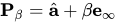
It is convenient to use two null vectors no and n as basis vectors in place of e+ and e, where no = (ee+)/2, and n = e + e+. It can be verified, where x is in the base space, that:

These properties lead to the following formulas for the basis vector coefficients of a general vector r in the representation space for a basis with elements ei orthogonal to every other basis element:

The coefficient of no for r is nr
The coefficient of n for r is nor
The coefficient of ei for r is ei−1r.

Mapping between the base space and the representation space

[edit]

The mapping from a vector in the base space (being from the origin to a point in the affine space represented) is given by the formula:[b]

Points and other objects that differ only by a nonzero scalar factor all map to the same object in the base space. When normalisation is desired, as for generating a simple reverse map of a point from the representation space to the base space or determining distances, the condition g(x) ⋅ n = −1 may be used.

Change of normalisation: mapping the null cone from the hyperplane r ⋅ (nno) = 1 to the hyperplane rn = −1.

The forward mapping is equivalent to:

  • first conformally projecting x from e123 onto a unit 3-sphere in the space e+e123 (in 5-D this is in the subspace r ⋅ (−no1/2n) = 0);
  • then lift this into a projective space, by adjoining e = 1, and identifying all points on the same ray from the origin (in 5-D this is in the subspace r ⋅ (−no1/2n) = 1);
  • then change the normalisation, so the plane for the homogeneous projection is given by the no co-ordinate having a value 1, i.e. rn = −1.

Inverse mapping

[edit]

An inverse mapping for X on the null cone is given (Perwass eqn 4.37) by
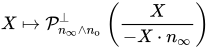
This first gives a stereographic projection from the light-cone onto the plane rn = −1, and then throws away the no and n parts, so that the overall result is to map all of the equivalent points αX = α(no + x + 1/2x2n) to x.

Origin and point at infinity

[edit]

The point x = 0 in Rp,q maps to no in Rp+1,q+1, so no is identified as the (representation) vector of the point at the origin.

A vector in Rp+1,q+1 with a nonzero n coefficient, but a zero no coefficient, must (considering the inverse map) be the image of an infinite vector in Rp,q. The direction n therefore represents the (conformal) point at infinity. This motivates the subscripts o and for identifying the null basis vectors.

The choice of the origin is arbitrary: any other point may be chosen, as the representation is of an affine space. The origin merely represents a reference point, and is algebraically equivalent to any other point. As with any translation, changing the origin corresponds to a rotation in the representation space.

Geometrical objects

[edit]

Basis

[edit]

Together with and , these are the 32 basis blades of the algebra. The Flat Point Origin is written as an outer product because the geometric product is of mixed grade.().

Basis blades of
Elements Geometric concept
Point and dual sphere
Without is dual plane
Point Pair
Bivector
Tangent vector
Direction vector (plus Bivector is Dual Line)
Flat Point Origin *
Circle
3D Pseudoscalar
Tangent Bivector
Direction Bivector (plus is the Line)
Sphere
Without is the Plane

As the solution of a pair of equations

[edit]

Given any nonzero blade A of the representing space, the set of vectors that are solutions to a pair of homogeneous equations of the form[3]

is the union of homogeneous 1-d subspaces of null vectors, and is thus a representation of a set of points in the base space. This leads to the choice of a blade A as being a useful way to represent a particular class of geometric objects. Specific cases for the blade A (independent of the number of dimensions of the space) when the base space is Euclidean space are:

  • a scalar: the empty set
  • a vector: a single point
  • a bivector: a pair of points
  • a trivector: a generalized circle
  • a 4-vector: a generalized sphere
  • etc.

These each may split into three cases according to whether A2 is positive, zero or negative, corresponding (in reversed order in some cases) to the object as listed, a degenerate case of a single point, or no points (where the nonzero solutions of XA exclude null vectors).

The listed geometric objects (generalized n-spheres) become quasi-spheres in the more general case of the base space being pseudo-Euclidean.[4]

Flat objects may be identified by the point at infinity being included in the solutions. Thus, if nA = 0, the object will be a line, plane, etc., for the blade A respectively being of grade 3, 4, etc.

As derived from points of the object

[edit]

A blade A representing of one of this class of object may be found as the outer product of linearly independent vectors representing points on the object. In the base space, this linear independence manifests as each point lying outside the object defined by the other points. So, for example, a fourth point lying on the generalized circle defined by three distinct points cannot be used as a fourth point to define a sphere.

odds

[edit]
Points in e123 map onto the null cone—the null parabola if we set .
We can consider the locus of points in e123 s.t. in conformal space , for various types of geometrical object A.
We start by observing that

compare:

  • x. a = 0 => x perp a; x.(a∧b) = 0 => x perp a and x perp b
  • x∧a = 0 => x parallel to a; x∧(a∧b) = 0 => x parallel to a or to b (or to some linear combination)

the inner product and outer product representations are related by dualisation

x∧A = 0 <=> x . A* = 0 (check—works if x is 1-dim, A is n-1 dim)

g(x) . A = 0

[edit]
  • A point: the locus of x in R3 is a point if A in R4,1 is a vector on the null cone.
(N.B. that because it's a homogeneous projective space, vectors of any length on a ray through the origin are equivalent, so g(x).A =0 is equivalent to g(x).g(a) = 0).
  • A sphere: the locus of x is a sphere if A = S, a vector off the null cone.
    If then S.X = 0 =>
    these are the points corresponding to a sphere
    for a vector S off the null-cone, which directions are hyperbolically orthogonal? (cf Lorentz transformation pix)
    in 2+1 D, if S is (1,a,b), (using co-ords e-, {e+, ei}), the points hyperbolically orthogonal to S are those euclideanly orthogonal to (−1,a,b)—i.e., a plane; or in n dimensions, a hyperplane through the origin. This would cut another plane not through the origin in a line (a hypersurface in an n-2 surface), and then the cone in two points (resp. some sort of n-3 conic surface). So it's going to probably look like some kind of conic. This is the surface that is the image of a sphere under g.
  • A plane: the locus of x is a plane if A = P, a vector with a zero no component. In a homogeneous projective space such a vector P represents a vector on the plane no = 1 that would be infinitely far from the origin (ie infinitely far outside the null cone), so g(x).P = 0 corresponds to x on a sphere of infinite radius, a plane.
    In particular:

  • corresponds to x on a plane with normal an orthogonal distance α from the origin.
  • corresponds to a plane half way between a and b, with normal a - b

  • circles
  • tangent planes
  • lines
  • lines at infinity
  • point pairs

Transformations

[edit]
  • reflections
It can be verified that forming P g(x) P gives a new direction on the null-cone, g(x' ), where x' corresponds to a reflection in the plane of points p in R3 that satisfy g(p) . P = 0.
g(x) . A = 0 => P g(x) . A P = 0 => P g(x) P . P A P (and similarly for the wedge product), so the effect of applying P sandwich-fashion to any the quantities A in the section above is similarly to reflect the corresponding locus of points x, so the corresponding circles, spheres, lines and planes corresponding to particular types of A are reflected in exactly the same way that applying P to g(x) reflects a point x.

This reflection operation can be used to build up general translations and rotations:

  • translations
Reflection in two parallel planes gives a translation,
If and then
  • rotations
corresponds to an x' that is rotated about the origin by an angle 2 θ where θ is the angle between a and b -- the same effect that this rotor would have if applied directly to x.

  • general rotations
rotations about a general point can be achieved by first translating the point to the origin, then rotating around the origin, then translating the point back to its original position, i.e. a sandwiching by the operator so
  • screws
the effect a screw, or motor, (a rotation about a general point, followed by a translation parallel to the axis of rotation) can be achieved by sandwiching g(x) by the operator .
M can also be parametrised (Chasles' theorem)
  • inversions
an inversion is a reflection in a sphere – various operations that can be achieved using such inversions are discussed at inversive geometry. In particular, the combination of inversion together with the Euclidean transformations translation and rotation is sufficient to express any conformal mapping – i.e. any mapping that universally preserves angles. (Liouville's theorem).
  • dilations
two inversions with the same centre produce a dilation.

Generalizations

[edit]

History

[edit]

Conferences and journals

[edit]

There is a vibrant and interdisciplinary community around Clifford and Geometric Algebras with a wide range of applications. The main conferences in this subject include the International Conference on Clifford Algebras and their Applications in Mathematical Physics (ICCA) and Applications of Geometric Algebra in Computer Science and Engineering (AGACSE) series. A main publication outlet is the Springer journal Advances in Applied Clifford Algebras.

Notes

[edit]

References

[edit]

Bibliography

[edit]
Revisions and contributorsEdit on WikipediaRead on Wikipedia
from Grokipedia
Conformal geometric algebra (CGA) is a model of geometric algebra that embeds n-dimensional Euclidean geometry into a Clifford algebra of signature (n+1,1), providing a unified algebraic framework for representing points, lines, planes, circles, spheres, and other primitives as blades (outer products of vectors), while treating transformations such as rotations, translations, reflections, inversions, and dilations as versors composed via the geometric product.[1] This embedding introduces two additional basis vectors, typically denoted e+e_+ and ee_- with signatures +1 and -1 respectively, from which the origin eo=12(ee+)e_o = \frac{1}{2}(e_- - e_+) and infinity e=e+e+e_\infty = e_- + e_+ are derived as null vectors satisfying eoe=1e_o \cdot e_\infty = -1 and eo2=e2=0e_o^2 = e_\infty^2 = 0; a point xx in Euclidean space is then represented as the null vector X=x+eo+12x2eX = x + e_o + \frac{1}{2}x^2 e_\infty, normalized such that Xe=1X \cdot e_\infty = -1.[1] Lines are constructed as the outer product of two points and ee_\infty, planes as the outer product of a line and another point or normal, circles as the wedge of three points, and spheres as the wedge of four points or dually as S=c12r2eS = c - \frac{1}{2}r^2 e_\infty where cc is the center and rr the radius.[1] The conformal metric preserves angles under transformations, enabling the full conformal group—including the Euclidean group as a subgroup—to be generated by rotors of the form R=eB/2R = e^{B/2} where BB is a bivector.[1] The conformal model was developed by David Hestenes as part of his foundational work on geometric algebra in the late 1980s and 1990s, building on earlier ideas from William Clifford and Hermann Grassmann to create a coordinate-free system that integrates vector analysis, complex numbers, and quaternions into a single structure; key publications include Hestenes and Sobczyk's 1984 book Clifford Algebra to Geometric Calculus[2], which provides foundational work on geometric algebra, and his 2001 article "Old Wine in New Bottles: A new algebraic framework for computational geometry,"[3] which formalized the model's application to Euclidean geometry. Subsequent advancements by researchers like Anthony Lasenby and Joan Lasenby in the early 2000s, including collaborations with Chris Doran, emphasized its projective and hybrid geometric capabilities, while Leo Dorst, Daniel Fontijne, and Stephen Mann popularized it through computational implementations in their 2007 book Geometric Algebra for Computer Science.[4][5] CGA's advantages lie in its compactness and efficiency for geometric computing: operations like intersection (via the meet product) and incidence (via the outer product) are direct algebraic, avoiding coordinate transformations and enabling parallelization on GPUs; it also unifies non-Euclidean geometries by treating spheres and hyperboloids naturally within the same framework.[1][5] Notable applications include computer graphics for ray tracing and animation, where spheres and circles are manipulated seamlessly; computer vision for pose estimation and 3D reconstruction; robotics for kinematic modeling and path planning; and physics simulations involving conformal mappings, such as in molecular modeling and electromagnetic field visualization.[4][5] Recent extensions apply CGA to mechanism design and geometric constraint solving, leveraging its primitive representations for compact formulations in engineering problems.[6]

Foundations

Definition and motivation

Conformal geometric algebra (CGA) is a specific instance of Clifford algebra, denoted as Cl_{n+1,1}, constructed over the Minkowski space \mathbb{R}^{n+1,1} with signature (n+1,1), where the base space is the Euclidean space \mathbb{R}^n embedded into this higher-dimensional structure to facilitate conformal mappings.[7] This embedding introduces two additional basis vectors, typically representing a point at infinity and the origin, enabling a projective and conformal extension of the original geometry.[8] The primary motivation for CGA arises from the need for a unified algebraic framework that integrates diverse geometric entities and transformations, simplifying computations in fields such as computer graphics, robotics, and physics.[9] Unlike traditional vector algebra, which handles points and vectors separately, or projective geometry, which requires homogeneous coordinates for incidences, CGA represents points, lines, circles, spheres, planes, and conformal transformations—including inversions, translations, and rotations—as elements within the same multivector space.[8] This approach leverages the geometric product's ability to encode both inner and outer products, allowing operations like intersections and unions to be expressed algebraically without coordinate-specific formulas.[7] A key advantage of the conformal model in CGA is its treatment of all geometric objects as blades (grade-specific multivectors), where incidence and tangency relations are determined directly via the inner product, often yielding simple scalar results like zero for tangency.[9] This contrasts sharply with conventional methods that demand distinct equations and algorithms for each object type, such as separate formulas for sphere-sphere intersections versus line-plane incidences, thereby reducing complexity and enhancing computational efficiency in applications like rigid body motion and shape analysis.[8]

Construction from base space

Conformal geometric algebra (CGA) is constructed by embedding the Euclidean base space Rn\mathbb{R}^n, equipped with the standard positive-definite inner product (dot product), into a higher-dimensional representation space that incorporates conformal properties such as inversion and allows uniform treatment of points at infinity.[10] This embedding preserves the Euclidean structure while extending it to handle spheres, planes, and other round objects algebraically. The representation space is the Minkowski space Rn+1,1\mathbb{R}^{n+1,1} with quadratic form signature (n+1,1)(n+1, 1), realized as the geometric algebra Cl(n+1,1)\mathrm{Cl}(n+1,1).[10] It is generated by adjoining two additional basis vectors to the Euclidean basis {e1,,en}\{e_1, \dots, e_n\} (with ei2=1e_i^2 = 1 and eiej=0e_i \cdot e_j = 0 for iji \neq j): the origin vector e0e_0 and the infinity vector ee_\infty, both null vectors satisfying e02=e2=0e_0^2 = e_\infty^2 = 0 and orthogonal in the sense that e0e=1e_0 \cdot e_\infty = -1. The embedded Euclidean vectors xRnx \in \mathbb{R}^n satisfy xe0=xe=0x \cdot e_0 = x \cdot e_\infty = 0. This structure ensures the algebra captures both finite and infinite geometries through null cones. A point xRnx \in \mathbb{R}^n is mapped to a conformal point XRn+1,1X \in \mathbb{R}^{n+1,1} via the embedding formula
X=e0+x+12x2e, X = e_0 + x + \frac{1}{2} x^2 e_\infty,
where x2=xxx^2 = x \cdot x. This representation is normalized such that Xe=1X \cdot e_\infty = -1, and for points at finite distance, XX is a null vector with X2=0X^2 = 0.[10] The embedding ensures that the inner product between two distinct conformal points XX and YY yields XY=12(xy)2X \cdot Y = -\frac{1}{2} (x - y)^2, directly giving the squared Euclidean distance up to a factor. To recover the original Euclidean point xx from the normalized conformal point XX, one projects onto the Euclidean subspace using the formula
x=X+(Xe0)e+(Xe)e0. x = X + (X \cdot e_0) e_\infty + (X \cdot e_\infty) e_0.
[8] This extracts the position vector by isolating the components in the original Euclidean basis, discarding the contributions from e0e_0 and ee_\infty.

Notation and key elements

In conformal geometric algebra (CGA), geometric entities are classified into flat objects, such as vectors and planes, which represent linear subspaces, and round objects, such as spheres and circles, which represent curved surfaces of constant curvature.[8] Blades refer to homogeneous multivectors formed as the outer product of linearly independent vectors, serving as the building blocks for representing subspaces of various dimensions.[8] Versors are invertible even multivectors generated as products of invertible vectors, functioning as generators for conformal transformations like rotations and translations.[8] The standard notation for CGA begins with the basis of the underlying Euclidean space Rn\mathbb{R}^n, denoted by orthonormal vectors e1,e2,,ene_1, e_2, \dots, e_n satisfying eiej=δije_i \cdot e_j = \delta_{ij} and ei2=1e_i^2 = 1. To embed this into the conformal model, two additional null vectors are introduced: e0e_0, representing the origin, and ee_\infty, representing the point at infinity, with e02=e2=0e_0^2 = e_\infty^2 = 0 and e0e=1e_0 \cdot e_\infty = -1.[8] The full basis for the conformal space Rn+1,1\mathbb{R}^{n+1,1} thus consists of {e0,e1,,en,e}\{e_0, e_1, \dots, e_n, e_\infty\}. The unit pseudoscalar EE is defined as the outer product E=e0e1eneE = e_0 \wedge e_1 \wedge \dots \wedge e_n \wedge e_\infty, satisfying E2=1E^2 = -1 and commuting with all even-grade elements, which enables duality operations throughout the algebra. Key elements in CGA include reciprocal frames, which are dual bases {fi}\{f_i\} satisfying fifj=δijf_i \cdot f_j = \delta_{ij}, allowing efficient representation of coordinates and projections in the algebra.[8] Weight normalization is applied to conformal objects AA (such as points or spheres) via the condition Ae=1A \cdot e_\infty = -1, ensuring consistent scaling and simplifying computations for intersections and tangencies.[8] The inner product plays a central role in defining incidence relations between objects; for instance, a point lies on a plane if their inner product vanishes, capturing geometric relationships like orthogonality or containment without coordinate transformations. The duality operator in CGA maps an object to its geometric complement using the pseudoscalar: for a multivector AA, the dual is A=EAE1A^* = -E A E^{-1}.[8] This operator interchanges representations, such as mapping a point to the plane through the origin perpendicular to the vector from the origin to that point, facilitating unified treatments of primal and dual geometries.

Geometric representations

Points, vectors, and infinity

In conformal geometric algebra (CGA), points in the underlying Euclidean space Rn\mathbb{R}^n are represented as null vectors in the higher-dimensional algebra Cl(n+1,1)\mathcal{Cl}(n+1,1). Specifically, a point with position vector xRnx \in \mathbb{R}^n is embedded as the multivector X=x+12x2e+e0X = x + \frac{1}{2} |x|^2 e_\infty + e_0, where e0e_0 and ee_\infty are additional basis vectors satisfying e02=0e_0^2 = 0, e2=0e_\infty^2 = 0, and e0e=1e_0 \cdot e_\infty = -1.[11] This representation ensures that XX is a null vector, meaning X2=0X^2 = 0, which geometrically corresponds to the point having zero distance to itself.[11] Additionally, the normalization condition Xe=1X \cdot e_\infty = -1 fixes the scale of the point representation, facilitating computations like distance measurements via the inner product XY=12xy2X \cdot Y = -\frac{1}{2} |x - y|^2. Direction vectors in CGA are derived as differences between point representations, yielding v=XYv = X - Y, which subtracts the conformal components to isolate the pure vector part in Rn\mathbb{R}^n.[11] These vectors retain their Euclidean interpretation and can also be expressed directly using the basis elements eie_i (for i=1,,ni = 1, \dots, n) of the original space, preserving operations like addition and scaling without the null vector structure.[11] This difference mechanism allows vectors to emerge naturally from point geometry, enabling seamless transitions between position and direction in algebraic expressions. The basis vector ee_\infty plays a central role in modeling infinity and directions at infinity within CGA.[11] It represents the point at infinity, where all parallel lines in the Euclidean space are considered to intersect, thus incorporating projective and homogeneous coordinates into the framework.[11] Planes passing through the origin are represented as grade-3 blades, such as the outer product of the normal's orthogonal complement basis and ee_\infty, aligning with the primal model where planes are trivectors in 3D.[11] This form captures the plane's orientation and its extension to infinity, distinguishing flat objects from finite ones. Incidence relations between points and geometric objects are determined using the inner product in CGA. For instance, two points XX and YY are incident on a third object ZZ (such as a plane or line) if (XY)Z=0(X - Y) \cdot Z = 0, which enforces that the vector between the points lies orthogonal to ZZ or satisfies the object's defining equation.[11] This dot product provides a scalar test for membership, aligning with the algebra's emphasis on geometric invariants. For normalized conformal point XX and object AA, incidence is given by XA=0X \cdot A = 0.

Spheres, circles, and planes

In conformal geometric algebra (CGA), spheres are represented in the dual model as vectors of the form $ S = C - \frac{1}{2} r^2 e_\infty $, where $ C = c + e_0 + \frac{1}{2} |c|^2 e_\infty $ is the conformal embedding of the center $ c \in \mathbb{R}^n $, $ r $ is the radius, $ e_0 $ represents the origin (a null vector), and $ e_\infty $ represents the point at infinity (another null vector).[12][13] In the primal model, spheres correspond to grade-4 blades from the outer product of four points, satisfying $ S \cdot e_\infty = 0 $ to ensure they are finite round objects in the conformal embedding.[12] This representation allows spheres to be treated uniformly with other geometric primitives through algebraic operations.[14] Circles in CGA are constructed as the intersection of two spheres, given by the outer (wedge) product $ C = S_1 \wedge S_2 $, which yields a grade-2 blade representing the oriented circle.[14] Alternatively, point pairs (degenerate circles) can be represented using the outer product of a sphere and the difference of two points, $ S \wedge (X_1 - X_2) $, where $ X_1 $ and $ X_2 $ are conformal points.[12] This formulation captures circles as round objects lying in a plane, facilitating computations like intersections and transformations without coordinate-specific adjustments.[14] Planes are modeled as infinite-radius spheres, or "∞-spheres," with the representation $ P = n + d e_\infty $, where $ n $ is the unit normal vector to the plane and $ d $ is the signed distance from the origin to the plane.[12] In this dual vector form, for normalized $ P $ with $ n^2 = 1 $, $ P^2 = 1 $, reflecting the Euclidean metric on the normal and the flat, infinite nature in the conformal space.[14] This aligns planes with the broader class of round and flat primitives, enabling unified algebraic manipulations.[12] Key properties of these objects are derived from inner products in CGA. For a normalized sphere ( $ S \cdot e_\infty = -1 $ ), the squared radius is computed as $ r^2 = S \cdot S $.[14] Incidence relations, such as a point $ X $ lying on a sphere $ S $, circle $ C $, or plane $ P $, are tested via the inner product condition $ X \cdot A = 0 $, where $ A $ is the respective object; a zero result indicates membership.[12][14]

Higher-order objects

In conformal geometric algebra (CGA), lines are constructed as the outer product (join) of two distinct points X1X_1 and X2X_2, yielding a grade-2 blade L=X1X2L = X_1 \wedge X_2.[15] This representation captures the unique line passing through the points in the Euclidean subspace, with the infinite point ee_\infty implicitly incorporated to handle flat geometry. Equivalently, a line can be viewed as a circle degenerate through infinity, where the outer product with ee_\infty enforces linearity. The dual of a line corresponds to the regressive product (meet) of a pair of planes, providing a complementary representation for incidence relations.[16] Composite objects arise naturally from intersections of primitives. For instance, a circle emerges as the join of a sphere SS (grade 1 in dual) and a plane PP (grade 1 in dual), given by the grade-2 blade C=SPC = S \wedge P, which geometrically traces their common curve. Similarly, a line is the join of two points, reinforcing the hierarchical construction from lower- to higher-order elements. These operations leverage the outer product to build subspaces containing the operands, enabling robust computation of derived geometries without coordinate singularities.[17] Higher-grade blades represent more complex objects such as reguli and quadrics. A regulus, a ruled surface consisting of mutually skew lines forming a hyperboloid or paraboloid, is encoded as a grade-3 blade B=abcB = a \wedge b \wedge c, where a,b,ca, b, c are lines or points defining the rulings around an axis with intersections on a perpendicular plane. This captures the regulus as the span of linear combinations of the generating elements, facilitating analysis of their geometric invariants like the axis and directrix. Quadrics, including general conic sections in higher dimensions, extend this via grade-4 or higher blades derived from multiple primitives.[18] Paraboloids and other conics are represented through specific multivector combinations incorporating ee_\infty to model degeneracy and curvature. An elliptic paraboloid, for example, can be constructed as the outer product of six control points q=x1x2x6q = x_1 \wedge x_2 \wedge \cdots \wedge x_6. Hyperbolic paraboloids follow analogously with appropriate sign changes, emphasizing saddle-like geometry. These constructions intersect the CGA embedding with a paraboloid sheet along the ee_\infty axis, projecting to conic loci in the base space.[19] Such objects can also be derived as loci of points satisfying algebraic constraints. For a line LL, the points XX lying on it solve the system (XL)e0=0(X \wedge L) \cdot e_0 = 0, where e0e_0 is the origin basis vector, ensuring the wedge product remains orthogonal to the origin in the incidence algebra. This approach generalizes to higher-order derivations, where solutions to multivector equations define the enclosing geometry from point sets.[15]

Algebraic structure

Basis and versors

Conformal geometric algebra (CGA) for an nn-dimensional Euclidean base space is realized as the Clifford algebra Cl(n+1,1)\mathrm{Cl}(n+1,1), which possesses a vector space dimension of 2n+22^{n+2}. This algebra is spanned by a graded orthogonal basis consisting of 2n+22^{n+2} elements, ranging from the grade-0 scalar 11 to the grade-(n+2)(n+2) pseudoscalar I=e1ene0eI = e_1 \wedge \cdots \wedge e_n \wedge e_0 \wedge e_\infty. The basis incorporates the nn orthonormal Euclidean vectors {e1,,en}\{e_1, \dots, e_n\} with ei2=1e_i^2 = 1 and eiej=0e_i \cdot e_j = 0 for iji \neq j, augmented by two additional null vectors: the origin e0e_0 and infinity ee_\infty, satisfying e02=e2=0e_0^2 = e_\infty^2 = 0 and e0e=1e_0 \cdot e_\infty = -1.[20] The full basis comprises all wedge products of these vectors, forming blades of various grades that represent oriented subspaces.[21] The graded structure of CGA partitions multivectors into even and odd grades, with the even subalgebra Cleven(n+1,1)\mathrm{Cl}^\mathrm{even}(n+1,1) generated by scalars and bivectors (and higher even grades), while the odd subalgebra includes vectors and odd-grade blades. Even-grade elements preserve orientation and form a group under the geometric product suitable for rotations and translations, whereas odd-grade elements reverse orientation and are associated with reflections.[20] Normalization in CGA often involves weights derived from the quadratic form; for instance, basis elements like points or spheres are normalized such that their inner product with themselves yields a specific value (e.g., XX=0X \cdot X = 0 for normalized points), ensuring consistent scaling in representations and transformations.[22] Versors in CGA are multivectors of the form V=i=1kaiV = \prod_{i=1}^k a_i, where each aia_i is a unit vector, or equivalently, for simple transformations, V=exp(B/2)V = \exp(B/2) with BB a bivector generating the transformation plane.[21] These versors act on multivector objects AA via the sandwich product A=VAV~A' = V A \tilde{V}, where V~\tilde{V} is the reverse of VV, preserving the grade and geometric type of AA. Even versors (rotors) maintain orientation and include compositions like rotations and translations, while odd versors (reflectors) invert it and are foundational for constructing even ones via products of two reflections.[20] Odd elements, in particular, play a role in defining object equations, such as the inner product condition g(x)A=0g(x) \cdot A = 0, where g(x)g(x) is an odd-grade generator and AA represents a geometric entity like a sphere.

Products and grades

In conformal geometric algebra (CGA), the geometric product serves as the fundamental binary operation, defined for any two multivectors AA and BB as AB=AB+ABAB = A \cdot B + A \wedge B, where ABA \cdot B is the inner product and ABA \wedge B is the outer product. This product is associative and distributive over addition, providing a universal framework that encompasses both the inner product, which captures symmetric interactions like distances, and the outer product, which generates antisymmetric combinations representing oriented subspaces. For vectors aa and bb, the inner product is the scalar ab=12(ab+ba)a \cdot b = \frac{1}{2}(ab + ba) and the outer product is the bivector ab=12(abba)a \wedge b = \frac{1}{2}(ab - ba), with the anticommutator {a,b}=ab+ba=2ab\{a, b\} = ab + ba = 2a \cdot b and commutator [a,b]=abba=2ab[a, b] = ab - ba = 2a \wedge b deriving these components.[16] The conformal product generalizes these operations in the conformal model, denoted as ABk\langle AB \rangle_k for the grade-kk projection of the geometric product ABAB, which extracts the kk-blade component of the result. This allows specialized inner products tailored to grades, such as the regressive product (or meet) \vee, used for intersections of objects, defined as the dual of the outer product of their duals, and the progressive product (or join) \wedge, used for unions like spans of points. Grade projections Ak\langle A \rangle_k decompose any multivector AA into its homogeneous components by grade kk, enabling derivations like the commutator for outer products and anticommutator for inner products, which underpin differential operations in the algebra.[16] Geometric objects in CGA are often normalized using inner product null space (IPNS) or outer product null space (OPNS) representations, distinguishing primal and dual forms. In IPNS, an object AA is represented such that points XX on it satisfy AX=0A \cdot X = 0, capturing intersections or incidences via the inner product null space, while OPNS uses AX=0A \wedge X = 0 for the outer product null space, defining spans or joins in the dual space. These dual equation pairs—AX=0A \cdot X = 0 for primal forms like spheres and AX=0A \wedge X = 0 for dual forms like point pairs—facilitate normalized representations, with IPNS preferred for transformation invariance and OPNS for constructive unions.[16]

Equations for objects

In conformal geometric algebra (CGA), geometric objects are often defined algebraically through their inner product null space (IPNS) representation, where an object is encoded as a multivector AA and the points XX lying on the object satisfy the equation XA=0X \cdot A = 0. This equation arises as the kernel of a linear map defined by the contraction with AA, capturing the geometric locus as the set of null vectors XX orthogonal to AA under the inner product. Such representations unify points, spheres, planes, circles, and higher-order primitives under a single framework, leveraging the graded structure of the algebra.[23] In general, for a multivector AA of grade kk, the condition XA=0X \cdot A = 0 sets the grade-(k-1) component to zero. In CGA, due to the conformal metric, this effectively provides a scalar constraint for membership on round objects. This graded decomposition allows precise membership tests and intersections without coordinate-specific formulas.[24] Objects can be derived from sets of points by fitting the multivector AA in a least-squares sense within the multivector space, minimizing the sum of squared norms of the relevant grade components of XiAX_i \cdot A over sample points XiX_i. For instance, to find a circle passing through three points in 2D CGA, solve for coefficients of AA (a grade-3 multivector) such that the grade-0 and grade-1 parts of each XiA=0X_i \cdot A = 0, yielding A=λjXjA = \sum \lambda_j X_j where the λj\lambda_j satisfy the resulting linear system; this approach extends to approximate fits for noisy data using standard least-squares optimization in the coefficient space. Such methods are computationally efficient due to the linearity in the algebra's basis.[25] Membership tests for points on objects often employ the embedded form g(x)A=0g(x) \cdot A = 0, where g(x)=x+12x2e+e0g(x) = x + \frac{1}{2} x^2 e_\infty + e_0 maps Euclidean points xx to normalized conformal points, incorporating the infinity ee_\infty and origin e0e_0 basis elements to preserve conformal invariance. This form ensures the equation aligns with the metric of the ambient space, allowing direct substitution for Euclidean coordinates in algebraic computations.[24] Odd-grade conditions appear in object equations to incorporate orientation or chirality, particularly for directed or signed primitives; for example, using odd-grade multivectors in the IPNS representation can encode oriented spheres or planes, where the odd part of AA determines the handedness via the sign in the inner product equation, enabling distinctions in applications like robotics or molecular modeling.[23]

Transformations

Rotors and translators

In conformal geometric algebra (CGA), rotors are even-grade versors that generate rotations in the Euclidean subspace, preserving angles and orientations. A rotor $ R $ for a rotation by angle $ \phi $ around a unit bivector $ B $ (with $ B^2 = -1 $) in the Euclidean plane is given by the exponential form $ R = \exp\left(-\frac{\phi}{2} B\right) $, where the transformation of a multivector $ X $ is applied as $ X' = R X \tilde{R} $ and $ \tilde{R} $ denotes the reverse of $ R $.[26] This formulation arises from composing two reflections over planes, ensuring the rotor lies in the even subalgebra and normalizes to unit magnitude for orthogonal transformations.[27] Translators in CGA represent Euclidean translations within the conformal model, leveraging the nilpotent structure of the infinity basis element $ e_\infty $ (with $ e_\infty^2 = 0 $). For a translation by a vector $ \mathbf{a} $ in direction $ \mathbf{e}i $, the translator $ T $ is $ T = \exp\left( \frac{1}{2} \mathbf{a} e\infty \right) $, or more precisely $ T = \exp\left( -\frac{t}{2} e_\infty \wedge \mathbf{e}_i \right) $ for distance $ t $ along unit vector $ \mathbf{e}_i $. The transformed point $ X' = T X \tilde{T} $ expands to $ X' = X + t \mathbf{e}i + $ higher-order terms that vanish due to the nilpotency of $ e\infty $, effectively embedding translations as exact Euclidean motions in the higher-dimensional conformal space.[26][28] Compositions of rotors and translators yield motors that describe screw motions, combining rotation and translation along a common axis. A general motor $ M = T R $ (or $ R T $, depending on order) generates such a rigid body motion, where the product simplifies due to the Clifford algebra structure; for instance, a screw motion by angle $ \phi $ around bivector $ P $ and translation $ \mathbf{a} $ parallel to the axis is $ M = \left[ \cos\left(\frac{\phi}{2}\right) + \sin\left(\frac{\phi}{2}\right) P \right] \left( 1 + \frac{1}{2} \mathbf{a} e_\infty \right) $. Simple rotors without translational components handle pure spins.[26][28] This approach unifies all Euclidean isometries—rotations and translations—as exponentials of bivectors in the CGA framework, integrating seamlessly with projective geometry by treating points at infinity and enabling compact representations for kinematics and computer graphics applications.[27][26]

Dilators and special conformal transformations

In conformal geometric algebra (CGA), dilators represent scaling transformations that enlarge or reduce geometric objects by a factor $ r $ relative to a specified center, preserving angles while altering distances. These transformations extend the isometries covered by rotors and translators by introducing non-uniform scaling, and they are typically realized through compositions involving spherical inversions rather than direct exponential forms for arbitrary centers. The generator for a dilation about the origin is the bivector $ e_0 e_\infty $, where $ e_0 $ and $ e_\infty $ are the basis vectors representing the origin and infinity, respectively; the rotor is given by $ D = \exp\left( \frac{\lambda}{2} e_0 e_\infty \log r \right) $, with $ \lambda $ adjusting the scaling parameter, applied via the sandwich product $ X' = D X \tilde{D} $ to a point $ X $.[26] Dilators map spheres to spheres and circles to circles, maintaining the conformal structure of the space, and their exponential form simplifies compositions with other transformations like rotations. For scaling about a general center $ m $, the dilator can be constructed as a commutator or via successive inversions in spheres centered at $ m $, ensuring the transformation aligns with the full conformal group. This approach leverages the null vector properties of points in CGA, where normalized points satisfy $ X \cdot e_\infty = -1 $, allowing dilations to adjust the Euclidean part while preserving the conformal embedding.[26] Special conformal transformations introduce "bending" effects, such as mapping straight lines to circles, and are essential for generating the full conformal group beyond rigid motions and scalings. These are represented by rotors generated by trivectors of the form $ e_0 \wedge e_\infty \wedge \mathbf{d} $, where $ \mathbf{d} $ is a unit direction vector; the rotor is $ K = \exp\left( \frac{\mu}{2} e_0 \wedge e_\infty \wedge \mathbf{d} \right) $, with $ \mu $ controlling the magnitude, and applied as $ X' = K X \tilde{K} $. Such transformations preserve circles and spheres, mapping them to equivalent objects, and are orientation-preserving components of the conformal group.[29][26] A key property is that translations can be derived from compositions of special conformal transformations: specifically, the translator $ T = K_1 K_2^{-1} $, where $ K_1 $ and $ K_2 $ are special conformals centered at distinct points, yields a pure translation without scaling or rotation. This composition highlights the generative power of special conformals within CGA, enabling the representation of the entire special conformal subgroup $ SO^+(p+1, q+1) $. In two dimensions, these transformations correspond to Möbius transformations, which map generalized circles (lines or circles) to generalized circles.[29] Inversions form the foundational odd elements of the conformal group in CGA, representing reflections across spheres that swap inside and outside while preserving angles. The inversion in a sphere $ S $ acts on a point $ X $ via $ X' = S X \tilde{S} / (S \cdot X) $, where points and spheres are appropriately normalized. For the unit sphere at the origin, the inversion is $ X' = -e_o X e_o $.[26][29] The conformal group in CGA is fundamentally generated by these inversions, as any conformal transformation can be decomposed into a sequence of spherical reflections, mirroring the Cartan-Dieudonné theorem for orthogonal transformations. This structure unifies dilators and special conformals as even parts derived from even numbers of inversions, with the full group isomorphic to $ O(p+1, q+1) $, acting linearly on the augmented space. In particular, the 2D case yields the Möbius group $ PSL(2,\mathbb{C}) $, generated by inversions in circles.[29]

Compositions and applications

In conformal geometric algebra (CGA), transformations are represented by versors, which are products of invertible even-grade elements that preserve the conformal structure. The general conformal versor $ V $ can be decomposed as a composition $ V = T R D K $, where $ T $ is a translator, $ R $ a rotor, $ D $ a dilator, and $ K $ a special conformal transformation; this factorization allows any orientation-preserving conformal map to be expressed compactly and applied via the sandwich product $ X' = V X \tilde{V} $ to geometric objects $ X $. For rigid body motions, which combine rotations and translations without scaling or inversion, the subalgebra of motors $ M = T R $ forms the conformal motor algebra, enabling unified representation of Euclidean isometries as even-grade multivectors that simplify kinematics and dynamics computations. In computer graphics, CGA facilitates efficient ray tracing by representing rays as lines and spheres (or other quadrics) as multivectors, where intersections are computed via the inner product nullifying to zero, such as $ A \cdot B = 0 $ for object $ A $ and ray $ B $, reducing the need for separate coordinate systems and enabling novel surface parameterizations like implicit quadrics.[30] Collision detection benefits similarly, as the geometric product allows direct testing of incidence between primitives (points, lines, circles, spheres) through grade selection from the product, with GPU-accelerated implementations achieving real-time performance for complex scenes by unifying collision types in a single algebraic framework. Applications in robotics leverage CGA for pose estimation, where dual quaternions—equivalent to the even subalgebra of 3D CGA—encode rigid transformations for aligning 3D models to 2D images via constraint equations on corresponding points, lines, or planes, improving robustness in visually guided systems.[31] Path planning employs conformal maps to interpolate trajectories around obstacles, representing robot configurations and constraints as spheres or flats, with optimization algorithms generating smooth, collision-free paths in cluttered environments.[32] In physics, CGA models geometric aspects of waves and relativity by embedding Minkowski spacetime in a conformal framework, where lightlike infinity $ e_\infty $ represents the light cone, allowing covariant descriptions of null geodesics and conformal symmetries without full metric distortions, though applications remain primarily geometric rather than dynamical. Numerical stability in CGA implementations is maintained by normalizing representatives, such as ensuring points satisfy $ X \cdot e_\infty = -1 $ to avoid singularities from the degenerate metric involving $ e_\infty $, which prevents exponential growth in computations during iterative transformations.

Extensions and relations

Generalizations to other dimensions

Conformal geometric algebra (CGA) generalizes naturally to higher-dimensional spaces by extending the underlying Clifford algebra from the standard Cl(4,1) for 3D Euclidean geometry to Cl(n+1,1) for an n-dimensional Euclidean base space R^n. This construction preserves the conformal embedding, allowing representations of spheres, planes, and other round objects as blades in the higher-dimensional algebra, with transformations unified under rotors. For instance, in 4D Euclidean space, Cl(5,1) enables modeling of hyperspheres and conformal mappings in computer graphics and robotics applications.[33] For base spaces with indefinite metrics, such as Minkowski spacetime R^{1,3} in relativity, the conformal extension uses signatures like Cl(2,4) or Cl(4,2), embedding the conformal group SO(4,2) within the Clifford algebra of 4D spacetime Cl(1,3). This timelike extension, often termed conformal spacetime algebra (CSTA) with signature Cl(4,2), facilitates the description of Lorentz transformations, dilatations, and special conformal mappings directly as versors, aiding analyses of wave propagation and gravitational effects. A variant, the 1d-up approach, reduces the dimension to Cl(4,1) for 4D spacetime geometry, avoiding the full 6D embedding while maintaining conformal properties. Recent work has extended CGA to Galilean spacetime, providing a conformal model for non-relativistic physics.[34][35][36][37] In lower dimensions, 2D CGA for circle geometry employs Cl(3,1), where points in the plane are mapped to the projective null cone, enabling compact representations of circles and inversions without an explicit infinity point. For 3D sphere geometry, the standard Cl(4,1) applies, but projective variants omit the infinity basis vector e_∞ to focus on flat projective transformations. These lower-dimensional models simplify computations for planar and spherical incidences in vision and animation.[38][39] Non-Euclidean generalizations adjust the signature for hyperbolic or elliptic spaces; for example, hyperbolic geometry in n dimensions uses Cl(n,2), modeling hyperboloids via the conformal embedding in a space with two negative directions, supporting Möbius transformations adapted to constant negative curvature. Elliptic spaces employ signatures like Cl(n+1,0) with positive definite metrics, though less common in CGA due to compactness issues. These variants extend CGA to curved manifolds in differential geometry and cosmology.[40][41] Despite these extensions, higher-dimensional CGA incurs significant computational costs due to the exponential growth in basis elements—Cl(n+1,1) has 2^{n+2} dimensions—complicating real-time applications in simulation and optimization. Software like Gaalop mitigates this by precompiling geometric products into efficient code for GPUs and CPUs, optimizing versor computations in dimensions up to 10 or more for practical use in engineering and physics.[42][43]

Connections to projective and other algebras

Conformal geometric algebra (CGA) maintains a deep connection to projective geometric algebra (PGA), the latter employing a degenerate metric with signature (n+1, 0, 1) to facilitate computations with flat primitives such as points, lines, and planes in Euclidean geometry.[44] In PGA, the algebra's structure emphasizes incidence relations among these flats, making it ideal for applications like computer vision and robotics where planar and linear elements dominate.[44] CGA, by contrast, adopts the non-degenerate signature (n+1, 1, 0), enabling the unified representation of both flat and round objects, including spheres and circles, with PGA emerging as a subalgebra where flat primitives retain identical encodings.[44] This duality positions PGA as particularly advantageous for line- and plane-centric tasks, such as motor algebra for rigid motions, while CGA's conformal framework proves superior for scenarios involving curved entities and inversion-based operations.[45] The shared projective foundation allows seamless transitions between the two, with CGA's additional null vectors providing the machinery for round primitives without altering flat representations.[44] As a specialized Clifford algebra, CGA extends the Grassmann algebra, which is limited to the exterior (wedge) product for generating multivectors in a metric-free manner. Clifford algebras, including CGA, incorporate a quadratic form to define the full geometric product, blending symmetric inner and antisymmetric outer products to enable metric-aware operations like distances and angles. This augmentation unifies vector algebra, complex numbers, and quaternions under a single framework, surpassing Grassmann's exterior algebra by providing invertible elements and conformal embeddings. In three-dimensional CGA, the even-grade subalgebra aligns with dual quaternions, which encode rotations via quaternions and translations through their dual component, thus representing full rigid-body poses. Dual quaternions serve as a subalgebra within the 32-dimensional Cl(4,1) of 3D CGA, but CGA broadens this to encompass dilations, inversions, and higher-order objects like spheres, offering greater unification for geometric computing. CGA's versors generate Möbius transformations, the full group of conformal mappings in the space, which equate to the projective linear transformations of the underlying projective geometry.[45] These transformations preserve angles and map circles to circles (or lines), mirroring projective group actions while embedding them in a conformal context.[45] Unlike standard projective geometry, CGA's conformal metric inherently supports inversions as simple versor actions, allowing natural treatment of round objects and harmonic divisions without auxiliary coordinates.[44] This distinction enhances CGA's utility for applications requiring curvature, such as lens distortion modeling or sphere packing, where projective methods demand more cumbersome embeddings.[45]

Variants and modifications

One notable variant of conformal geometric algebra (CGA) is the "1D-up" approach, which reduces the dimensional overhead by embedding Euclidean geometry into a single additional dimension rather than the standard two, resulting in a 4D algebra for 3D space instead of 5D. This simplification leverages constant curvature spaces (spherical or hyperbolic) to represent points and transformations using a single extra vector for the origin, eliminating the need for separate null vectors like ee_\infty and e0e_0. Versors, such as rotors for rotations and translations, are constructed from lower-grade elements like unit vectors and bivectors, avoiding higher-grade complications and enabling covariant formulations for applications like line fitting and rigid body dynamics. This variant recovers Euclidean limits through a scaling parameter approaching infinity, offering computational efficiency for kinematics and quantum mechanics tasks.[46] In standard CGA, points are typically represented as unnormalized homogeneous coordinates, but variants introduce weighting or normalization schemes to enhance numerical robustness, particularly in floating-point computations where null vectors can lead to instabilities. Normalized points, often scaled such that the inner product with ee_\infty equals -1, mitigate scaling ambiguities and preserve distances under transformations, reducing errors in iterative algorithms like pose estimation. Unweighted representations, while simpler, suffer from precision loss in higher dimensions due to the degenerate metric involving ee_\infty, necessitating 32-bit arithmetic in conformal models to avoid underflow or overflow. Weighted variants, incorporating grade-specific normalization, improve stability in machine learning applications, such as equivariant transformers for 3D geometry, though they increase preprocessing overhead.[47] Tangent algebra variants extend CGA to differential geometry by incorporating tangent spaces as subalgebras, allowing representation of velocities, curvatures, and infinitesimal transformations on manifolds. These modifications treat tangent vectors as elements in the Clifford algebra over the tangent bundle, unifying conformal primitives with differential operators like the covariant derivative for applications in robotics and computer vision. By projecting conformal objects onto local tangent planes, this approach facilitates computations of geodesic distances and extrinsic curvatures without global embeddings, enhancing expressivity in non-Euclidean settings. Such variants are particularly useful for modeling deformable bodies or flow fields, where standard CGA's flat-space assumptions limit accuracy.[2] Software implementations like Ganja.js provide flexible variants of CGA through code generation for custom subalgebras and projections, enabling tailored representations for web-based visualization and simulation. Ganja.js supports conformal algebras with operator overloading for versors and multivectors, allowing users to define projections that map higher-dimensional CGA elements to 2D/3D renderings via WebGL, bypassing some null-vector normalizations for real-time performance. These custom setups, often used in interactive demos for education and prototyping, integrate join and meet operations akin to projective variants, facilitating hybrid workflows in JavaScript environments without full recompilation.[48] Criticisms of standard CGA center on the null nature of ee_\infty, which introduces division issues in operations like inversion or distance computation, as adding multiples of ee_\infty to points alters representations without changing geometry, demanding constant renormalization. Modifications address this by adopting projective duals, where the dual of a point-pair (join) replaces null-vector reliance, avoiding singularities in degenerate metrics. Projective geometric algebra (PGA), a close variant using Cl(3,0,1) for 3D, treats infinity as a degenerate plane rather than a point, enabling robust handling of lines and planes without normalization pitfalls. This shift improves numerical stability in applications like constrained dynamics, where CGA's conformal metric complicates projective transformations.[49][50][47]

History and development

Origins in geometric algebra

The foundations of conformal geometric algebra (CGA) trace back to the development of Clifford algebras, introduced by William Kingdon Clifford in his 1878 paper "Applications of Grassmann's Extensive Algebra," where he generalized Hermann Grassmann's exterior algebra to incorporate geometric products that unify scalars, vectors, bivectors, and higher-grade elements into a single algebraic structure. These algebras provided a framework for representing geometric transformations through multivectors, though they remained largely overlooked after Clifford's early death. Clifford algebras were revived and reformulated as geometric algebra (GA) by David Hestenes in the 1960s and 1970s, with applications to physics emphasizing their utility in unifying classical and quantum mechanics.[51] Hestenes' seminal 1966 book Space-Time Algebra demonstrated how GA integrates vectors and spinors in a spacetime framework, treating Dirac spinors as even subalgebras of the Clifford algebra over Minkowski space to simplify relativistic formulations without matrices. This work laid the groundwork for GA as a coordinate-free language for physics, influencing subsequent extensions to non-Euclidean geometries. CGA emerged from Hestenes' efforts to model Euclidean geometry conformally within GA, detailed in the 2001 chapter "Generalized Homogeneous Coordinates for Computational Geometry" co-authored with Hongbo Li and Alyn Rockwood, where the embedding of 3-dimensional Euclidean space R3\mathbb{R}^3 into the 5-dimensional Minkowski space R4,1\mathbb{R}^{4,1} via the conformal model was introduced for computational purposes.[52] This embedding represents points as null vectors on the null cone, analogous to the light cone in special relativity, enabling unified treatment of points, spheres, lines, and planes through simple algebraic operations. The approach was motivated by challenges in classical mechanics and early computer vision, where projective methods struggled with conformal mappings and incidence relations; CGA resolved these by incorporating inversions and dilations naturally within the geometric product.

Key developments and contributors

David Hestenes played a pivotal role in the development of conformal geometric algebra (CGA) during the late 1980s and 1990s, extending his foundational work in geometric algebra outlined in his 1986 book New Foundations for Classical Mechanics, which provided precursors for handling Euclidean geometry through algebraic structures. In the early 2000s, following the introduction of CGA, Hestenes advanced its applications to robotics and computer graphics, introducing a coordinate-free framework for manipulating geometric primitives like spheres and lines, as detailed in his 2001 chapter on computational geometry. Parallel to Hestenes' work, Chris Doran, Anthony Lasenby, and their collaborators at the University of Cambridge developed the conformal model in the late 1990s, with early publications emphasizing its use in physics and engineering, paving the way for unified frameworks in the early 2000s.[53] In the 2000s, Leo Dorst and Joan Lasenby significantly contributed to the computational implementation of CGA, emphasizing its utility in software for geometric modeling and vision. Dorst, along with co-authors Daniel Fontijne and Stephen Mann, published Geometric Algebra for Computer Science in 2007, which systematically presented CGA as an object-oriented approach for handling conformal transformations in programming environments. Lasenby collaborated on covariant formulations of CGA for projective geometry, enhancing its applicability in engineering simulations during this period. The international community propelled CGA forward through dedicated forums, including the inaugural Applied Geometric Algebras in Computer Science and Engineering (AGACSE) conference in 1999 and earlier European meetings on Clifford algebras from the mid-1990s, such as those in Gent (1993) and Aachen (1996), which laid groundwork for CGA discussions.[54] Key introductions to the graphics field occurred via SIGGRAPH courses and papers in 2001, demonstrating CGA for ray tracing and intersection computations in rendering pipelines.[55] Major milestones included the 2002 consolidation of the conformal model through seminal publications that standardized its algebraic representation for Euclidean geometry, building on Hestenes' framework. Around 2010, CGA integrated with GPU computing via tools like Gaalop, enabling efficient parallel processing of geometric operations for real-time applications. Specific advancements featured Charles Gunn's work in the 2000s on versors within CGA for animation, facilitating smooth interpolations and rigid body dynamics in computer graphics.

Modern advancements

In recent years, conformal geometric algebra (CGA) has seen significant integration with artificial intelligence, particularly for tasks involving 3D reconstruction and scene editing. A 2024 study introduced a framework combining large language models with CGA to enable controllable 3D scene manipulation, leveraging CGA's multivector representations for precise geometric operations in neural architectures.[56] Similarly, advancements in the 2020s have explored CGA within neural networks for enhanced spatial reasoning, such as in geometric algebra-based convolutional models that improve feature extraction in computer vision applications.[57] CGA has also found applications in quantum computing simulations, where multivectors facilitate hybrid models blending geometric algebras with quantum circuits. For instance, the geometric (Clifford) quanvolutional neural network (GQNN), proposed in 2024, merges CGA elements with quantum convolutional layers to process hypercomplex data, demonstrating potential for quantum-enhanced geometric computations.[58] These developments build on broader quantum machine learning trends, incorporating CGA for simulating multivector transformations in quantum environments.[59] Software tools supporting CGA have advanced notably since 2015, with libraries like Versor++ (libvsr) providing efficient C++ implementations for conformal operations in graphical experimentation.[60] The Clifford library in Python has similarly evolved, offering robust CGA modules for projective geometry and conformal transformations, updated through 2025 for broader mathematical applications.[39] In Julia, GeometricAlgebra.jl enables multivector computations tailored to CGA, supporting research in higher-dimensional extensions.[61] By 2023, real-time CGA integration appeared in game engines, exemplified by a production-ready Unity package that embeds conformal operations for seamless 3D graphics and simulations.[62] Key challenges in CGA include computational scalability, particularly in high dimensions where normalization of conformal multivectors becomes resource-intensive.[63] Hybrid approaches with deep learning for object recognition face hurdles in parameter efficiency, as graph-based geometric algebra networks struggle with large-scale 3D data processing.[64] As of 2025, CGA's use in augmented reality (AR) and virtual reality (VR) for conformal mapping has grown, aiding immersive geometric transformations in interactive environments.[65] Conferences such as AGACSE 2024 highlighted emerging biomedical imaging applications, where CGA supports algebraic modeling of anatomical structures.[66] Future directions emphasize standardization of CGA implementations to facilitate interdisciplinary adoption, including formal verification efforts in theorem provers like Lean.[67] Additionally, bridges to category theory are being explored to abstract CGA's geometric structures, potentially unifying it with broader algebraic frameworks for advanced theoretical geometry.[68]

References

User Avatar
No comments yet.