Hubbry Logo
Constitutional ArmyConstitutional ArmyMain
Open search
Constitutional Army
Community hub
Constitutional Army
logo
8 pages, 0 posts
0 subscribers
Be the first to start a discussion here.
Constitutional Army
Constitutional Army
from Wikipedia
Constitutional Army
Ejército Constitucionalista
Entrance of the constitutional cavalry to the Paseo de la Reforma.
Active1913–1920
Disbanded1920
NicknameCarrancistas
EngagementsMexican Revolution
Commanders
Notable
commanders
Venustiano Carranza

The Constitutional Army (Spanish: Ejército constitucional), also known as the Constitutionalist Army (Spanish: Ejército constitucionalista), was the army that fought against the Federal Army, and later, against the Villistas and Zapatistas during the Mexican Revolution. It was formed in March 1913 by Venustiano Carranza, so-called "First-Chief" of the army, as a response to the murder of President Francisco I. Madero and Vice President José María Pino Suárez by Victoriano Huerta during La Decena Trágica (Ten Tragic Days) of 1913, and the resulting usurpation of presidential power by Huerta.

Written on this photo taken between 1911 and 1914 is "despedido de los constitucionalistas" (farewell of the constitutionalists) of soldiers standing on top of S.P. de M. railroad cars during the Mexican revolution.

Carranza had a few military forces on which he could rely for loyalty. He had the theoretical support of Pancho Villa and Emiliano Zapata, but they soon turned against the Constitutionalists after Huerta's defeat in 1914.

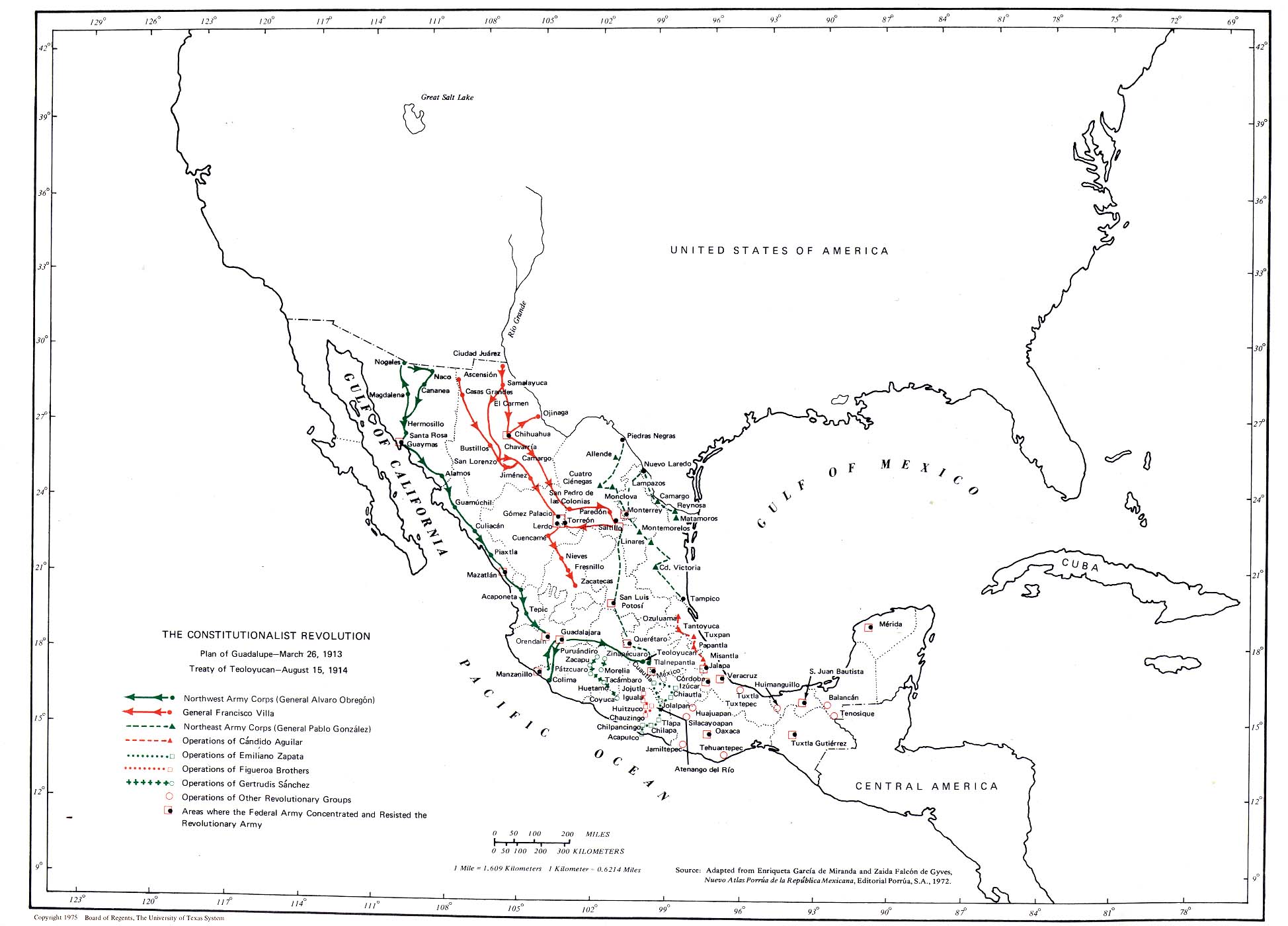
In July 1913, Carranza divided the country into seven areas for military operations. Each area was, at least in theory, the responsibility of a general commanding an Army corps. These corps were: Northeast, Northwest, Central, East, West, South and Southeast. However the last four existed only on paper and in reality the Constitutionalist army was made up of only the Northwest Corps (renamed the Army of Operations) under Álvaro Obregón, the Northeast Corps under Pablo González, and the Central Corps under Pánfilo Natera.

When fighting broke out in 1914 between the Constitutionalists (Carranza, Obregón, etc.) and the Conventionalists (Villa and Zapata) following the Convention of Aguascalientes, the Constitutional Army numbered 57,000 men, to Villa and Zapata's 72,000 men. But as the Constitutionalists grew stronger, Villa and Zapata grew weaker. Eventually the war against the Conventionalists was won after the assassination of Zapata in 1919 and the surrender of Villa in July 1920. By 1917, the main fighting of the civil war between the two factions was over, with some minor revolts by Felicistas (supporters of Félix Díaz, nephew of ousted president Porfirio Díaz). This marked the end of any real resistance to Carranza.

However, when Carranza's autocratic rule was threatened, the threat would come from the Constitutionalist army he had set up. Carranza was assassinated after he tried to have Obregón arrested on false charges (Obregón was put up for election for president, which threatened Carranza and his choice of successor, Ignacio Bonillas) and Obregón, under the Plan of Agua Prieta, marched on Mexico City with his army. Carranza fled the capital and was killed in the Sierra Norte of Puebla on 21 May 1920.

In 1920, Obregón was elected Mexico's president,[1] and some other former Constitutionalist generals would eventually become presidents and leading politicians in the years ahead.

See also

[edit]

References

[edit]
[edit]
Revisions and contributorsEdit on WikipediaRead on Wikipedia
from Grokipedia
The Constitutional Army, known in Spanish as the Ejército Constitucionalista, was the armed force established in March 1913 under the Plan de Guadalupe to overthrow the regime of , who had seized power through a coup against , aiming to restore constitutional governance in . Led by as the "First Chief," the army comprised irregular revolutionary units from northern Mexico, including cavalry and infantry divisions that emphasized mobility and rapid maneuvers against federal forces. Its key commanders, such as Álvaro Obregón and Pablo González, orchestrated decisive victories, culminating in the fall of Huerta in July 1914 following the Battle of Zacatecas. The Constitutional Army's subsequent campaigns targeted rival factions, notably defeating Pancho Villa's Division of the North and Emiliano Zapata's Liberation Army of the South, which sought more radical agrarian reforms beyond the Constitutionalists' focus on legal restoration, judicial independence, and resource sovereignty. This consolidation of power enabled the drafting and promulgation of the 1917 Mexican Constitution, a landmark document that enshrined progressive provisions on labor rights, education, and land redistribution while centralizing authority under civilian rule. Despite these achievements, the army faced internal divisions and accusations of authoritarian tactics, contributing to Carranza's ouster in 1920 by former allies like Obregón, who capitalized on widespread disillusionment with unfulfilled promises of stability. The Constitutionalists' triumph reshaped Mexico's political landscape, establishing a framework that endured amid ongoing factional strife and economic challenges.

Origins and Formation

Background in the Mexican Revolution

The Mexican Revolution, which began on November 20, 1910, as a widespread uprising against the authoritarian rule of , initially succeeded in forcing his resignation and exile in May 1911, paving the way for Francisco I. Madero's election as president later that year. However, Madero's failure to enact sweeping land reforms and suppress ongoing insurgencies by figures like and eroded his support, fostering military discontent that culminated in the coup known as the Decena Trágica from February 9 to 22, 1913. During this period, General , initially tasked with quelling unrest in , orchestrated the overthrow of Madero, who was arrested, forced to resign on February 19, 1913, and assassinated alongside Vice President on February 22. Huerta then seized the presidency, dissolving Congress and ruling as a backed by conservative elites and foreign interests, including tacit U.S. recognition until June 1913. Venustiano Carranza, governor of Coahuila and a veteran politician aligned with Madero's constitutionalist ideals, emerged as a key opponent to Huerta's usurpation from northern Mexico. On March 26, 1913, Carranza issued the Plan de Guadalupe from the Hacienda de Guadalupe in Coahuila, a manifesto that explicitly rejected Huerta's legitimacy, labeling him the "principal responsible for the crime against the constitutional order" and calling for his removal through armed struggle. The plan reaffirmed loyalty to the 1857 Constitution, positioned Carranza as Primer Jefe (First Chief) of a new revolutionary force, and outlined the objective of defeating Huerta's Federal Army to restore legitimate governance, with Carranza assuming executive authority upon the Constitutionalists' occupation of Mexico City. This document provided the ideological and organizational foundation for the Constitutional Army, transforming disparate anti-Huerta sentiments into a structured movement that initially garnered alliances with revolutionary leaders such as Pancho Villa in Chihuahua and Álvaro Obregón in Sonora. The formation of the Constitutional Army marked a pivotal shift in the Revolution from fragmented rebellions to a centralized constitutionalist front, emphasizing legal continuity over radical agrarian or social reforms espoused by rivals like Zapata. By 1913, Carranza had relocated his headquarters to , issuing decrees to fund the army through proportional contributions from Mexicans and initiating recruitment among northern landowners and federal defectors. This northern base proved strategically vital, as the army's early operations exploited Huerta's vulnerabilities in the and Pacific regions, setting the stage for broader campaigns that would culminate in Huerta's resignation on , 1914. The Constitutionalists' focus on constitutional restoration distinguished them within the Revolution's chaotic factionalism, though it later sowed seeds of conflict with more populist Conventionist forces.

Response to Huerta's Coup

Following the coup led by , which deposed President on February 18, 1913, and the subsequent execution of Madero and Vice President José María Pino Suárez on February 22, 1913, constitutionalist opposition rapidly organized in northern Mexico to reject Huerta's usurpation. , then governor of and a Madero loyalist, refused to recognize Huerta's regime, viewing it as a betrayal of the 1910 revolution's principles. On March 26, 1913, Carranza issued the Plan of Guadalupe from his Hacienda de Guadalupe in , a concise denouncing Huerta as a traitor and calling for his immediate overthrow through military means to restore constitutional governance. The plan appointed Carranza as Primer Jefe (First Chief) of the newly designated Ejército Constitucionalista (Constitutionalist Army), emphasizing armed resistance without proposing broader social reforms, thereby framing the conflict as a restoration of legitimate authority rather than radical change. It recognized key northern revolutionary leaders such as in Chihuahua and sought to unify anti-Huerta forces under a federalist banner, excluding southern agrarian rebels like . The proclamation prompted swift initial mobilization, with Carranza directing the assembly of irregular forces from Coahuila and adjacent states, numbering in the thousands by April 1913, primarily drawn from local militias and disaffected federal soldiers. Pablo González, under Carranza's command, led early advances southward from , capturing key towns like by May 1913 and establishing supply lines along the border. In , Álvaro Obregón aligned with the plan by April 1913, raising troops and securing the region against Huerta loyalists, which bolstered the constitutionalists' northern front. These efforts transformed scattered Madero supporters into a coordinated , setting the stage for broader campaigns despite internal tensions over and resources.

Initial Organization and Mobilization

Following Victoriano Huerta's coup d'état during the Decena Trágica from February 9 to 22, 1913, which resulted in the assassination of President Francisco I. Madero and Vice President José María Pino Suárez, Venustiano Carranza, then governor of Coahuila, refused to recognize Huerta's regime. On March 26, 1913, Carranza proclaimed the Plan of Guadalupe from the Hacienda de Guadalupe in Nuevo León, designating himself as the "First Chief" of the newly formed Constitutionalist Army and calling for Huerta's removal without restoring Madero, whom he deemed unable to govern effectively. The plan outlined the army's objective to restore constitutional order by defeating the federal forces loyal to Huerta, emphasizing military action over broad social reforms at this stage. Initial organization centered in , particularly , where Carranza leveraged his governorship to rally local militias and irregular forces previously active against earlier rebels like . Pablo González Garza, Carranza's chief lieutenant from the 1912 Orozco campaign, was appointed to command operations in the northeast, mobilizing troops from and adjacent states to launch early offensives against federal garrisons. By April 1913, these forces had begun coordinated advances, capturing key border towns such as Piedras Negras on May 8, 1913, which facilitated arms smuggling from the and expanded recruitment among disaffected peons and ranchers. Mobilization extended to Sonora under Álvaro Obregón, a former chickpea farmer turned military leader, who aligned the state with Carranza's plan in early April 1913 despite initial hesitations from Governor Ignacio Pesqueira. Obregón rapidly assembled a force of approximately 2,000 men, primarily indigenous fighters and local volunteers, equipping them with smuggled rifles and launching attacks on federal positions, including the capture of by June 27, 1913. This northwest mobilization complemented northeastern efforts, forming the backbone of the Constitutionalist Army's early strategy of isolating Huerta's regime from its northern supply lines. Recruitment emphasized loyalty to constitutional principles over personalist leadership, drawing from middle-class professionals, agrarian workers, and defecting federal soldiers, though initial armament remained rudimentary, relying on captured rifles and limited . By mid-1913, the army's ranks had swelled to tens of thousands through these regional mobilizations, setting the stage for broader campaigns southward.

Leadership and Military Structure

Key Leaders and Commanders

Venustiano Carranza served as the supreme political and military authority of the Constitutionalist Army, assuming the title of "First Chief" upon its formation on March 26, 1913, through the issuance of the Plan of Guadalupe, which explicitly rejected Victoriano Huerta's usurpation of power and pledged restoration of Mexico's 1857 Constitution. From his base in Sonora, Carranza coordinated the army's early mobilization, drawing on alliances with northern revolutionary leaders while maintaining strict civilian oversight over military operations to prevent factional warlordism. His leadership emphasized legalistic constitutionalism over radical agrarian reforms, distinguishing the Constitutionalists from rivals like Pancho Villa's Division of the North. Álvaro Obregón emerged as the most capable field commander, leading the Army of the Northwest from 1913 onward and securing critical victories against Huerta's , including the capture of on November 11, 1914. Obregón's forces, initially numbering around 5,000 men in , expanded through disciplined recruitment and innovative tactics such as entrenchment and machine-gun employment, which he adapted from European warfare reports, enabling the defeat of numerically superior opponents at battles like Santa Rosa in January 1915. By 1915, Obregón commanded over 40,000 troops, playing a pivotal role in the march on and later suppressing Conventionist challenges. Pablo González Garza directed the Northeastern Division, launching offensives from that captured key border cities like Piedras Negras on June 15, 1913, and by early 1914, disrupting Huerta's supply lines along the . González's command emphasized rapid cavalry advances, amassing forces that grew to approximately 20,000 by mid-1914, though his operations were marred by reports of reprisals against civilians suspected of Huerta loyalty. Post-Huerta, he led campaigns against Zapatista holdouts in starting in , employing scorched-earth strategies to dismantle guerrilla networks. Subordinate commanders such as , who served under Obregón in and later as military governor of in 1915, contributed to logistical innovations and regional control, while Cándido Aguilar commanded eastern forces after defecting from Huerta in April 1913, facilitating Veracruz's isolation. These leaders operated under Carranza's centralized Plan of Guadalupe structure, which subordinated regional autonomy to unified command, though tensions arose over promotions and spoils, foreshadowing post-1917 fractures.

Composition and Recruitment

The Constitutionalist Army comprised primarily volunteers from rural , including peasants, agricultural workers, and indigenous groups such as the , who formed a significant contingent in General Álvaro Obregón's forces in . These recruits were often personal followers of regional leaders like Obregón and Pablo González, reflecting a mix of local loyalties, adventurers, and former bandits unified against Victoriano Huerta's regime. The force included few professional soldiers from the pre-revolutionary , instead drawing on civilian militias with minimal formal training, irregular armament, and no standardized uniforms. Recruitment emphasized voluntary enlistment motivated by adherence to Venustiano Carranza's Plan de Guadalupe, issued on March 26, 1913, which promised restoration of constitutional order and opposition to Huerta's coup. Unlike the conscript-heavy Federal forces, the Constitutionalists attracted eager fighters through appeals to regional autonomy and anti-dictatorship sentiment, organizing state militias into semi-autonomous bands under Carranza's overall command as Primer Jefe. While predominantly spontaneous and leader-driven, some areas saw coerced recruitment to sustain numbers amid prolonged campaigning. Following Huerta's ouster in , the incorporated urban laborers and defectors from rival factions, augmenting its ranks for conflicts with Conventionists. By the late revolutionary phase around 1920, the force had grown to approximately men, more than triple the size of the Díaz-era . This expansion reflected both successful mobilization in northern strongholds like and and the absorption of local irregulars, though internal rivalries among commanders often hindered cohesive organization.

Logistics and Armament

The Constitutionalist Army primarily relied on captured armaments from federal forces during its early campaigns against Victoriano Huerta's regime, including rifles chambered in 7mm, which formed the backbone of infantry equipment due to their prevalence in government arsenals. Machine guns such as Colt-Browning M1895s, Hotchkiss models, and Gatling guns were also seized and redeployed, providing crucial firepower in defensive positions, as demonstrated in Álvaro Obregón's tactics at the 1915 . Artillery pieces, including Schneider-Danglis 75mm field guns and captured howitzers, supplemented these, though shortages limited their widespread use until federal depots in fell in July 1914. Following U.S. recognition of Venustiano Carranza's government on October 19, 1915, the Constitutionalists gained legal access to arms imports from the , alleviating prior embargoes that had favored Huerta's opponents indirectly through seizures like the April 1914 occupation of Veracruz, which intercepted a German shipment of rifles and ammunition intended for the . via northern border routes and Pacific ports such as continued to supplement supplies, with some weapons sourced from European exporters before Carranza rejected overtures for German military aid in 1917. By mid-1915, these efforts enabled the issuance of over 672 million pesos in Constitutionalist currency to fund procurements, contrasting with the pre-revolutionary circulation of just 193 million pesos nationwide. Logistics hinged on Mexico's railroad network, which facilitated rapid troop movements and supply distribution from northern strongholds like and Chihuahua, with lines connecting to U.S. borders enabling cross-border acquisitions post-1915. Control of key junctions, such as those near , allowed efficient provisioning of food, ammunition, and fodder, though rugged terrain often necessitated reliance on local and mule trains for remote operations. Challenges persisted, including by rival factions and the army's expansion straining resources, but Obregón's innovations—like armored railcars for protection—enhanced supply line security against Conventionist raids. units, integral to mobile logistics, were armed with carbine variants of rifles and sabers, depending on remounts and grain shipments to maintain operational tempo across arid regions. Overall, the shift from scavenging to structured imports marked a decisive advantage over less organized opponents like Pancho Villa's Division of the North by 1916.

Major Military Campaigns

Defeat of the Huerta Regime

The Constitutionalist Army's campaign against Victoriano Huerta's regime intensified in early 1914, following initial organizational efforts and partial successes in 1913, as federal forces loyal to Huerta struggled with low morale, supply shortages, and defections. Pancho Villa's Division of the North spearheaded the northern offensive, recapturing on April 2, 1914, after fierce fighting that killed approximately 2,000 federal troops and captured vast stores of armaments, weakening Huerta's control over northern rail lines. This victory enabled further advances, including the taking of San Pedro de las Colonias and Paredón, disrupting federal logistics and forcing Huerta to divert reinforcements. The pivotal Battle of on June 23, 1914, delivered a crushing blow to Huerta's army, with Villa's forces—numbering around 25,000—overrunning federal defenders estimated at 12,000 under General Luis Medina Barrón, resulting in federal casualties exceeding 8,000 killed or wounded and the capture of as a key rail hub. Constitutionalist charges, leveraging mobility and numerical superiority, exploited federal disarray, as Huerta's troops, many conscripts with poor training, collapsed under the assault. Complementing this, Álvaro Obregón's Northwestern Army advanced from , securing Guadalajara by July, while the U.S. occupation of on April 21, 1914—prompted by the —severed Huerta's access to European arms and revenue, compelling him to recall garrisons to the capital and exposing flanks to Constitutionalist incursions. Huerta's regime unraveled amid these military reversals and his failed June 1, 1914, presidential "election," which lacked international recognition and alienated potential supporters. By mid-July, with Constitutionalist armies converging on —Obregón's forces nearing from the west and Villa's poised from the north—federal units disintegrated through mass desertions and mutinies. Huerta resigned on July 15, 1914, transferring power to interim President Francisco Carbajal before fleeing into exile via Puerto México, marking the effective collapse of his 17-month sustained primarily by repression rather than broad legitimacy. This defeat stemmed from the Constitutionalists' superior adaptation to guerrilla-style warfare, effective use of railroads for rapid maneuvers, and Huerta's overreliance on a brittle, professionally stagnant unable to counter decentralized revolutionary tactics.

Conflicts with Conventionist Factions

The schism between Constitutionalists and Conventionists emerged following the in October-November 1914, where delegates loyal to and rejected Venustiano Carranza's leadership and Plan of Guadalupe, demanding broader land reforms and decentralized power, thus fracturing the anti-Huerta alliance into civil war. Constitutionalist forces, emphasizing restoration of constitutional order with targeted reforms, mobilized under Álvaro Obregón to confront the Conventionist armies, which comprised Villa's Division of the North and Zapata's , totaling over 100,000 fighters combined by early 1915. The primary Conventionalist threat in the north centered on Villa's forces, leading to decisive engagements in the region. In the Battles of (April 6–7 and April 13–15, 1915), Obregón's approximately 14,000 Constitutionalist troops, entrenched with barbed wire, machine guns, and artillery, decisively repelled Villa's 25,000–30,000 cavalry-heavy Division of the North using defensive tactics adapted from observer reports. Villa's repeated massed charges resulted in catastrophic losses, with estimates of 4,000–6,000 Villistas killed in the first clash alone and up to 15,000 total across both battles, shattering his army's offensive capacity. Obregón followed with victories at León (June 1915) and elsewhere, capturing strategic rail lines and reducing Villa's forces to guerrilla remnants by mid-1916, though sporadic raids persisted until 1920. In the south, conflicts with Zapatistas proved more protracted and asymmetric, focused on and surrounding states. Constitutionalists, after expelling Zapatista forces from on January 4, 1915, launched invasions into Zapatista strongholds, occupying in April 1916 with superior numbers and logistics, but faced relentless guerrilla tactics emphasizing defense over conventional battles. Zapata's 8,000–10,000 fighters inflicted attrition through ambushes and , reclaiming territories intermittently until Carrancista reprisals, including scorched-earth policies, weakened their base; the endured until Zapata's on April 10, 1919, by a Constitutionalist . These clashes highlighted Constitutionalist advantages in and supply lines against Conventionist reliance on mobility and popular support, ultimately securing Carranza's dominance by 1917.

Key Battles and Strategies

The Constitutionalist Army's campaigns against Victoriano Huerta's Federal forces from 1913 to 1914 emphasized coordinated advances along rail lines in northern and western , leveraging recruitment from agrarian and urban populations to outmaneuver federal garrisons. Under Álvaro Obregón's command in the Northwest, forces captured key ports and cities, including in November 1913 and in early 1914, disrupting Huerta's supply lines through amphibious and overland assaults that integrated indigenous fighters skilled in regional terrain. These operations relied on rapid mobilization via railroads, a that allowed Constitutionalists to concentrate troops faster than Huerta's decentralized defenses, culminating in the seizure of Guadalajara by July 1914, which isolated federal remnants in central . Following Huerta's resignation on July 15, 1914, the Constitutionalists shifted to confronting Conventionist factions led by , employing defensive strategies that contrasted with Villa's reliance on massed cavalry charges. The Battles of Celaya (April 6–15, 1915) marked a , where Obregón's approximately 30,000 troops fortified positions with trenches, entanglements, and machine-gun nests amid irrigation ditches, inflicting over 4,000 casualties on Villa's larger force of around 25,000 in the first engagement alone. Obregón's tactics, informed by emerging doctrines, included feigned retreats to lure attackers into kill zones, as when he ordered calls mimicking Villa's signals to draw forces into range, resulting in Villa's retreat with heavy losses estimated at 15,000 total across both battles. Subsequent engagements, such as the Battle of León (April 25–June 3, 1915), extended these methods, with Obregón using fortified rail hubs to repel Villa's assaults, destroying much of the Division of the North's offensive capacity through attrition and superior logistics. Overall strategies prioritized disciplined infantry over , integrating U.S.-sourced armaments like machine guns and emphasizing supply depots to sustain prolonged defenses, which eroded Conventionist morale and enabled Constitutionalist control of the region by mid-1915. Against Emiliano Zapata's southern forces, smaller-scale operations focused on encirclement rather than direct confrontation, avoiding guerrilla ambushes through troop concentrations near .

Political Ideology and Objectives

Commitment to Constitutionalism

The Constitutionalist Army's commitment to constitutionalism originated in opposition to Victoriano Huerta's coup d'état on February 19, 1913, which dissolved Congress, assassinated President Francisco Madero, and suspended adherence to the 1857 Constitution. Venustiano Carranza, then governor of Coahuila, responded by issuing the Plan of Guadalupe on March 26, 1913, from Hacienda de Guadalupe, proclaiming himself First Chief of the Constitutionalist Army with the explicit aim of deposing Huerta's "usurping" regime and restoring legitimate constitutional governance without proposing alterations to the existing framework. The plan designated the force as "Constitutionalist" to underscore its defense of , , and the against dictatorship, organizing militias from northern states into a structured army focused on legal restoration rather than radical restructuring. This ideological stance differentiated the Constitutionalists from other revolutionary factions, such as the Villistas and Zapatistas, who prioritized agrarian reform and social upheaval over strict constitutional fidelity; Carranza's manifesto targeted only Huerta, Félix Díaz, and as enemies of Madero's elected government, rejecting broader ideological overhauls in favor of reinstating pre-coup institutions. Military successes, including Huerta's resignation on July 15, 1914, were framed as triumphs of constitutional legitimacy, with the Plan of Guadalupe reaffirmed as guiding doctrine until full restoration, emphasizing procedural legality in governance transitions. Following internal conflicts with Conventionist forces, the commitment culminated in Carranza's call for a constituent congress in December 1916, which promulgated the Political Constitution of the United Mexican States on February 5, 1917, reforming the 1857 document to incorporate limited revolutionary demands like labor rights and land redistribution while preserving core principles of federal republicanism and individual guarantees. This evolution reflected a pragmatic adherence to constitutional processes amid revolutionary pressures, as Carranza submitted a draft emphasizing continuity with prior legal traditions, though subsequent articles 27 and 123 introduced social provisions influenced by allied reformers. The army's dissolution into regular forces post-1917 underscored its role as a temporary instrument for reinstating constitutional order, prioritizing institutional stability over perpetual militarism.

Role in Drafting the 1917 Constitution

The Constitutionalist Army, under the command of Venustiano Carranza as its First Chief, provided the military foundation for the convening of the Constituent Congress that drafted the 1917 Mexican Constitution. On September 14, 1916, Carranza issued a decree from the Plan of Guadalupe's addenda, calling for elections of deputies to a constituent assembly tasked with restoring constitutional order amid the revolution's chaos. This move followed the army's decisive victories against Victoriano Huerta's forces, which had secured northern and central Mexico for constitutionalist control by mid-1914, enabling the organization of elections in loyal territories. The convocatoria for elections was published on September 19, 1916, stipulating universal male suffrage for deputies, though practical voting occurred only in army-held regions, resulting in 85 delegates predominantly aligned with constitutionalist principles. The Congress assembled in Querétaro on December 1, 1916—chosen for its strategic security under constitutionalist garrisons—and operated until February 5, 1917, when the constitution was promulgated. Constitutionalist troops maintained order around the session, shielding it from incursions by rival Conventionist armies led by and , whose ongoing threats in 1916-1917 could have derailed proceedings. Carranza, leveraging his authority as provisional executive backed by the army, submitted a draft constitution in December 1916, rooted in the liberal 1857 framework but amended to address revolutionary grievances like and ; delegates, influenced by the army's enforcement of constitutionalist dominance, expanded these into radical provisions such as Article 27 on national sovereignty over resources and Article 123 on workers' protections. While the drafting itself was civilian-led, the army's role extended to ideological enforcement: military delegates and officers among the deputies, alongside Carranza's oversight, ensured rejection of more radical agrarian or federalist demands from non-constitutionalist factions, prioritizing a centralized state capable of post-revolutionary stabilization. This alignment reflected the army's evolution from a guerrilla force into a structured entity governed by emerging constitutional norms, with Carranza promoting decrees during the to integrate revolutionary veterans. The resulting document, effective May 1, 1917, codified the constitutionalists' objectives, crediting the army's territorial control for enabling its creation without compromise to defeated adversaries.

Differences from Other Revolutionary Factions

The Constitutionalist Army, under Venustiano Carranza's leadership, prioritized political and institutional reforms centered on restoring and amending Mexico's 1857 Constitution to establish a stronger central government, independent judiciary, and national control over natural resources, viewing these as prerequisites for stability following the ouster of Victoriano Huerta in July 1914. In contrast, the Conventionist factions—comprising Pancho Villa's Division of the North and Emiliano Zapata's Liberation Army—advocated for the outcomes of the Aguascalientes Convention (October-November 1914), which demanded immediate land expropriation from haciendas, worker rights, and decentralized power sharing to address peasant grievances, often rejecting Carranza's authority as insufficiently transformative. Carranza's rejection of the convention as illegitimate highlighted this rift, positioning Constitutionalists as reformers seeking orderly transition rather than the radical redistribution favored by Conventionists. Socially and demographically, Constitutionalists recruited primarily from urban middle-class professionals, liberal intellectuals, and northern state elites who favored gradual modernization and legalistic change over upheaval, enabling broader alliances with foreign interests and domestic moderates wary of anarchy. Conventionists, however, mobilized rural peasant majorities: Zapatistas from Morelos's indigenous villages emphasizing communal under the 1911 Plan de Ayala, and Villistas from Chihuahua's miners and vaqueros seeking opportunistic spoils alongside agrarian appeals, fostering insurgent loyalties tied to local autonomy rather than national constitutional frameworks. This base disparity contributed to Constitutionalists' portrayal of opponents as bandit-like threats to order, while Conventionists critiqued them as elitist betrayers of the revolution's anti-Porfirian roots. Militarily, the Constitutionalists developed a more hierarchical and professional force by 1915, incorporating U.S.-supplied artillery and disciplined infantry under , which enabled strategic maneuvers like that decisively repelled Villa's cavalry charges at the (April 6-15, 1915). Villista and Zapatista armies relied on irregular guerrilla tactics and massed horsemen—effective against Huerta but vulnerable to sustained campaigns—lacking the logistical integration and officer training that allowed Constitutionalists to control key railroads and ports, sustaining operations until Villa's defeat at in November 1915. These organizational edges stemmed from Constitutionalist emphasis on over factional improvisation, ultimately enabling their dominance by 1917 despite numerical parity in earlier phases.

Controversies and Criticisms

Alleged Atrocities and Repressions

During campaigns against Zapatista forces in state, Constitutionalist troops under generals such as Pablo González were accused of committing atrocities against civilians, including summary executions and destruction of villages suspected of harboring insurgents, contributing to Zapatista forces regaining territory by mid-1915. These actions were part of broader efforts to dismantle agrarian rebel networks, often involving reprisals that blurred lines between combatants and non-combatants in rural areas. Constitutionalist authorities under repressed emerging labor organizations, particularly anarcho-syndicalist groups, through arrests, disbandment of strikes, and suppression of worker assemblies, which facilitated a shift toward state-controlled unions by 1916–1917. In , where Carranza established his in late 1914, clashes escalated during the city's first in 1916, with federal troops deploying force against urban workers demanding better conditions, marking a pivotal confrontation between the regime and the . Anticlerical policies of the Constitutionalists led to documented outrages against Catholic clergy and religious personnel, including and desecrations amid the revolutionary upheaval, as reported in contemporaneous accounts of Carrancista operations. Such incidents reflected the faction's commitment to curbing influence but drew for excesses in a context where revolutionary armies across factions routinely targeted perceived ideological opponents. Reports of these repressions, while attributed to specific units, often stemmed from adversarial sources like Zapatista or Villista sympathizers, complicating verification amid the era's documentation biases toward victors.

Internal Divisions and Betrayals

Following the ouster of Victoriano Huerta on July 15, 1914, the Constitutionalist leadership under Venustiano Carranza faced mounting factional strains as victorious revolutionary armies vied for influence in post-Huerta governance. To mediate these disputes, Carranza summoned the Convention of Aguascalientes, which convened on October 5, 1914, ostensibly to unify military commands and establish an interim government. However, the assembly, comprising delegates from diverse revolutionary currents including Pancho Villa's Division of the North and Emiliano Zapata's Liberation Army, quickly diverged from Carranza's agenda by electing Eulalio Gutiérrez as provisional president on November 6, 1914, and demanding Carranza's resignation as First Chief. Carranza refused to recognize these outcomes, viewing them as a power grab by agrarian radicals and northern populists incompatible with his emphasis on constitutional order, which prompted loyalists like General Álvaro Obregón to align firmly with him, thereby narrowing the Constitutionalist Army into a more cohesive but isolated force amid the ensuing civil war against Conventionist opponents. This post-convention cohesion masked underlying rivalries among Constitutionalist generals, particularly between Obregón's Sonora-based clique and commanders like Pablo González, fueled by competition for promotions, resources, and regional dominance during campaigns against from 1915 onward. Such tensions simmered without fracturing the army's wartime command structure, as shared opposition to Conventionists prioritized tactical unity under Carranza's civilian oversight. Yet, victory in the revolutionary civil war by 1917 exposed these fissures, with Obregón—Carranza's most capable field commander, credited with key triumphs at and León—growing resentful of Carranza's reluctance to reward contributions with political succession. The decisive internal betrayal materialized in the lead-up to the 1920 presidential election, when Carranza maneuvered to install diplomat Ignacio Bonillas as his successor, sidelining Obregón's open candidacy announced on June 1, 1919. Facing arrest on trumped-up charges of plotting rebellion, Obregón's allies, including and , proclaimed the Plan of on April 23, 1920, explicitly rejecting Carranza's authority and calling for his ouster to restore revolutionary principles. Carranza's support eroded rapidly; he evacuated on May 7, 1920, with loyal troops, but was ambushed and assassinated on May 21, 1920, in Tlaxcalantongo, , by mutinous elements of his escort under Rodolfo Herrero, amid the collapsing regime. Obregón's revolt, backed by U.S. recognition and the defection of much of the , underscored how personal ambition and disputes over democratic transitions undermined the Constitutionalists' purported commitment to institutional stability, paving Obregón's path to the via on October 26, 1920.

Criticisms of Authoritarianism

Carranza's governance as First Chief of the Constitutionalist movement from 1914 to 1917 relied heavily on executive decrees, effectively centralizing power in the absence of a functioning or , which critics viewed as a dictatorship despite the movement's nominal commitment to restoring constitutional order. This approach extended to the abolition of the in favor of a loyal Constitutional Army, the suspension of , the closure of courts, and strict press controls, measures that suppressed dissent and mirrored the tactics of prior regimes like those of and . Historians have noted that these steps prioritized regime stability over revolutionary pluralism, sidelining local leaders and rival factions in state governance. During his presidency from May 1917 to May 1920, Carranza continued to deploy the Constitutional Army against internal opposition, including labor strikes and radical reformers, while implementing only selective elements of the 1917 Constitution's agrarian and labor provisions, leading to accusations of betraying the document's progressive intent for conservative centralization. His 1919 decision to impose Ignacio Bonillas as his successor—bypassing the more popular —exemplified caudillo-style control over electoral processes, sparking the Plan de Agua Prieta rebellion on April 23, 1920, and Carranza's flight and assassination on May 21, 1920. Contemporary critics, including socialist and anarchist groups, argued this reflected a broader pattern where the army served personal and elite interests rather than democratic transition. These practices contributed to factional divisions within the Constitutionalist ranks, as military leaders like Obregón grew disillusioned with Carranza's top-down rule, ultimately transitioning power to a new generation that perpetuated military influence in governance. While some analyses attribute such authoritarianism to the exigencies of civil war and state-building—requiring decisive action amid anarchy—others contend it entrenched a legacy of executive dominance that undermined the revolution's federalist ideals.

Dissolution and Legacy

Transition to Post-Revolutionary Institutions

Following the defeat of major opposing factions by 1917, the Constitutionalist Army, under President , transitioned from a decentralized revolutionary coalition into a centralized national institution aligned with the new constitutional order. On May 1, 1917, as Carranza assumed the presidency, the force was formally redesignated the National Army, marking its integration as the core of Mexico's post-revolutionary defense apparatus rather than a temporary insurgent body. This shift emphasized professionalization to support constitutional governance, with pre-1917 initiatives like the establishment of the Academia del Estado Mayor on October 15, 1916, for advanced officer training, and the creation of a General Staff (Departamento del Estado Mayor) on March 14, 1916, extending into the postwar period to centralize command and reduce factional autonomy. Reorganization efforts focused on logistical self-sufficiency and downsizing to fit peacetime needs, including the founding of munitions factories such as the Fábrica Nacional de Armas and the consolidation of military hospitals into 12 regional centers. To address surplus personnel from the war's expansion—which had swelled ranks to over 100,000 by late 1915—a Comisión Superior Revisora de Hojas de Servicio evaluated officers' records, reassigning many to reserve status at half pay, while the Región de Honor program, launched in 1919, enabled honorable retirement with full pay for excess generals and colonels. The reopening of the Colegio Militar in 1919 further institutionalized training, aiming to instill discipline and loyalty to the civilian-led state over revolutionary warlords. This evolution subordinated the military to constitutional authority, with Carranza prioritizing suppression of residual threats like Villista and Zapatista remnants over expansive reforms, though implementation remained incomplete amid internal rivalries. By 1920, however, mounting dissatisfaction among generals, including , culminated in Carranza's overthrow on May 21, 1920, after which the National Army—built on Constitutionalist foundations—underwent further consolidation under Obregón's wartime secretaryship, solidifying its role in the emerging institutional revolutionary framework without full dissolution but through enforced subordination to elected civilian rule. The process reflected causal tensions between military power accumulated during conflict and the first-principles need for stable governance, as evidenced by the army's pivotal yet constrained position in upholding the 1917 Constitution against rebellions.

Long-Term Impact on Mexican Governance

The Constitutional Army's military victories, culminating in the defeat of Victoriano Huerta's regime in July 1914 and subsequent rival factions by 1919, facilitated the convening of the Constitutional Convention of 1916–1917, which produced the Mexican Constitution promulgated on February 5, 1917. This document enshrined a with a strong executive , , and provisions for social reforms, including Article 27's restrictions on foreign land ownership and promotion of agrarian redistribution, Article 123's , and Article 3's mandates. These elements established a statist framework that prioritized national and , influencing by embedding revolutionary principles into the state's foundational legal structure, which has endured with over 700 amendments as of 2023 to adapt to changing conditions while preserving core institutional designs. In practice, the constitutionalist emphasis on centralized authority to consolidate post-revolutionary order contributed to the formation of the (PRI) in 1929, which dominated Mexican politics until 2000 by institutionalizing the army's legacy of disciplined hierarchy and co-optation. PRI governments, emerging from constitutionalist military figures like and , implemented land reforms redistributing over 100 million hectares by 1990 but maintained one-party hegemony through electoral control, labor union incorporation, and suppression of dissent, resulting in a hybrid authoritarian system often termed "imperfect democracy." This structure delayed multipartisan competition, with opposition parties holding fewer than 20% of congressional seats until the , reflecting the causal link between the army's victory in enforcing constitutional supremacy and the long-term prioritization of stability over pluralism. The enduring impact manifests in Mexico's persistent executive dominance, where presidents have historically wielded extensive decree powers and influence over judicial appointments, as seen in the constitution's original lack of strong checks until 1994 reforms. Post-2000 democratization has not fully eroded these traits; for instance, the PRI's return to power in 2012 under highlighted the system's adaptability via frequent amendments, yet persistent issues like corruption scandals involving over 1,000 public officials prosecuted between 2018 and 2023 underscore unresolved centralization legacies. Moreover, the constitutionalist model's fusion of military loyalty with civilian rule prefigured modern debates on armed forces' roles, though recent expansions under non-PRI administrations diverge from the army's 1920s demobilization into a professionalized of approximately 200,000 active personnel by 2020. Historians attribute the constitution's longevity to its balance of liberal proceduralism and substantive social guarantees, which legitimized state interventionism and forestalled radical upheavals, but critique it for enabling PRI-era by design, as the army's hierarchical command structure translated into party-state fusion that controlled 95% of governorships from to 1988. This legacy has fostered a model resilient to crises, such as the 1982 debt default and 1994 peso crisis, through adaptive where subnational entities remain fiscally dependent on federal transfers exceeding 80% of state budgets annually. However, it has also perpetuated inefficiencies, including uneven , with ranking 126th out of 180 in corruption perceptions as of 2023, tracing back to the constitutionalists' prioritization of unified command over decentralized .

Historical Assessments and Debates

Historians generally credit the Constitutional Army with decisive military successes against Victoriano Huerta's regime, particularly through coordinated campaigns in that secured border regions for arms smuggling and logistics. Key victories along the , such as the Battle of on May 10, 1913, where approximately 500 Constitutionalists defeated 150 federal troops with 23 total deaths, and the capture of Matamoros on June 3-4, 1913, involving around 1,000 rebels overcoming 407 federals at a cost of 28 Constitutionalist lives, demonstrated tactical adaptability and high morale under leaders like Lucio Blanco. These operations disrupted federal supply lines, including railroad , and established Matamoros as a vital port hub, contributing to Huerta's overthrow by July 15, 1914. Álvaro Obregón's broader northern advances, culminating in the Battle of Zacatecas on June 23, 1914, further underscored the army's operational effectiveness against larger federal forces. Debates among scholars center on the army's ideological depth and long-term revolutionary impact, with assessments dividing along lines of whether it prioritized legal restoration over socioeconomic transformation. Proponents of a conservative interpretation, such as those emphasizing Carranza's Plan de Guadalupe (March 26, 1913), argue the forces embodied a measured return to Francisco Madero's constitutional framework, focusing on and national resource control rather than Villa's or Zapata's demands for extensive land redistribution. Critics, however, contend this reflected bourgeois interests, as evidenced by Carranza's reversal of Blanco's early land grants in Matamoros (August 1913), which prioritized political unity over agrarian reform and fueled historiographical questions about the revolution's social authenticity. Total campaign losses of 1,500–2,000 dead in the Rio Grande theater highlight the human cost, yet also the army's resilience in leveraging U.S. border proximity despite occasional setbacks like the failed assault on (January 1-3, 1914), which incurred around 700 casualties. Post-Huerta fractures have drawn particular scrutiny, with evaluations of Carranza's leadership as First Chief ranging from indomitable stabilizer of the revolutionary cause to self-serving figure whose mistrust of allies like —manifest in supply restrictions and strategic positioning of Obregón—prolonged civil conflict after the Aguascalientes Convention (October 1914). While the army's dominance enabled the 1917 Constitution's drafting, internal divisions and Obregón's eventual rebellion (April 1920) underscore debates over its authoritarian tendencies and failure to consolidate factional loyalty, ultimately leading to Carranza's overthrow and assassination on May 21, 1920. Some analyses frame these dynamics as caudillismo's inevitable byproduct, delaying democratic consolidation, while others attribute the army's legacy to modernizing military reforms under Obregón that outlasted Carranza's tenure.

References

Add your contribution
Related Hubs
User Avatar
No comments yet.