Hubbry Logo
Thread (online communication)Thread (online communication)Main
Open search
Thread (online communication)
Community hub
Thread (online communication)
logo
8 pages, 0 posts
0 subscribers
Be the first to start a discussion here.
Thread (online communication)
from Wikipedia

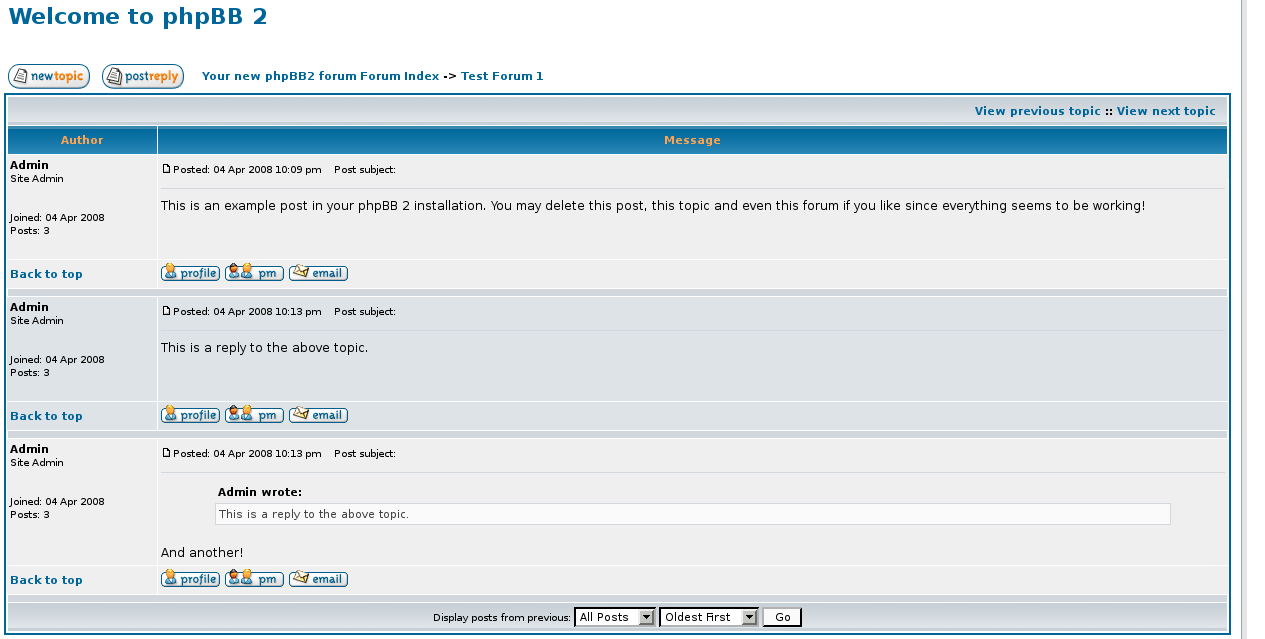
Example of a topic thread on an internet forum
Thread view in a discussion group. At the top level, a discussion with several posts. Next to the subject, number of lines, sender and date is shown for each post.

Conversation threading is a feature used by many email clients, bulletin boards, newsgroups, and Internet forums in which the software aids the user by visually grouping messages with their replies. These groups are called a conversation, topic thread, or simply a thread. A discussion forum, e-mail client or news client is said to have a "conversation view", "threaded topics" or a "threaded mode" if messages can be grouped in this manner.[1] An email thread is also sometimes called an email chain.

Threads can be displayed in a variety of ways. Early messaging systems (and most modern email clients) will automatically include original message text in a reply, making each individual email into its own copy of the entire thread. Software may also arrange threads of messages within lists, such as an email inbox. These arrangements can be hierarchical or nested, arranging messages close to their replies in a tree, or they can be linear or flat, displaying all messages in chronological order regardless of reply relationships.

Conversation threading as a form of interactive journalism became popular on Twitter from around 2016 onward, when authors such as Eric Garland and Seth Abramson began to post essays in real time, constructing them as a series of numbered tweets, each limited to 140 or 280 characters.[2]

Mechanism

[edit]

Internet email clients compliant with the RFC 822 standard (and its successor RFC 5322) add a unique message identifier in the Message-ID: header field of each message, e.g.

Message-ID: <xNCx2XP2qgUc9Qd2uR99iHsiAaJfVoqj91ocj3tdWT@wikimedia.org>

If a user creates message B by replying to message A, the mail client will add the unique message ID of message A in form of the fields

In-Reply-To: <xNCx2XP2qgUc9Qd2uR99iHsiAaJfVoqj91ocj3tdWT@wikimedia.org>
References: <xNCx2XP2qgUc9Qd2uR99iHsiAaJfVoqj91ocj3tdWT@wikimedia.org>

to the header of reply B. RFC 5322 defines the following algorithm for populating these fields:

The "In-Reply-To:" field will contain the contents of the
"Message-ID:" field of the message to which this one is a reply (the
"parent message"). If there is more than one parent message, then
the "In-Reply-To:" field will contain the contents of all of the
parents' "Message-ID:" fields. If there is no "Message-ID:" field in
any of the parent messages, then the new message will have no "In-
Reply-To:" field.

The "References:" field will contain the contents of the parent's
"References:" field (if any) followed by the contents of the parent's
"Message-ID:" field (if any). If the parent message does not contain
a "References:" field but does have an "In-Reply-To:" field
containing a single message identifier, then the "References:" field
will contain the contents of the parent's "In-Reply-To:" field
followed by the contents of the parent's "Message-ID:" field (if
any). If the parent has none of the "References:", "In-Reply-To:",
or "Message-ID:" fields, then the new message will have no
"References:" field.

Modern email clients then can use the unique message identifiers found in the RFC 822 Message-ID, In-Reply-To: and References: fields of all received email headers to locate the parent and root message in the hierarchy, reconstruct the chain of reply-to actions that created them, and display them as a discussion tree. The purpose of the References: field is to enable reconstruction of the discussion tree even if some replies in it are missing.

Advantages

[edit]

Elimination of turn-taking and time constraints

[edit]

Threaded discussions allow readers to quickly grasp the overall structure of a conversation, isolate specific points of conversations nested within the threads, and as a result, post new messages to extend discussions in any existing thread or sub-thread without time constraints. With linear threads on the other hand, once the topic shifts to a new point of discussion, users are: 1) less inclined to make posts to revisit and expand on earlier points of discussion in order to avoid fragmenting the linear conversation similar to what occurs with turn-taking in face-to-face conversations; and/or 2) obligated to make a motion to stay on topic or move to change the topic of discussion. Given this advantage, threaded discussion is most useful for facilitating extended conversations or debates [3] involving complex multi-step tasks (e.g., identify major premises → challenge veracity → share evidence → question accuracy, validity, or relevance of presented evidence) – as often found in newsgroups and complicated email chains – as opposed to simple single-step tasks (e.g., posting or share answers to a simple question).

Message targeting

[edit]

Email allows messages to be targeted at particular members of the audience by using the "To" and "CC" lines. However, some message systems do not have this option. As a result, it can be difficult to determine the intended recipient of a particular message. When messages are displayed hierarchically, it is easier to visually identify the author of the previous message.

Eliminating list clutter

[edit]

It can be difficult to process, analyze, evaluate, synthesize, and integrate important information when viewing large lists of messages. Grouping messages by thread makes the process of reviewing large numbers of messages in context to a given discussion topic more time efficient and with less mental effort, thus making more time and mental resources available to further extend and advance discussions within each individual topic/thread.

In group forums, allowing users to reply to threads will reduce the number of new posts shown in the list.

Some clients allow operations on entire threads of messages. For example, the text-based newsreader nn has a "kill" function which automatically deletes incoming messages based on the rules set up by the user matching the message's subject or author. This can dramatically reduce the number of messages one has to manually check and delete.

Real-time feedback

[edit]

When an author, usually a journalist, posts threads via Twitter, users are able to respond to each 140- or 280-character tweet in the thread, often before the author posts the next message. This allows the author the option of including the feedback as part of subsequent messages.[2]

Disadvantages

[edit]

Reliability

[edit]

Accurate threading of messages requires the email software to identify messages that are replies to other messages.

Some algorithms used for this purpose can be unreliable. For example, email clients that use the subject line to relate messages can be fooled by two unrelated messages that happen to have the same subject line.[4]

Modern email clients use unique identifiers in email headers to locate the parent and root message in the hierarchy. When non-compliant clients participate in discussions, they can confuse message threading as it depends on all clients respecting these optional mail standards when composing replies to messages.[5][6]

Individual message control

[edit]

Messages within a thread do not always provide the user with the same options as individual messages. For example, it may not be possible to move, star, reply to, archive, or delete individual messages that are contained within a thread.

The lack of individual message control can prevent messaging systems from being used as to-do lists (a common function of email folders). Individual messages that contain information relevant to a to-do item can easily get lost in a long thread of messages.

Parallel discussions

[edit]

With conversational threading, it is much easier to reply to individual messages that are not the most recent message in the thread. As a result, multiple threads of discussions often occur in parallel. Following, revisiting, and participating in parallel discussions at the same time can be mentally challenging. Following parallel discussions can be particularly disorienting and can inhibit discussions [7] when discussion threads are not organized in a coherent, conceptual, or logical structure (e.g., threads presenting arguments in support of a given claim under debate intermingled with threads presenting arguments in opposition to the claim).

Temporal fragmentation

[edit]

Thread fragmentation can be particularly problematic for systems that allow users to choose different display modes (hierarchical vs. linear). Users of the hierarchical display mode will reply to older messages, confusing users of the linear display mode.

Examples

[edit]

The following email clients, forums, bbs, newsgroups, image/text boards, and social networks can group and display messages by thread.

Client-based

[edit]

Web-based

[edit]

References

[edit]
Revisions and contributorsEdit on WikipediaRead on Wikipedia
from Grokipedia
In online communication, a thread refers to a sequential or hierarchical series of messages, posts, or replies centered around an initial topic or query, commonly used in discussion forums, bulletin board systems, email clients, and social media platforms to organize ongoing conversations. This structure allows participants to respond directly to specific contributions, creating a traceable dialogue that evolves over time, often with indentation or nesting to show relationships between replies. Threads originated in the late 1970s with Usenet, a distributed discussion system developed in 1979 at Duke University, where messages were grouped by subject into newsgroups and displayed in threaded views to facilitate following complex exchanges across networked computers. As the internet evolved, the threaded model was adopted by web-based forums in the late 1990s and early 2000s, such as those powered by software like phpBB, enabling broader public participation in asynchronous discussions on diverse topics from technical support to community debates. In contemporary platforms like Reddit and X (formerly Twitter), threads extend this concept to microblogging and social networking, where users chain short posts or comments to build narratives, share information, or engage in real-time discourse, often reaching millions of participants. The format promotes accessibility and depth in online interactions but can also lead to challenges like information overload or fragmented conversations if not moderated effectively.

Fundamentals

Definition and Characteristics

A thread in online communication refers to a series of interconnected messages or posts that form a cohesive centered on a specific topic, typically organized either chronologically or in a to reflect the flow of replies and responses. This format facilitates asynchronous participation, where users contribute at their own pace without requiring real-time interaction. Threads originated in early distributed systems but have become a staple in modern forums, , and clients. Key characteristics of threads include their sequential structure, which allows replies to nest under parent messages, creating a branched or tree-like that preserves the of the discussion. This nesting is often visually represented through indentation or collapsible sections, making it easier to trace conversational paths. Additionally, threads exhibit , meaning the entire remains archived and accessible over time, supporting reflection, , and entry by new participants at any point. They also commonly support attachments, such as images, videos, or documents, as well as quoting mechanisms that enable users to specific parts of prior messages for clarity and continuity. Unlike linear messaging systems, such as traditional or flat chat logs, where messages appear in a simple chronological sequence without branching, threads enable hierarchical replies that allow multiple sub-conversations to develop from a single root message. This distinction promotes deeper, more organized exchanges by maintaining relationships between responses, rather than treating all contributions as a uniform stream. For example, a basic thread structure might begin with a root post posing a question, followed by two direct replies addressing different aspects of it; one of those replies could then spawn a sub-reply, forming a simple tree:
  • Root Post: Initial question or statement.
    • Reply 1: Response to root, with agreement and elaboration.
      • Sub-Reply: Further comment on Reply 1, adding new details.
    • Reply 2: Alternative perspective on root, introducing counterpoints.
This visualization highlights how threads capture the evolving nature of dialogue without losing traceability.

Historical Development

The origins of threaded online communication trace back to the late 1970s and early 1980s, when and newsgroups introduced structured discussions through follow-up posts that formed sequential or branching threads. BBS, which proliferated starting around 1978, allowed users to dial into local servers for text-based exchanges, organizing replies under original messages to maintain context in asynchronous conversations. , developed in 1979 by students Tom Truscott and Jim Ellis and launched in 1980, extended this model across a distributed network using the protocol, with the NNTP protocol introduced in 1986; enabling replies to be linked as threads for easier navigation of ongoing debates. In the 1990s, the rise of the transformed threaded discussions into web forums, with software like —released in 2000—facilitating persistent, hierarchical reply structures for community building. This era marked a shift toward more accessible platforms, as forums gained popularity for niche topics, evolving from the decentralized nature of and BBS. By the mid-1990s, itself had expanded dramatically, supporting millions of users across tens of thousands of newsgroups and fostering large-scale online communities through threaded interactions. The 2000s further integrated threading into everyday tools, exemplified by Gmail's introduction of conversation view in 2004, which grouped replies into collapsible threads to streamline inboxes and mimic forum-style organization. The 2010s brought threads into mainstream , with formalizing its threading feature in December 2017 to connect multiple short posts into longer narratives, addressing character limits while preserving chronological flow. During this period, threads evolved from text-only formats to multimedia-inclusive ones, incorporating images, videos, and links, particularly through mobile-optimized apps that enhanced usability on smaller devices. Platforms like , with its nested comment threading established since the site's launch, exemplified this adaptation, allowing deeper, indented replies that scaled discussions for mobile users and supported richer, visual content. These developments reflected broader cultural shifts, enabling scalable, global communities where threads facilitated sustained engagement, from academic exchanges to viral , and laid the groundwork for modern social networking.

Operational Mechanics

Core Mechanism

A thread in online communication begins with the initiation of a root post, which serves as the starting point for discussion. Users create this initial message on a platform such as a forum, email system, or social media site, often including a subject line to define the topic. Subsequent replies are then attached to this root post or to existing replies, forming a chain or tree-like structure where each new message references its parent via specific headers or identifiers. This process ensures that responses are logically linked, allowing conversations to branch out from the original post. Threads can adopt linear or nested structures to organize messages. In a linear (flat) structure, replies are displayed in chronological order without indentation, presenting all messages in a single sequence regardless of their reply relationships, which simplifies scanning but may obscure context in complex discussions. Nested (hierarchical) structures, by contrast, use indentation or visual cues to show reply depth, creating a tree where child messages are grouped under parents, facilitating better tracking of sub-conversations. Threading algorithms typically group messages by analyzing reply-to headers, subject lines, or explicit references, such as the "In-Reply-To" and "References" fields in email protocols, to reconstruct these structures accurately even if headers are incomplete. Navigation within threads involves mechanisms to manage visibility and order of messages, particularly in lengthy discussions. Users can or expand reply branches to hide or reveal sub-threads, reducing by focusing on high-level overviews before diving deeper. Sorting options allow reordering messages by time (chronological), relevance (based on keywords or user votes), or popularity (e.g., most replied-to), while breaks long threads into pages to improve loading times and readability. These features, rooted in early systems like , enable efficient traversal of conversation trees. User interactions in threads include quoting parts of parent messages for context in replies, which embeds excerpts to maintain reference without full reproduction, and editing messages if the platform permits, typically limited to the original poster within a time window to preserve discussion integrity. Many systems impose threading limits, such as maximum reply depth (e.g., three levels) or total message count per thread, to prevent overly complex nesting that could hinder navigation. These flows promote coherent exchanges while enforcing structural boundaries.

Technical Implementation

Threading in online communication relies on standardized protocols to manage the linking and retrieval of messages. For , the Network News Transfer Protocol (NNTP), defined in RFC 3977, facilitates the distribution and retrieval of articles across servers, with threading achieved through the "References" header in article formats specified by RFC 5536, which chains messages by listing message-IDs of prior posts in a . In email systems, the (IMAP) supports server-side threading via the THREAD extension in RFC 5256, enabling clients to query and sort messages based on "References" and "In-Reply-To" headers from RFC 5322, while POP3 lacks native extensions and typically handles threading client-side. Web-based forums commonly employ HTTP and RESTful APIs for threading, where endpoints such as GET /forums/{id}/threads/{thread_id}/posts allow retrieval of nested replies, often using representations with parent-child relationships defined by foreign keys or embedded structures. Backend systems for threaded discussions predominantly use relational databases to store and query message hierarchies. A common approach is the , where a posts table includes a like parent_id to link replies to their parents, enabling simple insertion but requiring queries (e.g., via Common Table Expressions in SQL) for full thread reconstruction. Alternative structures, such as the , assign left and right values to nodes for efficient subtree queries without , though updates like insertions demand recalculating ranges across affected branches. Tree data structures, often materialized in or via materialized paths (storing ancestor paths as strings), complement these for client-side rendering of nested views. Open-source software exemplifies these implementations. , a Ruby on Rails-based platform, stores threads in a database using adjacency lists for topics and posts, with its RESTful API exposing endpoints for creating and fetching threaded content in format. For email clients, implements local threading by indexing messages in its storage format (e.g., or ) and grouping them based on matching "Subject" prefixes and "References" headers, rendering conversations as expandable trees in the UI. Implementing scalable threaded systems faces challenges, particularly in handling high-volume discussions. For instance, deep or broad threads can strain query performance in relational databases, addressed through techniques like database sharding—partitioning data across servers by thread ID or user—to distribute load and prevent hotspots, though this complicates cross-shard joins for global searches. Security features, such as thread moderation , require role-based access controls and to prevent abuse, often integrated via or API keys in endpoints. Modern threaded chats integrate WebSockets for real-time updates, as defined in RFC 6455, establishing persistent, bidirectional TCP connections that push new replies to participants without polling, enhancing responsiveness in applications like collaborative forums. This basic reply attachment mechanism allows immediate visualization of nested responses in the .

Advantages

Efficiency in Communication Flow

Threaded discussions facilitate asynchronous communication by eliminating the strict required in synchronous formats like real-time chats or meetings, where participants must wait for others to finish speaking, often leading to production blocking that suppresses ideas. In contrast, threads allow multiple users to contribute independently at any time, enabling parallel input without interruption and fostering a more inclusive flow of ideas. This mechanism is particularly beneficial in distributed teams, as it supports global participation across different time zones, with users engaging when convenient rather than adhering to a shared schedule. The asynchronous nature of threads further enhances efficiency by permitting users to read, reflect, and reply on their own timeline, reducing the pressure of immediate responses and allowing for more thoughtful contributions. For instance, unlike real-time meetings that typically last hours and limit depth due to time constraints, forum threads can evolve over days or weeks, accommodating extended and iterative feedback. This flexibility has been shown to improve , especially for diverse or introverted participants who might hesitate in live settings, ultimately streamlining the overall communication process by minimizing scheduling barriers. Threads also promote scalability in group interactions, handling large volumes of replies without descending into chaos, as related messages are nested under a core topic. Platforms like demonstrate this, where questions received around 2.3 answers on average as of 2011, though high-engagement threads can extend to dozens or hundreds of posts while maintaining coherence through hierarchical structure. In broader online forums, average thread lengths have been reported as about 10-11 posts in specific datasets such as forums as of 2012, supporting efficient navigation even as participation grows. Compared to non-threaded message lists, such as flat inboxes or unorganized chat logs, threads prevent by grouping replies contextually, making it easier to trace conversation flows and prioritize relevant input. This organization reduces the of sifting through disparate messages, enabling quicker comprehension and response in high-volume scenarios.

Enhanced Organization and Interaction

Threading in online communication enables precise message targeting by allowing users to direct replies to specific posts within a , thereby minimizing confusion in group discussions where multiple participants contribute. This mechanism supports quoting portions of prior messages to provide necessary , ensuring that responses remain relevant and traceable without requiring recipients to scroll through unrelated content. For instance, in platforms supporting threaded replies, users can select and quote exact text from an original post, which embeds the reference directly in their response, facilitating clearer interpersonal exchanges in asynchronous environments. A key advantage of threading lies in its ability to eliminate clutter by consolidating related messages into a single, hierarchical view that hides extraneous details from the main feed or inbox. Introduced in Gmail's view feature in , this approach groups emails by subject and reply chain, presenting them as a unified thread rather than scattered individual items, which streamlines navigation and reduces the associated with sifting through disjointed communications. Such consolidation has been shown to enhance overall inbox manageability, allowing users to focus on substantive content without the distraction of visual noise from ancillary posts or emails. Threading also incorporates real-time feedback mechanisms, such as instant notifications for replies, which alert participants to new contributions within a thread without overwhelming the primary channel. In hybrid systems like Slack, these notifications appear immediately upon posting a reply, with options for users to follow specific threads and receive live updates as the discussion evolves, promoting timely engagement while maintaining the asynchronous nature of the interaction. This setup ensures that users stay informed of targeted responses, bridging gaps in group dynamics. Furthermore, threading fosters deeper engagement through nested discussions that encourage sustained participation over flat, linear formats. Research on social news platforms transitioning to threaded interfaces demonstrates significant increases in the number of comments, participating users, and reciprocal interactions, as the structured format makes it easier to build on ideas and sustain conversations. These enhancements lead to more robust community collaboration, with studies indicating higher levels of user involvement compared to non-threaded discussions.

Disadvantages

Reliability and Control Challenges

In distributed systems that support threaded online communications, such as and forums, reliability issues arise from message loss or desynchronization, often due to network noise, collisions, or server failures. For instance, bit errors with a rate as low as 10^{-6} can corrupt messages, while protocols like Ethernet may experience over 10% loss during high contention, leading to incomplete threads where replies appear out of order or vanish entirely. In systems, server issues can exacerbate this, causing previous messages in a thread to disappear from views, breaking the conversation chain and requiring manual recovery from deleted items folders. Long threads, spanning hundreds of replies, heighten these risks, necessitating regular backups to preserve integrity; forum software like supports regular backups to mitigate in large discussions. Individual control over threaded content is limited, as deleting a single reply often disrupts the entire structure, rendering subsequent quotes or references incoherent for other users. This design choice prevents fragmentation but complicates user , particularly in asynchronous environments where edits cannot retroactively adjust dependent messages without moderator intervention. Moderation in public forums adds further challenges, with volunteer moderators facing issues in detecting and removing problematic replies amid high volumes, often relying on community reports that may overlook subtle violations. Trust in threaded communications is undermined by misattribution risks, where quoted excerpts from replies lose context, leading users to incorrectly ascribe statements to the wrong participant or intent. Spam infiltration exploits reply chains, inserting unsolicited content that blends into legitimate discussions; a seminal example occurred in the 1990s spam waves, such as the 1994 Canter & Siegel campaign, which flooded over 6,000 newsgroups with identical advertisements, disrupting threaded conversations and popularizing the term "spam." These tactics persist in modern reply-chain , where attackers hijack threads to insert malicious links, evading filters by mimicking ongoing dialogues. Mitigation strategies include versioning systems and edit logs, which track changes to messages with timestamps and histories, allowing reconstruction of threads without permanent loss. Platforms implementing these, such as collaborative tools with audit trails, enhance reliability by enabling to prior states, though asynchronous setups inherently retain risks like delayed propagations across distributed nodes.

Fragmentation and Usability Issues

One significant challenge in threaded online communication is the emergence of parallel discussions, where multiple sub-threads diverge from the main topic, leading to confusion and disjointed conversations. In traditional threaded forums, responses often branch into unrelated or tangential directions, fragmenting the overall and making it difficult for participants to maintain a cohesive understanding of the primary subject. For instance, this can manifest as "forum hijacks," where off-topic branches dominate and overshadow the original intent, as observed in Q&A platforms where parallel answers scatter relevant information across isolated replies. Such fragmentation arises from the linear structure of threads, which encourages siloed replies rather than integrated dialogue, a limitation highlighted in early analyses of asynchronous conferencing systems. Temporal fragmentation further complicates , as gaps between replies—often spanning days or weeks in asynchronous environments—hinder users' ability to recall and sustain . Long threads, such as those exceeding 100 posts, become overwhelming, with participants struggling to track evolving arguments amid delayed responses that disrupt flow. on asynchronous computer conferences shows that these time lags reduce the immediacy of interactions, causing threads to "die" prematurely as users lose and fail to reference prior contributions effectively. This issue is exacerbated in unmoderated settings, where extended timelines amplify cognitive demands on and comprehension. Usability hurdles in threaded systems include poor rendering of deeply nested structures on mobile devices, where indentation and scrolling become cumbersome, increasing and leading to user frustration. Studies on chat applications reveal that navigating deep nests requires excessive scrolling and mental effort to parse hierarchies, with prototypes showing lower (SUS) scores for inline threading due to visual clutter. In unmoderated threads, this contributes to high abandonment rates, with user testing indicating that dense, lengthy discussions prompt participants to disengage due to navigational overload. Socially, fragmentation creates entry barriers for new users, who face exclusion when attempting to join established threads dominated by prior exchanges. Long-running discussions often intimidate newcomers with their volume and insider references, reducing participation rates among novices in online forums. Analyses of user behaviors in support communities confirm that extended threads deter fresh entrants, as the accumulated context overwhelms attempts to contribute meaningfully.

Applications

Traditional Implementations

Traditional forum software, such as released in 2000 and , first released in 2000, structured discussions around hierarchical threads where initial posts initiated conversations, and subsequent replies formed nested or linear responses to maintain context. These systems, built on and databases, allowed moderators to lock threads once a topic was resolved, preventing further replies to preserve the discussion's final state and reduce clutter. For instance, in , locking was a core moderator tool accessible via quick moderation options, ensuring orderly management in community-driven environments. Email clients pioneered threading to organize asynchronous exchanges, with introducing conversation views in 2010, enabling users to group related messages chronologically. , launched in 2004, enhanced this by automatically bundling emails with identical or similar subject lines into collapsible threads, displaying the conversation history in reverse chronological order for quick reference. Threading in these systems typically handles forwarded messages by including them in the parent chain if the subject line remains unchanged or references the original headers, though alterations could create separate threads, as seen in eDiscovery tools that reconstruct such sequences using message IDs and reply indicators. Desktop clients like , first released in 2004, rendered threads locally by downloading full message bodies to the user's device, supporting offline access to entire conversation histories without internet connectivity. This local storage allowed users to view, search, and compose replies to threaded emails offline, with synchronization upon reconnection, providing reliability in low-connectivity scenarios. Threaded discussions dominated online communities in the and , as expanded from under 1% global penetration in to over 15% by , fostering widespread adoption of forums for niche interactions. Sites like , launched in 1997, exemplified this era's reliance on threaded comments for tech discourse, where user-submitted stories sparked hierarchical reply chains moderated for quality, influencing early web culture through thousands of daily engagements.

Modern Platforms and Examples

In contemporary , (now X) introduced an official threading feature in December 2017, enabling users to compose and publish connected sequences of posts as long-form narratives exceeding the platform's 280-character limit per post. This innovation facilitated "tweetstorms" for storytelling, debates, and educational content, with usage surging alongside the platform's growth to over 500 million monthly active users by 2023, though specific annual thread counts remain proprietary. Similarly, implemented comment threading in August 2017, allowing replies to nest under original comments on posts, which users can like individually to highlight valuable responses and foster deeper interactions. This feature, integrated into the app's core discussion mechanics, supports threaded conversations on photos, videos, and , enhancing engagement in visual-centric feeds. App-based platforms have advanced threading for organized . Discord rolled out server threads in July 2021, permitting users to spawn temporary sub-channels from specific messages within broader channels, ideal for topic-specific discussions in gaming communities or study groups without cluttering main feeds. These threads auto-archive after inactivity, promoting efficient channel management. Reddit employs nested comment threading as a foundational element, where replies form hierarchical trees sorted by upvotes, controversial score, or recency, enabling users to drill down into sub-discussions on forums like r/technology or . Web-based systems continue to evolve threading for professional and knowledge-sharing contexts. structures Q&A as threaded discussions, with answers upvoted and one optionally accepted by the question asker to denote the optimal solution, a mechanism central to its 20 million+ registered users since the site's inception. In collaborative environments, introduced threaded channels in 2025, blending linear posts with nested replies to mimic chat-like flows while retaining searchable archives, particularly useful in enterprise settings for project updates. Recent innovations emphasize AI integration and mobile optimization in threading. Tools like ThreadMaster AI, emerging in the mid-2020s, assist users in generating and summarizing social media threads by analyzing conversation patterns and suggesting continuations, reducing creation time for platforms like X and . Mobile-first designs dominate, with apps such as and prioritizing swipeable, touch-optimized interfaces for threading—evident in vertical scrolling nests and gesture-based replies—to accommodate over 60% of global social media traffic from smartphones. These trends reflect threading's shift toward seamless, AI-enhanced experiences in hybrid social-professional ecosystems.

References

Add your contribution
Related Hubs
User Avatar
No comments yet.