



Community hub
Recent from talks
Contribute something
Nothing was collected or created yet.
Coprime integers
View on WikipediaIn number theory, two integers a and b are coprime, relatively prime or mutually prime if the only positive integer that is a divisor of both of them is 1.[1] Consequently, any prime number that divides a does not divide b, and vice versa. This is equivalent to their greatest common divisor (GCD) being 1.[2] One says also a is prime to b or a is coprime with b.
The numbers 8 and 9 are coprime, despite the fact that neither—considered individually—is a prime number, since 1 is their only common divisor. On the other hand, 6 and 9 are not coprime, because they are both divisible by 3. The numerator and denominator of a reduced fraction are coprime, by definition.
Notation and testing
[edit]When the integers a and b are coprime, the standard way of expressing this fact in mathematical notation is to indicate that their greatest common divisor is one, by the formula gcd(a, b) = 1 or (a, b) = 1. In their 1989 textbook Concrete Mathematics, Ronald Graham, Donald Knuth, and Oren Patashnik proposed an alternative notation to indicate that a and b are relatively prime and that the term "prime" be used instead of coprime (as in a is prime to b).[3]

A fast way to determine whether two numbers are coprime is given by the Euclidean algorithm and its faster variants such as binary GCD algorithm or Lehmer's GCD algorithm.
The number of integers coprime with a positive integer n, between 1 and n, is given by Euler's totient function, also known as Euler's phi function, φ(n).
A set of integers can also be called coprime if its elements share no common positive factor except 1. A stronger condition on a set of integers is pairwise coprime, which means that a and b are coprime for every pair (a, b) of different integers in the set. The set {2, 3, 4} is coprime, but it is not pairwise coprime since 2 and 4 are not relatively prime.
Properties
[edit]The numbers 1 and −1 are the only integers coprime with every integer, and they are the only integers that are coprime with 0.
A number of conditions are equivalent to a and b being coprime:
- No prime number divides both a and b.
- There exist integers x, y such that ax + by = 1 (see Bézout's identity).
- The integer b has a multiplicative inverse modulo a, meaning that there exists an integer y such that by ≡ 1 (mod a). In ring-theoretic language, b is a unit in the ring of integers modulo a.
- Every pair of congruence relations for an unknown integer x, of the form x ≡ k (mod a) and x ≡ m (mod b), has a solution (Chinese remainder theorem); in fact the solutions are described by a single congruence relation modulo ab.
- The least common multiple of a and b is equal to their product ab, i.e. lcm(a, b) = ab.[4]

As a consequence of the third point, if a and b are coprime and br ≡ bs (mod a), then r ≡ s (mod a).[5] That is, we may "divide by b" when working modulo a. Furthermore, if b1, b2 are both coprime with a, then so is their product b1b2 (i.e., modulo a it is a product of invertible elements, and therefore invertible);[6] this also follows from the first point by Euclid's lemma, which states that if a prime number p divides a product bc, then p divides at least one of the factors b, c.
As a consequence of the first point, if a and b are coprime, then so are any powers ak and bm.
If a and b are coprime and a divides the product bc, then a divides c.[7] This can be viewed as a generalization of Euclid's lemma.

The two integers a and b are coprime if and only if the point with coordinates (a, b) in a Cartesian coordinate system would be "visible" via an unobstructed line of sight from the origin (0, 0), in the sense that there is no point with integer coordinates anywhere on the line segment between the origin and (a, b). (See figure 1.)
In a sense that can be made precise, the probability that two randomly chosen integers are coprime is 6/π2, which is about 61% (see § Probability of coprimality, below).
Two natural numbers a and b are coprime if and only if the numbers 2a − 1 and 2b − 1 are coprime.[8] As a generalization of this, following easily from the Euclidean algorithm in base n > 1:

Coprimality in sets
[edit]A set of integers can also be called coprime or setwise coprime if the greatest common divisor of all the elements of the set is 1. For example, the integers 6, 10, 15 are coprime because 1 is the only positive integer that divides all of them.

If every pair in a set of integers is coprime, then the set is said to be pairwise coprime (or pairwise relatively prime, mutually coprime or mutually relatively prime). Pairwise coprimality is a stronger condition than setwise coprimality; every pairwise coprime finite set is also setwise coprime, but the reverse is not true. For example, the integers 4, 5, 6 are (setwise) coprime (because the only positive integer dividing all of them is 1), but they are not pairwise coprime (because gcd(4, 6) = 2).
The concept of pairwise coprimality is important as a hypothesis in many results in number theory, such as the Chinese remainder theorem.
It is possible for an infinite set of integers to be pairwise coprime. Notable examples include the set of all prime numbers, the set of elements in Sylvester's sequence, and the set of all Fermat numbers.
Probability of coprimality
[edit]Given two randomly chosen integers a and b, it is reasonable to ask how likely it is that a and b are coprime. In this determination, it is convenient to use the characterization that a and b are coprime if and only if no prime number divides both of them (see Fundamental theorem of arithmetic).
Informally, the probability that any number is divisible by a prime (or in fact any integer) p is for example, every 7th integer is divisible by 7. Hence the probability that two numbers are both divisible by p is and the probability that at least one of them is not is Any finite collection of divisibility events associated to distinct primes is mutually independent. For example, in the case of two events, a number is divisible by primes p and q if and only if it is divisible by pq; the latter event has probability If one makes the heuristic assumption that such reasoning can be extended to infinitely many divisibility events, one is led to guess that the probability that two numbers are coprime is given by a product over all primes,



Here ζ refers to the Riemann zeta function, the identity relating the product over primes to ζ(2) is an example of an Euler product, and the evaluation of ζ(2) as π2/6 is the Basel problem, solved by Leonhard Euler in 1735.
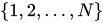
There is no way to choose a positive integer at random so that each positive integer occurs with equal probability, but statements about "randomly chosen integers" such as the ones above can be formalized by using the notion of natural density. For each positive integer N, let PN be the probability that two randomly chosen numbers in are coprime. Although PN will never equal 6/π2 exactly, with work[9] one can show that in the limit as the probability PN approaches 6/π2.

More generally, the probability of k randomly chosen integers being setwise coprime is

Generating all coprime pairs
[edit]
All pairs of positive coprime numbers (m, n) (with m > n) can be arranged in two disjoint complete ternary trees, one tree starting from (2, 1) (for even–odd and odd–even pairs),[10] and the other tree starting from (3, 1) (for odd–odd pairs).[11] The children of each vertex (m, n) are generated as follows:
- Branch 1:
- Branch 2:
- Branch 3:


This scheme is exhaustive and non-redundant with no invalid members. This can be proved by remarking that, if is a coprime pair with then


- if then is a child of along branch 3;
- if then is a child of along branch 2;
- if then is a child of along branch 1.






In all cases is a "smaller" coprime pair with This process of "computing the father" can stop only if either or In these cases, coprimality, implies that the pair is either or


Another (much simpler) way to generate a tree of positive coprime pairs (m, n) (with m > n) is by means of two generators and , starting with the root . The resulting binary tree, the Calkin–Wilf tree, is exhaustive and non-redundant, which can be seen as follows. Given a coprime pair one recursively applies or depending on which of them yields a positive coprime pair with m > n. Since only one does, the tree is non-redundant. Since by this procedure one is bound to arrive at the root, the tree is exhaustive.


Applications
[edit]In machine design, an even, uniform gear wear is achieved by choosing the tooth counts of the two gears meshing together to be relatively prime. When a 1:1 gear ratio is desired, a gear relatively prime to the two equal-size gears may be inserted between them.
In pre-computer cryptography, some Vernam cipher machines combined several loops of key tape of different lengths. Many rotor machines combine rotors of different numbers of teeth. Such combinations work best when the entire set of lengths are pairwise coprime.[12][13][14][15]
Generalizations
[edit]This concept can be extended to other algebraic structures than for example, polynomials whose greatest common divisor is 1 are called coprime polynomials.

Coprimality in ring ideals
[edit]Two ideals A and B in a commutative ring R are called coprime (or comaximal) if This generalizes Bézout's identity: with this definition, two principal ideals (a) and (b) in the ring of integers are coprime if and only if a and b are coprime. If the ideals A and B of R are coprime, then furthermore, if C is a third ideal such that A contains BC, then A contains C. The Chinese remainder theorem can be generalized to any commutative ring, using coprime ideals.



See also
[edit]
Notes
[edit]- ^ Eaton, James S. (1872). A Treatise on Arithmetic. Boston: Thompson, Bigelow & Brown. p. 49. Retrieved 10 January 2022.
Two numbers are mutually prime when no whole number but one will divide each of them
- ^ Hardy & Wright 2008, p. 6
- ^ Graham, R. L.; Knuth, D. E.; Patashnik, O. (1989), Concrete Mathematics / A Foundation for Computer Science, Addison-Wesley, p. 115, ISBN 0-201-14236-8
- ^ Ore 1988, p. 47
- ^ Niven & Zuckerman 1966, p. 22, Theorem 2.3(b)
- ^ Niven & Zuckerman 1966, p. 6, Theorem 1.8
- ^ Niven & Zuckerman 1966, p.7, Theorem 1.10
- ^ Rosen 1992, p. 140
- ^ This theorem was proved by Ernesto Cesàro in 1881. For a proof, see Hardy & Wright 2008, Theorem 332
- ^ Saunders, Robert & Randall, Trevor (July 1994), "The family tree of the Pythagorean triplets revisited", Mathematical Gazette, 78: 190–193, doi:10.2307/3618576.
- ^ Mitchell, Douglas W. (July 2001), "An alternative characterisation of all primitive Pythagorean triples", Mathematical Gazette, 85: 273–275, doi:10.2307/3622017.
- ^ Klaus Pommerening. "Cryptology: Key Generators with Long Periods".
- ^ David Mowry. "German Cipher Machines of World War II". 2014. p. 16; p. 22.
- ^ Dirk Rijmenants. "Origins of One-time pad".
- ^ Gustavus J. Simmons. "Vernam-Vigenère cipher".
References
[edit]- Hardy, G.H.; Wright, E.M. (2008), An Introduction to the Theory of Numbers (6th ed.), Oxford University Press, ISBN 978-0-19-921986-5
- Niven, Ivan; Zuckerman, Herbert S. (1966), An Introduction to the Theory of Numbers (2nd ed.), John Wiley & Sons
- Ore, Oystein (1988) [1948], Number Theory and Its History, Dover, ISBN 978-0-486-65620-5
- Rosen, Kenneth H. (1992), Elementary Number Theory and its Applications (3rd ed.), Addison-Wesley, ISBN 978-0-201-57889-8
Further reading
[edit]- Lord, Nick (March 2008), "A uniform construction of some infinite coprime sequences", Mathematical Gazette, 92: 66–70.
Coprime integers
View on GrokipediaDefinition and Basic Concepts
Definition of Coprimality
Two integers and are said to be coprime, or relatively prime, if their greatest common divisor equals 1.[9] The greatest common divisor of and is the largest positive integer that divides both without remainder.[10] This condition implies that and share no common prime factors other than possibly 1, ensuring they have no nontrivial common divisors.[9] Although the definition applies to all integers, discussions of coprimality often focus on positive integers for simplicity, as the gcd is invariant under signs: .[11] Special care is needed for zero; for any integer , so 0 and are coprime only if .[11] Thus, 0 is coprime with 1 and -1, but not with any other integer.[11] The concept originates in Euclid's Elements (circa 300 BCE), where relatively prime numbers are defined in Book VII, Definition 12 as those "measured by a unit alone as a common measure."[12] This foundational idea underpins the unique factorization of integers into primes, as coprimality guarantees that factorizations do not share common elements beyond unity.[13] For example, 8 and 15 are coprime because , as 8 factors as and 15 as , with no shared prime factors.[10]Notation and Testing
Two integers and are denoted as coprime if their greatest common divisor satisfies , where is the standard notation for the gcd.[14] An alternative symbol in some number theory texts is , employing the perpendicularity notation to signify that no prime divides both and . In computational mathematics and programming libraries, such as those in symbolic algebra systems, a predicate like RelPrime(a, b) may return true if the pair is coprime.[14] The primary method to test coprimality is the Euclidean algorithm, which efficiently computes for integers . The algorithm proceeds recursively: , continuing until the remainder is zero, at which point the non-zero remainder is the gcd; if this value is 1, then and are coprime.[15] This process relies on the property that the gcd remains unchanged under replacement of the larger number by its remainder when divided by the smaller.[16] The Euclidean algorithm has a time complexity of , as each step roughly halves the size of the numbers involved, leading to at most a logarithmic number of divisions.[17] For verification purposes, the extended Euclidean algorithm augments the basic version by tracking coefficients to express the gcd as a linear combination: it finds integers and such that ; when the gcd is 1, this confirms coprimality via Bézout's identity.[18] Consider the example of testing : The last non-zero remainder is 1, so , confirming that 48 and 35 are coprime.[15]Properties of Coprime Integers
Arithmetic Properties
A fundamental arithmetic property of coprime integers is their invariance under addition multiples. Specifically, if , then for any integer . This follows from the general relation , which holds because any common divisor of and also divides , and conversely, any common divisor of and divides . Bézout's identity provides a characterization of coprimality in terms of linear combinations. It states that two integers and are coprime if and only if there exist integers and such that . More generally, for any integers and not both zero, there exist integers and such that . The proof is constructive and relies on the extended Euclidean algorithm, which back-substitutes the steps of the Euclidean algorithm to express the gcd as such a combination, though the explicit steps are omitted here.[19] A key consequence is that the set of all integer linear combinations , where and range over the integers, consists precisely of the multiples of . Thus, when and are coprime, these linear combinations generate all integers, meaning the ideal generated by and in the ring of integers is the entire ring . For example, the equation has integer solutions, such as and , since .[19] In contrast, if and are not coprime, with , then divides every linear combination , including . Consequently, , illustrating how non-coprimality propagates under addition.Multiplicative Properties
One fundamental multiplicative property of coprimality is its preservation under multiplication: if and , then .[20] This follows from the fact that any common divisor of and must divide and separately, but since shares no common factors with either, the gcd remains 1.[21] A more general result is the multiplicative formula for the gcd: if , then .[22] For example, if , , and , then and . This property highlights how coprimality allows the gcd to "distribute" over multiplication without interference from shared factors. Coprimality is intimately connected to the unique factorization theorem, which states that every integer greater than 1 has a unique prime factorization up to ordering. Two integers are coprime if and only if they share no common prime factors in their factorizations. For instance, distinct primes and are coprime, so has the distinct prime factors and with multiplicity one each. This coprimality condition is a prerequisite for Euler's theorem in modular arithmetic: if , then , where is Euler's totient function.[23]Coprimality in Sets
Pairwise and Mutual Coprimality
In number theory, a finite set of integers with is said to be pairwise coprime if for every pair of distinct indices . This condition ensures that no prime divides more than one element in the set. For example, the set is pairwise coprime, as , , and .[24][25] A set of integers is mutually coprime (also called setwise coprime) if the greatest common divisor of all its elements is 1, that is, . This property is weaker than pairwise coprimality, as it only requires that no single prime divides every element in the set, without restricting shared factors between subsets. For instance, the set is mutually coprime since , but it is not pairwise coprime because , , and .[26] Pairwise coprimality implies mutual coprimality: if every pair has gcd 1, then no prime can divide all elements, so the overall gcd is 1. The converse does not hold, and the distinction first arises for sets of size 3, as any two integers are either both pairwise and mutually coprime or neither. A key property is that if the elements of a pairwise coprime set are each square-free (divisible by no squared prime greater than 1), then their product is also square-free. This follows from the unique prime factorization theorem, as no prime divides more than one factor, preventing any squared primes in the product.Coprime Sets and Sequences
A coprime sequence refers to an infinite sequence of integers where each pair of consecutive terms is coprime, satisfying for all . The Fibonacci sequence, defined by , , and for , exemplifies this property, as consecutive terms are always coprime; more generally, for any positive integers and , ensuring the condition holds since when .[27] Infinite coprime sets consist of infinitely many integers that are pairwise coprime, meaning for all distinct . The set of all prime numbers serves as a fundamental example, with distinct primes sharing no common prime factors.[24] Additional constructions include the Fermat numbers for , which are pairwise coprime due to the relation dividing for , and Sylvester's sequence, defined by and for , where each term is the product of all previous terms plus one, ensuring pairwise coprimality.[26] Such sets highlight the existence of infinite pairwise coprime collections with varying growth rates and densities, from zero asymptotic density in the primes to sparser distributions in sequences like Sylvester's. A key property connecting coprime integers to sequences is Zsigmondy's theorem, which asserts that if and are coprime positive integers with and is an integer, then possesses a primitive prime divisor—a prime dividing but no for —with exceptions only for and cases where and is a power of 2.[28] This result guarantees new prime factors in sequences like for coprime bases, aiding analysis of primitivity in cyclotomic polynomials and related constructions.Probabilistic Aspects
Probability of Coprimality
The probability that two randomly selected positive integers and are coprime, meaning , is a fundamental result in analytic number theory. This probability equals , indicating that approximately 60.8% of pairs of positive integers share no common prime factors other than 1.[29][30] The derivation relies on the Euler product formula for the Riemann zeta function . Specifically, the probability is given by the infinite product over all primes : where the product converges because the sum is finite. This product equals , and since , the probability simplifies to . The interpretation arises from the fact that for each prime , the probability that does not divide both and is , and independence over primes yields the full product.[29][31] This result traces back to Leonhard Euler's 1737 paper "Variae observationes circa series infinitas," where he established the Euler product for and evaluated using the infinite product over primes, laying the groundwork for the coprimality probability. The explicit connection to the probability of coprimality follows directly from this product, with convergence ensured by the finiteness of .[32] In practice, for finite ranges, the proportion of coprime pairs with approaches as . The number of such pairs is asymptotically , confirming the limiting probability through rigorous error bounds.[31][30]Density and Distribution
The natural density of the set of positive integers coprime to a fixed positive integer is , where is Euler's totient function. This implies that the number of such integers not exceeding is asymptotically , with an error term bounded by the number of divisors of .[33] In higher dimensions, the asymptotic density of -tuples of positive integers with each that are pairwise coprime is given by the infinite product over all primes of the local factor , which simplifies for to and yields smaller values for larger , such as approximately 0.286 for . This product arises from the probability that no prime divides more than one member of the tuple at each prime locus, and while it lacks a closed form like the mutual coprimality case, numerical evaluation shows it decreases with . For mutual coprimality (gcd of all being 1), the density is instead , where is the Riemann zeta function, providing a benchmark for comparison in multidimensional settings.[34][33] The integers coprime to a fixed exhibit equidistribution properties in arithmetic progressions. Specifically, when , these integers are equidistributed modulo , meaning each residue class contains asymptotically the same proportion of them up to . More generally, for progressions with , the coprime integers align uniformly under compatibility conditions with , reflecting the periodic nature of the set via the Chinese remainder theorem.[33] Despite these average behaviors, the distribution of coprime pairs and tuples displays irregularities and gaps, particularly in short intervals or along specific lines in the lattice. The Hardy-Littlewood conjectures, through the circle method and singular series, predict fine-scale asymptotics for the count of coprime pairs with bounded differences or in restricted regions, accounting for local obstructions at primes and suggesting Poisson-like fluctuations around the mean density. These conjectures remain unproved but guide estimates for gaps between consecutive coprime integers or tuples.Generating Coprime Pairs
Algorithms and Methods
One effective method for generating coprime integer pairs involves the use of Farey sequences, which systematically enumerate all reduced fractions where , , and the fractions are ordered increasingly between 0 and 1. The construction is recursive: begin with the Farey sequence of order 1, . To obtain from , insert the mediant between every pair of adjacent fractions and in whenever , ensuring all inserted fractions are in lowest terms. This process generates approximately coprime pairs up to denominator , providing a complete list without duplicates or omissions for the specified range.[35] Sieve-based approaches adapt the sieve of Eratosthenes to identify and mark non-coprime pairs within bounds up to , enabling efficient enumeration of coprime ones. Precompute the smallest prime factor for each integer up to using a linear sieve in time. Then, for generating pairs with , iterate over possible values and use the precomputed factors to skip or mark positions sharing common primes, effectively filtering to retain only coprime pairs. This method avoids computing the GCD for every potential pair, reducing redundant operations by leveraging prime multiplicity markings across the range. For random generation of coprime pairs, rejection sampling offers a straightforward probabilistic algorithm: select integers and uniformly at random from , compute , and accept the pair if it equals 1; otherwise, reject and resample. The acceptance probability is , implying an expected trials per valid pair, independent of for large ranges. This efficiency stems from the asymptotic density of coprime pairs among all integer pairs, derived from the Euler product over primes.[36] This efficiency stems from the asymptotic density of coprime pairs among all integer pairs, derived from the Euler product over primes.[30] The overall time complexity for generating all coprime pairs up to using sieve-based methods is , accounting for the harmonic summation over primes in the marking process and the output size of approximately pairs.Constructions and Examples
One of the simplest constructions of coprime integer pairs is the set of consecutive integers for any integer . These pairs are always coprime, as any common divisor of and would also divide their difference , which is impossible.[29] Pairs of distinct primes with form another infinite family of coprime integers. By the definition of primes, the only positive divisors of are 1 and , and similarly for ; since , the only shared divisor is 1, so .[29] A further construction yields coprime pairs from powers of 2 and odd integers: for and any odd positive integer , the pair satisfies . This holds because the prime factorization of consists solely of the prime 2, while has no factor of 2, as guaranteed by the fundamental theorem of arithmetic, which uniquely decomposes every positive integer into a power of 2 times an odd part.[37] Consecutive Fibonacci numbers provide yet another infinite family of coprime pairs: for the sequence defined by , , and for , it follows that for all . This is proven by induction: the base cases hold, and assuming , any common divisor of and would divide , contradicting the inductive hypothesis unless the divisor is 1.[38] Illustrative examples of coprime pairs can be found among small positive integers. The table below lists the first 10 such pairs with , ordered lexicographically by increasing and then :| 1 | 2 |
| 1 | 3 |
| 1 | 4 |
| 1 | 5 |
| 1 | 6 |
| 1 | 7 |
| 1 | 8 |
| 1 | 9 |
| 1 | 10 |
| 1 | 11 |