


Community hub
Recent from talks
Contribute something
Nothing was collected or created yet.
Copyright infringement
View on Wikipedia


Copyright infringement (at times referred to as piracy) is the use of works protected by copyright without permission for a usage where such permission is required, thereby infringing certain exclusive rights granted to the copyright holder, such as the right to reproduce, distribute, display or perform the protected work, or to produce derivative works. The copyright holder is usually the work's creator, or a publisher or other business to whom copyright has been assigned. Copyright holders routinely invoke legal and technological measures to prevent and penalise copyright infringement.
Copyright infringement disputes are usually resolved through direct negotiation, a notice and take down process, or litigation in civil court. Egregious or large-scale commercial infringement, especially when it involves counterfeiting, or the fraudulent imitation of a product or brand,[1] is sometimes prosecuted via the criminal justice system.
Estimates of the actual economic impact of copyright infringement vary widely and depend on other factors. Nevertheless, copyright holders, industry representatives, and legislators have long characterised copyright infringement as piracy or theft – language which some US courts now regard as pejorative or otherwise contentious.[2][3][4]
Terminology
[edit]The terms piracy and theft are often associated with copyright infringement.[5][6] The original meaning of piracy is "robbery or illegal violence at sea",[7] but the term has been in use for centuries as a synonym for acts of copyright infringement.[8] Theft, meanwhile, emphasises the potential commercial harm of infringement to copyright holders. However, copyright is a type of intellectual property, an area of law distinct from that which covers robbery or theft, offences related only to tangible property. Not all copyright infringement results in commercial loss, and the US Supreme Court ruled in 1985 that infringement does not easily equate with theft.[2]
This was taken further in the case MPAA v. Hotfile, where Judge Kathleen M. Williams granted a motion to deny the MPAA the usage of words whose appearance was primarily "pejorative". This list included the word "piracy", the use of which, the motion by the defence stated, serves no court purpose but to misguide and inflame the jury.[3][9]
"Piracy"
[edit]
The term "piracy" has been used to refer to the unauthorised copying, distribution and selling of works in copyright.[8] In 1668 publisher John Hancock wrote of "some dishonest Booksellers, called Land-Pirats, who make it their practise to steal Impressions of other mens Copies" in the work A String of Pearls: or, The Best Things Reserved till Last by Thomas Brooks.[10] Over time the metaphor mostly used in the book-trade became more common, such that the use of the word 'pirate' itself to describe unauthorised publishing of books was attested to in Nathan Bailey's 1736 dictionary An Universal Etymological English Dictionary:
'One who lives by pillage and robbing on the sea. Also a plagiary'[11]
The practice of labelling the infringement of exclusive rights in creative works as "piracy" predates statutory copyright law. Prior to the Statute of Anne in 1710, the Stationers' Company of London in 1557, received a royal charter giving the company a monopoly on publication and tasking it with enforcing the charter. Article 61 of the 1994 Agreement on Trade-Related Aspects of Intellectual Property Rights (TRIPs) requires criminal procedures and penalties in cases of "willful trademark counterfeiting or copyright piracy on a commercial scale."[12]: 208 Piracy traditionally refers to acts of copyright infringement intentionally committed for financial gain, though more recently, copyright holders have described online copyright infringement, particularly in relation to peer-to-peer file sharing networks, as "piracy".[8]
Richard Stallman and the GNU Project have criticised the use of the word "piracy" in these situations, saying that publishers use the word to refer to "copying they don't approve of" and that "they [publishers] imply that it is ethically equivalent to attacking ships on the high seas, kidnapping and murdering the people on them."[13]
"Theft"
[edit]
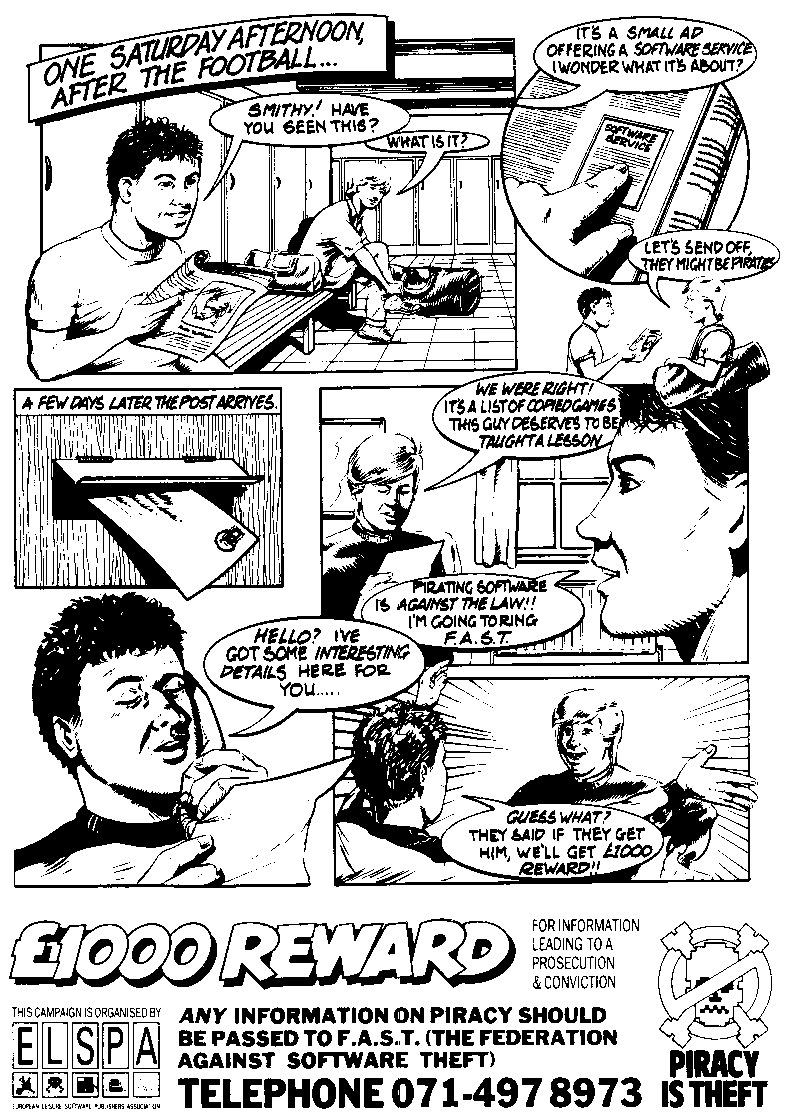
Copyright holders frequently refer to copyright infringement as theft, "although such misuse has been rejected by legislatures and courts".[14] The slogan "Piracy is theft" was used beginning in the 1980s, and is still being used.[15][16] In copyright law, infringement does not refer to theft of physical objects that take away the owner's possession, but an instance where a person exercises one of the exclusive rights of the copyright holder without authorisation.[17] Courts have distinguished between copyright infringement and theft.[14] For instance, the United States Supreme Court held in Dowling v. United States (1985) that bootleg phonorecords did not constitute stolen property. Instead,
interference with copyright does not easily equate with theft, conversion, or fraud. The Copyright Act even employs a separate term of art to define one who misappropriates a copyright: '[...] an infringer of the copyright.'
The court said that in the case of copyright infringement, the province guaranteed to the copyright holder by copyright law – certain exclusive rights – is invaded, but no control, physical or otherwise, is taken over the copyright, nor is the copyright holder wholly deprived of using the copyrighted work or exercising the exclusive rights held.[2]
"Freebooting"
[edit]The term "freebooting" has been used to describe the unauthorised copying of online media, particularly videos, onto websites such as Facebook, YouTube or Twitter. The word itself had already been in use since the 16th century, referring to pirates, and meant "looting" or "plundering". This form of the word – a portmanteau of "freeloading" and "bootlegging" – was suggested by YouTuber and podcaster Brady Haran in the podcast Hello Internet.[18][19] Haran advocated the term in an attempt to find a phrase more emotive than "copyright infringement", yet more appropriate than "theft".[19][20]
Motivation
[edit]Some of the motives for engaging in copyright infringement are the following:[21]
- Pricing – unwillingness or inability to pay the price requested by the legitimate sellers
- Testing and evaluation – try before paying for what may be bad value
- Unavailability – no legitimate sellers providing the product in the language or country of the end-user: not yet launched there, already withdrawn from sales, never to be sold there, geographical restrictions on online distribution and international shipping
- Usefulness – the legitimate product comes with various means (DRM, region lock, DVD region code, Blu-ray region code) of restricting legitimate use (backups, usage on devices of different vendors, offline usage) or comes with non-skippable advertisements and anti-piracy disclaimers, which are removed in the unauthorised product, making it more desirable for the end-user
- Shopping experience – no legitimate sellers providing the product with the required quality through online distribution and through a shopping system with the required level of user-friendliness
- Anonymity – downloading works does not require identification whereas downloads directly from the website of the copyright owner often require a valid email address and/or other credentials
- Freedom of information – Some people engage in copyright infringement due to opposition to copyright law or a belief that certain information should be freely accessible.[22][23]
- Protest/boycotting - Infringement can be used to protest against specific companies they disagree with. A person may pirate a company to avoid giving money to a company as a way to voice disapproval of their business practices or perceived greed especially if they want or need the copyrighted work but don’t want to support them. Others use copyrighted art without permission to create protest arts for social movements or political commentary.[24]
Sometimes only partial compliance with licence agreements is the cause. For example, in 2013, the United States Army settled a lawsuit with Texas-based company Apptricity which makes software that allows the army to track their soldiers in real time. In 2004, the US Army paid the company a total of $4.5 million for a licence of 500 users while allegedly installing the software for more than 9000 users; the case was settled for US$50 million.[25][26] Major anti-piracy organisations, like the BSA, conduct software licensing audits regularly to ensure full compliance.[27]
Cara Cusumano, director of the Tribeca Film Festival, stated in April 2014: "Piracy is less about people not wanting to pay and more about just wanting the immediacy – people saying, 'I want to watch Spiderman right now' and downloading it". The statement occurred during the third year that the festival used the Internet to present its content, while it was the first year that it featured a showcase of content producers who work exclusively online. Cusumano further explained that downloading behaviour is not merely conducted by people who merely want to obtain content for free:
I think that if companies were willing to put that material out there, moving forward, consumers will follow. It's just that [consumers] want to consume films online and they're ready to consume films that way and we're not necessarily offering them in that way. So it's the distribution models that need to catch up. People will pay for the content.[5]
In response to Cusumano's perspective, Screen Producers Australia executive director Matt Deaner clarified the motivation of the film industry: "Distributors are usually wanting to encourage cinema-going as part of this process [of monetizing through returns] and restrict the immediate access to online so as to encourage the maximum number of people to go to the cinema." Deaner further explained the matter in terms of the Australian film industry, stating: "there are currently restrictions on quantities of tax support that a film can receive unless the film has a traditional cinema release."[5]
In a study published in the Journal of Behavioural and Experimental Economics, and reported on in early May 2014, researchers from the University of Portsmouth in the UK discussed findings from examining the illegal downloading behaviour of 6,000 Finnish people, aged seven to 84. The list of reasons for downloading given by the study respondents included money saving; the ability to access material not on general release, or before it was released; and assisting artists to avoid involvement with record companies and movie studios.[28]
In a public talk between Bill Gates, Warren Buffett, and Brent Schlender at the University of Washington in 1998, Bill Gates commented on piracy as a means to an end, whereby people who use Microsoft software illegally will eventually pay for it, out of familiarity, as a country's economy develops and legitimate products become more affordable to businesses and consumers:
Although about three million computers get sold every year in China, people don't pay for the software. Someday they will, though. And as long as they're going to steal it, we want them to steal ours. They'll get sort of addicted, and then we'll somehow figure out how to collect sometime in the next decade.[29]
Developing world
[edit]
In Media Piracy in Emerging Economies, the first independent comparative study of media piracy focused on Brazil, India, Russia, South Africa, Mexico, Turkey and Bolivia, "high prices for media goods, low incomes, and cheap digital technologies" are the chief factors that lead to the global spread of media piracy, especially in emerging markets.[30] According to the study, even though digital piracy inflicts additional costs on the production side of media, it also offers the main access to media goods in developing countries. The strong tradeoffs that favour using digital piracy in developing economies dictate the current neglected law enforcement's toward digital piracy.[30]
In China as of 2013, the issue of digital infringement has not merely been legal, but social – originating from the high demand for cheap and affordable goods as well as the governmental connections of the businesses which produce such goods.[31]
Motivations due to censorship
[edit]There have been instances where a country's government bans a movie, resulting in the spread of copied videos and DVDs. Romanian-born documentary maker Ilinca Calugareanu wrote a New York Times article telling the story of Irina Margareta Nistor, a narrator for state TV under Nicolae Ceauşescu's regime. A visitor from the west gave her bootlegged copies of American movies, which she dubbed for secret viewings through Romania. According to the article, she dubbed more than 3,000 movies and became the country's second-most famous voice after Ceauşescu, even though no one knew her name until many years later.[32]
Existing and proposed laws
[edit]

Most countries extend copyright protections to authors of works. In countries with copyright legislation, enforcement of copyright is generally the responsibility of the copyright holder.[12]: 211 However, in several jurisdictions there are also criminal penalties for copyright infringement.[33] According to the US Chamber of Commerce's 2021 IP Index, the nations with the lowest scores for copyright protection were Vietnam, Pakistan, Egypt, Nigeria, Brunei, Algeria, Venezuela and Argentina.[34][35]
Civil law
[edit]Copyright infringement in civil law is any violation of the exclusive rights of the owner. In US law, these rights include reproduction, preparation of derivative works, distribution of copies by sale or rental, and public performances or displays.[36]
In the United States, copyright infringement is sometimes confronted via lawsuits in civil court, against alleged infringers directly or against providers of services and software that support unauthorised copying. For example, major motion-picture corporation MGM Studios filed suit against P2P file-sharing services Grokster and Streamcast for their contributory role in copyright infringement.[37] In 2005, the Supreme Court ruled in favour of MGM, holding that such services could be held liable for copyright infringement since they functioned and, indeed, wilfully marketed themselves as venues for acquiring copyrighted movies. The MGM v. Grokster case did not overturn the earlier Sony v. Universal City Studios decision, but rather clouded the legal waters; future designers of software capable of being used for copyright infringement were warned.[38]
In the United States, copyright term has been extended many times over[39] from the original term of 14 years with a single renewal allowance of 14 years, to the current term of the life of the author plus 70 years. If the work was produced under corporate authorship it may last 120 years after creation or 95 years after publication, whichever is sooner.
Article 50 of the Agreement on Trade-Related Aspects of Intellectual Property Rights (TRIPs) requires that signatory countries enable courts to remedy copyright infringement with injunctions and the destruction of infringing products, and award damages.[12]: 208 Some jurisdictions only allow actual, provable damages, and some, like the United States, allow for large statutory damage awards intended to deter would-be infringers and allow for compensation in situations where actual damages are difficult to prove.
In some jurisdictions, copyright or the right to enforce it can be contractually assigned to a third party which did not have a role in producing the work. When this outsourced litigator appears to have no intention of taking any copyright infringement cases to trial, but rather only takes them just far enough through the legal system to identify and exact settlements from suspected infringers, critics commonly refer to the party as a "copyright troll". Such practices have had mixed results in the US[40]
Criminal law
[edit]Punishment of copyright infringement varies case-by-case across countries. Convictions may include jail time or severe fines for each instance of copyright infringement. In the United States, wilful copyright infringement carries a maximum fine of $150,000 per instance.[41]
Article 61 of the Agreement on Trade-Related Aspects of Intellectual Property Rights (TRIPs) requires that signatory countries establish criminal procedures and penalties in cases of "willful trademark counterfeiting or copyright piracy on a commercial scale".[12]: 208 Copyright holders have demanded that states provide criminal sanctions for all types of copyright infringement.[12]: 211
The first criminal provision in US copyright law was added in 1897, which established a misdemeanor penalty for "unlawful performances and representations of copyrighted dramatic and musical compositions" if the violation had been "willful and for profit".[42] Criminal copyright infringement requires that the infringer acted "for the purpose of commercial advantage or private financial gain" (17 U.S.C. § 506). To establish criminal liability, the prosecutor must first show the basic elements of copyright infringement: ownership of a valid copyright, and the violation of one or more of the copyright holder's exclusive rights. The government must then establish that defendant wilfully infringed or, in other words, possessed the necessary mens rea. Misdemeanor infringement has a very low threshold in terms of number of copies and the value of the infringed works.
The ACTA trade agreement, signed in May 2011 by the United States, Japan, and the EU, requires that its parties add criminal penalties, including incarceration and fines, for copyright and trademark infringement, and obligated the parties to actively police for infringement.[12]: 211 [43][44]
United States v. LaMacchia 871 F.Supp. 535 (1994) was a case decided by the United States District Court for the District of Massachusetts which ruled that, under the copyright and cybercrime laws effective at the time, committing copyright infringement for non-commercial motives could not be prosecuted under criminal copyright law. The ruling gave rise to what became known as the "LaMacchia Loophole", wherein criminal charges of fraud or copyright infringement would be dismissed under current legal standards, so long as there was no profit motive involved.[45]
The United States No Electronic Theft Act (NET Act), a federal law passed in 1997, in response to LaMacchia, provides for criminal prosecution of individuals who engage in copyright infringement under certain circumstances, even when there is no monetary profit or commercial benefit from the infringement. Maximum penalties can be five years in prison and up to $250,000 in fines. The NET Act also raised statutory damages by 50%. The court's ruling explicitly drew attention to the shortcomings of current law that allowed people to facilitate mass copyright infringement while being immune to prosecution under the Copyright Act.
Proposed laws such as the Stop Online Piracy Act broaden the definition of "willful infringement", and introduce felony charges for unauthorised media streaming. These bills are aimed towards defeating websites that carry or contain links to infringing content, but have raised concerns about domestic abuse and internet censorship.
Non-commercial file sharing
[edit]Legality of downloading
[edit]
To an extent, copyright law in some countries permits downloading copyright-protected content for personal, noncommercial use. Examples include Canada[46] and European Union (EU) member states like Poland.[47]
The personal copying exemption in the copyright law of EU member states stems from the Information Society Directive of 2001, which is generally devised to allow EU members to enact laws permitting making copies without authorisation, as long as they are for personal, noncommercial use. The Directive was not intended to legitimise file-sharing, but rather the common practice of space shifting copyright-protected content from a legally purchased CD (for example) to certain kinds of devices and media, provided rights holders are compensated and no copy protection measures are circumvented. Rights-holder compensation takes various forms, depending on the country, but is generally either a levy on "recording" devices and media, or a tax on the content itself. In some countries, such as Canada, the applicability of such laws to copying onto general-purpose storage devices like computer hard drives, portable media players, and phones, for which no levies are collected, has been the subject of debate and further efforts to reform copyright law.
In some countries, the personal copying exemption explicitly requires that the content being copied be obtained legitimately (i.e. from authorised sources, not file-sharing networks). In April 2014, the Court of Justice of the European Union ruled that "national legislation which makes no distinction between private copies made from lawful sources and those made from counterfeited or pirated sources cannot be tolerated."[48]
Legality of uploading
[edit]Although downloading or other private copying is sometimes permitted, public distribution – by uploading or otherwise offering to share copyright-protected content – remains illegal in most, if not all, countries. For example, in Canada, even though it was once legal to download any copyrighted file as long as it was for noncommercial use, it was still illegal to distribute the copyrighted files (e.g. by uploading them to a P2P network).[49]
Relaxed penalties
[edit]Some countries, like Canada and Germany, have limited the penalties for non-commercial copyright infringement. For example, Germany has passed a bill to limit the fine for individuals accused of sharing movies and series to €800–900. Canada's Copyright Modernization Act claims that statutory damages for non-commercial copyright infringement are capped at C$5,000 but this only applies to copies that have been made without the breaking of any "digital lock." However, this only applies to "bootleg distribution" and not non-commercial use.[50]
DMCA and anti-circumvention laws
[edit]Title I of the US DMCA, the WIPO Copyright and Performances and Phonograms Treaties Implementation Act has provisions that prevent persons from "circumvent[ing] a technological measure that effectively controls access to a work". Thus if a distributor of copyrighted works has some kind of software, dongle or password access device installed in instances of the work, any attempt to bypass such a copy protection scheme may be actionable – though the US Copyright Office is currently[timeframe?] reviewing anticircumvention rulemaking under DMCA – anti-circumvention exemptions that have been in place under the DMCA include those in software designed to filter websites that are generally seen to be inefficient (child safety and public library website filtering software) and the circumvention of copy protection mechanisms that have malfunctioned, have caused the instance of the work to become inoperable or which are no longer supported by their manufacturers.[51] According to Abby House Media Inc. v. Apple Inc., it is legal to point users to DRM-stripping software and inform them how to use it because of lack of evidence that DRM stripping leads to copyright infringement.[52][53][54]
Online intermediary liability
[edit]Whether Internet intermediaries are liable for copyright infringement by their users is a subject of debate and court cases in a number of countries.[55]
Definition of intermediary
[edit]Internet intermediaries were formerly understood to be internet service providers (ISPs). However, questions of liability have also emerged in relation to other Internet infrastructure intermediaries, including Internet backbone providers, cable companies and mobile communications providers.[56]
In addition, intermediaries are now also generally understood to include Internet portals, software and games providers, those providing virtual information such as interactive forums and comment facilities with or without a moderation system, aggregators of various kinds, such as news aggregators, universities, libraries and archives, web search engines, chat rooms, web blogs, mailing lists, and any website which provides access to third party content through, for example, hyperlinks, a crucial element of the World Wide Web.
Litigation and legislation concerning intermediaries
[edit]Early court cases focused on the liability of Internet service providers (ISPs) for hosting, transmitting or publishing user-supplied content that could be actioned under civil or criminal law, such as libel or pornography.[57]
The debate has shifted away from questions about liability for specific content, including that which may infringe copyright, towards whether online intermediaries should be generally responsible for content accessible through their services or infrastructure.[58]
The US Digital Millennium Copyright Act (1998) and the European E-Commerce Directive (2000) provide online intermediaries with limited statutory immunity from liability for copyright infringement. Online intermediaries hosting content that infringes copyright are not liable, so long as they do not know about it and take actions once the infringing content is brought to their attention. In US law this is characterised as "safe harbor" provisions. Under European law, the governing principles for Internet Service Providers are "mere conduit", meaning that they are neutral 'pipes' with no knowledge of what they are carrying; and 'no obligation to monitor' meaning that they cannot be given a general mandate by governments to monitor content. These two principles are a barrier for certain forms of online copyright enforcement and they were the reason behind an attempt to amend the European Telecoms Package in 2009 to support new measures against copyright infringement.[59]
Peer-to-peer issues
[edit]Peer-to-peer file sharing intermediaries have been denied access to safe harbour provisions in relation to copyright infringement. Legal action against such intermediaries, such as Napster, are generally brought in relation to principles of secondary liability for copyright infringement, such as contributory liability and vicarious liability.[60]
These types of intermediaries do not host or transmit infringing content, themselves, but may be regarded in some courts as encouraging, enabling or facilitating infringement by users. These intermediaries may include the author, publishers, and marketers of peer-to-peer networking software, and the websites that allow users to download such software. In the case of the BitTorrent protocol, intermediaries may include the torrent tracker and any websites or search engines which facilitate access to torrent files. Torrent files do not contain copyrighted content, but they may refer to files that do, and they may point to trackers which coordinate the sharing of those files. Some torrent indexing and search sites, such as The Pirate Bay, now encourage the use of magnet links, instead of direct links to torrent files, creating another layer of indirection; using such links, torrent files are obtained from other peers, rather than from a particular website.
Since the late 1990s, copyright holders have taken legal actions against a number of peer-to-peer intermediaries, such as pir, Grokster, eMule, SoulSeek, BitTorrent and Limewire, and case law on the liability of Internet service providers (ISPs) in relation to copyright infringement has emerged primarily in relation to these cases.[61]
Nevertheless, whether and to what degree any of these types of intermediaries have secondary liability is the subject of ongoing litigation. The decentralised structure of peer-to-peer networks, in particular, does not sit easily with existing laws on online intermediaries' liability. The BitTorrent protocol established an entirely decentralised network architecture in order to distribute large files effectively. Recent developments in peer-to-peer technology towards more complex network configurations are said to have been driven by a desire to avoid liability as intermediaries under existing laws.[62]
Limitations
[edit]Copyright law does not grant authors and publishers absolute control over the use of their work. Only certain types of works and kinds of uses are protected;[63] only unauthorised uses of protected works can be said to be infringing.
Non-infringing uses
[edit]Article 10 of the Berne Convention mandates that national laws provide for limitations to copyright, so that copyright protection does not extend to certain kinds of uses that fall under what the treaty calls "fair practice", including but not limited to minimal quotations used in journalism and education.[64] The laws implementing these limitations and exceptions for uses that would otherwise be infringing broadly fall into the categories of either fair use or fair dealing. In common law systems, these fair practice statutes typically enshrine principles underlying many earlier judicial precedents, and are considered essential to freedom of speech.[65]
Another example is the practice of compulsory licensing, which is where the law forbids copyright owners from denying a licence for certain uses of certain kinds of works, such as compilations and live performances of music. Compulsory licensing laws generally say that for certain uses of certain works, no infringement occurs as long as a royalty, at a rate determined by law rather than private negotiation, is paid to the copyright owner or representative copyright collective. Some fair dealing laws, such as Canada's, include similar royalty requirements.[66]
In Europe, the copyright infringement case Public Relations Consultants Association Ltd v Newspaper Licensing Agency Ltd had two prongs; one concerned whether a news aggregator service infringed the copyright of the news generators; the other concerned whether the temporary web cache created by the web browser of a consumer of the aggregator's service, also infringed the copyright of the news generators.[67] The first prong was decided in favour of the news generators; in June 2014 the second prong was decided by the Court of Justice of the European Union (CJEU), which ruled that the temporary web cache of consumers of the aggregator did not infringe the copyright of the news generators.[67][68][69]
Non-infringing types of works
[edit]In order to qualify for protection, a work must be an expression with a degree of originality, and it must be in a fixed medium, such as written down on paper or recorded digitally.[70][71] The idea itself is not protected. That is, a copy of someone else's original idea is not infringing unless it copies that person's unique, tangible expression of the idea. Some of these limitations, especially regarding what qualifies as original, are embodied only in case law (judicial precedent), rather than in statutes.
In the United States, for example, copyright case law contains a substantial similarity requirement to determine whether the work was copied. Likewise, courts may require computer software to pass an Abstraction-Filtration-Comparison test (AFC Test)[72][73] to determine if it is too abstract to qualify for protection, or too dissimilar to an original work to be considered infringing. Software-related case law has also clarified that the amount of R&D, effort and expense put into a work's creation does not affect copyright protection.[74]
Evaluation of alleged copyright infringement in a court of law may be substantial; the time and costs required to apply these tests vary based on the size and complexity of the copyrighted material. Furthermore, there is no standard or universally accepted test; some courts have rejected the AFC Test, for example, in favour of narrower criteria.
Preventive measures
[edit]The BSA outlined four strategies that governments can adopt to reduce software piracy rates in its 2011 piracy study results:
- "Increase public education and raise awareness about software piracy and IP rights in cooperation with industry and law enforcement."
- "Modernize protections for software and other copyrighted materials to keep pace with new innovations such as cloud computing and the proliferation of networked mobile devices."
- "Strengthen enforcement of IP laws with dedicated resources, including specialized enforcement units, training for law enforcement and judiciary officials, improved cross-border cooperation among law enforcement agencies, and fulfillment of obligations under the World Trade Organization's Agreement on Trade-Related Aspects of Intellectual Property Rights (TRIPS)."
- "Lead by example by using only fully licensed software, implementing software asset management (SAM) programs, and promoting the use of legal software in state-owned enterprises, and among all contractors and suppliers."[75]
Legal
[edit]Corporations and legislatures take different types of preventive measures to deter copyright infringement, with much of the focus since the early 1990s being on preventing or reducing digital methods of infringement. Strategies include education, civil and criminal legislation, and international agreements,[76][77] as well as publicizing anti-piracy litigation successes and imposing forms of digital media copy protection, such as controversial DRM technology and anti-circumvention laws, which limit the amount of control consumers have over the use of products and content they have purchased.
Legislatures have reduced infringement by narrowing the scope of what is considered infringing. Aside from upholding international copyright treaty obligations to provide general limitations and exceptions,[64] nations have enacted compulsory licensing laws applying specifically to digital works and uses. For example, in the US, the DMCA, an implementation of the 1996 WIPO Copyright Treaty, considers digital transmissions of audio recordings to be licensed as long as a designated copyright collective's royalty and reporting requirements are met.[78] The DMCA also provides safe harbour for digital service providers whose users are suspected of copyright infringement, thus reducing the likelihood that the providers themselves will be considered directly infringing.[79]
Some copyright owners voluntarily reduce the scope of what is considered infringement by employing relatively permissive, "open" licensing strategies: rather than privately negotiating licence terms with individual users who must first seek out the copyright owner and ask for permission, the copyright owner publishes and distributes the work with a prepared licence that anyone can use, as long as they adhere to certain conditions. This has the effect of reducing infringement – and the burden on courts – by simply permitting certain types of uses under terms that the copyright owner considers reasonable. Examples include free software licences, like the GNU General Public License (GPL), and the Creative Commons licences, which are predominantly applied to visual and literary works.[80]
Protected distribution
[edit]To maximise revenue, pre-COVID-19 film distribution typically began with cinemas (theatrical window), on average approximately 16+1⁄2 weeks,[81] before the release to Blu-ray and DVD (entering its video window). During the theatrical window, digital versions of films are often transported in data storage devices by couriers rather than by data transmission.[82] The data can be encrypted, with the key being made to work only at specific times in order to prevent leakage between screens.[82]
Watermarking
[edit]Coded anti-piracy marks can be added to films to identify the source of illegal copies and shut them down. In 2006, a notable example of using Coded Anti-Piracy marks resulted in a man being arrested[83] for uploading a screener's copy of the movie Flushed Away. Some photocopiers use Machine Identification Code dots for similar purposes.[according to whom?] The EURion constellation on banknotes is used to prevent copying to make counterfeit currency.
Economic impact of copyright infringement
[edit]Organisations disagree on the scope and magnitude of copyright infringement's free rider economic effects and public support for the copyright regime.
The European Commission funded a study[84] to analyse "the extent to which unauthorised online consumption of copyrighted materials (music, audiovisual, books and video games) displaces sales of online and offline legal content", across Germany, the United Kingdom, Spain, France, Poland and Sweden; the public funding behind the study provided a necessary basis for its neutrality.[85] 30,000 users, including minors between 14 and 17 years, were surveyed among September and October 2014. While a negative impact was found for the film industry, videogame sales were positively affected by illegal consumption, possibly due to "the industry being successful in converting illegal users to paying users" and employing player-oriented strategies (for example, by providing additional bonus levels or items in the gameplay for a fee); finally, no evidence was found for any claims of sales displacement in the other market sectors. According to the European Digital Rights association, the study may have been censored: specifically, as of 2018, the European Commission has not published the results, except in the part where the film industry was found to be adversely affected by illegal content consumption. Access to the study was requested and obtained by Member of the European Parliament Felix Reda.[86][87]
In relation to computer software, the Business Software Alliance (BSA) claimed in its 2011 piracy study: "Public opinion continues to support intellectual property (IP) rights: Seven PC users in 10 support paying innovators to promote more technological advances."[75]
Following consultation with experts on copyright infringement, the United States Government Accountability Office (GAO) clarified in 2010 that "estimating the economic impact of IP [intellectual property] infringements is extremely difficult, and assumptions must be used due to the absence of data", while "it is difficult, if not impossible, to quantify the net effect of counterfeiting and piracy on the economy as a whole."[88]
The US GAO's 2010 findings regarding the great difficulty of accurately gauging the economic impact of copyright infringement was reinforced within the same report by the body's research into three commonly cited estimates that had previously been provided to US agencies. The GAO report explained that the sources – a Federal Bureau of Investigation (FBI) estimate, a Customs and Border Protection (CBP) press release and a Motor and Equipment Manufacturers Association estimate – "cannot be substantiated or traced back to an underlying data source or methodology."[88]
Deaner explained the importance of rewarding the "investment risk" taken by motion picture studios in 2014:
Usually, movies are hot because a distributor has spent hundreds of thousands of dollars promoting the product in print and TV and other forms of advertising. The major Hollywood studios spend millions on this process with marketing costs rivalling the costs of production. They are attempting then to monetise through returns that can justify the investment in both the costs of promotion and production.[5]
Motion picture industry estimates
[edit]In 2008, the Motion Picture Association of America (MPAA) reported that its six major member companies lost US$6.1 billion to piracy.[89] A 2009 Los Angeles Daily News article then cited a loss figure of "roughly $20 billion a year" for Hollywood studios.[90] According to a 2013 article in The Wall Street Journal, industry estimates in the United States range between $6.1B to $18.5B per year.[91]
In an early May 2014 article in The Guardian, an annual loss figure of US$20.5 billion was cited for the movie industry. The article's basis is the results of a University of Portsmouth study that only involved Finnish participants, aged between seven and 84. The researchers, who worked with 6,000 participants, stated: "Movie pirates are also more likely to cut down their piracy if they feel they are harming the industry compared with people who illegally download music".[28]
However, a study conducted on data from sixteen countries between 2005 and 2013, many of which had enacted anti-piracy measures to increase box office revenues of movies, found no significant increases in any markets attributable to policy interventions, which calls into doubt the claimed negative economic effects of digital piracy on the film industry.[92]
Software industry estimates
[edit]Psion Software claimed in 1983 that software piracy cost it £2.9 million a year, 30% of its revenue.[93] Will Wright said that Raid on Bungeling Bay sold 20,000 copies for the Commodore 64 in the US, but 800,000 cartridges for the Nintendo Famicom with a comparable installed base in Japan, "because it's a cartridge system [so] there's virtually no piracy".[94]
According to a 2007 BSA and International Data Corporation (IDC) study, the five countries with the highest rates of software piracy were: 1. Armenia (93%); 2. Bangladesh (92%); 3. Azerbaijan (92%); 4. Moldova (92%); and 5. Zimbabwe (91%). According to the study's results, the five countries with the lowest piracy rates were: 1. the US (20%); 2. Luxembourg (21%); 3. New Zealand (22%); 4. Japan (23%); and 5. Austria (25%). The 2007 report showed that the Asia-Pacific region was associated with the highest amount of loss, in terms of US dollars, with $14,090,000, followed by the European Union, with a loss of $12,383,000; the lowest amount of US dollars was lost in the Middle East/Africa region, where $2,446,000 was documented.[95]
In its 2011 report, conducted in partnership with IDC and Ipsos Public Affairs, the BSA stated: "Over half of the world's personal computer users – 57 percent – admit to pirating software." The ninth annual "BSA Global Software Piracy Study" claims that the "commercial value of this shadow market of pirated software" was worth US$63.4 billion in 2011, with the highest commercial value of pirated PC software existent in the US during that time period (US$9,773,000). According to the 2011 study, Zimbabwe was the nation with the highest piracy rate, at 92%, while the lowest piracy rate was present in the US, at 19%.[75]
The GAO noted in 2010 that the BSA's research up until that year defined "piracy as the difference between total installed software and legitimate software sold, and its scope involved only packaged physical software."[88]
Music industry estimates
[edit]In 2007, the Institute for Policy Innovation (IPI) reported that music piracy took $12.5 billion from the US economy. According to the study, musicians and those involved in the recording industry are not the only ones who experience losses attributed to music piracy. Retailers have lost over a billion dollars, while piracy has resulted in 46,000 fewer production-level jobs and almost 25,000 retail jobs. The US government was also reported to suffer from music piracy, losing $422 million in tax revenue.[96][97][98]
A 2007 study in the Journal of Political Economy found that the effect of music downloads on legal music sales was "statistically indistinguishable from zero".[99]
A report from 2013, released by the European Commission Joint Research Centre suggests that illegal music downloads have almost no effect on the number of legal music downloads. The study analysed the behaviour of 16,000 European music consumers and found that although music piracy negatively affects offline music sales, illegal music downloads had a positive effect on legal music purchases. Without illegal downloading, legal purchases were about two per cent lower.[100]
The study has received criticism, particularly from the International Federation of the Phonographic Industry, which believes the study is flawed and misleading. One argument against the research is that many music consumers only download music illegally. The IFPI also points out that music piracy affects not only online music sales but also multiple facets of the music industry, which is not addressed in the study.[101]
Media industry estimates
[edit]In a March 2019 article, The New York Times reported that the Qatar-based beIN Media Group suffered "billions of dollars" of losses, following the unilateral cancellation of an exclusive contract it shared with the Asian Football Confederation (AFC) for the past 10 years. The decision by the AFC to invalidate its licence for broadcasting rights to air games in Saudi Arabia came after the kingdom was accused of leading a piracy operation through its television broadcaster, beoutQ, misappropriating sports content owned by beIN Sports since 2017, worth billions of dollars.[102]
In January 2020, the European Commission released a report on protection and enforcement of intellectual property rights in third countries. The report named as many as 13 countries, including Argentina, Brazil, China, Ecuador, India, Indonesia, and Saudi Arabia, the last being included for the first time. The report said piracy is "causing considerable harm to EU businesses" and high economic losses have occurred in Argentina, China, Ecuador and India. It also informed Saudi Arabia has not "taken sufficient steps to stop the infringement" caused via BeoutQ, like other countries have, to minimize the extent of financial and economic loss.[103]
Legal costs of defending and litigations copyright infringement
[edit]In addition to suffering losses to income, copyright holders can end up spending up to 10 thousand dollars proving in court when dealing with piracy which can divert resources away from creating new creative works.[104] This includes communication, planning, necessary court filings, meetings with opposing counsel or judges dealing with lawsuits that can typically last for months to years and costing from $5000 to $350,000.[104][105] Artists may need to reclaim there right to their own copyright which the process can last for up to months.[106] And if they were for what ever reason not successful, they may need to appeal or create a new work.
Criticism of industry estimates
[edit]Some claims made by industry representatives have been criticised as overestimating the monetary loss caused by copyright infringement. In one example, the RIAA claimed damages against LimeWire totalling $75 trillion – more than the global GDP – with the judge overseeing the case ruling that such claims were "absurd".[107] The $75 trillion figure had been obtained by counting each song downloaded as an infringement of copyright. After the conclusion of the case, LimeWire agreed to pay $105 million to RIAA.[108]
In another decision, US District Court Judge James P. Jones found that the "RIAA's request problematically assumes that every illegal download resulted in a lost sale",[109] indicating profit/loss estimates were likely extremely off.
Critics of industry estimates argue that those who use peer-to-peer sharing services, or practice "piracy" are actually more likely to pay for music. A Jupiter Research study in 2000 found that "Napster users were 45 percent more likely to have increased their music purchasing habits than online music fans who don't use the software were."[110] This indicated that users of peer-to-peer sharing did not hurt the profits of the music industry, but in fact may have increased it.
Professor Aram Sinnreich, in his book The Piracy Crusade, states that the connection between declining music sales and the creation of peer-to-peer file sharing sites such as Napster is tenuous, based on correlation rather than causation. He argues that the industry at the time was undergoing artificial expansion, what he describes as a "'perfect bubble'—a confluence of economic, political, and technological forces that drove the aggregate value of music sales to unprecedented heights at the end of the twentieth century".
Sinnreich cites multiple causes for the economic bubble, including the CD format replacement cycle; the shift from music speciality stores to wholesale suppliers of music and 'minimum advertised pricing'; and the economic expansion of 1991–2001. He believes that with the introduction of new digital technologies, the bubble burst, and the industry suffered as a result.[111]
Economic impact of infringement in emerging markets
[edit]The 2011 Business Software Alliance Piracy Study Standard estimated the total commercial value of illegally copied software to be at $59 billion in 2010, with emerging markets accounting for $31.9 billion, over half of the total. Furthermore, mature markets for the first time received fewer PC shipments than emerging economies in 2010. In addition with software infringement rates of 68 per cent comparing to 24 per cent of mature markets, emerging markets thus possessed the majority of the global increase in the commercial value of counterfeit software. China continued to have the highest commercial value of such software at $8.9 billion among developing countries and second in the world behind the US at $9.7 billion in 2011.[112][113] In 2011, the Business Software Alliance announced that 83 per cent of software deployed on PCs in Africa had been pirated (excluding South Africa).[114]
Some countries distinguish corporate piracy from private use, which is tolerated as a welfare service.[citation needed] This is the leading reason developing countries refuse to accept or respect copyright laws. Traian Băsescu, the president of Romania from 2004 to 2014, stated that "piracy helped the young generation discover computers. It set off the development of the IT industry in Romania."[115]
Pro-free-culture organisations
[edit]- Free Software Foundation (FSF)
- Open Source Initiative (OSI)
- Electronic Frontier Foundation (EFF)
- Creative Commons (CC)
- Demand Progress
- Fight for the Future
- Pirate Party
- Plan S, by major funders of scientific research
Anti-copyright-infringement organisations
[edit]- Business Software Alliance (BSA)
- Canadian Alliance Against Software Theft (CAAST)
- Entertainment Software Association (ESA)
- Federation Against Copyright Theft (FACT)
- Federation Against Software Theft (FAST)
- International Intellectual Property Alliance (IIPA)
- Copyright Alliance
See also
[edit]- Abandonware
- In re Aimster Copyright Litigation
- Copy protection § Anti-piracy
- Copyright law of Australia
- Cable television piracy
- Center for Copyright Information
- Comparison of anti-plagiarism software
- Computer Associates Int. Inc. v. Altai Inc.
- Copyfraud
- Copyleft
- Copyright aspects of downloading and streaming
- Copyright, Designs and Patents Act 1988
- Copyrighted content on file sharing networks
- Copyright Remedy Clarification Act
- Criminal remedies for copyright infringement
- Elektra Records Co. v. Gem Electronic Distributors, Inc.
- Fair Use
- Federation Against Copyright Theft (FACT)
- Intellectual property in China
- Internet Privacy Act
- Jacobsen v. Katzer
- Legal aspects of copyright infringement
- Licence laundering
- Missionary Church of Kopimism
- Open Letter to Hobbyists
- Pirated movie release types
- Plagiarism
- Playboy Enterprises, Inc. v. Frena
- Product activation
- Public domain
- Radio music ripping
- Software copyright
- Software cracking
- Trade group efforts against file sharing
- Trans-Pacific Partnership
- Video copy detection
- Video game piracy
- Warez
- Windows Genuine Advantage
- World Anti-Piracy Observatory (WAPO)
References
[edit]- ^ "What is Counterfeiting". International AntiCounterfeiting Coalition. Retrieved 11 March 2025.
- ^ a b c Dowling v. United States (1985), 473 U.S. 207, pp. 217–218.
- ^ a b "MPAA Banned From Using Piracy and Theft Terms in Hotfile Trial". 29 November 2013. Archived from the original on 30 November 2013. Retrieved 30 November 2013.
- ^ "MPAA Banned from Using Piracy and Theft Terms in Hotfile Trial". Archived from the original on 3 December 2013. Retrieved 30 November 2013.
- ^ a b c d Matt Eaton (17 April 2014). "Tribeca Film Festival programmer urges film industry to forget piracy and embrace internet". Australia: ABC News. Retrieved 21 April 2014.
- ^ Nick Ross (8 April 2014). "Game of Thrones: Another case for piracy". ABC technology+games. ABC. Retrieved 21 April 2014.
- ^ "piracy". Dictionary.com. 2014. Retrieved 21 April 2014.
- ^ a b c Panethiere, Darrell (July–September 2005). "The Persistence of Piracy: The Consequences for Creativity, for Culture, and for Sustainable Development" (PDF). UNESCO e-Copyright Bulletin. p. 2. Archived from the original (PDF) on 16 August 2008.
- ^ "Omnibus Order" (PDF). Assets.documentcloud.org. Retrieved 22 February 2022.
- ^ Blayney, Peter W. M. (March 2022). "Two Tales of Piracy". The Library. 23 (1): 3–24. doi:10.1093/library/22.3.3.
- ^ Bailey, Nathan (1736). An Universal Etymological English Dictionary. T. Cox at the Lamb under the Royal-Exchange. p. 620.
- ^ a b c d e f Li, Xuan; Correa, Carlos M., eds. (2009). Intellectual Property Enforcement: International Perspectives. Edward Elgar Publishing. ISBN 978-1-84844-663-2.
- ^ Stallman, Richard. "Confusing Words and Phrases That Are Worth Avoiding". Free Software, Free Society: The Selected Essays of Richard M. Stallman. GNU Press. Archived from the original on 31 May 2010. Retrieved 1 June 2010.
- ^ a b Patry, William (2009). Moral Panics and the Copyright Wars. Oxford University Press, USA. p. 92. ISBN 978-0-19-538564-9.
- ^ "Photographic image of 'Piracy is Theft' cartoon" (GIF). Ntk.net. Retrieved 22 February 2022.
- ^ "CLASSIC ANTI-PIRACY ADS". Worldofstuart.excellentcontent.com.
- ^ Clough, Jonathan (2010). Principles of Cybercrime. Cambridge University Press. p. 221. ISBN 978-0-521-72812-6.
- ^ "Freebooter". Merriam-Webster. Retrieved 24 July 2017.
- ^ a b Oremus, Will (8 July 2015). "Facebook's Piracy Problem". Slate. The Slate Group. Retrieved 9 March 2017.
- ^ Foxx, Chris (31 August 2015). "Facebook announces new tools to tackle video theft". BBC News. Retrieved 9 March 2017.
- ^ "Interview: Gabe Newell". Tcs.cam.ac.uk. 24 November 2011. Archived from the original on 26 November 2011. Retrieved 27 January 2012.
- ^ Wagner, R. Polk (1 January 2003). "Information Wants to Be Free: Intellectual Property and the Mythologies of Control". Columbia Law Review. 103 (4): 995–1034. doi:10.2307/1123783. JSTOR 1123783.
- ^ Maddi, Abdelghani; Sapinho, David (30 August 2023), "On the culture of open access: The Sci-hub paradox", Scientometrics, 128 (10): 5647–5658, arXiv:2309.12349, doi:10.1007/s11192-023-04792-5
- ^ Ladyzhinskaya, Alina (2021). "Protest Art and Copyright Law: Weaponizing Intellectual Property Protest Art and Copyright Law: Weaponizing Intellectual Property against Systemic Inequality and Social Injustice". 3. 37.
- ^ "US agrees to pay $50m after 'piracy' of software". BBC News. 28 November 2013. Retrieved 21 April 2014.
- ^ "US Army settles in $180 million software piracy case". Fox News. 2 December 2013. Retrieved 21 April 2014.
- ^ IDG Network World Inc (17 November 1997). "Surviving an audit". Network World: 81. ISSN 0887-7661.
- ^ a b Samuel Gibbs (6 May 2014). "Piracy study shows illegal downloaders more likely to pay for films than music". The Guardian. Retrieved 12 May 2014.
- ^ Gates, Bill (20 July 1998). "The Bill & Warren Show" (Digital newspaper archive). Fortune. Retrieved 16 January 2015.
- ^ a b "Media Piracy in Emerging Economies" (PDF). The American Assembly. Social Science Research Council. 2011. pp. i. Archived from the original (PDF) on 22 June 2016. Retrieved 1 April 2013.
- ^ Hua, Yu (13 March 2013). "Opinion | Stealing Books for the Poor". The New York Times. Retrieved 28 April 2013.
- ^ Calugareanu, Ilinca (17 February 2014). "VHS vs. Communism". The New York Times. Retrieved 18 February 2014.
- ^ Irina D. Manta Spring 2011 The Puzzle of Criminal Sanctions for Intellectual Property Infringement Harvard Journal of Law & Technology 24(2):469–518
- ^ "U.S. Chamber International IP Index 2021" (PDF). U.S. Chamber of Commerce, Global Innovation Policy Center. p. 7. Archived (PDF) from the original on 14 December 2021.
- ^ Khoa, Dang (3 April 2021). "Vietnam boosts intellectual property index score". VnExpress. Archived from the original on 4 April 2021. Retrieved 24 January 2022.
- ^ "17 U.S. Code § 106 – Exclusive rights in copyrighted works". Legal Information Institute (LII).
- ^ McDonald, Paul, and Janet Wasko. The Contemporary Hollywood Film Industry. Malden, MA: Blackwell Pub., 2008. Print. p.202
- ^ McDonald, Paul, and Janet Wasko. The Contemporary Hollywood Film Industry. Malden, MA: Blackwell Pub., 2008. Print.p.203
- ^ "U.S. Copyright Office – Information Circular". Copyright.gov. Retrieved 27 January 2012.
- ^ "Piracy and Copyright in Australia". Howard Smith of Geelong. 19 February 2015. Archived from the original on 19 February 2015. Retrieved 19 February 2015.
- ^ "U.S. Copyright Office – Copyright Law: Chapter 5". Copyright.gov. Retrieved 27 January 2012.
- ^ Act of 6 January 1897, ch. 4, 29 Stat. 481-82.
- ^ Miriam Bitton (2012) Rethinking the Anti-Counterfeiting Trade Agreement's Criminal Copyright Enforcement Measures The Journal of Criminal Law & Criminology 102(1):67–117
- ^ "The Anti-Counterfeiting Trade Agreement – Summary of Key Elements Under Discussion" (PDF). transparency paper. Swiss Federation of Intellectual Property. November 2009. Retrieved 8 June 2010.
- ^ "United States of America v. David LaMacchia, Memorandum of Decision and Order on Defendant's Motion to Dismiss". 28 December 1994.
- ^ "Your Interview: Michael Geist". CBC News. 7 April 2008. Archived from the original on 12 April 2008.
Downloading music for personal, non-commercial purposes is arguably legal in Canada due to the private copying levy which places a levy on blank media such as blank CDs. The private copying levy does not extend to video, as it only covers sound recordings. Making a personal copy of a music CDs is also covered by the private copying levy.
- ^ "Dozwolony użytek prywatny". Fundacja Nowoczesna Polska. Archived from the original on 12 January 2014. Retrieved 1 January 2014.
- ^ "The amount of the levy payable for making private copies of a protected work may not take unlawful reproductions into account" (PDF). Court of Justice of the European Union. 10 April 2014.
- ^ "Canada deems P2P downloading legal". CNET News. 12 December 2003. Retrieved 27 December 2012.
- ^ For a discussion, see Copyright Infringement Advisor Archived 13 April 2014 at the Wayback Machine : Cap on Non-Commercial Copyright Damages
- ^ "U.S. Copyright Office – Copyright Law: Chapter 12". copyright.gov.
- ^ "Abbey House Media v. Apple Inc". Electronic Frontier Foundation. 10 December 2014. Retrieved 30 November 2016.
- ^ Higgins, Parker. "It's Perfectly Legal to Tell People How to Remove DRM". Gizmodo. Retrieved 30 November 2016.
- ^ "Telling people how to remove DRM isn't illegal". Engadget. 12 December 2014. Retrieved 30 November 2016.
- ^ Edwards, Lilian; Waelde, Charlotte (2005). "Online Intermediaries and Liability for Copyright Infringement" (PDF). Keynote paper at WIPO Workshop on Online Intermediaries and Liability for Copyright, Geneva. World Intellectual Property Organisation (WIPO). p. 2. Retrieved 1 September 2010.
- ^ Edwards, Lilian; Waelde, Charlotte (2005). "Online Intermediaries and Liability for Copyright Infringement" (PDF). Keynote paper at WIPO Workshop on Online Intermediaries and Liability for Copyright, Geneva. World Intellectual Property Organisation (WIPO). pp. 5–6. Retrieved 1 September 2010.
- ^ Edwards, Lilian; Waelde, Charlotte (2005). "Online Intermediaries and Liability for Copyright Infringement" (PDF). Keynote paper at WIPO Workshop on Online Intermediaries and Liability for Copyright, Geneva. World Intellectual Property Organisation (WIPO). p. 4. Retrieved 1 September 2010.
- ^ Edwards, Lilian; Waelde, Charlotte (2005). "Online Intermediaries and Liability for Copyright Infringement" (PDF). Keynote paper at WIPO Workshop on Online Intermediaries and Liability for Copyright, Geneva. World Intellectual Property Organisation (WIPO). p. 5. Retrieved 1 September 2010.
- ^ Horten, Monica (2012). The Copyright Enforcement Enigma – Internet Politics and the Telecoms Package. Palgrave Macmillan. pp. 104–106. ISBN 978-0-230-32171-7.
- ^ Edwards, Lilian; Waelde, Charlotte (2005). "Online Intermediaries and Liability for Copyright Infringement" (PDF). Keynote paper at WIPO Workshop on Online Intermediaries and Liability for Copyright, Geneva. World Intellectual Property Organisation (WIPO). p. 10. Retrieved 1 September 2010.
- ^ Edwards, Lilian; Waelde, Charlotte (2005). "Online Intermediaries and Liability for Copyright Infringement" (PDF). Keynote paper at WIPO Workshop on Online Intermediaries and Liability for Copyright, Geneva. World Intellectual Property Organisation (WIPO). p. 7. Retrieved 1 September 2010.
- ^ Edwards, Lilian; Waelde, Charlotte (2005). "Online Intermediaries and Liability for Copyright Infringement" (PDF). Keynote paper at WIPO Workshop on Online Intermediaries and Liability for Copyright, Geneva. World Intellectual Property Organisation (WIPO). p. 9. Retrieved 1 September 2010.
- ^ Smith, Chris (6 June 2014). "Pirating copyrighted content is legal in Europe, if done correctly". Bgr.com. Boy Genius Report. Archived from the original on 22 October 2025. Retrieved 20 December 2014.
- ^ a b Berne Convention Article 10, article 10bis.
- ^ Eldred v. Ashcroft, 537 U.S. 186, 219, 221 (U.S. 2003). in which the court describes fair use as a "free speech safeguard" and a "First Amendment accommodation"
- ^ "Canada – U.S. Copyright Comparison" (PDF). Association of Universities and Colleges of Canada. Archived from the original (PDF) on 30 April 2013. Retrieved 14 February 2014.
- ^ a b Meyer, David (5 June 2014). "You can't break copyright by looking at something online, Europe's top court rules". Gigaom. Archived from the original on 7 January 2018.
- ^ "Case C‑360/13". Court of Justice of the European Union. Retrieved 21 December 2014.
- ^ "CJEU Judgment: No Copyright Infringement in Mere Web Viewing". Scl.org. SCL – The IT Law Community (UK). 5 June 2014. Archived from the original on 20 December 2014. Retrieved 21 December 2014.
- ^ "Berne Convention for the Protection of Literary and Artistic Works (Paris Text 1971)". zvon.org.
- ^ 17 U.S.C. § 102(b), for example.
- ^ "Copyright in Open Source Software – Understanding the Boundaries". Ifosslr.org. Retrieved 20 September 2012.
- ^ "Feature: 8 Cores on a Budget- Building a Better Workstation". 11 September 2008. Archived from the original on 13 February 2010.
- ^ "3.3 The "Abstraction, Filtration, Comparison" Test". Ladas.com. Archived from the original on 27 January 2012. Retrieved 27 January 2012.
- ^ a b c "Shadow Market – In Brief" (PDF). 2011 BSA Global Software Piracy Study. Business Software Alliance (BSA). 2011. Archived from the original (PDF) on 19 August 2014. Retrieved 21 April 2014.
- ^ Ram D. Gopal and G. Lawrence Sanders. "International Software Piracy: Analysis of Key Issues and Impacts". Information Systems Research 9, no. 4 (December 1998): 380–397.
- ^ Gopal, Ram D.; Sanders, G. Lawrence (December 1998). "International Software Piracy: Analysis of Key Issues and Impacts". Information Systems Research. 9 (4): 380–397. doi:10.1287/isre.9.4.380. ISSN 1047-7047.
- ^ 17 U.S.C. § 514(f)–(g); see SoundExchange.
- ^ 17 U.S.C. § 512(a)–(d); see Online Copyright Infringement Liability Limitation Act.
- ^ "Creative Commons – About The Licenses". CreativeCommons.org.
- ^ Ethan Smith; Lauren A. E. Schuker (12 February 2010). "Movie Studios Push to Unlock DVD Release Dates – WSJ". The Wall Street Journal.
- ^ a b Crisp, Virginia; Gonring, Gabriel Menotti (2015). Besides the Screen: Moving Images through Distribution, Promotion and Curation. Palgrave Macmillan. ISBN 978-1-137-47103-1.
- ^ Olsen, Stefanie (22 February 2007). "Man nabbed for uploading Oscar 'screener'". CNET. Retrieved 9 August 2020.
- ^ "Estimating displacement rates of copyrighted content in the EU, Final Report" (PDF). Archived from the original (PDF) on 21 June 2018.
- ^ "Expired UDL link – TED Tenders Electronic Daily". ted.europa.eu.
- ^ "Did the EU Commission hide a study that did not suit their agenda?". European Digital Rights.
- ^ "Estimating displacement rates of copyrighted content in the EU – a Freedom of Information request to Secretariat General of the European Commission". AsktheEU.org. 27 July 2017.
- ^ a b c United States Government Accountability Office (April 2010). "Intellectual Property – Observations on Efforts to Quantify the Economic Effects of Counterfeit and Pirated Goods" (PDF). Report to Congressional Committees. United States Government Accountability Office. Retrieved 21 April 2014.
- ^ Shea Serrano (19 March 2008). "Movie Pirates". Houston Press. Archived from the original on 21 October 2013. Retrieved 21 April 2014.
- ^ Bob Strauss (6 April 2009). "Film piracy heads north of border". Los Angeles Daily News. Retrieved 21 April 2014.
- ^ Bialik, Carl (6 April 2013). "Putting a Price Tag on Film Piracy". The Wall Street Journal. Retrieved 9 October 2021.
- ^ McKenzie, Jordi (2017). "Graduated response policies to digital piracy: Do they increase box office revenues of movies?". Information Economics and Policy. 38: 1–11. doi:10.1016/j.infoecopol.2016.12.004.
- ^ Gosnell, Kelvin (12 May 1983). "Happy days for software pirates". New Scientist. Vol. 98, no. 1357. Reed Business Information. pp. 376–377. ISSN 0262-4079.[permanent dead link]
- ^ Wright, Will (2011). Classic Game Postmortem – Raid on Bungeling Bay (YouTube). Game Developers Conference. Event occurs at 36:20. Archived from the original on 28 October 2021. Retrieved 9 April 2020.
- ^ "Fifth Annual BSA and IDC Global Software Piracy Study" (PDF). BSA (The Software Alliance). 2007. Archived from the original (PDF) on 24 May 2013. Retrieved 21 April 2014.
- ^ "Music Piracy Costs U.S. Economy $12.5 Billion, Report Reveals". InformationWeek. 22 August 2007. Archived from the original on 13 October 2012. Retrieved 27 August 2019.
- ^ Siwik, Stephin (August 2007). "The True Cost of Sound Recording Reducing Government Consumption, Piracy to the U.S. Economy" (PDF): 1.
{{cite journal}}: Cite journal requires|journal=(help) - ^ "The True Cost of Sound Recording Piracy to the U.S. Economy | IPI". RIAA. Retrieved 6 October 2025.
- ^ Oberholzer-Gee, Felix (February 2007). "The Effect of File Sharing on Record Sales: An Empirical Analysis" (PDF). Journal of Political Economy. 115 (1): 1–42. doi:10.1086/511995. hdl:1808/10115. S2CID 14114650.
- ^ Delehaye, Dominique (19 November 2013). "The JRC in Seville (Spain)". EU Science Hub. European Commission.
- ^ Rothman, Lily (21 March 2013). "Illegal Music Downloads Not Hurting Industry, Study Claims". Time – via entertainment.time.com.
- ^ Panja, Tariq (12 March 2019). "Feud Over Soccer Piracy Deepens as A.F.C. Ends BeIN Sports Contract". The New York Times. Retrieved 12 March 2019.
- ^ "European Commission calls out Saudi Arabia for sports piracy". Broadband TV News. 28 January 2020. Retrieved 28 January 2020.
- ^ a b Swan, Keli Johnson (22 December 2020). "The True Cost of Defending Against Copyright Infringement Litigation – Scott & Scott LLP". Retrieved 7 October 2025.
- ^ "How much does it cost to litigate a copyright case?". www.vondranlegal.com. Retrieved 7 October 2025.
- ^ Porter, Ben (22 July 2024). "The Economic Impact of Music Copyright Infringement". CoverNet. Retrieved 7 October 2025.
- ^ Vijayan, Jaikumar (28 March 2011). "Judge rules punitive damages against LimeWire 'absurd'". Archived from the original on 9 February 2014. Retrieved 8 June 2013.
- ^ Korte, Travis (17 May 2011). "LimeWire Settlement: RIAA, Record Labels Win $105M, But Artists May Not Benefit". Huffington Post.
- ^ United States of America v. Daniel Dove, 7 November 2008
- ^ Aram Sinnreich, "Digital Music Subscriptions: Post-Napster Product Formats", Jupiter Research (2000).
- ^ Sinnreich, Aram (2013). The Piracy Crusade: How the Music Industry's War on Sharing Destroys Markets and Erodes Civil Liberties. University of Massachusetts Press. pp. 94–118. ISBN 978-1-62534-052-8.
- ^ "Shadow Market: 2011 BSA Global Software Piracy Study" (PDF). BSA (The Software Alliance). 2012. p. 4. Archived from the original (PDF) on 1 November 2013. Retrieved 1 April 2013.
- ^ "Software piracy rate statistics – countries compared". Nation Master. Retrieved 27 January 2012.
- ^ "Software Piracy (Infographic)". TorrentFreak. 22 August 2011.
- ^ Nathan Davis (5 February 2007). "Thanks for letting us pirate". APC Magazine. Archived 17 August 2011 at the Wayback Machine
Further reading
[edit]- Hamerman, Sarah (11 September 2015). "Pirate Libraries and the Fight for Open Information". The Media.
- Deka, Maitrayee (2017). "Calculation in the pirate bazaars" (PDF). Journal of Cultural Economy. 10 (5): 450–461. doi:10.1080/17530350.2017.1352009. S2CID 56318191.
- Horten, Monica (2012). The Copyright Enforcement Enigma – Internet Politics and the Telecoms Package. Palgrave Macmillan. ISBN 978-0-230-32171-7.
- Johns, Adrian (2009). Piracy. The Intellectual Property Wars from Gutenberg to Gates. The University of Chicago Press. ISBN 978-0-226-40118-8.
- Karaganis, Joe, ed. (2011). Media Piracy in Emerging Economies. Social Science Research Council. ISBN 978-0-9841257-4-6.
- Rosen, Ronald (2008). Music and Copyright. Oxford Oxfordshire: Oxford University Press. ISBN 978-0-19-533836-2.
- Abbott; Madigan; Mossoff; Osenga; Rosen. "Holding States Accountable for Copyright Piracy" (PDF). Regulatory Transparency Project. Retrieved 15 May 2021.
External links
[edit] Media related to Copyright infringement at Wikimedia Commons

Copyright law by country | |||||
|---|---|---|---|---|---|
| Africa |  | ||||
| Americas | |||||
| Asia | |||||
| Europe |
| ||||
| Oceania | |||||
Copyright infringement
View on GrokipediaDefinition and Terminology
Legal Definition and Elements
Copyright infringement constitutes the act of exercising one or more of the exclusive rights granted to a copyright owner without authorization or a valid exception. Under United States federal law, specifically 17 U.S.C. § 501(a), infringement arises when any exclusive right under § 106 is violated, including the rights to reproduce the copyrighted work in copies or phonorecords, prepare derivative works, distribute copies to the public by sale or other transfer of ownership or by rental, lease, or lending, perform the work publicly if literary, musical, dramatic, or choreographic, display the work publicly, or perform publicly by digital audio transmission if a sound recording.[9] These rights apply to original works of authorship fixed in a tangible medium of expression, encompassing literary, musical, dramatic, pictorial, graphic, sculptural, audiovisual, and architectural works, among others, provided they exhibit a minimal degree of creativity.[10] A prima facie case of copyright infringement in U.S. courts requires the plaintiff to prove two core elements: (1) ownership of a valid copyright, and (2) unauthorized copying of constituent original elements of the plaintiff's work by the defendant. Ownership is established through evidence of originality and fixation, with a U.S. Copyright Office registration certificate serving as prima facie evidence of validity if obtained before infringement or within five years of first publication, shifting the burden to the defendant to rebut.[11] Copying, which encompasses reproduction or creation of derivatives, must be shown either directly (e.g., via admissions or eyewitness accounts) or circumstantially by demonstrating the defendant's access to the original work—such as through widespread dissemination or direct contact—and a substantial similarity between the works that is probative of copying rather than independent creation, focusing on protectable expression rather than unprotected ideas, facts, or functional elements.[12][13] Internationally, copyright infringement is similarly framed around the unauthorized exploitation of exclusive rights, as harmonized by treaties like the Berne Convention (1886, revised 1971), which mandates member states—over 180 as of 2023—to grant nationals of other members the same protection as their own, including against reproduction without permission, with minimum terms of life plus 50 years. National laws implement these standards variably; for instance, in the European Union, Directive 2001/29/EC requires proof of a valid right and an infringing act like reproduction or communication to the public without consent, often assessed under a three-step test for exceptions.[14] Claims universally demand evidence of infringement beyond de minimis use, though defenses like fair use (U.S.-specific) or fair dealing (common in Commonwealth jurisdictions) may negate liability if the use aligns with enumerated purposes such as criticism, research, or private study.) In criminal contexts, such as under 17 U.S.C. § 506(a), additional elements include willful infringement for commercial advantage or private financial gain, with thresholds like reproduction of at least 1,000 copies or phonorecords worth over $2,500 within 180 days.[4]Debates on Terminology (Piracy, Theft, and Euphemisms)
The application of the term piracy to copyright infringement originated in the 18th century, analogizing unauthorized reproduction and sale of printed works—such as books and sheet music—to the predatory seizure of goods at sea.[15] Entertainment industry organizations, including the Motion Picture Association of America (MPAA), amplified its use from the 1980s onward to underscore the commercial scale and perceived moral outrage of mass copying, framing it as a direct assault on creators' livelihoods.[16] Proponents maintain that the label aptly conveys the causal harm of revenue diversion, with global estimates of piracy-related losses exceeding $2.3 trillion in media industries by 2019 according to Frontier Economics analysis commissioned by industry groups. Critics, including economists and digital rights advocates, contend that "piracy" inflames debate by importing connotations of violence, risk to life, and state-level threats absent in non-physical copying, thus distorting rational assessment of infringement's effects.[17] They argue this rhetorical strategy, rooted in industry lobbying rather than legal precision, overlooks empirical nuances like substitution effects where copying may not always displace paid consumption, as evidenced in econometric studies showing piracy's net impact varying by market and enforcement levels.[18] Debate over equating infringement with theft similarly divides along metaphorical and literal lines. Advocates for the "theft" framing, often from rights-holder perspectives, assert it reflects the real-world deprivation of economic value from intellectual labor, akin to converting property without consent, and aligns with moral intuitions predating statutory copyright.[19] However, U.S. courts have explicitly rejected this equivalence in criminal contexts; in Dowling v. United States (1985), the Supreme Court held that infringing copies of copyrighted phonorecords did not qualify as "stolen property" under federal interstate commerce statutes, as the owner retains the original work and its use is not wholly extinguished.[20] This legal distinction underscores that infringement constitutes a statutory tort or civil wrong, remedied via damages rather than theft's criminal restitution of tangible goods, a view reinforced by commentators emphasizing that conflating the two erodes precise policy discourse on optimal enforcement.[21] From first-principles analysis, while copying imposes no zero-sum loss of the physical artifact, it causally undermines incentives for creation by eroding exclusivity, with panel data regressions indicating 10-20% sales drops in music post-Napster attributable to peer-to-peer infringement.[18] Euphemisms such as "file sharing" or "sharing is caring" proliferate in online communities to normalize unauthorized digital distribution, recasting infringement as a communal or liberatory act rather than a violation of exclusive rights.[22] These terms, critiqued by policy observers for sanitizing intent, emerged prominently with peer-to-peer networks in the early 2000s, framing copying as extension of pre-digital norms like library lending despite lacking consent or compensation mechanisms.[23] Such rhetoric faces pushback for understating verifiable harms, including creator revenue shortfalls documented in IFPI reports (e.g., $2.7 billion lost to global recorded music piracy in 2022) and innovation disincentives, where euphemistic framing correlates with higher infringement rates in surveys of user attitudes. Balanced scrutiny reveals biases in source selection: industry-funded studies may overstate losses by assuming one-to-one substitution, while access-advocacy outlets often minimize them, yet causal econometric evidence consistently links lax terminology to permissive norms exacerbating infringement prevalence.[24]Historical Context
Origins in Print and Early Media
The invention of the movable-type printing press by Johannes Gutenberg around 1440 in Germany revolutionized the dissemination of knowledge but simultaneously enabled widespread unauthorized reproduction of texts. By the late 15th century, as the press spread to England with William Caxton's establishment of the first press in Westminster in 1476, printers began seeking exclusive privileges from monarchs to protect their investments against rival copiers who produced competing editions of profitable works without permission.[25][26] These early infringements were driven by economic incentives, as copiers could undercut prices by avoiding the costs of original composition and editing, leading to disputes resolved through royal interventions rather than formalized legal frameworks.[27] In response to escalating piracy, the Stationers' Company received a royal charter in 1557 granting it authority over printing in England, including the power to seize unauthorized presses and copies to enforce monopolies held by its members. This guild system prioritized trade regulation and censorship over authors' rights, yet it inadvertently curbed some infringement by centralizing control; however, internal violations persisted, with members reprinting assigned titles illicitly. A notable example occurred in the 1580s when printer John Wolfe evaded restrictions by operating presses abroad and smuggling pirated editions of foreign works, such as Niccolò Machiavelli's The Prince, back into England for sale.[28][29] The passage of the Statute of Anne in 1710 introduced the world's first statutory copyright, vesting authors with exclusive rights to print and reprint their works for 14 years (renewable once), explicitly addressing infringement by requiring registration and providing remedies like forfeiture of pirated copies. Prior to this, protections were perpetual but precarious, often lapsing into public domain chaos where multiple printers claimed rights, fostering rampant duplication; post-1710, infringement cases increasingly involved unauthorized reprints of registered books, setting precedents for judicial enforcement. Early media extensions included unauthorized copying of engravings and maps accompanying texts, treated similarly under privilege systems.[30][31]Expansion in the Digital Age
The proliferation of personal computers and broadband internet in the 1990s enabled unprecedented reproduction and distribution of copyrighted works, as digital files could be copied identically and shared globally at minimal cost, contrasting with the degradation and logistical limits of analog media.[32] This shift amplified infringement scale, with peer-to-peer (P2P) networks allowing users to exchange files directly, bypassing traditional intermediaries.[33] Napster, launched on June 1, 1999, by Shawn Fanning and Sean Parker, pioneered centralized P2P file sharing focused on MP3 audio files, peaking at over 80 million users by February 2001 and facilitating millions of daily transfers of copyrighted music.[34] Recording Industry Association of America (RIAA) lawsuits, including high-profile actions by artists like Metallica against Napster for contributory infringement, culminated in a July 2001 court injunction mandating shutdown of its indexing servers, as the platform failed to prevent unauthorized sharing.[35] Successor decentralized protocols like Gnutella (March 2000) and FastTrack (used in Kazaa from 2001) evaded single-point shutdowns, sustaining infringement through distributed architectures.[36] The BitTorrent protocol, released by Bram Cohen on July 2, 2001, revolutionized large-file distribution by leveraging swarms of uploaders and downloaders, reducing bandwidth demands and enabling efficient sharing of movies, software, and TV episodes.[37] Torrent sites indexing magnet links and .torrent files proliferated; The Pirate Bay, established in November 2003 in Sweden, indexed billions of files and withstood raids and convictions—its founders sentenced to one year in prison in 2010 for assisting infringement—due to its resilient, mirrored infrastructure.[38] By the mid-2000s, P2P accounted for substantial internet traffic, with estimates of 20-30% in some regions dedicated to file sharing.[32] Illegal streaming expanded infringement in the 2010s, allowing on-demand access without permanent downloads via rogue sites and apps that aggregated unauthorized embeds or rips from legitimate platforms. Tools like Popcorn Time, released in 2014, combined torrenting with a Netflix-like interface, peaking at millions of users before legal pressures fragmented it.[37] Streaming piracy grew with mobile devices and high-speed connections, comprising over 50% of global infringement visits by 2022, particularly for video content.[39] Quantitatively, digital infringement imposed significant economic burdens; a 2019 Frontier Economics study for the U.S. Chamber of Commerce calculated $29.2 billion in annual U.S. revenue losses from online piracy across sectors, including displaced jobs and taxes.[40] Industry reports, such as those from RIAA and MPAA, claim broader global figures exceeding $75 billion yearly, though these originate from stakeholders incentivized to highlight harms and may not fully account for substitution effects or enforcement variables.[41] A 2020 USPTO review of 29 empirical studies corroborated sales displacement in music, film, and books, attributing net negative impacts despite debates over piracy's promotional role for niche content.[42] This expansion prompted iterative legal adaptations, including strengthened notice-and-takedown regimes under the 1998 Digital Millennium Copyright Act, yet infringement persisted due to technological circumvention and jurisdictional challenges.[36]Legal Foundations
International Treaties and Standards
The Berne Convention for the Protection of Literary and Artistic Works, signed on September 9, 1886, and administered by the World Intellectual Property Organization (WIPO), establishes the foundational international standards for copyright protection, requiring member states to grant automatic protection to works from other members without formalities such as registration.[43] It mandates national treatment, meaning foreign works receive the same protection as domestic ones, and sets a minimum term of the author's life plus 50 years, with exclusive rights against reproduction, translation, adaptation, public performance, and communication to the public.[44] As of 2025, the convention has 182 member states, covering over 95% of global trade in copyrighted works, though adherence varies in enforcement rigor due to domestic implementation differences.[45] Infringement under Berne standards involves unauthorized exercise of these exclusive rights, but the treaty lacks direct enforcement mechanisms, relying instead on member states' national laws to define and penalize violations such as unauthorized copying or distribution.[46] The Agreement on Trade-Related Aspects of Intellectual Property Rights (TRIPS), effective January 1, 1995, under the World Trade Organization (WTO), builds on Berne by imposing enforceable minimum standards on all 164 WTO members, including compliance with Berne's substantive provisions except moral rights, protection for computer programs as literary works, and coverage of rental rights for software and cinematographic works.[47] TRIPS explicitly addresses infringement through Part III, requiring civil remedies like injunctions, damages, and seizure of infringing goods; criminal sanctions for willful commercial piracy, including counterfeit goods; and border measures to prevent importation of infringing copies.[48] It allows for more extensive protections but prohibits measures diminishing Berne rights, with dispute settlement via WTO panels; for instance, over 50 IP-related disputes have invoked TRIPS since 1995, often resulting in compliance adjustments for deficient enforcement.[47] These provisions aim to harmonize anti-infringement efforts amid global trade, though critics note uneven application in developing nations due to capacity constraints rather than treaty weaknesses.[49] The WIPO Copyright Treaty (WCT), adopted December 20, 1996, and effective 2002, updates Berne for digital environments as a special agreement thereunder, with 114 contracting parties as of 2025, mandating protections for computer programs, compilations of data (databases), and rights of distribution, rental, and making works available online.[50] It introduces obligations to prevent circumvention of technological measures protecting copyrighted works (Article 11) and protect rights management information (Article 12), directly targeting digital infringement like unauthorized online dissemination or hacking of digital rights management systems.[51] Infringement under WCT encompasses violations of these digital-specific rights, enforceable through national laws, though implementation has sparked debates over balancing access and protection, with some states adopting broader anti-circumvention rules than required.[50] Related rights treaties complement core copyright standards; the Rome Convention of October 26, 1961, administered jointly by WIPO, the International Labour Organization, and UNESCO, protects performers, phonogram producers, and broadcasters against unauthorized fixation, reproduction, and distribution of performances or recordings, with a minimum 20-year term for phonograms and 50 years for performers' rights from fixation or performance.[52] It has 94 parties and influences infringement claims in audiovisual sectors, such as bootleg recordings, without affecting underlying copyright in the works performed.[53] The WIPO Performances and Phonograms Treaty (WPPT), adopted in 1996 alongside WCT and effective 2002, extends similar digital-era protections to these neighboring rights, ratified by 116 states, reinforcing anti-infringement measures for online exploitation of performances and sound recordings.[46] These frameworks collectively standardize infringement as any unauthorized exploitation of protected rights, promoting reciprocity while allowing national exceptions like fair use equivalents, though global enforcement gaps persist due to varying judicial capacities and priorities.[45]Key National Frameworks (United States, European Union, and Others)
In the United States, the primary legal framework for copyright infringement is the Copyright Act of 1976, codified as Title 17 of the United States Code and enacted on October 19, 1976, which superseded earlier statutes and provides the foundation for protecting original works of authorship fixed in a tangible medium of expression.[54] This Act grants copyright owners exclusive rights to reproduce the work, prepare derivative works, distribute copies, perform the work publicly, and display it publicly, with infringement occurring upon violation of any of these rights by one who is not the owner or an authorized party.[9] Civil remedies for infringement include injunctive relief, actual damages plus the infringer's profits, or statutory damages ranging from $750 to $30,000 per work, escalating to $150,000 for willful violations; criminal penalties apply for willful infringement for commercial advantage or private financial gain, with fines up to $250,000 and imprisonment up to 10 years for repeat offenses.[9] The Digital Millennium Copyright Act (DMCA), enacted in 1998 as part of the same Title, addresses digital infringement by prohibiting circumvention of technological measures protecting copyrighted works and establishing safe harbor protections for online service providers that promptly remove infringing material upon notification, alongside notice-and-takedown procedures to limit liability.[55] In the European Union, copyright infringement frameworks are harmonized across member states primarily through the Directive 2001/29/EC on the harmonization of certain aspects of copyright and related rights in the information society, adopted on May 22, 2001, which mandates exclusive rights including reproduction, distribution, rental, and communication to the public (encompassing making works available online).[56] Member states must transpose these into national legislation, defining infringement as unauthorized exercise of these rights, with remedies enforced under Directive 2004/48/EC on the enforcement of intellectual property rights, adopted April 29, 2004, which requires proportionate civil measures such as injunctions, damages calculated on lost profits or fair compensation, seizure of infringing goods, and disclosure of evidence from infringers.[57] The Directive (EU) 2019/790 on copyright and related rights in the Digital Single Market, adopted April 17, 2019, and fully applicable by June 7, 2021, imposes specific liability on online content-sharing service providers for unauthorized user-uploaded content, requiring them to obtain authorizations, implement best-effort measures to prevent infringement, and provide expeditious redress mechanisms for users.[58] In other major jurisdictions, national frameworks vary in stringency and enforcement efficacy. China's Copyright Law, originally enacted in 1990 and substantially amended effective June 1, 2021, protects literary, artistic, and scientific works with exclusive rights to reproduction, distribution, and communication, defining infringement as unauthorized exploitation and providing civil remedies like damages (including up to five times actual losses for severe cases), administrative fines up to 1 million RMB, and criminal penalties including imprisonment for large-scale willful infringement.[59] India's Copyright Act of 1957, last majorly amended in 2012, grants similar exclusive rights but lacks comprehensive protections for technological measures against circumvention, with infringement remedies including damages, accounts of profits, and criminal sanctions up to three years imprisonment for knowing violations, though practical enforcement is hindered by judicial backlogs and inadequate digital protections.[60] Brazil's Law No. 9,610 of February 19, 1998, outlines exclusive rights for reproduction and public communication, with infringement addressed through civil damages, seizure, and criminal fines or up to four years imprisonment, but systemic challenges persist in combating widespread importation and online distribution of counterfeits due to limited border and prosecutorial resources.[61]Types and Mechanisms of Infringement
Unauthorized Reproduction and Copying
Unauthorized reproduction forms a core category of copyright infringement, defined as the act of fixing a copyrighted work in any tangible medium of expression without the permission of the rights holder, thereby violating the exclusive reproduction right granted to copyright owners. In the United States, this right is codified in 17 U.S.C. § 106(1), which empowers owners to control the making of copies or phonorecords of their works, including literary, musical, dramatic, pictorial, graphic, sculptural, audiovisual, and architectural creations.[62] Internationally, the Berne Convention for the Protection of Literary and Artistic Works (1886, as amended) mandates that member states provide authors with the exclusive right of authorizing reproductions of their works in any manner or form, a standard incorporated into domestic laws worldwide. Infringement requires neither intent nor profit motive; even non-commercial personal copying suffices if it exceeds statutory limits or exceptions.[63] The reproduction right applies to both analog and digital formats, encompassing processes that result in substantially similar fixed copies. Analog examples include photocopying pages from a book or manually transcribing sheet music, which create unauthorized duplicate instances of the original expression.[64] Digitally, reproduction occurs when software duplicates files onto hard drives, such as copying an e-book PDF or ripping audio tracks from a compact disc to a computer without a license.[65] U.S. courts have clarified that a "copy" demands fixation perceptible either directly or with mechanical aid for more than a transitory duration, excluding ephemeral actions like mental recollection but including buffered data in web browsers if it meets fixation thresholds, as affirmed in cases like MAI Systems Corp. v. Peak Computer, Inc. (1991), where loading software into RAM constituted reproduction.[66] Scale influences enforcement: small-scale copying for private use often evades detection, while large-volume operations, such as printing 10 or more unauthorized copies within 180 days, trigger criminal penalties under 17 U.S.C. § 506(a).[67] Detection and proof of unauthorized reproduction typically rely on demonstrating access to the original and substantial similarity between the source and the alleged copy, though direct evidence like forensic file analysis or digital watermarks strengthens claims in software and media cases.[68] Notable examples include the 1984 Sony Corp. v. Universal City Studios litigation, where home videotaping of broadcast television was challenged as infringing reproduction but ultimately deemed fair use for time-shifting; conversely, commercial duplication of sound recordings without mechanical licenses has led to multimillion-dollar awards, as in suits against bootleg CD manufacturers.[69] Empirical studies indicate that unauthorized digital reproduction remains prevalent, with a 2023 International Intellectual Property Alliance report estimating global losses from software piracy alone at $46.6 billion annually, driven by unauthorized copying in emerging markets. Rights holders enforce via cease-and-desist notices, digital rights management tools, and litigation, underscoring the causal link between unchecked reproduction and diminished incentives for original creation.[9]Distribution, Uploading, and Peer-to-Peer Sharing
Uploading copyrighted material to online platforms or servers without permission infringes the copyright owner's exclusive right to distribute copies of the work to the public. Under United States law, this right is explicitly protected by 17 U.S.C. § 106(3), which prohibits unauthorized public dissemination through sale, transfer, rental, lease, or lending. Courts interpret "distribution" to require evidence of copies reaching the public, distinguishing it from mere private possession or preparation of infringing copies. Internationally, the Berne Convention for the Protection of Literary and Artistic Works mandates member states to safeguard similar distribution rights, ensuring uploading equates to enabling public access and thus infringement in jurisdictions like the European Union under Directive 2001/29/EC. Uploading often occurs via file-hosting services, cloud storage, or content platforms, where files are made accessible via links or embeds. For instance, in Viacom International Inc. v. YouTube LLC (settled in 2014 after a 2007 lawsuit), plaintiffs alleged over 150,000 unauthorized uploads of Viacom-owned videos, highlighting how user-initiated uploads trigger direct infringement liability for the uploader, though platforms may invoke safe harbor defenses under the Digital Millennium Copyright Act (DMCA) if they lack knowledge or fail to act on notices. Individual uploaders face civil damages up to $150,000 per willful infringement, with platforms secondarily liable for contributory infringement if they materially contribute to the activity. Criminal penalties apply for large-scale uploading, such as distributing at least 10 copies within 180 days for commercial gain, carrying up to five years imprisonment under 17 U.S.C. § 506(a) and 18 U.S.C. § 2319. Peer-to-peer (P2P) sharing amplifies distribution infringement by decentralizing file exchanges, where participants upload segments of files while downloading, creating a self-sustaining network of copies. Technologies like BitTorrent protocols enable this by dividing files into pieces verified via hashes, allowing efficient dissemination without central servers, but each upload in the swarm constitutes a public distribution violating copyright. P2P networks have facilitated billions of transfers; a 2012 study quantified BitTorrent alone as generating hundreds of millions of copyright violations daily worldwide, primarily of music, films, and software. Copyright holders attribute substantial economic harm to P2P, with file sharing linked to a 20-30% decline in U.S. music album sales from 2000-2005 due to unauthorized sharing. Enforcement targets both users and facilitators, as P2P inherently involves simultaneous uploading, negating claims of mere downloading without distribution. Key cases underscore P2P liability. In A&M Records, Inc. v. Napster, Inc. (2001), the Ninth Circuit held Napster contributorily and vicariously liable for enabling millions of users to share copyrighted songs, as its centralized index promoted infringement despite no direct hosting. Metro-Goldwyn-Mayer Studios Inc. v. Grokster, Ltd. (2005) extended this by ruling that distributors of P2P software inducing infringement—through advertising or design—face liability, even without active filtering. These precedents have led to shutdowns of services like LimeWire (settled 2010) and ongoing prosecutions, such as the 2007 conviction of Jammie Thomas for sharing 24 songs via Kazaa, resulting in initial damages of $220,000 later reduced. Despite technological evasion attempts, empirical tracking shows P2P persists as a primary infringement vector, with rightsholders using forensic software to trace IP addresses in swarms for litigation.Creation of Derivative Works
A derivative work, under United States copyright law, is defined as a work based upon one or more preexisting works, such as a translation, musical arrangement, dramatization, fictionalization, motion picture version, sound recording, art reproduction, abridgment, condensation, or any other form in which a work may be recast, transformed, or adapted.[70] This definition, codified in 17 U.S.C. § 101, emphasizes that the new work must incorporate substantial elements of the original to qualify as derivative, thereby triggering the copyright owner's exclusive rights under 17 U.S.C. § 106(2), which grants the sole authority to prepare or authorize such works. Unauthorized creation of a derivative work constitutes infringement by violating this monopoly, as the owner retains control over adaptations to prevent dilution of the original's market value or expressive integrity.[70] In practice, infringement occurs when the derivative recasts protected expression without permission, even if new elements are added; mere copying of uncopyrightable ideas or facts does not suffice, but reproduction of original literary, artistic, or structural components does.[71] For instance, converting a novel into an unapproved screenplay or film adaptation reproduces the underlying narrative and character expressions, infringing the literary work's copyright, as seen in cases where Hollywood studios license book rights explicitly to avoid liability.[72] Similarly, unauthorized musical arrangements, such as remixing a song's melody or lyrics into a new composition, infringe if they substantially derive from the original recording or score, a principle reinforced in sampling disputes where even brief excerpts without clearance violate the derivative right.[73] Notable U.S. court cases illustrate enforcement. In Castle Rock Entertainment, Inc. v. Carol Publishing Group, Inc. (1998), a trivia book compiling questions from the television series Seinfeld was ruled an infringing derivative work, as it appropriated the show's original scenarios and dialogues without transformative purpose sufficient to evade liability, resulting in summary judgment for the plaintiff.[74] Another example is Bridgeport Music, Inc. v. Dimension Films (2005), where the Sixth Circuit held that digital sampling of a two-note guitar riff constituted unauthorized creation of a derivative sound recording, rejecting de minimis defenses and establishing that any unlicensed use of a musical work's sound recording infringes, regardless of length.[74] Internationally, similar protections exist under the Berne Convention for the Protection of Literary and Artistic Works (1886, revised 1971), which Article 2(3) requires member states to extend copyright to "adaptations, arrangements of music and other alterations of a literary or artistic work," prohibiting unauthorized derivatives. In the European Union, Directive 2001/29/EC harmonizes the adaptation right across members, treating unauthorized transformations—like a French court's 2021 ruling against Jeff Koons for a sculpture deriving from an existing photograph—as infringement, emphasizing reproduction of original elements over novelty claims.[75] Japan's Copyright Act (Article 2(1)(x)) mirrors this by protecting against unpermitted adaptations, as in a 2023 precedent where exhibiting a derivative artwork without consent was deemed infringing due to retained original expressions.[76] These frameworks underscore that derivative infringement hinges on unauthorized recasting of protectable expression, with remedies including injunctions and damages calibrated to lost licensing fees.[77]Public Performance, Display, and Streaming
Public performance of a copyrighted work constitutes infringement when the copyright owner has not authorized the transmission or rendition of the work to a public audience. Under United States copyright law, the exclusive right to perform literary, musical, dramatic, or choreographic works, pantomimes, and motion pictures or other audiovisual works publicly is granted by 17 U.S.C. § 106(4).[78] A performance qualifies as public if it occurs at a place open to the public or where a substantial number of persons outside of a normal circle of a family and its social acquaintances is gathered, or if it involves transmitting a performance to such a public or to transmitters accessible to the public.[79] Violation of this right, as outlined in 17 U.S.C. § 501, exposes infringers to civil liability, including statutory damages ranging from $750 to $30,000 per infringed work, escalating to $150,000 if the infringement is willful.[63][80] For musical compositions, public performances often require licenses from performing rights organizations such as ASCAP, BMI, SESAC, or GMR, which represent songwriters and publishers.[81] Businesses playing copyrighted music via consumer streaming services (e.g., Spotify, Apple Music) without separate PRO licenses commit public performance infringement, even in employee-only areas, as these services do not provide the necessary public performance rights for commercial settings.[82] Unauthorized performances, such as playing copyrighted music in bars, restaurants, or events without these licenses, have led to numerous lawsuits; for instance, in March 2024, ASCAP initiated legal action against 13 venues across the United States for performing its members' works without permission.[83] By July 2025, ASCAP had publicly cited additional federal lawsuits against entities like clubs for similar unlicensed uses, emphasizing that even one-time performances trigger infringement claims.[84] The public display right, codified in 17 U.S.C. § 106(5), prohibits unauthorized showing of the original or a copy of literary, musical, dramatic, or choreographic works, as well as pictorial, graphic, or sculptural works, to the public.[78] Unlike sound recordings, which lack a general public display right, visual works such as photographs or paintings fall under this protection when exhibited publicly, whether physically or via transmission methods like digital projection.[85] Infringement occurs without owner permission, potentially subjecting violators to the same remedies as performance claims, though displays are often litigated alongside other rights violations.[86] Streaming services transmitting copyrighted audiovisual or musical content to users typically infringe the public performance right through the "transmit clause," which equates online retransmissions to public performances.[87] In the 2014 Supreme Court case American Broadcasting Cos., Inc. v. Aereo, Inc., the Court ruled 6-3 that Aereo's cloud-based service, which captured and streamed over-the-air television broadcasts to subscribers without licenses, constituted an infringing public performance, as each transmission was functionally equivalent to a direct broadcast despite individual user antennas.[88] This decision affirmed that streaming technologies cannot evade liability by technical distinctions like user-initiated copies. For music streaming, platforms must secure PRO licenses to avoid infringement; failure to do so, as in unlicensed webcasting, results in damages calculable per performance or subscriber.[85] Enforcement against unauthorized streaming sites continues, with PROs pursuing both domestic venues and digital platforms for unlicensed reproductions during transmission.[81]Defenses, Limitations, and Exceptions
Fair Use Doctrine and Jurisdictional Variants
The fair use doctrine, codified in Section 107 of the United States Copyright Act of 1976 (17 U.S.C. § 107), provides a defense against copyright infringement claims by permitting limited use of copyrighted material without permission under certain circumstances.[62] It applies to purposes such as criticism, comment, news reporting, teaching, scholarship, or research, with courts weighing four non-exclusive factors to determine fairness: (1) the purpose and character of the use, including whether it is commercial or transformative (adding new expression, meaning, or message); (2) the nature of the copyrighted work (favoring factual over creative works); (3) the amount and substantiality of the portion used in relation to the whole; and (4) the effect of the use upon the potential market for or value of the original work.[5] These factors emerged from judicial precedents predating the statute but were formalized in 1976 to balance copyright incentives with free expression and public access needs.[62] In Sony Corp. of America v. Universal City Studios, Inc. (464 U.S. 417, 1984), the U.S. Supreme Court ruled that non-commercial home recording of television broadcasts for later viewing ("time-shifting") constituted fair use, emphasizing the fourth factor's minimal market harm and the first factor's non-transformative but personal nature. Conversely, in Campbell v. Acuff-Rose Music, Inc. (510 U.S. 569, 1994), the Court held that 2 Live Crew's commercial parody of Roy Orbison's "Oh, Pretty Woman" qualified as fair use, prioritizing the transformative purpose that critiqued the original while finding no significant market substitution.[89] These decisions illustrate fair use's case-by-case application, often favoring uses that do not supplant the original's market but enhance cultural discourse, though commercial intent weighs against the defense without offsetting transformative value.[5] Outside the U.S., no equivalent open-ended fair use doctrine exists; instead, jurisdictions employ more restrictive variants like fair dealing in common law countries or enumerated exceptions in civil law systems. Fair dealing, prevalent in the UK, Canada, Australia, and others, limits exceptions to specific allowable purposes—such as research, private study, criticism, review, or news reporting—followed by a fairness assessment considering factors akin to U.S. ones, including amount used and market impact.[90] In the UK, under the Copyright, Designs and Patents Act 1988, fair dealing requires the use to be genuine to the stated purpose and not excessive, with courts rejecting overly broad interpretations that undermine copyright holders' rights.[90] Canada's fair dealing, expanded by the Supreme Court in CCH Canadian Ltd. v. Law Society of Upper Canada (2004 SCC 13), adopts a two-step test: first confirming the purpose falls within enumerated categories (e.g., research or education), then evaluating fairness via six factors including purpose, character, amount copied, alternatives, nature of the work, and market effect.[91] This 2004 ruling upheld photocopy access in law libraries as fair dealing for research, interpreting "research" expansively to include user-driven activities while stressing that large-scale dissemination could fail the fairness prong.[92] In contrast, the European Union under Directive 2001/29/EC (InfoSoc Directive) mandates a closed list of optional exceptions in Article 5, such as quotations, parodies, or private copying, all subject to the Berne Convention's three-step test: special cases, no conflict with normal exploitation, and no unreasonable prejudice to legitimate interests.[14] EU Member States implement these variably—e.g., France permits limited private copying levies, Germany allows classroom uses—but lack fair use's flexibility, prioritizing rightholder protections and requiring explicit national legislation without judicial broadening beyond the list.[14] This results in narrower defenses, with empirical analyses showing EU exceptions support fewer transformative or innovative uses compared to U.S. fair use outcomes.[93]Statutory Limitations and Compulsory Licensing
Statutory limitations and compulsory licensing in copyright law consist of legislatively enacted provisions that restrict the scope of exclusive rights, allowing specified uses of protected works without the copyright owner's individualized permission, often contingent on compliance with procedural requirements and royalty payments. These mechanisms serve to promote public access to information, cultural dissemination, and technological innovation while ensuring creators receive remuneration through government-set rates or collective administration. Unlike flexible doctrines such as fair use, statutory limitations are narrowly tailored and rigidly defined to avoid undermining the economic incentives of copyright.[94] In the United States, the Copyright Act provides multiple compulsory licensing schemes administered by the Licensing Section of the U.S. Copyright Office. A key example is Section 115, which grants a compulsory license for the reproduction and distribution of nondramatic musical works in phonorecords, including physical formats like CDs and digital phonorecord deliveries such as permanent downloads, limited downloads, and interactive streams. This license becomes available once the work has been previously distributed publicly in the U.S. under the copyright owner's authority, requiring licensees to serve a notice of intention before or within 30 days of reproduction and distribution, and to pay statutory royalties calculated per phonorecord made (e.g., rates set by the Copyright Royalty Judges, historically around 2.75 cents per copy or 0.5 cents per minute but adjusted periodically through rate-setting proceedings).[95] For digital uses, royalties are managed by the Mechanical Licensing Collective (MLC), established under the Music Modernization Act of 2018, with monthly reporting of usage data and payments due 45 days after the period, ensuring distribution to identified copyright owners or holding unclaimed funds for potential claims.[95] Additional U.S. compulsory licenses include Section 111 for secondary transmissions by cable systems, permitting retransmission of over-the-air broadcasts upon royalty payments based on subscriber numbers and distant signal carriage; Section 119 for satellite carriers retransmitting local and distant signals; and Section 118 for noncommercial educational broadcasting entities using musical, pictorial, and literary works. These schemes involve statements of account filed with the Copyright Office and royalties deposited quarterly, with rates determined by Copyright Royalty Judges to reflect fair market value while preventing monopolistic control over broadcasting. Statutory limitations also encompass non-licensing exceptions, such as Section 108, which authorizes libraries and archives to reproduce works for preservation or replacement without permission under strict conditions like noncommercial purpose and no adverse market effect.[96] Internationally, the Berne Convention for the Protection of Literary and Artistic Works allows limited compulsory licensing, particularly through its Appendix for developing countries, which permits non-exclusive licenses for translations into local languages after a three-year period (or one year for certain works) if the rightsholder fails to meet demand, and for reproduction in anthologies or schoolbooks after delays if originals are unavailable at reasonable prices. These provisions, introduced in the 1971 Paris Act, balance protection with access in low-resource contexts but prohibit broader compulsory reproduction rights conflicting with normal exploitation under Article 9(2)'s three-step test. In the European Union, compulsory licensing in copyright remains sporadic and national rather than harmonized; the InfoSoc Directive (2001/29/EC) mandates exceptions for research, education, and private copying but defers compulsory mechanisms to member states, with examples including retransmission levies or broadcasting licenses in countries like Germany or France, though a 2025 regulation introduces EU-wide compulsory licensing for intellectual property in cross-border crises, potentially extending to copyright in emergencies like pandemics.[97][98] Such arrangements underscore a tension between creator incentives and societal benefits, with empirical critiques noting that rigid statutory rates may undervalue works in dynamic markets.[94]Works Not Subject to Infringement Claims
Certain elements and types of content fall outside the scope of copyright protection and thus cannot form the basis of infringement claims. Under United States law, copyright safeguards only original works of authorship fixed in a tangible medium of expression, explicitly excluding ideas, procedures, processes, systems, methods of operation, concepts, principles, or discoveries, irrespective of their description or embodiment.[10] This limitation preserves the free flow of information and innovation, as protecting mere ideas would hinder downstream creativity without incentivizing original expression.[62] Facts, data, and raw information similarly receive no copyright coverage, as they lack the requisite originality; only the specific expressive choices in compiling or presenting them may qualify for protection if sufficiently creative.[99] For instance, historical events, scientific discoveries, or statistical figures can be freely reproduced, though a novel arrangement of unprotected facts in a database or compilation might independently warrant safeguarding under criteria established in Feist Publications, Inc. v. Rural Telephone Service Co. (1991), where the Supreme Court ruled that minimal creativity is needed for such works but mere alphabetical listings fail the threshold.[100] Short phrases, titles, slogans, names, and similar de minimis expressions are ineligible for copyright due to insufficient originality and length to embody authorship.[101] The U.S. Copyright Office has consistently rejected registrations for such items, emphasizing that protection extends to trademarks or patents where applicable, but not copyright; for example, advertising taglines like "Just Do It" cannot be copyrighted as phrases alone.[102] Works produced by the United States federal government, defined as those prepared by officers or employees within official duties, are statutorily barred from copyright.[103] This includes reports, legislation, and judicial opinions, enabling public access without infringement risk, though states and contractors may hold rights in commissioned materials. In contrast, European Union member states vary: many exempt official texts like laws and court decisions from protection under national implementations of the InfoSoc Directive (2001/29/EC), but administrative works often receive limited sui generis safeguards.[104] Public domain materials, comprising works with expired terms—such as those published before 1929 in the U.S. as of 2025—or deliberately dedicated via tools like Creative Commons Zero, evade infringement claims entirely, as no valid copyright subsists.[105] Reproduction of these, including adaptations, incurs no liability, though new derivative expressions layered atop public domain elements can attract fresh protection.[70] Jurisdictional variances persist; for example, EU rule of the shorter term may keep some U.S. public domain works protected abroad until local expiration.[106]Enforcement and Remedies
Civil Litigation and Damages
Civil litigation for copyright infringement typically commences when a copyright owner files a complaint in federal district court, asserting ownership of a valid copyright and unauthorized copying by the defendant. To prevail, the plaintiff must prove two elements: (1) valid ownership, often evidenced by a certificate of registration from the U.S. Copyright Office, and (2) infringement through either direct evidence of copying or circumstantial evidence demonstrating the defendant's access to the work combined with substantial similarity between the original and accused works. Courts assess substantial similarity by comparing protectable elements, excluding ideas, facts, or scènes à faire, and may infer access from widespread dissemination or striking similarity obviating the need for access proof. The statute of limitations requires actions to be filed within three years of when the infringement claim accrues, though a 2024 U.S. Supreme Court ruling clarified that damages recovery is not confined to infringements within the three years preceding suit, allowing claims for ongoing violations under the discovery rule. Remedies in successful civil actions include preliminary and permanent injunctions to halt further infringement, as well as orders for impoundment and destruction of infringing materials. Monetary damages fall into three categories: actual damages, representing the copyright owner's lost revenue or fair market licensing value, often calculated via expert testimony on market harm; the infringer's profits attributable to the infringement, where the plaintiff need only prove gross revenue and the defendant bears the burden of deducting allowable expenses; or, at the plaintiff's election if registration preceded infringement, statutory damages ranging from $750 to $30,000 per infringed work for non-willful violations. Courts may enhance statutory awards to $150,000 per work upon finding willfulness, proven by evidence of deliberate intent or reckless disregard, or reduce to $200 minimum for innocent infringers with reasonable belief in permissible use. Plaintiffs must elect between actual/profits and statutory damages before trial, with statutory options incentivizing timely registration to avoid caps or ineligibility. In addition to damages, prevailing parties may recover full costs and, at the court's discretion under 17 U.S.C. § 505, reasonable attorney's fees, guided by factors such as frivolous claims, litigation conduct, and advancement of copyright objectives; fees are more readily awarded to defendants against objectively unreasonable plaintiffs to deter abuse. Average litigation costs exceed $278,000, underscoring the financial barriers, though alternatives like the Copyright Claims Board offer streamlined resolution for claims under $30,000 with statutory damages capped at $15,000 per work. Enforcement varies internationally, with jurisdictions like the EU harmonizing remedies under the InfoSoc Directive but lacking uniform statutory damages, relying instead on actual harm and moral rights considerations.Criminal Prosecution and Penalties
Criminal prosecution for copyright infringement requires proof of willful infringement undertaken for commercial advantage or private financial gain, as defined under 17 U.S.C. § 506(a).[107] Such offenses are distinguished from civil claims by the intent element and scale, typically targeting organized reproduction or distribution rather than isolated personal use.[4] In the United States, the Department of Justice (DOJ) prosecutes these cases federally, with penalties escalating based on the offense's severity and the defendant's history.[108] Misdemeanor penalties apply to first-time offenders who infringe one or more copyrights through reproduction or distribution during a 180-day period, where the total retail value exceeds $1,000 but falls short of felony thresholds.[107] These include up to one year of imprisonment and fines not exceeding $100,000 per offense under 18 U.S.C. § 3571.[109] Felony charges arise for larger-scale operations, such as distributing at least 10 copies or phonorecords of one or more works with a retail value over $2,500 in 180 days, or infringing 65 or more works in that period regardless of value; first-time felonies carry up to five years imprisonment and fines up to $250,000, doubling to ten years and higher fines for recidivists.[4][107] Courts may also order forfeiture of infringing materials and equipment used in the offense.[9] Prosecutions remain infrequent relative to civil actions, focusing on commercial piracy rings rather than individual consumers, with U.S. Sentencing Commission data from fiscal year 2015 showing over half of copyright offenses involved infringement values of $120,000 or less.[110] Notable cases include the 2012 sentencing of John M. Harris to 18 months imprisonment for camcording and distributing over 100 motion pictures, generating substantial unauthorized revenue.[111] Enforcement trends indicate a historical increase in referrals to prosecutors from 1994 to 2002, but overall criminal cases have declined amid emphasis on civil remedies for deterrence.[112][113] Internationally, criminal penalties vary by jurisdiction without harmonization under treaties like the Berne Convention, which mandates civil but not criminal enforcement.[114] Many nations impose imprisonment and fines for willful infringement, such as Indonesia's 1-10 years and fines up to IDR 4 billion for large-scale violations, or Cameroon's protections tied to fixation terms but with unspecified criminal sanctions.[115][116] The World Intellectual Property Organization notes broad criminalization in member states, yet enforcement challenges persist due to jurisdictional limits, as seen in failed U.S. efforts to prosecute foreign operators like The Pirate Bay founders.[117][118] Fines in such cases accrue to governments, not rights holders, limiting direct economic recovery.[119]Intermediary Liability and Safe Harbor Provisions
Intermediary liability in copyright law addresses the extent to which third parties, such as internet service providers (ISPs), web hosting services, search engines, and online platforms, can be held responsible for infringing acts committed by their users, including unauthorized reproduction, distribution, or display of copyrighted works. Social media platforms, as online service providers, prohibit copyright infringement through content policies that ban illegal activities, with enforcement relying on reactive measures such as DMCA takedown notices and user reports, alongside proactive content scans on platforms equipped with recognition technologies, driven by safe harbor qualifications and legal pressures from copyright holders.[55] Absent protective provisions, intermediaries risk secondary liability under doctrines like contributory infringement (aiding knowledge of infringement) or vicarious liability (financial benefit with control over infringing activity), as established in U.S. cases like Sony Corp. v. Universal City Studios (1984), where the Supreme Court declined to impose liability on VCR manufacturers absent evidence of intent to induce infringement.[120] Safe harbor provisions emerged to balance incentives for innovation and infrastructure development against copyright enforcement, shielding qualifying intermediaries from monetary damages and certain injunctive relief if they adhere to specified procedures, such as implementing notice-and-takedown mechanisms.[121] In the United States, the Digital Millennium Copyright Act (DMCA) of 1998, codified at 17 U.S.C. § 512, provides four distinct safe harbors tailored to intermediary functions: transitory network communications (e.g., routing data without modification), system caching (temporary storage for efficient transmission), information storage (user-hosted content), and information location tools (e.g., hyperlinks or search results).[122] To qualify, intermediaries must lack actual or "red flag" knowledge of specific infringing material, refrain from receiving direct financial benefit from infringing activity while possessing the right and ability to control it, expeditiously remove or disable access to identified infringing content upon proper notification, and designate a registered agent with the U.S. Copyright Office to receive such notices.[55] Non-compliance, such as ignoring repeat infringers or failing to terminate accounts of habitual violators, forfeits protection.[123] Courts have interpreted these narrowly; for instance, in Viacom International Inc. v. YouTube, LLC (2012), the Second Circuit upheld YouTube's safe harbor eligibility under the storage provision, ruling that general knowledge of infringement on the platform does not suffice—specific "volitional conduct" by the intermediary is required beyond automated hosting.[124] Internationally, analogous regimes exist but vary in scope and stringency. The European Union's e-Commerce Directive (2000/31/EC) offers horizontal safe harbors for "mere conduit," caching, and hosting intermediaries, conditioned on no actual knowledge of illegality and prompt action upon notice, influencing implementations in member states like the UK's hosting exemptions under the Copyright, Designs and Patents Act.[125] The EU's Digital Services Act (DSA), effective 2024, maintains conditional immunity while imposing proactive obligations on larger platforms, such as risk assessments and content moderation, potentially eroding traditional safe harbors for systemic issues like widespread infringement.[126] In contrast, countries like India under Section 79 of the Information Technology Act provide intermediary immunity contingent on non-initiation or modification of content and observance of due diligence, as affirmed in cases like Amazon Seller Services Pvt. Ltd. v. Amway India Enterprises Pvt. Ltd. (2020), where platforms were shielded absent active facilitation.[127] Other jurisdictions, such as Brazil, continue to litigate the boundaries, with ongoing Supreme Court deliberations as of 2024 on whether platforms face liability without court orders for removal.[128] Beyond safe harbor provisions, copyright holders can issue takedown requests to hosting providers and domain registrars to suspend services for websites facilitating infringement, as well as notify payment processors to terminate financial transactions supporting such operations, given prohibitions on illegal activities in processor terms. These actions, often combined with civil litigation under national laws supported by international treaties like the Berne Convention, have led to closures of infringing online shops or removal of bootleg products in various instances, highlighting intermediary cooperation in enforcement efforts.[129][130] Empirical analyses reveal mixed effects: safe harbors have facilitated platform growth, with U.S. OSPs handling billions of DMCA notices annually (e.g., Google reported over 5.5 billion URLs in 2023), enabling rapid scaling without preemptive censorship.[131] However, critics, including the U.S. Copyright Office in its 2020 report, argue the regime disproportionately burdens rights holders with enforcement costs, contributing to a "value gap" where user-upload services pay lower royalties per stream compared to interactive platforms—e.g., one study found U.S. UGC sites remitting 60-80% less per equivalent usage.[132][133] Proponents counter that without such protections, intermediaries would over-block legitimate content, stifling expression, as evidenced by lower infringement rates on platforms with robust filtering but higher false positives in early implementations.[134] Reforms proposed include mandatory filtering or revenue-sharing adjustments, though causal evidence links safe harbors more to innovation incentives than direct infringement proliferation, per economic models emphasizing reduced monitoring costs for neutral conduits.[135]Economic Impacts
Quantified Losses Across Industries
The motion picture industry experiences substantial revenue shortfalls from unauthorized distribution. According to a 2025 U.S. Chamber of Commerce report, digital video piracy inflicts annual losses of $29 billion to $71 billion in the United States alone, encompassing both films and television content, with corresponding reductions in job opportunities estimated at hundreds of thousands. Globally, the film sector faces revenue losses ranging from $40 billion to $97.1 billion per year due to digital piracy, as derived from industry analyses of illegal downloads and streams that displace legitimate sales and subscriptions. In specific markets like India, piracy accounted for $1.2 billion in lost media industry revenue in 2024, with projections indicating potential doubling by 2029 absent interventions.[136][137][138]| Industry | Estimated Annual Losses | Region | Year | Source |
|---|---|---|---|---|
| Motion Pictures (Digital Video) | $29–71 billion | United States | Ongoing | U.S. Chamber of Commerce[136] |
| Film (Global) | $40–97.1 billion | Worldwide | Recent | Industry estimates[137] |
| Media (Piracy Impact) | $1.2 billion | India | 2024 | MUSO analysis[138] |