


Community hub
Recent from talks
Contribute something
Nothing was collected or created yet.
Corn dolly
View on Wikipedia

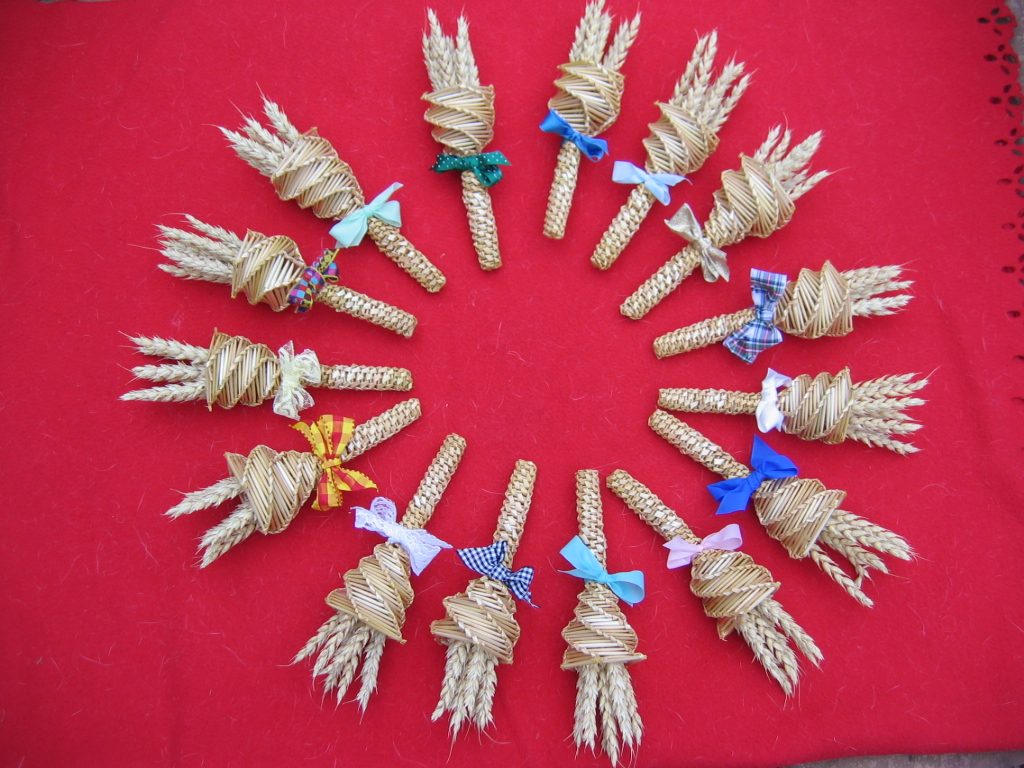
Corn dollies or corn mothers are a form of straw work made as part of harvest customs of Europe before mechanisation.
Scholars of the 18th and 19th centuries theorized that before Christianisation, in traditional pagan European culture it was believed that the spirit of the corn (in American English, "corn" would be "grain") lived amongst the crop, and that the harvest made it effectively homeless. James Frazer devotes chapters in The Golden Bough to "Corn-Mother and Corn-Maiden in Northern Europe" (chs. 45–48) and adduces European folkloric examples collected in great abundance by the folklorist Wilhelm Mannhardt. Among the customs attached to the last sheaf of the harvest were hollow shapes fashioned from the last sheaf of wheat or other cereal crops. The corn spirit would then spend the winter in this home until the "corn dolly" was ploughed into the first furrow of the new season.
Background
[edit]James George Frazer discusses the Corn-mother and the Corn-maiden in Northern Europe, and the harvest rituals that were being practised at the beginning of the 20th century:
In the neighbourhood of Danzig the person who cuts the last ears of corn makes them into a doll, which is called the Corn-mother or the Old Woman and is brought home on the last waggon. In some parts of Holstein the last sheaf is dressed in women's clothes and called the Corn-mother. It is carried home on the last waggon, and then thoroughly drenched with water. The drenching with water is doubtless a rain-charm. In the district of Bruck in Styria the last sheaf, called the Corn-mother, is made up into the shape of a woman by the oldest married woman in the village, of an age from 50 to 55 years. The finest ears are plucked out of it and made into a wreath, which, twined with flowers, is carried on her head by the prettiest girl of the village to the farmer or squire, while the Corn-mother is laid down in the barn to keep off the mice. In other villages of the same district the Corn-mother, at the close of harvest, is carried by two lads at the top of a pole. They march behind the girl who wears the wreath to the squire's house, and while he receives the wreath and hangs it up in the hall, the Corn-mother is placed on the top of a pile of wood, where she is the centre of the harvest supper and dance.[1]

Many more customs are instanced by Frazer. For example, the term "Old Woman" (Latin vetula) was in use for such "corn dolls" among the Germanic pagans of Flanders in the 7th century, where Saint Eligius discouraged them from their old practices: "[Do not] make vetulas, (little figures of the Old Woman), little deer or iotticos or set tables [for the house-elf, compare Puck] at night or exchange New Year gifts or supply superfluous drinks [a Yule custom]."[2] Frazer writes: "In East Prussia, at the rye or wheat harvest, the reapers call out to the woman who binds the last sheaf, “You are getting the Old Grandmother.... In Scotland, when the last corn was cut after Hallowmas, the female figure made out of it was sometimes called the Carlin or Carline, that is, the Old Woman."[3]
The mechanisation of harvesting cereal crops probably brought an end to traditional straw dolly and figure making at the beginning of the 20th century.[4] In the UK corn dolly making was revived in the 1950s and 1960s. Farm workers created new creations including replicas of farm implements and models such as windmills and large figures.[5] New shapes and designs with different techniques were being created. In the 1960/70s several books were published on the subject. (see Lettice Sandford) The simple origins of the craft had been lost and new folk lore stories were added to the original ideas.[6]
The Pitt Rivers Museum[7] in Oxford, the Museum of English Rural Life in Reading, and the Ryedale Folk Museum in Yorkshire have collections of corn dollies from around the world.[8]
The craft of making corn dollies is listed as endangered by the Heritage Crafts Association.[9]
Materials used
[edit]- Great Britain: mainly wheat, oats, rye and barley
- Ireland: rush
- Southern France: palm leaves
With the advent of the combine harvester, the old-fashioned, long-stemmed and hollow-stemmed wheat varieties were replaced with knee-high, pithy varieties. However, a number of English and Scottish farmers are still growing the traditional varieties of wheat, such as Maris Wigeon, Squarehead Master, Elite Le Peuple.[10] mainly because they are in great demand in thatching, a craft which is enjoying a renaissance, with customers facing long waiting lists for having their roofs thatched or repaired.
Types
[edit]Corn dollies and other similar harvest straw work can be divided into these groups:
Traditional corn dollies named after counties or place names of England, Scotland and Wales
[edit]-
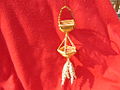 Barton Turf dolly, Norfolk
 -
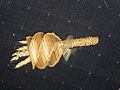 Cambridgeshire Handbell
 -
-
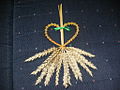
-
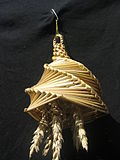 Hereford Lantern
 -
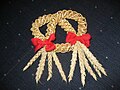
-
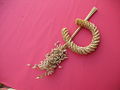 Suffolk Horseshoe
 -
 Yorkshire Spiral or Drop Dolly


- Other corn dollies include Anglesey Rattle, Cambridgeshire Umbrella, Durham Chandelier, Claidheach (Scotland) Herefordshire Fan, Kincardine Maiden (Scotland), Leominster Maer (Herefordshire), Norfolk Lantern, Northamptonshire Horns, Okehampton Mare, Oxford Crown, Suffolk Bell, Suffolk Horseshoe and Whip, Teme Valley Crown (Shropshire), Welsh Border Fan, Welsh Long Fan, Worcester Crown.
- There are also corn dolly designs from other countries, for example the Kusa Dasi from Turkey, named after the town of Kuşadası.
Countryman's favours and other harvest designs
[edit]A countryman's favour was usually a plait of three straws and tied into a loose knot to represent a heart. It is reputed to have been made by a young man with straws picked up after the harvest and given to his loved one. If she was wearing it next to her heart when he saw her again then he would know that his love was reciprocated. Three straws can be plaited using the hair plait or a cat's foot plait. Favours can be made with two, three, four or more straws.
-
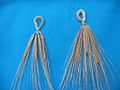 Countryman's Favour in barley
 -
 Glory Braid
 -
 Cornucopia (Horn of plenty)
 -
 Corn Maiden
 -
 Harvest Cross
 -
 Harvest Wreath
 -
 Corn maiden
 -
 Countryman's Favours


Other examples include:
- Bride of the Corn ("Aruseh" in North Africa)
- Devonshire Cross, a harvest cross from Topsham, Devon
- Dedham Cross
- St Brigid's Cross; the National Museum of Ireland has many examples of harvest crosses.
Fringes
[edit]- Larnaca Fringe
- Montenegrin Fringe
- Lancashire Fringe
Large straw figures
[edit]

These are representations of animals or humanoid beings made from an entire sheaf. They are known by a variety of names, depending on location and also the time of harvesting:
- The Goddess Ceres[citation needed]
- Maiden or Bride (harvest before All Saints):
- Kirn Dolly (Roxburghshire)
- Kirn Baby (Lothians)
- Kern Baby (Northumberland)
- The Neck (Cornwall and Devon)
- Hare (Galloway)
- Lame Goat, Scottish Gaelic: gobhar bacach (Harris, Skye, Glenelg)
- Straw dog - strae bikko (Shetland, Orkney)
- Cailleach Gaelic: Old Woman or The Hag (harvest after All Saints)
- Caseg Fedi or harvest mare in Wales.
- 'Y Wrach' or 'The Hag' in Caernarvonshire, Wales
- Whittlesey Straw Bear, the centre of a ceremony in Whittlesey, Cambridgeshire, every January. Its origins are obscure.
Tied straw work
[edit]Here the straw is not plaited, but tied with yarn, wool, raffia or similar. This type of straw work is particularly popular in Scandinavia and German-speaking countries. Examples of these are the Oro (Swedish Straw Crown); the Tomte or Nisse; and smaller versions of the Yule Goat.
-
 Tied straw work
 -
 Swedish Dwarves
 -
 Reindeer garland
 -
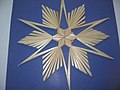 Large tied star


Ridge finials
[edit]- These are straw sculptures which are placed on the ridge of the thatched roof. They are sometimes purely for decoration, but can be the signature of a particular thatcher. Animal shapes (birds, foxes etc.) are the most common. In days gone by, hay-ricks would also be thatched, and topped with a straw decoration.
See also
[edit]- Æcerbot
- Corn husk doll
- Crying the Neck
- Didukh, sheaf of grain, believed to contain spirits, and also stored inside the house over winter, in East Slavic cultures.[citation needed]
- Food grain
- Harvest festival
- John Barleycorn
- Kadomatsu
- Mistletoe
- Poppet
- Straw plaiting
- The Corn Dollies (band)
- The Green Man
- Wicker man
References
[edit]- ^ The Golden Bough, chapter 45
- ^ Saint Ouen of Rouen; trans. Jo Ann McNamara. The Life of Saint Eligius (Vita Sancti Eligii). Archived from the original on 2013-05-08.
{{cite book}}: CS1 maint: bot: original URL status unknown (link) - ^ Frazer, ch. 45.
- ^ Adkins, Roy and Lesley. "Corn Dollies". Adkins History. Retrieved 6 December 2019.
- ^ Mizen, Brian. "Fred Mizen". Fred Mizen. Brian Mizen Thatching. Retrieved 6 December 2019.[permanent dead link]
- ^ Carpenter, Daniel. "Corn Dolly Making". Corn Dolly Making. Heritage Crafts Association. Retrieved 6 December 2019.
- ^ "Harvest Trophies". England: The Other Within. Pitt Rivers Museum. Retrieved 6 December 2019.
- ^ "Coker, Alec (corn dollies)". Coker, Alec (corn dollies). Museum of English Rural Life. Retrieved 6 December 2019.
- ^ "Corn Dolly Making". Heritage Craft. Heritage Craft Association. Retrieved 23 August 2025.
- ^ "Guild of Straw Craftsmen - Frequently asked questions". Strawcraftsmen.co.uk. 2008-08-16. Retrieved 2014-06-25.
Further reading
[edit]- Discovering Corn Dollies By M. Lambeth ISBN 0-85263-283-5
- Corn Dollies: Their Story, Traditions and How to Make Them by David J Keighley ISBN 0-9504215-0-2
- A Golden Dolly, the Art, Mystery and History of Corn Dollies by M. Lambeth
External links
[edit]- Sir James George Frazer, The Golden Bough, chapter 45, and § 2. The Rice-mother in the East Indies
- The Guild of Straw Craftsmen UK association for all aspects of straw craft
- "Putting out the hare, putting on the harvest knots" Irish harvest customs
- Neil Thwaites Yorkshire corn dolly crafter

Corn dolly
View on GrokipediaHistory and Origins
Pre-Christian Roots
In pre-Christian Europe, pagan communities held animistic beliefs that crops, especially grains, were inhabited by vital spirits essential for fertility and abundance. These spirits, often personified as the "corn spirit," were thought to dwell within the growing fields and retreat to the final standing sheaf as harvest progressed, embodying the life force of the earth.[7] Such concepts paralleled veneration of earth mother goddesses, including the Greek Demeter, whose myths centered on the cycle of grain sowing, reaping, and rebirth, and the Germanic Nerthus, a fertility deity associated with agricultural prosperity and ritual processions among early tribes.[8] The earliest indications of these beliefs appear in folklore parallels traceable to Iron Age cultures, with strong echoes in Celtic and Norse mythologies where the last sheaf symbolized a dying and reborn deity tied to the harvest cycle. In Celtic traditions, festivals like Lughnasadh honored grain deities such as Lugh, reflecting rituals to appease field spirits for future yields, while Norse accounts describe harvest offerings to wights or land spirits residing in the final sheaf.[7] These myths, recorded in later classical sources but rooted in pre-Christian oral traditions, portrayed the sheaf as the embodiment of seasonal renewal, ensuring the spirit's safe passage to the next growing season.[8] Central to these practices were rituals focused on the last harvest sheaf, which was carefully bound or woven to "trap" the departing corn spirit and avert misfortune, such as crop failure, in the coming year. Farmers would encircle the final patch with sickles thrown from afar or tie the sheaf into symbolic forms to contain the spirit's essence, preventing it from fleeing and cursing the land.[7] These acts, documented in ethnographic studies of surviving customs, underscored the belief that properly honoring or capturing the spirit guaranteed communal prosperity.[8] Archaeological evidence for such straw-based effigies remains limited, though Bronze Age sites in Britain yield traces of grain offerings and ritual deposits suggesting early veneration of agricultural spirits. These pre-Christian foundations later influenced adaptations in the British Isles during the Christian era, blending pagan harvest symbols with emerging folk customs.[7]Development in the British Isles
The tradition of corn dolly making in the British Isles emerged within medieval harvest festivals, evolving from earlier pagan concepts of a resident corn spirit that required honoring through symbolic effigies to ensure future fertility. By the 16th and 17th centuries, English folk records documented these figures as "kirn babies" or "neck" effigies, crafted from the final sheaves of the harvest and incorporated into communal celebrations.[6] For instance, in the late 1500s, accounts from Windsor in Berkshire describe the "harvest home" procession featuring a Harvest Maiden effigy, carried by reapers with music and feasting before being displayed in the barn.[6] In northern England and Scotland, the "kirn baby"—a doll-like figure from the last sheaf—was similarly paraded amid songs and dances, symbolizing the culmination of the communal labor. These practices, observed in regions like Northumberland and the Lothians, underscored the social cohesion of rural harvest gatherings during this period.[5] The Enclosure Acts, passed throughout the 18th century, reshaped British agriculture by privatizing common lands and promoting more uniform farming methods, which often disrupted community-based harvest rituals and contributed to the decline of traditions like corn dolly making amid rural depopulation and socio-economic shifts, though some customs persisted in isolated areas.[9][10] In Ireland, the Great Famine of the 1840s profoundly impacted rural society and agriculture, leading to widespread emigration, population decline, and shifts in farming practices that affected traditional harvest customs, including those involving grain and straw work.[11][12] The advent of mechanized harvesting in the late 19th century marked the beginning of the tradition's decline across the British Isles, as machines scattered straw and eliminated the ritual of selecting the "last sheaf," rendering the craft obsolete in many areas.[13] By around 1900, widespread use had largely ceased, particularly in East Anglia— a historic center for straw work—where reaper-binders and threshing machines supplanted hand methods, though isolated rural holdouts persisted into the early 20th century.[6][4] This technological shift not only ended the practical basis for dolly production but also eroded the associated folk beliefs and festivals that had sustained it for centuries.[14]Symbolism and Beliefs
The Corn Spirit Concept
The corn spirit, in European agricultural folklore, represents the vital essence or life force inherent in grain crops, believed to animate the fields and ensure fertility across seasons. This animistic concept posits that the spirit resides particularly in the final standing sheaf of the harvest, which is ritually preserved and transformed into a corn dolly to safeguard its power through winter and guarantee the vitality of the following year's crop. As described by anthropologist James George Frazer, the corn spirit embodies the grain's soul, with its "death" occurring as the last stalks are cut, necessitating careful transfer to an effigy to prevent agricultural misfortune.[8] Depictions of the corn spirit vary to reflect the agricultural cycle of death and rebirth, often manifesting as a crone symbolizing the withered end of the harvest or a maiden representing renewal and spring growth. In Scottish traditions, for instance, the spirit appears as the Cailleach or "Old Wife" in the last sheaf, an aged figure embodying the dying year, while in other regions like Yorkshire, it takes the form of a youthful "Maiden" to invoke fresh abundance. Frazer interprets these dual forms as symbolic of the vegetation god's annual decline and resurgence, drawing parallels to myths like Demeter and Persephone, where the old corn yields to the new.[8] Folklore across Europe reinforces the corn spirit's potency, with German traditions of the "Old Woman" (a ragged effigy from the last sheaf) influencing British practices, where the figure was thought to carry the harvest's essence and harming it could invite curses upon the fields by disrupting the spirit's protective role. In these beliefs, the dolly served as a vessel to house the displaced spirit, ensuring continuity; mishandling it was akin to harming the crop's soul, potentially leading to barrenness or calamity.[8][15] Nineteenth-century scholars like Frazer provided key anthropological interpretations, viewing the corn spirit as a psychological projection of humanity's dependence on nature, where rituals around the dolly expressed fears of scarcity and hopes for regeneration in pre-industrial societies. In The Golden Bough, Frazer analyzes these customs as survivals of primitive animism, linking them to broader patterns of sympathetic magic that mimic the crop's lifecycle to influence outcomes.[8] Later scholars, such as historian Ronald Hutton, have critiqued Frazer's broad theories as speculative and based on limited evidence, while documenting similar localized harvest customs.[16]Rituals and Superstitions
Corn dollies played a central role in harvest rituals across the British Isles, embodying the culmination of the season's labor and invoking prosperity for the coming year. In Cornwall, the "crying of the neck" ceremony marked the cutting of the final sheaf, where workers gathered around the last standing corn, and one held it aloft while the group shouted "The neck! The neck!" in unison, often three times, to celebrate the harvest's end; the sheaf was then fashioned into a dolly, decorated with ribbons, and paraded through the fields before being hung in the farmhouse for good fortune.[8] This practice, documented in 19th-century accounts, symbolized the safe return of the harvest spirit to the home, ensuring luck and abundance. Associated superstitions revolved around the corn dolly's protective and generative powers, rooted in the concept of the corn spirit as a vital force inhabiting the grain. Dollies were preserved in farmhouses or barns throughout the winter to safeguard the household and livestock from evil influences, such as fairies or witchcraft, and to promote fertility for the next crop; in Scottish traditions, for instance, the "clyack sheaf" dolly was kept specifically to bless animals and avert misfortune.[8] These beliefs extended to rituals where the dolly ensured bountiful yields and healthy livestock, with its placement in barns or fields thought to ward off harm and foster renewal.[17] Historical records from the 18th and 19th centuries describe communal harvest feasts, known as "mell suppers" or "harvest homes," where the dolly served as the focal point of celebrations, often carried in procession amid singing and revelry; at the feast's close, it might be ritually burned in a bonfire or buried in the field to liberate the spirit and prepare the soil for the new sowing.[18]Materials and Techniques
Straw Selection and Preparation
The creation of corn dollies begins with careful selection of straw, traditionally sourced from cereal crops to ensure the material's suitability for intricate weaving. Wheat straw is most commonly preferred for its fine, pliable quality ideal for detailed plaiting, while rye provides sturdier stems for more robust figures; barley and oats are occasionally used for coarser rural designs, though barley is less typical due to its shorter, thicker stalks.[19][20] Specific heritage varieties such as Maris Widgeon, Squareheads Master, or Elite Le Peuple are favored for their long, hollow stems between the seed head and first node, which support elaborate patterns; modern hybrids are unsuitable due to thick walls and short lengths.[21] Harvest timing is crucial, with straw ideally cut from the final sheaf of the crop to capture the symbolic essence of the harvest's culmination, a practice rooted in pre-mechanized farming. The straw is gathered when the grain is just turning from green to yellow, cut above the first joint to yield the longest usable sections, and allowed to dry naturally by standing the sheaves upright in the sun for several days to drain moisture and retain natural oils that enhance flexibility.[20][21] Hand-reaping is essential to avoid bruising or bending the stems, ensuring straight, unblemished straw that symbolizes the purity of the harvest spirit; modern machine-harvested or chemically treated crops are generally avoided, as they compromise the straw's integrity and availability has declined due to industrialized agriculture.[22][23] Preparation involves sorting the dried straw by length, reserving the longest pieces—from the seed head to the first leaf node—for structural bases and finer sections for decorative elements. The selected straw, which must be hollow-stemmed for optimal manipulation, is then softened through damping: soaking in cool to lukewarm water for 20 minutes to several hours until pliable, without overheating to prevent brittleness or loss of sheen.[21][20] Excess water is drained, and the straw is bundled into small wisps or preliminary plaits, wrapped in a damp towel to maintain moisture until weaving begins, ensuring durability in the final corn dolly.[21][24]Weaving and Assembly Methods
The weaving and assembly of corn dollies primarily involve plaiting and interlacing hollow-stemmed straw, such as wheat from the seed head to the first node, which is dampened to enhance pliability without splitting. Basic methods begin with a three-plait start for forming doll bodies: select three equal-length straws, tie them just below the heads using a clove hitch knot secured with an overhand knot, then braid by passing the right outer straw under the middle one, followed by the left outer straw under the new middle, repeating to create a uniform plait.[20][25] For heads, hollow stems are often bundled and shaped.[6] Advanced techniques build on these foundations, employing spiral binding for elements like arms and structural supports. In a five-straw spiral plait, five damp straws are tied to a central core (such as a wire or thicker straw) at right angles; the process uses a "lift and bend" method where the lower right straw is folded anti-clockwise over the adjacent one, followed by a 90-degree clockwise rotation of the work, repeating to form a tightening spiral that can be shaped into limbs or curves. Clove hitch knots secure joins and ends, while interlacing or passementerie-inspired weaving adds complexity to decorative forms. In humid climates, preservation involves thorough drying after assembly and storage in dry, ventilated areas to prevent mold.[26][6] Tools remain minimal and traditional, relying on hands for most plaiting, with occasional use of a bodkin—a blunt bone or wooden needle—for threading straws through tight weaves—or wooden pegs to temporarily hold plaits in place during assembly. Right-handed plaiting predominates in documented techniques, with left-handed practitioners adjusting the rotation direction in spirals to maintain tension. Common errors include uneven tension causing twists in plaits, which can distort shapes; fixes involve consistent dampening of prepared straw and practicing even pressure to ensure smooth, spirit-honoring forms as per harvest folklore.[26][27][6]Regional Types and Designs
English and Welsh Variations
English and Welsh corn dolly variations are characterized by county-specific designs that evolved from 19th-century harvest traditions, with patterns documented in early craft manuals such as those by Minnie Lambeth.[6] These forms often served dual roles as protective symbols for the harvest and decorative elements, using plaited wheat straw to create intricate shapes believed to house the corn spirit. Small-scale dollies were crafted for personal use to bring luck to individuals or households, while larger versions were displayed communally at harvest suppers or atop ricks to ensure future fertility.[28] In Essex, the Terret is a distinctive design resembling part of a horse's harness, formed by spiraling and plaiting straw.[1][29] This form reflects the region's agricultural practices and exemplifies the practical yet symbolic role of corn dollies in rural life.[30] In Suffolk, the Horseshoe is a common design woven from straw plaits, used as a decorative harvest token in homes or barns.[31] In Staffordshire, the Stafford Knot is a looped plaited form symbolizing good fortune.[32] Welsh traditions include designs such as the Welsh Border Fan, consisting of a plaited core leading to a fan shape, often used in harvest celebrations.[33] Unique to many Welsh variants is the incorporation of colored ribbons tied into the straw for added vibrancy at seasonal celebrations, enhancing their role as festive adornments.[31]Scottish and Irish Forms
In Scotland, the Kirn Maiden represents a traditional female figure crafted from the last sheaf of grain harvested, embodying the spirit of the corn and ensuring fertility for the following year. This dolly, also known as the kirn-baby or kirn-dolly, was typically made by a young woman who dressed it with ribbons and hung it in the farmhouse until the next harvest, symbolizing the transition from the old to the new corn spirit.[34] In the Scottish Highlands, the Maiden (Gaelic: Maidhdean-buain) was cut ceremonially by a youth and preserved for rituals, such as feeding it to a newborn foal for good health, reflecting beliefs in the corn spirit's protective powers.[34] Irish corn dolly traditions feature the Cailleach, a crone-like figure woven from the final standing sheaf to symbolize the end of winter and the harvest's triumph over scarcity. This effigy, representing the hag-like aspect of the corn spirit, was often dressed in dark attire and kept through the winter months before being burned in spring rites to release the spirit for renewal.[8] The Cailleach underscores Celtic folklore's duality of death and rebirth in agriculture, contrasting with more youthful harvest figures elsewhere.[8] A simpler Irish form is the Harvest Knot, consisting of plaited straw rings or intertwined loops created from remnant wheat after the main harvest. These decorative pieces were exchanged during communal Lúnasa festivities to mark the season's abundance and were hung in homes as tokens of the completed harvest.[35] In Irish tradition, such knots emphasized collective celebration, often worn or displayed to invoke blessings on the community for the year ahead.[35]Other European Influences
In Germany, harvest traditions included the creation of straw figures such as the Roggenbock, a rye buck or goat-like effigy embodying the spirit of the rye crop, often fashioned from the last sheaf to ensure fertility for the following year.[36] Similar customs featured the Rye-wolf or other animal representations from the final sheaf, which were carried in processions or used in rituals to transfer the corn spirit to the next harvest.[37] These practices likely influenced British corn dolly making through 17th-century trade and migration routes across the North Sea, where German agricultural communities shared techniques for weaving protective harvest symbols.[38] In France, the "Mère" or Mother Sheaf was a prominent figure formed by pleating and binding wheat stalks from the last harvest bundle into a humanoid shape, symbolizing the nurturing aspect of the grain spirit and hung in homes to safeguard against misfortune.[39] This custom paralleled British humanoid corn dollies, with the pleated forms emphasizing maternal protection over the fields, and spread to the British Isles via Huguenot and merchant exchanges in the 17th century that facilitated the exchange of rural folklore and crafting methods.[6] Scandinavian traditions featured the Swedish Straw Goat, or Julbock, constructed from plaited harvest straw into large animal shapes for Yule celebrations, representing renewal and drawing from pagan harvest deities to invoke bountiful crops.[40] These oversized effigies influenced British practices by inspiring similar large-scale straw animal forms in harvest festivals, transmitted through Viking-era settlements and later Nordic trade networks that blended continental motifs with insular designs.[41] Eastern European variants included the Ukrainian Diduch, a multi-sheaf guardian made by bundling the first and last sheaves of rye or wheat, decorated and placed in the home during winter to honor ancestors and protect the household until the next planting.[42] Unlike the more humanoid British forms, the Diduch emphasized stacked sheaves for communal warding, yet shared animistic roots in viewing the harvest remnants as vital spirits.[43] Nineteenth-century folklorists, notably James George Frazer in The Golden Bough, highlighted cross-European similarities in last-sheaf customs, such as the widespread belief in an indwelling corn spirit embodied in effigies across Germany, France, Scandinavia, and Eastern Europe, suggesting a shared pagan origin that subtly shaped British variations through cultural diffusion.[37]Modern Practices and Revival
20th-Century Resurgence
The resurgence of corn dolly making in the 20th century emerged as part of a broader folk craft movement dedicated to preserving traditional rural skills in response to the cultural erosion caused by industrialization and agricultural mechanization. By the early 20th century, the practice had largely faded with the decline of manual harvesting, but renewed interest surfaced in the 1920s and 1930s as part of general efforts to document English folk customs. A significant post-World War II surge occurred in the 1950s, fueled by women's institutes and local craft guilds that organized workshops and demonstrations to counteract the loss of traditional practices amid widespread farm mechanization. These groups emphasized hands-on learning to maintain regional designs and techniques, with women's institutes producing instructional guides that popularized the craft among rural and urban communities alike.[44][6] The 1951 Festival of Britain marked a turning point, where Essex straw craftsman Fred Mizen created monumental corn dolly sculptures, including a lion and unicorn, showcased on the South Bank, which captivated the public and elevated the craft's visibility. In the 1960s and 1970s, preservation efforts intensified through documentation, with influential books like Lettice Sandford's Straw Work and Corn Dollies (1974) standardizing patterns and providing step-by-step instructions to safeguard endangered methods, alongside earlier works such as her collaborative guides from the 1950s. Institutional backing grew via emerging craft networks influenced by historical straw plaiting traditions, supporting the standardization and teaching of diverse forms across Britain.[45][46][47]Contemporary Uses and Adaptations
In contemporary settings, corn dollies continue to feature prominently in harvest festivals, particularly during Lammas celebrations, where they symbolize the grain spirit and are crafted from the last sheaves of wheat to honor agricultural abundance. For instance, at Ad Gefrin's annual Gaderung event in Northumberland, UK, held on August 3, 2025, participants engaged in demonstrations and crafting sessions that revived Anglo-Saxon Lammas traditions, incorporating corn dollies as central elements to connect modern audiences with rural heritage.[48] These festivals often blend educational workshops with communal activities, fostering appreciation for the craft's role in seasonal rites. As symbols of fertility and prosperity, corn dollies are adapted for personal milestones such as weddings, where they serve as decorative tokens evoking earth's bounty and good fortune. The Guild of Straw Craftsmen notes their use in marriage ceremonies alongside christenings and housewarmings, valued for their intricate designs that represent agrarian continuity in modern homes.[31] Similarly, during the winter season, they appear as Christmas ornaments, with workshops like those at Butser Ancient Farm in Hampshire teaching participants to plait straw into festive shapes such as hearts, lanterns, and tree-hanging tokens, often adorned with ribbons and charms for gifting.[49] Building on mid-20th-century revivals, adaptations in neopagan practices, including Wicca, integrate corn dollies into harvest altars for rituals like Lammas and Mabon, where they embody the cycle of growth and sacrifice. Practitioners craft them from straw or corn husks to represent deities of abundance, placing them as focal points for offerings and meditations on seasonal change.[50] Eco-friendly versions emphasize organic, locally sourced straw from heritage wheat varieties, aligning with sustainable crafting principles that avoid synthetic materials and promote biodegradable artistry.[6] Interest in British-style corn dollies spread to North America in the 1980s through tourists importing examples from the UK.[4] Separately, corn husk dolls—a distinct tradition originating from Native American practices thousands of years ago and adopted by European settlers in the 1600s–1700s—have become popular DIY projects in U.S. folk traditions, including among Amish communities, serving as toys and protective charms.[51] Since the 2000s, online tutorials have further boosted accessibility for both traditions, enabling widespread home crafting through step-by-step guides on plaiting techniques.[52] In the UK, heritage tourism has driven growth, with over 100 leisure makers participating in regional workshops by the 2020s, as reported by the Heritage Crafts Association, including events at sites like the Museum of Cambridge and Cirencester History Festival that attract visitors to learn and purchase these living cultural artifacts.[6] As of 2025, corn dolly making remains an endangered craft, with increasing leisure interest but limited professional practitioners due to the scarcity of suitable traditional straw varieties. Despite challenges in preserving traditional knowledge amid modern agriculture, the craft's emphasis on natural materials supports sustainability efforts in contemporary applications.[6]References
- https://en.wikisource.org/wiki/The_Golden_Bough/Corn-Mother_and_Corn-Maiden_in_N._Europe
- https://en.wikisource.org/wiki/The_Golden_Bough/The_Corn-Spirit_as_an_Animal