Hubbry Logo
TAZ 90TAZ 90Main
Open search
TAZ 90
Community hub
TAZ 90
logo
8 pages, 0 posts
0 subscribers
Be the first to start a discussion here.
TAZ 90
TAZ 90
from Wikipedia

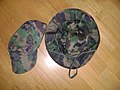
The TAZ 90 (TarnAnZug in German and TASS 90 in French)[1] is the camouflage patterns for current standard issue battledress and service dress uniform of the Swiss Armed Forces.

Key Information

History

[edit]

The TAZ 90 was issued to the Swiss military in 1993 after the TAZ 83 had been phased out of service.[2] ETH Zurich played a role in its creation, since the pattern was made to suit Swiss environment.

Replacement

[edit]

The TAZ 16 ("Multiumfeldtarnmuster 16") will be introduced to the troop from 2022.[3][4] The geometry of the pattern is kept as it is, but the colour pattern will be slightly modified. The black is replaced by a tan-like light brown.

The new pattern will be applied to the new personal equipment of the Swiss Army that will be supplied to the new recruits. It is known as the MBAS program, and its cost is estimated to be CHF 215 million.[5]

Pattern

[edit]

The four-colour pattern consists of tan, brown, green and black and is a development of the Taz 57 and Taz 83 (the "Alpenflage") patterns which it replaced in the early 1990s.[6] Even so, the pattern is based on the alpenflage, but with the deletion of the white spots and the red colour found in the alpenflage, along with minor changes.[7]

Variants

[edit]

Taz 90/06

[edit]

In 2006, the Taz was changed to include Velcro insignia and Velcro name tabs (Taz 90/06).

Desert

[edit]
TAZ 07 swatch.

A desert variant for Swiss troops working abroad in peacekeeping operations.[8] Known sometimes as TAZ 07, Südtarn or Wüstetarn,[9] the variant was seen with Swiss troops in Kosovo in peacekeeping operations.[9]

[edit]

References

[edit]

Bibliography

[edit]
Revisions and contributorsEdit on WikipediaRead on Wikipedia
from Grokipedia
The TAZ 90 (Tarnanzug 90) is the woodland camouflage pattern that served as the standard issue for battledress and service dress uniforms of the from 1990 until its gradual replacement in the early 2020s. It features a four-color design of tan, , , and black irregular spots, optimized for concealment in the diverse terrains of , including forests, mountains, and alpine regions. Introduced in as a direct successor to the Alpenflage, the TAZ 90 represents a recolored adaptation of the Swiss Leibermuster pattern originally developed in 1957, with hues scientifically selected by the Eidgenössische Technische Hochschule in to better match local natural surroundings and eliminate the red tones of earlier variants. This pattern draws indirect inspiration from camouflage designs, such as the ERDL and M81 patterns, but was tailored specifically for Swiss environmental conditions. Printed on a variety of uniform items—including combat trousers, jackets, and —as well as field equipment like backpacks and tentage, the TAZ 90 became the defining visual element of Swiss military attire for over three decades. In addition to the primary woodland variant, a desert-adapted version known as TAZ 07 was introduced around 2007–2008 to support Swiss troops in overseas missions, such as operations in arid environments. The pattern's longevity stemmed from its effectiveness in providing low-observable blending across 's varied landscapes, though it began to be phased out starting in 2018 with the development of updated combat ensembles, culminating in its full replacement by the modular Bekleidungs- und Ausrüstungssystem (MBAS) by 2022. Despite its retirement from active service, surplus TAZ 90 items remain popular among collectors and civilian enthusiasts for their durable construction and distinctive aesthetic.

History

Development and Introduction

The TAZ 90 camouflage pattern emerged as the successor to the , known as Alpenflage, which had been the standard Swiss since 1983, building on earlier designs like the TAZ 57 from the . Developed to address evolving tactical requirements in 's diverse landscapes, including dense forests, alpine meadows, and mountainous regions, the pattern aimed to provide enhanced concealment across multiple environments by refining the underlying structure for better adaptability. Conceptual work on TAZ 90 began in the late , driven by the need for a more versatile uniform that could meet modern operational demands while maintaining effectiveness in 's varied terrain. The Eidgenössische Technische Hochschule (ETH) Zurich contributed scientific expertise, particularly in selecting color palettes optimized for natural surroundings to improve performance in woodland and transitional settings. This collaboration ensured the design incorporated empirical data on visual disruption and environmental blending, marking a shift toward evidence-based development. The was officially introduced in 1990 as the standard pattern for the ' battledress and service uniforms, replacing the across active service. Initial production utilized durable fabric blends, typically 50% and 50% material, to balance breathability, weather resistance, and longevity for field use. Distribution commenced immediately for new uniform issuances, with the pattern printed on attire, equipment covers, and related gear to standardize concealment for all branches. By the early , it had achieved full adoption, serving as the primary for over two decades.

Replacement

The replacement of the TAZ 90 camouflage pattern is occurring as part of the Modular Bekleidungs- und Ausrüstungssystem (MBAS) program, which serves as the modernization initiative for the ' basic soldier equipment and introduces the Multiumfeldtarnmuster 16 (also known as TAZ 16) as the successor pattern. The MBAS encompasses 148 modular components, including combat clothing, carrying systems, drinking systems, and ballistic protection, designed to enhance thermophysiological comfort, , and adaptability across mission types while reducing overall weight and volume. The program equips approximately 100,000 personnel. The TAZ 16 was announced in 2017 as the new multi-environment to accompany the MBAS rollout, with initial troop testing beginning that year and full introduction originally planned from 2022. However, delays due to liquidity issues in 2024 pushed the timeline back; as of November 2025, the program has been in stepwise implementation since autumn 2023, with fully equipped by April 2025, non-traditional units (such as Swissint and mountain troops) scheduled for the first half of 2026, and the remaining forces (including and ) to follow progressively, potentially extending to 2027 or later depending on supply availability. Consequently, TAZ 90 continues to see widespread use in the alongside the emerging TAZ 16. The TAZ 16 retains the core geometric structure of the TAZ 90 but features modified colors for improved versatility, incorporating chocolate brown, moss green, and light brown elements on a tan or background to replace darker tones like black spots, thereby enhancing concealment in diverse environments such as lighter woodlands and transitional terrains. The overall MBAS program has a total budget of 347.8 million CHF, approved by in the 2018 Armaments Program, covering for all components including the transition. As the phase-out progresses, surplus TAZ 90 stocks are being managed through disposal processes inherent to the equipment replacement.

Design

Pattern Characteristics

The TAZ 90 camouflage pattern is a woodland-oriented characterized by irregular, jagged shapes that emulate of natural foliage, branches, and terrain features prevalent in forested and alpine settings. This abstract layout employs non-repeating blotches and spots of varying sizes and orientations to create a disruptive effect, breaking up the human and blending with the surrounding environment. Developed in collaboration with researchers at , the TAZ 90 prioritizes functionality in 's mixed alpine and woodland terrains, where its geometric irregularities provide effective visual disruption for personnel at typical engagement distances. The design's hard-edged, sharp forms and layered motifs enhance translucency and depth, mimicking light filtration through to reduce detectability in both shaded and open areas. This approach ensures the remains non-directional and adaptable, avoiding predictable repetition that could aid enemy observation. The TAZ 90 is printed on ripstop fabrics, maintaining the pattern's intricate details and durability under field conditions. Overall, its emphasis on abstract, foliage-inspired geometry underscores a focus on practical concealment rather than literal representation, making it well-suited to the Swiss Armed Forces' operational needs in temperate, vegetated landscapes.

Color Palette

The TAZ 90 camouflage pattern utilizes a four-color scheme consisting of tan, brown, green, and black, selected to optimize visual disruption in Switzerland's diverse terrains including forests, mountains, and transitional zones. These hues were chosen by the Eidgenössische Technische Hochschule in Zürich (ETH Zurich) to match local natural surroundings, ensuring high compatibility with central European woodland conditions. The tan functions as a for blending with ground cover and rocky surfaces, while the brown provides mid-tone contrasts to mimic and variations. Dark green replicates foliage density in vegetated areas, and delivers deep accents specifically for breaking up equipment and human outlines, thereby reducing detection at various distances. This palette represents an from the TAZ 83's more vibrant five-color scheme, notably excluding bright reds to improve low-light and overall naturalistic integration without compromising effectiveness. Applied to durable polyester-cotton blend fabrics with weaves, the colors exhibit fade resistance that withstands abrasion, washing, and environmental exposure during extended field use.

Variants

TAZ 90/06

The TAZ 90/06 designates the revised combat uniform system of the , introduced as an update to the original TAZ 90 in 2006 while preserving the established camouflage pattern for continuity in tactical environments. This revision, formally known as Kampfbekleidung 90/06, focused on enhancing practical wearability through modifications to garment construction, allowing for greater modularity and ease of maintenance in field conditions. The system was developed to address evolving operational needs without altering the core visual elements that had proven effective since the 1990s. Key enhancements in the TAZ 90/06 included improvements to and weather protection, following the onion shell principle for layering, while using durable materials to ensure compatibility with field use. Adoption of the TAZ 90/06 occurred through a phased rollout beginning in 2006, coinciding with broader equipment modernization efforts. The system remained the standard issue until the introduction of the Modular Bekleidungs- und Ausrüstungssystem (MBAS) in 2022, after which select components continued in limited use as service dress. As of 2025, components of Kampfbekleidung 90/06 continue in limited use.

TAZ 07 Desert

The TAZ 07, officially designated as a desert-adapted camouflage pattern and commonly referred to as Südtarn (southern camouflage) or Wüstetarn ( camouflage), was introduced in 2007 specifically for deployments in arid and semi-arid environments. This variant was developed to support non-European missions where standard woodland patterns proved unsuitable, marking the first specialized camouflage in Swiss service history. Building on the core geometric framework of the base TAZ 90 pattern, the TAZ 07 employs a recolored scheme optimized for sandy and rocky terrains, featuring a lighter palette of beige, light brown, olive, and pale green to enhance blending in desert landscapes. These modifications shift away from the darker tones of the original design, prioritizing visibility reduction in sun-bleached, low-contrast settings typical of Middle Eastern and North African regions. The pattern retains the irregular polygons and disruptive shapes that define TAZ 90, ensuring continuity in production while adapting to environmental demands. Production of TAZ 07 uniforms is limited to requirements for overseas operations, utilizing fabrics similar to those in the standard issue for durability and tear resistance in harsh conditions. Issuance is restricted to personnel assigned to international peacekeeping and training missions, with no widespread domestic adoption. Field testing has demonstrated its effectiveness in arid settings. As of 2025, TAZ 07 is issued for ongoing overseas operations.

Usage

Swiss Armed Forces

The TAZ 90 camouflage pattern serves as the standard battledress and service uniform for the , integrated across all branches including , artillery, and since its introduction in the early 1990s. Initially issued to and mechanized/ troops around 1992, it was progressively extended to all personnel by the late 1990s as part of the Armee 95 reform, supporting domestic training exercises and territorial defense operations. Introduced under the 1989 armament program, the pattern enhances combat effectiveness through its design tailored to Swiss environments. In equipment applications, TAZ 90 is printed on core components such as jackets and pants, which follow an "onion principle" layering system for protection against weather, visibility, heat, cold, fire, and shrapnel. It also covers helmet liners, field caps, and modular combat packs, including ammunition pouches and field bottles, to maintain uniformity during operations. Special adaptations, like one-piece suits for armored troops, further integrate the into branch-specific gear. Training protocols incorporate TAZ 90 as standard issue for mobilization and annual militia refresher courses, where it supports practical exercises focused on territorial defense. The uniform's badges and labeling systems aid in troop identification and discipline during alpine and forested maneuvers. Logistically, TAZ 90 aligns with Switzerland's militia-based structure, with personal equipment issued individually and stored in regional depots for rapid mobilization. Over hundreds of thousands of sets were produced to equip the force, reflecting the scale of the all-arms militia system. The pattern's adoption bolsters the neutral defense doctrine by improving low-observability in Switzerland's varied terrain, contributing to a strategy emphasizing territorial integrity and deterrence. Some units have begun transitioning to updated systems like the Modular Bekleidungs- und Ausrüstungssystem (MBAS) since 2023.

International Missions

The TAZ 90 camouflage pattern debuted in international operations with the ' participation in the (KFOR) starting in late 1999, where Swiss contingents employed the standard woodland variant for temperate European environments. In parallel, a desert-adapted version, TAZ 07, was later utilized for arid or transitional zones within such deployments to address environmental mismatches. Key deployments of TAZ 90 included the Stabilization Force (SFOR) in during the late 1990s, where Swiss troops wore TAZ 90 uniforms with English-language labels for multinational interoperability. In , under the (ISAF) from 2003 to 2007, Swiss staff officers primarily used TAZ 90 for base operations, with TAZ 07 adaptations for any arid environments. More recently, TAZ 90 has supported Swiss contributions to missions in , such as military observer roles in the (MONUSCO) and (MINURSO), emphasizing its role in diverse contexts since the 2000s. Adaptations for international use involved overprinting TAZ 90 fabrics for enhanced modular integration or layering with host-nation or NATO-standard gear to facilitate operations. The TAZ 90/06 variant, introduced around 2006, incorporated provisions for attachments like and load-bearing equipment, improving versatility in prolonged field rotations. Feedback from deployments highlighted TAZ 90's effectiveness in temperate zones but revealed limitations in desert efficacy, prompting the development of TAZ 07 specifically for overseas arid missions. Overall, the pattern received positive assessments for concealment in European woodlands during KFOR and Bosnian operations. As of 2025, TAZ 90 remains in phased use for ongoing rotations in legacy contingents, increasingly supplemented by the newer TAZ 16 in fresh deployments to align with updated Swiss uniform standards; the Modular Bekleidungs- und Ausrüstungssystem (MBAS), which incorporates the Multiumfeld-Tarnmuster 16 (TAZ 16) pattern, has been issued to all new recruits since summer 2025.

References

Add your contribution
Related Hubs
User Avatar
No comments yet.