


Community hub
Recent from talks
Contribute something
Nothing was collected or created yet.
Cushitic languages
View on Wikipedia| Cushitic | |
|---|---|
| Geographic distribution | Egypt, Sudan, Horn of Africa, East Africa |
Native speakers | c. 85 million |
| Linguistic classification | Afro-Asiatic
|
| Proto-language | Proto-Cushitic |
| Subdivisions | |
| Language codes | |
| ISO 639-2 / 5 | cus |
| Glottolog | cush1243 |
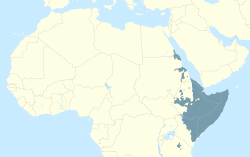
 Distribution of the Cushitic languages in Africa | |
 Map of the Cushitic languages | |
The Cushitic languages are a branch of the Afroasiatic language family. They are spoken primarily in the Horn of Africa, with minorities speaking Cushitic languages to the north in Egypt and Sudan, and to the south in Kenya and Tanzania. As of 2012, the Cushitic languages with over one million speakers were Oromo, Somali, Beja, Afar, Hadiyya, Kambaata, and Sidama.[1]
Official status
[edit]The Cushitic languages with the greatest number of total speakers are Oromo (37 million),[2] Somali (24 million),[3] Beja (3.2 million),[4] Sidamo (3 million),[5] and Afar (2 million).[6]
Oromo serves as one of the official working languages of Ethiopia[7] and is also the working language of several of the states within the Ethiopian federal system including Oromia,[8] Harari and Dire Dawa regional states and of the Oromia Zone in the Amhara Region.[9]
Somali is the first of two official languages of Somalia and three official languages of Somaliland.[10][11] It also serves as a language of instruction in Djibouti,[12] and as the working language of the Somali Region in Ethiopia.[9]
Beja, Afar, Blin and Saho, the languages of the Cushitic branch of Afroasiatic that are spoken in Eritrea, are languages of instruction in the Eritrean elementary school curriculum.[13] The constitution of Eritrea also recognizes the equality of all natively spoken languages.[14] Additionally, Afar is a language of instruction in Djibouti,[12] as well as the working language of the Afar Region in Ethiopia.[9]
Origin and prehistory
[edit]Christopher Ehret argues for a unified Proto-Cushitic language in the Red Sea Hills as far back as the Early Holocene.[15] The expansion of Cushitic languages of the Southern Cushitic branch into the Rift Valley is associated with the Savanna Pastoral Neolithic.[16]
Typological characteristics
[edit]Phonology
[edit]Most Cushitic languages have a simple five-vowel system with phonemic length (/a a: e e: i i: o o: u u:/); a notable exception are the Agaw languages, which do not contrast vowel length, but have one or two additional central vowels.[17][18] The consonant inventory of many Cushitic languages includes glottalic consonants, e.g. in Oromo, which has the ejectives /pʼ tʼ tʃʼ kʼ/ and the implosive /ᶑ/.[19] Less common are pharyngeal consonants /ħ ʕ/, which appear e.g. in Somali or the Saho–Afar languages.[17][19]
Most Cushitic languages have a system of restrictive tone also known as "pitch accent" in which tonal contours overlaid on the stressed syllable play a prominent role in morphology and syntax.[17][20]
Grammar
[edit]Nouns
[edit]Nouns are inflected for case and number. All nouns are further grouped into two gender categories, masculine gender and feminine gender. In many languages, gender is overtly marked directly on the noun (e.g. in Awngi, where all female nouns carry the suffix -a).[21]
The case system of many Cushitic languages is characterized by marked nominative alignment, which is typologically quite rare and predominantly found in languages of Africa.[22] In marked nominative languages, the noun appears in unmarked "absolutive" case when cited in isolation, or when used as predicative noun and as object of a transitive verb; on the other hand, it is explicitly marked for nominative case when it functions as subject in a transitive or intransitive sentence.[23][24]
Possession is usually expressed by genitive case marking of the possessor. South Cushitic—which has no case marking for subject and object—follows the opposite strategy: here, the possessed noun is marked for construct case, e.g. Iraqw afé-r mar'i "doors" (lit. "mouths of houses"), where afee "mouth" is marked for construct case.[25]
Most nouns are by default unmarked for number, but can be explicitly marked for singular ("singulative") and plural number. E.g. in Bilin, dəmmu "cat(s)" is number-neutral, from which singular dəmmura "a single cat" and plural dəmmut "several cats" can be formed. Plural formation is very diverse, and employs ablaut (i.e. changes of root vowels or consonants), suffixes and reduplication.[26][27]
Verbs
[edit]Verbs are inflected for person/number and tense/aspect. Many languages also have a special form of the verb in negative clauses.[28]
Most Cushitic languages distinguish seven person/number categories: first, second, third person, singular and plural number, with a masculine/feminine gender distinction in third person singular. The most common conjugation type employs suffixes. Some languages also have a prefix conjugation: in Beja and the Saho–Afar languages, the prefix conjugation is still a productive part of the verb paradigm, whereas in most other languages, e.g. Somali, it is restricted to only a few verbs. It is generally assumed that historically, the suffix conjugation developed from the older prefix conjugation, by combining the verb stem with a suffixed auxiliary verb.[29] The following table gives an example for the suffix and prefix conjugations in affirmative present tense in Somali.[30]
| suffix conjugation |
prefix conjugation | |||
|---|---|---|---|---|
| "bring" | "come" | |||
| 1st person |
singular | keen-aa | i-maadd-aa | |
| plural | keen-naa | ni-maad-naa | ||
| 2nd person |
singular | keen-taa | ti-maadd-aa | |
| plural | keen-taan | ti-maadd-aan | ||
| 3rd person |
singular | masc. | keen-aa | yi-maadd-aa |
| fem. | keen-taa | ti-maadd-aa | ||
| plural | keen-aan | yi-maadd-aan | ||
Syntax
[edit]Basic word order is verb final, the most common order being subject–object–verb (SOV). The subject or object can also follow the verb to indicate focus.[31][32]
Classification
[edit]Overview
[edit]The phylum was first designated as Cushitic in 1858.[33] Traditionally, Cushitic has been divided into North Cushitic (consisting solely of Beja), Central Cushitic (the Agaw languages), and the large East Cushitic group. Greenberg (1950) argued for the inclusion of the South Cushitic group. The Omotic languages, once classified as West Cushitic, have almost universally been reclassified as a separate branch of Afroasiatic.
- Cushitic
- North Cushitic (Beja)
- Central Cushitic (Agaw)
- East Cushitic
- South Cushitic
This classification has not been without contention. For example, it has been argued that Southern Cushitic belongs in the Eastern branch, with its divergence explained by contact with Hadza- and Sandawe-like languages. Hetzron (1980) and Fleming (post-1981) exclude Beja altogether, though this is rejected by other linguists. Some of the classifications that have been proposed over the years are summarized here:
| Greenberg (1963)[34] | Hetzron (1980)[35] | Orel & Stolbova (1995) | Ehret (2011)[36] |
|---|---|---|---|
|
|
|
|
For debate on the placement of the Cushitic branch within Afroasiatic, see Afroasiatic languages.
Beja
[edit]Beja constitutes the only member of the Northern Cushitic subgroup. As such, Beja contains a number of linguistic innovations that are unique to it, as is also the situation with the other subgroups of Cushitic (e.g. idiosyncratic features in Agaw or Central Cushitic).[37][38][39] Hetzron (1980) argues that Beja therefore may comprise an independent branch of the Afroasiatic family.[35] However, this suggestion has been rejected by most other scholars.[40] The characteristics of Beja that differ from those of other Cushitic languages are instead generally acknowledged as normal branch variation.[37]
Didier Morin (2001) assigned Beja to Lowland East Cushitic on the grounds that the language shared lexical and phonological features with the Afar and Saho idioms, and also because the languages were historically spoken in adjacent speech areas. However, among linguists specializing in the Cushitic languages, the standard classification of Beja as North Cushitic is accepted.[41]
Blemmyan, an early form of Beja – mostly attested through onomastic evidence, but also directly by a small text on an ostracon from Saqqara – was spoken by the Blemmyes, an ancient people of Lower Nubia that appears in the Egyptian historical records from the 6th century BCE onwards. It is also likely that the Medjay spoke a language that was ancestral to Beja.[42]
Omotic
[edit]Cushitic was formerly seen as also including most or all of the Omotic languages. An early view by Enrico Cerulli proposed a "Sidama" subgroup comprising most of the Omotic languages and the Sidamic group of Highland East Cushitic. Mario Martino Moreno in 1940 divided Cerulli's Sidama, uniting the Sidamic proper and the Lowland Cushitic languages as East Cushitic, the remainder as West Cushitic or ta/ne Cushitic. The Aroid languages were not considered Cushitic by either scholar (thought by Cerulli to be instead Nilotic); they were added to West Cushitic by Joseph Greenberg in 1963. Further work in the 1960s soon led to the putative West Cushitic being seen as typologically divergent and renamed as "Omotic".[43]
Today the inclusion of Omotic as a part of Cushitic has been abandoned. Omotic is most often seen as an independent branch of Afroasiatic, primarily due to the work of Harold C. Fleming (1974) and Lionel Bender (1975); some linguists like Paul Newman (1980) challenge Omotic's classification within the Afroasiatic family itself.
Other divergent languages
[edit]There are also a few languages of uncertain classification, including Yaaku, Dahalo, Aasax, Kw'adza, Boon, Ongota and the Cushitic component of Mbugu (Ma'a). There is a wide range of opinions as to how the languages are interrelated.[44]
The positions of the Dullay languages and of Yaaku are uncertain. They have traditionally been assigned to an East Cushitic subbranch along with Highland (Sidamic) and Lowland East Cushitic. However, Hayward thinks that East Cushitic may not be a valid node and that its constituents should be considered separately when attempting to work out the internal relationships of Cushitic.[44] Bender (2020) suggests Yaaku to be a divergent member of the Arboroid group.[45]
The Afroasiatic identity of Ongota has also been broadly questioned, as is its position within Afroasiatic among those who accept it, because of the "mixed" appearance of the language and a paucity of research and data. Harold C. Fleming (2006) proposes that Ongota is a separate branch of Afroasiatic.[46] Bonny Sands (2009) thinks the most convincing proposal is by Savà and Tosco (2003), namely that Ongota is an East Cushitic language with a Nilo-Saharan substratum. In other words, it would appear that the Ongota people once spoke a Nilo-Saharan language but then shifted to speaking a Cushitic language while retaining some characteristics of their earlier Nilo-Saharan language.[47][48]
Hetzron (1980)[49] and Ehret (1995) have suggested that the South Cushitic languages (Rift languages) are a part of Lowland East Cushitic, the only one of the six groups with much internal diversity.
Hypothesized Cushitic substrate languages
[edit]Some of the ancient peoples of Nubia are hypothesized to have spoken languages belonging to the Cushitic group, especially the people of the C-Group culture. It has been speculated that these people left a substratum of Cushitic words in the modern Nubian languages. Given the scarcity of data (all onomastic or toponymic), however, it remains unclear if the C-Group culture in fact spoke a Cushitic language.[50]
Christopher Ehret (1998) proposed on the basis of loanwords that South Cushitic languages (called "Tale" and "Bisha" by Ehret) were spoken in an area closer to Lake Victoria than are found today.[51][52]
Also, historically, the Southern Nilotic languages have undergone extensive contact with a "missing" branch of East Cushitic that Heine (1979) refers to as Baz.[53][54] Mous and Rapold (2025) instead attribute these loans to various stages of other, already attested Cushitic languages.[55]
Reconstruction
[edit]Christopher Ehret proposed a reconstruction of Proto-Cushitic in 1987, but did not base this on individual branch reconstructions.[56] Grover Hudson (1989) has done some preliminary work on Highland East Cushitic,[57] David Appleyard (2006) has proposed a reconstruction of Proto-Agaw,[58] and Roland Kießling and Maarten Mous (2003) have jointly proposed a reconstruction of West Rift Southern Cushitic.[59] No reconstruction has been published for Lowland East Cushitic, though Paul D. Black wrote his (unpublished) dissertation on the topic in 1974.[60] Hans-Jürgen Sasse (1979) proposed a reconstruction of the consonants of Proto-East Cushitic.[61] No comparative work has yet brought these branch reconstructions together.
Comparative vocabulary
[edit]Basic vocabulary
[edit]Sample basic vocabulary of Cushitic languages from Vossen & Dimmendaal (2020:318) (with PSC denoting Proto-Southern Cushitic):[62]
| Branch | Northern | Southern | Eastern | Central | ||
|---|---|---|---|---|---|---|
| Gloss | Beja[63] | Iraqw[64][65] | Oromo[66] | Somali[67] | Awŋi[68] | Kemantney[69] |
| 'foot' | ragad/lagad | yaaee | miila/luka | lug | lɨkw | lɨkw |
| 'tooth' | kwire | siħinoo | ilkee | ilig | ɨrkwí | ɨrkw |
| 'hair' | hami/d.ifi | seʔeengw | dabbasaa | timo | ʧiʧifí | ʃibka |
| 'heart' | gin'a | muuná | onnee | wadne | ɨʃew | lɨbäka |
| 'house' | gau/'anda | doʔ | mana | guri/min | ŋɨn | nɨŋ |
| 'wood' | hindi | ɬupi | mukha | qori/alwaax | kani | kana |
| 'meat' | ʃa/dof | fuʔnaay | foon | so'/hilib | ɨʃʃi | sɨya |
| 'water' | yam | maʔay | biʃan | biyo/maayo | aɣu | axw |
| 'door' | ɖefa/yaf | piindo | balbala | irrid/albaab | lɨmʧi/sank | bäla |
| 'grass' | siyam/ʃuʃ | gitsoo | ʧ'itaa | caws | sigwi | ʃanka |
| 'black' | hadal/hadod | boo | gurraʧʧa | madow | ʧárkí | ʃämäna |
| 'red' | adal/adar | daaʕaat | diimaa | cas/guduud | dɨmmí | säraɣ |
| 'road' | darab | loohi | karaa/godaana | jid/waddo | dad | gorwa |
| 'mountain' | reba | tɬooma | tuullu | buur | kán | dɨba |
| 'spear' | fena/gwiʃ'a | *laabala (PSC) | waraana | waran | werém | ʃämärgina |
| 'stick' (n) | 'amis/'adi | *ħada | ulee/dullaa | ul | gɨmb | kɨnbɨ |
| 'fire' | n'e | ʔaɬa | ibidda | dab | leg | wɨzɨŋ |
| 'donkey' | mek | daqwaay | haare | dameer | dɨɣwarí | dɨɣora |
| 'cat' | bissa/kaffa | maytsí | adure | bisad/dummad | anguʧʧa | damiya |
| 'dog' | yas/mani | seeaay | seere | eey | gɨséŋ | gɨzɨŋ |
| 'cow' | ʃ'a/yiwe | ɬee | sa'a | sac | ɨllwa | käma |
| 'lion' | hada | diraangw | lenʧ'a | libaax | wuʤi | gämäna |
| 'hyena' | galaba/karai | *bahaa (PSC) | waraabo | waraabe | ɨɣwí | wäya |
| 'sister' | kwa | ħoʔoo | obboleeytii | walaalo/abbaayo | séná | ʃän |
| 'brother' | san | nana | obboleessa | walaal/abboowe | sén | zän |
| 'mother' | de | aayi | haaɗa | hooyo | ʧwá | gäna |
| 'father' | baba | taata | aabba | aabbe | tablí | aba |
| 'sit' | s'a/ʈaʈam | iwiit | taa'uu | fadhiiso | ɨnʤikw- | täkosɨm- |
| 'sleep' | diw/nari | guuʔ | rafuu | hurud | ɣur\y- | gänʤ- |
| 'eat' | tam/'am | aag | ɲaaʧʧu | cun | ɣw- | xw- |
| 'drink' | gw'a/ʃifi | wah | ɗugaaiti | cab | zɨq- | ʤax- |
| 'kill' | dir | gaas | aʤʤeesuu | dil | kw- | kw- |
| 'speak' | hadid/kwinh | ʔooʔ | dubbattu | hadal | dibs- | gämär- |
| 'thin' | 'iyai/bilil | *ʔiiraw (PSC) | hap'ii | caato | ɨnʧu | k'ät'än- |
| 'fat' | dah/l'a | *du/*iya (PSC) | furdaa | shilis/buuran | morí | wäfär- |
| 'small' | dis/dabali | *niinaw (PSC) | t'innoo | yar | ʧɨlí | ʃigwey |
| 'big' | win/ragaga | *dir (PSC) | guddaa/dagaaga | weyn | dɨngulí | fɨraq |
Numerals
[edit]Comparison of numerals in individual Cushitic languages:[70]
| Classification | Language | 1 | 2 | 3 | 4 | 5 | 6 | 7 | 8 | 9 | 10 |
|---|---|---|---|---|---|---|---|---|---|---|---|
| North | Beja (Bedawi) | ɡaːl | ˈmale | mheːj | ˈfaɖiɡ | eːj (lit: 'hand') | aˈsaɡwir (5 + 1) | asaːˈrama (5 + 2) | asiˈmheːj (5 + 3) | aʃˈʃaɖiɡ (5 + 4) | ˈtamin |
| Central | Bilin (Bilen) | laxw / la | ləŋa | səxwa | sədʒa | ʔankwa | wəlta | ləŋəta | səxwəta | səssa | ʃɨka |
| Central, Eastern | Xamtanga | lə́w | líŋa | ʃáqwa | síza | ákwa | wálta | láŋta / lánta | sə́wta | sʼájtʃʼa | sʼɨ́kʼa |
| Central, Southern | Awngi | ɨ́mpɨ́l / láɢú | láŋa | ʃúɢa | sedza | áŋkwa | wɨ́lta | láŋéta | sóɢéta | sésta | tsɨ́kka |
| Central, Western | Kimant (Qimant) | laɣa / la | liŋa | siɣwa | sədʒa | ankwa | wəlta | ləŋəta | səɣwəta | səssa | ʃɨka |
| East, Highland | Alaaba | matú | lamú | sasú | ʃɔːlú | ʔɔntú | lehú | lamalá | hizzeːtú | hɔnsú | tɔnnsú |
| East, Highland | Burji | mitʃːa | lama | fadia | foola | umutta | lia | lamala | hiditta | wonfa | tanna |
| East, Highland | Gedeo | mitte | lame | sase | ʃoole | onde | dʒaane | torbaane | saddeeta | sallane | tomme |
| East, Highland | Hadiyya | mato | lamo | saso | sooro | onto | loho | lamara | sadeento | honso | tommo |
| East, Highland | Kambaata | máto | lámo | sáso | ʃóolo | ónto | lého | lamála | hezzéeto | hónso | tordúma |
| East, Highland | Libido | mato | lamo | saso | sooro | ʔonto | leho | lamara | sadeento | honso | tommo |
| East, Highland | Sidamo (Sidaama) | mite | lame | sase | ʃoole | onte | lee | lamala | sette | honse | tonne |
| East, Dullay | Gawwada | tóʔon | lákke | ízzaħ | sálaħ | xúpin | tappi | táʔan | sétten | kóllan | ħúɗɗan |
| East, Dullay | Tsamai (Ts'amakko) | doːkːo | laːkːi | zeːħ | salaħ | χobin | tabːen | taħːan | sezːen | ɡolːan | kuŋko |
| East, Konsoid | Bussa (Harso-Bobase) | tóʔo | lakki, lam(m)e, lamay |
ezzaħ, siséħ |
salaħ | xúpin | cappi | caħħan | sásse /sésse | kollan | húddʼan |
| East, Konsoid | Dirasha (Gidole) | ʃakka(ha) (fem.) / ʃokko(ha) (masc.) |
lakki | halpatta | afur | hen | lehi | tappa | lakkuʃeti | tsinqoota | hunda |
| East, Konsoid | Konso | takka | lakki | sessa | afur | ken | lehi | tappa | sette | saɡal | kuɗan |
| East, Oromo | Orma | tokkō | lamā | sadi | afurī | ʃanī | dʒa | torbā | saddeetī | saɡalī | kuɗenī |
| East, Oromo | West Central Oromo | tokko | lama | sadii | afur | ʃani | dʒaha | torba | saddet | saɡal | kuɗan |
| East, Saho-Afar | Afar | enèki / inìki | nammàya | sidòħu / sidòħoòyu |
ferèyi / fereèyi |
konòyu / konoòyu |
leħèyi / leħeèyi |
malħiini | baħaàra | saɡaàla | tàbana |
| East, Saho-Afar | Saho | inik | lam:a | adoħ | afar | ko:n | liħ | malħin | baħar | saɡal | taman |
| East, Rendille-Boni | Boni | kóów, hál-ó (masc.) / hás-só (fem) |
lába | síddéh | áfar | ʃan | líh | toddóu | siyyéèd | saaɡal | tammán |
| East, Rendille-Boni | Rendille | kôːw / ko:kalɖay (isolated form) |
lámːa | sɛ́jːaħ | áfːar | t͡ʃán | líħ | tɛːbá | sijːɛ̂ːt | saːɡáːl | tomón |
| East, Somali | Garre (Karre) | kow | lamma | siddeh | afar | ʃan | liʔ | toddobe | siyeed | saɡaal | tommon |
| East, Somali | Somali | ków | labá | sáddex | áfar | shán | lix | toddobá | sideed | sagaal | toban |
| East, Somali | Tunni (Af-Tunni) | ków | lámma | síddiʔ | áfar | ʃán | líʔ | toddóbo | siyéed | saɡáal | tómon |
| East, Arboroid | Arbore | tokkó (masc.) / takká (fem.), ˈtaˈka |
laamá, ˈlaːma | sezzé, ˈsɛːze | ʔafúr, ʔaˈfur | tʃénn, t͡ʃɛn | dʒih, ˈd͡ʒi | tuzba, ˈtuːzba | suyé, suˈjɛ | saaɡalɗ, ˈsaɡal |
tommoɲɗ, ˈtɔmːɔn |
| East, Arboroid | Bayso (Baiso) | koo (masc.) too (fem.) |
lɑ́ɑmɑ | sédi | ɑ́fɑr | ken | le | todobɑ́ | siddéd | sɑ́ɑɡɑɑl | tómon |
| East, Arboroid | Daasanach | tɪ̀ɡɪ̀ɗɪ̀ (adj.) / tàqàt͡ʃ ̚ (ord.)/ ʔɛ̀ɾ (ord.) |
nàːmə̀ | sɛ̀d̪ɛ̀ | ʔàfʊ̀ɾ | t͡ʃɛ̀n | lɪ̀h | t̪ɪ̀ːjə̀ | síɪ̀t̚ | sàːl | t̪òmòn |
| East, Arboroid | El Molo | t'óko / t'áka | l'ááma | séépe | áfur | kên, cên | yíi | tíípa, s'ápa | fúe | s'áákal | t'ómon |
| South or East | Dahalo | vattúkwe (masc.) / vattékwe (fem.) |
líima | kʼaba | saʕála | dáwàtte, possibly ← 'hand' |
sita < Swahili | saba < Swahili | nane | kenda / tis(i)a | kumi |
| South | Alagwa (Wasi) | wák | ndʒad | tam | tsʼiɡaħ | kooʔan | laħooʔ | faanqʼw | dakat | ɡwelen | mibi |
| South | Burunge | leyiŋ / leẽ | t͡ʃʼada | tami | t͡ʃʼiɡaħa | koːʔani | laħaʔu | faɴqʼu | daɡati | ɡweleli | mili |
| South | Gorowa (Gorwaa) | wak | tsʼar | tám | tsʼiyáħ | kooʔán | laħóoʔ | fâanqʼw | dakáat | ɡwaléel / ɡweléel | mibaanɡw |
| South | Iraqw | wák | tsár | tám | tsíyáħ | kooán | laħoóʔ | faaɴw | dakaát | ɡwaleél | mibaaɴw |
See also
[edit]Notes
[edit]- ^ Mous (2012), pp. 343–345.
- ^ Eberhard, David M.; Simons, Gary F.; Fennig, Charles D., eds. (2021). "Oromo". Ethnologue: Languages of the World (Twenty-fourth ed.). Dallas, Texas: SIL International. Retrieved 2 March 2021.
- ^ Eberhard, David M.; Simons, Gary F.; Fennig, Charles D., eds. (2021). "Somali". Ethnologue: Languages of the World (Twenty-fourth ed.). Dallas, Texas: SIL International. Retrieved 20 April 2021.
- ^ "Bedawiyet". Ethnologue. Retrieved 22 November 2017.
- ^ "Sidamo". Ethnologue. Retrieved 22 November 2017.
- ^ "Afar". Ethnologue. Retrieved 22 November 2017.
- ^ Shaban, Abdurahman. "One to five: Ethiopia gets four new federal working languages". Africa News. Archived from the original on 15 December 2020. Retrieved 12 April 2021.
- ^ "Ethiopia". The World Factbook (2025 ed.). Central Intelligence Agency. 6 June 2022. (Archived 2022 edition.)
- ^ a b c "Constitution of the Federal Democratic Republic of Ethiopia" (PDF). Government of Ethiopia. pp. 2 & 16. Archived (PDF) from the original on 15 June 2015. Retrieved 22 November 2017.
- ^ "Somaliland profile". BBC News. 14 December 2017. Retrieved 19 October 2021.
- ^ "The Constitution of the Somali Republic (as amended up to October 12, 1990)" (PDF). Government of Somalia. p. 2. Archived (PDF) from the original on 1 December 2017. Retrieved 23 November 2017. "The Transitional Federal Charter of the Somali Republic" (PDF). Government of Somalia. p. 5. Archived (PDF) from the original on 1 December 2017. Retrieved 23 November 2017.
- ^ a b "Journal Officiel de la République de Djibouti – Loi n°96/AN/00/4èmeL portant Orientation du Système Educatif Djiboutien" (PDF). Government of Djibouti. Archived (PDF) from the original on 1 December 2017. Retrieved 22 November 2017.
- ^ Graziano Savà; Mauro Tosco (January 2008). ""Ex Uno Plura": the uneasy road of Ethiopian languages toward standardization". International Journal of the Sociology of Language. 2008 (191): 117. doi:10.1515/ijsl.2008.026. S2CID 145500609. Retrieved 23 November 2017.
- ^ "The Constitution of Eritrea" (PDF). Government of Eritrea. p. 524. Archived from the original (PDF) on 15 December 2017. Retrieved 22 November 2017.
- ^ Stevens, Chris J.; Nixon, Sam; Murray, Mary Anne; Fuller, Dorian Q. (July 2016). Archaeology of African Plant Use. Routledge. p. 239. ISBN 978-1-315-43400-1.
- ^ Ambrose (1984), p. 234.
- ^ a b c Appleyard (2012), p. 202.
- ^ Mous (2012), p. 353.
- ^ a b Mous (2012), p. 355.
- ^ Mous (2012), p. 350–351.
- ^ Appleyard (2012), pp. 204–206.
- ^ König (2008), p. 138.
- ^ Appleyard (2012), pp. 205.
- ^ Mous (2012), p. 369.
- ^ Mous (2012), pp. 373–374.
- ^ Appleyard (2012), p. 204.
- ^ Mous (2012), pp. 361–363.
- ^ Mous (2012), p. 389.
- ^ Appleyard (2012), pp. 207–208.
- ^ Appleyard (2012), pp. 254–255.
- ^ Appleyard (2012), pp. 210–211.
- ^ Mous (2012), pp. 411–412.
- ^ Lipiński, Edward (2001). Semitic Languages: Outline of a Comparative Grammar Volume 80 of Orientalia Lovaniensia analecta. Peeters Publishers. p. 21. ISBN 90-429-0815-7. Retrieved 21 November 2016.
- ^ Greenberg, Joseph (1963). The Languages of Africa. Bloomington: Indiana University. pp. 48–49.
- ^ a b Hetzron (1980).
- ^ Ehret, Christopher (2011). History and the Testimony of Language. Berkeley: University of California Press. pp. 138, 147. ISBN 978-0-520-26204-1.
- ^ a b Zaborski, Andrzej (1988). Fucus – "Remarks on the Verb in Beja". John Benjamins Publishing. p. 491. ISBN 90-272-3552-X. Retrieved 30 September 2017.
- ^ Treis, Yvonne; Vanhove, Martine (31 May 2017). Similative and Equative Constructions: A cross-linguistic perspective. John Benjamins Publishing Company. p. 189. ISBN 978-90-272-6597-5.
- ^ Vanhove, Martine (2016). "North-Cushitic". Halshs.
- ^ Güldemann (2018), pp. 327–328.
- ^ Vanhove, Martine. "North-Cushitic". LLACAN, CNRS-INALCO, Université Sorbonne Paris-Cité. Retrieved 12 November 2017.
- ^ Rilly 2019, pp. 131–134.
- ^ Lamberti, Marcello (1991). "Cushitic and its Classifications". Anthropos: 552–561.
- ^ a b Richard Hayward, "Afroasiatic", in Heine & Nurse, 2000, African Languages
- ^ Bender, M. Lionel. (2020). Cushitic Lexicon and Phonology. ed. Grover Hudson. (Schriften zur Afrikanistik / Research in African Studies, 28). Berlin: Peter Lang. ISBN 978-3-631-60089-4
- ^ "Harrassowitz Verlag – The Harrassowitz Publishing House". Archived from the original on 16 July 2011. Retrieved 16 July 2011.
- ^ Savà, Graziano; Tosco, Mauro (2003). "The classification of Ongota". In Bender, M. Lionel; et al. (eds.). Selected comparative-historical Afrasian linguistic studies. LINCOM Europa.
- ^ Sands, Bonny (2009). "Africa's Linguistic Diversity". Language and Linguistics Compass. 3 (2): 559–580. doi:10.1111/j.1749-818x.2008.00124.x.
- ^ Robert Hetzron, "The Limits of Cushitic", Sprache und Geschichte in Afrika 2. 1980, 7–126.
- ^ Rilly (2019), pp. 134–137.
- ^ Kießling, Roland; Mous, Maarten; Nurse, Derek (2007). "The Tanzanian Rift Valley area". In Bernd Heine; Derek Nurse (eds.). A Linguistic Geography of Africa. Cambridge University Press. Retrieved 22 March 2020.
- ^ Schoenbrun, David L. (1993). "We Are What We Eat: Ancient Agriculture between the Great Lakes". The Journal of African History. 34 (1): 1–31. doi:10.1017/S0021853700032989. JSTOR 183030. S2CID 162660041.
- ^ Güldemann (2018).
- ^ Heine, Bernd, Franz Rottland & Rainer Voßen. 1979. Proto-Baz: Some aspects of early Nilotic-Cushitic contacts. Sprache und Geschichte in Afrika 1. 75‒92.
- ^ Mous, Maarten; Rapold, Christian (2025). "Cushitic loans in South Nilotic revisited. A deconstruction of Proto Baz". Afrika und Übersee. 98 (1): 239–289. doi:10.15460/auue.2025.98.1.368.
- ^ Ehret, Christopher. 1987. Proto-Cushitic Reconstruction. In Sprache und Geschichte in Afrika 8: 7–180. University of Cologne.
- ^ Hudson, Grover (1989). Highland East Cushitic Dictionary. Hamburg: Helmut Buske Verlag. ISBN 3-87118-947-2.
- ^ Appleyard, David (2006). A Comparative Dictionary of the Agaw Languages. Köln: Rüdiger Köppe. ISBN 3-89645-481-1.
- ^ Kießling, Roland; Mous, Maarten (2003). The Lexical Reconstruction of West-Rift Southern Cushitic. Köln: Rüdiger Köppe Verlag. ISBN 3-89645-068-9.
- ^ Black, Paul (1974). Lowland East Cushitic: Subgrouping and Reconstruction (PhD). Yale University.
- ^ Sasse, Hans-Jürgen (1979). "Consonant Phonemes of Proto East Cushitic". Afro-Asiatic Linguistics. 7 (1): 1–57.
- ^ Vossen, Rainer and Gerrit J. Dimmendaal (eds.). 2020. The Oxford Handbook of African Languages. Oxford: Oxford University Press.
- ^ Roper, E.M. (1928). Tu Beḍawiɛ: Grammar, texts and vocabulary. Hertford: Stephen Austin and Sons.
- ^ Kieβling, Roland (2002). Iraqw texts. (Archiv afrikanistischer Manuskripte, 4.) Köln: Rüdiger Köppe Verlag.
- ^ Kieβling, R., and Mous, M. (2003). The Lexical Reconstruction of West-Rift Southern Cushitic. Cologne: Rüdiger Köppe.
- ^ Mahdi Hamid Muudee (1995). Oromo Dictionary I. Atlanta: Sagalee Oromoo Publishing.
- ^ Puglielli, A. & Mansuur, C. (2012). Qaamuuska Af-Soomaaliga. Roma: RomaTrE-Press.
- ^ Appleyard, D. (2006). A Comparative Dictionary of the Agäw Languages. Cologne: Rüdiger Köppe.
- ^ Zelealem Leyew (2003). The Kemantney Language: A sociolinguistic and grammatical study of language replacement. Cologne: Rüdiger Köppe.
- ^ Chan, Eugene (2019). "The Niger-Congo Language Phylum". Numeral Systems of the World's Languages.
References
[edit]- Ethnologue on the Cushitic branch
- Ambrose, Stanley H. (1984). "The Introduction of Pastoral Adaptations to the Highlands of East Africa". In Clark, J. Desmond; Brandt, Steevn A. (eds.). From Hunters to Farmers: The Causes and Consequences of Food Production in Africa. University of California Press. pp. 212–239. ISBN 0-520-04574-2. Retrieved 23 February 2020.
- Appleyard, David (2012). "Cushitic". In Edzard, Lutz (ed.). Semitic and Afroasiatic: Challenges and Opportunities. Wiesbaden: Harrassowitz Verlag. pp. 199–295. ISBN 978-3-447-06695-2.
- Bender, Marvin Lionel. 1975. Omotic: a new Afroasiatic language family. Southern Illinois University Museum series, number 3.
- Bender, M. Lionel. 1986. A possible Cushomotic isomorph. Afrikanistische Arbeitspapiere 6:149–155.
- Bender, M. Lionel (2019). Grover Hudson (ed.). Cushitic Lexicon and Phonology. Schriften Zur Afrikanistik – Research in African Studies. Vol. 28. Berlin: Peter Lang. ISBN 978-3-631-60089-4.
- Bechhaus-Gerst, Marianne (2000). "Linguistic evidence for the prehistory of livestock in Sudan". In Blench, Roger; MacDonald, Kevin (eds.). The Origins and Development of African Livestock: Archaeology, Genetics, Linguistics and Ethnography. Routledge. pp. 449–461. ISBN 978-1-135-43416-8. Retrieved 22 February 2020.
- Cooper, Julien (2017). "Toponymic Strata in Ancient Nubia Until the Common Era". Dotawo: A Journal of Nubian Studies. 4: 197–212. doi:10.5070/D64110028.
- Fleming, Harold C. 1974. Omotic as an Afroasiatic family. In: Proceedings of the 5th annual conference on African linguistics (ed. by William Leben), p 81-94. African Studies Center & Department of Linguistics, UCLA.
- Greenberg, Joseph H. (1950). "Studies in African linguistic classification: IV. Hamito-Semitic". Southwestern Journal of Anthropology. 6 (1): 47–63.
- Güldemann, Tom (2018). "Historical linguistics and genealogical language classification in Africa". In Güldemann, Tom (ed.). The Languages and Linguistics of Africa. The World of Linguistics, Volume 11. Berlin: De Mouton Gruyter. pp. 58–444.
- Hetzron, Robert (1980). "The limits of Cushitic". Sprache und Geschichte in Afrika. 2: 7–126.
- Kießling, Roland & Maarten Mous. 2003. The Lexical Reconstruction of West-Rift Southern Cushitic. Cushitic Language Studies Volume 21
- König, Christa (2008). Case in Africa. Oxford University Press. ISBN 978-0-19-923282-6.
- Lamberti, Marcello. 1991. Cushitic and its classification. Anthropos 86(4/6):552-561.
- Mous, Maarten (2012). "Cushitic". In Frayzingier, Zygmunt; Shay, Erin (eds.). The Afroasiatic Languages. Cambridge University Press. pp. 342–422.
- Newman, Paul. 1980. The Classification of Chadic within Afroasiatic. Universitaire Pers.
- Rilly, Claude (2008). "Enemy brothers. Kinship and relationship between Meroites and Nubians (Noba)". In Godlewski, Włodzimierz; Łajtar, Adam (eds.). Between the Cataracts. Proceedings of the 11th International Conference for Nubian Studies Warsaw University 27 August-2 September 2006. Part 1. Main Papers. Warszawa: PAM Supplement Series. pp. 211–225. doi:10.31338/uw.9788323533269.pp.211-226. ISBN 978-83-235-3326-9.
- Rilly, Claude (2011). "Recent Research on Meroitic, the Ancient Language of Sudan" (PDF). ITYOPIS – Northeast African Journal of Social Sciences and Humanities. 1: 10–24.
- Rilly, Claude (2016). "The Wadi Howar Diaspora and its role in the spread of East Sudanic languages from the fourth to the first millenia BCE". Faits de Langues. 47: 151–163. doi:10.1163/19589514-047-01-900000010.
- Rilly, Claude (2019). "Languages of Ancient Nubia". In Dietrich Raue (ed.). Handbook of Ancient Nubia. Berlin: Walter de Gryuter. pp. 129–151.
- Zaborski, Andrzej. 1986. Can Omotic be reclassified as West Cushitic? In Gideon Goldenberg, ed., Ethiopian Studies: Proceedings of the 6th International Conference, pp. 525–530. Rotterdam: Balkema.
- Reconstructing Proto-Afroasiatic (Proto-Afrasian): Vowels, Tone, Consonants, and Vocabulary (1995) Christopher Ehret
Further reading
[edit]- Skoglund, Pontus; Thompson, Jessica C.; Prendergast, Mary E.; Mittnik, Alissa; Sirak, Kendra; Hajdinjak, Mateja; Salie, Tasneem; Rohland, Nadin; Mallick, Swapan (21 September 2017). "Reconstructing Prehistoric African Population Structure". Cell. 171 (1): 59–71.e21. doi:10.1016/j.cell.2017.08.049. ISSN 0092-8674. PMC 5679310. PMID 28938123.
External links
[edit]
Cushitic languages
View on GrokipediaDistribution and Sociolinguistics
Geographic Spread
Cushitic languages, a branch of the Afroasiatic family, are primarily distributed across the Horn of Africa, with the majority of speakers concentrated in Ethiopia, Somalia, Eritrea, and Djibouti.[4] Approximately 40 languages in this group are spoken mainly within these countries, reflecting a core region of usage tied to historical pastoralist and agricultural communities.[3] North Cushitic languages, notably Beja, extend northward into northeastern Sudan and southeastern Egypt along the Red Sea coast.[5] Central Cushitic Agaw languages are restricted to northern and central highlands of Ethiopia.[6] East Cushitic languages, comprising the largest subgroup, dominate in Ethiopia's Oromia, Somali, and Afar regions, as well as Somalia, Djibouti, and Eritrea, with peripheral extensions into northern Kenya and Tanzania, where endangered varieties like Dahalo persist.[7][5] Spillover populations in adjacent areas, such as Sudanese Beja communities and Kenyan Rendille or Borana speakers, indicate historical migrations, though the bulk of diversity and speaker numbers remain centered in Ethiopia, home to over 30 Cushitic languages.[3] Urbanization and cross-border movements have led to diaspora communities, but native geographic cores align with semi-arid lowlands and highlands of Northeast Africa.[4]Speaker Populations and Vitality
The Cushitic languages are spoken by approximately 55 million people across roughly 30 languages, predominantly in the Horn of Africa, with significant concentrations in Ethiopia, Somalia, Kenya, Sudan, and Tanzania.[1] The vast majority of speakers belong to the East Cushitic subgroup, which accounts for the largest populations, while North, Central, and South Cushitic have fewer but more fragmented communities. Speaker numbers have grown in recent decades due to high birth rates in rural pastoralist and agricultural populations, though urban migration and assimilation pressures affect smaller varieties. The most populous Cushitic languages are concentrated in East Cushitic, led by Oromo with estimates of 24-25 million speakers primarily in Ethiopia and northern Kenya, followed by Somali with around 16-18 million speakers across Somalia, Ethiopia, Kenya, and Djibouti.[8][9] Other notable East Cushitic languages include Afar (over 1 million speakers in Ethiopia, Eritrea, and Djibouti), Sidaama (about 3 million in southern Ethiopia), and Hadiyya (over 1 million in Ethiopia).[9] North Cushitic is represented mainly by Beja, spoken by roughly 3 million people in Sudan and Eritrea. Central Cushitic languages like Awngi have fewer speakers, numbering in the tens of thousands, while South Cushitic varieties such as Iraqw (in Tanzania) and Dahalo (in Kenya) each have under 200,000 speakers.[1]| Language | Subgroup | Approximate Speakers | Primary Countries |
|---|---|---|---|
| Oromo | East | 24-25 million | Ethiopia, Kenya |
| Somali | East | 16-18 million | Somalia, Ethiopia, Kenya |
| Beja | North | 3 million | Sudan, Eritrea |
| Sidaama | East | 3 million | Ethiopia |
| Afar | East | >1 million | Ethiopia, Eritrea, Djibouti |
Official Recognition and Usage
Somali, the most widely spoken Cushitic language with over 20 million speakers, holds official status in Somalia alongside Arabic, as stipulated in the provisional constitution adopted in 2012, which mandates its use in government, education, and public administration.[12] This recognition dates to 1972, when Somali was standardized and adopted for nationwide literacy campaigns, replacing Italian and English in schools and leading to near-universal primary education in the language by the 1980s.[12] In the self-declared Republic of Somaliland, Somali similarly serves as the de facto official language in governance and media, though English is used in some higher education contexts. In Ethiopia's federal system, established by the 1995 Constitution, several Cushitic languages enjoy regional official recognition as working languages of their respective ethnic federal states, including Oromo in Oromia (home to about 35 million speakers), Afar in the Afar Region, and Somali in the Somali Region.[13] Oromo, the largest Cushitic language, is used in primary and secondary education, regional courts, and local media within Oromia, supporting bilingual policies alongside Amharic at the federal level.[14] Afar functions similarly in Ethiopia's Afar Region for schooling and administration, with over 90% of the local population using it daily.[15] In Djibouti, Afar is recognized as a national language, employed in broadcasting by the state-owned Radio Television of Djibouti and in community education, though French and Arabic remain the official languages for formal government proceedings. Somali also sees national recognition there, used in media and informal sectors. In Eritrea, Cushitic languages such as Afar and Saho are acknowledged as working languages in their ethnic regions for primary education and local administration, with Latin-script materials introduced post-1993 independence, but they lack nationwide official status. North Cushitic Beja, spoken by approximately 2 million in Sudan and Eritrea, receives no formal official recognition; in Sudan, Arabic dominates education and governance with no mother-tongue instruction policy, while in Eritrea, limited Latin-script schooling exists but remains underdeveloped.[16] Other Cushitic languages, such as those in Central and South subgroups (e.g., Agaw, Sidamo), are used regionally in Ethiopian education and radio broadcasts but hold no national official standing outside their locales.[17] Overall, official usage emphasizes local vitality in multilingual Horn of Africa states, with Cushitic languages prominent in primary education (reaching 80-90% enrollment in Somali and Oromo areas) and state media, though often supplemented by Semitic or colonial languages in higher domains.[18]Historical Origins
Proposed Homeland and Prehistory
Proto-Cushitic, the reconstructed ancestor of the Cushitic languages, is associated with pastoralist societies in northeastern Africa. Linguistic reconstructions indicate diversification at least 7,000 years ago, with a proposed homeland in the region of modern Ethiopia.[19] Vocabulary in Proto-Cushitic, such as *hlee- meaning "head of cattle," reflects an economy centered on livestock herding, including cattle, sheep, and goats, consistent with the emergence of pastoralism in northeastern Africa around 11,000 years ago.[19] Scholars differ on the precise location of the Proto-Cushitic homeland. Christopher Ehret posits a unified Proto-Cushitic spoken in the Red Sea Hills—encompassing parts of Sudan, Eritrea, and Ethiopia—as early as the Early Holocene, around 10,000 years ago. Roger Blench suggests an origin in the Nile Valley-Ethiopia border area between 6,000 and 5,000 years before present, linking it to Neolithic traditions like the Khartoum complex (circa 5,700 BP) and subsequent Leiterband pottery cultures (circa 4,000 BP).[20] Prehistoric Cushitic speakers are tied to the spread of agro-pastoralism across the Horn of Africa and beyond, with shared lexical items for livestock (e.g., terms cognate between Cushitic and Chadic branches of Afroasiatic) indicating early interactions and migrations westward toward the Lake Chad basin around 3,000 years ago.[20] These movements correlate with archaeological evidence of pastoral expansions, though direct material links to specific linguistic groups remain tentative due to limited interdisciplinary synthesis.[19] The retention of North Cushitic Beja in Sudan supports a northern component to the homeland, while the concentration of Central and East Cushitic varieties in Ethiopia underscores the highlands' role in core diversification.[20]Migrations and Expansions
Proto-Cushitic is reconstructed to have originated in the Horn of Africa, likely in eastern Ethiopia or Eritrea, around 7,000 years ago, with early diversification tied to the adoption of pastoralism evidenced by reconstructed vocabulary for cattle herding and milking, such as hlee meaning "head of cattle."[19] This homeland served as a base for subsequent expansions, facilitated by the spread of livestock domestication from northeastern Africa southward and westward, correlating with archaeological evidence of pastoral sites dating to approximately 8,000–4,500 years ago in the region.[19] Linguistic innovations, such as shared terms for goats (#kol) and sheep (#t-m-k) across Cushitic branches, support these movements, though debates persist on the extent of westward influence toward Chadic-speaking areas around Lake Chad circa 3,000 years before present.[20] Southern Cushitic speakers undertook early expansions into the East African Rift Valley and northern Tanzania around 4,000 years ago, introducing mixed pastoralism and cultivation, as indicated by genetic admixture in local forager populations like the Hadza and Sandawe, who carry 6–9% Cushitic-related ancestry linked to pastoralist Y-chromosome haplogroups such as E1b1b.[21] Archaeological correlates include pastoral sites in Tanzania predating Bantu arrivals, with linguistic evidence from substrate influences in Bantu languages suggesting Cushitic precedence in the region.[21] These migrations likely occurred in waves, with Southern Cushitic languages like Iraqw retaining archaic features pointing to an ancient divergence from core Proto-Cushitic. North Cushitic (Beja) expanded northwestward into Sudan and southern Egypt, possibly as early as 4,000–2,000 years ago, associating with nomadic pastoral groups documented in Egyptian records as Medjay, whose language shows affinities to Beja through archaeological and toponymic evidence.[22] East Cushitic subgroups saw broader prehistoric dispersals across the Horn, with later historical expansions, such as the Oromo migrations from southern Ethiopia into central highlands and Kenya during the 16th century, substantiated by linguistic reconstructions of clan genealogies and contemporary chronicles.[23] These movements displaced or assimilated earlier populations, contributing to the current geographic spread from Eritrea to Tanzania, though genetic studies reveal complex admixtures including Arabian-like components from bidirectional East African-Middle Eastern gene flow without precise dating for Cushitic-specific events.[24]Classification
Core Subgroups
The Cushitic languages are conventionally classified into four core subgroups—North, Central, East, and South—distinguished primarily by innovations in phonology (such as ejective consonants and vowel systems), morphology (including gender marking and verbal derivations), and lexicon, as reconstructed from comparative studies.[25] [26] This quadripartite division, first systematically outlined by linguists in the mid-20th century, reflects divergent evolutionary paths from Proto-Cushitic, estimated to date back 5,000–7,000 years based on glottochronological approximations and archaeological correlations with pastoralist expansions in the Horn of Africa.[1] East Cushitic forms the largest and most diverse subgroup, encompassing over 20 languages spoken by approximately 50 million people, while the others are smaller in scope.[10] North Cushitic comprises a single extant language, Beja (also known as Bedawiye), spoken by about 2 million people across Sudan, Eritrea, and Egypt, characterized by its retention of archaic features like pharyngeal fricatives and a VSO word order.[25] Central Cushitic, or Agaw, includes around six languages (such as Awngi and Bilin) with roughly 2 million speakers concentrated in Ethiopia's highlands, notable for prefixal verb conjugations diverging from the suffixing patterns dominant elsewhere in Cushitic.[10] [25] South Cushitic features a handful of languages like Iraqw and Gorowa, spoken by under 1 million in Tanzania, marked by click consonants in some varieties (e.g., Dahalo) and clickless tonal systems in others, suggesting substrate influences from Khoisan languages.[26] These subgroups exhibit internal coherence through shared isoglosses, such as labiovelar consonants in East and South branches, supporting their status as primary nodes in the family tree despite ongoing debates over exact branching order.[1]North Cushitic: Beja
Beja (Bedawi or Bidhaawiye) constitutes the sole surviving language of the North Cushitic subgroup, positioned as the earliest-diverging branch within the Cushitic family of the Afroasiatic phylum.[27] [22] It is spoken by the Beja people across eastern Sudan, southeastern Egypt, and northeastern Eritrea, with roughly 1.1 million speakers documented in Sudan alone as of the 1998 census.[16] The language's isolation as the only North Cushitic representative underscores its retention of archaic traits, potentially linking it to extinct varieties such as Medjay and Blemmyes attested in ancient records.[22] Classification as Cushitic relies on core shared innovations, notably the suffix-conjugation verbal system, which aligns Beja morphologically with lowlands East Cushitic languages like Somali and Afar, despite lexical and typological divergences.[27] Lexicostatistical analyses confirm this affiliation through quantified cognates, estimating divergence times that place Beja as a basal split, with shared vocabulary exceeding thresholds for subgrouping while exhibiting higher retention of proto-forms.[28] [29] Beja's North Cushitic status is further justified by unique developments, including non-concatenative root-and-pattern morphology featuring vocalic roots and stems, qualitative ablaut for semantic derivation (e.g., expressing causatives or inchoatives via vowel shifts), and vocalic alternation distinguishing active from middle voice—features absent or rudimentary in other Cushitic branches.[30] [31] [22] Phonologically, Beja operates as a stress language, with each word bearing a single primary stressed syllable that determines prosodic prominence, differing from tone-based systems in some East Cushitic varieties.[32] Grammatically, it employs a VSO word order typical of Cushitic, but innovates with a definite article derived from *ʔan (cognate to East Cushitic forms) and extensive suppletive paradigms in verbs, reflecting both inheritance and contact-induced shifts from prolonged interaction with Semitic languages like Arabic and ancient Egyptian.[33] These traits, while affirming Cushitic membership, highlight Beja's peripheral evolution, possibly accelerated by geographic isolation in the Red Sea hills.[30]Central Cushitic: Agaw
The Agaw languages form the Central Cushitic subgroup within the Cushitic branch of the Afro-Asiatic family, traditionally distinguished from other Cushitic divisions by their geographical concentration in the Ethiopian highlands and Eritrea.[34] These languages are spoken by ethnic Agaw (or Agew) communities, who historically inhabited the northern and central Ethiopian plateau, including regions around Amhara, Gojjam, and Wag, as well as enclaves near Keren in Eritrea for Bilin.[35] Despite their ancient presence as indigenous Cushitic speakers in the Ethio-Eritrean highlands, many Agaw populations underwent language shift to Ethio-Semitic languages like Amharic, leading to reduced vitality in several varieties.[36] The subgroup typically includes four to six principal languages, often classified into northern, central, southern, and western divisions: Bilin (northern, spoken in Eritrea with dialects like Tä'aḳwər and Tärḳeḳwər, estimated at 90,000–120,000 speakers), Xamtanga (central, in northern Ethiopia around Sekota), Awngi (southern, in western Gojjam with dialects like Kunfal), and Qimant (western, in northern Gondar, now moribund with most speakers shifted to Amharic).[37] [38] [39] Additional varieties, such as Kwara (Qwara, now extinct) and Xamir or Kulisi (potentially distinct dialects or languages in northern Ethiopia), reflect ongoing debates in internal subgrouping based on shared innovations in lexicon and phonology.[40] [34] Sociolinguistic surveys indicate low intercomprehension among these languages, with Bilin showing greater divergence due to substrate influences from neighboring Tigrinya.[38] Linguistically, Agaw languages exhibit typological traits diverging from core East Cushitic patterns, including non-contrastive vowel length (unlike many Cushitic varieties) and the development of ejective consonants in proto-forms, potentially from earlier glottalized stops.[34] [41] Phonological reconstructions of Proto-Agaw highlight a system with coronal ejectives and borrowing from Ethio-Semitic sources, evidenced in lexemes like those for body parts and numerals.[42] Grammatical features include subject-object-verb word order, gender marking on nouns, and verbal derivations via prefixes and suffixes, though detailed comparative work remains limited by data scarcity from endangered varieties.[33] Efforts in phonological reconstruction, such as those targeting sound patterns across Awngi, Bilin, and Xamtanga, underscore shared retentions like labialized consonants, supporting their coherence as a genetic unit despite contact-induced changes.[41]East Cushitic Divisions
East Cushitic constitutes the largest and most diverse branch of the Cushitic language family, comprising over twenty languages spoken primarily in the Horn of Africa and extending into northern Kenya and Tanzania. Linguists conventionally divide East Cushitic into two main branches: Highland East Cushitic, a compact subgroup confined to the Ethiopian highlands, and Lowland East Cushitic, a geographically broader and internally heterogeneous group distributed across lowland regions. This bifurcation reflects differences in phonological, morphological, and lexical features, though the unity of Lowland East Cushitic as a coherent clade remains debated, with some scholars viewing it as a residual category rather than a tightly knit subgroup.[43][44] Highland East Cushitic encompasses five to seven closely interrelated languages, exhibiting high mutual intelligibility and shared innovations such as specific verbal derivation patterns and nasal-obstruent metathesis in certain forms. These languages are spoken in south-central Ethiopia, particularly in the Sidama, Hadiya, and Kembata zones, by communities numbering in the millions collectively. Key members include Sidama (also known as Sidaamu Afo), Hadiyya, Kambaata, Alaba, and Burji, with the latter sometimes considered transitional to Lowland varieties due to migrations. The subgroup's homogeneity supports its recognition as a distinct genetic unit within East Cushitic, distinct from neighboring Omotic and Ethiosemitic languages despite areal influences.[1][45] Lowland East Cushitic, in contrast, includes a larger array of languages with greater typological variation, subdivided into several proposed clusters based on shared retentions and innovations. Prominent among these are the Saho-Afar languages (Saho and Afar), spoken in Eritrea and northern Ethiopia with pharyngeal consonants preserved from Proto-Cushitic; the Oromoid group, dominated by Oromo (Afaan Oromoo) and its dialects; and the Somali cluster, encompassing Somali (Af Soomaali), Rendille, and Boni. Additional subgroups encompass Omo-Tana varieties like Arbore and Daasanech in southern Ethiopia, and sometimes divergent tongues such as Dullay and the extinct Yaaku in Kenya, though their precise affiliation sparks ongoing discussion. Grammatical diversity within Lowland East Cushitic, including varying degrees of case marking and verb morphology, underscores challenges in reconstructing a unified proto-form, with some analyses positing earlier splits from Highland varieties.[1][6][46]South Cushitic Languages
The South Cushitic languages form a proposed branch of the Cushitic family within Afroasiatic, primarily spoken in north-central Tanzania along the Rift Valley. This subgroup is characterized by four closely related languages constituting the West Rift branch: Iraqw, Gorowa (also known as Gorwaa), Alagwa, and Burunge. These languages are distinguished from other Cushitic varieties by shared innovations in phonology, morphology, and lexicon, as reconstructed by linguists such as Christopher Ehret.[47][48] Iraqw, the largest member, is spoken by approximately 460,000 to 550,000 people in the Manyara and Arusha regions, serving as a lingua franca among some neighboring groups. Gorowa has around 10,000 to 20,000 speakers in Babati District, while Alagwa and Burunge each count fewer than 30,000 speakers, primarily in Hanang and Kondoa districts, respectively. Speaker populations remain vital but face pressures from dominant Bantu languages like Swahili and Datoga, though Iraqw shows expansion due to ethnic growth.[25][1] Classification of South Cushitic traces to early proposals by Greenberg and Tucker, refined by Ehret's lexicostatistical and phonological reconstructions, which highlight a common ancestor diverging from East Cushitic around 3,000–4,000 years ago. However, the unity of South Cushitic has been debated, with some analyses questioning whether shared traits reflect genetic inheritance or areal diffusion from contact with Nilotic and Bantu languages; recent lexicostatistic studies support a narrow core grouping excluding outliers like Dahalo (with click consonants from a Khoisan substrate) and extinct varieties such as Aasax or Qwadza.[2] Linguistically, South Cushitic languages exhibit a five-vowel system (*i, *e, *a, *o, *u) typical of Cushitic, but with innovations like labialized consonants in some varieties and elaborate verbal derivations using suffixes for causatives, middles, and applicatives. Nominal morphology features gender marking (masculine/feminine) and case systems reduced from Proto-Cushitic, often with head-marking tendencies in possession. Syntax is predominantly subject-object-verb (SOV), with postpositions and complex tense-aspect systems incorporating auxiliaries. These traits, detailed in comparative studies, underscore their divergence while retaining Cushitic hallmarks like labiovelars and pharyngeal fricatives.[49][50]Inclusion of Omotic: Evidence and Debates
The classification of Omotic languages as part of Cushitic, initially proposed by Joseph Greenberg in his 1963 outline of Afroasiatic, encompassed certain southwestern Ethiopian varieties—particularly the Aroid (South Omotic) group—under the label "West Cushitic," based on perceived shared phonological and morphological traits with other Cushitic subgroups.[26] This inclusion rested on preliminary comparative data suggesting areal and genetic affinities, such as nominal gender systems and certain consonant inventories common in the Horn of Africa.[25] Harold C. Fleming challenged this in 1969, advocating separation due to profound divergences: Omotic languages exhibit markedly different verbal inflection patterns, pronoun paradigms, and case marking from core Cushitic branches like East and Central Cushitic, with lexical cognacy rates below 10% in basic vocabulary lists.[51] M. Lionel Bender's 2000 comparative morphology study further documented these disparities, identifying Omotic-specific innovations, such as labialized consonants and distinct derivational morphology, absent in Cushitic proper, while noting insufficient shared innovations to substantiate subgrouping.[52] Empirical reconstructions reveal that apparent parallels, like passive formations (e.g., East Cushitic and some Omotic *-ad suffixes), likely stem from substrate influence or convergence rather than inheritance, given Omotic's internal diversity exceeding that of Cushitic subgroups.[53] A minority of scholars, including Andrzej Zaborski (1984, 1986) and Marcello Lamberti (1988), have argued for partial or full reintegration, pointing to retained Afroasiatic archaisms—such as pharyngeal consonants and certain pronominal roots (e.g., 1st person *ʔa- forms)—as evidence of deeper Cushitic ties over mere contact.[25][51] However, these claims rely heavily on typological resemblances susceptible to areal diffusion in Ethiopia's multilingual southwest, where Omotic and Cushitic speakers have coexisted for millennia, fostering borrowed features like switch-reference systems documented in contact zones.[54] Critics, including David Appleyard (2005), emphasize that methodological flaws in early inclusions—such as overreliance on unrigorous lexicostatistics without phonological correspondence rules—undermine pro-inclusion positions, with Omotic's typological profile (e.g., head-marking tendencies vs. Cushitic's dependent-marking) aligning more closely as a parallel Afroasiatic branch.[25] By the 1990s, the consensus shifted decisively against inclusion, as articulated by Richard Hayward (1990), viewing Omotic as genetically equidistant from Cushitic within Afroasiatic, with debates persisting mainly over internal Omotic coherence rather than Cushitic affiliation.[25] This separation is supported by phylogenetic analyses showing Omotic's divergence predating Cushitic expansions, corroborated by low shared etymological stock beyond proto-Afroasiatic levels.[51] Ongoing research prioritizes contact linguistics to explain residual similarities, underscoring the need for fuller documentation to resolve residual uncertainties.[54]Other Divergent or Extinct Varieties
Several extinct varieties of South Cushitic are attested in Tanzania, where speakers shifted to neighboring Nilotic or Bantu languages. Aasax (also Asa), spoken by hunter-gatherers in the Arusha region, became extinct between 1952 and 1956, with its last fluent speakers documented in limited wordlists showing affinities to other South Cushitic languages like Kw'adza.[55] Kw'adza (Qwadza), also from the Mbulu District, went extinct sometime between 1976 and 1999, retaining possible non-Cushitic substrate elements from earlier language shifts but classified within South Cushitic based on morphology and lexicon.[56] Elmolo, an Eastern Cushitic language once spoken by fishing communities around Lake Turkana in Kenya, is now extinct, with only remembered vocabulary and phrases preserved among Samburu-speaking descendants as of 2015.[57] Efforts to revitalize it as "Gura Pau" draw on this residual Cushitic material, highlighting its divergence from modern Eastern varieties due to isolation and shift.[58] Boon (Af-Boon), a nearly extinct unclassified East Cushitic language in southern Somalia's Jilib District, had 59 speakers recorded in 2000, primarily among the Boon clan, and faces imminent loss without documentation beyond basic listings.[59] Dahalo, spoken by about 500–600 people near Kenya's Tana River, is classified as South Cushitic but diverges markedly due to its click consonants, likely a substrate retention from a pre-Cushitic hunter-gatherer language, setting it apart typologically from core Cushitic phonologies. Ongota, a moribund language of southwestern Ethiopia spoken only by elders in a hunter-gatherer community, defies clear classification but shows potential Afroasiatic (possibly Cushitic) traits in pronouns and verbs, overlaid with Omotic and Cushitic borrowings from neighbors like Ts'amakko, rendering its status debated among linguists.[60]Typological Profile
Phonology
Cushitic languages generally feature consonant inventories of 20 to 30 phonemes, including voiceless and voiced stops, fricatives, nasals, liquids, and glides, with many branches retaining glottalized consonants such as ejectives (e.g., /pʼ/, /tʼ/, /kʼ/) and implosives (e.g., /ɗ/, /ɠ/) particularly in East and Central subgroups.[61] Pharyngeal fricatives /ħ/ and /ʕ/ are common, reflecting Proto-Afroasiatic inheritance, though their presence varies; for instance, they are robust in Beja (North Cushitic) but reduced or lost in some East Cushitic varieties like Somali.[25] Proto-Eastern Cushitic reconstructions posit a system with approximately 20 consonants, including labial, dental, palatal, and velar series, alongside sibilants and lateral fricatives in certain daughter languages.[61] Ejectives in Central Cushitic (Agaw) likely arose through internal developments rather than retention from Proto-Cushitic, as evidenced by comparative patterns across the family.[62] Vowel systems in most Cushitic languages are simple, comprising five basic qualities (/i, e, a, o, u/) distinguished primarily by phonemic length, yielding short and long variants that contrast meaningfully (e.g., Oromo bada 'sea' vs. baada 'bad').[10] This ten-vowel inventory is typical across East and South Cushitic, with length often correlating to prosodic weight; diphthongs are rare or analyzable as vowel sequences. Central Cushitic languages like Awngi deviate with six vowels, including a near-high central vowel /ɨ/, while North Cushitic Beja maintains a triangular system but shows mergers in some dialects.[63] Vowel harmony, particularly labial or pharyngeal influences on height or backness, occurs in subsets like Highland East Cushitic (e.g., T'ambaaro), but is not family-wide.[64] Suprasegmental phonology centers on tone or pitch accent, with most Cushitic languages employing restricted systems featuring high and low tones, often limited to one tonal peak per word and serving grammatical functions such as marking case, verb conjugation, or nominal derivation.[65] Unlike full tonal languages, Cushitic tone is not lexically contrastive on every syllable but interacts with morphology; for example, in Somali (Lowland East Cushitic), high tone aligns with stress and distinguishes tenses, while Southern Cushitic languages like Iraqw exhibit tonogenesis from lost consonants, yielding moderate two-tone systems.[66] Central Cushitic Agaw languages show more elaborate tonal melodies tied to noun classes, and Beja features word-initial stress with tonal overlays, underscoring tone's primacy over stress in family typology.[67] These systems likely evolved from Proto-Cushitic prosody, with areal contacts influencing developments like pitch-accent in contact zones.[68]Nominal System
Cushitic languages feature a nominal morphology that typically encodes gender, number, and case, with significant variation across branches. Grammatical gender is binary, distinguishing masculine and feminine classes, where feminine is often overtly marked by suffixes such as -t or -o, while masculine serves as the unmarked default.[25] This system conditions agreement on adjectives, demonstratives, and verbs within the noun phrase.[33] Number marking is morphologically complex and not always obligatory, with many languages employing a general or unspecified number form alongside singular and plural. Plural formation employs diverse strategies, including suffixation (e.g., -o for feminine plurals), internal modification, reduplication, or suppletion, reflecting historical layering from Afroasiatic roots.[69] In certain East Cushitic varieties, such as those in the Omo-Tana subgroup, gender polarity prevails: nouns are masculine in the singular and feminine in the plural, inverting the default pattern and treating plural as a distinct gender category.[70] [71] Some languages, like Bayso, extend number to four categories—singular, plural, singulative (for units from mass nouns), and collective—further complicating the interplay with gender.[72] Case systems generally follow a nominative-accusative alignment, with an absolutive base form serving multiple functions (subject of intransitives, object of transitives, and citation form) contrasted against a marked nominative for transitive subjects.[25] This marked nominative pattern, realized via suffixes like -u or -i, appears in East and North Cushitic branches, including Beja, which additionally encodes accusative and possessive cases on nouns.[33] Possession is commonly expressed through suffixes or enclitics on the possessor noun, indexing the gender and number of the possessed, rather than genitive cases on the head noun.[33] Derivational morphology includes singulatives for mass-to-count derivation, often via -had or similar affixes, highlighting the system's productivity in handling semantic distinctions.[73]Verbal System
Cushitic languages typically distinguish two primary tenses: a past tense encoding completed actions and a non-past tense covering present, habitual, and future reference, though the latter often aligns more closely with imperfective aspect than strict time. This bipartite system prevails across branches, with variations in aspectual nuances; for instance, some East Cushitic languages emphasize perfective versus imperfective distinctions within the past. Mood marking includes subjunctive or jussive forms, frequently derived from non-past stems via vowel alternations or auxiliaries, while imperatives are often bare stems or simplified non-past forms.[74] Subject agreement in verbal inflection follows distinct conjugation paradigms. The prefix conjugation (PC), reconstructible to Proto-Cushitic, employs subject prefixes (e.g., *ʔ- for 1SG, *t- for 2SG) primarily in non-past affirmative forms, maintaining the same markers across tenses for same-subject continuity; this pattern persists robustly in Beja (North Cushitic) but recedes in Oromo and Highland East Cushitic, where clitics or zero-marking supplant prefixes. The suffix conjugation 1 (SC1), widespread in East and Central Cushitic, uses suffixes for person-number agreement (e.g., *-i for 3MSG past, *-in for 3PL), with tense distinguished by stem vowels or endings like *-a (non-past) versus *-e or *-aa (past); it likely derives from nominal-stem plus auxiliary constructions rather than Proto-Afroasiatic statives. A secondary suffix conjugation 2 (SC2) appears in East Cushitic for stative or resultative predicates, featuring bare stems in the present (e.g., Somali cusúb "is new") and suffixed forms in the past.[74] Derivational processes modify valency and voice through suffixation, applied before inflectional endings. Causatives increase transitivity, often via short suffixes like *-s- on intransitives (e.g., Kambaata waal- "come" > waash-sh- "bring") or extended *-siis- on transitives (e.g., il- "give birth" > il-siis- "assist in birth"), with double causatives possible for iterated causation. Passives and anticausatives reduce valency using *-am- (e.g., Kambaata fan- "open" > fan-am- "be opened"), without dedicated morphological distinction between agentive and non-agentive interpretations. Middles, conveying autobenefactive or reflexive senses, employ infixes or suffixes like -ʔ- or -aqq- (e.g., Kambaata fan- "open" > fa<ʔ>nn- "open for oneself"), preserving or minimally altering valency. These derivations exhibit lexical exceptions and suppletion in some pairs, reflecting historical irregularities.[75][74] Grammaticalization from lexical verbs enriches the TAM inventory, a reconstructible Cushitic innovation. Light verbs like di- "say" evolve into purpose clauses, future/intention markers, or quotatives across branches (e.g., Beja future from di-, Agaw volition from "say"); hi- "give" yields benefactives. Progressive aspects arise from "be" verbs in Lowland East Cushitic, perfects from "know" in Highland varieties, and phasal terminatives from "stand up." Such processes renew paradigms, with pronominal prefixes potentially cliticizing from independent pronouns (e.g., Proto-Cushitic ʔani 1SG). Proto-Cushitic reconstructions posit PC with formatives like i- (non-past) and a-/y- (past), alongside SC1 suffixes *-iyV (1SG), *-itu (2SG), though stem variations and auxiliaries complicate full recovery.[33][74]Syntax and Word Order
Cushitic languages predominantly exhibit subject–object–verb (SOV) word order, with the finite verb typically occupying clause-final position in declarative sentences.[6] This configuration aligns with broader head-final tendencies, including the use of postpositions to mark oblique arguments and the placement of subordinate clauses before main clauses in complex constructions.[76] For instance, in Sidaama (Highland East Cushitic), basic transitive clauses follow SOV, as in subject-object-verb sequences where case suffixes on nouns facilitate identification of grammatical roles.[76] Similarly, Somali (Lowland East Cushitic) maintains SOV as the underlying order, though surface realizations may vary.[77] Word order flexibility arises in many East Cushitic languages due to pragmatic encoding of focus and topic, often through cleft constructions or preverbal "selectors" that highlight new information.[10] This discourse-configurationality allows non-canonical orders like OSV for focus on the object, supported by morphological case marking such as marked-nominative systems, where transitive subjects bear nominative case while objects remain unmarked (absolutive).[10] In Southern Cushitic languages like Iraqw, moderate SOV predominates, but case agreement within noun phrases and post-nominal modifiers (e.g., possessives, demonstratives) contribute to head-initial elements in NPs despite verb-final clauses.[49] Clause chaining relies heavily on converbs—non-finite verb forms that link dependent clauses without conjunctions—preserving SOV in each subunit while sequencing events.[6] Noun phrases are generally head-initial in Lowland East and Southern branches, with adjectives, genitives, and numerals following the noun (e.g., Somali naagóod áfar 'three women'), contrasting with head-final patterns in Highland East Cushitic and Agaw.[10] Relative clauses typically precede the head noun in verb-final contexts, reinforcing the overall syntactic cohesion through suffixal morphology and agreement in gender and number.[76]Proto-Cushitic Reconstruction
Phonological Elements
The phonological reconstruction of Proto-Cushitic, primarily advanced by Christopher Ehret in 1987, posits a consonant system characteristic of early Afroasiatic languages, including a series of ejective (glottalized) stops and affricates alongside plain voiceless and voiced obstruents.[78] Ejectives such as *tʔ (alveolar) and *kʔ (velar) are evidenced by consistent reflexes across major branches, including Agaw (e.g., Blin kʔ), East Cushitic, and South Cushitic languages, indicating their retention from the proto-level rather than later innovations.[78] Fricatives included sibilants like *s and a voiced counterpart *z, the latter appearing as a solitary voiced fricative in the inventory and subject to fortition (e.g., *z > *d) in early South Cushitic developments, as seen in correspondences like Proto-Cushitic *zab- 'to grasp' yielding Dahalo forms with initial *d.[79]| Place of Articulation | Stops/Ejectives | Fricatives | Nasals | Laterals/Approximants |
|---|---|---|---|---|
| Bilabial/Alveolar/Velar | *p, *b; *t, *d, *tʔ; *k, *g, *kʔ | *z (voiced sibilant) | *m, *n | *l, *r |
Morphological and Syntactic Reconstructions
Reconstructions of Proto-Cushitic morphology draw primarily from comparative evidence across the family's branches, revealing a system characterized by agglutinative suffixation for case, gender, and number marking on nouns, alongside prefixal and suffixal elements in the verb. The nominal domain featured a marked nominative case system, typologically rare, in which the subject (nominative) was overtly suffixed—often with *-u or a variant—while the direct object (accusative or absolutive) remained unmarked. This alignment is attested widely in East and North Cushitic (e.g., Somali nominative *-i(d), Afar *-u), with remnants in Central Cushitic suggesting retention from the proto-level before shifts to accusative systems in some subgroups. Sasse (1984) posits this as an archaic Afroasiatic feature, supported by parallel developments in Berber, though Central and South Cushitic innovations obscure full uniformity. Gender distinction (masculine/feminine) was marked by suffixal formatives, with masculine often default or unmarked and feminine via *-t- or vowel quality shifts, as seen in cognates like Proto-East Cushitic *ʔan- 'milk' (m. sg.) vs. *-t- augmented forms. Number marking employed plural suffixes such as *-an or *-t, with collective and singulative derivations via *-had/-od for mass-to-count shifts, evident in shared lexical items across branches.[82][10] The verbal morphology of Proto-Cushitic is reconstructed with three primary inflectional paradigms, reflecting both inherited Afroasiatic patterns and internal innovations. The prefix conjugation (PC), an older system, utilized subject-agreeing prefixes (e.g., 1sg. *ʔa-, 3sg.m. *y-) on a consonantal stem, primarily for non-past or dynamic aspects, as preserved in Beja (e.g., *y-adang- 'he comes') and traces in Rendille. Suffix conjugation 1 (SC1) involved postverbal clitics or suffixes derived possibly from a periphrastic auxiliary *e- ('say'), marking past/non-past via vowel alternations (e.g., *a- for affirmative non-past, *e- for past), widespread in East Cushitic like Oromo and Somali. Suffix conjugation 2 (SC2), a stative or resultative pattern, featured dedicated endings such as 1sg. *-i-yi, 2sg. *-i-tu, 3sg.m. *-i-yo, linked to Afroasiatic statives and evident in forms like Saho-Afar *cusub-i-yo 'it is new'. Derivational morphology included causative prefixes (*s- or *ʔa-) and middle/reflexive *-ad, with aspectual formatives like *aa- for perfective preterite shared across branches (e.g., Burunge yáa- 'past'). Banti (2004) argues these paradigms represent an ancient inflected system renewed via grammaticalization, though exact tense-aspect oppositions remain provisional due to analogical leveling in daughter languages.[83] Syntactic reconstructions are more tentative, relying on typological commonalities rather than direct morpheme correspondences. Proto-Cushitic is inferred to have favored subject-object-verb (SOV) order with postpositions, head-final noun phrases, and verb-final clauses, as dominant in most modern Cushitic languages except verb-initial varieties like Beja (VSO). Subordinate clauses likely employed nominalized verb forms or relative pronouns derived from demonstratives, with focus marking via clefting or fronting. These features align with broader Afroasiatic head-final tendencies but show variability, possibly due to substrate influences or drift, limiting robust proto-reconstructions beyond basic word order probabilities.[83]Lexical Reconstructions
Christopher Ehret's 1987 study provides the foundational extensive reconstruction of Proto-Cushitic lexicon, compiling hundreds of etymologies derived from systematic comparison across Cushitic branches, with forms posited via established sound laws such as the treatment of proto-Afroasiatic pharyngeals and laryngeals.[84] This work, spanning 174 pages in Sprache und Geschichte in Afrika, emphasizes roots for basic concepts, kinship terms, and environmental features, though its reliance on limited South Cushitic data has drawn scrutiny for potential overinterpretation of irregular correspondences.[44] More recently, M. Lionel Bender's Cushitic Lexicon and Phonology (2020), posthumously edited by Grover Hudson, synthesizes and refines Proto-Cushitic lexical forms, incorporating phonological reconstructions and evaluations of extra-Cushitic Afroasiatic cognates for over 1,000 entries across proto-stages.[85] Bender's approach prioritizes verifiable reflexes in well-attested branches like East Cushitic while noting gaps in Central and South Cushitic, yielding a conservative lexicon suitable for glottochronology; for instance, it aligns with Ehret on core vocabulary stability but adjusts forms based on updated subgroup phylogenies.[86] Exemplary reconstructions include *ʔerd- 'young man' (male human), supported by Eastern Cushitic reflexes such as Arbore perd’e 'young man, youth' and broader evidence confirming non-ejective velars in the proto-form. Another is *cal- 'to disapprove of', a verbal root attested in Proto-Eastern Cushitic with consistent sibilant developments. Such forms illustrate Proto-Cushitic's retention of emphatic and glottal contrasts, though lexical depth remains limited by extinct or poorly documented varieties, necessitating ongoing refinement through new fieldwork data.[87]Substrate and Contact Influences
Hypothesized Cushitic Substrates in Neighboring Languages
Scholars hypothesize that Cushitic languages served as substrates for Ethio-Semitic languages, which are Semitic varieties spoken in Ethiopia and Eritrea, due to the migration of Semitic-speaking populations into regions predominantly occupied by Cushitic speakers around the first millennium BCE.[25] This contact is posited to have introduced Cushitic features into Ethio-Semitic phonology, morphology, syntax, and lexicon, as Semitic languages shifted from their typical verb-subject-object (VSO) order to subject-object-verb (SOV), mirroring dominant Cushitic patterns.[25][88] Wolf Leslau's 1945 analysis identifies phonological influences, such as the development of specific vowel qualities and consonant shifts in Ethio-Semitic attributable to pre-existing Cushitic systems, alongside morphological adaptations like the adoption of Cushitic-style plural suffixes (e.g., *-t for feminine plurals in some forms).[88] Syntactic convergence is evident in the pervasive SOV order and head-final constructions in modern Ethio-Semitic languages like Amharic and Tigrinya, which deviate from Proto-Semitic VSO structures and align with Cushitic norms.[25][89] Lexical borrowing includes Cushitic-derived terms for local flora, fauna, and cultural concepts, with estimates suggesting up to 20-30% of basic vocabulary in some Ethio-Semitic registers showing substrate traces.[88] The Agaw languages, a northern branch of Cushitic spoken in northern Ethiopia, are particularly implicated as substrates for central Ethio-Semitic varieties, influencing case marking and derivational morphology; for instance, Agaw's use of prepositional phrases for oblique relations parallels shifts observed in Amharic. Studies by Appleyard (2015) and others corroborate these patterns through comparative reconstruction, noting that such features are absent in non-Ethiopian Semitic languages like Arabic or Classical Hebrew, supporting a localized substrate effect rather than independent parallel evolution.[25][89] Hypotheses extend to Modern South Arabian Semitic languages, where some linguists propose Cushitic substrates explaining shared innovations in plural formations and pastoral terminology, potentially from ancient contacts across the Red Sea; however, these remain contested, with critics attributing similarities to shared Proto-Afroasiatic retention or later Arabic mediation rather than direct Cushitic overlay.[89] In contrast, influences on non-Afroasiatic neighbors like Nilotic languages in southern Ethiopia show minimal substrate evidence, limited mostly to loanwords for agriculture and topology rather than structural shifts.[25] These proposals rely on comparative methods, with ongoing debates centering on distinguishing substrate retention from areal convergence or coincidence.[88]Cushitic Borrowings and Impacts on Afroasiatic and Non-Afroasiatic Families
Cushitic languages have exerted notable lexical and structural influence on the Ethio-Semitic subgroup of Semitic languages through prolonged contact in the Ethiopian highlands, where Cushitic speakers formed substrata populations prior to Semitic expansions. This interaction introduced numerous Cushitic loanwords into Ethio-Semitic varieties such as Amharic, Ge'ez, and Gurage, particularly in nominal morphology and basic vocabulary, with Eastern Cushitic languages like Sidamo serving as key sources.[90][91] Phonological features, including coronal ejectives in some Central Cushitic languages like Agaw, trace back to borrowings or shared innovations with Ethio-Semitic, though debates persist on whether certain forms reflect ancient Afroasiatic retentions or contact-induced changes.[42] Morpho-syntactic alignments, such as verbal frequentatives and case marking patterns, further evidence this convergence within the Ethiopian Linguistic Area, where Semitic and Cushitic systems hybridized over millennia.[89][92] Agaw languages, a Central Cushitic branch, are posited as a primary substratum for northern Ethio-Semitic tongues like Tigre and Tigrinya, contributing morphological structures such as definite suffixes and gender agreements that deviate from Classical Semitic norms.[93] Studies by Wolf Leslau document over a hundred Cushitic-derived roots in Gurage dialects alone, spanning agriculture, kinship, and topography, underscoring asymmetric borrowing driven by Cushitic demographic dominance in pre-Aksumite eras.[89] While some scholars attribute these to shared Afroasiatic heritage, empirical lexicon comparisons favor contact explanations, as parallel Semitic cognates elsewhere lack the phonological adaptations observed in Ethiopian varieties.[94] Beyond Afroasiatic, Cushitic expansions southward and westward introduced pastoral terminology into Nilo-Saharan families, particularly Nilotic branches, via migrating herders from the Horn of Africa dating to circa 3000–1000 BCE. Southern Nilotic languages, spoken in Kenya and Tanzania, exhibit Cushitic-derived vocabulary for livestock management and social organization, reflecting substrate effects from displaced or assimilated Cushitic groups.[95] For example, roots denoting male goats, bulls, and rams in East African Nilotic idioms trace to Highland East Cushitic sources like Hadiyya, as reconstructed through comparative cattle nomenclature across pastoral interfaces.[96][20] Kuliak languages in Uganda further display Cushitic phonological and syntactic imprints, suggesting localized language shifts among Nilo-Saharan speakers adopting Cushitic agropastoral practices.[97] In Niger-Congo Bantu languages of coastal and inland East Africa, Cushitic impacts manifest as substrates from South Cushitic languages, now largely extinct or marginalized, which preceded Bantu migrations around 500–1000 CE. East African Bantu varieties incorporate Cushitic loanwords for flora, fauna, and metallurgy, with hypotheses of deeper structural borrowing in numeral systems and verb serialization proposed by researchers like Christopher Ehret, though contested due to sparse direct attestations.[98] Archaeological correlations link these to Cushitic-Nilotic interactions in northwest Kenya, where pastoral loan layers in Bantu lexica align with material evidence of horned cattle introductions.[99] Links to distant Chadic or Omotic branches remain speculative, with lexical parallels potentially attributable to ancient Afroasiatic dispersals rather than direct Cushitic mediation, as central Chadic forms show only superficial resemblances without systematic sound correspondences.[100] Overall, these borrowings highlight Cushitic agency in diffusing Afroasiatic pastoral innovations across phyla boundaries, verifiable through etymological mapping and glottochronology.Criticisms of Substrate Hypotheses
Criticisms of the hypothesis that Cushitic languages provided a significant substrate to Ethio-Semitic languages center on the paucity of identifiable Cushitic loanwords in Ethio-Semitic basic vocabulary. Lexicostatistical analyses, such as Grover Hudson's examination of 98-word and 250-word Swadesh lists, reveal limited borrowing from Cushitic branches like Agaw and East Cushitic, with Ethio-Semitic sharing fewer cognates with Proto-North Agaw (maximum 45 in Ge'ez) than with Proto-East Cushitic (maximum 68 in Silt'e), and far fewer than with Proto-Semitic (282). This low incidence of loans—often fewer than expected for a substrate scenario involving population language shift—undermines claims of profound Cushitic influence in shaping core Ethio-Semitic lexicon, as Olga Kapeliuk has noted in questioning the substrate's foundational role.[101][102] Marvin Bender's studies further challenge the directionality of influence, finding no support in basic vocabulary for the traditional view of Agaw profoundly impacting Amharic, and instead evidencing primary borrowing from Ethio-Semitic into Agaw. Of the limited shared lexemes between Ethio-Semitic and Agaw, at least 11 are attributable to retained Proto-Afroasiatic roots rather than Cushitic-to-Semitic transfer, reducing the evidentiary base for substrate claims. Geographic factors exacerbate these issues, as Agaw-speaking areas are distant from many Ethio-Semitic centers, complicating models of widespread pre-Semitic Cushitic dominance.[101] Syntactic innovations in Ethio-Semitic, such as SOV word order, cleft constructions, and relative verb usage (e.g., 77% of main clauses in Kemant Agaw employing relative verbs), are often ascribed to Cushitic substrate but may alternatively arise from areal convergence within the Ethiopian linguistic area (sprachbund), involving prolonged adstrate contact among coexisting languages rather than unidirectional shift. Kapeliuk and others highlight parallels with Modern South Arabian languages (e.g., zero copula in Mehri aligning with Ethio-Semitic patterns), absent in Ancient South Arabian or Ge'ez, suggesting independent developments or shared Afroasiatic inheritances over substrate imposition. The underdeveloped reconstruction of Proto-Cushitic further hampers verification, as distant intra-Cushitic relationships obscure potential source forms, leading critics to favor mutual influence models over asymmetric substrate effects.[101][102]Comparative Lexicon
Basic Vocabulary Comparisons
Basic vocabulary in Cushitic languages, including numerals, body parts, and pronouns, demonstrates cognacy across branches despite divergence, supporting genetic unity within the Afroasiatic family. These items, often resistant to borrowing, allow reconstruction of Proto-Cushitic forms through the comparative method, as detailed in specialized studies. Variations arise from sound changes, such as ejective consonants in East Cushitic or implosives in some Southern forms, but shared roots persist, e.g., for 'five' as *kan across East and parts of South Cushitic.[103] Numeral systems provide clear comparative evidence, with Proto-Cushitic reconstructions showing reflexes in daughter branches. For instance, 'two' reconstructs as *ɬaama in Proto-Cushitic, reflected diversely: *lam(m) in Proto-East Cushitic (e.g., Somali lámad, Oromo lamaan), *tsada in Proto-West-Rift South Cushitic (e.g., Iraqw tsadha), and *läŋa in Proto-Agaw (Central Cushitic). 'Three' varies as *saddeħ in Proto-East (e.g., Somali saddex) versus *tam in Proto-West-Rift South (e.g., Alagwa tama), while 'four' appears as *’afur in East (e.g., Somali afar) and *ts’igaħa in West-Rift South. 'Five' shows a stable *kan root in East Cushitic and correspondences in Tanzanian South Cushitic subgroups.[104][103]| Branch | 2 | 3 | 4 | 5 |
|---|---|---|---|---|
| Proto-East Cushitic | lam(m) | saddeħ | ’afur | kan |
| Proto-West-Rift South | tsada | tam | ts’igaħa | (kan correspondences) |
| Proto-Agaw (Central) | läŋa | säɣwa | säƷa | - |
Numeral Systems
The numeral systems of Cushitic languages are predominantly decimal, with cardinal numerals typically forming a base-10 structure, though underived forms for low numerals (1–5 or 6) often combine with multipliers for higher values, and derived forms incorporate compounding or subtraction in some branches.[106] Innovations, semantic shifts, and borrowings—particularly from Nilotic in South Cushitic and Semitic in East Cushitic—mark higher numerals, while low numerals retain greater stability across branches, allowing partial reconstruction of Proto-Cushitic forms.[107] Comparisons reveal cognates like *lam-/*ɬam(m)a for "two" and variants of *sad-/*šazħ- for "three" in North, Central, and East Cushitic, but South Cushitic shows disruptions, such as in Proto-Tanzanian where *tam (originally "two") shifted to "three" and the prior "three" to "four" (*ts’igaħa), likely from contact-induced resegmentation with East Cushitic *sadii/*siddaħ "three."[107] Reconstructions of Proto-Cushitic low cardinals draw from comparative evidence across branches: *tok- or *laħ-/*liħ- for "one" (cognate with digit/finger terms in some varieties), *lam-/*ɬa(a)ma for "two," *sedeh-/*sazħ- for "three," *sVl or *Ɂafar for "four," and *kan for "five," with *liħ for "six" appearing reliably in East Cushitic reflexes.[107] Central Cushitic (Agaw) preserves forms like *Ɂankwa "five," while North Cushitic (Beja) aligns closely with East for "two" (*lab-/*lum-) but innovates elsewhere.[107] South Cushitic West Rift languages (e.g., Iraqw, Gorwaa) maintain decimal compounding but derive numerals above five from base forms plus suffixes, with irregularities like Gorwaa using subtraction (e.g., "ten minus one" for nine).[106]| Numeral | Proto-Cushitic/East Cushitic | South Cushitic (e.g., Proto-Tanzanian) | Central Cushitic (Agaw) | Notes |
|---|---|---|---|---|
| 1 | *tok-/*laħ- | *tokw-/*duku | - | Often linked to "finger" or unit markers.[107] |
| 2 | *lam(m)-/*ɬam- | *tsada (innovation) | *ɬəm- | Stable across branches pre-shift.[107] |
| 3 | *šizħ-/*sazħ- | *tam (shifted from "two") | *sədd- | Semantic shifts in South.[107] |
| 4 | *Ɂaf(a)r/*sVl | *ts’igaħa (shifted from "three") | *sägya | Borrowings in some South varieties from Nilotic.[107] |
| 5 | *kan | *kooɁan | *Ɂankwa | Consistent decimal half.[107] |
| 6 | *liħ | *laħooɁu | - | Compounded as "five + one" in reflexes.[107] |
| 10 | *tomn- | *mibi | *ʔəsar | Base for multiples; higher tens vary.[107] |