



Community hub
Recent from talks
Contribute something to knowledge base
Content stats: 0 posts, 0 articles, 1 media, 0 notes
Members stats: 0 subscribers, 0 contributors, 0 moderators, 0 supporters
Subscribers
Supporters
Contributors
Moderators
Hub AI
Cyperus rotundus AI simulator
(@Cyperus rotundus_simulator)
Hub AI
Cyperus rotundus AI simulator
(@Cyperus rotundus_simulator)
Cyperus rotundus
Cyperus rotundus (coco-grass, Java grass, nut grass, purple nut sedge or purple nutsedge, red nut sedge, Khmer kravanh chruk) is a species of sedge (Cyperaceae) native to Africa, southern and central Europe (north to France and Austria), and southern Asia. The word cyperus derives from the Greek κύπερος, kyperos, and rotundus is from Latin, meaning "round". The earliest attested form of the word cyperus is the Mycenaean Greek 𐀓𐀞𐀫, ku-pa-ro, written in Linear B syllabic script.
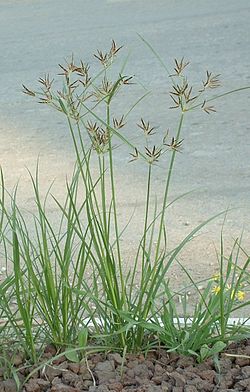
Cyperus rotundus is a perennial plant, that may reach a height of up to 140 cm (55 in). The names "nut grass" and "nut sedge" – shared with the related species Cyperus esculentus – are derived from its tubers, that somewhat resemble nuts, although botanically they have nothing to do with nuts.
As in other Cyperaceae, the leaves sprout in ranks of three from the base of the plant, around 5–20 cm (2–8 in) long. The flower stems have a triangular cross-section. The flower is bisexual and has three stamina and a three-stigma pistil, with the inflorescence having three to eight unequal spikes. The fruit is a three-angled achene.
Young plants initially form white, fleshy rhizomes, up to 25 mm (1.0 in) in dimension, in chains. Some rhizomes grow upward in the soil, then form a bulb-like structure from which new shoots and roots grow, and from the new roots, new rhizomes grow. Other rhizomes grow horizontally or downward, and form dark reddish-brown tubers or chains of tubers.
C. esculentus – is visually similar but has yellow to bright-yellow florets (lacking the darkened reddish colour of C. rotundus' inflorescence, which can be a bit greenish-pallid without), often arranged in a ladder-like way.
C. longus – has leaves that sheath the stem and diverge from some way up the stem, and is invariably a rather larger plant.
C. serotinus – also has leaves that sheath the stem and diverge from some way up the stem, and has the spikes of flowers with the spikelets separated in a ladder-like way.
C. rotundus was part of a set of starchy tuberous sedges that may have been eaten by Pliocene hominins. Biomarkers and microscopic evidence of C. rotundus are present in human dental calculus found at the Al Khiday archaeological complex in central Sudan dating from before 6700 BC to the Meroitic pre-Islamic Kingdom of 300–400 AD. It is suggested that C. rotundus consumption may have contributed to the relatively low frequency of dental caries among the Meroitic population of Al Khiday because of its ability to inhibit Streptococcus mutans.
Cyperus rotundus
Cyperus rotundus (coco-grass, Java grass, nut grass, purple nut sedge or purple nutsedge, red nut sedge, Khmer kravanh chruk) is a species of sedge (Cyperaceae) native to Africa, southern and central Europe (north to France and Austria), and southern Asia. The word cyperus derives from the Greek κύπερος, kyperos, and rotundus is from Latin, meaning "round". The earliest attested form of the word cyperus is the Mycenaean Greek 𐀓𐀞𐀫, ku-pa-ro, written in Linear B syllabic script.
Cyperus rotundus is a perennial plant, that may reach a height of up to 140 cm (55 in). The names "nut grass" and "nut sedge" – shared with the related species Cyperus esculentus – are derived from its tubers, that somewhat resemble nuts, although botanically they have nothing to do with nuts.
As in other Cyperaceae, the leaves sprout in ranks of three from the base of the plant, around 5–20 cm (2–8 in) long. The flower stems have a triangular cross-section. The flower is bisexual and has three stamina and a three-stigma pistil, with the inflorescence having three to eight unequal spikes. The fruit is a three-angled achene.
Young plants initially form white, fleshy rhizomes, up to 25 mm (1.0 in) in dimension, in chains. Some rhizomes grow upward in the soil, then form a bulb-like structure from which new shoots and roots grow, and from the new roots, new rhizomes grow. Other rhizomes grow horizontally or downward, and form dark reddish-brown tubers or chains of tubers.
C. esculentus – is visually similar but has yellow to bright-yellow florets (lacking the darkened reddish colour of C. rotundus' inflorescence, which can be a bit greenish-pallid without), often arranged in a ladder-like way.
C. longus – has leaves that sheath the stem and diverge from some way up the stem, and is invariably a rather larger plant.
C. serotinus – also has leaves that sheath the stem and diverge from some way up the stem, and has the spikes of flowers with the spikelets separated in a ladder-like way.
C. rotundus was part of a set of starchy tuberous sedges that may have been eaten by Pliocene hominins. Biomarkers and microscopic evidence of C. rotundus are present in human dental calculus found at the Al Khiday archaeological complex in central Sudan dating from before 6700 BC to the Meroitic pre-Islamic Kingdom of 300–400 AD. It is suggested that C. rotundus consumption may have contributed to the relatively low frequency of dental caries among the Meroitic population of Al Khiday because of its ability to inhibit Streptococcus mutans.
Recent media
Recent media