
Recent from talks
Cyrene, Libya
Knowledge base stats:
Talk channels stats:
Members stats:
Cyrene, Libya
Cyrene, also sometimes anglicized as Kyrene, was an ancient Greek colony and Roman city near present-day Shahhat in northeastern Libya in North Africa. It was part of the Pentapolis, an important group of five cities in the region, and gave the area its classical and early modern name Cyrenaica.
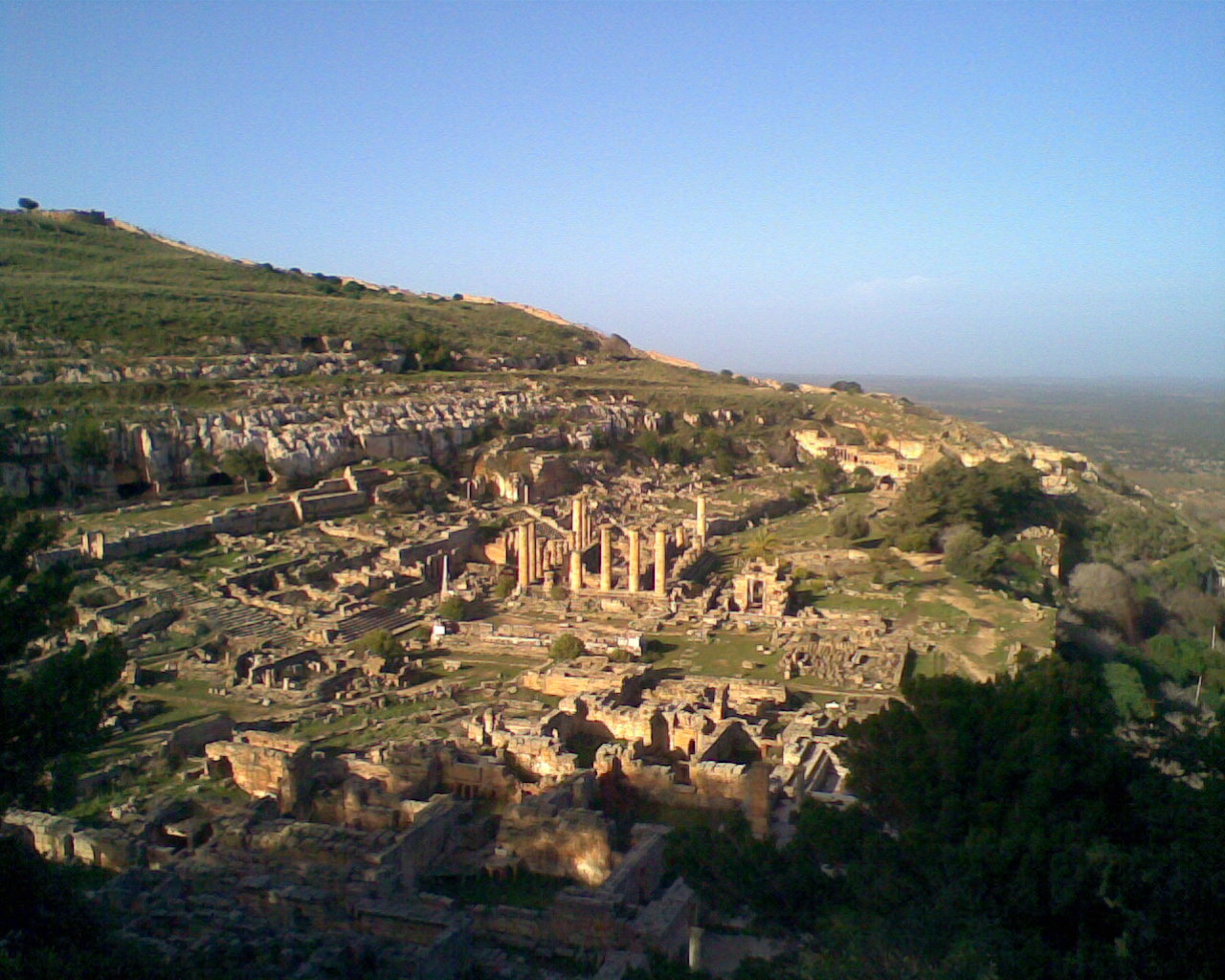
Cyrene lies on a ridge of the Jebel Akhdar uplands. The archaeological remains cover several hectares and include several monumental temples, stoas, theatres, bathhouses, churches, and palatial residences. The city is surrounded by the Necropolis of Cyrene. Since 1982, it has been a UNESCO World Heritage Site. The city's port was Apollonia (Marsa Sousa), located about 16 kilometres (10 mi) to the north.
The city was attributed to Apollo and the legendary etymon Cyrene by the Greeks themselves but it was probably actually colonized by settlers from Thera (modern Santorini) in the late seventh century BC. It was initially ruled by a dynasty of monarchs called the Battiads, who grew rich and powerful as a result of successive waves of immigration and the export of horses and silphium, a medicinal plant. By the fifth century BC, they had expanded their control over the other cities of Cyrenaica. It became the seat of the Cyrenaics, a school of philosophy in the fourth century BC, founded by Aristippus, a disciple of Socrates. In the Hellenistic Age, the city alternated between being part of Ptolemaic Egypt and the capital of an independent kingdom. It was also an important Jewish hub. In 96 BC, it passed to the Roman Republic and became part of the province of Crete and Cyrenaica. The city was destroyed by Jewish fighters in AD 115 during the Diaspora revolt, and slowly rebuilt over the following century. Earthquakes in 262 and 365 devastated the city, but some habitation continued through the early Byzantine period and the Muslim conquest of the Maghreb in 642, after which the site was abandoned until the establishment of an Italian military base on the site in 1913. Excavations have been ongoing since that time.
Cyrene is the latinized form of the Greek name Kȳrḗnē (Κυρήνη) of uncertain origin. The Greeks themselves attributed the name to the legendary Thessalian princess Cyrene who supposedly founded the city with help from the sun god Apollo. Some modern scholars sometimes attribute the name to its spring Cyra (Κύρα, Kýra), which was considered sacred to Apollo by the city's Greco-Roman inhabitants. The legend of Thessalian Cyrene seems to long predate attestation of the spring, however, and Janko instead suggests that the existing legend and name were adopted by the early Theran settlers for this specific location after some unattested but similar local name in the Libu or Garamantian language. Although both the Greek and Latin forms of the name were pronounced something like /kuˈreɪneɪ/ koo-RAY-nay, they are more often read in English as /kaɪˈriːni/ ky-REE-nee or, in its Latin form, /saɪˈriːni/ sy-REE-nee.[citation needed]
People have lived in Cyrenaica since the Palaeolithic. There is some evidence for settlement in the caves below the Acropolis which may pre-date Greek settlement. It is possible that Minoans and Mycenaeans visited Cyrene in the Bronze Age, since it is on the easiest sea route from the Aegean to Egypt, but the only archaeological evidence for this are separate finds of a small Minoan altar and a Minoan seal, which might have been brought over at a later date.
A Greek myth first recorded by Pindar in the early fifth century BC reports that the god Apollo fell in love with the huntress Cyrene and brought her to Libya, where she gave birth to a son Aristaeus. Greek historical traditions, reported in Herodotus' Histories and in a fourth-century BC inscription found at Cyrene, say that a group of Cretan Greeks, who had been expelled from Sparta and settled on the island of Thera, founded Cyrene in 631 BC, under the leadership of Battus I, at the prompting of the Oracle of Delphi. Some traditions say that the settlers left Thera because of a famine, others because of a civil war. Most say that the colonists first settled on an island at Aziris (east of Derna) before relocating to Cyrene. The historicity of these narratives is uncertain, particularly the idea that Thera was Cyrene's sole "mother city." Relationships with other cities, such as Sparta and Samos, mentioned in the foundation narratives, are uncertain.
Archaeological evidence from the site, especially ceramic finds, confirm that Greek settlement began in the mid-seventh century BC. This early pottery derves from Thera, Sparta, and Samos, but also Rhodes. The initial area of habitation was a ridge stretching eastwards from the Acropolis to the Agora, but the city rapidly expanded eastwards. The sanctuary of Apollo to the north of the Acropolis, of Demeter to the south, and of Zeus to the east all go back to the seventh or sixth centuries BC. Archaeological evidence shows that several other sites in Cyrenaica, such as Apollonia, Euesperides, and Taucheira (modern Benghazi and Tocra) were settled at the same time as Cyrene.
After its foundation, the city was ruled by a series of monarchs descended from Battus I. Over the course of the sixth century BC, Cyrene grew to become the most powerful city in the region. In the first half of the sixth century BC, Battus II encouraged further Greek settlement in the city, especially from the Peloponnese and Crete. This sparked conflict with the indigenous Libyans, whose king Adicran appealed to Egypt for help around 570 BC. The pharaoh Apries launched a military expedition against Cyrene, but was decisively defeated at the Battle of Irasa.
Hub AI
Cyrene, Libya AI simulator
(@Cyrene, Libya_simulator)
Cyrene, Libya
Cyrene, also sometimes anglicized as Kyrene, was an ancient Greek colony and Roman city near present-day Shahhat in northeastern Libya in North Africa. It was part of the Pentapolis, an important group of five cities in the region, and gave the area its classical and early modern name Cyrenaica.
Cyrene lies on a ridge of the Jebel Akhdar uplands. The archaeological remains cover several hectares and include several monumental temples, stoas, theatres, bathhouses, churches, and palatial residences. The city is surrounded by the Necropolis of Cyrene. Since 1982, it has been a UNESCO World Heritage Site. The city's port was Apollonia (Marsa Sousa), located about 16 kilometres (10 mi) to the north.
The city was attributed to Apollo and the legendary etymon Cyrene by the Greeks themselves but it was probably actually colonized by settlers from Thera (modern Santorini) in the late seventh century BC. It was initially ruled by a dynasty of monarchs called the Battiads, who grew rich and powerful as a result of successive waves of immigration and the export of horses and silphium, a medicinal plant. By the fifth century BC, they had expanded their control over the other cities of Cyrenaica. It became the seat of the Cyrenaics, a school of philosophy in the fourth century BC, founded by Aristippus, a disciple of Socrates. In the Hellenistic Age, the city alternated between being part of Ptolemaic Egypt and the capital of an independent kingdom. It was also an important Jewish hub. In 96 BC, it passed to the Roman Republic and became part of the province of Crete and Cyrenaica. The city was destroyed by Jewish fighters in AD 115 during the Diaspora revolt, and slowly rebuilt over the following century. Earthquakes in 262 and 365 devastated the city, but some habitation continued through the early Byzantine period and the Muslim conquest of the Maghreb in 642, after which the site was abandoned until the establishment of an Italian military base on the site in 1913. Excavations have been ongoing since that time.
Cyrene is the latinized form of the Greek name Kȳrḗnē (Κυρήνη) of uncertain origin. The Greeks themselves attributed the name to the legendary Thessalian princess Cyrene who supposedly founded the city with help from the sun god Apollo. Some modern scholars sometimes attribute the name to its spring Cyra (Κύρα, Kýra), which was considered sacred to Apollo by the city's Greco-Roman inhabitants. The legend of Thessalian Cyrene seems to long predate attestation of the spring, however, and Janko instead suggests that the existing legend and name were adopted by the early Theran settlers for this specific location after some unattested but similar local name in the Libu or Garamantian language. Although both the Greek and Latin forms of the name were pronounced something like /kuˈreɪneɪ/ koo-RAY-nay, they are more often read in English as /kaɪˈriːni/ ky-REE-nee or, in its Latin form, /saɪˈriːni/ sy-REE-nee.[citation needed]
People have lived in Cyrenaica since the Palaeolithic. There is some evidence for settlement in the caves below the Acropolis which may pre-date Greek settlement. It is possible that Minoans and Mycenaeans visited Cyrene in the Bronze Age, since it is on the easiest sea route from the Aegean to Egypt, but the only archaeological evidence for this are separate finds of a small Minoan altar and a Minoan seal, which might have been brought over at a later date.
A Greek myth first recorded by Pindar in the early fifth century BC reports that the god Apollo fell in love with the huntress Cyrene and brought her to Libya, where she gave birth to a son Aristaeus. Greek historical traditions, reported in Herodotus' Histories and in a fourth-century BC inscription found at Cyrene, say that a group of Cretan Greeks, who had been expelled from Sparta and settled on the island of Thera, founded Cyrene in 631 BC, under the leadership of Battus I, at the prompting of the Oracle of Delphi. Some traditions say that the settlers left Thera because of a famine, others because of a civil war. Most say that the colonists first settled on an island at Aziris (east of Derna) before relocating to Cyrene. The historicity of these narratives is uncertain, particularly the idea that Thera was Cyrene's sole "mother city." Relationships with other cities, such as Sparta and Samos, mentioned in the foundation narratives, are uncertain.
Archaeological evidence from the site, especially ceramic finds, confirm that Greek settlement began in the mid-seventh century BC. This early pottery derves from Thera, Sparta, and Samos, but also Rhodes. The initial area of habitation was a ridge stretching eastwards from the Acropolis to the Agora, but the city rapidly expanded eastwards. The sanctuary of Apollo to the north of the Acropolis, of Demeter to the south, and of Zeus to the east all go back to the seventh or sixth centuries BC. Archaeological evidence shows that several other sites in Cyrenaica, such as Apollonia, Euesperides, and Taucheira (modern Benghazi and Tocra) were settled at the same time as Cyrene.
After its foundation, the city was ruled by a series of monarchs descended from Battus I. Over the course of the sixth century BC, Cyrene grew to become the most powerful city in the region. In the first half of the sixth century BC, Battus II encouraged further Greek settlement in the city, especially from the Peloponnese and Crete. This sparked conflict with the indigenous Libyans, whose king Adicran appealed to Egypt for help around 570 BC. The pharaoh Apries launched a military expedition against Cyrene, but was decisively defeated at the Battle of Irasa.
Recent media