



Community hub
Recent from talks
Contribute something
Nothing was collected or created yet.
Anglicisation of names
View on Wikipedia
 | This article has multiple issues. Please help improve it or discuss these issues on the talk page. (Learn how and when to remove these messages)
|


The anglicisation of personal names is the change of non-English-language personal names to spellings nearer English sounds, or substitution of equivalent or similar English personal names in the place of non-English personal names.
Anglicisation of personal names
[edit]Classical, medieval and Renaissance figures
[edit]A small number of figures, mainly very well-known classical and religious writers, appear under English names—or more typically under Latin names, in English texts. This practice became prevalent as early as in English-language translations of the New Testament, where translators typically renamed figures such as Yeshua and Simon bar-Jonah as Jesus and Peter, and treated most of the other figures in the New Testament similarly. In contrast, translations of the Old Testament traditionally use the original names, more or less faithfully transliterated from the original Hebrew. Transatlantic explorers such as Zuan Chabotto and Cristoforo Colombo became popularly known as John Cabot and Christopher Columbus; the English-speaking world typically knows the French-born theologian Jean Calvin as John Calvin. Such anglicisations became less usual after the sixteenth century.
Non-English-language areas of Great Britain and Ireland
[edit]Most Gaelic language surnames of Ireland, Scotland, and the Isle of Man have been anglicized at some time. The Gaels were among the first Europeans to adopt surnames during the Dark Ages. Originally, most Gaelic surnames were composed of the given name of a child's father, preceded by Mac (son) or Nic (or Ní, both being variants of nighean, meaning daughter) depending on the gender. These surnames would not be passed down another generation, and a woman would keep her birth surname after marriage. The same was originally true of Germanic surnames which followed the pattern [father's given name]+son/daughter (this is still the case in Iceland, as exemplified by the singer Björk Guðmundsdóttir and former Prime Minister Sigmundur Davíð Gunnlaugsson). When referring to siblings collectively (or to members of a family or clan that share a "Mac-" surname), the prefix for son or daughter was pluralised. By example, MacAoidh (son of Hugh) becomes MicAoidh (sons of Hugh) and Clann MhicAoidh (literally children/descendants of Hugh). The Jacksons in English (with Jack being derived from John) would in Gaelic be rendered a MhicSheain (the sons of John).
Over the centuries, under the influence of post-medieval English practice, this type of surname has become static over generations, handed down the male lineage to all successive generations so that it no longer indicates the given name of a holder's father any more than the suffix -son on a Germanic language surname does today. Among English-speaking peoples of Gaelic heritage, the use of Nic as a prefix for daughters has been replaced by Mac, regardless of sex (as per Geraldine McGowan, Alyth McCormack, and Sarah McLachlan). Wives also began to take on the surnames of their husbands.
Another common pattern of surname was similar to that preceded by Mac/Nic, but instead was preceded by Ó or Ui, signifying a grandchild or descendant. Not all Gaelic surnames signified relationship to a forebear, however. Some signified an ancestral people or homeland, such as MacDhubhghaill (son of a dark-haired foreigner; referring to one type of Scandinavian), MacFhionnghaill (son of a fair-haired foreigner; also referring to a Scandinavian people), MacLachlainn or MacLachlainneach (son of a Scandinavian). Others indicated the town or village of a family's origin, sometimes disguised as an ancestor's name as in Ó Creachmhaoil, which prefixes a toponym as though it was the name of a person. As with other culturo-linguistic groups, other types of surnames were often used as well, including trade-names such as MacGhobhainn, Mac a'Ghobhainn or Mac Gabhainn (son of the smith), and physical characteristics such as hair colour.
In anglicizing Gaelic names, the prefixes Mac, Nic, and Ó were frequently removed (the name Ó Fathaigh, by example, was sometimes anglicized as Fahey or Fay, identically to the given name; Ó Leannáin and Ó Lionáin have both been anglicized as Lennon; Ó Ceallaigh and Ó Cadhla have been anglicized as Kelly). Where they were retained, Mac was often rendered Mc, M', or Mag- (the last is seen in renderings such as Maguire for Mac Uidhir) and Ó/Ui became O'. MacGhobhainn, Mac a'Ghobhainn and Mac Gabhainn (son of the smith) were anglicized as McGowan, Gowan, McGavin, and Gavin. In surnames which had been prefixed Mac (which includes most Manx surnames), the final hard c sound remained when the Mac was removed. As Gaelic spelling rules required the first letter of a name preceded by Mac or Nic to be lenited (providing it was a consonant other than l, n, or r, which are not generally lenited in Gaelic, or c or g; although in the case of the last two, they are lenited when the intended connotation is "son/daughter of" rather than a surname. By example, if stating that James (Scott) is the son of Calum (Stuart) in Gaelic, it would be phrased Seumas mac Chaluim, as distinct from Seumas MacCaluim for a James with the surname MacCaluim) with the addition of an h after it (originally, this had been indicated in handscript by a dot above the letter, but with the introduction of printing with movable type the h was substituted) after a consonant (silencing it, or changing its sound), and for the last vowel to be slender (i or e) if male, the anglicized form of a Gaelic name could look quite different. By example, MacPhearais (Mac+Pearas=son of Pierce) has been anglicized as Corish, and MacAonghais has been anglicized as MacAngus, MacInnis, MacInnes, Innis, Innes, and Guinness.[1]
As with Gaelic and Germanic surnames, Welsh surnames and Cornish surnames had originally been mostly patronymic, though others contained toponymic elements, or were derived from trades, or personal characteristics. Surnames which remained fixed across generations, passed down along the male line of descent (provided parents were married) were adopted under the dictate of the English Government from the sixteenth century. As in the Gaelic-speaking areas, many Welsh (Cymric) patronyms were anglicised by omitting the prefix indicating son of and either exchanging the father's Welsh forename for its English equivalent, or re-spelling it according to English spelling rules, and, either way, most commonly adding -s to the end, so that the such as 'ap Hywell' became Powell, and 'ap Siôn' to Jones or Upjohn. The first generation to adopt this Anglicisation hereafter handed it down unchanged to children.[2] Many Cornish (Kernewek) names have been anglicised in similar ways.
Immigration to English-speaking countries
[edit]Anglicisation of non-English-language names was common for immigrants, or even visitors, to English-speaking countries. An example is the German composer Johann Christian Bach, the "London Bach", who was known as "John Bach" after emigrating to England.[3]
During the time in which there were large influxes of immigrants from Europe to the United States and United Kingdom during the 19th and 20th centuries, the given names and surnames of many immigrants were changed. This became known colloquially as the "Ellis Island Special", after the U.S. immigrant processing center on Ellis Island; contrary to popular myth, no names were ever legally changed at Ellis Island, and immigrants almost always changed them at their own discretion.
Traditionally common Christian given names could be substituted: such as James for the etymologically connected Jacques. Alternatively phonetical similarities, such as Joe for Giò (Giovanni or Giorgio); or abbreviation, Harry for Harilaos, or Ricky for Enrique (Henry), as common in Spanish, instead of for (Ricardo) Richard as in English.
The anglicisation of a personal name now usually depends on the preferences of the bearer. Name changes are less common today for Europeans emigrating to the United States than they are for people originating in, or descending from those who emigrated from, East Asian countries. Requests that the bearer anglicize their personal name against their wishes are viewed as a form of racism or xenophobia.[4]
French surnames
[edit]French immigrants to the United States (both those of Huguenot and French-Canadian background) often accommodated those unfamiliar with French pronunciations and spellings by altering their surnames (or encounter having them altered) in either of two ways: spellings were changed to fit the traditional pronunciation (Pariseau became Parizo, Boucher became Bushey, Mailloux became Mayhew, Cartier became Carter, Carpentier became Carpenter), or pronunciations were changed to fit the spelling (Benoît, pronounced French pronunciation: [bənwa], became Benway, or Bennett /bɛnˈɔɪt/).[5][6][7][8][9]
- Benoit: Bennett, Benning, Benway
- Boucher: Bush, Bushey
- Caúvin: Calvin
- Carpentier: Carpenter
- Carré: Carey, Carrey
- Carteret, Cartier: Carter
- Croquetagne: Crockett
- Cussaq: Cusack, Cusick
- DeMontgomerie: Montgomery
- Goúrdon: Gordon
- Gránd, LeGránd: Grant
- Olivier: Oliver
- Parquier: Parker
- Phillippe: Philips, Phillips
- Poitier: Porter
- Steuart: Stewart, Stuart
- Vernou: Vernon
Greek given names
[edit]Some Greek names are anglicized using the etymologically related name: Agni: Agnes; Alexandros/Alexis: Alexander/Alex; Alexandra: Alexandra/Alex; Andreas: Andrew; Christophoros: Christopher; Evgenios/Evgenis: Eugene/Gene; Eleni: Helen; Georgios/Yorgos: George; Ioannis/Yannis: John; Irini: Irene; Katharini: Catherine/Kate; Markos: Mark; Michail/Michalis: Michael; Nikolaos: Nicholas; Pavlos: Paul; Petros: Peter; Stephanos: Stephen; Theodoros: Theodore/Ted; and so on.
Besides simple abbreviation or anglicisation of spelling, there are some conventional English versions of or nicknames for Greek names which were formerly widely used and are still encountered:[10][11][12]
- Anestis: Ernest
- Alexandros: Alexander, Alex
- Apostolos: Paul
- Aristotelis: Aristotle
- Anastasia: Ana, Stasi, Stacey
- Andreas: Andrew
- Angeliki: Angela, Angel
- Athanasios: Thomas, Tom, Athan, Nathan
- Christos: Chris
- Demosthenes: Dick
- Despina: Dessi, Tessi, Tess
- Dimitrios/Dimi: James, Jim, Jimmy, Demi
- Dionysios: Dennis, Dean
- Haralambos: Harry, Bob
- Harilaos: Charles, Harry
- Eleftherios/Lefteris: Terence, Terry
- Eleftheria: Elli, Terrie
- Eleni: Helen, Elaine
- Evgenia: Eugenia
- Gavriil: Gabriel, Gabe
- Georgios, Yiorgos: George
- Ilias: Louie, Elias, Lou, Louis
- Konstantinos/Kostas: Gus, Charles, Dean, Constantine
- Leonidas: Leo
- Maria: Mary, Marie
- Michail: Michael, Mike
- Michaella: Michelle
- Nikolaos: Nicholas, Nick
- Panayiotis: Peter, Pete (cf. Petros)
- Pavlos: Paul
- Stavros: Steve
- Vasilios: William, Bill; (etymologically correct but not preferred: Basil)
Hundreds of Spiritual Christian Doukhobors who migrated from Russia to Canada from 1899 to 1930, changed their surnames. Genealogist Jonathan Kalmakoff posted comprehensive lists for
- Alberta (1935–1975) Archived 2017-12-08 at the Wayback Machine[13]
- British Columbia Archived 2020-12-01 at the Wayback Machine (1936–1975)[14]
- Saskatchewan (1917–1975) Archived 2019-08-19 at the Wayback Machine[15]
Russian surnames
[edit]Many descendants of Spiritual Christians from Russia in California, whose parents immigrated to Los Angeles (1904–1912), hid their family surnames due to real and perceived ethnic discrimination during the Cold War.[16]
- Androff, Veronin: Andrews
- Butchinoff: Baker
- Baklanov: Bakly
- Bolderoff: Bolder
- Pivovaroff: Brewer
- Chernikoff: Cherney
- Arinin, Orloff: Eagles
- Carpoff: Karp
- Chernabieff: Sharon
- Chickenoff, Chickinoff: Chick
- Corneyff: Corney
- Domansky: Domane
- Egnatoff: Egnatu
- Elinov: Eleen
- Fetesoff: Martin
- Fettesoff, Fettisoff: Fettis
- Galitzen: Riley
- Gordonov: Gordon
- Goulokin: Golf
- Gvozdiff: Niles
- Hallivichoff, Golovachev: Hall
- Kalpakoff: Kalp
- Kashirsky: Kash
- Kasimoff: Kazy
- Kisseloff, Kesseloff: Kissell
- Klubnikin: Klubnik
- Konovaloff: Conway
- Kotoff: Kott
- Krasilnikoff: Krase
- Kriakin: Emerald
- Kuznetsoff: Cousins
- Laschenco: Lashin
- Ledieav: Liege
- Mackshanoff: Maxwell
- Martinov, Martynov: Martin
- Melnikoff: Melnick
- Moiseve: Mosser
- Petrov, Petrova: Peters
- Petrovich: Peterson
- Plujnkoff: Pluss
- Popoff: Preston
- Rabinovich, Rabinovitz, Rabinowitz: Robbins, Robinson
- Robertov, Robertovich: Roberts, Robertson
- Robinovich, Robinov: Robbins, Robinson
- Rudometkin: Remmy
- Rudometkin: Ruddy
- Semenisheff: Samoff
- Slivkoff: Martin
- Smitrovich, Zmitrowicz: Smith
- Syapin: Seaking
- Tikhunov: Saber
- Tolmasoff: Thomas, Thompson, Tolmas
- Urane: Durain
- Uren: Wren
- Varonin: Johnson
- Volkoff: Wolf
German surnames
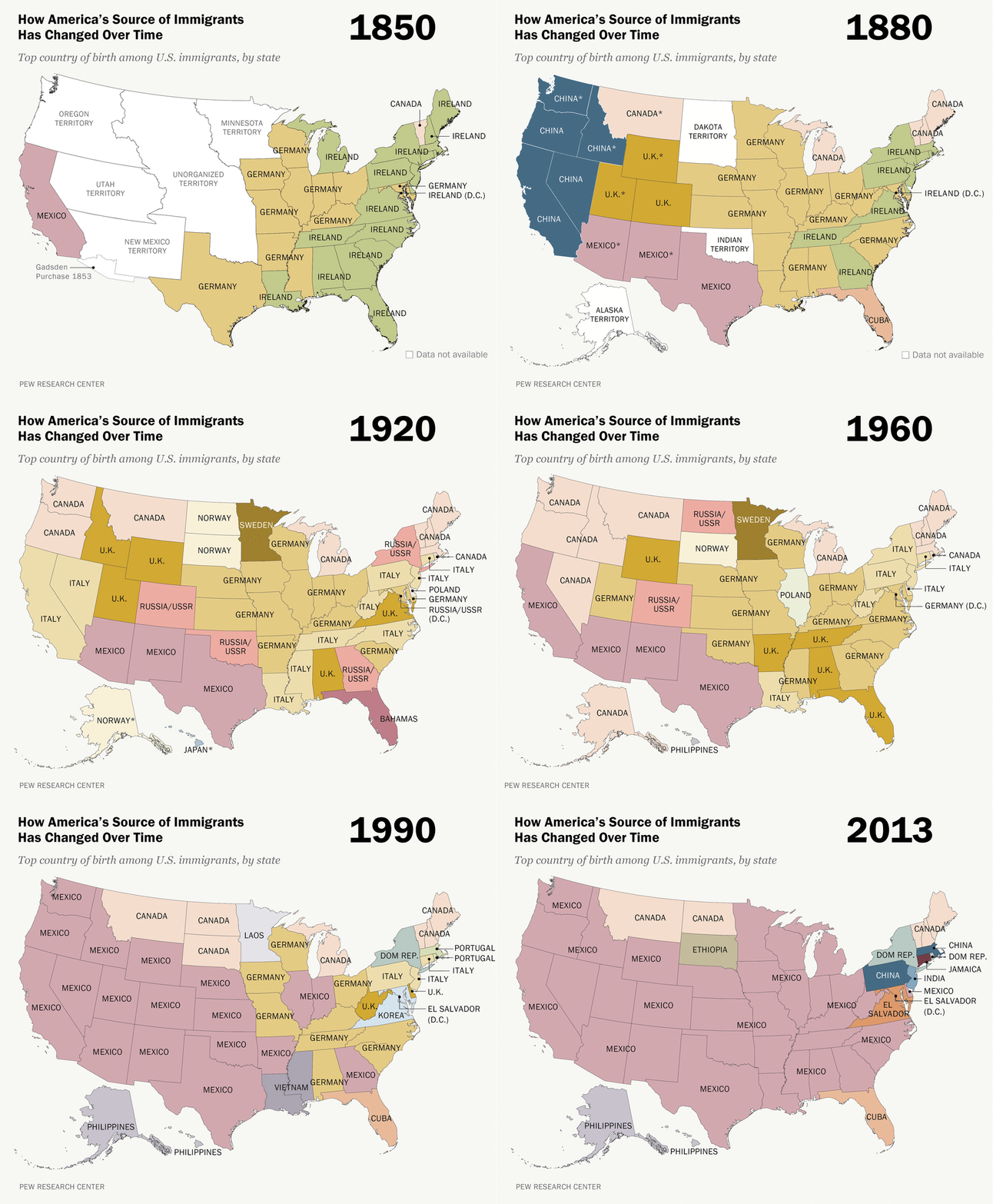
[edit]German Americans are the second largest ethnic group in the USA numbering at almost 16 million of US population. with an additional 29 million with some German ancestry. Immigration from Germany can be traced back to 1608 (Jamestown, VA), but migration was highest between the mid 19th century and early 20th century.[17] From 1876 to 1923, Germany was the largest source of US Immigrants.[18] From 1923 to 1970, it was the 2nd largest source of US Immigrants after Italy.[19]
A formal immigration process channeling immigrants through Ellis Island only began in 1892.[20] Immigrants arriving prior to this, did not receive official immigration papers documenting their names. This created a fluidity in how families chose to spell their names.[21]
Legal problems caused by spelling variations in surnames were addressed by the Land Purchases Act. This established the principle of idem sonans, that is, if differently spelled names "sounded the same," a claim of an unbroken line of ownership could be acknowledged.[22] Since preserving the name's sound was legally important, common forms of surname changes involved spelling adaptations that helped English readers replicate the original German pronunciation.[23]
The First and Second World Wars created pockets of xenophobia against German Americans. During the same period, the Anti-Saloon League successfully lobbied the Government to enact prohibition, using racist "us vs them" propaganda against German Americans, who owned a large percentage of American breweries.[24]
During the window of anti-German hostilities in the US, some German Americans chose to blur their connections with their ancestral homeland, by translating part or whole of their surnames into English. Once again, translations that limited change in sound were preferred over those that sounded different.[25] Relative to the sustained German mass immigration during the 19th and early 20th century, this practice of surname translation was unusual and not very widespread.[26]
In the 1940s, automobile registration documents, along with widespread implementation of social security,[27] played an important role in stabilizing American surnames by legally documenting most of the US population's names.[28]
- Becker: Baker, Beck
- Bennink: Benning
- Bresler, Bressler: Presley
- Braum, Braun: Brown
- Fischer: Fisher
- Freedman, Freedmann, Friedman, Friedmann: Freeman
- Gaetz: Gates
- Grandt: Grant
- Jensen, Jenssens: Johnson
- Koch: Cook
- Müller, Mueller: Miller
- Nauman, Naumann, Neuman, Neumann, Nieman, Niemann, Numan, Numann: Newman
- Nielsen, Nilsen: Nelson
- Pieters, Pieterse: Peters
- Pietersen, Pieterssen: Peterson
- Rodberts: Roberts
- Presler, Pressler: Presley
- Schmid, Schmidl, Schmidt, Schmitt, Schmitz: Smith
- Schweigert, Siewert, Steier, Steiert, Steiger, Steuer, Steuert, Stewert, Zweigert: Stewart, Stuart
- Stadler, Stetler: Statler
- Sten, Stein, Steinn, Steiner: Stone
- Wachter, Watcher, Welker, Welcker: Walker
- Weber: Weaver, Webb, Webster
- Werner, Werhner: Warner
- Wilhelms, Wilhelmson: Williams, Williamson, Wilson
Italian surnames
[edit]Italian surnames were often anglicized in the United States: for example, the i-ending of a number of Italian names becomes y, e, or ie.[29]
- Amici: Ameche
- Barbieri: Barber
- Benetti, Benedetto: Benedict, Bennett, Benning
- Bevilacqua: Drinkwater
- Bianco: White
- Bonfiglio: Bonfield
- Borgnino: Borgnine
- Brucceleri: Brooklier
- Canadeo: Kennedy
- Castiglia: Costello
- Cestaro: Chester
- Cilibrizzi: Celebrezze
- Cipulli: Cipully
- Crocetti: Crockett
- Cucco, Cuoco: Cook
- DeCesare: Chase
- DeMarti, DeMartina, DeMartini, DeMartino: Martin
- Marti, Martina, Martini, Martino: Martin
- Mercante: Merchant
- Morillo: Morill
- Pace: Pace same spelling different pronunciation
- Perri: Perry
- Piccolo: Little
- Rossellini: Russell
- Rossi: Ross
- Sangiovanni: St. John
- Saraceni: Sarazen
- Scalice, Scalise: Scalise, Scalish
- Scornavacca, Scornavacco: Scarnavack
- Scotta, Scotti, Scotto: Scott
- Ta(g)liaferro: Tolliver, Toliver
- Trafficante: Traficant
- Valentino: Valentine
- Vinciguerra: Winwar
Dutch surnames
[edit]When Dutch immigrants arrived in the United States, often their names were changed. This was either done deliberately, to make the name easier to write and remember, or by accident because the clerk did not know how to spell the name and wrote it down phonetically.[30][31]
- Aalderink: Aaldering, Aldering
- Bennink: Benning
- Buiel: Boyle
- Damkot: Damcott
- de Jong: Dejong, DeYoung, Young
- Dijkstra: Dykstra
- Filips: Philips, Phillips
- Gerritsen: Garrison
- Glieuwen: Glewen
- Goudswaard: Houseworth
- Griffoen: Griffin
- Hoed: Hood
- Janszoon, Janssens: Johnson
- Kempink: Camping
- Konings: King
- Kuiper: Cooper
- Langstraat: Longstreet
- Meester: Master
- Nieuwenhuis, Nijenhuis: Newhouse
- Nieman, Niemann: Newman
- Piek: Pike
- Pieters, Pieterse: Peters
- Pietersen, Pieterssen, Pieterszoon: Peterson
- Smid: Smith
- Spaak: Spock
- Steyaert, Stuywaert, Styaert: Stewart, Stuart
- Van Cruijningen: Cunningham
- Veenhuis: Feenhouse
- Welhuis, Welhuizen: Wellhouse, Willhouse
- Zutphen: Sutphin
Swedish surnames
[edit]Swedish surnames were anglicised in the United States, such as converting -sson to -son.
- Andersson: Anderson
- Björk: Birch[32]
- Carlsson: Carlson[32]
- Eklund: Oakgrove[32]
- Ekström: Oakstream[32]
- Engström: Meadowstream[32]
- Jacobsson: Jacobson
- Kalsberg: Colesberry[33]
- Sjöberg: Seaberry[34]
- Svensson: Swanson[32]
- Wikström: Baygrove[32]
Colonization by English-speaking countries
[edit]North America
[edit]Coastal Salish
[edit]Coastal Salish people were often given "Boston names" by early European settlers. These English names often had similar sounds to original Lushootseed names.[35][36][37]
When Lushootseed names were integrated into English, they were often recorded and pronounced very differently. An example of this is Chief Seattle. The name Seattle is an anglicisation of the modern Duwamish conventional spelling Si'ahl, equivalent to the modern Lushootseed spelling siʔaɫ Salishan pronunciation: [ˈsiʔaːɬ]. He is also known as Sealth, Seathle, Seathl, or See-ahth.[38]
See also
[edit]References
[edit]- ^ Dwelly, Edward (1994). Faclair Gaidhlig Gu Beurla Le Dealbhan; Dwelly's Illustrated Gaelic to English Dictionary. Glasgow, Scotland: Gairm Gaelic Publications, 29 Waterloo Street, Glasgow. ISBN 1871901286.
- ^ Frederick Wilgar Boal, J. Neville H. Douglas, Jenitha A. E. Orr Integration and division: geographical perspectives on the ... Northern Ireland 1982 – Page 42 "Substantial assimilation in the form of the anglicisation of personal names, language, religion, or the adoption of new agricultural practices, house forms, and other aspects of British material culture could only be anticipated in the lowland"
- ^ Eric Siblin The Cello Suites: J. S. Bach, Pablo Casals, and the Search for a ... 2011 – Page 234 "Known as the "London Bach," he travelled to Italy, converted to Roman Catholicism, and enjoyed celebrity status in England, going by the name John Bach. Only fourteen years old when Bach died, Johann Christian apparently occupied a ..."
- ^ EXCLUSIVE: Laney College's Phuc Bui says teacher Matthew Hubbard asked her to 'anglicize' her name
- ^ Evacie, Angela and Epp, Henry, 'What's The History Of French Canadian Immigration Into Vermont?', Vermont Public, May 4, 2018.
- ^ Provencher, Jean (2014-10-15). "Des noms de famille québécois devenus bien étranges". Les Quatre Saisons (in French). Retrieved 2024-12-11.
- ^ Corbeil, Jean-Claude (1976). "Origine historique de la situation linguistique québécoise". Langue française (in French) (31): 6–19. doi:10.3406/lfr.1976.4790. Retrieved 2024-12-11.
- ^ Anglicized French Surnames, Projet GenWeb du Québec
- ^ Surnames French-Canadian: Variants, Dit, Anglicization, etc., American-French Genealogical Society.
- ^ Mencken, all editions, passim
- ^ Parianou, Anastasia (1962-06-01). "Greek Personal Names" (PDF) (revised and updated by Anastasia Parianou, 2007 ed.). Central Intelligence Agency / SUNY Fredonia. Retrieved 2024-12-11.
- ^ Greek Boston, "Greek Name Day Calendar"
- ^ Kalmakoff, Jonathan. "Changes of Name of Persons of Doukhobor Ancestry in Alberta, 1935–1975" (PDF). Doukhobor Genealogy Website. Archived from the original (PDF) on 8 December 2017. Retrieved 18 September 2019.
- ^ Kalmakoff, Jonathan. "Changes of Name of Persons of Doukhobor Ancestry in British Columbia, 1936–1975" (PDF). Doukhobor Genealogy Website. Archived from the original (PDF) on 1 December 2020. Retrieved 18 September 2019.
- ^ Kalmakoff, Jonathan. "Changes of Name of Persons of Doukhobor Ancestry in Saskatchewan, 1917–1975" (PDF). Doukhobor Genealogy Website. Archived from the original (PDF) on 19 August 2019. Retrieved 18 September 2019.
- ^ Conovaloff, Andrei. "Taxonomy of 3 Spiritual Christian groups: Molokane, Pryguny and Dukh-i-zhizniki – books, fellowship, holidays, prophets and songs". Spiritual Christians Around the World. Retrieved 19 September 2019.
- ^ "Chronology : The Germans in America (European Reading Room, Library of Congress)". www.loc.gov. Retrieved 2021-02-09.
- ^ "Chronology : The Germans in America (European Reading Room, Library of Congress)". www.loc.gov. Retrieved 2021-02-01.
- ^ "How America's Source of Immigrants Has Changed Over Time". Pew Research Center. Retrieved 2021-02-09.
- ^ "Ellis Island | History, Facts, & Museum". Encyclopedia Britannica. Retrieved 2021-02-01.
- ^ Menchen, Henry Louis (1919). The American Language. p. 483.
- ^ "Title News" (PDF). American Title Association. XXXIV: 6. July 1955.
- ^ Barker, Howard F. Types of German Surname Changes in America (PDF). p. 26.
- ^ "World War I played key role in passage of Prohibition". The Mob Museum. 2018-11-09. Retrieved 2021-02-01.
- ^ Barker, Howard F (1935). How the American Changes His Name. p. 102.
- ^ Haugen, Einar (1953). The Norwegian language in America. p. 204.
- ^ "Social Security History". www.ssa.gov. Retrieved 2021-02-09.
- ^ Mencken, Henry Louis (1936). The American Language Supplement 2. Knopf. p. 461. ISBN 9780307813442.
{{cite book}}: ISBN / Date incompatibility (help) - ^ Joseph G. Fucilla, Our Italian Surnames, Genealogical Publishing Com, 1949, p. 238. ISBN 0806311878
- ^ "English versions of Dutch last names", by Yvette Hoitink, dutchgenealogy.nl, 15 May 2005.
- ^ "Making Sense Of Your Dutch Surname", dutchancestrycoach.com, 27 June 2010.
- ^ a b c d e f g Kiley, Jeff. "Common Anglicized Names Of American Immigrants". Common History Archives.
- ^ "Swedish names and their English counterparts". PA-Roots.
- ^ "Seaberry Family History". FamilySearcg.
- ^ Dougherty, Phil (October 5, 2007). "Comeford, James Purcell (1833–1909)". HistoryLink. Retrieved January 24, 2017.
- ^ Comeford, T. F. (November 1908). Wilhelm, Honor L. (ed.). "Marysville, Washington". The Coast. XVI (5). Seattle: The Coast Publishing Company: 329–332. OCLC 81457448. Retrieved March 18, 2017 – via Google Books.
- ^ Hunt, Herbert; Kaylor, Floyd C. (1917). Washington, West of the Cascades: Historical and Descriptive. Chicago: S. J. Clarke Publishing Company. p. 395. OCLC 10086413. Retrieved April 10, 2017 – via Internet Archive.
- ^ "Chief Seattle (Seattle, Chief Noah [born si?al, 178?–1866])". Retrieved 2018-10-06.
Bibliography
[edit]- H. L. Mencken, The American Language, 2nd edition, 1921, Chapter X, part 2. full text
- H. L. Mencken, The American Language, 4th edition, 1936, pp. 510–525.
- H. L. Mencken, The American Language, Supplement Two, 1948, pp. 516–525.
Anglicisation of names
View on GrokipediaDefinition and Conceptual Framework
Etymology and Historical Usage of the Term
The verb anglicize (or anglicise in British English), from which "anglicisation" derives, first appeared in English around 1710, formed by combining Medieval Latin Anglicus ("of the English," from Angli, the Angles) with the suffix -ize, indicating the act of rendering something English in form, character, or usage.[8][9] This neologism reflected emerging awareness of linguistic and cultural adaptation amid England's growing influence, initially applied to words, customs, or institutions rather than names specifically. The noun anglicization (or anglicisation) emerged in 1836 as a derivative, denoting the process of such transformation, coinciding with 19th-century philological studies and colonial documentation where English norms were imposed on diverse languages.[10] In historical usage, the term encompassed the phonetic and orthographic modification of foreign personal names to align with English conventions, a practice driven by administrative convenience, pronunciation ease, and assimilation pressures in English-dominant societies. For instance, 19th-century U.S. immigration records frequently show European surnames like "Schwarz" simplified to "Swartz" or "Giovanni" to "John," illustrating anglicisation as a survival strategy amid xenophobia and bureaucratic standardization, with over 30 million immigrants between 1815 and 1915 undergoing such changes to facilitate integration.[2] This nomenclature gained traction in colonial contexts, such as British India, where officials anglicized local names (e.g., "Mumbai" precursors to "Bombay") from the 18th century, though the explicit term postdated initial practices and was retroactively applied in linguistic analyses.[11] Unlike mere transliteration, which preserves original script sounds, anglicisation prioritized English phonology, often erasing etymological nuances, as seen in earlier medieval adaptations of Norman-French names post-1066 Conquest, where the process occurred without the modern terminology.[12] By the 20th century, "anglicisation of names" entered scholarly discourse on identity and empire, critiquing it as a tool of cultural erasure—evident in Asian American communities where names like "Mei-Ling" became "Mary" during early 1900s exclusionary eras—while primary sources like Ellis Island manifests (1892–1954) document over 12 million entries with evident alterations, underscoring empirical patterns of voluntary or coerced conformity.[12][2] The term's application remains precise to English-specific adaptations, distinguishing it from parallel processes like Gallicisation in French colonies, rooted in causal dynamics of linguistic hegemony rather than neutral equivalence.Distinctions from Related Processes (e.g., Transliteration vs. Adaptation)
Anglicisation of names differs from transliteration in that the latter is a systematic process of converting characters from a non-Latin script to Latin equivalents, aiming to approximate the original pronunciation without significant alteration for the target language's convenience.[13] Transliteration employs standardized schemes, such as Pinyin for Mandarin (e.g., "Mao Zedong" from Chinese characters) or the Library of Congress system for Arabic, to enable reversibility and phonological fidelity.[14] In anglicisation, however, the focus shifts to assimilation into English norms, often resulting in simplifications or substitutions that prioritize ease of articulation and spelling for English speakers, potentially diverging from source sounds—such as rendering the French "René" without the nasal vowel as "Rene" or approximating German umlauts in "Müller" as "Muller." This process reflects practical usage rather than phonetic precision, as evidenced in immigrant name changes documented in U.S. records from the 19th to 20th centuries, where non-English surnames were routinely modified for administrative and social integration.[15] While anglicisation constitutes a form of linguistic adaptation, it is distinguished by its specificity to English phonological, orthographic, and cultural constraints, whereas adaptation broadly describes the integration of foreign elements into any recipient language through phonetic, morphological, or semantic adjustments.[16] Adaptation may involve calques (direct translations, e.g., "New York" from Dutch "Nieuw Amsterdam") or partial retention of source forms in multilingual contexts, but anglicisation typically emphasizes simplification to fit English's limited phoneme inventory and aversion to diacritics, leading to conventionalized variants like "Fidel Castro" pronounced with an English "Cas-tro" stress rather than Spanish rules.[15] In cases of non-Latin scripts, transliteration often precedes anglicisation as an intermediate step, but the latter introduces variability driven by speaker conventions rather than fixed rules, as seen in the anglicisation of Akan names in Ghanaian English contexts, where indigenous forms undergo structural and pronunciational shifts (e.g., tonal elements flattened to English intonation). This targeted adaptation underscores anglicisation's role in cultural assimilation, particularly in Anglophone colonial and diaspora settings, without the broader applicability of general adaptation across languages.Historical Evolution
Pre-Modern Instances in the British Isles and Europe
In medieval England, following the Norman Conquest of 1066, the elite adopted French-derived personal names, which were initially preserved in their continental forms within Latin administrative records such as the Domesday Book of 1086. Over subsequent centuries, as Middle English emerged as the vernacular, these names underwent phonetic and orthographic adaptation to align with English pronunciation and spelling conventions; for example, the Norman "Guillaume" standardized as "William" in English usage by the late 12th century, reflecting the assimilation of Norman nomenclature into the indigenous linguistic framework.[17] This process accelerated among the Anglo-Norman aristocracy, where bilingualism facilitated gradual shifts, though full anglicisation varied by region and social stratum. By the 17th century, name changes or variations in England commonly arose from personal motivations, including inheritance conditions requiring adoption of a benefactor's surname to receive property, anglicization to aid social or professional integration, and spelling inconsistencies in records due to phonetic transcription and pre-standardized orthography.[18][19] Similar adaptations occurred in Ireland after the Anglo-Norman invasion of 1169, where Gaelic patronymics were restructured using the French "fitz" (son of) prefix, yielding anglicised hybrids like Fitzpatrick from the Irish Mac Giolla Phádraig.[20] In Wales, post the Edwardian conquests of 1277–1283, incoming English administrators began rendering native Welsh names in anglicised forms for legal and ecclesiastical purposes, though widespread personal name changes remained sporadic until later Tudor policies. Scotland exhibited parallel trends in the Lowlands, influenced by Anglo-Norman settlers from the 12th century, with Norse-derived names in the Danelaw-influenced north—such as "Óláfr" rendered as "Anlaf" in English chronicles—further illustrating early phonetic accommodations to English phonology.[21] In continental Europe, pre-1500 instances of name anglicisation were rare and localized, primarily confined to English mercantile communities in trading hubs like Bruges or Calais, where foreign counterparts' names might be approximated in English ledgers for transactional clarity; however, no large-scale patterns emerged due to the limited projection of English cultural dominance prior to the Reformation era. These early adaptations underscore a pragmatic response to linguistic convergence rather than deliberate cultural imposition, often driven by administrative needs in multi-ethnic polities.Expansion During the Age of Exploration and Empire (16th–19th Centuries)
In the Caribbean, British colonization from the mid-17th century onward involved assigning English-style names to enslaved Africans, often upon purchase, baptism, or birth, to impose cultural and administrative uniformity. Plantation records from Barbados between 1650 and 1830 show that over 90% of given names for slaves were English or European-derived, such as William, Elizabeth, or diminutives like Billy and Betty, with classical references like Pompey or Venus comprising a smaller portion; African names, when retained, were sometimes abbreviated or altered for English pronunciation.[22] This practice facilitated record-keeping, as planters favored names mirroring their own societal norms, though slaves occasionally used African day-names privately or in community settings. Similar patterns appeared in Jamaica and other islands, where male slaves received names tied to British places or trades, underscoring the role of naming in enforcing hierarchy.[23] As the empire expanded into Africa during the 19th century, missionary activities and colonial governance promoted the adoption of English or biblical names among local populations, particularly elites and converts, to signify assimilation and access to education or administration. In Sierra Leone, the Krio community—formed from freed slaves resettled from 1787—integrated English surnames like Davies or Williams alongside traditional elements, reflecting Victorian influences and intermarriage with British officials.[24] This voluntary or coerced shift, driven by mission schools emphasizing Christian nomenclature, contrasted with retention of indigenous names in rural areas but accelerated urbanization and elite mobility, with numbers of such adoptions rising post-1807 abolition of the slave trade. Place names underwent systematic anglicization to support navigation, settlement, and imperial mapping, adapting indigenous or local terms to English orthography and phonetics. In Aden, seized by Britain in 1839, Arabic toponyms were frequently recast; for instance, Ma'alla harbor became "Steamer Point" and Tawahi "The Lines," prioritizing functional English descriptors over originals to aid coaling stations and military logistics until 1967.[25] In Australia, following settlement in 1788, Aboriginal names were often phonetically anglicized or supplemented with English ones—such as "Wollongong" retained but respelled—while new settlements drew from British geography, like Sydney after Viscount Sydney, blending adaptation with imposition to claim sovereignty over 7.7 million square kilometers by 1900.[26] These changes, totaling thousands across empire territories, stemmed from practical imperatives like phonetic accessibility for non-speakers, though they erased linguistic nuances and facilitated land dispossession.Anglicisation of Personal Names
Adaptation Among Historical Figures and Elites
Among elites, anglicisation of personal names frequently served strategic purposes, such as demonstrating allegiance to the host society, circumventing wartime prejudices, or enhancing prospects in commerce and politics. This was especially prevalent among immigrant nobles, royalty of continental origin, and rising merchant classes integrating into British or American elites during eras of cultural consolidation or conflict.[27] A landmark instance unfolded during World War I, when anti-German sentiment prompted King George V to issue a royal proclamation on July 17, 1917, renaming the British royal house from the German-derived Saxe-Coburg and Gotha to Windsor, after the family's castle residence.[27] This change affected the sovereign and his immediate relatives, symbolizing national unity; George V explicitly rejected other proposals like Tudor-Stewart to favor an unequivocally English identifier.[28] Concurrently, extended royal kin adapted similarly: Prince Louis Alexander of Battenberg, a naturalized British admiral of Hessian descent born in 1854, relinquished his German titles and anglicised his surname to Mountbatten on the same date, translating "Battenberg" (referencing a Hessian town) into its English equivalent of "mount" for "berg."[28] This adaptation extended to his descendants, including his son Louis Mountbatten (1900–1979), who rose to prominence as the last Viceroy of India, illustrating how such changes preserved elite status while aligning with British identity.[29] Earlier examples include immigrant entrepreneurs who ascended to elite ranks through name adaptation. John Jacob Astor, born Johann Jakob Astor on July 17, 1763, in Walldorf, Germany, anglicised his forename and retained a simplified surname upon arriving in London around 1779 to apprentice with his uncle's musical instrument business.[30] Emigrating to New York in 1783, he leveraged this anglicised identity to dominate the fur trade and real estate, amassing a fortune estimated at $20–30 million by his death in 1848—equivalent to over $1 billion today—establishing the Astor dynasty as fixtures of American high society.[31] French Huguenot elites, fleeing persecution after the 1685 Revocation of the Edict of Nantes, also pursued anglicisation for seamless incorporation into England's aristocracy and gentry; records show families naturalized from 1681 onward often rendered surnames phonetically English or via direct translation, such as "Boulanger" to "Baker" or "Blanc" to "White," aiding retention of wealth and titles amid Protestant refugee influxes numbering around 50,000.[32] Such shifts, documented in denization rolls, enabled figures like merchants and minor nobles to intermarry into established English families, perpetuating influence despite origins.[33]Regional Patterns Within the British Isles
In Ireland, anglicisation of personal names intensified during the 16th and 17th centuries amid Tudor conquests and plantations, with Gaelic prefixes like Ó (grandson/descendant) and Mac (son) adapted to O' and Mac/Mc forms, as documented in records from the reigns of Elizabeth I and James I.[34] Given names underwent phonetic shifts, such as Diarmaid becoming Darby or Dermot, reflecting administrative pressures and cultural assimilation under English rule.[35] This process was uneven but widespread, particularly among elites navigating penal laws and land confiscations, leading to fixed surnames replacing fluid patronymics by the early modern period.[36] In Wales, name anglicisation accelerated following the Laws in Wales Acts of 1535 and 1542, which incorporated Wales into England's legal and administrative framework, mandating English usage in courts and records, thereby prompting shifts from patronymic forms like ap (son of) to anglicised fixed surnames such as Jones from ap Siôn (son of John).[37] This bureaucratic influence, building on post-Edwardian conquest trends from the 13th century, resulted in common epithets being adapted—e.g., Fychan (small) to Vaughan—primarily among the gentry seeking integration, though rural persistence of Welsh forms delayed full uniformity until the 17th century.[38] Unlike Ireland's more coercive context, Welsh changes emphasized orthographic simplification for English literacy, with over 90% of prevalent surnames like Davies (from ap Dafydd) deriving from such patronymic anglicisations by the 19th century.[39] Scotland exhibited stark regional divides, with Lowland names anglicising earlier from the 11th century onward due to Norman and Anglo-Saxon influxes post-1066, incorporating English-style fixed surnames while Highlands retained Gaelic Mac- clan structures longer.[40] Highland personal names, such as Iain evolving to John or Ian, saw increased adaptation after the 1745 Jacobite defeat and subsequent clearances, which eroded Gaelic usage, though many clan identifiers like MacDonald persisted with modified spellings for English orthography.[41] Lowland-Highland disparities stemmed from geographic isolation and varying degrees of royal union integration, contrasting Ireland's plantation-driven uniformity and Wales' legal mandates, with Gaelic forms comprising a minority in national records by 1800.[42]Immigration-Driven Changes in Anglophone Nations
In the United States, immigration waves from Europe between the late 19th and early 20th centuries prompted many newcomers to voluntarily anglicize their personal names to facilitate assimilation, pronunciation by English speakers, and access to employment opportunities.[1] Contrary to popular myths, such changes rarely occurred at entry points like Ellis Island, where officials recorded names as presented on manifests rather than altering them; instead, immigrants often modified names themselves or through subsequent legal processes to adopt phonetically simpler English equivalents, such as Giuseppe becoming Joseph or Schmidt rendered as Smith.[43] [44] A 2018 analysis of historical data indicated that approximately 33% of immigrants changed their given names within the first decade of arrival, driven by practical needs and social pressures.[45] Empirical studies confirm economic incentives underpinned these adaptations, with anglicized or less ethnically marked names correlating with higher occupational success and fewer hiring barriers. For instance, research examining U.S. Census records from 1920 and 1940 found that immigrants with anglicized first names achieved greater intergenerational mobility in earnings and professions compared to those retaining original names, even after controlling for surname ethnicity.[3] This pattern persisted into the mid-20th century among groups like Italians, Germans, and Eastern Europeans, where name changes mitigated perceived foreignness amid nativist sentiments and labor market discrimination.[46] Similar dynamics emerged in other Anglophone nations, though data is sparser. In Australia, post-World War II immigration of over 2 million Europeans, including displaced persons, frequently involved name simplifications for administrative and social integration, such as Polish surnames shortened for ease in English contexts.[47] Recent field experiments underscore ongoing incentives, revealing that job applicants with ethnic names in Australia received 57.4% fewer callbacks for leadership roles than those with English-sounding names, despite identical qualifications, suggesting persistent pressure to anglicize for professional advancement.[48] In Canada, parallel voluntary changes occurred among 19th- and 20th-century European arrivals, often documented in naturalization records rather than at ports, mirroring U.S. practices to align with English-dominant bureaucracies.[46] In the United Kingdom, 20th-century inflows from Ireland, Europe, and the Commonwealth led to selective anglicizations, particularly among earlier cohorts; for example, Jewish immigrants from Eastern Europe in the early 1900s commonly adopted anglicized versions like Abram to Abraham to evade antisemitism and integrate into industrial workplaces.[49] However, rates have declined across these nations since the late 20th century, as multiculturalism policies, ethnic pride, and legal protections reduced the perceived necessity of name changes, with newcomers increasingly retaining original names to preserve heritage amid diversified societies.[50] This shift reflects broader assimilation patterns, where earlier immigrants prioritized conformity for survival, while contemporary ones benefit from greater tolerance.[51]Effects in Colonial and Post-Colonial Contexts
In British colonial India, anglicisation of personal names often accompanied administrative reforms, such as the introduction of fixed surnames for census enumeration beginning in 1871, which converted traditional, context-dependent naming—tied to kinship, occupation, or village—into static, lineage-based identifiers to streamline governance and taxation.[52] This practice, while enhancing bureaucratic efficiency, disrupted indigenous systems where names conveyed relational and temporal meanings, leading to a partial erosion of cultural specificity as individuals adapted names for interactions with colonial officials or English-medium education. Elites sometimes voluntarily anglicized first names, like adopting "John" or "Mary" alongside vernacular ones, to access civil service positions or missionary schools, thereby gaining economic mobility but at the cost of diluted familial nomenclature.[11] Across African colonies under British rule, such as in Ghana and Nigeria, colonial administrators and Christian missionaries systematically anglicized indigenous personal names during registration, baptism, and labor contracts, replacing semantically rich terms—often denoting birth circumstances, ancestry, or virtues—with phonetic approximations or English equivalents like "James" for complex Akan day-names.[53] [54] Among the Akan, this altered pronunciation and structure, stripping names of their encoded social data, such as gender roles or historical events, which facilitated colonial oversight of populations but contributed to intergenerational loss of linguistic heritage. In Nigeria, hybrid forms emerged, blending elements like tonal shifts in Igbo or Yoruba names to approximate English phonetics, aiding trade and missionary integration but fostering a dual-identity tension.[54] Post-colonially, anglicized names have endured in former British territories due to institutional inertia and pragmatic incentives, with surveys in Zimbabwe revealing that as of 2023, a majority of parents preferred English first names—such as "Oliver" or "Elizabeth"—over Shona equivalents for perceived employability and international compatibility, despite independence in 1980.[55] This persistence underscores causal factors like English's status as a lingua franca in commerce and education, outweighing symbolic decolonization for many families. However, reclamation efforts have gained traction; in parts of West Africa and the Indian diaspora, individuals revert to pre-anglicized forms—evident in rising registrations of traditional Akan or Yoruba names since the 2000s—to reaffirm ethnic identity amid globalization, though such shifts remain minority practices amid broader retention for administrative continuity.[53] [54] Overall, these effects highlight a trade-off: facilitated socioeconomic integration versus sustained cultural fragmentation, with empirical data indicating voluntary perpetuation in diverse contexts over forced revival.[55]Anglicisation of Place Names
Transformations in the British Isles
In Wales, anglicisation of native Brythonic place names intensified following the Norman Conquest of 1066 and subsequent English administrative integration, with many Welsh forms adapted to English phonetics and orthography for official records and maps. Examples include Caerffili becoming Caerphilly, Rhaglan to Raglan, Treorci to Treorchy, and Merthyr Tudful to Merthyr Tydfil, reflecting simplifications that prioritized English pronunciation while retaining partial etymological roots.[56] These changes often occurred in border regions like Pembrokeshire, where Anglo-Norman influences introduced English-derived names alongside Welsh ones, as seen in settlements blending linguistic layers from the 12th century onward.[57] In Ireland, the process accelerated during the Tudor reconquest (16th century) and Cromwellian plantations (1650s), culminating in the Ordnance Survey of Ireland (1824–1842), which systematically anglicised Gaelic toponyms through phonetic approximation, partial translation, or mispronunciation to facilitate English governance and land surveying. Approximately 90% of Irish place names originate from Irish Gaelic, with transformations like Eochaill (yew woods) to Youghal exemplifying semantic and phonetic shifts that obscured original meanings.[58][59] Other cases include Viking-derived names like Strangford from Old Norse Strangfjǫrðr, further adapted under English rule, and widespread application of prefixes such as bally- from baile (townland), resulting in over 11,000 such anglicised forms by the 19th century.[60][61] Scottish Gaelic toponyms underwent similar anglicisation, particularly after the 1707 Acts of Union and the Highland Clearances (18th–19th centuries), with no standardized rules—names were either literally translated, respelled phonetically, or newly coined in English equivalents, often rendering original descriptive senses opaque in their anglicised versions. Common elements like baile (farmstead or village) prefixed as bal- appear in places such as Balmoral, derived from baile nam mòr-bhealaich (settlement of the great mountain pass), while island terms eilean or innis became island or inch- in forms like Inchcolm.[62][63] In regions like Islay and the Hebrides, Norse-Gaelic hybrids were anglicised post-1746 Culloden to align with Lowland English administration, preserving Gaelic roots in over 70% of Highland names but prioritizing usability in English-dominant contexts.[64] These transformations collectively stemmed from English linguistic hegemony, enabling efficient cartography and bureaucracy across the Isles by the 19th century.[65]North American Examples and Rationales
In colonial North America, British settlers and administrators frequently adapted indigenous place names to English phonetic and orthographic conventions, preserving core elements while simplifying for pronunciation and documentation. For example, the Algonquian term misi-ziibi ("great river") was rendered as Mississippi in English records by the early 1700s, as seen in maps and explorer accounts from French and British sources alike.[66] Similarly, the Miami-Illinois šikaakwa ("wild garlic" or "wild onion") became Chicago, with the spelling adjusted in 17th- and 18th-century colonial surveys to align with English vowel sounds and consonant clusters.[67] The Iroquoian Onguiaahra ("point of land cut" or strait) evolved into Niagara for the falls and river, a form standardized in British cartography by the mid-18th century to facilitate regional mapping.[67] In Canada, parallel adaptations occurred post-1763 British conquest, such as the Huron-Wendat tkaronto ("where there are trees standing in the water") becoming Toronto, with English spelling reflecting settler transcriptions in land grants and fur trade ledgers.[68] These changes were not wholesale replacements but modifications of existing descriptors for natural features, as complete invention was rarer for prominent rivers and lakes due to their established use in indigenous-guided exploration.[69] The rationales for these adaptations centered on practical necessities of governance and communication in English-speaking colonies. Phonetic simplification reduced ambiguities in oral and written references, essential for land surveying, legal deeds, and military logistics, where precise identification prevented disputes over boundaries—evidenced by inconsistencies in early French spellings that British officials corrected for uniformity in treaties like the 1763 Treaty of Paris.[70] Orthographic alignment with English conventions supported administrative standardization, as colonial boards and later the U.S. Board of Geographic Names (from 1890) prioritized forms amenable to English literacy, minimizing errors in public records and promoting efficient resource allocation in expanding settlements.[67] Economically, anglicized names aided trade networks by enabling non-indigenous merchants to reference locales without linguistic intermediaries, as demonstrated in 18th-century Hudson's Bay Company logs adapting Cree and other terms for forts and waterways.[68] This process reflected causal pressures of scale: as English populations grew, dominant-language usability trumped fidelity to original phonemes, yielding measurable benefits in interoperability across diverse frontiers.[70]Cases from Other English-Speaking Colonies
In Australia, British colonization from 1788 onward involved systematic replacement of Indigenous place names with English ones to assert territorial control and facilitate administration. Governor Arthur Phillip renamed Port Jackson as Sydney on 26 January 1788, honoring British Home Secretary Thomas Townshend, Viscount Sydney, thereby overwriting local Eora nomenclature. Similarly, the Yarra River in Victoria, known to the Wurundjeri as Birrarung ("river of mists"), was redesignated in 1835 by surveyor Robert Hoddle, reflecting a colonial practice of phonetic simplification or outright substitution to align with European mapping conventions. Other examples include the renaming of natural features like Uluru, dubbed Ayers Rock in 1873 by explorer William Gosse after South Australian Premier Henry Ayers, prioritizing commemorative English naming over Pitjantjatjara descriptors. This pattern extended to settlements, with Melbourne named in 1837 after British Prime Minister Lord Melbourne, supplanting Indigenous terms like Naarm.[70][71] Some Indigenous names were retained but anglicized for ease of pronunciation and orthographic standardization by English speakers. For instance, the Dharug term "Burramatta," denoting a place of eel resting, evolved into Parramatta by the 1790s under colonial usage, preserving a semblance of the original while adapting to English phonetics. In Tasmania, palawa names like "Legana" (meaning "fresh water") were incorporated into colonial maps from the early 1800s, often with simplified spellings. Such adaptations occurred amid broader imposition, as evidenced by surveys in Victoria where Anglo-Indigenous toponymy blended elements but ultimately served colonial lexical dominance. By the mid-19th century, over 80% of major Australian settlements bore English-derived names, underscoring the prevalence of replacement over hybrid forms.[72][73][74] In New Zealand, colonial naming from the 1760s blended imposition of British imperial references with selective retention or anglicization of Māori names, influenced by ongoing Māori land occupation and later policy shifts. Captain James Cook, during his 1769–1770 voyages, anglicized the Dutch "Nova Zeelandia" to New Zealand and bestowed English names on features like Poverty Bay (Tūranga-nui-a-Kiwa), prioritizing navigational utility and homage to British patrons. Urban centers followed suit: Auckland was named in 1840 after George Eden, Earl of Auckland, supplanting Māori descriptors, while Wellington honored Prime Minister Arthur Wellesley in 1840. Temporary replacements occurred, such as Pātea becoming Carlyle in the 1860s before reverting due to local preference, and major rivers like the Waihou initially Thames before restoration. However, from 1894, the Designation of Districts Act prioritized Māori names in new designations, leading to higher retention rates—approximately 70% of North Island geographic features retained Māori origins by the early 20th century—contrasting Australia's more uniform anglicization. Dual naming emerged later, as with Matiu/Somes Island formalized in the 1990s.[75][76][77] In South Africa's English-speaking Cape Colony, acquired by Britain in 1806, anglicization targeted Dutch-derived names alongside Khoisan originals, exemplifying adaptation in a multilingual colonial context. Places like Kaapstad became Cape Town, with English forms imposed for official use, while new settlements such as Grahamstown (1812, after Colonel John Graham) replaced Indigenous terms to commemorate military victories. Xhosa and Khoisan names were often phoneticized or supplanted, as in the Eastern Cape where British surveys from the 1820s standardized English orthography. This process, less totalizing than in Australia due to entrenched Dutch influence, still advanced administrative cohesion under British rule until the 1910 Union.[70]Methods and Linguistic Mechanisms
Phonetic and Orthographic Simplification
Phonetic simplification adapts foreign name pronunciations to English phonological constraints by substituting non-native sounds with approximate English equivalents, deleting epenthetic elements, or reducing syllable complexity to enhance intelligibility. English phonology, lacking sounds such as the Polish retroflex /ʂ/ in "sz" or nasal vowels in various languages, prompts approximations like rendering /ʂ/ as /s/ or /ʃ/, and denasalizing vowels to oral forms. In transcription practices, recorders impose their English phonemic filters, resulting in variability; for instance, Eastern European immigrants' names with fricative clusters were often simplified in American records to align with alveolar or sibilant English consonants. During U.S. immigration peaks from 1892 to 1924, officials phonetically reinterpreted names heard at entry points, transforming consonant-dense forms into more vowel-balanced English-like utterances to avoid miscommunication.[78][79] Orthographic simplification restructures foreign spellings to conform to the English alphabet's 26 letters, eliminating diacritics, digraphs unfamiliar to English keyboards, and multisyllabic clusters that defy standard conventions. This includes dropping accents (e.g., háčeks, rings, or ogoneks) and substituting sequences like "sz" with "s" or "w" with "v" to reflect anglicized pronunciations. Polish immigrants, for example, altered "Szumowski" to "Sumowski" by simplifying the "sz" cluster, while "Dąbrowski" became "Dombrowski" via nasal vowel replacement with "om" for typographic ease. Czech names like "Dvořák" were respelled "Dvorak," removing diacritics to fit English orthographic norms without altering core consonants. Such modifications were prevalent among Eastern European arrivals, where illiteracy or clerical errors compounded voluntary changes for record-keeping simplicity.[78][2] These mechanisms often intersect, as phonetic shifts drive orthographic adjustments; Russian "Smiloff" evolved to "Smiley" through both auditory simplification and respelling to favor English vowel-consonant balance, motivated by immigrants' reports of original names hindering employment due to their "consonant-heavy" structure. In practice, voluntary adoptions outnumbered imposed changes, with families citing reduced ridicule and administrative friction as benefits.[1]| Original Name | Anglicized Form | Primary Simplification |
|---|---|---|
| Szumowski | Sumowski | Orthographic (cluster reduction: sz → s)[78] |
| Dąbrowski | Dombrowski | Orthographic (diacritic and vowel: ą → om)[78] |
| Dvořák | Dvorak | Orthographic (diacritics removal)[2] |
| Smiloff | Smiley | Phonetic/orthographic (vowel insertion, ending alteration)[1] |
| Łukasz | Lukasz | Orthographic (diacritic drop: ł → l) with phonetic easing[2] |