


Community hub
Recent from talks
Contribute something
Nothing was collected or created yet.


PSD-95 (postsynaptic density protein 95) also known as SAP-90 (synapse-associated protein 90) is a protein that in humans is encoded by the DLG4 (discs large homolog 4) gene.[5][6][7]
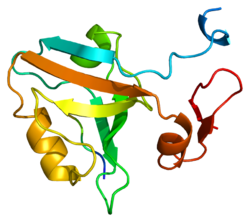
PSD-95 is a member of the membrane-associated guanylate kinase (MAGUK) family. With PSD-93 it is recruited into the same NMDA receptor and potassium channel clusters. These two MAGUK proteins may interact at postsynaptic sites to form a multimeric scaffold for the clustering of receptors, ion channels, and associated signaling proteins.[5] PSD-95 is the best studied member of the MAGUK-family of PDZ domain-containing proteins. Like all MAGUK-family proteins, its basic structure includes three PDZ domains, an SH3 domain, and a guanylate kinase-like domain (GK) connected by disordered linker regions. It is almost exclusively located in the post synaptic density of neurons,[8] and is involved in anchoring synaptic proteins. Its direct and indirect binding partners include neuroligin, NMDA receptors, AMPA receptors, and potassium channels.[9] It plays an important role in synaptic plasticity and the stabilization of synaptic changes during long-term potentiation.[10]
MAGUK superfamily and constituent domains
[edit]PSD-95 (encoded by DLG4) is a member of the MAGUK superfamily, and part of a subfamily which also includes PSD-93, SAP97 and SAP102. The MAGUKs are defined by their inclusion of PDZ, SH3 and GUK domains, although many of them also contain regions homologous of CaMKII, WW and L27 domains.[11] The GUK domain that they have is structurally very similar to that of the guanylate kinases, however it is known to be catalytically inactive as the P-Loop which binds ATP is absent. It is thought that the MAGUKs have subfunctionalized the GUK domain for their own purposes, primarily based on its ability to form protein-protein interactions with cytoskeleton proteins, microtubule/actin based machinery and molecules involved in signal transduction.
The PDZ domain which are contained in the MAGUKs in varying numbers, is replicated three times over in PSD-95. PDZ domains are short peptide binding sequences commonly found at the C-terminus of interacting proteins. The three copies within the gene have different binding partners, due to amino acid substitutions within the PSD-95 protein and its ligands. The SH3 domain is again a protein-protein interaction domain. Its family generally bind to PXXP sites, but in MAGUKs it is known to bind to other sites as well. One of the most well known features is that it can form an intramolecular bond with the GUK domain, creating what is known as a GUK-SH3 'closed' state. The regulatory mechanisms and function are unknown but it is hypothesized that it may involve a hook region and a calmodulin binding region located elsewhere in the gene.
Interactions
[edit]PSD-95 has been shown to interact with:
- ADAM22[12]
- Beta-1 adrenergic receptor[13]
- CACNG2[14][15]
- CASK[16]
- DLG3[17]
- DLGAP1[18][19][20][21][22][23]
- DLGAP2[19]
- DYNLL1[18]
- DYNLL2[18]
- ERBB4[24][25]
- EXOC4[26][27]
- FYN[28][29]
- FZD7[30]
- GRIK1[31]
- GRIK2[32][33]
- GRIK5[32][33]
- GRIN2A[21][28][34][35]
- GRIN2B[26][34][36][37][38][39]
- GRIN2C[36]
- HER2/neu[24]
- HGS[16]
- KCNA2[40]
- KCNA4[37][38][40][41]
- KCNA5[40][42]
- KCNJ12[37][43][44][45]
- Kir2.1[45]
- LGI1[12]
- LRP1[46]
- LRP2[46][47]
- NLGN1[34]
- NOS1[48][49]
- PTK2B[50]
- SEMA4C[51] and
- SHANK2.[18][20]
See also
[edit]References
[edit]- ^ a b c GRCh38: Ensembl release 89: ENSG00000132535 – Ensembl, May 2017
- ^ a b c GRCm38: Ensembl release 89: ENSMUSG00000020886 – Ensembl, May 2017
- ^ "Human PubMed Reference:". National Center for Biotechnology Information, U.S. National Library of Medicine.
- ^ "Mouse PubMed Reference:". National Center for Biotechnology Information, U.S. National Library of Medicine.
- ^ a b "Entrez Gene: DLG4 discs, large homolog 4 (Drosophila)".
- ^ Cho KO, Hunt CA, Kennedy MB (Nov 1992). "The rat brain postsynaptic density fraction contains a homolog of the Drosophila discs-large tumor suppressor protein". Neuron. 9 (5): 929–942. doi:10.1016/0896-6273(92)90245-9. PMID 1419001. S2CID 28528759.
- ^ Stathakis DG, Hoover KB, You Z, Bryant PJ (Nov 1997). "Human postsynaptic density-95 (PSD95): location of the gene (DLG4) and possible function in nonneural as well as in neural tissues". Genomics. 44 (1): 71–82. doi:10.1006/geno.1997.4848. PMID 9286702.
- ^ Hunt CA, Schenker LJ, Kennedy MB (Feb 1996). "PSD-95 is associated with the postsynaptic density and not with the presynaptic membrane at forebrain synapses". Journal of Neuroscience. 16 (4): 1380–1388. doi:10.1523/JNEUROSCI.16-04-01380.1996. PMC 6578559. PMID 8778289.
- ^ Sheng M, Sala C (2001). "PDZ domains and the organization of supramolecular complexes". Annu. Rev. Neurosci. 24: 1–29. doi:10.1146/annurev.neuro.24.1.1. PMID 11283303.
- ^ Meyer D, Bonhoeffer T, Scheuss V (2014). "Balance and stability of synaptic structures during synaptic plasticity". Neuron. 82 (2): 430–43. doi:10.1016/j.neuron.2014.02.031. PMID 24742464.
- ^ Woods DF, Bryant PJ (December 1993). "ZO-1, DlgA and PSD-95/SAP90: homologous proteins in tight, septate and synaptic cell junctions". Mech. Dev. 44 (2–3): 85–9. doi:10.1016/0925-4773(93)90059-7. PMID 8155583. S2CID 5785380.
- ^ a b Fukata Y, Adesnik H, Iwanaga T, Bredt DS, Nicoll RA, Fukata M (September 2006). "Epilepsy-related ligand/receptor complex LGI1 and ADAM22 regulate synaptic transmission". Science. 313 (5794): 1792–5. Bibcode:2006Sci...313.1792F. doi:10.1126/science.1129947. PMID 16990550. S2CID 33024022.
- ^ Hu LA, Tang Y, Miller WE, Cong M, Lau AG, Lefkowitz RJ, Hall RA (December 2000). "beta 1-adrenergic receptor association with PSD-95. Inhibition of receptor internalization and facilitation of beta 1-adrenergic receptor interaction with N-methyl-D-aspartate receptors". J. Biol. Chem. 275 (49): 38659–66. doi:10.1074/jbc.M005938200. PMID 10995758.
- ^ Chen L, Chetkovich DM, Petralia RS, Sweeney NT, Kawasaki Y, Wenthold RJ, Bredt DS, Nicoll RA (2000). "Stargazin regulates synaptic targeting of AMPA receptors by two distinct mechanisms". Nature. 408 (6815): 936–43. Bibcode:2000Natur.408..936C. doi:10.1038/35050030. PMID 11140673. S2CID 4427689.
- ^ Choi J, Ko J, Park E, Lee JR, Yoon J, Lim S, Kim E (April 2002). "Phosphorylation of stargazin by protein kinase A regulates its interaction with PSD-95". J. Biol. Chem. 277 (14): 12359–63. doi:10.1074/jbc.M200528200. PMID 11805122.
- ^ a b Chetkovich DM, Bunn RC, Kuo SH, Kawasaki Y, Kohwi M, Bredt DS (August 2002). "Postsynaptic targeting of alternative postsynaptic density-95 isoforms by distinct mechanisms". J. Neurosci. 22 (15): 6415–25. doi:10.1523/JNEUROSCI.22-15-06415.2002. PMC 6758133. PMID 12151521.
- ^ Masuko N, Makino K, Kuwahara H, Fukunaga K, Sudo T, Araki N, Yamamoto H, Yamada Y, Miyamoto E, Saya H (February 1999). "Interaction of NE-dlg/SAP102, a neuronal and endocrine tissue-specific membrane-associated guanylate kinase protein, with calmodulin and PSD-95/SAP90. A possible regulatory role in molecular clustering at synaptic sites". J. Biol. Chem. 274 (9): 5782–90. doi:10.1074/jbc.274.9.5782. PMID 10026200.
- ^ a b c d Naisbitt S, Valtschanoff J, Allison DW, Sala C, Kim E, Craig AM, Weinberg RJ, Sheng M (June 2000). "Interaction of the postsynaptic density-95/guanylate kinase domain-associated protein complex with a light chain of myosin-V and dynein". J. Neurosci. 20 (12): 4524–34. doi:10.1523/JNEUROSCI.20-12-04524.2000. PMC 6772433. PMID 10844022.
- ^ a b Takeuchi M, Hata Y, Hirao K, Toyoda A, Irie M, Takai Y (May 1997). "SAPAPs. A family of PSD-95/SAP90-associated proteins localized at postsynaptic density". J. Biol. Chem. 272 (18): 11943–51. doi:10.1074/jbc.272.18.11943. PMID 9115257.
- ^ a b Boeckers TM, Winter C, Smalla KH, Kreutz MR, Bockmann J, Seidenbecher C, Garner CC, Gundelfinger ED (October 1999). "Proline-rich synapse-associated proteins ProSAP1 and ProSAP2 interact with synaptic proteins of the SAPAP/GKAP family". Biochem. Biophys. Res. Commun. 264 (1): 247–52. Bibcode:1999BBRC..264..247B. doi:10.1006/bbrc.1999.1489. PMID 10527873.
- ^ a b Satoh K, Yanai H, Senda T, Kohu K, Nakamura T, Okumura N, Matsumine A, Kobayashi S, Toyoshima K, Akiyama T (June 1997). "DAP-1, a novel protein that interacts with the guanylate kinase-like domains of hDLG and PSD-95". Genes Cells. 2 (6): 415–24. doi:10.1046/j.1365-2443.1997.1310329.x. PMID 9286858. S2CID 8934092.
- ^ Wu H, Reissner C, Kuhlendahl S, Coblentz B, Reuver S, Kindler S, Gundelfinger ED, Garner CC (November 2000). "Intramolecular interactions regulate SAP97 binding to GKAP". EMBO J. 19 (21): 5740–51. doi:10.1093/emboj/19.21.5740. PMC 305801. PMID 11060025.
- ^ Kim E, Naisbitt S, Hsueh YP, Rao A, Rothschild A, Craig AM, Sheng M (February 1997). "GKAP, a Novel Synaptic Protein That Interacts with the Guanylate Kinase-like Domain of the PSD-95/SAP90 Family of Channel Clustering Molecules". J. Cell Biol. 136 (3): 669–78. doi:10.1083/jcb.136.3.669. PMC 2134290. PMID 9024696.
- ^ a b Huang YZ, Won S, Ali DW, Wang Q, Tanowitz M, Du QS, Pelkey KA, Yang DJ, Xiong WC, Salter MW, Mei L (May 2000). "Regulation of neuregulin signaling by PSD-95 interacting with ErbB4 at CNS synapses". Neuron. 26 (2): 443–55. doi:10.1016/S0896-6273(00)81176-9. PMID 10839362. S2CID 1429113.
- ^ Garcia RA, Vasudevan K, Buonanno A (March 2000). "The neuregulin receptor ErbB-4 interacts with PDZ-containing proteins at neuronal synapses". Proc. Natl. Acad. Sci. U.S.A. 97 (7): 3596–601. doi:10.1073/pnas.070042497. PMC 16285. PMID 10725395.
- ^ a b Sans N, Prybylowski K, Petralia RS, Chang K, Wang YX, Racca C, Vicini S, Wenthold RJ (June 2003). "NMDA receptor trafficking through an interaction between PDZ proteins and the exocyst complex". Nat. Cell Biol. 5 (6): 520–30. doi:10.1038/ncb990. PMID 12738960. S2CID 13444388.
- ^ Riefler GM, Balasingam G, Lucas KG, Wang S, Hsu SC, Firestein BL (July 2003). "Exocyst complex subunit sec8 binds to postsynaptic density protein-95 (PSD-95): a novel interaction regulated by cypin (cytosolic PSD-95 interactor)". Biochem. J. 373 (Pt 1): 49–55. doi:10.1042/BJ20021838. PMC 1223477. PMID 12675619.
- ^ a b Hou XY, Zhang GY, Yan JZ, Chen M, Liu Y (November 2002). "Activation of NMDA receptors and L-type voltage-gated calcium channels mediates enhanced formation of Fyn-PSD95-NR2A complex after transient brain ischemia". Brain Res. 955 (1–2): 123–32. doi:10.1016/S0006-8993(02)03376-0. PMID 12419528. S2CID 85751.
- ^ Tezuka T, Umemori H, Akiyama T, Nakanishi S, Yamamoto T (January 1999). "PSD-95 promotes Fyn-mediated tyrosine phosphorylation of the N-methyl-d-aspartate receptor subunit NR2A". Proc. Natl. Acad. Sci. U.S.A. 96 (2): 435–40. Bibcode:1999PNAS...96..435T. doi:10.1073/pnas.96.2.435. PMC 15154. PMID 9892651.
- ^ Hering H, Sheng M (June 2002). "Direct interaction of Frizzled-1, -2, -4, and -7 with PDZ domains of PSD-95". FEBS Lett. 521 (1–3): 185–9. Bibcode:2002FEBSL.521..185H. doi:10.1016/S0014-5793(02)02831-4. PMID 12067714. S2CID 39243103.
- ^ Hirbec H, Francis JC, Lauri SE, Braithwaite SP, Coussen F, Mulle C, Dev KK, Coutinho V, Meyer G, Isaac JT, Collingridge GL, Henley JM, Couthino V (February 2003). "Rapid and differential regulation of AMPA and kainate receptors at hippocampal mossy fibre synapses by PICK1 and GRIP". Neuron. 37 (4): 625–38. doi:10.1016/S0896-6273(02)01191-1. PMC 3314502. PMID 12597860.
- ^ a b Mehta S, Wu H, Garner CC, Marshall J (May 2001). "Molecular mechanisms regulating the differential association of kainate receptor subunits with SAP90/PSD-95 and SAP97". J. Biol. Chem. 276 (19): 16092–9. doi:10.1074/jbc.M100643200. PMID 11279111.
- ^ a b Garcia EP, Mehta S, Blair LA, Wells DG, Shang J, Fukushima T, Fallon JR, Garner CC, Marshall J (October 1998). "SAP90 binds and clusters kainate receptors causing incomplete desensitization". Neuron. 21 (4): 727–39. doi:10.1016/S0896-6273(00)80590-5. PMID 9808460. S2CID 18723258.
- ^ a b c Irie M, Hata Y, Takeuchi M, Ichtchenko K, Toyoda A, Hirao K, Takai Y, Rosahl TW, Südhof TC (September 1997). "Binding of neuroligins to PSD-95". Science. 277 (5331): 1511–5. doi:10.1126/science.277.5331.1511. PMID 9278515.
- ^ Sans N, Petralia RS, Wang YX, Blahos J, Hell JW, Wenthold RJ (February 2000). "A developmental change in NMDA receptor-associated proteins at hippocampal synapses". J. Neurosci. 20 (3): 1260–71. doi:10.1523/JNEUROSCI.20-03-01260.2000. PMC 6774158. PMID 10648730.
- ^ a b Lim IA, Hall DD, Hell JW (June 2002). "Selectivity and promiscuity of the first and second PDZ domains of PSD-95 and synapse-associated protein 102". J. Biol. Chem. 277 (24): 21697–711. doi:10.1074/jbc.M112339200. PMID 11937501.
- ^ a b c Inanobe A, Fujita A, Ito M, Tomoike H, Inageda K, Kurachi Y (June 2002). "Inward rectifier K+ channel Kir2.3 is localized at the postsynaptic membrane of excitatory synapses". Am. J. Physiol., Cell Physiol. 282 (6): C1396–403. doi:10.1152/ajpcell.00615.2001. PMID 11997254.
- ^ a b Niethammer M, Valtschanoff JG, Kapoor TM, Allison DW, Weinberg RJ, Craig AM, Sheng M (April 1998). "CRIPT, a novel postsynaptic protein that binds to the third PDZ domain of PSD-95/SAP90". Neuron. 20 (4): 693–707. doi:10.1016/S0896-6273(00)81009-0. PMID 9581762. S2CID 16068361.
- ^ Kornau HC, Schenker LT, Kennedy MB, Seeburg PH (September 1995). "Domain interaction between NMDA receptor subunits and the postsynaptic density protein PSD-95". Science. 269 (5231): 1737–40. Bibcode:1995Sci...269.1737K. doi:10.1126/science.7569905. PMID 7569905.
- ^ a b c Eldstrom J, Doerksen KW, Steele DF, Fedida D (November 2002). "N-terminal PDZ-binding domain in Kv1 potassium channels". FEBS Lett. 531 (3): 529–37. Bibcode:2002FEBSL.531..529E. doi:10.1016/S0014-5793(02)03572-X. PMID 12435606. S2CID 40689829.
- ^ Kim E, Sheng M (1996). "Differential K+ channel clustering activity of PSD-95 and SAP97, two related membrane-associated putative guanylate kinases". Neuropharmacology. 35 (7): 993–1000. doi:10.1016/0028-3908(96)00093-7. PMID 8938729. S2CID 23755452.
- ^ Eldstrom J, Choi WS, Steele DF, Fedida D (July 2003). "SAP97 increases Kv1.5 currents through an indirect N-terminal mechanism". FEBS Lett. 547 (1–3): 205–11. Bibcode:2003FEBSL.547..205E. doi:10.1016/S0014-5793(03)00668-9. PMID 12860415. S2CID 34857270.
- ^ Leonoudakis D, Conti LR, Radeke CM, McGuire LM, Vandenberg CA (April 2004). "A multiprotein trafficking complex composed of SAP97, CASK, Veli, and Mint1 is associated with inward rectifier Kir2 potassium channels". J. Biol. Chem. 279 (18): 19051–63. doi:10.1074/jbc.M400284200. PMID 14960569.
- ^ Leonoudakis D, Conti LR, Anderson S, Radeke CM, McGuire LM, Adams ME, Froehner SC, Yates JR, Vandenberg CA (May 2004). "Protein trafficking and anchoring complexes revealed by proteomic analysis of inward rectifier potassium channel (Kir2.x)-associated proteins". J. Biol. Chem. 279 (21): 22331–46. doi:10.1074/jbc.M400285200. PMID 15024025.
- ^ a b Nehring RB, Wischmeyer E, Döring F, Veh RW, Sheng M, Karschin A (January 2000). "Neuronal inwardly rectifying K(+) channels differentially couple to PDZ proteins of the PSD-95/SAP90 family". J. Neurosci. 20 (1): 156–62. doi:10.1523/JNEUROSCI.20-01-00156.2000. PMC 6774109. PMID 10627592.
- ^ a b Gotthardt M, Trommsdorff M, Nevitt MF, Shelton J, Richardson JA, Stockinger W, Nimpf J, Herz J (August 2000). "Interactions of the low density lipoprotein receptor gene family with cytosolic adaptor and scaffold proteins suggest diverse biological functions in cellular communication and signal transduction". J. Biol. Chem. 275 (33): 25616–24. doi:10.1074/jbc.M000955200. PMID 10827173.
- ^ Larsson M, Hjälm G, Sakwe AM, Engström A, Höglund AS, Larsson E, Robinson RC, Sundberg C, Rask L (July 2003). "Selective interaction of megalin with postsynaptic density-95 (PSD-95)-like membrane-associated guanylate kinase (MAGUK) proteins". Biochem. J. 373 (Pt 2): 381–91. doi:10.1042/BJ20021958. PMC 1223512. PMID 12713445.
- ^ Jaffrey SR, Snowman AM, Eliasson MJ, Cohen NA, Snyder SH (January 1998). "CAPON: a protein associated with neuronal nitric oxide synthase that regulates its interactions with PSD95". Neuron. 20 (1): 115–24. doi:10.1016/S0896-6273(00)80439-0. PMID 9459447. S2CID 14613261.
- ^ Brenman JE, Chao DS, Gee SH, McGee AW, Craven SE, Santillano DR, Wu Z, Huang F, Xia H, Peters MF, Froehner SC, Bredt DS (March 1996). "Interaction of nitric oxide synthase with the postsynaptic density protein PSD-95 and alpha1-syntrophin mediated by PDZ domains". Cell. 84 (5): 757–67. doi:10.1016/S0092-8674(00)81053-3. PMID 8625413. S2CID 15834673.
- ^ Seabold GK, Burette A, Lim IA, Weinberg RJ, Hell JW (April 2003). "Interaction of the tyrosine kinase Pyk2 with the N-methyl-D-aspartate receptor complex via the Src homology 3 domains of PSD-95 and SAP102". J. Biol. Chem. 278 (17): 15040–8. doi:10.1074/jbc.M212825200. PMID 12576483.
- ^ Inagaki S, Ohoka Y, Sugimoto H, Fujioka S, Amazaki M, Kurinami H, Miyazaki N, Tohyama M, Furuyama T (March 2001). "Sema4c, a transmembrane semaphorin, interacts with a post-synaptic density protein, PSD-95". J. Biol. Chem. 276 (12): 9174–81. doi:10.1074/jbc.M009051200. PMID 11134026.
External links
[edit]- DLG4 protein, human at the U.S. National Library of Medicine Medical Subject Headings (MeSH)