


Community hub
Recent from talks
Contribute something
Nothing was collected or created yet.
Dark pattern
View on Wikipedia

- Fake urgency
- Offer of dubious value
- Fake social proof
- Obscure opt-out with confirm-shaming
- Hard-to-click preselected checkbox with trick wording
A dark pattern (also known as a "deceptive design pattern") is a user interface that has been carefully crafted to trick users into doing things, such as buying overpriced insurance with their purchase or signing up for recurring bills.[1][2][3] User experience designer Harry Brignull coined the neologism on 28 July 2010 with the registration of darkpatterns.org, a "pattern library with the specific goal of naming and shaming deceptive user interfaces".[4][5][6] In 2023, he released the book Deceptive Patterns.[7]
In 2021, the Electronic Frontier Foundation and Consumer Reports created a tip line to collect information about dark patterns from the public.[8]
Patterns
[edit]Bait-and-switch
[edit]Bait-and-switch patterns advertise a free (or at a greatly reduced price) product or service that is wholly unavailable or stocked in small quantities. After announcing the product's unavailability, the page presents similar products of higher prices or lesser quality.[9][10]
ProPublica has long reported on how Intuit, the maker of TurboTax, and other companies have used the bait and switch pattern to stop Americans from being able to file their taxes for free.[11] On March 29, 2022, the Federal Trade Commission announced that they would take legal action against Intuit, the parent company of TurboTax in response to deceptive advertising of its free tax filing products.[12][13] The commission reported that the majority of tax filers cannot use any of TurboTax's free products which were advertised, claiming that it has misled customers to believing that tax filers can use TurboTax to file their taxes. In addition, tax filers who earn farm income or are gig workers cannot be eligible for those products. Intuit announced that they would take counter action, announcing that the FTC's arguments are "not credible" and claimed that their free tax filing service is available to all tax filers.[14]
On May 4, 2022, Intuit agreed to pay a $141 million settlement over the misleading advertisements.[15] In May 2023, the company began sending over 4 million customers their settlement checks, which ranged from $30 to $85 USD.[16] In January 2024, the FTC ordered Intuit to fix its misleading ads for "free" tax preparation software - for which most filers wouldn't even qualify.[17]
As of March 2024, Intuit has stopped providing its free TurboTax service.[18]
Drip pricing
[edit]Drip pricing is a pattern where a headline price is advertised at the beginning of a purchase process, followed by the incremental disclosure of additional fees, taxes or charges. The objective of drip pricing is to gain a consumer's interest in a misleadingly low headline price without the true final price being disclosed until the consumer has invested time and effort in the purchase process and made a decision to purchase.
Confirmshaming
[edit]Confirmshaming uses shame to drive users to act, such as when websites word an option to decline an email newsletter in a way that shames visitors into accepting.[10][19]
Misdirection
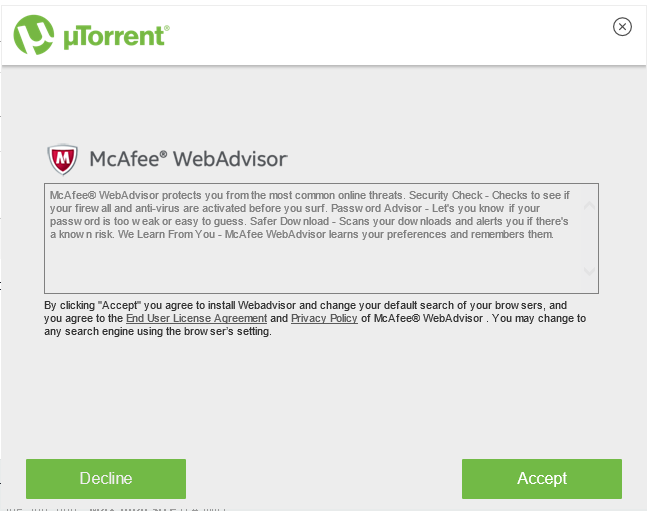
[edit]Common in software installers, misdirection presents the user with a button in the fashion of a typical continuation button. A dark pattern would show a prominent "I accept these terms" button asking the user to accept the terms of a program unrelated to the one they are trying to install.[20] Since the user typically will accept the terms by force of habit, the unrelated program can subsequently be installed. The installer's authors do this because the authors of the unrelated program pay for each installation that they procure. The alternative route in the installer, allowing the user to skip installing the unrelated program, is much less prominently displayed,[21] or seems counter-intuitive (such as declining the terms of service).
Confusing wording may be also used to trick users into formally accepting an option which they believe has the opposite meaning. For example a personal data processing consent button using a double-negative such as "don't not sell my personal information".[22]
Privacy Zuckering
[edit]"Privacy Zuckering" – named after Facebook co-founder and Meta Platforms CEO Mark Zuckerberg – is a practice that tricks users into sharing more information than they intended to.[23][24] Users may give up this information unknowingly or through practices that obscure or delay the option to opt out of sharing their private information.
California has approved regulations that limit this practice by businesses in the California Consumer Privacy Act.[25]
In AI model training
[edit]In mid-2024, Meta Platforms announced plans to utilize user data from Facebook and Instagram to train its AI technologies, including generative AI systems. This initiative included processing data from public and non-public posts, interactions, and even abandoned accounts. Users were given until June 26, 2024, to opt out of the data processing. However, critics noted that the process was fraught with obstacles, including misleading email notifications, redirects to login pages, and hidden opt-out forms that were difficult to locate. Even when users found the forms, they were required to provide a reason for opting out, despite Meta's policy stating that any reason would be accepted, raising questions about the necessity of this extra step.[26][27]
The European Center for Digital Rights (Noyb) responded to Meta's controversial practices by filing complaints in 11 EU countries. Noyb alleged that Meta's use of "dark patterns" undermined user consent, violating the General Data Protection Regulation (GDPR). These complaints emphasized that Meta's obstructive opt-out process included hidden forms, redirect mechanisms, and unnecessary requirements like providing reasons for opting out—tactics exemplifying "dark patterns," deliberately designed to dissuade users from opting out. Additionally, Meta admitted it could not guarantee that opted-out data would be fully excluded from its training datasets, raising further concerns about user privacy and data protection compliance.[28][29]
Amid mounting regulatory and public pressure, the Irish Data Protection Commission (DPC) intervened, leading Meta to pause its plans to process EU/EEA user data for AI training. This decision, while significant, did not result in a legally binding amendment to Meta's privacy policy, leaving questions about its long-term commitment to respecting EU data rights. Outside the EU, however, Meta proceeded with its privacy policy update as scheduled on June 26, 2024, prompting critics to warn about the broader implications of such practices globally.[30][31]
The incident underscored the pervasive issue of dark patterns in privacy settings and the challenges of holding large technology companies accountable for their data practices. Advocacy groups called for stronger regulatory frameworks to prevent deceptive tactics and ensure that users can exercise meaningful control over their personal information.[32]
Roach motel
[edit]A roach motel or a trammel net design provides an easy or straightforward path to get in but a difficult path to get out.[33] Examples include businesses that require subscribers to print and mail their opt-out or cancellation request.[9][10]
For example, during the 2020 United States presidential election, Donald Trump's WinRed campaign employed a similar dark pattern, pushing users towards committing to a recurring monthly donation.[34]
Research
[edit]In 2016 and 2017, research documented social media anti-privacy practices using dark patterns.[35][36] In 2018, the Norwegian Consumer Council (Forbrukerrådet) published "Deceived by Design," a report on deceptive user interface designs of Facebook, Google, and Microsoft.[37] A 2019 study investigated practices on 11,000 shopping web sites. It identified 1,818 dark patterns in total and grouped them into 15 categories.[38]
Research from April 2022 found that dark patterns are still commonly used in the marketplace, highlighting a need for further scrutiny of such practices by the public, researchers, and regulators.[39]
Under the European Union General Data Protection Regulation (GDPR), all companies must obtain unambiguous, freely-given consent from customers before they collect and use ("process") their personally identifiable information. A 2020 study found that "big tech" companies often used deceptive user interfaces in order to discourage their users from opting out.[40] In 2022, a report by the European Commission found that "97% of the most popular websites and apps used by EU consumers deployed at least one dark pattern."[41]
Research on advertising network documentation shows that information presented to mobile app developers on these platforms is focused on complying with legal regulations, and puts the responsibility for such decisions on the developer. Also, sample code and settings often have privacy-unfriendly defaults laced with dark patterns to nudge developers’ decisions towards privacy-unfriendly options such as sharing sensitive data to increase revenue.[42]
Legality
[edit]United States
[edit]Bait-and-switch is a form of fraud that violates US law.[43]
On 9 April 2019, US senators Deb Fischer and Mark Warner introduced the Deceptive Experiences To Online Users Reduction (DETOUR) Act, which would make it illegal for companies with more than 100 million monthly active users to use dark patterns when seeking consent to use their personal information.[44]
In March 2021, California adopted amendments to the California Consumer Privacy Act, which prohibits the use of deceptive user interfaces that have "the substantial effect of subverting or impairing a consumer's choice to opt-out."[22]
In October 2021, the Federal Trade Commission (FTC) issued an enforcement policy statement, announcing a crackdown on businesses using dark patterns that "trick or trap consumers into subscription services." As a result of rising numbers of complaints, the agency is responding by enforcing these consumer protection laws.[45]
In 2022, New York Attorney General Letitia James fined Fareportal $2.6 million for using deceptive marketing tactics to sell airline tickets and hotel rooms[46] and the Federal Court of Australia fined Expedia Group's Trivago A$44.7 million for misleading consumers into paying higher prices for hotel room bookings.[47]
In March 2023, the United States Federal Trade Commission fined Fortnite developer Epic Games $245 million for use of "dark patterns to trick users into making purchases." The $245 million will be used to refund affected customers and is the largest refund amount ever issued by the FTC in a gaming case.[48]
European Union
[edit]In the European Union, the GDPR requires that a user's informed consent to processing of their personal information be unambiguous, freely-given, and specific to each usage of personal information. This is intended to prevent attempts to have users unknowingly accept all data processing by default (which violates the regulation).[49][50][51][52][53][excessive citations]
According to the European Data Protection Board, the "principle of fair processing laid down in Article 5 (1) (a) GDPR serves as a starting point to assess whether a design pattern actually constitutes a 'dark pattern'."[54]
At the end of 2023 the final version of the Data Act[55] was adopted. It is one of the three EU legislations which deal expressly with dark patterns.[56] Another one being the Digital Services Act.[57] The third EU legislation on dark patterns in force is the directive financial services contracts concluded at a distance.[58] The Public German Consumer Protection Organisation claims Big Tech uses dark patterns to violate the Digital Services Act.[59]
United Kingdom
[edit]In April 2019, the UK Information Commissioner's Office (ICO) issued a proposed "age-appropriate design code" for the operations of social networking services when used by minors, which prohibits using "nudges" to draw users into options that have low privacy settings. This code would be enforceable under the Data Protection Act 2018.[60] It took effect 2 September 2020.[61][62]
See also
[edit]- Anti-pattern – Solution to a problem that may be commonly used but is generally a bad choice
- Confusopoly – Intentionally confusing marketing
- Gamification – Using game design elements in non-games
- Growth hacking – Subfield of marketing
- Jamba!
- Marketing ethics
- Opt-in email – System in which a user must opt into an emailing list to receive it
- Opt-out – Option avoid receiving unsolicited product or service information
- Revolving credit – Type of credit that does not have a fixed number of payments
- Shadow banning – Blocking a user from an online community without their awareness
- Surreptitious advertising – Stealth marketing
References
[edit]- ^ Campbell-Dollaghan, Kelsey (21 December 2016). "The Year Dark Patterns Won". CO.DESIGN. Retrieved 29 May 2017.
- ^ Singer, Natasha (14 May 2016). "When Websites Won't Take No For An Answer". The New York Times. Retrieved 29 May 2017.
- ^ Nield, David (4 April 2017). "Dark Patterns: The Ways Websites Trick Us Into Giving Up Our Privacy". Gizmodo. Retrieved 30 May 2017.
- ^ Brignull, Harry (1 November 2011). "Dark Patterns: Deception vs. Honesty in UI Design". A List Apart. Retrieved 29 May 2017.
- ^ Grauer, Yael (28 July 2016). "Dark Patterns Are Designed to Trick You, and They're All Over the Web". Ars Technica. Retrieved 29 May 2017.
- ^ Fussell, Sidney, The Endless, Invisible Persuasion Tactics of the Internet, The Atlantic, 2 August 2019
- ^ "Deceptive Patterns". www.deceptive.design. Retrieved 19 May 2024.
- ^ Release, Press (19 May 2021). "Coalition Launches 'Dark Patterns' Tip Line to Expose Deceptive Technology Design". Electronic Frontier Foundation. Archived from the original on 19 May 2021. Retrieved 27 May 2021.
- ^ a b Snyder, Jesse (10 September 2012). "Dark Patterns in UI and Website Design". evatotuts+. Archived from the original on 26 December 2022. Retrieved 29 May 2017.
- ^ a b c Brignull, Harry. "Types of Dark Patterns". Dark Patterns. Retrieved 29 May 2017.
- ^ "The TurboTax Trap". ProPublica. 4 May 2022. Retrieved 22 March 2025.
- ^ "FTC Sues Intuit for Its Deceptive TurboTax "free" Filing Campaign". Federal Trade Commission. 29 March 2022. Retrieved 22 March 2025.
- ^ "FTC sues Intuit to stop 'bait-and-switch' TurboTax ads". AP News. 29 March 2022. Retrieved 22 March 2025.
- ^ Dress, Brad (29 March 2022). "FTC sues Intuit over TurboTax 'free' filing ad campaign". The Hill. Archived from the original on 22 August 2023. Retrieved 22 March 2025.
- ^ "Intuit to pay $141M settlement over 'free' TurboTax ads". AP News. 4 May 2022. Retrieved 22 March 2025.
- ^ Valinsky, Jordan (9 May 2023). "TurboTax is sending checks to 4.4 million customers as part of a $141 million settlement | CNN Business". CNN. Retrieved 22 March 2025.
- ^ Kiel, Justin Elliott,Paul (23 January 2024). "FTC Orders Maker of TurboTax to Cease "Deceptive" Advertising". ProPublica. Retrieved 22 March 2025.
{{cite web}}: CS1 maint: multiple names: authors list (link) - ^ FreeFile. "IRS Free File Program delivered by TurboTax is no longer available". freefile.intuit.com. Retrieved 22 March 2025.
- ^ "UX Dark Patterns: Manipulinks and Confirmshaming". UX Booth. Retrieved 2 November 2019.
- ^ "Terms of service for McAffee in μTorrent installer". 2017. Retrieved 13 October 2018.
- ^ Brinkmann, Martin (17 July 2013). "SourceForge's new Installer bundles program downloads with adware". Retrieved 13 October 2018.
... The offer is displayed on the screen, and below that a gray decline button, a green accept button ...
- ^ a b Vincent, James (16 March 2021). "California bans 'dark patterns' that trick users into giving away their personal data". The Verge. Retrieved 21 March 2021.
- ^ "Privacy Zuckering - Dark Patterns". old.deceptive.design. Retrieved 23 July 2025.
- ^ "Chapter 20: Forced action – Deceptive Patterns". www.deceptive.design. Retrieved 23 July 2025.
- ^ "Attorney General Becerra Announces Approval of Additional Regulations That Empower Data Privacy Under the California Consumer Privacy Act". State of California - Department of Justice - Office of the Attorney General. 15 March 2021. Retrieved 13 December 2021.
- ^ Heikkilä, Melissa (14 June 2024). "How to opt out of Meta's AI training". MIT Technology Review. Archived from the original on 14 June 2024. Retrieved 31 December 2024.
- ^ Wrona, Aleksandra (13 June 2024). "Why Opting Out of Meta's Use of Facebook, Instagram Posts for AI Training Isn't Easy". Snopes. Retrieved 31 December 2024.
- ^ "noyb urges 11 DPAs to immediately stop Meta's abuse of personal data for AI". noyb.eu. Retrieved 31 December 2024.
- ^ "DataGuidance". DataGuidance. Retrieved 31 December 2024.
- ^ "(Preliminary) noyb WIN: Meta stops AI plans in the EU". noyb.eu. Retrieved 31 December 2024.
- ^ STAHIE, Silviu. "Meta Forced to Pause AI Training on Data Collected from Facebook and Instagram Users in Europe". Hot for Security. Retrieved 31 December 2024.
- ^ Sawers, Paul (3 October 2024). "Hey, UK! Here's how to 'opt out' of Meta using your Facebook and Instagram data to train its AI". TechCrunch. Retrieved 31 December 2024.
- ^ Brignull, Harry (29 August 2013). "Dark patterns: Inside the interfaces designed to trick you". The Verge. Retrieved 29 May 2017.
- ^ Goldmacher, Shane (3 April 2021). "How Trump Steered Supporters Into Unwitting Donations". The New York Times. Archived from the original on 1 May 2021.
- ^ Bösch, Christoph; Erb, Benjamin; Kargl, Frank; Kopp, Henning; Pfattheicher, Stefan (1 October 2016). "Tales from the Dark Side: Privacy Dark Strategies and Privacy Dark Patterns". Proceedings on Privacy Enhancing Technologies. 2016 (4): 237–254. doi:10.1515/popets-2016-0038. ISSN 2299-0984.
- ^ Fritsch, Lothar (2017). Privacy dark patterns in identity management. Gesellschaft für Informatik, Bonn. ISBN 978-3-88579-671-8.
- ^ Moen, Gro Mette, Ailo Krogh Ravna, and Finn Myrstad: Deceived by Design - How tech companies use dark patterns to discourage us from exercising our rights to privacy. Archived 11 October 2020 at the Wayback Machine, 2018, Consumer council of Norway / Forbrukerrådet. Report.
- ^ Mathur, Arunesh; Acar, Gunes; Friedman, Michael J.; Lucherini, Elena; Mayer, Jonathan; Chetty, Marshini; Narayanan, Arvind (November 2019). "Dark Patterns at Scale: Findings from a Crawl of 11K Shopping Websites". Proceedings of the ACM on Human-Computer Interaction. 3 (CSCW): 81:1–81:32. arXiv:1907.07032. Bibcode:2019arXiv190707032M. doi:10.1145/3359183. ISSN 2573-0142. S2CID 196831872.
- ^ Runge, Julian; Wentzel, Daniel; Huh, Ji Young; Chaney, Allison (14 April 2022). ""Dark patterns" in online services: a motivating study and agenda for future research". Marketing Letters. 34: 155–160. doi:10.1007/s11002-022-09629-4. hdl:10419/310008. ISSN 1573-059X. S2CID 248198573.
- ^ Human, Soheil; Cech, Florian (2021). "A Human-Centric Perspective on Digital Consenting: The Case of GAFAM" (PDF). In Zimmermann, Alfred; Howlett, Robert J.; Jain, Lakhmi C. (eds.). Human Centred Intelligent Systems. Smart Innovation, Systems and Technologies. Vol. 189. Singapore: Springer. pp. 139–159. doi:10.1007/978-981-15-5784-2_12. ISBN 978-981-15-5784-2. S2CID 214699040.
- ^ European Commission. Directorate General for Justice and Consumers (2022). Behavioural study on unfair commercial practices in the digital environment: dark patterns and manipulative personalisation : final report. LU: Publications Office. doi:10.2838/859030. ISBN 9789276523161.
- ^ Tahaei, Mohammad; Vaniea, Kami (8 May 2021). "Developers Are Responsible": What Ad Networks Tell Developers About Privacy (PDF). pp. 1–11. doi:10.1145/3411763.3451805. hdl:20.500.11820/4b6bc799-2bed-423f-b9d4-6c8bb37c2418. ISBN 978-1-4503-8095-9. S2CID 233987185.
- ^ Title 16 of the Code of Federal Regulations § 238
- ^ Kelly, Makena (9 April 2019). "Big Tech's 'dark patterns' could be outlawed under new Senate bill". The Verge. Retrieved 10 April 2019.
- ^ "FTC to Ramp up Enforcement against Illegal Dark Patterns that Trick or Trap Consumers into Subscriptions". Federal Trade Commission. 28 October 2021. Retrieved 13 December 2021.
- ^ "Assurance of discontinuance" (PDF). March 2022.
- ^ "Australia fines Expedia Group's Trivago $33 million on misleading hotel room rates". au.finance.yahoo.com. 22 April 2022. Retrieved 14 June 2022.
- ^ "Fortnite Video Game Maker Epic Games to Pay More Than Half a Billion Dollars over FTC Allegations of Privacy Violations and Unwanted Charges". March 2023.
- ^ "Understanding 'trust' and 'consent' are the real keys to embracing GDPR". The Drum. Retrieved 10 April 2019.
- ^ "Facebook and Google hit with $8.8 billion in lawsuits on day one of GDPR". The Verge. Archived from the original on 25 May 2018. Retrieved 26 May 2018.
- ^ "Max Schrems files first cases under GDPR against Facebook and Google". The Irish Times. Archived from the original on 25 May 2018. Retrieved 26 May 2018.
- ^ "Facebook, Google face first GDPR complaints over 'forced consent'". TechCrunch. 25 May 2018. Archived from the original on 26 May 2018. Retrieved 26 May 2018.
- ^ Meyer, David. "Google, Facebook hit with serious GDPR complaints: Others will be soon". ZDNet. Archived from the original on 28 May 2018. Retrieved 26 May 2018.
- ^ "Guidelines 3/2022 on Dark patterns in social media platform interfaces: How to recognise and avoid them" (PDF). European Data Protection Board.
- ^ Regulation (EU) 2023/2854 of the European Parliament and of the Council of 13 December 2023 on harmonised rules on fair access to and use of data and amending Regulation (EU) 2017/2394 and Directive (EU) 2020/1828 (Data Act), 13 December 2023, retrieved 10 January 2024
- ^ Pál, Szilágyi (3 December 2023). "Consensus on the Data Act at the Council". Dark patterns, neuromarketing. Retrieved 10 January 2024.
- ^ Regulation (EU) 2022/2065 of the European Parliament and of the Council of 19 October 2022 on a Single Market For Digital Services and amending Directive 2000/31/EC (Digital Services Act). OJ L 277, 27.10.2022, p. 1–102.
- ^ Pál, Szilágyi (11 January 2024). "Dark patterns everywhere: ESMA". Dark patterns, neuromarketing. Retrieved 11 January 2024.
- ^ "Combining data and bundling services under the digital markets act" (PDF). Bundesverband der Verbraucherzentralen und Verbraucherverbände. 16 July 2024. Retrieved 8 August 2024.
- ^ "Under-18s face 'like' and 'streaks' limits". BBC News. 15 April 2019. Retrieved 15 April 2019.
- ^ Lomas, Natasha (22 January 2020). "UK watchdog sets out 'age appropriate' design code for online services to keep kids' privacy safe". TechCrunch. Retrieved 9 April 2023.
- ^ Lomas, Natasha (1 September 2021). "UK now expects compliance with children's privacy design code". TechCrunch. Retrieved 9 April 2023.
External links
[edit]- Deceptive Design (formerly darkpatterns.org)
- Tip line to report dark patterns to the Electronic Frontier Foundation and Consumer Reports
- Dark patterns at the UX Pedagogy and Practice Lab at Purdue University
Dark pattern
View on GrokipediaDefinition and Historical Development
Origins and Coining of the Term
The term "dark patterns" was coined in 2010 by Harry Brignull, a British user experience consultant with a PhD in cognitive science, to describe user interface designs intentionally crafted to manipulate users into making decisions against their interests, such as unintended purchases or data sharing.[2][3] Brignull introduced the concept via his website darkpatterns.org (later rebranded as deceptive.design), where he cataloged examples drawn from real-world websites and apps, framing the term as a deliberate contrast to benign "design patterns" in software engineering.[13] Brignull developed the idea from observing recurring deceptive tactics in digital interfaces during the early 2010s, motivated by ethical concerns over how companies exploited cognitive vulnerabilities for commercial gain; he initially presented it in conference talks to highlight these practices without initially anticipating widespread adoption.[14] The term's origins trace to broader critiques of interface deception predating 2010, such as early e-commerce tricks like hidden fees or disguised opt-outs, but Brignull's nomenclature provided the first systematic label, emphasizing intent over mere poor design.[2] By mid-decade, the phrase had entered academic and regulatory discourse, with Brignull's repository serving as a primary reference for researchers analyzing manipulative UX; however, some critiques note that not all cited examples unequivocally prove designer malice, as user confusion can arise from incompetence rather than deception.[15][13]Early Examples and Evolution
The manipulative design techniques now termed dark patterns have roots in longstanding retail practices, such as bait-and-switch tactics and hidden fees, which transitioned to digital interfaces in the 1990s as e-commerce emerged. Early web shopping carts, for example, frequently employed pre-selected checkboxes for ancillary products like extended warranties or mailing lists, exploiting user inertia to boost ancillary sales without explicit consent; these were commonplace by the early 2000s on platforms like early Amazon and eBay implementations.[16][17] The term "dark patterns" was formally coined in 2010 by British UX specialist Harry Brignull, who drew inspiration from "white hat" ethical design patterns to highlight their unethical counterparts. Brignull launched darkpatterns.org (later rebranded deceptive.design) as a "Hall of Shame" cataloging real-world instances, defining them as user interface tricks that induce unintended actions, such as unintended purchases or data sharing.[2][4][1] Initial entries included "roach motels," where subscriptions were easy to initiate but arduous to cancel—patterns observed in early 2000s software trials and services like Worldpay's merchant tools—and "sneak into basket," adding extraneous items during checkout, as seen in contemporaneous e-commerce flows.[18] Post-2010, awareness evolved through academic scrutiny and regulatory interest, with Brignull's typology expanding to over a dozen categories by 2012, influencing UX discourse. This period saw proliferation alongside growth hacking trends, such as opaque auto-renewals in SaaS models (e.g., early Dropbox-like referrals morphing into stickier commitments), driven by A/B testing that prioritized conversion over transparency. By the mid-2010s, interdisciplinary studies linked these to cognitive exploitation, spurring FTC workshops in 2019 and EU proposals for bans, marking a shift from anecdotal documentation to formalized critique amid rising privacy concerns.[17][19][20]Psychological and Design Mechanisms
Exploited Cognitive Biases
Dark patterns leverage cognitive biases—systematic deviations from rational judgment documented in behavioral economics—to steer users toward outcomes favoring designers, often at the expense of informed consent or optimal decisions. These manipulations are rooted in empirical findings from psychology, where biases arise from heuristics that economize mental effort but introduce predictability exploitable in interface design. Studies mapping dark patterns to biases emphasize that such designs amplify non-reflective responses, reducing user agency without altering underlying preferences.[21][22] The default bias, also termed status quo bias, is prominently exploited by pre-selecting unfavorable options, as individuals exhibit strong inertia toward maintaining the presented status, perceiving defaults as recommendations or normative. In subscription interfaces, opt-in checkboxes for premium add-ons or data sharing are enabled by default, leading to higher acceptance rates; experimental evidence shows opt-out rates drop significantly when defaults favor retention, with users 2-4 times more likely to accept pre-checked terms than to actively select them.[5][21] This bias underpins "roach motel" patterns, where entering commitments is seamless but exiting requires disproportionate effort, as inertia discourages navigation of buried cancellation paths.[23] Anchoring bias influences perception through initial reference points, causing subsequent judgments to insufficiently adjust from them; dark patterns deploy this in pricing by displaying inflated original costs adjacent to discounted offers, skewing value assessments upward. Research on e-commerce interfaces reveals that anchoring via crossed-out high prices increases perceived savings and purchase likelihood by up to 20-30%, even when the anchor lacks relevance, as users anchor on the first numeral encountered.[21][24] Loss aversion, where losses loom larger than equivalent gains (typically weighted 2:1 in prospect theory), drives urgency tactics like countdown timers or "limited stock" warnings, framing inaction as forfeiture. Empirical tests of scarcity notifications show conversion rates rising 10-15% due to heightened aversion to missing out, though actual scarcity is often fabricated, exploiting the bias without genuine constraint.[23][5] Hyperbolic discounting further aids patterns involving deferred costs, as users undervalue future burdens relative to immediate gratifications; privacy disclosures buried in fine print succeed because short-term convenience trumps long-term data risks, with studies indicating disclosure rates increase when immediate opt-ins bypass deliberation on downstream harms.[24] Framing effects compound this by presenting choices in loss-oriented language (e.g., "Don't lose your progress" to block exits), altering decisions without changing facts, as evidenced in A/B tests where reframed unsubscribes reduced cancellations by 15%.[25][22] Overchoice, or choice overload, manifests when excessive options paralyze decision-making, defaulting users to passive acceptance; dark patterns overwhelm with variant plans or consents, reducing opt-out efficacy, as lab simulations confirm error rates and satisficing behaviors surge beyond 6-9 alternatives.[24] These biases interact synergistically—for instance, defaults anchored in scarcity frames—amplifying manipulation, though vulnerability varies by demographics like age or cognitive load, with older users showing heightened susceptibility in vulnerability analyses.[21][23]Technical Implementation Strategies
Dark patterns leverage conventional web development technologies—primarily HTML for structure, CSS for styling, and JavaScript for interactivity—to subtly distort user interfaces and guide decisions toward undesired outcomes. These implementations exploit the flexibility of client-side rendering to prioritize service goals over user intent, often evading immediate detection by regulators or users. For example, visual misdirection techniques use CSS properties like low opacity, reduced font sizes, or inadequate color contrast ratios to de-emphasize opt-out or cancellation options, making them harder to perceive or interact with compared to primary actions.[26][27] Dynamic manipulation is frequently achieved through JavaScript, enabling runtime alterations to the DOM that simulate urgency or restrict choices. Countdown timers, a common tactic in e-commerce to pressure purchases, are implemented via periodic DOM updates monitored by libraries like Mutation Summary, which track changes to elements such as text nodes displaying time-sensitive prompts.[26] Similarly, interruptive modals can be triggered withsetTimeout functions to appear after a delay, disrupting user navigation and funneling attention toward affirmative actions like subscriptions. Event listeners, such as oncopy for copy-paste traps, redirect users or inject ads upon innocuous interactions, overriding expected behaviors.[28]
Form-based deceptions rely on HTML attributes combined with scripting for defaults that favor the platform. Pre-checked checkboxes for consents or subscriptions are set using the checked attribute on <input type="checkbox"> elements or via JavaScript's element.checked = true, requiring users to actively deselect rather than opt in, which contravenes principles of granular consent in regulations like GDPR.[29] Hidden fees or terms are obscured through CSS minification of text (e.g., font-size: 0.7em;) or JavaScript-driven progressive disclosure, where additional costs load only after initial engagement, exploiting users' commitment consistency.[30]
Page segmentation and layout tricks further embed dark patterns by structuring HTML into hierarchical elements (e.g., nested <div> or <section> tags) that CSS positions to bury negative options amid positive ones, such as placing unsubscribe links in footers with low visibility thresholds (e.g., elements smaller than 1 pixel filtered out in rendering but present for compliance claims).[26] These strategies are scalable across web and mobile modalities, with JavaScript frameworks like React enabling reusable components that propagate deceptive flows, though detection tools increasingly parse such patterns via computer vision on screenshots or NLP on rendered text.[27] Overall, the technical simplicity of these methods—relying on core web standards rather than bespoke exploits—facilitates widespread adoption while complicating automated scrutiny.[31]