Recent from talks
Nothing was collected or created yet.
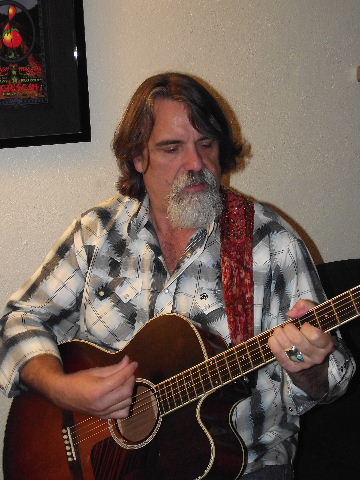
Darrell Scott
View on Wikipedia
Key Information
James Darrell Scott (born August 6, 1959)[1] is an American singer-songwriter, multi-instrumentalist, and producer. He has written several mainstream country hits, and is well-established as one of Nashville's premier session instrumentalists.
Biography
[edit]Early life and career
[edit]Scott was born in London, Kentucky, and at an early age his family moved to East Gary, Indiana, where his father Wayne worked in a steel mill. Scott's father was also a musician and songwriter who encouraged Darrell and his brothers Denny, Dale, Don, and David to play instruments in the family band at schools and church events.[2] In 1971 the Scott family moved to San Bernardino, California and started a business erecting chain-link fencing and playing California honky-tonks as Wayne Scott and Harlan County. At age 16 Darrell completed high school via the California equivalency exam and left the family band in favor of playing professionally in dance bands and country music groups, eventually playing five nights a week as a member of a house band at a San Bernardino bar called the Brandin' Iron.[3]
In 1980 he began traveling north from gig to gig while living in a van, eventually ending up in Stratford, Ontario, where he performed as a one-man band before auditioning and being hired to play with the Mercey Brothers. Scott wrote two songs that were included on a Mercey Brothers album, with one being released as a single, and Scott signed a music publishing deal, but didn't like writing the style of songs he was playing with the Mercey Brothers. In 1983, with a renewed interest in pursuing a college education, Scott moved to Bedford, Massachusetts and attended Middlesex Community College for two years before enrolling at Tufts University. Scott saw a volume of poetry by Tufts artist-in-residence Philip Levine and was inspired to enroll in classes taught by Levine. With Levine's guidance, Scott wrote the song "Uncle Lloyd". Having found his writer's voice, Scott had soon produced a demo tape that made its way to Charles Koppelman of SBK records and, eventually, a record contract. Scott recorded an album of 12 songs in Memphis with producer Norbert Putnam but the label, not hearing any obvious hit singles on the record, chose not to release it, which also prohibited Scott from recording any of the songs on the album for the next seven years.[3]
Move to Nashville and breakthrough
[edit]
In 1992 Scott moved to Nashville, Tennessee, where he began working as a session musician, landing work with Guy Clark the following year. More session work followed, as well as a new publishing contract. He self-produced another album, Aloha from Nashville (1996), which was picked up for distribution by Sugar Hill Records. The same year, Suzy Bogguss' recording of the Scott-penned song "No Way Out" made it onto the country singles chart.[4] The following year, Garth Brooks' version of "When There's No One Around", co-written by Scott and Tim O'Brien, was included on Brooks' #1 album Sevens.[2]
In 1999 Scott released his second album, Family Tree. He collaborated with O'Brien to release their first album as a duo, Real Time (2000),[5] and the song "The Second Mouse" from that album being nominated for the 2001 Grammy Award for Best Country Instrumental Performance.[6]
In 2000, Sara Evans had a hit with "Born to Fly", co-written with Scott.[2] Meanwhile, more of Scott's songs were being recorded by other artists. The Dixie Chicks recorded Scott's song "Heartbreak Town" for inclusion on their 1999 album Fly, and released the song as the album's 7th single in June 2001.[2] Travis Tritt's version of "It's a Great Day to Be Alive", released in December 2000, achieved a new level of commercial success for one of Scott's songs, reaching number 2 on the Billboard Hot Country Songs chart and at number 33 on the Billboard Hot 100 chart.[7] Patty Loveless recorded "You'll Never Leave Harlan Alive" for her 2001 album Mountain Soul, featuring Scott playing banjo. Loveless' rendition was nominated for the 2002 International Bluegrass Music Awards Song of the Year.[8] The song has subsequently been covered by Brad Paisley, Kathy Mattea, Montgomery Gentry and others. The Dixie Chicks recorded another of Scott's songs, "Long Time Gone". Released as the lead single from their 2002 album Home, the Dixie Chicks' version reached a peak of number 2 on the Billboard Hot Country Songs chart and number 7 on the Billboard Hot 100 chart,[9] and won a Grammy Award for Best Country Vocal Performance by a Duo or Group.[10]
In 2001, Scott was named Songwriter of the Year by the Nashville Songwriters Association International, and received the same honor from ASCAP the following year.[4] In 2003 he launched his own label, Full Light Records, and revisited and re-recorded the songs from his unreleased debut album, releasing them as Theatre of the Unheard. In early 2005, the album won the 4th Annual Independent Music Awards Album of the Year.[11] That same year, Scott produced his father Wayne's debut album, This Weary Way, featuring Darrell's longtime collaborators O'Brien, Dan Dugmore, Casey Driessen, Suzi Ragsdale, and Verlon Thompson, as well as a duet with Guy Clark.[2]
In 2006 he released The Invisible Man,[12] with the song "Hank Williams' Ghost" from that album awarded the 2007 Song of the Year by the Americana Music Association.[13] In 2008, he released Modern Hymns, an album of twelve of Scott's favorite songs by twelve favorite songwriters recorded live with engineer Gary Paczosa in Blackbird Studio C.[12]

Scott has collaborated with Steve Earle, Sam Bush, Emmylou Harris, John Cowan, Kate Rusby, Jimmie Dale Gilmore, Mary Gauthier, Dan Tyminski, and many others. He tours regularly with his own band and as a member of Steve Earle's Bluegrass Dukes.[4] In 2010, Scott was announced as part of the Band of Joy, performing alongside Robert Plant, credited with vocals, mandolin, guitar, accordion, pedal, lap steel and banjo.
His album, Crooked Road, was released May 25, 2010.[14] In January 2011 Crooked Road won the award for the Country Album category from The 10th Annual Independent Music Awards.[15][3]
In 2010, Brad Paisley's cover of "You'll Never Leave Harlan Alive" was played during the final scene of the season one finale of the TV drama Justified, and different versions of the song were used for the second, fourth, and fifth-season finales,[16][17] with the original recording by Darrell Scott himself used for the series finale.[18]
On November 2, 2016, at the 50th Annual Country Music Association Awards, Beyoncé performed a remix of her song "Daddy Lessons" together with the Dixie Chicks, including excerpts from their version of Scott's song "Long Time Gone". A studio version was released after the performance.[19]
In August 2023, the Darrell Scott String Band, a group consisting of Scott and longtime fellow musicians Matt Flinner, Bryn Davies, Shad Cobb, John Cowan, and Daniel de los Reyes, released Old Cane Back Rocker, a studio string band music album of original and cover songs.[20][21] He produced Steep Canyon Rangers' album Morning Shift (2023), and Willi Carlisle's Critterland (2024).[22]
On September 10, 2025, Scott was presented with the Lifetime Achievement Award at the 2025 Americana Music Honors & Awards.[23][24]
Songs by Darrell Scott covered by other musicians
[edit]- "It's a Great Day to Be Alive" – Travis Tritt, Cory Morrow[2]
- "You'll Never Leave Harlan Alive" – Montgomery Gentry, Brad Paisley, Patty Loveless,[2] Kathy Mattea, Murder By Death (band), Red Molly, Dave Alvin, Ruby Friedman Orchestra, Maxida Märak, Jonah Michea Judy, and Downhill Bluegrass Band[25]
- "Long Time Gone" – The Chicks[4]
- "We've Got Nothing But Love to Prove" – Faith Hill[2]
- "Proving You Wrong" – Keb' Mo'
- "Out In The Parking Lot" – Guy Clark, Brad Paisley with Alan Jackson[2]
- "River Take Me" – Montgomery Gentry, Sam Bush
- "Heartbreak Town" – The Chicks[2]
- "Head South" – Robinella
- "Family Tree" – Darryl Worley[2]
- "With A Memory Like Mine" – John Cowan, Mountain Heart
- "Love's Not Through With Me Yet" – Johnsmith
- "Daddy Lessons" – Beyoncé (remix with The Chicks sampled Long Time Gone)
- "It's Another Day" - Tim O'Brien on Traveler
- "Uncle Lloyd" - The Steel Woods
- "Old Town New" - Tim McGraw
Singles composed with others
[edit]Discography
[edit]| Year | Title | Label | Peak chart positions | |||
|---|---|---|---|---|---|---|
| US Country [26] |
US Heat [27] |
US Folk [28] |
US Grass [29] | |||
| 1997 | Aloha From Nashville | JustUs | — | — | — | — |
| 1999 | Family Tree | Sugar Hill | — | — | — | — |
| 2000 | Real Time (with Tim O'Brien) | Full Light | — | — | — | — |
| 2003 | Theatre of the Unheard | — | — | — | — | |
| 2004 | Live in NC (with Danny Thompson and Kenny Malone) | — | — | — | — | |
| 2006 | The Invisible Man | — | — | — | — | |
| 2008 | Modern Hymns | Appleseed | — | — | — | — |
| 2010 | A Crooked Road | Full Light | — | 32 | 13 | — |
| 2012 | Long Ride Home | 55 | 22 | 14 | — | |
| Live: We're Usually a Lot Better Than This (with Tim O'Brien) |
64 | 35 | — | 3 | ||
| 2013 | Memories and Moments (with Tim O'Brien) | Full Skies | 36 | 9 | 13 | 2 |
| 2015 | Ten: Songs of Ben Bullington | Full Light | — | — | — | — |
| 2016 | Couchville Sessions | 41 | 24 | 21 | — | |
| 2020 | Sings the Blues of Hank Williams[30] | — | — | — | — | |
| 2023 | Old Cane Back Rocker (as Darrell Scott String Band)[31] | — | — | — | — | |
| "—" denotes releases that did not chart | ||||||
Awards
[edit]References
[edit]- ^ "Darrell Scott | Music Biography, Credits and Discography". AllMusic. August 6, 1959. Retrieved July 16, 2014.
- ^ a b c d e f g h i j k Oermann, Robert K. (November 28, 2011). "Singer-Songwriter Wayne Scott Passes". Music Row. Retrieved November 29, 2024.
- ^ a b c Howard, Hugh (August 9, 2011). "Crooked Road to Nashville". Tufts Now. Retrieved November 29, 2024.
- ^ a b c d "Artists: Darrell Scott". The Kennedy Center. Retrieved November 29, 2024.
- ^ "Tim O'Brien & Darrell Scott On Mountain Stage". NPR. December 9, 2013. Retrieved December 2, 2024.
- ^ "43rd Annual Grammy Awards Nominations". DigitalHub. Retrieved January 26, 2021.
- ^ Nolan, Kathleen (February 21, 2022). "Behind the Song Lyrics: "It's a Great Day to Be Alive," Travis Tritt". American Songwriter. Retrieved November 29, 2024.
- ^ "Krauss tops Bluegrass award nominees". The Index-Journal. August 16, 2002. pp. 3C. Retrieved November 10, 2022.
- ^ Whitburn, Joel (2004). The Billboard Book Of Top 40 Country Hits: 1944-2006, Second edition. Record Research. p. 108.
- ^ "Search results for Dixie Chicks". Grammy.com. Retrieved July 8, 2022.
- ^ [1] Archived July 2, 2009, at the Wayback Machine
- ^ a b "Scott's 'Modern' Remedy". Mix. October 1, 2008. Retrieved November 18, 2024.
- ^ "Griffin wins big at Americana awards". The Worcester Telegram & Gazette. Retrieved September 29, 2022.
- ^ "A Crooked Road – Darrell Scott | Songs, Reviews, Credits, Awards". AllMusic. May 25, 2010. Retrieved July 16, 2014.
- ^ "Darrell Scott". Independentmusicawards.com. Retrieved July 16, 2014.
- ^ "Justified Season 4 Finale, Episode 13 Ghosts". Ace Weekly. April 3, 2013. Retrieved July 16, 2014.
- ^ Sepinwall, Alan (April 8, 2014). "Season finale review: Justified – Restitution: Daddys home?". Hitfix.com. Retrieved July 16, 2014.
- ^ Bianculli, David (April 15, 2015). "'Justified' Ends With An Unpredictable, Poetic And Memorable Finale". Npr.org. Retrieved April 16, 2018.
- ^ "Beyoncé made country magic with the Dixie Chicks on 'Daddy Lessons'". USA Today. Retrieved November 3, 2016.
- ^ Hollabaugh, Lorie (July 28, 2023). "Darrell Scott Reflects On His Roots On Latest Project, 'Old Cane Back Rocker'". Music Row. Retrieved November 29, 2024.
- ^ Zimmerman, Lee (August 24, 2023). "Darrell Scott talks bluegrass and Old Cane Back Rocker". Bluegrass Today. Retrieved November 29, 2024.
- ^ Himes, Geoffrey (September 20, 2023). "Darrell Scott and the Ghost of Hank Williams". Paste Magazine. Retrieved December 4, 2024.
- ^ Grein, Paul (September 9, 2025). "Sierra Ferrell, Billy Strings & More Nominated for 2025 Americana Honors & Awards: Full List". Billboard.
- ^ Hollabaugh, Lorie (September 5, 2025). "Americana Music Association Reveals 2025 Lifetime Achievement Honorees". MusicRow.
- ^ Maxida Märak. "Maxida Märak". Downhillbluegrassband.com. Retrieved April 23, 2020.
- ^ "Darrell Scott Album & Song Chart History – Country Albums". Billboard. Prometheus Global Media. Retrieved February 9, 2012.
- ^ "Darrell Scott Album & Song Chart History – Heatseekers Albums". Billboard. Prometheus Global Media. Retrieved February 9, 2012.
- ^ "Darrell Scott Album & Song Chart History – Folk Albums". Billboard. Prometheus Global Media. Retrieved February 9, 2012.
- ^ "Bluegrass Albums Week of October 27, 2012". Billboard. Prometheus Global Media. Retrieved October 18, 2012.
- ^ Horowitz, Hal (April 21, 2020). "Darrell Scott Offers Bluesy Tribute to Hank Williams On New Album". American Songwriter. Retrieved May 24, 2020.
- ^ "First & Latest: Darrell Scott And His "Hit" Songs, Then And Now". The Bluegrass Situation. September 27, 2023. Retrieved November 29, 2024.
External links
[edit]- Official Website
- Darrell Scott at AllMusic
- Darrell Scott discography at Discogs
- "Wayne and Darrell Scott: Father-Son Country", Fresh Air from WHYY-FM, July 3, 2006
- WoodSongs Old-Time Radio Hour, Archive, see episodes #103, #109, #326, #584
Darrell Scott
View on GrokipediaBiography
Early life and family
Darrell Scott was born James Darrell Scott on August 6, 1959, in London, Kentucky, to Wayne Scott, a country musician and songwriter, and his wife Evelyn.[4][8] As the fourth of five sons, Scott grew up in a deeply musical family; his brothers were Denny, who played guitar; Dale, on drums; Don, on bass; and the youngest, David, on piano.[4] The family initially moved to Michigan for work opportunities before returning briefly to Kentucky for Scott's birth, after which they relocated to northern Indiana, where they lived for nine years.[4] The family's peripatetic lifestyle continued due to Wayne's pursuits, with brief stints in Kentucky and Tennessee before settling in Bloomington, California, where Scott spent his junior high and high school years.[4] When Scott was eight years old, his parents divorced, leading to a second separation after a brief remarriage two years later; he and his three older brothers were raised primarily by their father, while David stayed with Evelyn.[4] This upheaval profoundly shaped Scott's early worldview, as he later reflected on understanding "that country music was telling the story of hillbilly families" amid such personal changes.[4] Music permeated the Scott household from an early age, with Wayne—a steel mill worker by trade but a performer at heart—instilling a love for classic country sounds in his sons.[4] By age four, Scott was captivated by guitars, influenced alongside brother Denny by their father's renditions of artists like Hank Williams, Johnny Cash, and Lefty Frizzell.[4] The brothers all pursued music professionally, and the family formed the band Wayne Scott and Harlan County, with young Scott playing bass, fostering his foundational exposure to performance and songcraft.[4]Education and early career
After attending Middlesex Community College for two years, Scott enrolled at Tufts University in Medford, Massachusetts, as part of the Resumed Education for Adult Learners (REAL) program at age 24.[2] There, he majored in English, focusing on literature and poetry, and took classes under poet Philip Levine, whose emphasis on drawing from personal history profoundly influenced his emerging songwriting.[2] Inspired by Levine's guidance to write about his own experiences with steel mills and chain-link fences from his childhood, Scott composed his first notable song, "Uncle Lloyd," a piece about a family friend who lived alone and symbolized unfulfilled familial bonds.[2] Scott graduated with a degree in English literature in 1988. Following graduation, he pursued music full-time, opting against further academic pursuits such as an M.F.A. in writing.[2] His family's musical background, rooted in playing with his father Wayne Scott's bar band from a young age, provided the foundation for his early professional endeavors.[4] In California, Scott began performing professionally at 16 after leaving high school via equivalency exam, joining local country and dance bands as a multi-instrumentalist, including a stint as the house band bassist at the Brandin' Iron in San Bernardino.[2] At 20, he married and moved to Canada, where he joined the Mercey Brothers, contributing to recordings of two songs that received some airplay but marked no major breakthrough.[2] Back in the United States, particularly in the Northeast during and after his Tufts years, he engaged in session work and local band performances, honing his skills on bass, guitar, mandolin, and dobro while extending the family band's bluegrass and country influences into these gigs, though without significant original recordings.[4] Throughout this period, Scott showed initial reluctance to perform his own songs publicly, preferring instrumental roles to support other artists rather than showcase his compositions, a approach shaped by observing audience resistance to originals in his father's sets.[4] This focus allowed him to build technical proficiency and session experience across regions, setting the stage for his later development as a songwriter without venturing into major spotlights.[2]Move to Nashville and breakthrough
In 1992, Darrell Scott relocated to Nashville, Tennessee, following the shelving of his debut album by SBK Records, on the advice of a friend who encouraged him to pursue opportunities in the city's vibrant music scene.[9] Upon arrival, he quickly established himself as a sought-after session musician, contributing his skills on guitar, banjo, and mandolin to recordings and tours by prominent artists in the bluegrass and country genres.[9] Notable early collaborations included touring with Sam Bush, a key figure in newgrass music, and working extensively with Tim O'Brien, with whom he co-wrote material and appeared on albums blending folk, bluegrass, and country elements.[10] These roles immersed Scott in Nashville's professional ecosystem, providing steady work and connections within the industry.[1] Scott's breakthrough as a songwriter came in the mid-1990s, as his compositions began attracting attention from major country artists. His first major cut was "No Way Out," co-written with Marcus Hummon and recorded by Suzy Bogguss on her 1996 album Give Me Some Wheels, marking his entry into the Nashville songwriting establishment.[11] The following year, "When There's No One Around," another collaboration with Tim O'Brien, appeared on Garth Brooks' blockbuster album Sevens, which sold millions and solidified Scott's reputation for crafting introspective, heartfelt narratives.[9] By 2000, "Born to Fly," co-written with Sara Evans and Hummon, became a No. 1 country hit from Evans' album of the same name, further cementing his status and leading to a stream of consistent publishing deals and cuts.[12] These successes highlighted Scott's ability to blend Americana roots with commercial appeal, earning him recognition among Nashville's top songwriters by the decade's end.[1] During this period, Scott began transitioning from behind-the-scenes contributions to more prominent front-stage presence, with initial solo performances emerging alongside his session and writing commitments. His signing with Sugar Hill Records in 1997 led to the release of his debut solo album Aloha from Nashville that year, which featured original material and showcased his multi-instrumental talents in live settings around the city.[13] These early outings marked a pivotal shift, allowing Scott to build a personal audience while maintaining his role in Nashville's collaborative music community.[14]Songwriting
Songs covered by other artists
Darrell Scott's songwriting has garnered significant recognition through covers by prominent country artists, particularly following his relocation to Nashville in the mid-1990s, where his compositions found broader commercial success.[2] One of Scott's most impactful songs, "Long Time Gone," co-written with Tim O'Brien and first recorded by them in 2000, was popularized by the Dixie Chicks on their 2002 album Home. The track, a critique of the Nashville music industry's commercialization, peaked at No. 2 on the Billboard Hot Country Songs chart and No. 7 on the Billboard Hot 100, helping propel Home to multi-platinum status.[15][16] "It's a Great Day to Be Alive," a solo composition from Scott's 1997 album Aloha from Nashville, achieved widespread acclaim via Travis Tritt's 2000 cover on Down the Road I Go. The optimistic anthem about resilience amid personal struggles reached No. 2 on the Billboard Hot Country Songs chart and No. 33 on the Hot 100, becoming a staple in country radio playlists.[17] "You'll Never Leave Harlan Alive," another solo Scott original from Aloha from Nashville, draws on Appalachian coal-mining heritage and was first notably covered by Patty Loveless on her 2001 album Mountain Soul. The haunting ballad, evoking the hardships of Kentucky's Harlan County, later appeared on Brad Paisley's 2001 album Part II, further cementing its status as a modern folk-country standard performed at events like the 2022 CMA Awards.[18][19] The Dixie Chicks also recorded Scott's "Heartbreak Town" on their 1999 album Fly, portraying the disillusionment of aspiring artists in Nashville. Released as a single in 2001, it peaked at No. 23 on the Billboard Hot Country Songs chart, underscoring Scott's knack for capturing the city's emotional toll.[20][21] Earlier in his career, Scott co-wrote "No Way Out" with Tim O'Brien, which Suzy Bogguss recorded on her 1991 album Aces; it peaked at No. 6 on the Billboard Hot Country Songs chart. Similarly, their collaboration "When There's No One Around" was covered by Garth Brooks on his 1997 album Sevens, reaching No. 26 on the Hot Country Songs chart.[22][23] Among other notable works, "Hank Williams' Ghost" from Scott's 2006 album The Invisible Man earned the 2007 Americana Music Association Song of the Year award for its tribute to the legendary singer's influence on roots music.[18] Scott's covered songs often explore themes rooted in his Appalachian upbringing and personal experiences, including labor struggles, industry critique, and everyday perseverance, blending folk authenticity with country appeal to resonate across generations.[2]Co-written singles and collaborations
Darrell Scott has frequently engaged in co-writing sessions in Nashville, where he collaborates with fellow songwriters to blend personal narratives and musical influences, often drawing inspiration from everyday observations and regional storytelling traditions. These partnerships have yielded several notable singles recorded by major artists, highlighting Scott's ability to contribute melodic and lyrical depth to commercial country hits.[24] One prominent example is "Born to Fly," co-written with Sara Evans and Marcus Hummon in the late 1990s during Nashville publishing sessions. The song, inspired by themes of aspiration and resilience, became the title track and lead single from Evans's 2000 album, reaching number one on the Billboard Hot Country Songs chart and earning platinum certification for its empowering message.[25] Scott's collaboration with Guy Clark produced "Out in the Parkin' Lot" in 2005, a lighthearted depiction of post-concert camaraderie rooted in Clark's observational style and Scott's rhythmic phrasing. First recorded as a duet by Brad Paisley and Alan Jackson on Paisley's Time Well Wasted, it peaked at number 23 on the country charts; it was later featured on Clark's 2006 album Workbench Songs, showcasing Scott's knack for vivid, slice-of-life vignettes.[26] With longtime partner Tim O'Brien, Scott co-wrote "Keep Your Dirty Lights On" for their 2013 duo album Memories and Moments, a protest anthem addressing environmental concerns that earned a Grammy nomination for Best American Roots Song. This track emerged from their shared bluegrass roots and iterative Nashville-area writing retreats, emphasizing harmony-driven melodies and social commentary.[27] Scott's involvement in Steve Earle's Bluegrass Dukes project further exemplified his collaborative spirit, though primarily through live performances rather than new co-writes; the ensemble, featuring O'Brien and others, reinterpreted Earle's catalog in acoustic arrangements during late-1990s and early-2000s tours, influencing Scott's approach to blending country and bluegrass elements in joint sessions.[28]Musical career
Solo recordings and performances
Darrell Scott released his debut solo album, Family Tree, in 1999 on Sugar Hill Records, marking his emergence as a singer-songwriter with a blend of folk, country, and Americana influences. The album featured original compositions that showcased his guitar and vocal skills, drawing from personal narratives and drawing critical praise for its authenticity.[29] Following this, Scott issued Theatre of the Unheard in 2003 through Full Light Records, an ambitious double album that expanded on his multi-instrumental talents, including mandolin and banjo, while exploring introspective themes. His 2006 release, The Invisible Man, further solidified his solo presence with a more polished production, highlighting his growth in crafting emotionally resonant tracks.[30][31] Albums like A Crooked Road (2010) and Long Ride Home (2012) bridged to the post-2010 era, where Scott's solo work shifted toward a more personal Americana style, emphasizing raw, narrative-driven songs that reflect life's complexities. The 2016 album Couchville Sessions, recorded in a home-like setting, captured this evolution through intimate arrangements addressing loneliness, relationships, and mortality, reinforcing his reputation as a thoughtful performer. Scott continued this trajectory with Sings the Blues of Hank Williams in 2020, a covers collection on Full Light Records that reinterpreted nine Hank Williams blues songs with his distinctive acoustic depth and emotional delivery. His 2024 album The New Modern Hymns revisited influences from artists like Bob Dylan, Joni Mitchell, and Gordon Lightfoot, presenting secular hymns in a hybrid gospel-bluegrass format without drums, digitally released after an earlier out-of-print version.[32][33][34] As a versatile multi-instrumentalist proficient on guitar, mandolin, banjo, and accordion, Scott has maintained an active touring schedule since the late 1990s, performing solo and in trios at venues across the U.S. and internationally. His live shows emphasize storytelling and improvisation, often adapting setlists to audience energy, as seen in recordings like the 2020 live album Jaroso and recent appearances at folk festivals. This touring history has allowed him to build a dedicated following, distinct from his songwriting successes covered by artists like the Dixie Chicks.[35][36][37]Production work and band projects
Darrell Scott has taken on significant production roles in family-oriented and collaborative projects, often infusing them with bluegrass and traditional elements. He produced his father Wayne Scott's debut album This Weary Way in 2005, a collection of introspective country and gospel songs that highlighted Wayne's raw songwriting and vocal style.[38] This work marked an early multi-generational effort, drawing on shared musical heritage from the Scott family. Scott later produced Wayne's posthumous sophomore album Wayne's Pain, released on Father's Day, June 15, 2025, which features contributions from his brothers—Denny, Dale, Don, and David—in an a cappella rendition of "I Still Miss Someone," alongside guests like Dirk Powell and Danny Thompson. The album includes the single "Doctor" and compiles unreleased tracks from sessions around This Weary Way, emphasizing themes of loss and resilience in a bluegrass-infused sound.[39][40][41] In addition to family productions, Scott co-produced the live album Real Time with Tim O'Brien, recorded in November 1999 and released in 2000 on Howdy Skies Records.[42][43] Capturing their longstanding musical partnership, the project blends progressive bluegrass with original and cover material, performed in an intimate, unpolished style that showcases Scott's multi-instrumental skills on guitar, banjo, and mandolin.[43] This collaboration stemmed from their shared session work in Nashville, where Scott honed his production instincts through early contributions to various artists' recordings.[42] Scott's band projects extend his collaborative spirit, notably as a performer in Robert Plant's Band of Joy in 2010, where he contributed acoustic guitar, mandolin, pedal steel, and vocals to the album and tour, co-produced by Plant and Buddy Miller.[44] The ensemble reimagined Americana and roots music, reflecting Scott's affinity for bluegrass-tinged arrangements. He has also performed and collaborated with Emmylou Harris and Joan Baez, contributing instrumentation and harmonies to their projects that echo traditional folk and country influences.[2][45] A highlight of Scott's recent band endeavors is the Darrell Scott String Band's Old Cane Back Rocker, released in August 2023, which he led as primary songwriter, performer, and implicit producer in its bluegrass framework.[46] Featuring Matt Flinner on mandolin and banjo, Shad Cobb on fiddle, and Bryn Davies on bass, the album explores personal narratives through originals like "Kentucky Morning" and covers such as Crosby, Stills & Nash's "Southern Cross," solidifying Scott's role in multi-generational bluegrass traditions. Additionally, the 2025 EP New Corinthians with Danny Barnes features three gospel-inspired tracks, highlighting collaborative interpretive work.[47][48][49]Discography
Solo studio albums
Darrell Scott has released numerous solo studio albums throughout his career, showcasing his songwriting, multi-instrumental talents, and eclectic influences from Americana to folk and country traditions.[50]| Album | Release Date | Label | Notable Tracks | Critical Reception |
|---|---|---|---|---|
| Aloha from Nashville | October 28, 1997 | Sugar Hill Records | "Aloha from Nashville", "I Should Let You Go" | Positive reception for debut effort blending country and folk.[51] |
| Family Tree | April 20, 1999 | Sugar Hill Records | "Family Tree", "Rhonda's Last Ride" | Praised for its thematic exploration of family dynamics and strong songcraft, earning an 8.1/10 user rating on AllMusic for its emotional depth and musical variety.[52][53] |
| Theatre of the Unheard | September 23, 2003 | Full Light Records | "Hank Williams' Ghost", "East of Gary" | Acclaimed for its eclectic blend of rock, folk, jazz, and country, with critics comparing it to the best work of Guy Clark and Bruce Springsteen; rated 8/10 on AllMusic.[54][55][56][57] |
| The Invisible Man | June 27, 2006 | Full Light Records | "Hank Williams' Ghost", "I'm Nobody" | Appreciated for its introspective lyrics and acoustic arrangements, receiving positive mentions for Scott's vocal and guitar work in Americana circles.[58][31] |
| Modern Hymns | August 19, 2008 | Appleseed Recordings | "All the Lovely Ladies" (Ian Tyson cover), "Urge for Going" (Joni Mitchell cover) | Lauded as a heartfelt tribute to influential songwriters like Gordon Lightfoot and Leonard Cohen, with live recordings capturing Scott's interpretive depth; strong fan appreciation for its reverence to folk traditions.[59][60] |
| A Crooked Road | May 25, 2010 | Full Light Records | "A Crooked Road", "Alton Air" | Celebrated for its narrative-driven songs and production, earning acclaim as a mature work in Scott's catalog with themes of life's journey; rated highly in Americana reviews.[61][62] |
| Long Ride Home | January 31, 2012 | Full Light Records | "Long Ride Home", "Hopkinsville" | Recognized for its poignant storytelling and acoustic intimacy, with critics noting its emotional resonance and Scott's growth as a solo artist.[63][64] |
| 10 (Songs of Ben Bullington) | May 19, 2015 | Full Light Records | "The One I'm Still Thinking About", "Born in '55" | Tribute album praised for honoring late songwriter Ben Bullington, blending country, folk, and bluegrass.[65][66] |
| Couchville Sessions | May 13, 2016 | Full Light Records | "Down To The River", "Waiting For The Clothes To Get Clean" | Praised as a stripped-down, authentic return to roots, highlighting Scott's guitar prowess and song selection; well-received for its homey, unpolished vibe in folk media.[67][68] |
| Sings the Blues of Hank Williams | April 24, 2020 | Full Light Records | "Lovesick Blues", "I'm So Lonesome I Could Cry" | Hailed as a respectful and innovative tribute to Hank Williams, blending Scott's style with blues inflections; positive reviews for its timely release during the pandemic.[32][69] |
| The New Modern Hymns | October 11, 2024 | Self-released (digital via platforms like Spotify) | Updated covers from folk icons, building on 2008 album | Described as a fresh take on classic hymns and songs, receiving attention for its modern production and Scott's enduring interpretive skills in recent Americana outlets.[70][34] |
Collaborative and live albums
Scott's collaborative efforts often highlight his versatility in bluegrass and Americana, blending his songwriting with partners' styles to create albums that emphasize acoustic interplay and shared narratives, distinct from his more introspective solo recordings. His work with Tim O'Brien, a fellow multi-instrumentalist, exemplifies this through projects rooted in traditional bluegrass elements like mandolin and fiddle, allowing Scott to explore harmony-driven arrangements over his usual solo guitar focus.[71] In 2000, Scott and O'Brien released Real Time, their debut duo album, which features original compositions and covers performed with a raw, unpolished energy captured in a single studio session without overdubs. Standout tracks include "The House Carpenter," a traditional ballad reimagined with Scott's resonant vocals and O'Brien's mandolin leads, and the co-written "Late Last Night," showcasing their seamless vocal harmonies. This bluegrass-infused collaboration marked Scott's shift toward group dynamics, differing from his solo work by prioritizing improvisational duets.[71][27] The duo's live recording We're Usually a Lot Better Than This (2012), captured during benefit concerts at the Grey Eagle in Asheville, North Carolina, in 2005 and 2006, captures their onstage chemistry with energetic renditions of folk standards and originals. Notable performances include "Climbing Up a Mountain," highlighting Scott's banjo work, and "House of Gold," a gospel-tinged cover emphasizing their shared Appalachian influences. This album stands out for its spontaneous feel, contrasting Scott's controlled solo live sets by incorporating audience interaction and extended jams.[72][73][74] Memories and Moments (2013), another studio collaboration with O'Brien, draws on personal reflections with seven originals and covers, produced to evoke intimate storytelling sessions. Key tracks like the co-written "Keep Your Dirty Lights On," a poignant commentary on environmental themes, and Scott's "It All Comes Down to Love," feature intricate guitar-mandolin dueling that underscores their bluegrass heritage, setting it apart from Scott's solo albums through balanced co-billing and thematic reciprocity.[75][76][77] Scott's role in Robert Plant's Band of Joy (2010) extended his collaborative reach into rock-Americana fusion, where he contributed guitar, banjo, mandolin, and accordion as a core band member. The album reinterprets covers like "Monkey" and originals such as "Silver Blades," with Scott's multi-instrumental layers adding rustic texture to Plant's vocals; tracks like "In the Mood" highlight his pedal steel, differentiating this ensemble project from his solo output by integrating psychedelic edges with folk roots.[78][79] In a family-oriented vein, Wayne's Pain (2025), a posthumous release by Scott's father Wayne Scott, was produced by Darrell and features the Scott Brothers—Denny, Dale, Don, Darrell, and David—on vocals and instruments. This 13-track album includes heartfelt country-folk songs like "I Know What It's Like to Be Alone" and "Call of the Wild," emphasizing raw emotional delivery and sibling harmonies that evoke generational bluegrass traditions, distinct from Scott's individual studio endeavors through its tribute-like intimacy.[39][80][40] Among live releases, Live in NC (2004), recorded over two nights in North Carolina with bassist Danny Thompson and drummer Kenny Malone, showcases Scott's acoustic prowess on tracks like "Miracle of Living" and "With a Memory Like Mine," blending jazz-inflected bass with his storytelling lyrics for a more percussive, trio-driven sound than his solo performances.[81][82][83] The Darrell Scott String Band's Old Cane Back Rocker (2023) captures a bluegrass ensemble vibe with original material, featuring standouts like story-songs tapping into Appalachian lore, where Scott's guitar anchors the band's fiddle and banjo, offering a collective energy that expands beyond his solo acoustic focus.[84][47] Additional live albums include Live at the Station Inn (2017), a Nashville bluegrass venue recording emphasizing high-energy sets, and Jaroso (Live) (2020), a stripped-down solo-ish live effort highlighting intimate performances of reflective tunes.[70][84][85]| Album | Year | Collaborators | Key Tracks | Style Notes |
|---|---|---|---|---|
| Real Time | 2000 | Tim O'Brien | "The House Carpenter," "Late Last Night" | Bluegrass duets, no overdubs |
| Band of Joy | 2010 | Robert Plant & Band of Joy | "Monkey," "Silver Blades" | Americana-rock fusion |
| We're Usually a Lot Better Than This | 2012 | Tim O'Brien | "Climbing Up a Mountain," "House of Gold" | Live bluegrass-folk energy |
| Memories and Moments | 2013 | Tim O'Brien | "Keep Your Dirty Lights On," "It All Comes Down to Love" | Intimate roots storytelling |
| Live in NC | 2004 | Danny Thompson, Kenny Malone | "Miracle of Living," "With a Memory Like Mine" | Jazz-tinged acoustic trio |
| Old Cane Back Rocker | 2023 | Darrell Scott String Band | Various originals | Ensemble bluegrass narratives |
| Wayne's Pain | 2025 | Wayne Scott & Scott Brothers | "I Know What It's Like to Be Alone," "Call of the Wild" | Family country-folk tribute |
| Live at the Station Inn | 2017 | Solo/band | Venue-specific sets | High-energy bluegrass |
| Jaroso (Live) | 2020 | Solo/band | Reflective tunes | Intimate live captures |
