Hubbry Logo
Gamble House (Pasadena, California)Gamble House (Pasadena, California)Main
Open search
Gamble House (Pasadena, California)
Community hub
Gamble House (Pasadena, California)
logo
8 pages, 0 posts
0 subscribers
Be the first to start a discussion here.
Gamble House (Pasadena, California)
from Wikipedia

David B. Gamble House
The Gamble House in 2016
Gamble House (Pasadena, California) is located in the Los Angeles metropolitan area
Gamble House (Pasadena, California)
Gamble House (Pasadena, California) is located in California
Gamble House (Pasadena, California)
Gamble House (Pasadena, California) is located in the United States
Gamble House (Pasadena, California)
Map
Interactive map showing the location for Gamble House
Location4 Westmoreland Place, Pasadena, California
Coordinates34°9′5.62″N 118°9′38.88″W / 34.1515611°N 118.1608000°W / 34.1515611; -118.1608000
Built1909
ArchitectGreene & Greene
Architectural styleBungalow in American Craftsman style of Arts and Crafts Movement
Websitegamblehouse.org
NRHP reference No.71000155
CHISL No.871[1]
Significant dates
Added to NRHPSeptember 3, 1971[3]
Designated NHLDecember 22, 1977[2]

The Gamble House, also known as the David B. Gamble House, is a historic American Craftsman home in Pasadena California designed by the architectural firm of Greene and Greene. Constructed in 1908–1909 as a winter home for David B. Gamble, son of Procter & Gamble founder James Gamble, it is a National Historic Landmark and a California Historical Landmark. It is open to the public regularly for tours and events.

History

[edit]
Exterior view from the front lawn, showing southwest-facing front door and front gable

Like a number of other wealthy Midwestern families, David and Mary Gamble chose to spend their winters in Pasadena, escaping the harsher climate of Cincinnati, where the Procter & Gamble Company was (and is) based. They were drawn to nearby examples of the architecture of the Greene and Greene firm, and hired the two brothers to design their home in May 1907.[4] Considering that many Greene and Greene homes have been altered to some degree and stripped of original furnishings designed for them by the architects, the Gamble House is rare in being intact and unaltered, as well as containing all of its original Greene and Greene furniture.[5]

David and Mary Gamble lived in the house during the winter months until their deaths in 1923 and 1929, respectively. Mary's younger sister Julia lived in the house until her death in 1943. Cecil Huggins Gamble and his wife Louise Gibbs Gamble lived in the house beginning in 1946. They briefly considered selling it, until prospective buyers spoke of painting the interior woodwork white.[6] In 1966, the Gamble family turned the house over to the city of Pasadena in a joint agreement with the University of Southern California (USC) School of Architecture. The Gamble House was declared a National Historic Landmark in 1977.[2][7] Today, two competitively selected students live in the house, changing annually.

Examples of the Greenes' architecture, including the Gamble House, fell out of fashion and were largely ignored by architectural critics during the 1930s and 40s.[8] After the Second World War, however, their work received newfound popularity, mainly due to the efforts of Elizabeth Gordon, editor of House Beautiful magazine.[5] Gamble House was included in a list of all-time top 10 houses in Los Angeles in a Los Angeles Times survey of experts in December 2008.[9]

The exterior of the house gained worldwide exposure as the Brown Mansion, the home (in 1955) of Emmett "Doc" Brown in the 1985 movie Back to the Future and more prominently in the 1990 Back to the Future III.[10]

Additionally, the house was featured on This Old House with then host Bob Vila in 1987.

Design

[edit]
View from the front porch

The design of the Gamble House shows the influence of traditional Japanese aesthetics and a certain California spaciousness born of available land and a permissive climate. The Arts and Crafts Movement in American Craftsman style architecture was focused on the use of natural materials, attention to detail, aesthetics, and craftsmanship.

The house is located on a grassy knoll overlooking Pasadena's Arroyo Seco, a broad, seasonally dry river bed. The Greenes designed the house to complement its natural setting. The architectural details reflect a love of nature, as flowers and trees were brought to the interior—creating pictures in wood, metal, art glass, and semi-precious stone. The building itself appears enmeshed with the landscape, achieved by a blend of man-made materials such as brick and rough dash-coat stucco and natural materials such as granite river stones and the creeping fig [ficus pumila] that grows on the foundations of the terrace and steps.

Lighting fixture at the Gamble House

The house displays a strong influence of Japanese architecture. Abstractions of clouds and mist, as well as other motifs applied to doors, windows, screens, beams, furniture, lanterns and more, show the influence of Japan.[11]

The three entry doors of the Gamble House

A "theme of three" runs through the house, with three architectural or decorative elements often grouped together, sometimes symmetrically arranged, but often not. The use of asymmetry alongside classical balance reflects nature's welcoming of variety in proportions.[12]

Interiors

[edit]
Carved wood design elements in the Gamble House

The interior spaces were finished using multiple species of wood. Teak, maple, oak, Port Orford cedar, and mahogany surfaces emphasize color, tone, grain and utility. An overriding impression of softness derives from the treatment of the wood surfaces, all of which have been rounded to eliminate sharp edges. Custom furniture, some with delicate inlay of contrasting wood, stones or metal, was designed by the architects for specific areas of the house. Fireplace surrounds and hearths feature decorative tile; even the fireplace tools were designed by the architects.

One of the teak panels in the entry hall is a concealed, spring-latch door leading to the kitchen; another panel opens to a coat closet.

The Greenes worked with an experienced team of local contractors and furniture makers, led by Peter and John Hall, who had worked with them in Pasadena on several previous homes. They, together with the Greenes, insisted on a high quality of woodworking throughout the house and for its furniture.

The woods, the low and horizontal room shapes, and the natural light that filters through the art glass exterior windows coexist with a relatively traditional plan, in which most rooms are regularly shaped and organized around a central hall. Although the house is not as spatially adventurous as the contemporary works of Frank Lloyd Wright, or even of the earlier New England "Shingle style," its casual plan reflects its original role as a seasonal home and its symmetries tend to be localized.

Ceiling heights are different on the first (8'10") and second floors (8'8") and in the den (9'10") and the forms and scales of the spaces are constantly shifting, especially as one moves from the interior of the house to its second-floor semi-enclosed porches and its free-form terraces, front and rear. The third floor was planned as a billiard room but was used as a storage attic by the Gamble family.

Rooms

[edit]

The living room was designed without doors so that the room would be as open and inviting as possible. It also consisted of a spacious sitting room, decorated with five rugs manufactured in Bohemia after a watercolor design by Charles Greene. Across from the fireplace, there is a window that leads to the terrace, which overlooks the garden. The expansive window was designed to let light brighten the room during the late afternoon. At the far end of the room lie bookcases, a small games table, and a piano to offer entertainment and leisure. The piano was designed by the Greenes to blend into the paneling of the room.

On the west wing of the house, the dining room is surrounded by the terrace and the garden on three sides. According to Gamble House: Greene and Greene, by Edward R. Bosley, the room was designed to offer "nature to the indoors."[5] The entrance of the room is diagonal from the hall with two doors. The doors are decorated with cloud-designed glass panels. The transition from hall to room was designed to provide a sense of "anticipation and discovery".[5]

Exterior and gardens

[edit]

Outdoor space was as important as the interior spaces. Exterior porches are found off three of the second-floor bedrooms and were used for sleeping or entertaining.

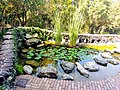
The main terrace is beyond the rear facade of the residence. It has patterned brick paving with planting areas, a large curvilinear pond, and garden walls made with distinctive clinker bricks and boulders. Paths made with large water-worn stones from the nearby Arroyo Seco are reminiscent of running brooks crossing the lawns. The overall landscape design and constructed garden elements are integrated with the architectural proportion and detailing. The triple front door and transom feature a Japanese black pine motif in plated (more than one layer) leaded art glass, highlighting the Asian influence that runs throughout the house.

California Historical Landmark Marker

[edit]

California Historical Landmark Marker NO. 871 at the site reads:[13]

NO. 871 THE GAMBLE HOUSE - Built in 1908, the David B. Gamble House is a tribute to the genius of architects Charles Sumner Greene and Henry Mather Greene. Its design represents a unique California lifestyle and is a masterpiece of American craftsmanship. In 1966 it was made a gift by the Gamble family to the City of Pasadena in a joint agreement with the University of Southern California.

Images

[edit]

David B. and Mary H. Gamble Professorship

[edit]

The Gamble family established a professorship at nearby Occidental College. The professorship has been held by Buddhist Studies expert, Dr. Dale Wright, and is currently held by Historian of Late Antiquity Dr. Kristi Upson-Saia.

See also

[edit]

References

[edit]

Further reading

[edit]
[edit]
Revisions and contributorsEdit on WikipediaRead on Wikipedia
from Grokipedia
The Gamble House is a renowned American Craftsman-style residence located at 4 Westmoreland Place in , constructed in 1908–1909 as a winter home for David B. Gamble, son of Procter & Gamble co-founder James Gamble, and his wife Mary H. Gamble. Designed by the Pasadena-based architectural firm —brothers Charles Sumner Greene and Henry Mather Greene—the house represents a pinnacle of the American , integrating architecture, interior furnishings, and into a cohesive whole. With its extensive use of , , and woods, handcrafted , and intricate details, the approximately 8,100-square-foot structure exemplifies the movement's emphasis on natural materials, craftsmanship, and harmony with the environment. The Gamble family's occupancy lasted until 1966, during which the house served as both a family residence and a symbol of early 20th-century luxury in ; after their departure, it faced potential but was preserved through a collaborative effort by the City of Pasadena, the , and the Gamble family descendants, who donated the house and its original furnishings in 1966. Today, owned by the City of Pasadena and operated by USC's , the Gamble House functions as a open to the public for guided tours, offering insights into Greene and Greene's innovative "Ultimate " concept and its influence on modern design. Designated a in 1977 and a in 1974, the Gamble House holds international significance as one of the finest surviving examples of Arts and Crafts architecture, drawing scholars, architects, and visitors to study its holistic approach that extends from the exterior's low-pitched roofs and exposed rafters to the interior's custom-built furniture and lighting fixtures. Its preservation underscores broader efforts to protect early 20th-century built heritage amid urban development pressures, ensuring that the house remains a living testament to the Greene brothers' legacy in blending functionality, artistry, and nature.

History

Construction and Commission

In 1907, David B. Gamble, a soap manufacturer and heir to the Procter & Gamble fortune, and his wife Mary H. Gamble commissioned the architectural firm of to design a winter residence in , seeking a seasonal retreat from their primary home in , . The Gambles selected brothers Charles Sumner Greene and Henry Mather Greene, renowned for their innovative Craftsman-style residences in Pasadena, after reviewing their portfolio of earlier works that emphasized natural materials and seamless indoor-outdoor integration. The site was chosen at 4 Westmoreland Place, a private lane off the prestigious Orange Grove Boulevard—once known as Millionaire's Row—for its elevated position amid mature coast live oaks and commanding views of the , which informed the house's harmonious placement within the landscape. Construction began in early 1908 under the supervision of general contractor Peter Hall, a Swedish immigrant and skilled builder who had collaborated with the Greenes since on several projects, ensuring meticulous execution of the design. The project, completed in 1909, incorporated premium woods such as redwood for structural elements, mahogany for paneling, Burmese for doors and trim, and for furniture accents, selected for their durability, grain patterns, and aesthetic warmth. The total cost, including the structure, custom-designed furnishings by the architects, garage, and landscaping, approximated $80,000—a substantial sum reflecting the craftsmanship. The design process was highly collaborative, involving iterative discussions among the Greene brothers, the Gambles, and craftsmen like Hall and his brother John, who fabricated much of the built-in and furniture on-site to achieve the architects' vision of a unified artistic whole. This partnership extended to sourcing materials and refining details, resulting in over 200 custom pieces of furniture integrated directly into the .

Gamble Family Occupancy

The David B. Gamble House in Pasadena served as the winter residence for David B. Gamble, a executive, and his wife Mary Huggins Gamble, who moved in with the family, including their sons Cecil, Sidney, and Clarence, in early 1909 following the home's completion. The family utilized the house seasonally from their primary home in , , enjoying Pasadena's mild climate for relaxation and social activities until David's death on July 16, 1923, at age 75, and Mary's on January 7, 1929. During their occupancy, the Gambles embraced an Arts and Crafts lifestyle that emphasized simplicity, craftsmanship, and , incorporating routines centered on outdoor living such as garden strolls, family gatherings on verandas, and communal meals that highlighted handmade furnishings and natural materials. Minor updates in the 1920s included enhancements to plumbing and electrical systems to align with evolving household conveniences, while preserving the home's original design integrity. Following their parents' deaths, the house remained occupied by family members, including Mary's sister Julia Huggins, who resided there until 1943; it stayed in family hands through the eldest son Cecil Huggins Gamble and his wife Louise until 1966. The family faced maintenance challenges during the and , including material shortages and rationing that limited repairs and upkeep amid economic strain. In 1966, amid Pasadena's urban development pressures and the threat of demolition under initiatives, the Gamble heirs donated the house and its furnishings to the City of Pasadena in a joint agreement with the to ensure its preservation as a public resource.

Transfer to Public Ownership

In 1966, the heirs of Cecil H. Gamble and his wife Louise—children of the original occupants' son, including daughters Elizabeth, , and Mary—donated the Gamble , along with its original furnishings and collections, to the of Pasadena in a joint agreement with the University of Southern California (USC) School of Architecture. This transfer was motivated by the family's desire to preserve the structure from potential commercial development, such as conversion into apartments, ensuring its continued integrity as a cultural asset. The agreement specified shared responsibilities for operation and maintenance, with the City holding ownership and USC managing the site as an educational and interpretive resource for public access, study, and teaching. Early public proved challenging, as the house had deteriorated from decades of private use and following the Gambles' occupancy. Initial efforts focused on stabilizing the structure and adapting it for visitors while retaining its historical authenticity. In the 1970s, volunteer preservation committees emerged to support these initiatives, including the formation of groups in 1967 to guide tours and luncheon committees to fund basic upkeep and operations. These activities culminated in a comprehensive restoration project launched in 1977, funded primarily through federal and private grants totaling over $1 million, which addressed structural repairs, original furnishings, and interior elements to restore the house to its 1908-1909 condition. That same year, the Gamble House received designation as a , formalizing its transition from family residence to a safeguarded public treasure and emphasizing its architectural significance. USC architecture faculty, including Randell Makinson, played a key role in early advocacy, documentation, and oversight during this period, leveraging academic expertise to guide preservation strategies.

Architecture and Design

Craftsman Style and Influences

The Gamble House exemplifies the style, a regional manifestation of the broader that emerged in the late 19th and early 20th centuries, emphasizing handcraftsmanship, the use of natural materials, and a harmonious integration with the natural environment. Architects Charles and Henry Greene realized their ultimate expression of this philosophy in the house, prioritizing simplicity, functionality, and the elimination of superfluous ornamentation to create spaces that fostered beauty and utility. This approach rejected the excesses of , favoring instead honest expression of materials like , , and native stone to evoke a sense of organic unity. Key influences on the design include the British Arts and Crafts movement, particularly the ideas of , who advocated for guilds of skilled artisans and the revival of medieval craftsmanship as a counter to industrialization; the Greenes drew from this to promote collaborative, high-quality production. also profoundly shaped the house, inspired by exposures at the World's Exposition's Japanese Pavilion and the 1904 St. Louis Exposition, incorporating elements such as bold , open railings, and subtle spatial flow to achieve serene, nature-inspired interiors. traditions further informed the structure, with features like broad gabled roofs, sleeping porches, and horizontal casement windows that blurred indoor and outdoor boundaries, adapting English cottage ideals to the region's mild climate. A hallmark of the Greene brothers' vision is the total design integration, where , , and furnishings form a unified ensemble, including custom pieces crafted from the same woods as the building and accented with inlays for contrast and durability. Signature elements include "cloud lift" motifs—curvilinear patterns evoking Asian cloud forms—applied to balustrades, doors, and furniture for rhythmic visual flow, alongside lantern-style lighting fixtures that provide soft, diffused illumination mimicking . This cohesive aesthetic aligned with the Gamble family's progressive values, commitment to social reform through ethical business and community welfare, as well as their deep appreciation for , evident in their outdoor pursuits and desire for a home that extended living spaces into the surrounding Arroyo Seco landscape.

Exterior Features

The Gamble House is a two-story structure, with a partial third level, spanning approximately 8,100 square feet and situated on a landscaped site measuring 240 feet by 240 feet. It features a low-pitched, overlapping covered in Malthoid material with integrally designed gutters and rolled edges, emphasizing wide overhanging and exposed tails that enhance the horizontal emphasis typical of Craftsman design. The overall layout promotes a broad, horizontal profile that integrates seamlessly with the surrounding Pasadena , using deep terraces and monumental to shelter porches and foster an indoor-outdoor connection suited to the region's mild climate. Exterior materials reflect a commitment to natural, locally sourced elements and meticulous craftsmanship, including redwood split-shake shingle siding stained olive green, posts and beams joined with pegged and doweled mortise-and-tenon connections without nails or metal fasteners, and foundations of , gunite, and local river stones. Stone piers support the structure, complemented by walls and creeping fig vines that root the building to its site, while three chimneys with concrete caps add vertical accents. Intricate appears in porch columns and supports crafted from Burma teak and San Domingo , showcasing the architects' emphasis on durable, exotic hardwoods. Key features include an arched entryway framed by a broad front porch with hand-made red mission tile flooring and exterior lanterns of metal, wood, and Tiffany glass hung from the eaves. The main entrance consists of three wide doors with transoms and Japanese-inspired stained-glass panels depicting a tree motif, flanked by banks of windows that maximize natural light and views. On the second floor, unscreened sleeping porches project over the terraces, providing passive ventilation and outdoor sleeping areas, while covered walkways and pergola structures resembling torii gates connect the house to the landscape. These verandas and porches adapt to California's temperate weather by encouraging al fresco living and airflow, with earth-tone finishes in browns, olive greens, and rust oranges blending harmoniously with the environment.

Interior Spaces and Furnishings

The Gamble House encompasses a two-story structure with a partial third floor, comprising approximately 18 rooms that blend public living areas, private family quarters, and service spaces to support the Gamble family's lifestyle. The ground floor centers on communal areas, including a spacious living room, formal dining room, den, kitchen with adjacent pantry and cold room, a guest bedroom, and four bathrooms, all connected by an entryway floored in handmade red mission tile. The second floor houses six bedrooms for family and staff, arranged around a central hall, along with three sleeping porches that extend from the bedrooms to promote healthful outdoor air circulation in the climate. A third-floor , now serving as a , and a full with , storage, and utilities complete the layout. Custom furnishings throughout the house were meticulously designed by Charles and Henry Greene in collaboration with Peter and John Hall, forming an integral part of the Arts and Crafts aesthetic and ensuring harmony between and interiors. In the , an alcove features built-in seating and crafted from , accented by carved friezes depicting natural elements like pinecones and clouds. Leaded glass windows adorn multiple rooms, incorporating nature-inspired motifs such as stylized feathers in the den and organic patterns influenced by , while built-in in and provides storage and display spaces with pegged joints for added durability and visual interest. The dining room includes a custom table with tsuba ( guard) motifs echoed in light switches and leaded glass panels, paired with amber-stained glass lanterns that diffuse soft light. Upstairs, bedrooms feature Greene-designed pieces like walnut dressers with fruitwood and semiprecious stone inlays in the master suite, and furniture in guest rooms, all emphasizing simplicity and functionality. The material palette prioritizes over 17 species of wood to celebrate natural grains and tones, creating a effect through contrasts in color and texture. , , , and dominate the interiors, with hand-stenciled beams in the living and dining rooms featuring and motifs, and pegs securing joints in visible woodwork for both structural integrity and decorative appeal. Multi-paned and leaded glass windows, often with Tiffany-style , maximize while framing views of the surrounding , enhancing the sense of connection to nature central to Arts and Crafts principles. -style fixtures, handcrafted with shades and metalwork, provide warm, ambient illumination that complements the wood tones without overpowering the spaces. Functionally, the design employs open floor plans on the ground level to foster family interaction, with expansive living and dining areas flowing seamlessly via wide openings and minimal partitions. Hidden service areas, including staff corridors and concealed doors behind wood paneling, allow discreet movement for butlers and maids, maintaining the elegance of main spaces while supporting efficient household operations. The original retains period appliances such as a large cast-iron range, sinks, and an island workspace, connected to a butler's via a service window for streamlined meal preparation and delivery. Sleeping porches on the second floor exemplify the era's emphasis on for , with screened openings and built-in seating that extend living areas outdoors without compromising .

Gardens and Landscape

The landscape of the Gamble House, designed by architects Charles Sumner Greene and Henry Mather Greene in 1909, forms an essential extension of the residence's Arts and Crafts aesthetic, integrating the structure with its natural surroundings on a high knoll overlooking the Arroyo Seco and . The original design emphasized harmony between built and natural elements, featuring rolling terraced lawns, a gently curving driveway, and retaining walls constructed from local Arroyo boulders and clinker bricks salvaged from the site's earlier structures. Multiple porches, floored with deep red mission tiles, provide transitional spaces that link the house's interiors to the outdoors, framing scenic views and allowing breezes to flow through open lantern-lit sleeping porches. Key features reflect Japanese design influences, including irregularly spaced along paths, a wooden gate with hand-forged iron latch and hinges at the entrance, and a small lily on the rear terrace with gently trickling , evoking tranquility and flow. The informal layout avoids rigid formality, instead using the terrain's contours to create secluded areas that complement the house's low-slung profile and organic materials. Although specific original plantings are sparsely documented, the design prioritized native and regionally adapted flora to blend the property seamlessly with its semi-arid environment. The Gamble family made few alterations to the landscape during their occupancy from to 1966, though unusually harsh winters between 1911 and 1914 destroyed most initial plantings, prompting near-complete replanting that maintained the original informal character. Following the house's transfer to public ownership, preservation efforts focused on authenticity; little of the early vegetation survived into later decades. In 2016, Isabelle Greene, granddaughter of Henry Mather Greene, led a major restoration drawing from Mary Gamble's early-20th-century records and photographs, replanting with period-appropriate species such as iris, statice, and columbine to revive the site's historical essence while ensuring compatibility with the house's wood and stone motifs. This work, supported by family endowments and donors, underscores the landscape's role as a living complement to the , now accessible via guided exterior tours.

Significance and Recognition

Historic Designations

The Gamble House received its first major federal recognition when it was listed on the on September 3, 1971, acknowledging its exceptional architectural merit as a Craftsman-style residence. This listing underscored the house's role in exemplifying the Arts and Crafts movement and the innovative designs of architects Charles Sumner Greene and Henry Mather Greene. In 1974, the State of designated the Gamble House as Historical Landmark No. 871, noting it as "a tribute to the genius of architects Greene and Henry Mather Greene, and a of American craftsmanship which represents a unique California lifestyle." The following year, on December 22, 1977, the U.S. Department of the Interior elevated its status to , recognizing it as one of the finest and most intact examples of the "ultimate " and a pinnacle of Greene and Greene's oeuvre. At the local level, the City of Pasadena designated the Gamble House a historic landmark, providing municipal protections for its preservation. This local status complements the federal and state recognitions, ensuring ongoing compliance with preservation easements established in the 1966 donation agreement that transferred ownership from the Gamble family to the City of Pasadena and the . These designations collectively affirm the house's enduring significance as a rare, fully intact embodiment of early 20th-century American residential .

Architectural Influence

The Gamble House, designed by architects Charles Sumner Greene and Henry Mather Greene in 1908, stands as a seminal work in architecture, often regarded as the "ultimate " for its masterful integration of natural materials, intricate craftsmanship, and holistic design principles. This residence established a benchmark for the Craftsman style, influencing subsequent revivals in the mid-20th century by emphasizing harmony between structure and environment, which resonated in post-World War II bungalow adaptations across . Its principles of using woods such as , , and , combined with exposed , inspired modern practices that prioritize material authenticity and energy-efficient natural ventilation over industrialized production. In academic and professional contexts, the Gamble House serves as a key in , particularly at institutions like the School of Architecture, which manages the property and integrates it into curricula for examining advanced techniques such as pegged mortise-and-tenon joints and connections. These methods, which allow for structural flexibility and aesthetic expression, are analyzed for their role in creating unified interiors and furnishings, inspiring students and practitioners to replicate similar bespoke approaches in contemporary residential projects. The house has motivated numerous adaptations and partial replicas in , including bungalow-style homes in Pasadena and beyond that echo its low-pitched roofs, overhanging eaves, and integrated cabinetry, thereby perpetuating Craftsman ideals in regional . As a model for preservation, the Gamble House exemplifies reversible restoration techniques, such as non-invasive wood treatments and selective seismic that preserve original fabric while enhancing resilience in earthquake-prone areas. Its scarf joints and flexible framing have informed guidelines for historic wood-frame buildings, influencing policies from organizations like the on balancing authenticity with safety in high-risk zones. On a global scale, the Gamble House is acknowledged in international Arts and Crafts scholarship for bridging American innovations with British precedents like William Morris's emphasis on handcraft and Japanese influences evident in its asymmetrical forms, shingle textures, and landscape integration. Scholars draw parallels to British Arts and Crafts estates in their rejection of Victorian excess and to Japanese minka structures in their use of natural motifs and spatial flow, positioning the house as a pivotal example in of early 20th-century design movements.

Cultural Depictions

The Gamble House gained widespread recognition through its appearance in the 1985 film , where its exterior served as the home of the character Doc Emmett Brown, portrayed by . This role significantly boosted the house's visibility among global audiences, though interior scenes were filmed on recreated sets in studios. The house has been prominently featured in various media beyond cinema, including the 2017 documentary The Gamble House, directed by Oscar-nominated filmmaker , which explores the architecture and family stories behind the Greene brothers' masterpiece. It has also appeared in publications such as , which highlighted it as one of the 10 homes that changed America for its embodiment of the Arts and Crafts movement. Additionally, the Gamble House is a frequent subject in books on Craftsman architecture, such as The Gamble House: Building Paradise in by photographer Alex Vertikoff, which documents its design and cultural legacy through detailed imagery and historical context. In popular culture, the house's connection to has inspired dedicated merchandise, including Pop! figures and T-shirts sold through the official Gamble House bookstore, capitalizing on the film's enduring fanbase. Public tours at the museum often emphasize these movie ties, drawing visitors who combine architectural appreciation with cinematic nostalgia. During the in the early , virtual tours of the house experienced increased online engagement, amplifying its presence in digital discussions and social platforms as a symbol of accessible . Broader cultural narratives portray the Gamble House as an emblem of the and the idyllic West Coast lifestyle, reflecting the prosperity and craftsmanship of early 20th-century Pasadena through its integration of natural materials and harmonious living spaces. This symbolism underscores its role in evoking an era of innovation and leisure, often referenced in discussions of American domestic ideals.

Current Use and Legacy

Museum Operations and Preservation

The Gamble House has been owned by the City of Pasadena since 1966, with operations jointly managed by the city and the (USC) from 1966 until 2019. In October 2019, the Pasadena City Council approved the transfer of operational control from USC to the newly formed nonprofit Gamble House Conservancy, enabling a more dedicated focus on preservation, education, and public access while maintaining city ownership. This transition followed the house's initial public handover in 1966 to prevent and ensure long-term . Preservation efforts at the Gamble House have emphasized maintaining its architectural integrity amid modern challenges. In the and early , a phased included seismic funded by FEMA, with internal reinforcements designed to enhance resistance without altering the visible Craftsman aesthetics. During the , furniture and fixtures conservation was led by architectural conservator John Griswold, who employed original techniques to restore pieces, including and elements, ensuring authenticity in material and method. In the , responses to climate threats intensified; during the January 2025 Eaton Fire, the house was placed in an evacuation zone, prompting temporary closure and protective measures such as securing artifacts and monitoring air quality to mitigate smoke damage. The Gamble House Conservancy employs a core staff of approximately 10, including curators, conservators, and administrators, supplemented by over 100 volunteers who assist with daily operations. Annual programs focus on preventive care, such as specialized wood treatments to weathering and routine garden upkeep to preserve the original . Funding supports these activities through an annual operating budget of about $1.7 million, derived primarily from tour admissions, foundation grants, and endowment contributions from partners like the Pasadena Community Foundation. As of 2025, the Conservancy has advanced through the ongoing Greene & Greene Virtual Archives project, which digitizes and provides public access to original blueprints and drawings, enhancing research while reducing physical handling of fragile documents. Sustainability initiatives include exploratory programs on , though no permanent solar installations on outbuildings have been implemented to date.

Public Tours and Access

The Gamble House offers guided one-hour docent-led interior tours Tuesday and Thursday through Sunday, with tickets priced at $15 for adults, $12.50 for seniors and students, and free for children 12 and under. Self-guided exploration of the exterior and gardens is available daily during operating hours, allowing visitors to wander the grounds without reservations. Advance reservations for all interior tours are required and can be made through the official website, as tours often sell out, particularly on weekends. Specialized tours enhance the visitor experience, including holiday open houses on select dates in and , such as November 28 and December 27, 2025, featuring seasonal decorations and extended self-guided access. An evening holiday gathering event is scheduled for December 7, 2025, from 5:00 p.m. to 7:00 p.m., offering a festive illuminated tour of the . Virtual tours are also available online, providing an immersive digital exploration of the interior details for those unable to visit in person, a option expanded following the . Accessibility features include limited first-floor interior access via a manual wheelchair lift, with full wheelchair paths available in the gardens and exterior areas; advance notice is recommended for accommodations. Audio guides are accessible through mobile apps like SmartGuide for self-paced tours, supporting visitors with hearing impairments. Visitor policies prohibit flash photography and touching artifacts to preserve the historic furnishings, with non-flash photos permitted in most areas. The house attracts over 30,000 visitors annually, drawn to its architectural significance. Community engagement includes free admission days open to the public, such as the annual Crafting Memories family event in October and Museums of the Arroyo Day in May, featuring self-guided tours and educational activities focused on and . School group programs offer tailored 45-minute tours for students, emphasizing the house's Arts and Crafts , with options for groups of 12 to 40 at $20 per person; the Junior Docent Program trains Pasadena Unified School District 7th and 8th graders to lead youth tours.

Endowments and Educational Impact

The Gamble House maintains a longstanding partnership with the University of Southern California (USC) School of Architecture, established in 1966, which facilitated joint management until 2019 and continues through the hosting of the Greene & Greene Virtual Archives in the USC Digital Library. This digital collection features approximately 4,000 key materials, including photographs, sketches, drawings, and letters related to the architects Charles and Henry Greene, serving as a primary resource for scholarly research on American Arts and Crafts architecture. In 2021, the physical Greene & Greene archives, comprising over 6,000 items such as design drawings, business correspondence, and family papers, were transferred to The Huntington Library while remaining accessible for academic study. A of the Gamble House's educational initiatives is the Scholars-in-Residence () Fellowship, originated in 1967 to provide hands-on training in and museum operations. Awarded annually to two advanced students or students in related fields from any university, the fellowship offers residency in the house's former for an , during which recipients assist with daily operations, conduct , and gain expertise in restoration techniques. This program has trained generations of emerging conservators, emphasizing practical skills in maintaining Craftsman-era structures and fostering a deeper understanding of Greene and Greene's design principles. The Gamble House extends its educational reach through targeted outreach programs, including lectures and workshops focused on Craftsman woodworking and architectural techniques. Examples include drop-in talks on Greene and Greene's personal collections and hands-on sketching workshops that explore the house's design elements, attracting students, professionals, and enthusiasts alike. Collaborative efforts, such as the Junior Docent program in partnership with the Pasadena Education Foundation's "My Masterpieces" initiative since , engage third-grade students in exploring the house's history and through guided presentations on form, function, and spatial design. These programs contribute to broader training in conservation by integrating the site into curricula that highlight preservation practices. Inter-institutional partnerships enhance research opportunities, including symposia and exhibitions with universities like Princeton, where the Gamble House has supported events tracing the Arts and Crafts movement's evolution, such as the landmark 1972 exhibition curated by Princeton faculty. The endowment, which stood at approximately $8 million in , sustains these initiatives by funding staff positions, research publications, and ongoing preservation efforts, ensuring the site's role in advancing architectural scholarship into the future.

References

Add your contribution
Related Hubs
User Avatar
No comments yet.